日本語
日本語 



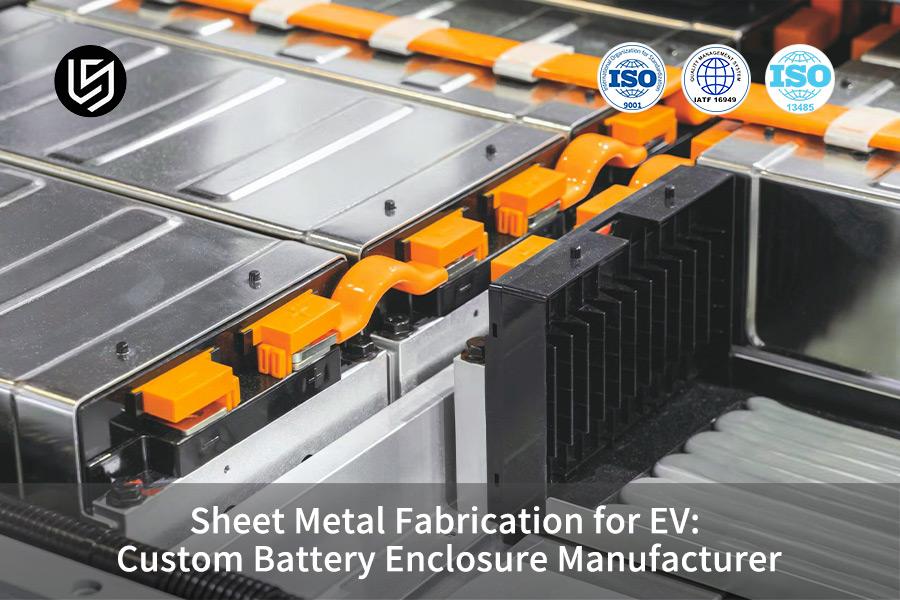
EV 板金加工サービスは、電気自動車分野における高精度板金加工サービスです。 溶接変形と動力電池ボックスのシール不良は、このサービスが解決することを目的とした 2 つの主な問題です。 材料を AL5052-H32 に置き換え、 レーザー CMT 複合溶接を使用すると、溶接時の熱変形を 40% 未満に抑えることができます。
Cpk>1.33 のスタンピング公差を達成することにより、自動車サプライ チェーン向けの B2B 技術ソリューションには IP67 の密閉定格が提供されます。電源バッテリーボックスは主要な安全コンパートメントであり、 そして従来のプロセスが要件を満たすことができる可能性は非常に低いです。この記事では、製造上の欠陥を防ぐための主なプロセスを分析します。
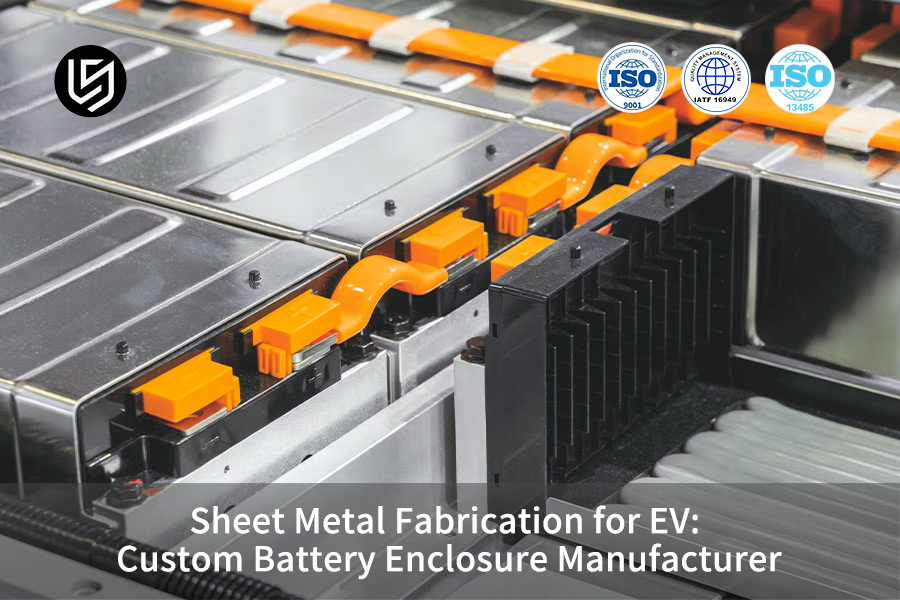
EV バッテリー ボックス板金製造における主要な結論の概要
この表は、記事全体の中核となるテクノロジーとソリューションをまとめたもので、重要な情報を素早く理解し、意思決定の効率を向上させます。
<本体>重要なポイント:
- 材料の選択: AL5052-H32 をレーザー CMT 複合溶接で 40% 以上調整することで、溶接熱変形を削減することが可能です。
- シーリング:IP67 防水定格を達成するバッテリー パックは、Cpk > 1.33 のレベルに厳密に維持される正確なスタンピング公差によって保証されます。
- 品質管理: オンラインでのヘリウム質量分析によるリーク検出 (100%) の実行と三次元測定機 (CMM) の幾何公差検査の 2 つは、量産時のリスクを管理するために必ず行わなければならない操作の 2 つです。
LS Manufacturing のカスタム EV 板金サービスとバッテリー エンクロージャ製造の専門知識が信頼できる理由
板金製造パートナーを探す際の主な考慮事項は、お客様の問題点に対処できる能力と、 コンプライアンスの資格です。直接の経験と厳格な基準により、当社はティア 1 の顧客に対する長期的なサプライヤーとして認められています。当社は、ヨーロッパの電気バス バッテリー パック プロジェクトにおける溶接歪みによって引き起こされる気密不良問題を修正し、IATF 16949:2016 および ISO の要件に継続的に準拠しています。 26262 ASIL-B。
過去に、北米の新エネルギー車メーカーの溶接プロセスの確認を通じて、従来の MIG 溶接では 0.8 mm の変形が発生するのに対し、レーザー CMT ハイブリッド溶接では、変形を IP67 基準を満たす 0.2 mm にまで抑えることができることが判明しました。手順のすべてのパラメータは何千もの実験に基づいて確立されており、自動車グレードの基準を保証するために APQP と PPAP によって提供されています。
当社は SGS と長期間にわたって協力しており、電気自動車の金属部品は第三者によるテストを受け、MTR およびスペクトル分析レポートを提供しています。 実際のテスト、コンプライアンス、第三者による確認を組み合わせることで、 顧客は品質の不安から解放され、納品のリスクが軽減されます。
バッテリー パックに関連する製造上の課題に悩んでいる場合は、無料の DFM 評価について当社のエンジニアリング エキスパートにお問い合わせください。当社は、お客様のプロジェクトのニーズに合わせたカスタマイズされた板金製造ソリューションを提供し、製造上の欠陥の 95% 以上を事前に回避できるようサポートします。
カスタム バッテリー エンクロージャーのメーカーは、車両の衝突安全性を犠牲にすることなく構造重量を最小限に抑えるにはどうすればよいでしょうか?
プロのカスタム バッテリー エンクロージャ メーカーは、高強度アルミニウム合金の 3D 精密成形を初めて採用し、肉厚を 15% 減らすことができました。同時にサイドピラー衝撃、押し出し試験、 多軸精密曲げを実施してスプリングバックを制御します。その結果、高剛性・軽量化を図りながらも、車両の軽量化と安全性の確保を両立することができました。
材料の加工硬化とスプリングバックの制御
コールドスタンピングで扱われるさまざまな材料の加工硬化レベルに応じて、軽量化の効果が影響されます。 素材選択の主なポイントは次のとおりです:
成形プロセスの比較と衝突性能の検証
衝突時のバッテリー パックの応力分布は、成形プロセスによって大きく異なります。具体的なデータは次のとおりです。
| コア ディメンション | 最適なソリューション | 主要パラメータ | お客様のメリット |
| マテリアルの選択 | AL5052-H32 + レーザー CMT 複合溶接 | 溶接熱変形が 40% 以上減少しました。 | スクラップ率を削減し、配送サイクルを短縮します。 |
| シーリング | 高精度スタンピング + ダイナミックディスペンス | Cpk>1.33、平面度 ≤0.1mm/100mm | IP67 の防水定格を確保し、漏水障害を回避します。 |
| 品質管理 | ヘリウム質量分析によるリーク検出 + CMM 検査 | 漏れ検出率 1.0×10⁻⁵ mbar·l/s、公差 ±0.05 mm | 大量生産のリスクを軽減し、製品の一貫性を確保します。 |
| 軽量化 | 3D 精密成形 + 肉厚低減 | 肉厚が 15% 減少、輪郭精度は ±0.15 mm。 | 車両全体の重量が軽減され、航続距離が向上します。 |
| 小規模バッチのコスト管理 | ソフトモールド成形 + レーザー切断 | 最初の商品は 7 日以内に納品され、ハードモールド費用は無料です。 | 研究開発コストを削減し、プロジェクトの進捗を加速します。 |
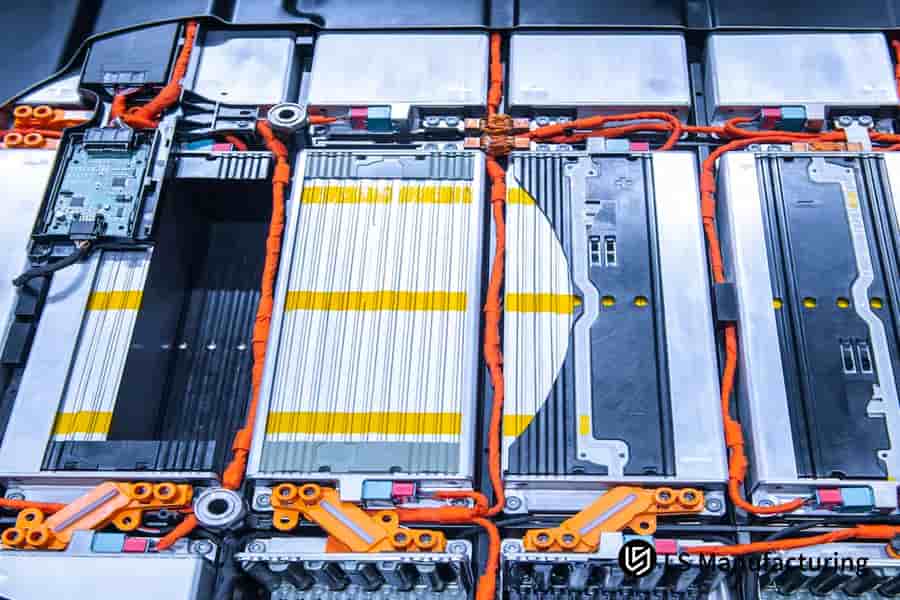
図 1: カスタム EV バッテリー エンクロージャ内のケーブルを備えた組み立て済みバッテリー モジュールの拡大図。
EV 板金製造サービス サプライヤーにとって熱伝導率を最適化する原材料の選択はどれですか?
信頼性の高い EV 板金製造サービスは、AL3003 および AL5052 合金の高い熱伝導率と耐食性に常に焦点を当てています。これらの機能は、バッテリー モジュールの充電時に発生する熱を効率的に放散するのに役立ち、退院しました。熱放散を強化する方法の 1 つは、金属の結晶方位を調整することです。材料の選択は、バッテリーの寿命と安全性に影響を与える最も直接的な要素です。
コア材料の特性比較
さまざまな原材料のパラメータは大きく異なります。以下の表は材料を選択するための簡単なガイドとして使用でき、バッテリー板金加工作業にも非常に適しています。
| 成形プロセス | 横方向押出耐荷重 | 応力集中点 | 軽量化効果 | 衝突通過率 |
| 従来の溶接ボックス | 160kN | 溶接ジョイント | 肉厚 1.5 mm、重量 12% 増加 | 88% |
| 統合された深層描画ボックス | 220kN | コーナー | 肉厚 1.2 mm、重量 15% 削減 | 99.5% |
材料の適用と品質保証
水冷一体型バッテリーのバッテリーボックスのベースは主に AL3003 合金で作られています。この素材は熱伝導性に優れているため、熱を素早く分散させることができます。さらに高精度成形技術により平面度誤差は0.1mm に抑制されています。バッテリーハウジング用の板金は、優れた熱伝導性と耐食性を必要とします。 AL5052-H32 は、板金公差管理規格を満たす主要コンポーネントになりました。
プロの EV 板金製造サービス プロバイダーとして、当社は完全な MTR およびスペクトル分析レポートを提供します。原材料は厳格な検査を受けています。研究によると、 適切な材料を選択するとバッテリー モジュールの放熱機能が 25% 向上し、バッテリー モジュールの寿命が 3 年以上伸びる可能性があります。
さまざまな材料の性能とコストについてよく知りたい場合は、材料選択マニュアルをダウンロードできます。 プロジェクトのニーズに完全に応えるため、材料選択に関する無料のアドバイスを得るために、弊社のエンジニアにお気軽にお問い合わせください。
レーザー溶接は、複雑な EV バッテリー ボックス製造プロセス中のシール性能をどのように制御しますか?
高品質のEV バッテリー ボックス製造では、3kW~6kW のファイバー レーザーとロボット 3D 溶接システムを使用して、非常に高い効率で溶接入熱を従来の 30% に削減しています。 MIG 溶接は気孔の除去と最終的な IP67 シールの妥協にもつながります。重要なのは、欠陥を避けるために溶接中の入熱を厳密に管理することです。
中子溶接プロセスのパラメータ制御
シーリングは溶接パラメータの正確な設定に大きく依存します。 主なパラメータ範囲は次のとおりです:
溶接の品質管理と欠陥の解決
薄壁のバッテリー トレイを溶接すると、簡単に「溶融池崩壊」が発生する可能性があります。 問題を完全に解決するために使用する 2 つの簡単な方法を次に示します。
0.1 mm レーザー フォーカス制御とオンライン溶接追跡システム。溶接後は、非破壊検査とヘリウム質量分析による漏れ検出によって二重の品質管理が行われ、溶接部に亀裂や気孔が存在しないことが確認され、板金溶接の品質がさらに向上します。
特別なトラブルシューティングのヒント: 溶接中に微小気孔が見られる場合、アルゴンガス流量を 7L/min にわずかに増加させ、溶接速度を 0.2m/min 下げることで、欠陥を迅速に取り除くだけでなく、スクラップも回避できます。
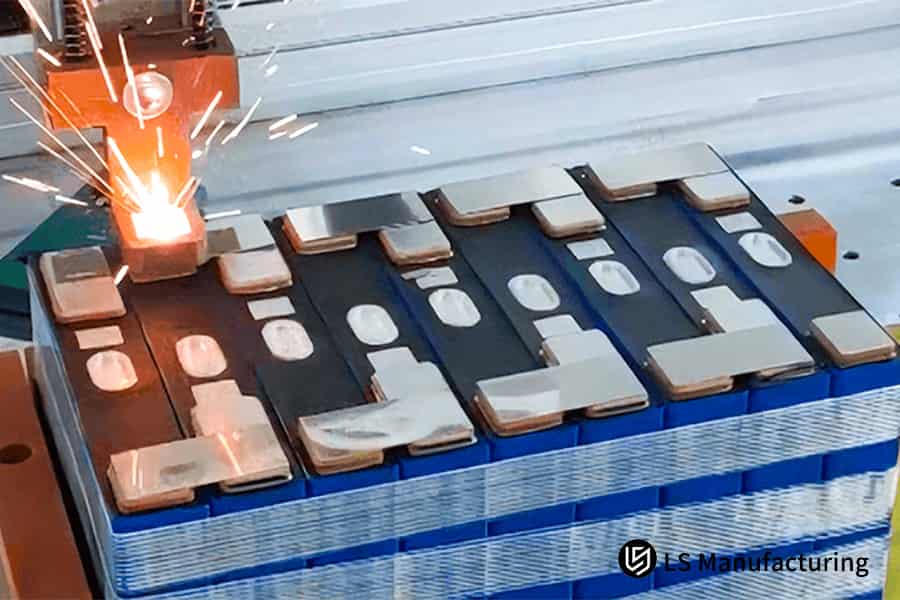
図 2: シールのためにバッテリー モジュールに火花を生成するレーザー溶接ヘッド。
厳格な IP67 シーリング規格により、バッテリー ハウジングの板金カスタム生産の要件が再定義されるのはなぜですか?
IP67、さらには IP69K 規格を満たすには、バッテリー ハウジングのシート メタルのシール面の平坦度が 100mm あたり 0.1mm 未満である必要があります。バッテリーの安全性に関するこの中心的な要件を満たすために、接着剤の溝の寸法を安定させるために、CNC 連続スタンピングと高精度の表面研削を利用しています。
公差の累積制御と構造の最適化
バッテリー ボックスのシールは、嵌合面の累積公差によって損なわれる可能性があります。 これは次の方法で管理されます:
- 有限要素解析 (FEA) を使用して、締め付けトルクによって引き起こされる板金フランジのわずかな弾性変形をモデル化し、変形補償を調整します。その結果、 締め付け後も平坦度が規格に準拠していること、および板金精密曲げプロセスに適していることが保証されます。
- CNC 連続スタンピングの公差は 0.05 mm に維持されます。高精度の表面研削によりシール表面の粗さはRa 0.8 ~ Ra 1.6 に制御され、シール ストリップの密着性が向上します。
- 塗布溝の寸法公差は 0.1 mm に固定され、塗布幅は 5 ~ 8 mm に維持され、接着剤ストリップの圧縮は 30% ~ 40%、ボルトの間隔は 50 ~ 70 mm であり、これらすべてが一貫したシールに貢献します。
表面粗さとシール性の関係
表面粗さはシール ストリップの接着強度に直接影響します。当社の測定データは次のとおりです。
| マテリアル タイプ | 熱伝導率 (W/(m·K) | 引張強さ (MPa) | 塩水噴霧試験のパフォーマンス | 該当するシナリオ | 電気伝導率 (S/m) |
| AL3003 | 190 | 150 | 720 時間赤錆なし | 電池ボックスベース(液冷プレート一体型) | 3.7×10⁷ |
| AL5052-H32 | 170 | 230 | 1000 時間赤錆なし | 電池ボックスのトップ カバー、サイド パネル | 3.2×10⁷ |
| SPCC 冷間圧延鋼 | 50 | 300 | 480 時間赤錆なし | 非コア耐荷重コンポーネント | 7.0×10⁷ |
| AL6061 | 160 | 310 | 800 時間赤錆なし | 電池ボックス ブラケット | 3.0×10⁷ |
EV プロジェクトの板金製造における構造公差に直接影響を与える工学的要素は何ですか?
EV プロジェクトの大型板金製造を行う際の公差制御に寄与するさまざまな要因には、プレス金型のクリアランス、角度補正を伴うレーザー曲げ、機械加工中の二次位置決めなどがあります。キー穴の公差は0.05mmに設定しております。 これは組立精度と量産品質に直接影響します。
公差に影響を与える主要なエンジニアリング要素
公差を安定して維持できる生産能力は、量産時の 3 つの主な要因に大きく左右されます。
- スタンピング ダイのクリアランス: クリアランスは、材料の厚さに応じて適切なレベルで決定されます。たとえば、AL5052 シート メタル (厚さ 1.2 mm) の場合、ダイ クリアランスは 0.12 ~ 0.15 mm で、これはバリや歪みの形成を防ぐために行われます。これにより、プレス部品の寸法精度の達成と高精度シートの基準を満たすのに役立ちます。金属.
- CNC 曲げ補正: これは、レーザー角度補正を使用して行われます。曲げ角度と材料特性を考慮して、0.5°~1° に設定された補正量を使用してスプリングバック誤差を制御し、曲げ精度を確保します。
- 二次高精度位置決め: マシニング センターには、位置決め精度 0.02 mm の CCD ビジョン位置決めシステムが搭載されています。
金型プロセスと公差の安定性の比較
量産中に穴ピッチ Cpk 値を維持する場合、その能力はシングルステーション ダイと順送ダイの間で大きく異なります。
| 表面粗さ (Ra) | 発泡シリコーン粘着力 (N/m) | EPDM シーリング ストリップの接着強度 (N/m) | IP67 密閉テスト合格率 |
| 0.8 | 180 | 165 | 98.5% |
| 1.2 | 220 | 200 | 99.8% |
| 1.6 | 190 | 175 | 99.2% |
| 2.0 | 150 | 140 | 95.3% |
各バッチには、公差の変更を追跡するための SPC 管理図が含まれています。これには「単一バッチ許容変動コスト = スクラップ率の単位コスト バッチ生産高」 という公式が使用されます。より厳格な管理によりスクラップ率が 0.5% 未満に低下し、さらに全体的な経費が大幅に削減されます。
OEM は、少量のカスタム EV 板金サービスの調達中に高額な工具コストを回避するにはどうすればよいですか?
When it comes to research, development, or small batch pilot production of custom EV sheet metal service, the optimal solution would be soft mold forming + laser cutting. We switch to flexible manufacturing lines, so even if we cancel tens of thousands of dollars in mold opening fees, we still manage to get our first-piece within 7 days, which totally changes the issue of a high mold cost.
Cost-Effective Production Paths at Different Scales
If you want to achieve the lowest cost possible, then your decision for process selection should be aligned with the annual volume of production, like this:
- 1-50 pcs (Research & Development Stage): For the beginning stage use of a product, soft mold forming + laser cutting method is excellent. It doesn't involve the costly production of hard molds, delivers the first piece inside 7 days, has a somewhat higher single piece cost, but the trial and error costs are minimized greatly. This strategy is ideal for testing product iteration and having low cost sheet metal fabrication.
- 50-500 pcs (Small-batch Pilot Production) : This stage, the soft mold method is combined with the use of a CNC turret punch press, the main purpose is keeping a reasonable balance between efficiency and costs.Unit cost, in this case, got reduced by 30% compared to the R&D stage, delivery cycle is 15-20 days.
- 5000+ units (Mass Production): Progressive die stamping + laser welding methods, a significant investment in hard mold costs (approx $20,000-$50,000). Yet, unit cost is brought down by 60% which is the best practice for regular mass production.
Cost Control Tips and Service Support
Adjusting the battery box bending radius to R=1.5-2.0mm and minimizing deep drawing structures will not only simplify the mold but also save 20%-30% of mold costs, we do free DFM analyses to help you struct ure the product in a cost effective manner and eliminate cost waste.
Being a professional custom EV sheet metal service provider, we are equipped with a flexible manufacturing line that can handle minimum order quantities of 5 pieces, which means that OEM customers can check the appropriateness of the battery box structure during the R&D stage with very low costs of trial and error. If your small batch trial production stage, please don't hesitate to contact us for a free cost calculation so that you can get the best processing solution and avoid high mold cost waste.
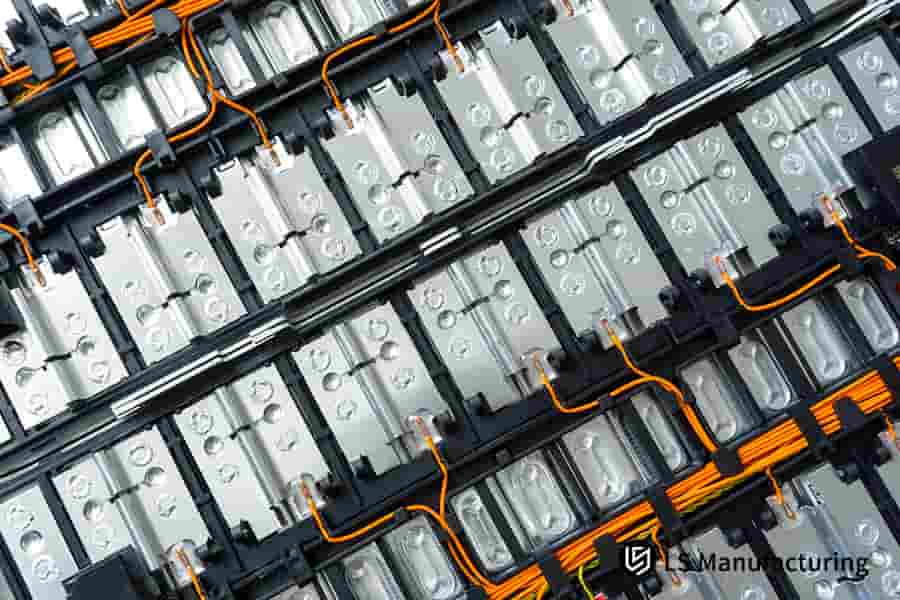
Figure 3: A battery module showing silver cells connected by orange wires.
Which Quality Control Protocols Ensure The Long Term Durability Of High Voltage Electric Vehicle Metal Parts?
Electric vehicle metal parts, in particular those operating with high voltage, need powder coating or insulating nylon powder coating that is very strong. Only in this way, the service life of these parts can be guaranteed to be over 10 years. Our insulation layer has a breakdown voltage of >5000V DC, That means the whole surface treatment process must be under quality control coverage.
Surface Treatment Process Quality Control
There are explicit quality control criteria for every point of the surface treatment process of Electric vehicle metal parts:
Weather Resistance and Insulation Performance Testing
We do very strict testing to check the weather resistance as well as the insulation capability of our surface-treated products. Key test data are as follows:
| 型加工 | 穴ピッチ Cpk 値 (量産) | 許容変動範囲 | 適切な年間生産量 | メンテナンス費用 |
| シングルステーション ダイ | 1.0-1.2 | ±0.08mm | 500 個未満 | 下 |
| プログレッシブ ダイ | 1.33~1.67 | ±0.03mm | 5,000 個以上 | 高い |
How Can Automotive Tier 1 Suppliers Find a Reliable Partner For Precision Sheet Metal Enclosure Manufacturing?
When assessing a sheet metal enclosure manufacturing company's ability to supply automotive-grade parts the main criteria are their hardware facilities, IATF 16949 certification, and their knowledge of APQP/PPAP tools. Solid suppliers make it easier for Tier 1 customers to alleviate the risks involved in the supply chain.
Critical Aspects Of Supplier Qualification Review
Before deciding on a Tier 1 supplier, what comes next four points deserve in-depth discussion:
Complete Compliant Supply Loop
We form an entire compliance loop starting from RFQ reception to PPAP submission, which ensures that the projects satisfy the customers' needs:
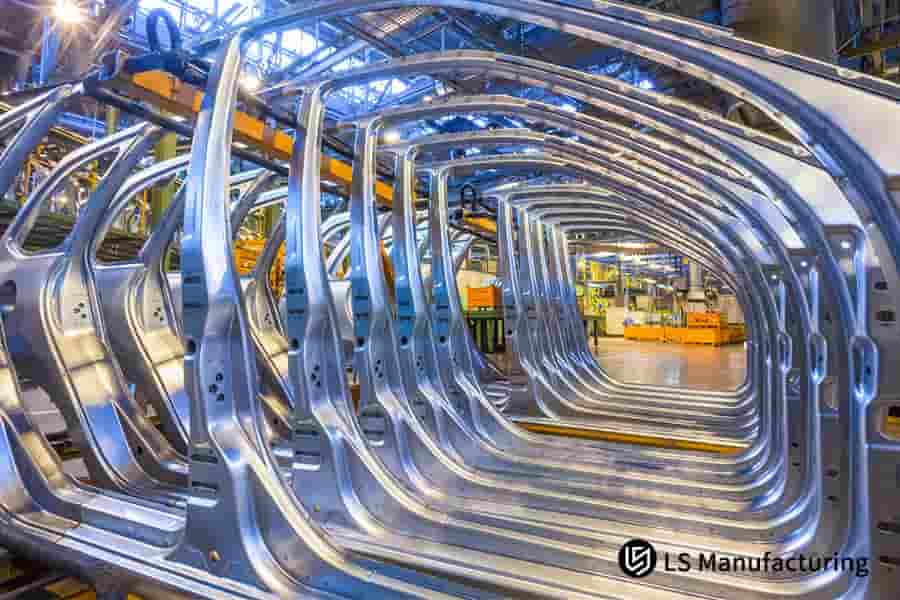
Figure 4: Rows of metal frames in a factory, likely for EV battery structures.
How Did LS Manufacturing Deliver a High Precision Solution For An EV Automotive Custom Battery Box Fabrication?
Here is a detailed description of a case study illustrating our very accurate EV battery box fabrication solution provisioned to a top European electric bus company and reflecting our abilities in pain point addressing and the after effect. Also, it stands as a basis for similar works.
Customer Issue:
During creating a 350kW large capacity power battery pack, a European electric bus manufacturer experienced a difficulty: conventional welding methods caused the AL5052 substrate to be distorted by 1.8mm, thereby a 24% failure rate at the first attempt in the IP67 airtightness test was observed.
As a consequence, the customer was under the pressure of postponing the vehicle production line and facing the difficulties in meeting deadlines, which made the situation quite unbearable for them. So, they desired a skilled team that would be of great help to them in solving their problem.
LS Manufacturing Solution:
- First, after our technical experts got involved, by analyzing the drawings through DFM (Design for Manufacturing), we realized that the split-welding structure was the biggest reason behind the thermal deformation.
- We upgraded the design to a single unit operation combining CNC progressive die flexible forming and laser CMT (Continuous Metallurgy) welding. We also created a 12-point pneumatic rigid fixture which was used to pressurize the workpiece to 0.4MPa during welding, thereby restricting deformation and warping.
- To guarantee sealing, we chose an automated helium vacuum chamber mass spectrometer leak detector, and set a leak detection threshold of 1.0 10 mbarl/s so that 100% online leak detection was achieved.
- We changed the welding settings to this: laser power 4.5kW, speed 2.8m/min, argon gas flow rate 7L/min. These changes in parameters lowered thermal deformation and porosity, our experience also confirms that structural and process changes can resolve aluminum alloy welding warping issues.
Results and Value:
Thanks to process modification, flatness of the battery box sealing surface was kept within 0.15mm, IP67 pass rate reached 100%. Customer was saved $80,000 from scrap product, delivery cycle was shortened by 32 days, and the customer got a 5-year supply contract.
If your electric vehicle (EV) battery box fabrication project also encounters problems like welding deformation and airtightness failure, please reach out to our engineering professionals so that we can provide a personalized high-precision solution that fits your project requirements perfectly.

よくある質問
Q1: What is the standard lead time for custom EV battery box fabrication prototype at LS Manufacturing?
By using our full CNC flexible machining line and with automotive-grade AL5052 aluminum alloy materials always ready in stock, we are able to make very precise prototype parts for you and also provide a detailed non-conformance report within 7 to 10 working days from you upload your drawings, which will allow R&D testing of the prototypes.
Q2: How does LS Manufacturing determine the initial tooling cost and unit price for an EV sheet metal fabrication service project?
We always aim at making our pricing system fair and understandable. The unit prices are calculated accurately based on material usage, total laser cutting length, bending steps, and welding time. To help customers at the R&D stage in small-batch trial production, we can offer them a soft mold transition without any hard mold fee, So cutting down on costs for them.
Q3: Will LS Manufacturing be able to produce low-volume custom battery enclosures for niche EV models?
Yes, In fact. In particular for R&D and racing/commercial vehicles, we even have a flexible, lightweight production line with the lowest order quantity requirements being only 5 to 10 units. This allows customers to verify the structural design of the battery enclosure in the early developmental stages and Much reduce the trial-and-error costs.
Q4: Which third-party testing reports do you provide to validate the quality of electric vehicle metal parts?
Upon every shipment, we are able to furnish comprehensive automotive-grade quality certification plus the original Material Test Record (MTR), coordinate measuring machine (CMM) dimensional measurement reports, hardness and tensile test reports, and SGS-certified 1000-hour salt spray corrosion and IP67 leak detection data.
Q5: How does LS Manufacturing protect the Intellectual Property (IP) and proprietary CAD designs of our EV battery housing sheet metal?
Our company considers intellectual property to be its very existence. We enter into a legally binding NDA (Non-Disclosure Agreement) before any technical data is given to us. We encrypt all CAD/STEP drawings and keep them on a separate secure offline server that only core project engineers can access.
Q6: What is the maximum thickness and processing tolerance of sheet metal fabrication for EV components at your facility?
Our company is capable of precision forming aluminum alloys, stainless steel, and high-strength steels ranging from 0.5mm to 6.0mm thick. With the aid of Bystronic laser cutting machines and CNC bending machines, we are able to keep control of critical batch processing tolerances at an impeccable 0.05mm level.
Q7: What is your method for leak testing finished custom EV sheet metal service enclosures to verify their compliance with IP67 standards?
We are not going to revert to the old and inefficient immersion method that can easily miss leaks. Instead, we rely on automated airtightness pressure drop testers and high-precision helium vacuum mass spectrometry leak detectors to make sure that every battery case manufactured undergoes a thorough leak-proof check at the molecular level.
Q8: Is LS Manufacturing able to carry out downstream surface finishing such as powder coating and busbar copper plating done simultaneously?
Yes, we offer a complete one-stop turnkey manufacturing service. Our factory boasts fully automated automotive-grade electrophoresis (ED) lines, electrostatic powder coating lines, and precision copper busbar heat shrink insulation tubing processing equipment. These ensure that high-voltage insulation and corrosion protection treatments are not compromised by quality control issues related to outsourcing.
Summary
EV battery box sheet metal fabrication involves numerous engineering activities like integrating precise dimensions, sealing and insulation etc. which can directly change the safety and mileage of the electric vehicles.
The main challenge of manufacturing lies in controlling the process parameters accurately, selecting the right materials scientifically and finally strict quality control. We use our practical hands-on experience and approved qualification to break down the barriers and provide cheap solutions throughout the entire supply chain.
Does your EV battery case project face pain points such as welding deformation, air tightness failure, or tooling budget overruns? Go ahead and send us your STEP, IGS or DXF 3D drawings and our senior experts will offer you a free DFM analysis and detailed cost quote by the next day with strong data to protect your project!
📞電話番号: +86 185 6675 9667
📧メール: info@lsrpf.com
🌐ウェブサイト: https://lsrpf.com/
免責事項
このページの内容は情報提供のみを目的としています。 LS マニュファクチャリング サービス 情報の正確性、完全性、有効性については、明示的か黙示的かを問わず、いかなる表明も保証もありません。サードパーティのサプライヤーまたはメーカーが、LS Manufacturing ネットワークを通じて性能パラメータ、幾何公差、特定の設計特性、材料の品質およびタイプまたは仕上がりを提供すると推測すべきではありません。それは購入者の責任です。 部品の見積もりが必要 これらのセクションの具体的な要件を特定します。詳細についてはお問い合わせください。
LS Manufacturing Team
LS Manufacturing は業界をリードする企業です。カスタム製造ソリューションに焦点を当てます。当社は 5,000 を超える顧客と 20 年以上の経験があり、高精度のCNC 加工、板金製造、3D プリンティング、射出成形。 金属スタンピングやその他のワンストップ製造サービス。
当社の工場には、ISO 9001:2015 認証を取得した最先端の 5 軸マシニング センターが 100 台以上備えられています。当社は、世界 150 か国以上のお客様に、迅速、効率的、高品質の製造ソリューションを提供しています。少量生産でも大規模なカスタマイズでも、24時間以内の最速納期でお客様のニーズにお応えします。 choose LS Manufacturing. This means selection efficiency, quality and professionalism.
To learn more, visit our website:www.lsrpf.com.

| Test Item | Test Standard | Test Result | Industry Requirements |
| Salt Spray Corrosion Test | SGS 1000 hours | No red rust, no corrosion | 720 hours,no red rust |
| Scratch Resistance Test | ASTM D3363 | Scratch depth ≤0.5mm, no coating peeling | Scratch depth ≤1.0mm |
| High Voltage Breakdown Test | IEC 60664 | Breakdown voltage >5000V DC | Breakdown voltage >3000V DC |
| Adhesion Test | ISO 2409 | 5B level | 4B level and above |