English



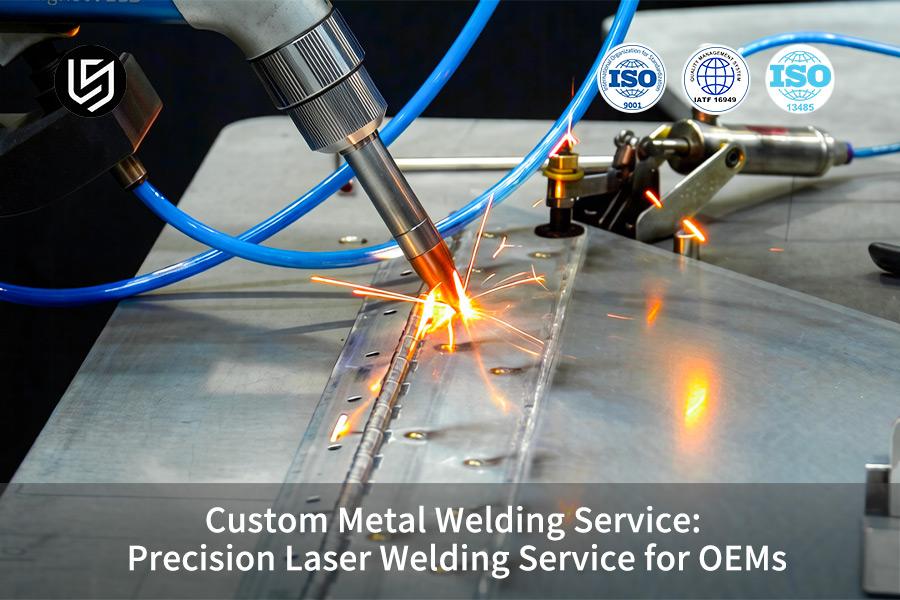
Custom metal welding service procurement in lightweight and precision OEM fabrication may be affected to some degree by the buyer's reluctance regarding 6 key disadvantages of laser welding, namely due to its relatively high starting costs, operational safety risks, and restrictive material limits. The main reason behind the mentioned issues lies in the absence of a complex power feedback system that cannot provide energy stability for welding at such a small scale as 0.1 mm.
We provide an answer to the problem by combining our 6000 W-class fiber laser with a CCD automatic visual focus system, thus making sure the heat-affected zone (HAZ) is strictly limited to less than 0.2 mm. The mentioned engineering design serves as a foundation for addressing material limitations and process instabilities, therefore turning technical constraints into competitive costs.
Precision Laser Welding Service: OEM Quick-Reference
| Critical Aspect | Our Technical Implementation |
| Ultra-Low Heat Input | Laser energy causes ultra-low HAZ, thus preventing warping in thin or heat-sensitive parts. |
| Automated Precision Control | Guidance through CNC-controlled optics and seam tracking allows accurate weld positioning within ±0.1mm tolerance level. |
| Dissimilar Material Joining |
Allows highly durable welding of different metal types such as copper with stainless steel for OEM multi-metal welding. |
| Hermetic & Vacuum Sealing | Special process allows obtaining deep, flawless penetration, ensuring hermetically sealed joints in sensors and batteries. |
| Our Process Optimization | Optimization is performed based on material thickness, reflectivity, and joint geometry to select proper type and parameters (power, pulse width). |
| Result: Clean, Ready-to-Use Welds | Offers seam welding that is free of any spatters, resulting in a high-quality look without the need for any further processing. |
| Result: Enhanced Durability | Prevents changes to the mechanical characteristics of the base materials and provides better resistance against fatigue, thus increasing the life span of vital assemblies. |
We solve OEMs' precision joining challenges with minimal thermal distortion and maximum repeatability. Our laser welding service delivers strong, clean, and reliable welds for delicate or complex assemblies. This enables innovative designs, improves product performance, and streamlines your manufacturing process, ensuring high-quality results batch after batch. This expertise supports your need for durable, high-integrity components in demanding applications.
Why Trust This Guide? Practical Experience From LS Manufacturing Experts
While there are many online articles regarding material selection in general, what makes our guide unique is the practicality involved in the manufacturing process. We have gone beyond the theoretical characteristics of materials and validated all the information using sources such as Granta Design (CES EduPack). The materials we recommend are derived from the convergence of theoretical performance and manufacturing requirements in terms of machining, heat treatment, and end use.
Material selection is key to success, especially when failure is never an option. When designing aerospace parts, you want to ensure high stress resistance and high temperatures; when making implants, you need to guarantee compatibility with human tissue; in vehicles, you need the material to be strong yet lightweight. To achieve this, we rely on reputable sources such as NIST Materials Data to guide us in the optimization process.
The actual price of any given material goes well beyond its mere price per kilogram. Experience—from successes as well as from expensive mistakes—has taught us how machinability impacts tool life, how thermal characteristics affect accuracy, and what properties make an alloy reliable. Herein lie the lessons we've learned and condensed into useful advice for making smart decisions on cost-effective materials that perform right out of the box.
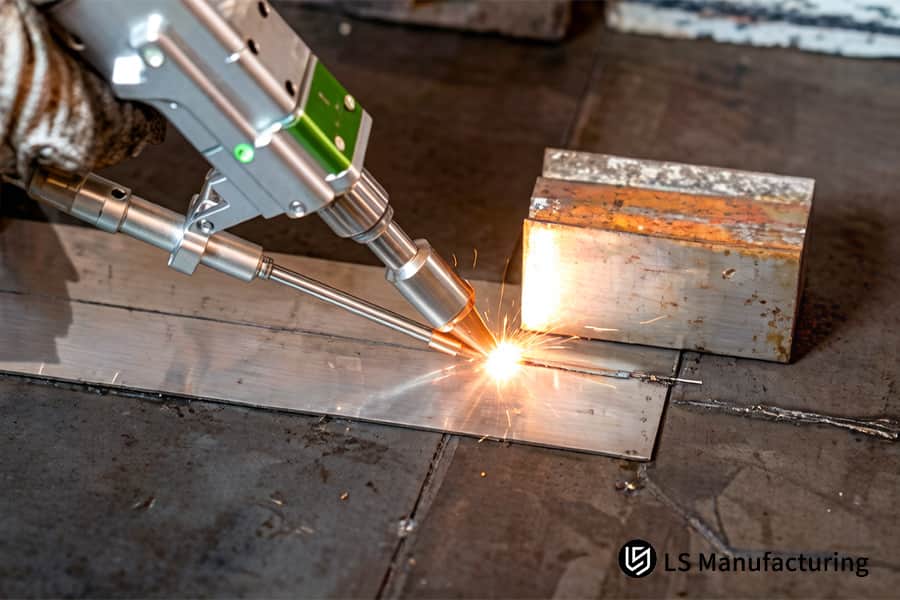
Figure 1: A robotic arm performs laser welding for OEMs on a steel part with flying sparks in a factory.
Why Is A Custom Metal Welding Service The Most Cost Effective Choice For Complex OEM Assemblies?
The custom metal welding service offered by TMC Solutions is specifically designed to address the main issues behind inefficient OEM manufacturing through turning precision welding into a process that cuts costs rather than generating them. The secret to this lies in tackling the underlying technical reasons behind rework and losses. This is explained below:
Precision Power Control to Eliminate Rework
The conventional high-strength metal welding tends to experience thermal distortion, which calls for additional correction expenses. With our solution, the laser welding system automatically compensates for changes in welding pool temperature, thus maintaining a stable welding pool and minimum heat affected zone. This ensures no warping and spatter, and decreases grinding effort up to 60%.
Optimized Joint Design for Material Efficiency
Over-engineering results in wasted materials during OEM manufacturing. For our front-end analysis on the design of precision metal welding, we design the joints to be strong yet with the least amount of materials used. With laser hybrid and autogenous welding, we reduce the number of fillers and the volume of the weld beads, increasing the utilization of materials by up to 15%.
Integrated Automation for Uninterrupted Speed
Speed is useless if not properly aligned. To ensure that the process of automated metal welding has the required speed of up to 80mm per second, we integrate robotically controlled seam tracking and CCD camera-based vision systems with high-speed metal welding. This ensures non-stop welding without manual interruptions.
This strategy represents our competitive advantage: we design efficiency in terms of cost optimization within the process itself. Our unique metal welding services give us the competitive edge in OEM manufacturing by eliminating any sources of inefficiency through adaptive control, design, and automation. This results in consistent delivery of high-quality products through our efficient processes and a superior metal welding service.

How Can A Precision Laser Welding Service Eliminate Post Weld Deformation In Thin Walled Medical Parts?
Deformation in thin wall welding (<0.5mm) is a major challenge when it comes to medical devices, as it can completely nullify the accuracy that had been achieved through machining. In order to overcome such challenges, we offer our precision laser welding service, which essentially involve reducing the heat input:
Micro-Spot Energy Concentration
- Core Mechanism: Through high precision laser welding, our focus spot is limited to 0.1mm.
- Result: Creates a deep, narrow seam with a HAZ only 1/10th that of TIG, foundational for deformation control.
Dynamic Thermal Process Management
- Active Strategy: Applies real-time power and pulse adjustment to manage inter-pulse cooling.
- Technology: Employs back-side cooling to cool the weld, which is crucial for our precision medical welding and specialized metal welding procedures.
Stabilized, Automated Execution
- Consistency: Relies on robotic seam detection to achieve perfect fit in thin wall welding.
- Assurance: Closed-loop feedback adjusts temperature inconsistencies, providing consistent, stress-free welds.
Effective deformation control requires engineering. The key distinguishing feature of our precision laser welding service is our approach to micro-energy control, active thermal management, and automation. With such a systemic approach, we are guaranteed to achieve dimensional accuracy, thereby turning a complex problem into a safe no-rework part of the manufacturing process for demanding metal welding applications.
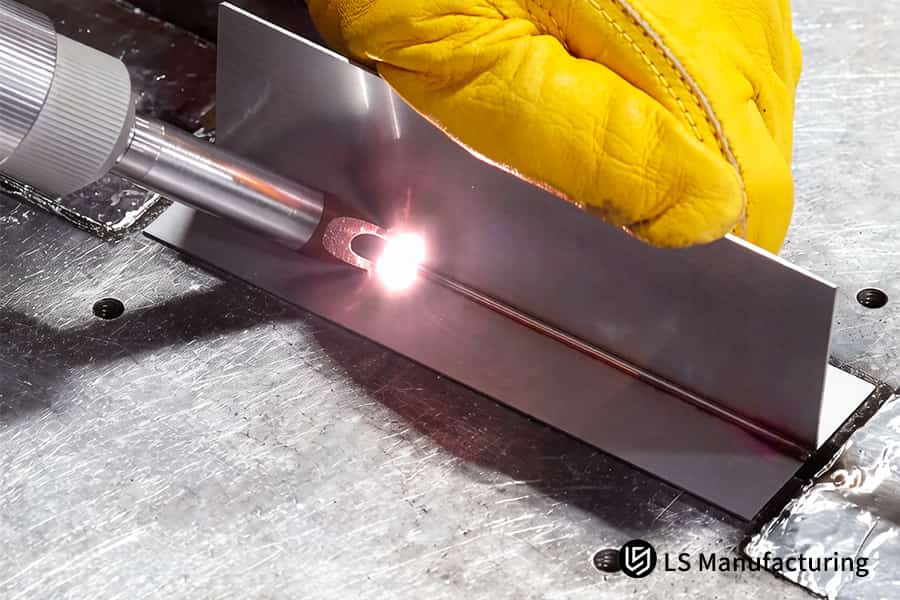
Figure 2: A hand steadies a 304 stainless bracket as a laser spot welds it for medical instrument or probe assembly.
Why Should Laser Welding For OEMs Prioritize Real Time Penetration Monitoring During Mass Production?
In high-volume mass production, latent defects in welding pose severe financial and reputational risks. Traditional post-process inspection fails to correct flaws after they occur. This document details why real-time penetration monitoring is non-negotiable for laser welding for OEMs, as it transforms the process into a verifiable, defect-preventing operation that ensures ultimate supply chain security and product reliability for mission-critical automotive metal welding.
| Aspect | Implementation in Our Service |
| Monitoring Technology | Plasma optical emission spectroscopy is used to monitor the real-time spectral signature of the weld plume. |
| Key Measurand | Spectral line intensity measurement in real-time gives direct feedback on weld penetration and pool stability, key factors in aerospace metal welding. |
| Defect Detection | Slight deviations result in alarms that indicate the presence of defects such as lack of fusion, allowing for prompt action. |
| Data & Traceability | Every single weld is automatically logged digitally, resulting in 100% quality monitoring records for 100% batch traceability. |
| Process Response | A closed loop system fine-tunes the process parameters, ensuring uniformity in critical medical device welding. |
The method raises the bar of metal welding service by addressing the core issue faced by OEMs, which is the presence of defects that cannot be seen in mass production. Through its use, it ensures that there is definitive quality monitoring because it makes sure that there will never be any need for recalls due to 100% digital traceability.
Can Custom Laser Welding Handle The Challenges Of Bonding Highly Reflective Copper And Aluminum Materials?
Bonding with very reflective materials such as copper and aluminum is a difficult task because they have low energy absorption, making them hard to bond. However, our custom laser welding addresses this problem by providing a solution that changes the nature of beam and material interaction, allowing the following critical bonds:
Overcoming Reflectivity via Green Laser Technology
Infrared lasers have a reflection rate of about 95% on copper, resulting in an absorption rate of 5%. A green laser is used in our copper welding process with a wavelength of around 515 nm, resulting in an absorption rate of over 40%, allowing us to create a keyhole with minimal spatter and deeper penetration.
Stabilizing the Weld Pool with Beam Oscillation
Wobble technology is used for aluminum welding. Beam oscillation is used to stir the pool of molten metal and make sure that the heat distribution is uniform and there will be no cracks. This technology plays an important role in ensuring successful high-strength metal welding in complex assemblies.
Ensuring Consistency Through Integrated Control
The process of attaining zero-spatter welding necessitates tight control. The application of an extensive cleaning procedure is coupled with the use of high-frequency pulsing during the high-conductivity metal welding process. This helps in regulating heat input, avoiding turbulence, and producing joints that are highly consistent and strong in order to satisfy the requirements of precision metal welding.
We address the challenges involved in welding reflective materials using a well-defined methodology, rather than relying on just specialized equipment. Using a strategic selection of wavelengths, dynamic control of the laser beam placement, and meticulous parameter management, our custom laser welding services produce sturdy, high-quality metal welding that deliver the essential results required in the manufacturing process where performance in terms of conductivity and heat resistance is an absolute necessity.
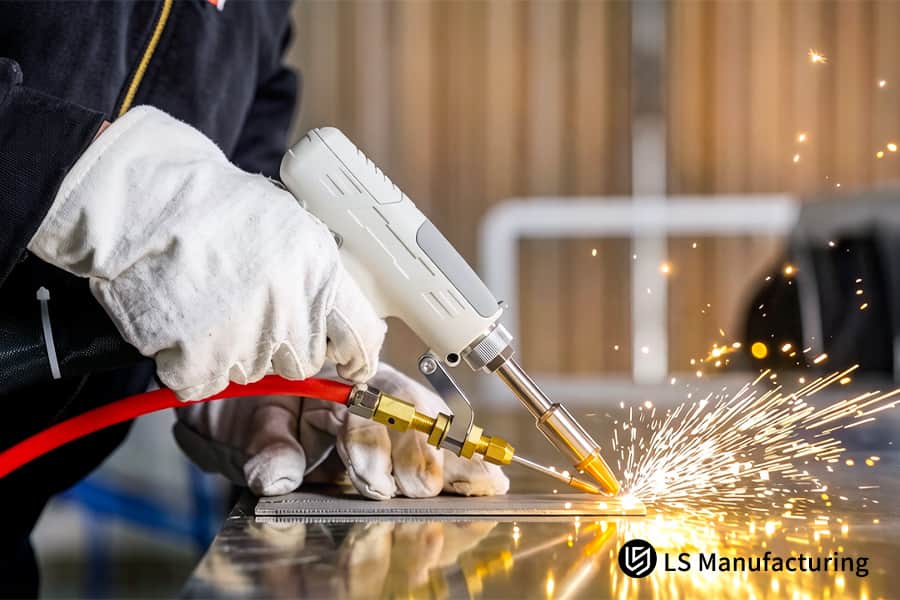
Figure 3: A technician uses a handheld laser to weld a steel sheet for automotive body or electronic enclosure assembly.
Why Does A Professional Metal Welding Service Incorporate DFM Analysis Before The First Weld Bead?
In order for a professional metal welding service to have real value, it needs to do much more than simply assemble the parts together. In essence, the value comes from the avoidance of expensive mistakes, and it begins with addressing manufacturing issues even before the metal pieces are welded together. This is precisely what makes the inclusion of DFM analysis so crucial in our custom metal welding service:
Structural Optimization for Joint Design
- Core Action: Improve joint geometry to maximize the strength and efficiency of the metal welding process.
- Specific Solution: Implement a lap joint in place of a regular butt joint, significantly expanding the effective bonding area by more than 30%.
- Impact: This helps alleviate stress concentration, increases integrity, and improves the durability of the final product.
Thermal Deformation Prediction and Compensation
- Core Action: Analyze thermal deformation through modeling and adjust for potential deformation.
- Specific Solution: Use FEA software to simulate the heating phase of the weld, analyzing thermal displacement down to 0.05mm.
- Impact: Deform the piece prior to welding in the reverse direction so that the heat causes distortion into the proper shape.
Process Parameter Simulation and Selection
- Core Action: Virtual simulation of welding parameters for finding the best process envelope.
- Specific Solution: Simulation of various settings of power, speed, and pattern to meet desired penetration with minimum heat-affected zone (HAZ).
- Impact: Prior knowledge of the right settings to prevent defects such as burning or lack of fusion in prototype welding is essential for complex metal welding projects.
Logistics and Fixturing Strategy
- Core Action: Designation of fixture and operations to ensure ease of access and stability.
- Specific Solution: Determining the most ergonomic weld order and fixture design for rigidity and tool access.
- Impact: It eliminates stress caused by inadequate fixturing in welding, ensures repeatability, and speeds up the production ramp-up cycle, which is an important aspect of our full-cycle metal welding service.
Our focus on DFM analysis upfront is one of the hallmarks of our approach. It is not merely a routine check but rather an exercise in predictive engineering that addresses potential manufacturing issues at the design stage itself. Our disciplined, simulation-based engineering support saves you 3-5 iterations of prototyping, mitigates production risks, and ensures that our metal welding service is not just an assembly process, but a fully validated production solution.
How Does Precision Metal Welding Ensure The Hermetic Seal Integrity Of Sensor Housings Under Vacuum?
The requirement for hermetic sealing sensor housings for operating under vacuum conditions necessitates the highest possible seam integrity. The slightest leak renders traditional processes unreliable in eliminating pores in joints. Precision metal welding, on the other hand, ensures the following benefits for sensor manufacturing and critical metal welding applications:
| Aspect | Implementation in Our Process |
| Primary Welding Technique | High precision laser welding is used with controlled pulses, providing a controlled welding method with minimal heat energy input into the housing. |
| Key Process Parameter | A minimum pulse overlap rate of over 85% is achieved to obtain a consistent and seamless weld without any micropores in the joint. |
| Defect Prevention | Adequate overlap ratio along with the accurate joint preparation will eliminate the micro-porosity formation in the vacuum-grade metal welding procedure. |
| Validation & Testing | Helium leak test is conducted on all housings with the performance criteria being a value of ≤ 10−9 Pa⋅m3/s. |
| Quality Assurance | Leak test results certified for each lot provide assurance of the quality of seal according to military standards. |
The approach to hermetic sealing that we employ addresses the fundamental problem of ensuring perfect and seamless connections in high-containment metal welding applications. This is accomplished by managing the precision metal welding process on a microscopic scale and using helium testing to confirm. Our high precision laser welding is designed to provide a proven seal, thereby removing risk from your most important sensor manufacturing processes.
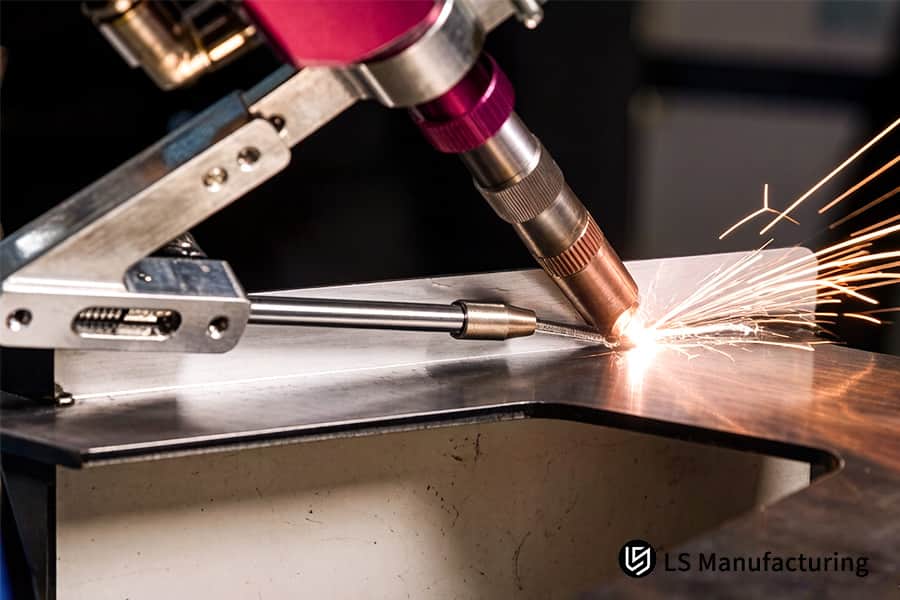
Figure 4: A laser welds a 6061 aluminum bracket for aircraft interior structural components using a custom metal welding service.
Why Is OEM Laser Welding The Best Solution For Reducing Overall Assembly Weight In Automotive Projects?
Automotive light-weighting is a fundamental design dilemma whereby mass reduction must be done without jeopardizing the rigidity and safety of a structure. This report will explain how the use of OEM laser welding offers the most appropriate solution for manufacturing complex, strong, and light structures that would not have been achieved otherwise.
Achieving Mass Optimization with Tailor Welded Blanks
Weight loss can be achieved directly through efficient material use. We utilize laser welding for OEMs to create Tailor Welded Blanks (TWBs). These TWBs are created by welding steel blanks of different sizes and strengths together, allowing for the most efficient allocation of materials, using thick steel in the crash areas and thinner in others. Consequently, we achieve up to 20% weight loss in one part through metal welding techniques without affecting the safety performance of the product.
Eliminating Fastener Weight through Continuous Seams
The redundant mechanical fasteners and their flanges increase parasitic mass. The new design removes these elements and uses continuous and robust laser welds in their place. Precision laser welding is a process that creates a monolithic structure and distributes the load evenly. It allows us to remove fasteners and save on materials, which is an important part of any automotive light-weighting industry.
Guaranteeing Structural Integrity with Optimized Weld Properties
Reducing weight requires dependable joint strength. This is achieved by precise control over the laser welding process, whereby proper heat input and cooling rates are used to generate joints with microstructures that are fine and ductile, avoiding weak heat-affected zones that would render the weld inferior to the base material. The ability to generate high-strength laser welding is necessary for safety considerations and is thus the basis for designing lightweight structures.
The OEM laser welding technology eliminates the key limitation associated with automotive light-weighting by combining these three features into one process. It does this by reducing components to form TWBs, eliminating fasteners and forming continuous joints, and ensuring joint strength through metallurgy. This is an important manufacturing technology for future vehicles.
How Can High Precision Laser Welding Improve The Fatigue Life Of Heavy Duty Industrial Power Tools?
High precision laser welding takes care of the main issue of assuring that the joint made at the welded area within heavy parts can endure millions of cycles of operations. Conventional welding techniques often introduce micro-cracks and stress concentrations causing the failure of the welded joints in advance. Our approach uses energy control to make deep and uniform welds that can significantly increase the product's fatigue life. Below is how we do this:
Achieving Full Penetration with Superior Metallurgy
- Objective: Make a crack-free joint at the thick part without deteriorating the microstructure of the substrate.
- Our Action: We use the keyhole mode welding process with optimal parameters.
- Technical Detail: It creates a deep vapor cavity to provide total fusion without heating up other regions.
- Outcome: The outcome becomes a fine structure of the weld metal and small HAZ, which constitutes the backbone of strong structures of industrial tools.
Engineering the Weld for Optimal Stress Distribution
- Objective: Optimize joint design to avoid stress concentrators, which act as the main trigger for fatigue cracks.
- Our Action: Apply custom laser welding pathways and seam geometries based on finite element analysis (FEA) of load paths.
- Technical Detail: The bead geometry is designed with transitions in mind, along with subsequent laser cleaning processes after welding.
- Outcome: As a result, this process ensures a higher level of crack resistance, thus improving the fatigue life of the product.
Quantifiable Quality Assurance and Process Control
- Objective: Convert laboratory proven results into measurable quality in production.
- Our Action: Adopt a closed-loop process that combines real-time laser welding monitoring with feedback control.
- Technical Detail: Process sensors monitor plume generation and seam tracking, enabling fine-tuning of power and speed levels in order to achieve the desired characteristics of the weld.
- Assurance: This guarantees that all welds made will comply with the metallurgical requirements set out by the industry for industrial tools.
This document describes an established engineering methodology rather than a capabilities statement. The emphasis will be on the science behind deep penetration laser welding and precise process control to address the expensive challenge of fatigue failure. From an OEM perspective, this means having a reliable method of delivering extremely durable products at a lower warranty cost, giving you a competitive advantage with the best industrial tools.
Case Study: LS Manufacturing Medical Endoscope Stainless Steel Housing Precision Laser Welding Custom Solution
A leading U.S. medical device OEM faced critical production challenges with its 316L stainless steel endoscope housing. The existing TIG welding process caused unacceptable distortion and weak joints. This case details how LS Manufacturing provided a tailored precision laser welding service that resolved these issues, demonstrating our capability for complex custom metal welding service:
Client Challenge
The client's 316L stainless steel housing was small in size, and it required a hermetically sealed weld without any distortion. The existing TIG welding technique generated 0.5 mm thermal distortion and caused brittleness in certain regions of the welded joint. This resulted in a weld success rate of only 45% under pressure and autoclave (sterilization by high temperature) tests; this hampered production, approval, and incurred high manufacturing costs.
LS Manufacturing Solution
This solution involved a pulsed laser welding system that employed a fiber laser emitting 1064nm wavelength radiation. A water-cooled rotary table assembly was designed to control temperature, and precise parameter tuning involved setting a stable pulse frequency of 40Hz, defocus of 0.8mm, and ±0.5% pulse stability. The custom laser welding system provided minimal heat input and resulted in an intact corrosion-resistant surface finish while delivering a completely penetrated weld.
Results and Value
The improvements made have been drastic. There was a post-weld distortion measurement of less than 0.02mm. The production yield increased from 55% to 99.5%. The welded parts successfully survived more than 500 autoclave sterilization cycles. This reliable laser process improved production capacity by three times and made LS Manufacturing the preferred laser welding solution provider in Asia.
The success story of this medical case study illustrates a strategy based on creating success using parameter engineering and heat control techniques. LS Manufacturing did not just use a laser, we created a process, which turned a malfunctioning part into a benchmark for reliability. This highlights our expertise in dealing with challenging and precision-oriented manufacturing requirements in the medical industry and elsewhere.
Pass 500 autoclave cycles with 99.5% yield. Inquire about our custom welding solution for medical housings.

FAQs
1. Why choose LS Manufacturing for my high-precision laser welding project?
Our company owns more than 10 stations of fiber laser welding and offers a CCD visual inspection rate of 100%, which guarantees the accuracy of the welding trajectory by ±0.05mm.
2. What materials can LS Manufacturing handle in its custom metal welding services?
Our company specializes in stainless steel, aluminum alloy, titanium alloy, copper alloy, and even nickel alloy, providing you with a one-stop solution starting from material selection to final product manufacturing.
3. How do you control welding quality for large-volume OEM laser welding orders?
We use the Industry 4.0 monitoring technology, which monitors the current, laser power, and shielding gas flow rate of each single part in real-time and creates a unique production data file for each individual part.
4. Is the cost of precision laser welding services higher than that of traditional TIG or MIG welding?
The equipment depreciation rate is relatively high; however, the unit cost will be relatively cheaper compared to the traditional welding technique due to the high-speed rate and lack of necessity for post-welding grinding process.
5. Can LS Manufacturing provide custom laser welding for micro-sized electronic parts?
Of course. We have precision tools that can make a smallest spot with the diameter of only 50 microns; our machines can weld heat-sensitive products such as sensor pins and small relays.
6. What is the lead time for a custom metal welding service quote and DFM report?
Upload your 3D model, and within 24 hours our engineers will carry out an evaluation of weldability and submit a complete quote for you.
7. How does LS Manufacturing ensure the safety and gas-tight integrity of welded parts?
We have our own helium leakage test, penetrant testing (PT) and metallographic lab at the plant, which enables us to generate a full report according to your needs.
8. Why is laser welding superior to adhesive bonding for high-performance OEM parts?
Laser welding creates atomic-level metal bonds, offering unparalleled resistance to aging, electrical conductivity, and high-temperature durability—making it the preferred choice for high-end industrial products.
Summary
In today’s competitive precision manufacturing landscape, laser welding is a strategic lever for product differentiation and cost control. LS Manufacturing’s custom welding expertise uses precise micro-energy control to solve complex manufacturing challenges—from ultra-thin medical parts to high-performance automotive assemblies. We deliver exceptional weld quality alongside DFM-driven optimization and automated workflows, achieving the ideal balance of precision, speed, and cost.
Struggling with part distortion or low efficiency from traditional welding? Start your precision transformation today. Click “Get a Quote” and upload your STEP files to receive a complimentary process feasibility report from our laser welding experts. Beyond competitive pricing, we provide strategic technical intervention to secure your competitive edge in the future market.
Become the exclusive partner in Asia. Achieve 99.5% assembly yield with our laser welding expertise.
📞Tel: +86 185 6675 9667
📧Email: info@lsrpf.com
🌐Website: https://lsrpf.com/
Disclaimer
The contents of this page are for informational purposes only. LS Manufacturing services There are no representations or warranties, express or implied, as to the accuracy, completeness or validity of the information. It should not be inferred that a third-party supplier or manufacturer will provide performance parameters, geometric tolerances, specific design characteristics, material quality and type or workmanship through the LS Manufacturing network. It's the buyer's responsibility. Require parts quotation Identify specific requirements for these sections.Please contact us for more information.
LS Manufacturing Team
LS Manufacturing is an industry-leading company. Focus on custom manufacturing solutions. We have over 20 years of experience with over 5,000 customers, and we focus on high precision CNC machining, Sheet metal manufacturing, 3D printing, Injection molding. Metal stamping,and other one-stop manufacturing services.
Our factory is equipped with over 100 state-of-the-art 5-axis machining centers, ISO 9001:2015 certified. We provide fast, efficient and high-quality manufacturing solutions to customers in more than 150 countries around the world. Whether it is small volume production or large-scale customization, we can meet your needs with the fastest delivery within 24 hours. choose LS Manufacturing. This means selection efficiency, quality and professionalism.
To learn more, visit our website:www.lsrpf.com.