中文 (简体)



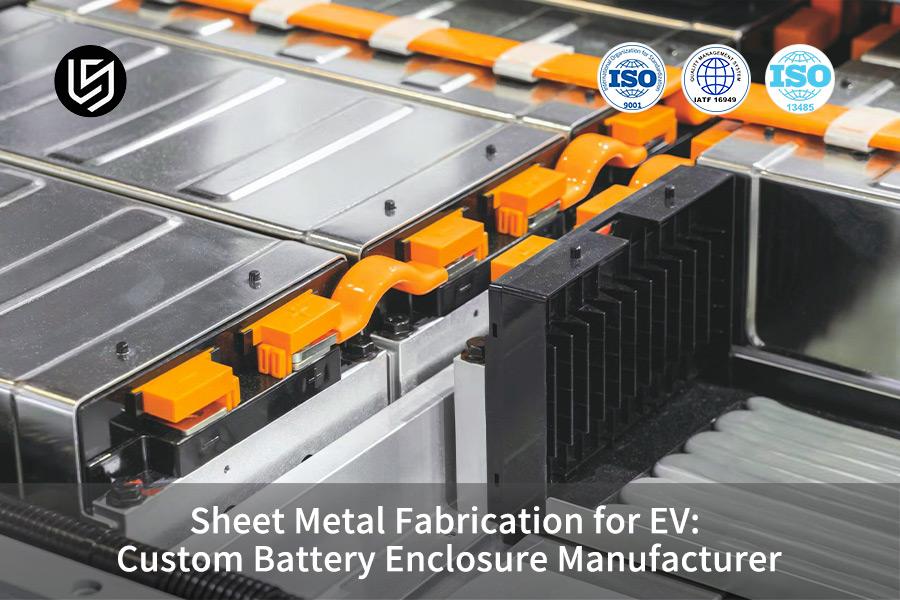
电动汽车钣金加工服务是电动汽车领域的高精度钣金加工服务。 动力电池箱焊接变形和密封失效是该服务主要解决的两个问题。 更换材料为AL5052-H32,采用激光CMT复合焊接可以使焊接时的热变形小于40%。
通过实现 Cpk>1.33 冲压公差,为汽车供应链的 B2B 技术解决方案提供 IP67 密封等级。动力电池箱是主要的安全舱,传统工艺很难满足要求。本文分析了预防生产缺陷的主要流程。

电动汽车电池箱钣金制造核心结论快速概述
该表格总结了整篇文章的核心技术和解决方案,有利于快速理解关键信息,提高决策效率。
<正文>关键要点:
- 材料选择:通过激光CMT复合焊接AL5052-H32,可以将焊接热变形减少40%以上。
- 密封:通过严格保持Cpk > 1.33水平的精确冲压公差,可以确保电池组达到IP67防水等级。
- 质量控制:在线氦质谱检漏(100%)和坐标测量机 (CMM) 几何公差检查是控制批量生产风险的两项必备操作。
为什么信任 LS Manufacturing 的定制电动汽车钣金服务和电池外壳制造专业知识?
寻找钣金制造合作伙伴时的主要考虑因素是他们解决您的痛点的能力以及他们的合规资格。凭借第一手经验和严格的标准,我们被公认为一级客户的长期供应商。我们纠正了欧洲电动客车电池组项目中焊接变形带来的气密性失效问题,并持续遵循IATF 16949:2016和ISO 26262的要求ASIL-B。
过去,通过对北美新能源汽车制造商的焊接工艺确认,我们发现传统MIG焊变形量为0.8mm,而激光CMT复合焊可以将变形量降低至0.2mm,符合IP67标准。流程的每个参数都是基于数千次实验而建立的,并由APQP和PPAP提供,以确保汽车级标准。
我们与SGS长期合作,电动车金属件接受第三方测试,提供MTR和光谱分析报告。 这种实际测试、合规性和第三方确认的结合使客户摆脱了质量担忧,并降低了交付风险。
<块引用>如果您正在努力解决与电池组相关的制造难题,请联系我们的工程专家进行免费的 DFM 评估。我们将根据您的项目需求提供定制钣金制造解决方案,帮助您提前避免超过 95% 的制造缺陷。
定制电池外壳制造商如何在不牺牲车辆碰撞安全性的情况下最大限度地减少结构重量?
专业定制电池外壳制造商首次采用高强度铝合金3D精密成型,使壁厚减少15%。同时,他们进行侧柱冲击、挤压测试和多轴精密弯曲来控制回弹。因此,即使采用高刚性和轻量化设计,他们也成功地平衡了汽车重量的减轻和保持汽车的安全性。
材料加工硬化和回弹控制
根据冷冲压处理的不同材料的加工硬化程度,会影响轻量化的效果。 选材要点是:
- AL5052-H32铝合金:抗拉强度达到230MPa,加工硬化指数n=0.25,冷冲压后硬度增加15%-20%,薄壁成型性能好,回弹可控最大3°,适合不同类型的定制钣金件。
- 高强度钢:抗拉强度350MPa,加工硬化速度非常快,成型难度高,回弹可达5°-8°,这意味着需要额外的回弹补偿来制造电动汽车钣金成型井。
- 回弹补偿方式:采用激光角度补偿技术,进行预设折弯角度偏差,与精密折弯机结合可实现局部轮廓精度0.15mm,与设计图纸完全吻合,无需二次修正。
成型工艺比较及碰撞性能验证
根据成型工艺的不同,电池组在碰撞时的应力分布有很大差异。具体数据如下:
| 核心尺寸 | 最优解 | 关键参数 | 客户利益 |
| 材质选择 | AL5052-H32 + 激光CMT复合焊接 | 焊接热变形减少40%+。 | 降低废品率并缩短交货周期。 |
| 密封 | 精密冲压+动态点胶 | Cpk>1.33,平整度≤0.1mm/100mm | 确保IP67防水等级,避免漏水故障。 |
| 质量控制 | 氦质谱检漏+三坐标测量 | 泄漏检测率1.0×10⁻⁵ mbar·l/s,公差±0.05mm | 降低量产风险,保证产品一致性。 |
| 轻量化 | 3D精密成型+壁厚减薄 | 壁厚减少15%,轮廓精度±0.15mm。 | 减轻车辆整体重量并提高续航里程。 |
| 小批量成本控制 | 软模成型 + 激光切割 | 首件7天内交货,无硬模费。 | 降低研发成本,加快项目进度。 |

图 1:定制电动汽车电池外壳中组装的电池模块及其电缆的特写。
哪种原材料选择可以优化电动汽车钣金制造服务供应商的导热率?
可靠的电动汽车钣金制造服务始终专注于AL3003和AL5052合金的高导热性和耐腐蚀性,因为这些特性有助于有效散发电池模块充电和放电时产生的热量。增强散热的方法之一是调整金属的晶粒取向。材料的选择是影响电池寿命和安全性最直接的因素。
核心材料属性比较
各种原材料的参数差别很大。您可以使用下表作为选择材料的简单指南,这些材料也非常适合电池钣金加工操作。
| 成型工艺 | 横向挤压承载能力 | 应力集中点 | 轻量化效果 | 碰撞通过率 |
| 传统焊接盒 | 160kN | 焊缝 | 1.5mm壁厚,重量增加12% | 88% |
| 集成深拉框 | 220kN | 角 | 1.2mm壁厚,减重15% | 99.5% |
材料应用及质量保证
液冷一体电池的电池盒底座主要材质为AL3003合金。这种材料优异的导热性使其能够非常快速地散发热量。此外,采用高精度成型技术,平整度误差控制在0.1mm。电池外壳金属板材具有良好的导热性和耐腐蚀性。 AL5052-H32已成为满足钣金公差控制标准的主要部件。
作为专业的电动汽车钣金加工服务商,我们提供完整的MTR和光谱分析报告。原材料均经过严格测试。研究表明,适当的材料选择可以将电池模组的散热功能提高25%,使电池模组的使用寿命延长3年以上。
<块引用>如果您想了解不同材料的性能和成本,可以下载我们的材料选择手册。 请随时联系我们的工程师,获取免费的材料选择建议,以完美满足您的项目需求。
激光焊接如何在复杂的电动汽车电池盒制造过程中控制密封性能?
为了实现高质量的电动汽车电池盒制造,我们使用 3kW-6kW 光纤激光器和机器人 3D 焊接系统,实现非常高的焊接热输入效率,减少至传统 MIG 焊接的 30%, 这也导致了孔隙率的消除和最终 IP67 密封的妥协。关键是在焊接过程中严格管理热输入以避免缺陷。
核心焊接工艺参数控制
密封很大程度上取决于焊接参数的准确设置。 主要参数范围如下:
- 激光功率:3kW-6kW,功率根据板材厚度变化。 4kW功率非常适合1.2mm厚的AL5052板材,焊接效果最佳。
- 焊接速度:2.5-3.5m/min。非常高的速度焊接结果可能是未熔透,反之极慢的速度则是热变形的原因。 2.8m/min是最佳速度。
- 保护气体:99.999%高纯氩气,横向保护气流5-8L/min,有效防止焊接区域氧化,有助于防止气孔。
- 工装夹具:12点全自动气动刚性a对位夹具同步锁紧压力0.3-0.5MPa焊接变形限制,焊后平整度保证0.2mm。
焊接质量控制和缺陷解决
焊接薄壁电池托盘很容易导致“熔池塌陷”。 以下是我们用来彻底解决问题的两个简单方法:
0.1mm 激光聚焦控制和在线焊接跟踪系统。焊接后,通过无损检测和氦质谱检漏进行双重质量控制,确保焊缝无裂纹和气孔,进一步钣金焊接质量提高。
独家故障排除提示:焊接时出现微气孔时,将氩气流量略微增加至7L/min,并降低焊接速度0.2m/min,不仅可以快速消除缺陷,还可以避免报废。
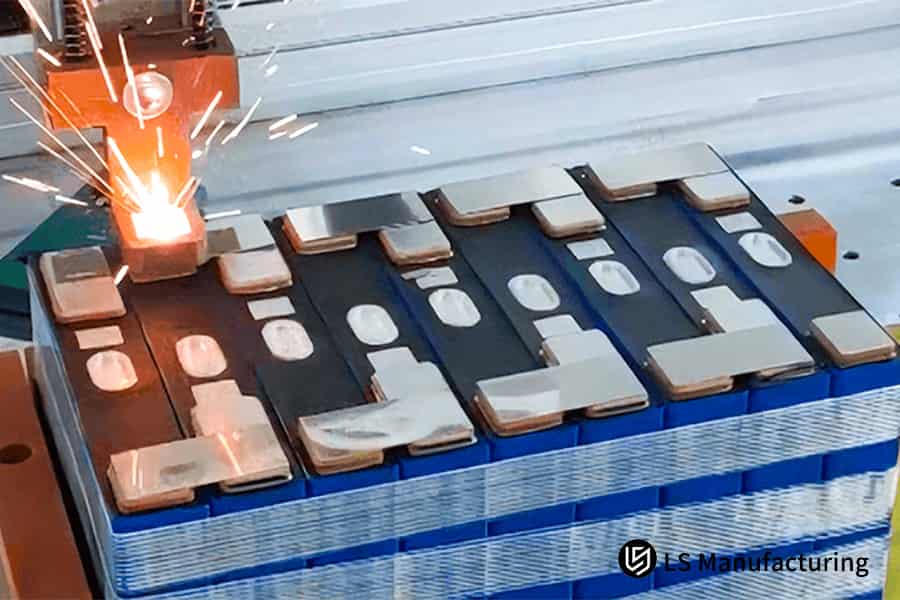
图 2:激光焊接头在电池模块上产生火花以进行密封。
为什么严格的IP67密封标准重新定义了电池外壳钣金定制生产的要求?
为了满足 IP67 甚至 IP69K 标准,电池外壳金属板密封表面的平整度必须小于每 100 毫米 0.1 毫米。为了满足电池安全的这一核心要求,我们依靠数控连续冲压和高精度表面研磨来保持胶槽尺寸稳定。
公差累积控制与结构优化
电池盒密封可能会因配合表面的累积公差而受到损害。 我们通过以下方式进行管理:
- 采用有限元分析 (FEA)对紧固扭矩引起的钣金法兰轻微弹性变形进行建模,并调整变形补偿。从而保证拧紧后平整度仍符合标准,适合钣金精密折弯工艺
- CNC连续冲压公差保持在0.05毫米。经过高精度表面研磨,密封面粗糙度控制在Ra 0.8-Ra 1.6,有利于密封条的附着力。
- 点胶槽尺寸公差固定为0.1mm,点胶宽度保持在5-8mm,胶条压缩率为30%-40%,螺栓间距为50-70mm,这些都有助于密封一致。
表面粗糙度与密封性能之间的关系
表面粗糙度直接影响密封条的粘合强度。我们测量的数据如下:
| 材质类型 | 热导率(W/(m·K) | 拉伸强度(MPa) | 盐雾测试性能 | 适用场景 | 电导率(S/m) |
| AL3003 | 190 | 150 | 720小时无红锈 | 电池盒底座(液冷板集成) | 3.7×10⁷ |
| AL5052-H32 | 170 | 230 | 1000小时无红锈 | 电池盒顶盖、侧板 | 3.2×10⁷ |
| SPCC冷轧钢 | 50 | 300 | 480小时无红锈 | 非核心承重组件 | 7.0×10⁷ |
| AL6061 | 160 | 310 | 800小时无红锈 | 电池盒支架 | 3.0×10⁷ |
哪些工程因素直接影响电动汽车项目钣金制造的结构公差?
在为电动汽车项目进行大型钣金制造时有助于公差控制的不同因素包括冲压模具间隙、带角度补偿的激光折弯、加工过程中的二次定位等。我们将钥匙孔的公差设置为 0.05 毫米。 这将直接影响装配精度和量产质量。
影响容差的核心工程因素
量产时能否稳定地保持公差主要取决于三个因素。
- 冲压模具间隙:间隙根据材料的厚度确定在合理的水平。例如,对于 AL5052 钣金(1.2 毫米厚),模具间隙为 0.12 至 0.15 毫米,这样做是为了防止形成毛刺和变形,从而有助于实现冲压件的尺寸精度并满足高精度板材的标准金属。
- CNC 弯曲补偿:这是使用激光角度补偿完成的。综合考虑折弯角度和材料特性,预设0.5°-1°的补偿量来控制回弹误差,保证折弯精度。
- 二次精密定位:加工中心配备CCD视觉定位系统,定位精度0.02mm。
模具工艺与公差稳定性比较
在批量生产期间保持孔距 Cpk 值时,单工位模具和级进模具之间的能力差异很大。
| 表面粗糙度 (Ra) | 发泡硅胶粘合强度(N/m) | EPDM密封条粘合强度(N/m) | IP67密封测试通过率 |
| 0.8 | 180 | 165 | 98.5% |
| 1.2 | 220 | 200 | 99.8% |
| 1.6 | 190 | 175 | 99.2% |
| 2.0 | 150 | 140 | 95.3% |
每个批次都包含 SPC 控制图来跟踪公差变化。这使用了公式“单批次公差波动成本 = 废品率单位成本批量输出”,更严格的控制可将废品率降低到 0. 5% 以下,并且显着降低总体费用。
OEM 在小批量定制电动汽车钣金服务采购过程中如何避免高昂的模具成本?
当涉及定制电动汽车钣金服务的研发或小批量试产时,最佳解决方案是软模成型+激光切割。我们切换to flexible manufacturing lines, so even if we cancel tens of thousands of dollars in mold opening fees, we still manage to get our first-piece within 7 days, which totally changes the issue of a high mold cost.
Cost-Effective Production Paths at Different Scales
If you want to achieve the lowest cost possible, then your decision for process selection should be aligned with the annual volume of production, like this:
- 1-50 pcs (Research & Development Stage): For the beginning stage use of a product, soft mold forming + laser cutting method is excellent. It doesn't involve the costly production of hard molds, delivers the first piece inside 7 days, has a somewhat higher single piece cost, but the trial and error costs are minimized greatly. This strategy is ideal for testing product iteration and having low cost sheet metal fabrication.
- 50-500 pcs (Small-batch Pilot Production) : This stage, the soft mold method is combined with the use of a CNC turret punch press, the main purpose is keeping a reasonable balance between efficiency and costs.Unit cost, in this case, got reduced by 30% compared to the R&D stage, delivery cycle is 15-20 days.
- 5000+ units (Mass Production): Progressive die stamping + laser welding methods, a significant investment in hard mold costs (approx $20,000-$50,000). Yet, unit cost is brought down by 60% which is the best practice for regular mass production.
Cost Control Tips and Service Support
Adjusting the battery box bending radius to R=1.5-2.0mm and minimizing deep drawing structures will not only simplify the mold but also save 20%-30% of mold costs, we do free DFM analyses to help you struct ure the product in a cost effective manner and eliminate cost waste.
<块引用>Being a professional custom EV sheet metal service provider, we are equipped with a flexible manufacturing line that can handle minimum order quantities of 5 pieces, which means that OEM customers can check the appropriateness of the battery box structure during the R&D stage with very low costs of trial and error. If your small batch trial production stage, please don't hesitate to contact us for a free cost calculation so that you can get the best processing solution and avoid high mold cost waste.
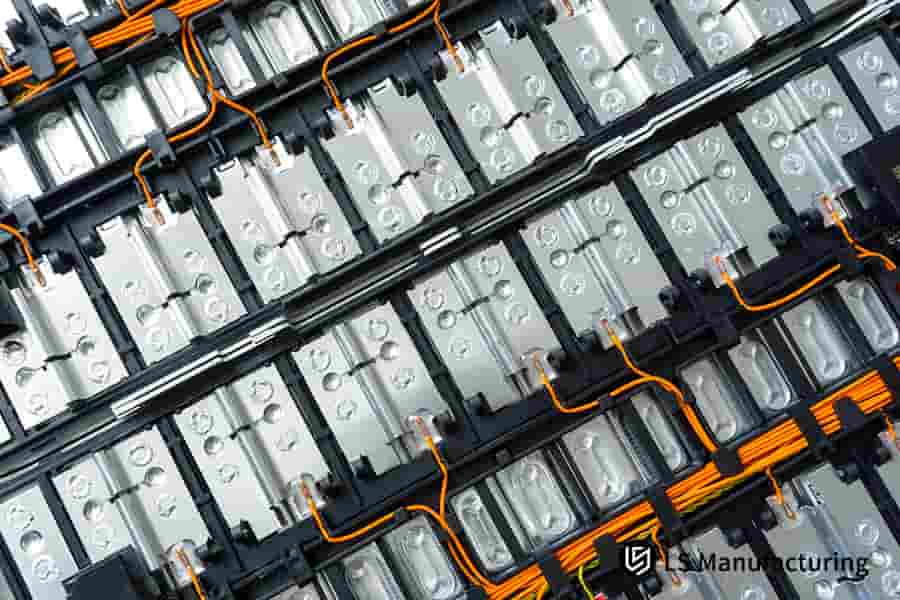
Figure 3: A battery module showing silver cells connected by orange wires.
Which Quality Control Protocols Ensure The Long Term Durability Of High Voltage Electric Vehicle Metal Parts?
Electric vehicle metal parts, in particular those operating with high voltage, need powder coating or insulating nylon powder coating that is very strong. Only in this way, the service life of these parts can be guaranteed to be over 10 years. Our insulation layer has a breakdown voltage of >5000V DC, That means the whole surface treatment process must be under quality control coverage.
Surface Treatment Process Quality Control
There are explicit quality control criteria for every point of the surface treatment process of Electric vehicle metal parts:
- Cleaning before treatment: Degreasing with an alkaline agent is done at 50-60℃, 10-15 minutes. Besides cleaning the surface from grease and other contaminants, the adhesion that is necessary for the subsequent steps is also achieved. This method is ideal for sheet metal surface finishing.
- Silane Passivation: This is a newer technique which is also replacing phosphating (environmentally friendly) and gives the passivation film at 0.5 to 1.0μm thickness that results in coating adhesion and protective ability against corrosion.
- ED (Electrophoretic Coating): The thickness of the electrophoretic layer is 20-30μm. The adhesion reaches the 5B level (cross-cut adhesion test) - absolute no peeling or flaking.
- Powder coating: The thickness of the insulation layer is 80-120μm, the online measurement of thickness error is 5μm, the breakdown voltage is >5000V DC, so high-voltage insulation requirements are considered to be met.
Weather Resistance and Insulation Performance Testing
We do very strict testing to check the weather resistance as well as the insulation capability of our surface-treated products. Key test data are as follows:
| 模具工艺 | 孔距Cpk值(批量生产) | 容差波动范围 | 合适的年产量 | 维护成本 |
| 单工位模具 | 1.0-1.2 | ±0.08mm | 500件以下 | 较低 |
| 渐进式模具 | 1.33-1.67 | ±0.03mm | 5000件以上 | 更高 |
How Can Automotive Tier 1 Suppliers Find a Reliable Partner For Precision Sheet Metal Enclosure Manufacturing?
When assessing a sheet metal enclosure manufacturing company's ability to supply automotive-grade parts the main criteria are their hardware facilities, IATF 16949 certification, and their knowledge of APQP/PPAP tools. Solid suppliers make it easier for Tier 1 customers to alleviate the risks involved in the supply chain.
Critical Aspects Of Supplier Qualification Review
Before deciding on a Tier 1 supplier, what comes next four points deserve in-depth discussion:
- System Certification: IATF 16949:2016 system certification is a must. This is the bare minimum qualification for automotive-grade parts supply as it confirms the production process is compliant.
- Tool Execution: Must be able to effectively implement the five core tools - APQP PPAP FMEA, SPC, and MSA - to help project risk minimization right from the starting stage.
- Hardware Equipment: Have make metrology equipment like Bystronic laser cutting machines and CNC bending machines to maintain a processing accuracy of 0.05mm.
- Testing Capabilities: Own testing devices like coordinate measuring machines (CMM) and helium mass spectrometer leak detectors, and provide full third-party testing reports.
Complete Compliant Supply Loop
We form an entire compliance loop starting from RFQ reception to PPAP submission, which ensures that the projects satisfy the customers' needs:
- RFQ Reception and Drawing Review: When a customer sends a quotation request, a complete 3D drawing review must be done within 24 hours and the DFM defect feedback must be given.
- Risk Analysis: The use of FMEA in analyzing the Risk Priority Number (RPN) enables the creation of precise risk control measures for manufacturing defects prevention.
- Production Control: We prepare in-depth control plans and keep track of the production activities continuously. For every batch, SPC control charts are given.
- PPAP Submission: The submission of PPAP documentation, complete with the samples, test reports, and control plans, etc. takes place after the production of parts, adhering to customer acceptance standards.
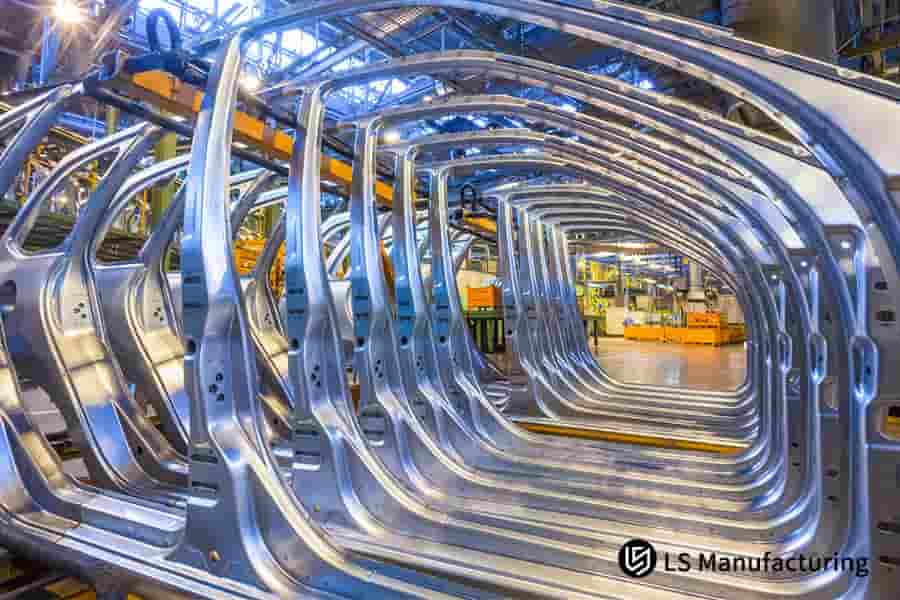
Figure 4: Rows of metal frames in a factory, likely for EV battery structures.
How Did LS Manufacturing Deliver a High Precision Solution For An EV Automotive Custom Battery Box Fabrication?
Here is a detailed description of a case study illustrating our very accurate EV battery box fabrication solution provisioned to a top European electric bus company and reflecting our abilities in pain point addressing and the after effect. Also, it stands as a basis for similar works.
Customer Issue:
During creating a 350kW large capacity power battery pack, a European electric bus manufacturer experienced a difficulty: conventional welding methods caused the AL5052 substrate to be distorted by 1.8mm, thereby a 24% failure rate at the first attempt in the IP67 airtightness test was observed.
As a consequence, the customer was under the pressure of postponing the vehicle production line and facing the difficulties in meeting deadlines, which made the situation quite unbearable for them. So, they desired a skilled team that would be of great help to them in solving their problem.
LS Manufacturing Solution:
- First, after our technical experts got involved, by analyzing the drawings through DFM (Design for Manufacturing), we realized that the split-welding structure was the biggest reason behind the thermal deformation.
- We upgraded the design to a single unit operation combining CNC progressive die flexible forming and laser CMT (Continuous Metallurgy) welding. We also created a 12-point pneumatic rigid fixture which was used to pressurize the workpiece to 0.4MPa during welding, thereby restricting deformation and warping.
- To guarantee sealing, we chose an automated helium vacuum chamber mass spectrometer leak detector, and set a leak detection threshold of 1.0 10 mbarl/s so that 100% online leak detection was achieved.
- We changed the welding settings to this: laser power 4.5kW, speed 2.8m/min, argon gas flow rate 7L/min. These changes in parameters lowered thermal deformation and porosity, our experience also confirms that structural and process changes can resolve aluminum alloy welding warping issues.
Results and Value:
Thanks to process modification, flatness of the battery box sealing surface was kept within 0.15mm, IP67 pass rate reached 100%. Customer was saved $80,000 from scrap product, delivery cycle was shortened by 32 days, and the customer got a 5-year supply contract.
<块引用>If your electric vehicle (EV) battery box fabrication project also encounters problems like welding deformation and airtightness failure, please reach out to our engineering professionals so that we can provide a personalized high-precision solution that fits your project requirements perfectly.

FAQs
Q1: What is the standard lead time for custom EV battery box fabrication prototype at LS Manufacturing?
By using our full CNC flexible machining line and with automotive-grade AL5052 aluminum alloy materials always ready in stock, we are able to make very precise prototype parts for you and also provide a detailed non-conformance report within 7 to 10 working days from you upload your drawings, which will allow R&D testing of the prototypes.
Q2: How does LS Manufacturing determine the initial tooling cost and unit price for an EV sheet metal fabrication service project?
We always aim at making our pricing system fair and understandable. The unit prices are calculated accurately based on material usage, total laser cutting length, bending steps, and welding time. To help customers at the R&D stage in small-batch trial production, we can offer them a soft mold transition without any hard mold fee, So cutting down on costs for them.
Q3: Will LS Manufacturing be able to produce low-volume custom battery enclosures for niche EV models?
Yes, In fact. In particular for R&D and racing/commercial vehicles, we even have a flexible, lightweight production line with the lowest order quantity requirements being only 5 to 10 units. This allows customers to verify the structural design of the battery enclosure in the early developmental stages and Much reduce the trial-and-error costs.
Q4: Which third-party testing reports do you provide to validate the quality of electric vehicle metal parts?
Upon every shipment, we are able to furnish comprehensive automotive-grade quality certification plus the original Material Test Record (MTR), coordinate measuring machine (CMM) dimensional measurement reports, hardness and tensile test reports, and SGS-certified 1000-hour salt spray corrosion and IP67 leak detection data.
Q5: How does LS Manufacturing protect the Intellectual Property (IP) and proprietary CAD designs of our EV battery housing sheet metal?
Our company considers intellectual property to be its very existence. We enter into a legally binding NDA (Non-Disclosure Agreement) before any technical data is given to us. We encrypt all CAD/STEP drawings and keep them on a separate secure offline server that only core project engineers can access.
Q6: What is the maximum thickness and processing tolerance of sheet metal fabrication for EV components at your facility?
Our company is capable of precision forming aluminum alloys, stainless steel, and high-strength steels ranging from 0.5mm to 6.0mm thick. With the aid of Bystronic laser cutting machines and CNC bending machines, we are able to keep control of critical batch processing tolerances at an impeccable 0.05mm level.
Q7: What is your method for leak testing finished custom EV sheet metal service enclosures to verify their compliance with IP67 standards?
We are not going to revert to the old and inefficient immersion method that can easily miss leaks. Instead, we rely on automated airtightness pressure drop testers and high-precision helium vacuum mass spectrometry leak detectors to make sure that every battery case manufactured undergoes a thorough leak-proof check at the molecular level.
Q8: Is LS Manufacturing able to carry out downstream surface finishing such as powder coating and busbar copper plating done simultaneously?
Yes, we offer a complete one-stop turnkey manufacturing service. Our factory boasts fully automated automotive-grade electrophoresis (ED) lines, electrostatic powder coating lines, and precision copper busbar heat shrink insulation tubing processing equipment. These ensure that high-voltage insulation and corrosion protection treatments are not compromised by quality control issues related to outsourcing.
摘要
EV battery box sheet metal fabrication involves numerous engineering activities like integrating precise dimensions, sealing and insulation etc. which can directly change the safety and mileage of the electric vehicles.
The main challenge of manufacturing lies in controlling the process parameters accurately, selecting the right materials scientifically and finally strict quality control. We use our practical hands-on experience and approved qualification to break down the barriers and provide cheap solutions throughout the entire supply chain.
Does your EV battery case project face pain points such as welding deformation, air tightness failure, or tooling budget overruns? Go ahead and send us your STEP, IGS or DXF 3D drawings and our senior experts will offer you a free DFM analysis and detailed cost quote by the next day with strong data to protect your project!
📞电话:+86 185 6675 9667
📧电子邮件:info@lsrpf.com
🌐网站:https://lsrpf.com/
免责声明
The contents of this page are for informational purposes only. LS Manufacturing services 对于信息的准确性、完整性或有效性,不作任何明示或暗示的陈述或保证。不应推断第三方供应商或制造商将通过 LS Manufacturing 网络提供性能参数、几何公差、具体设计特征、材料质量和类型或工艺。这是买家的责任。 需要零件报价 确定这些部分的具体要求。请联系我们了解更多信息。
LS 制造团队
LS Manufacturing is an industry-leading company.专注于定制制造解决方案。我们拥有超过 20 年的经验,服务超过 5,000 家客户,我们专注于高精度 CNC 加工、钣金制造、3D 打印、注塑。 金属冲压,以及其他一站式制造服务。
我们的工厂配备了 100 多台最先进的 5 轴加工中心,并通过了 ISO 9001:2015 认证。我们为全球150多个国家的客户提供快速、高效、高质量的制造解决方案。无论是小批量生产还是大规模定制,我们都能以最快的24小时内交货满足您的需求。选择LS制造。这意味着选择效率、质量和专业性。
要了解更多信息,请访问我们的网站:www.lsrpf.com。

| Test Item | Test Standard | Test Result | Industry Requirements |
| Salt Spray Corrosion Test | SGS 1000 hours | No red rust, no corrosion | 720 hours,no red rust |
| Scratch Resistance Test | ASTM D3363 | Scratch depth ≤0.5mm, no coating peeling | Scratch depth ≤1.0mm |
| High Voltage Breakdown Test | IEC 60664 | Breakdown voltage >5000V DC | Breakdown voltage >3000V DC |
| Adhesion Test | ISO 2409 | 5B level | 4B level and above |