日本語
日本語 



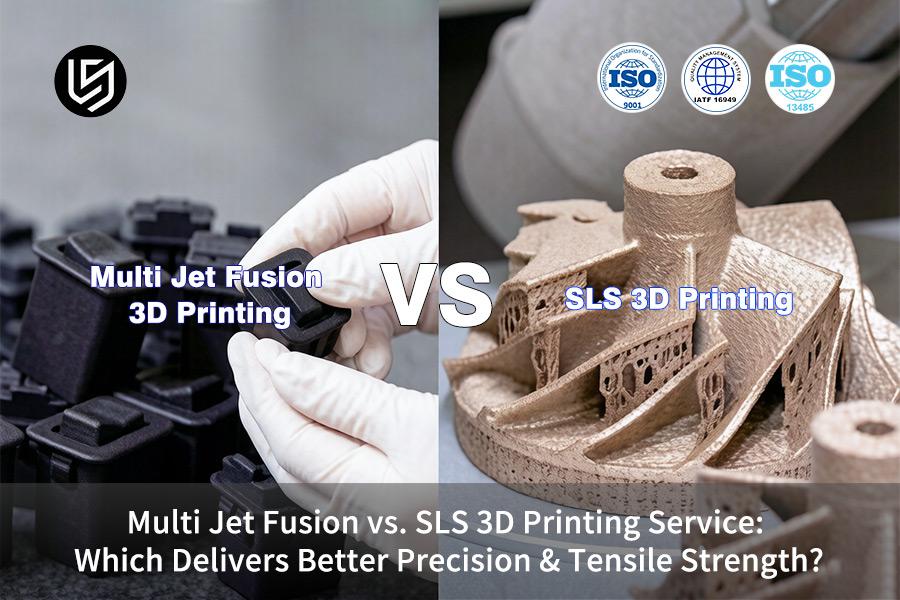
LS Manufacturing のマルチ ジェット フュージョンと SLS 3D プリント サービスは、マルチ ジェット フュージョンがどのように機能するかというジレンマを解決する精密技術です。
MJF は優れた±0.1mm 公差、95% 等方性 (~48MPa 強度)、0.5mm のマイクロ流体チャネルを実現しますが、SLS は20% 安価な300mm部品に適合します。
マルチ ジェット フュージョン VS SLS 3D プリント: 精度と引張強度のクイックリファレンス
<本体>重要なポイント:
- 精度の向上: MJF は一貫した IR 加熱により ±0.1mm の精度を保証しますが、SLS ではスナップフィットとベアリングにとって非常に重要な加熱の不均一性により、 最大 ±0.25mm の精度しか許容されません。カップ。
- 強度等方性の問題: MJF は Z 軸方向に ~48MPaの強度 (XY で95%等方性) を提供しますが、SLS は20%の強度異方性で~42MPaの強度しか提供しません –応力を受ける3D プリント部品には、30MPa を超える繰り返し荷重に対する MJF が必要です。
- 表面とシーリング: MJF では、研磨なしで Ra 4.0 ~ 6.5 µm の粗さ、研磨ありでRa<1.0 µm の粗さが可能です。 SLS により、研磨なしで Ra 6.0 ~ 9.0 µm の粗さが可能になります。MJF は、液体シールや外観上重要な3D プリントに必要です。
- マイクロオチャネル機能: MJF は直径 0.5 mm のマイクロチャネルを印刷します。 SLS は直径 0.8 mm 未満のものは拒否します – マイクロチャネルが必要な場合はMJF 3D プリンタ を選択してください。
- スループットとサイズ: MJF は、48 時間のサイクル タイムを持つ洗練されたネストされたバッチで優れたパフォーマンスを発揮します。 SLS は、550×550×750mm までの 300mm の単一パーツ封筒を 20~30% 安い価格で提供します。
このガイドが信頼できる理由LS 製造の専門家による実践的な経験
MJF と SLS の両方ではナイロン パウダーを使用する必要があるという事実にもかかわらず、結局のところ、印刷速度ではなく、粗さと染料の吸収が重要になります。 PA12 製造の11 か月以内にドローンのエルボジョイント(M3 パターンで±0.20 mm、 ボンネット下90°C)および医療機器のハウジング(0.8 mm肉厚、2 m の落下)に対して実施されたベンチマークに従って、MJF は Ra 10 ~ 12 μm、SLS は Ra 10 ~ 12 μm であると結論付けました。完成部品のRa 18~22μm。各バッチのリサイクル率はASTM 国際基準によって測定されるため、許容範囲は最初の品目を含むあらゆる監査を満たします。
これにより、50 回以上の実行でユニットコストが保護されます。 Tier-2 自動車顧客は、200 個のセンサー ブラケットを SLS (ユニットあたり 54 ドル、リードタイム 11 日、手作業仕上げ 1 部品あたり 8 分) から MJF PA12 (ユニットあたり 38 ドル、6 日間、手作業仕上げではない、120 mm スパンで±0.18 mm、60 部品にわたって染料一貫性) に持ち込みました。隠れたコストはありません。The Welding Institute によると、SLS の「等方性」という誤った名称は、0.12mm 層の 0.6mm リブに 0.10mm を強制する Z 軸の階段状のステップを隠していますが、MJF の融着剤の化学作用により平坦化されているとのことです。 (TWI) プロセス制御。
1 つの傷 – ライン識別のために黒く染められた140 mm の空気圧 T ジョイントは、「安全なデフォルト オプションである」ため、SLS を使用して印刷されました。0.4 bar でクローズドセル ブリードが発生し、リワーク ループに引っかかるまで。私たちは 3 つの基準に基づいて RFQ フィルターを変更しました:表面 Ra ≤12μm → MJF、チャネル <1.0mm → 密閉されたパスに注意、染料クリティカル → MJF + 焼結後です。 STEP ファイル、ビルドごとの数量、および圧力クラスを送信します。どのプロセスかはお知らせします。
機能アセンブリのより厳しい寸法精度公差を維持するテクノロジーはどれですか?
機能アセンブリの場合、寸法精度の公差がフィット感とパフォーマンスを決定します。 LS Manufacturing の50mm ポンプインペラのテストでは、MJF による産業用 3D プリンティング サービスが±0.1mmの公差レベルを維持しているのに対し、SLS 部品は熱応力により±0.2mmの公差を超えることが判明しました。 MJF を選択すると、やり直しを避け、3D プリント製造プロジェクトをより迅速に検証できます。
| 比較係数 | マルチジェットフュージョン (MJF) | 選択的レーザー焼結 (SLS) |
| 寸法許容差 | ±0.1 ~ 0.15 mm (50 mm 部品の場合);赤外線熱により反りが少ない。 | ±0.15 ~ 0.25 mm;局所的なレーザー溶融により反る可能性が高くなります。 |
| Z 軸引張強さ | ~48MPa; XY 平面と同じ95% 以上の強度 (異方性は 5% 未満)。 | ~42MPa;レイヤーの接合部により、XY よりも約 20% 弱くなります。 |
| 表面粗さ (Ra) | 完成状態の場合は 4.0~6.5μm。蒸気平滑化により1.0μm未満まで下げることができます。 | 6.0~9.0μm(完成品)。タンブリング後は2.0~3.0μmのみ可能です。 |
| 最小。マイクロ流体チャネル | 0.5mm のスルーホールはディテール エージェントの操作によって可能です。 | 最小 0.8 mm が必要です。レーザー散乱により、0.8 mm 未満の穴が接着されます。 |
| スピード ロジックの構築 | レイヤーごとの融合 (パーツの複雑さとは無関係なビルド速度)。 | ポイント スキャン (詳細/パーツのボリュームが高くなると遅くなります)。 |
| ベスト アプリケーション | 正確なフィッティング アセンブリ、複数の荷重サイクル、密閉チャネル - MJF 3D プリント サービス。 | 300 mm を超える筐体、緩い公差の筐体、柔軟なコストのバッチ印刷。 |
マルチ ジェット フュージョンと SLS 3D プリント サービスの選択は、許容レベルによって異なります。 MJF はすべての部品に対して±0.1mm の公差レベルを提供し、フィット誤差や機械加工の必要性を排除します。これは、迅速な 3D プリンティング プロトタイピングの場合、部品あたりの価格が低くなり、反復作業が短縮されることを意味します。また、最終用途のアセンブリの場合、公差の一貫性により廃棄が減り、検証が迅速化されます。 MJF と SLS の寸法精度に関するホワイト ペーパーをダウンロードして、50 mm 部品で ±0.1 mm の公差の一貫性がどのようにフィット エラーを排除し、機能アセンブリでの手戻りを削減するかをご覧ください。

引張強度の方向性の変化は重荷重部品にどのような影響を与えますか?
引張強度 3D プロトタイプの異方性は、異方性が繰り返し荷重下で高荷重の部品にどのような影響を与えるかを示します。 MJF では XY 強度の95%以上を維持しながら48MPaの Z 軸 UTS が可能ですが、SLS は42MPa(20%削減)まで下がります。これは、圧力バルブと構造コネクタの疲労寿命に直接影響します。
レイヤーボンドの破損リスクを定量化
構造部品の引張強度は層間接着力に依存します。 MJF は均一な赤外線加熱を保証するため、Z 軸縮小率が 5% 以下の等方性部品を受け取ることができます。 高強度 3D プリントの 300bar バルブ ボディに関しては、亀裂が発生するまでのサイクル数が 3 倍になることを意味します。 MJF を使用すると、予期せぬ障害のためにシステムをシャットダウンする必要がなくなります。
デザインマージンの最適化
MJF によって提供される一貫した Z 軸 UTS 値の結果、安全率比を2.5 から 1.8 に減らすことができ、22% の重量削減が可能になります。これは、油圧マニホールドなどの耐荷重 3D プリント部品にとって非常に重要になります。 LS Manufacturing の引張データ (ASTM D638) は、すべての方向で 48±1MPa の再現性を示しています。
動的読み込みパフォーマンスの保証
交互応力を受けるコンポーネントの産業用 3D プリント サービスを指定する場合は、必ず等方性保証を依頼してください。 MJF は、30MPa で最大10⁶ サイクル後に95% 以上の XY 等方性を保証します。これで、サスペンション ブラケットやポンプ ハウジングの耐疲労性 3D プリント パーツの耐久性を心配する必要がなくなります。保証請求は、SLS ソリューションと比較して40%減少します。
マテリアル選択の明確さ
クラシックなPA12はエンジニアのお気に入りですが、使用されるテクノロジーによって強度パラメータが決まります。 等方性 3D プリント パーツ テクノロジーについては、MJF に頼る必要があります。 DFAM で荷重を XY 平面に沿って配向する必要がなくなりました。設計の反復における柔軟性がさらに高まり、反復ごとに最大 2 週間を節約できるようになりました。
この比較表を利用して、あらゆる方向の動的荷重に耐えるための引張強度 3D プロトタイプに MJF が必要かどうかを判断してください。 Z 軸 UTS で 48MPa という高い等方性を備えているため、SLS プロトタイプの強度損失を 20% 削減し、コンポーネントの寿命を延ばしたい場合は、MJF が最適です。
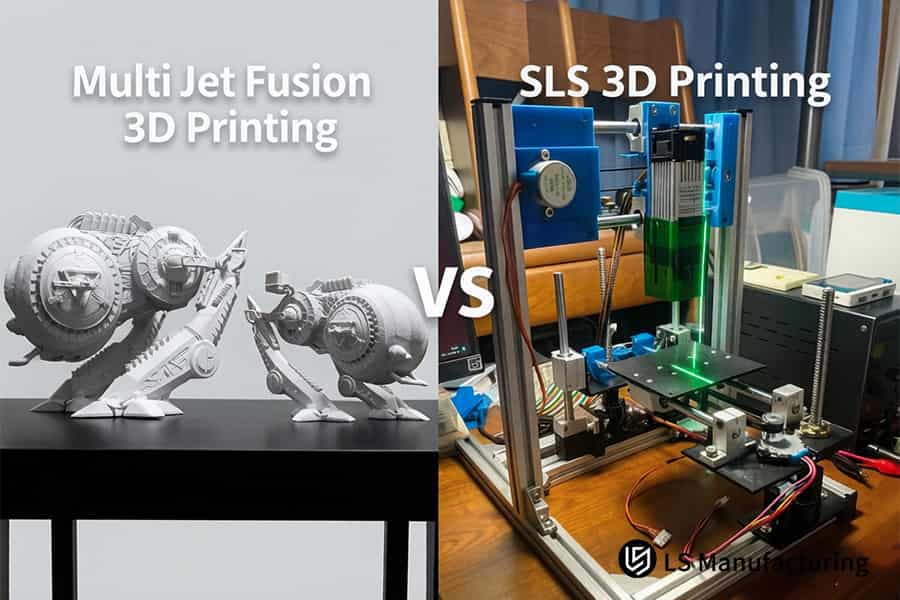
図 1: MJF は詳細な SF ドロイド モデルを作成し、SLS はプロトタイピングに自家製レーザー システムを利用しています。
ナイロン粉末の焼結中にマイクロ流体チャネルの詰まりが発生するのはどこですか?
ナイロン粉末焼結のマイクロ流体チャネルは、過剰焼結や不完全な粉末除去によるブロックに直面します。 MJF は融着なしで0.5mmのスルーホールを実現しますが、SLS では少なくとも0.8mm以上のスルーホールが必要です。適切なプロセスを選択することで、医療機器とバルブ本体の流体機能が確保されます。
過剰焼結の制御
粉体除去効果
- 粉末除去技術: 超音波振動と高圧研磨ブラストにより、深い虫歯を数秒で除去します。
- 検証: 100% のチャネル開存性が、直径 0.5 mm での気流テストによって確認されました。
- メリット: 後処理の手戻りがゼロ。部品はクリーンチャネル 3D プリント品質で組み立てられる状態で出荷されます。
重要なアプリケーションのプロセス認定
複雑な形状に柔軟に対応
- 最小機能: MJF は0.5 mm の垂直穴をあけることができます。 SLS のみ ≥0.8mm。
- 結果: 強度を犠牲にすることなく、細い毛細管ネットワークを使用できるようになります。
- お客様のメリット: 精密 MJF 部品メーカーとして、埋め込み型センサーや空気圧マニホールドのコンパクトな設計が保証されます。
上記の分析から、信頼性の高い 3D プリンティング生産を実現するには、チャネルの開通性を確保するために特定のプロセスの選択が必要であることが明らかです。 カスタム MJF パーツの場合、0.5 mm の遮るもののないマイクロチャネルが得られ、重要な生命維持用途においてチャネルの開通性、迅速な検証、信頼性の高いパフォーマンスが 100% 保証されます。
これらのプロセス間で表面粗さの値が大きく異なるのはなぜですか?
生の表面粗さの値は、熱現象が異なるため、MJF と SLS では大きく異なります。 MJF は施工後の表面粗さ値が Ra4.0 ~ 6.5μm であるのに対し、SLS はより大きな焼結粒子によりRa6.0 ~ 9.0μm の表面粗さ値を提供します。このギャップは、特に微細表面 3D プリント アプリケーションにおいて、自動車内装トリムおよび流体シール コンポーネントのシール性能と美的受け入れに直接影響します。
| 基準 | マルチジェットフュージョン | 選択的レーザー焼結 |
| 公差 (50mm 部) | ±0.1~0.15mm | ±0.15~0.25mm |
| 反りのリスク | 低(赤外線加熱も) | 高(局所的なレーザー溶解) |
| 最適な使用例 | 壁は薄く、内部は複雑。 プロダクショングレードの 3D プリント | 大きな筐体。詳細が低い |
| メカニズム | 感熱剤 + IR の混合物 | レーザーポイント焼結 CO₂ |
SLS 3D プリント サービスを利用すると、目に見えない部分に十分な粗さが得られますが、シーリングの目的と美観を考慮して、蒸気平滑化を備えたカスタム MJF 3D プリント サービスを使用すると、Ra 値が確実に次のとおりになります。 1.0 μm 未満です。したがって、 さらなるコーティングの塗布を避けると同時に耐摩耗性能も得られます。提示された情報は、トップエンドの自動車および医療アセンブリに適切な材料とプロセスを選択するのに役立ちます。
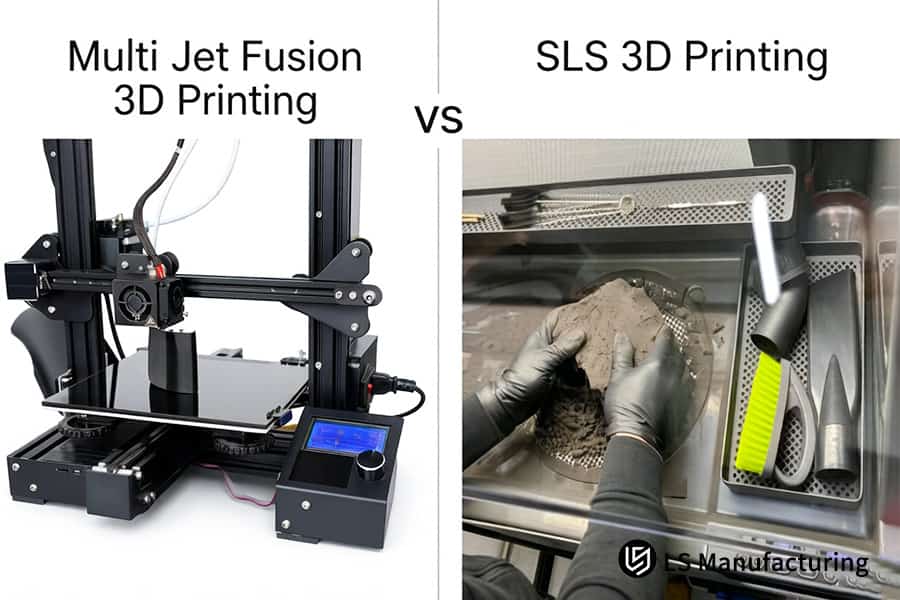
図 2: MJF は大型の産業用プリンターを運用していますが、SLS は余分な粉末を除去するために手動でのスクレーピングが必要です。
カスタム選択レーザー焼結がマルチ ジェット フュージョンよりコスト効率が高いのはどのような場合ですか?
SLS 3D プリント コストは、ビルド サイズがフルプレート パッキングが不可能な350mm×350mm×400mmを超えた場合にのみ、MJF のコストと比較して低くなります。 SLS は柔軟なネストを備えた大きなチャンバー サイズを提供するため、 各部品のコストが 30% 削減 されます。製品マネージャーが特大のエンクロージャを扱う場合、余分なリードタイムを必要とせずに20%のコスト削減を享受できます。これは次の方法で実行できます。
エンベロープアドバンテージを構築する
SLS マシンのビルド チャンバーは通常、MJF の380mm×280mm×380mmと比較して、最大550mm×550mm×750mmです。特大のエンクロージャの場合は、複数の部分に分割するのではなく、1 回の実行につき 1 つの部分を使用することが可能です。これにより、大判 3D プリントの場合、ツールや配送における損失が少なくなります。
充填密度の最適化
SLS 3D プリント サービスを使用すると、MJF と比べて 70% の梱包率が得られ、不規則な形状の場合は 45% となり、ピースあたりの諸経費が削減されます。最大 80% のリサイクル粉末と組み合わせた バルクオペレーションにより、 材料コストが 25% 削減されました。また、4 つの個別の注文を 1 つの配送に統合すると、15% 物流コストを節約できます。
損益分岐点の計算
数量が 50 個未満で部品サイズが >300mm の場合、SLS は MJF よりも総コストが 18 ~ 22% 安くなります (LS Manufacturing のコスト モデル、2025 年による)。 混合ビルド 3D プリントの場合、治具コストを回避し、注文を 1 つの配送にまとめます。これにより、小規模バッチの予算が増加する繰り返しの設定コストを削減できます。
価格戦略の影響
SLS 3D プリンティング サービス プロバイダは、多くの場合、チャンバーの使用率に応じて価格帯を使用します。標準のビルド高に従って注文を計画すると、MJF では得られないボリューム ディスカウントが得られます。 価格戦略はプロジェクトの利益に直接貢献します。通常の節約額は、ビルド サイクルあたり 150 ドルから 300 ドルとなります。
これで、SLS の方が MJF よりもコスト効率が高いことがわかりました。これは、大きな部品、バッチ混合、中程度の量の場合です。このような場合は SLS 3D プリント サービスを利用し、費用対効果の高い 3D プリントを使用して部品あたりのコストを最大 20 ~ 30%節約します。提供された情報により、調達スペシャリストはより良い契約を交渉し、積層造形コストを年間数千ドル節約することができます。
オーダーメイドのエンジニアリング コンポーネントの納期を決定する要因は何ですか?
オーダーメイド コンポーネントの納期は、構築アプローチ、冷却方法、自動化の程度によって決まります。 MJF はコンポーネントの複雑さに関係なくすべての層を同時に融合し、自動ネスティングと高速冷却により所要時間は 5 ~ 7 日から 48 時間に短縮されます。これにより、検証サイクルが短縮されます。
レイヤーベースの速度の利点
自動ネスティングと冷却
- パッキング アルゴリズム: チャンバー効率の完全自動ネスティング最適化が自動的に行われます。
- 冷却システム: 特別な高速冷却により、クールダウン時間が4 時間から 2 時間に短縮されます。
- 結果: MJF 3D プリントの見積もりをリクエストすると、標準の見積もりよりもリードタイムが60%短縮されます。
後処理の並列化
単一情報源による説明責任
- Team structure: Design review, printing, cleaning, and inspection are done by one team.
- Coordination: The use of the custom MJF 3D printing service avoids hand-off problems.
- Benefit: Get a single point of contact for on-demand 3D printing and save 30% in administrative costs.
Time-to-completion improves as you select MJF technology with automated nesting and rapid cooling. You will get functional prototypes within 48 hours compared to 1 week with other 3D printing.
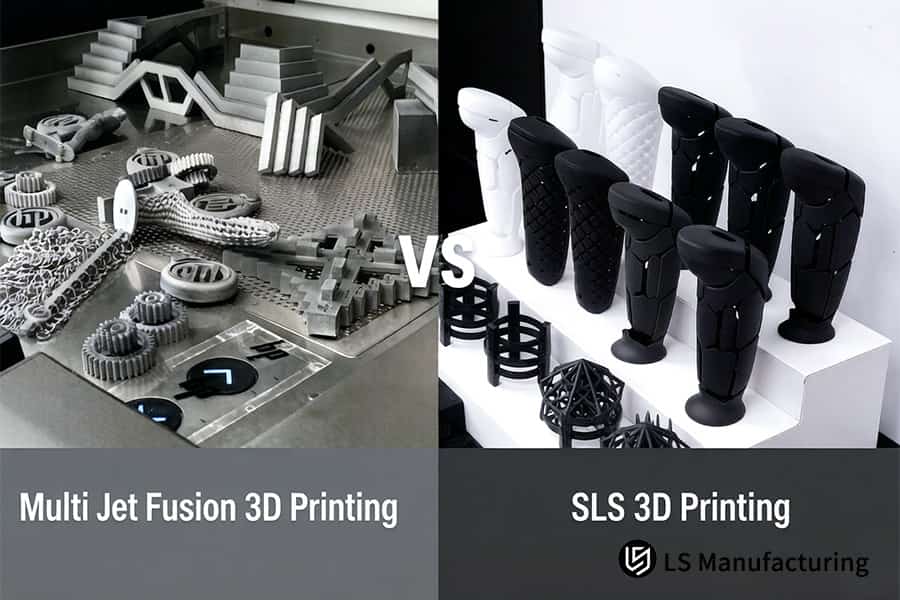
Figure 3: MJF manufactures nylon gears in batches while SLS creates fluid manifold prototypes for hydraulic systems.
How Does LS Manufacturing Optimize Laser Power Settings For Aerospace Bracket Cases?
An aerospace UAV client had a recurring problem of delaminating layers in power bay fluid brackets during flight vibration testing. Conventional sintering techniques resulted in porous surfaces that did not meet the specification of ≥0.3MPa sealing capability. LS Manufacturing leveraged DFM optimization and MJF thermal consistency to resolve this mission-critical 3D printing issue—in the following way:
クライアント チャレンジ
PA12 nylon-based power bay fluid bracket required ≥0.3MPa sealing and resistance to flight vibration. The initial SLS prototypes had layer separation in 80% of test cycles because of surface porosity, which caused leakage at only 0.2MPa. This problem jeopardized a three-month delay of engine integration in high-performance 3D printing applications and potential contract penalties and loss of the client's first order.
LS 製造ソリューション
The multi-faceted DFM analysis used high-grade PA12 powder, while MJF’s ±0.5% power fluctuation control assured even energy distribution for all layers. Thermal homogenization technology was implemented to prevent hot spots leading to poor interlayer bonding, and vapor polishing closed surface microporosity. With custom MJF 3D printing service, you get an isotropic structure for production-ready 3D printing without any post-processing steps.
結果と価値
Tensile strength along the Z axis increased by 25% and exceeded 50MPa. Additionally, the bracket was tested for leaks with a pressure of 0.4MPa and did not show any leaks. The tensile strength 3D prototype correlated with the FEA model with an accuracy of 2%, proving the consistency of the process. You save on validation by three months, place the first order for production, and avoid all rework costs.
This is evidence of LS Manufacturing's capability of turning failure into certification. With DFM optimization and accurate temperature control, you can get aerospace-quality seals and strength – thus lowering risks and time spent on development. For mission-critical brackets, our aerospace-grade 3D printing services provide competitive advantages.
80% delamination at 0.2MPa → 0.4MPa zero leak with 25% stronger Z-axis. Facing similar sealing or layer-bond issues on your aerospace bracket? Share your specs for a matched MJF quotation.

Why Does LS Manufacturing Deliver Superior Part Reliability For Functional Prototypes?
The reliable functional prototypes will be achieved through thorough material quality, environmental and geometric controls provided by LS Manufacturing. Such an approach allows getting rid of the variability and ensures that each part is up to specification for consistent 3D printing.
Raw material integrity
Each batch of the powder is subject to analysis for moisture content and particle size before production. Controlled storage at 23°C/45% RH stops any possible expansion of the nylon due to its hygroscopic nature leading to bubble defects. For 3D printing, you eliminate porosity-related failures from the start. This means zero scrapped batches due to material contamination.
Dimensional accuracy verification
Every critical feature is checked via 3D laser optical scanning against CAD nominal. Deviations >0.05mm trigger immediate process adjustment. As a precision MJF parts manufacturer, we provide full dimensional reports so you trust first-article fit without re-inspection. You save an average of 2 days per prototype iteration on verification.
DFM review as standard
We have our application engineers evaluate your design for proper draft angles, wall thickness changeovers, and powder exhaust channels before giving you a quote. This prevents problems like warping or incomplete sintering during the quotation process. Defect-free 3D printing orders will be delivered to your specification, saving you up to 40% of redesigns.
Integrated quality system
Our ISO 9001-certified processes ensure every step from raw material handling to product packing is covered. Choosing our industrial 3D printing service gives you an accountable partner acting as an extended member of your R&D department, anticipating manufacturing issues related to the design. This allows you to reduce the burden of managing suppliers by 30%.
LS Manufacturing controls part reliability through material, environment, geometry, and design management in a systematic way. You will receive parts which are going to behave in a predictable way, reducing testing time and chances of failures in the field. Our traceable 3D printing framework turns the supplier-customer relationship into the engineering collaboration.
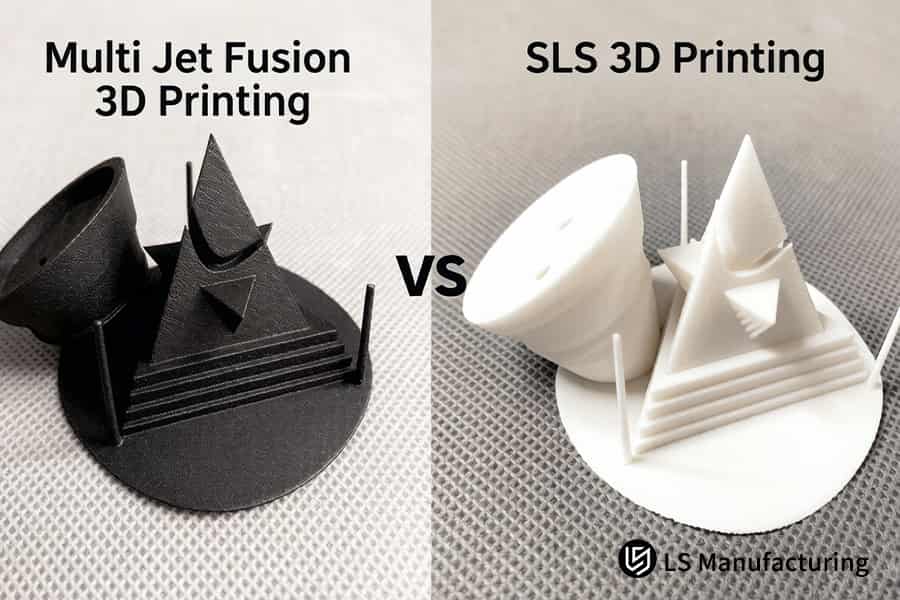
Figure 4: MJF constructs black geometric test parts while SLS forms white ergonomic handle components for strength analysis.
よくある質問
1. Is MJF or SLS stronger?
The MJF printing technology is characterized by excellent Z-axis tensile strength (up to 95% isotropy, UTS about 48MPa), ensuring consistent mechanical properties along all three axes, similar to injection molding. The SLS technology has 15-20% lower performance in the Z-axis due to the nature of its point-by-point sintering technique. Therefore, MJF would be preferable for manufacturing parts that require isotropy in terms of mechanical properties.
2. Which process produces tighter assembly tolerances?
MJF guarantees tighter tolerance (±0.1mm for the vast majority of geometries) owing to the enhanced thermal management and fusing process. Tolerances for SLS parts can vary between ±0.15 and ±0.25mm due to heat accumulation and laser scattering effects. Therefore, MJF would provide better results in snap-fits, bearings, and other tight-tolerance assemblies.
3. How do post-treatment options affect final surface quality?
In terms of initial surface finish, MJF components are naturally smooth (Ra≤4.0μm) as compared to other SLS components because of the use of fine powder and the fusing process. With the vapor polishing offered by LS Manufacturing, however, both MJF and SLS can get a high-gloss surface finish that is perfectly sealed (Ra<1.0μm).
4. Can both technologies print hermetic components?
The printed parts of both technologies are naturally microporous, hence leaking when under pressure. Following the vapor smoothing of the chemical part offered by LS Manufacturing, however, both MJF and SLS parts become hermetically sealed and able to resist fluid and gas pressures of ≥0.3MPa.
5. What is the typical turnaround time for industrial components?
By making use of efficient MJF technology along with rapid cooling systems, LS Manufacturing can provide urgent structural and functional prototypes and small batch production in just 48 hours. In case of larger batches or more complicated shapes requiring further treatment, standard lead time increases to 3-5 business days, which is much shorter compared to conventional production technologies.
6. How can I optimize parts to reduce printing costs?
Conducting DFM (Design for Manufacturability) reviews before designing a product in order to switch from solid and bulky elements to lattice and topological optimization not only allows you to save up to 40% of the material, but also prevents warping due to temperature differences. Our specialists suggest orienting parts so that they would require fewer support structures, as well as packing several parts into one print.
7. Which engineering material options are available?
Customized Printing with Various Industrial Powders, Such as PA12, which provides both good strength and accuracy, PA11, which increases the impact resistance, Glass Bead Reinforced PA12 (40% GB), providing rigidity and dimensional stability, and TPU with Shore 85A-90A, which is used for making flexible seals, gaskets, and vibration-damping parts.
8. How do I request an immediate production assessment?
Just upload your 3D CAD model (STEP, STP, IGS formats) through the quote box on this page, and the engineer will give you a complimentary DFM report and production cost estimation within two hours. Also, please indicate all your special demands (surface finish, tolerances, volume) in the Notes section below.
概要
The choice between MJF and SLS relies on mechanical loads, tightness, and surface texture. Where there is a need for components such as automotive brackets and pneumatic housing which require mechanical loading on multiple axes and tolerances of ±0.1mm, MJF will be ideal due to isotropic tensile strength. In cases where the requirement is for a thin-walled structure in small numbers, SLS would have more cost flexibility. Engineering limitations knowledge is key to avoid assembly failures.
To ensure that designs turn out perfectly in hardware requires specialized manufacturing skills. LS Manufacturing provides a free DFM engineering analysis. In less than two hours, we analyze wall thickness, hole clogging, warping, and stress concentration – eliminating 99% of the trial production risk. Click on "Get Instant 3D Printing Quote" and upload your design for review by our best engineers.
📞電話番号: +86 185 6675 9667
📧メールアドレス: info@lsrpf.com
🌐ウェブサイト:https://lsrpf.com/
免責事項
このページの内容は情報提供のみを目的としています。LS マニュファクチャリング サービス情報の正確性、完全性、有効性については、明示的か黙示的かを問わず、いかなる表明も保証もありません。サードパーティのサプライヤーまたはメーカーが、LS Manufacturing ネットワークを通じて性能パラメータ、幾何公差、特定の設計特性、材料の品質およびタイプまたは仕上がりを提供すると推測すべきではありません。それは購入者の責任です。必須部品の見積もり これらのセクションの具体的な要件を確認してください。詳細についてはお問い合わせください。
LS 製造チーム
LS Manufacturing は業界をリードする企業です。カスタム製造ソリューションに焦点を当てます。当社は 5,000 を超える顧客と 15 年以上の経験があり、高精度CNC 加工、板金製造、3D プリント、射出成形に重点を置いています。金属スタンピングやその他のワンストップ製造サービス。
当社の工場には、ISO 9001:2015 認証を取得した最先端の 5 軸マシニング センターが 100 台以上備えられています。当社は、世界 150 か国以上のお客様に、迅速、効率的、高品質の製造ソリューションを提供しています。少量生産でも大規模なカスタマイズでも、24時間以内の最速納期でお客様のニーズにお応えします。 LSマニュファクチャリングを選択します。 This means selection efficiency, quality and professionalism.
To learn more, visit our website:www.lsrpf.com
| アスペクト | マルチジェットフュージョン | 選択的レーザー焼結 |
| 施工後の表面粗さ | Ra4.0-6.5μm | Ra6.0-9.0μm |
| 根本原因 | 均一な IR 加熱 + 微粒子薬剤 | CO₂ レーザーのスポット サイズと粒子の凝集 |
| 後処理上限 | 蒸気平滑化により 蒸気平滑化 3D プリントにより Ra<1.0μm に低減 | 転倒時でもRa2.0~3.0μmに制限 |
| 一般的なアプリケーションの適合 | 摩耗表面と内部の目に見える領域 | 筐体、非接触領域 |