한국어
한국어 



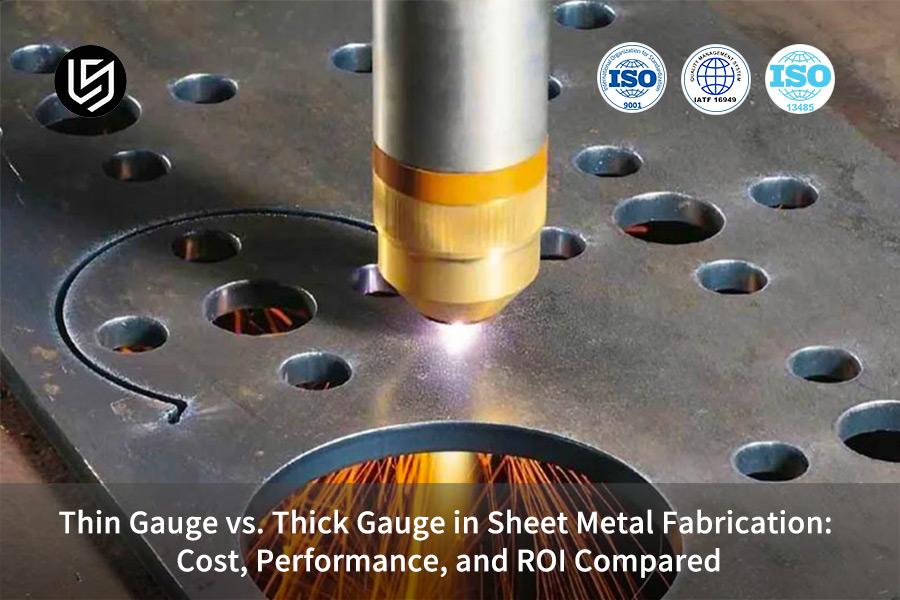
판금 제작 서비스는 다양한 두께의 금속판을 절단, 굽힘, 용접하는 과정을 포함합니다. 정밀기기용 하우징을 선정한 후 뒤틀림과 구조적 강도의 균형을 맞춰서 하우징을 찾는 어려움을 해결하는 방법 중 하나입니다. CNC 제어 캐비닛과 의료 장비 하우징에 사용되는 금속은 비용, 성능 및 ROI를 절충한 것임에도 불구하고 16게이지 판금입니다.
고정밀 로봇 조립 및 의료 장비 제어 캐비닛을 구매할 때 대부분의 회사는 두 가지 생각을 할 것입니다. 20-24게이지의 얇은 시트는 응력 방출로 인해 휘어질 가능성이 더 높은 반면, 7-14게이지의 두꺼운 시트는 너무 무겁고 굽힘 균열 발생률이 높기 때문에 전체 ROI가 낮아집니다. 가공 경화, 스프링백 보상 및 용접 열 응력은 공차에 영향을 미치는 공정입니다. 그러나 공급업체는 이러한 측면을 고려하지 않습니다. 이 기사에서는 항복 강도, 총 사이클 시간 및 DFM 응력 완화를 살펴본 후 이 두 가지 유형의 시트의 성능 경계와 비용 솔루션을 조사합니다.
얇은 판금 대 두꺼운 판금 제작: 주요 매개변수 개요
<테이블 스타일="테두리 축소: 축소; 너비: 100%; 테두리 너비: 1px; 테두리 색상: #000000;" border="1"> <몸> 비교 크기 얇은 시트(16-24게이지) 두꺼운 시트(7-14 게이지) 최적 선택 참조 벤딩 스프링백 각도 5°-8° 1°-2° 정확도 요구 사항 ≤±0.5° 두꺼운 시트 선호 용접 열 변형 위험 높음, 뒤틀리기 쉬움 낮고 충분한 강성 연속 용접 길이 > 200mm 두꺼운 시트 선호 단위 원자재 비용 단가가 높음, 경량 낮은 단가, 무거운 무게 경량 요구 사항에는 얇은 시트가 선호됩니다 조립 공차 안정성 스트레스 변동에 취약함 좋은 치수 일관성 대량, 수리가 필요 없는 조립에는 두꺼운 시트가 선호됩니다. 일반적인 애플리케이션 시나리오 쉘 차폐, 전자 패널 내하중 프레임, 구조용 브래킷 두꺼운 시트와 얇은 시트 조합으로 성능-비용 균형 달성주요 사항
- 간단하게 캐비닛 쉘 용접: 16 게이지(1.5mm)가 소형 사출 금형이 있는 제어 캐비닛 쉘에 가장 적합합니다. 부품에 대형 사출 금형이 있는 경우 18게이지(1.25mm)를 선택하세요.
- 스프링백 수정 마커: 22게이지의 스테인리스 스틸은 5~7도의 스프링백 각도를 생성합니다. 조립 설계에는 응력 완화 슬롯의 1.2배 이상 확장이 있어야 합니다.
- 유역: 용접 열 입력은 용접 입자 조대화를 방지하기 위해 두께가 0.125"(11 게이지)를 초과하는 구조 부재의 경우 0.8kJ/mm 미만으로 제어되어야 합니다.
LS제조의 판금 제조 서비스에 대한 얇은 제품과 두꺼운 제품 선택 가이드를 신뢰해야 하는 이유는 무엇입니까?
정밀 판금 제조에 사용되는 판금의 두께는 생산할 수 있는 제품의 양과 장기간에 걸친 제품의 신뢰성에 직접적인 영향을 미칩니다. 두께를 잘못 선택하면 일반적으로 초기 구매 비용의 2.7배에 달하는 재작업 비용이 발생합니다. 의료 장비 제어 캐비닛의 대량 생산 프로젝트 경험에 따르면 판금 두께 불일치만으로도 1차 통과 수율이 28% 감소할 수 있습니다.
<인용문>ISO 13920-BF 표준, 용접된 구조 구성 요소의 치수 및 기하학적 공차는 어셈블리 호환성을 보장하기 위해 해당 기능으로 분류되어야 합니다.
이 표준을 엄격하게 준수하기 위해 당사 DFM 팀은 측정된 재료 매개변수 및 공정 보상을 기반으로 각 공정 단계의 공차 요구 사항을 세분화하여 처음부터 프로젝트와 긴밀하게 협력합니다. 다양한 게이지의 스테인리스강에 대해 12세트의 비교 굽힘 및 용접 테스트를 수행하는 데 3개월이 걸렸습니다. 이를 통해 일반적으로 사용되는 17가지 재료를 포함하는 스프링백 데이터베이스와 응력 보정 계수 세트를 컴파일하는 데 도움이 되었습니다. 이를 통해 다양한 시트 두께로 인한 성형 위험을 정확하게 예측할 수 있습니다.
저희 제조 시스템은 ISO 13485 의료 품질 관리 시스템에 따라 인증되었으며 모든 매개변수는 이론 계산이 아닌 대량 생산을 통해 확인되었습니다.
과학적인 판 두께 선택은 프로젝트 비용을 절감하고 효율성을 향상시키는 첫 번째 단계입니다. '판금 게이지 선택 백서'를 다운로드하면 다양한 시나리오에서 선택 논리와 회피 지점을 신속하게 파악하여 초기 단계 프로젝트 평가를 위한 완전한 데이터 참조를 제공할 수 있습니다.

기존 가격 모델이 판금 게이지 선택 비용을 지속적으로 잘못 계산하는 이유는 무엇입니까?
판금 게이지 선택 과정에서 24게이지 얇은 시트는 조각당 무게가 가볍기 때문에 원자재 조달 측면에서 더 저렴합니다. 그러나 고주파 레이저 열 절단에 노출되면 얇은 시트가 가장자리 뒤틀림에 더 취약하여 레이아웃 활용도가 감소합니다. 게다가 레이저 용접 후 연소 비용은 35% 이상 증가할 수 있으며, 이는 전체 프로세스ssing 투자 수익을 감소시킵니다.
냉연강판 두께별 원가구조 비교
판금 두께 비용 비교(SPCC 냉연강판)
<테이블 스타일="국경 축소: 축소; 너비: 100%; 테두리 너비: 1px; 테두리 색상: #000000; 높이: 261.812px;" border="1"> <몸> 시트 사양 공칭 두께(mm) 원재료 단가(USD/kg) 레이아웃 활용 용접 시간 계수 단품 전체 비용 지수 24게이지 0.6 0.95 72% 1.35 1.05 20게이지 0.9 0.92 81% 1.15 0.98 16게이지 1.5 0.88 88% 1.00 1.00 11게이지 3.0 0.85 90% 1.20 1.22 7게이지 4.5 0.82 92% 1.45 1.45 <올>정밀 전자 인클로저를 위한 비용 최적화 논리
<올>즉, 포장지를 구입하는 것과 같습니다. 얇은 종이는 단위당 가격이 저렴하지만 손상되기 쉽습니다. 이로 인해 완충재가 더 많이 필요하게 되어 약간 두꺼운 종이를 사용하는 것보다 총 비용이 더 높아집니다.

그림 1: 얇은 것부터 두꺼운 것까지 다양한 판금 게이지의 비교 차트.
정밀 얇은 게이지 제작 서비스 중 심각한 구조적 변형을 완화하는 방법
얇은 게이지 제작 서비스에서 얇은 판금 부품의 뒤틀림을 방지하는 것은 벤딩 라인 및 구멍의 가장자리 거리에 응력 집중을 방지하는 것과 밀접한 관련이 있습니다. DFM 사양(구멍 벽에서 굽힘 반경 가장자리까지의 거리가 시트 두께의 두 배 이상임)을 사용하고 변형에 취약한 주요 영역에 미리 형성된 강화 리브를 제공하면 20게이지 스테인리스 스틸 인클로저의 모양 변경이 0.15mm를 초과하는 것을 제한할 수 있습니다.
굽힘 공정 매개변수 사양
- 하형의 V 홈 너비는 너무 좁은 V 홈으로 인해 금속판 외부에 과도한 인장 응력이 발생하지 않도록 6t~8t 범위에서 선택해야 합니다. 실제로 이는 박형 제작 서비스에서 성형 공정을 수행하기 위한 주요 기준이자 판금 제작 굽힘 매개변수입니다.
- 굽힘 속도는 고속 성형으로 인해 잔류 응력이 축적되지 않도록 최대 10mm/s로 제한되어야 합니다.
- 멀티 패스 연속 굽힘은 한쪽 면의 응력 축적으로 인한 전체 변형을 상쇄하기 위해 대칭 순서로 실행되어야 합니다. 이 규칙은 얇고 두꺼운 게이지 판금 제조에도 적용됩니다.
용접 응력 제어 방식
- 레이저 스폿 용접(Stitch Welding) 버전을 연속 전체 용접 버전으로 변경하여 총 열 입력량을 낮추세요.
- 용접 간격을 시트 두께의 15~20배로 설정하여 연결 강도와 열 변형 제어 간의 최적의 균형을 유지하세요. 이와 관련된 자세한 매개변수는 판금 두께 가이드의 해당 사양에서 확인할 수 있습니다. 판금 용접 매개변수의 주요 조정 항목입니다.
- 이 시스템에서는 24게이지 알루미늄 합금 5052 하우징의 전체 열 수축 수준이 60% 감소했습니다. 이는 슬라이드 레일의 고정밀, 틈새 없는 조립에 충분합니다.
아주 간단하게 말하면종이 껍질을 붙이는 행위에 비유할 수 있습니다. 접착제를 계속해서 바르면 가열하면 종이가 접힐 수 있습니다. 분할된 스팟 도포로 접합 강도와 플레이트 표면의 평탄도를 유지합니다.
맞춤형 게이지 판금 서비스에 대한 동적 스프링백 수정 지침은 무엇입니까?
맞춤형 게이지 판금 서비스 중에 스탬핑 및 굽힘 작업으로 인한 스프링백으로 인해 의료 기기의 조립 치수가 벗어날 수 있습니다. 22게이지 고강도 스테인리스강의 경우 LS Manufacturing에서는 5축 CNC 벤딩 머신을 사용하여 6° 과굴곡 보상을 사전 설정하여 최종 성형±0.5° 이내의 각도 공차를 달성합니다.
다양한 재료 두께에 대한 굽힘 스프링백 매개변수 비교
<테이블 스타일="국경 축소: 축소; 너비: 100%; 테두리 너비: 1px; border-color: #000000;" border="1"> <몸> 재료 시트 크기 항복 강도(MPa) 스프링백 각도 범위 권장되는 과도한 굽힘 보정 SPCC 저탄소강 12게이지 235 1°-2° 1.5° SPCC 저탄소강 24게이지 270 3°-4° 3.5° 304 스테인리스 스틸 22게이지 410 5°-8° 6.5° 5052 알루미늄 합금 20게이지 195 2°-3° 2.5°얇은 판과 두꺼운 판의 굽힘 성형 차이
<올>지능형 굽힘 보정 기술 적용
<올>스프링백 제어는 정밀 제품의 조립 정확도를 직접적으로 결정합니다. 제품 도면을 제출하여 얇은 두께와 두꺼운 게이지 판금 제조 스프링백 위험 평가를 무료로 받아, 수석 엔지니어가 목표 굽힘 보상 및 공정 최적화 제안을 제공할 수 있습니다.
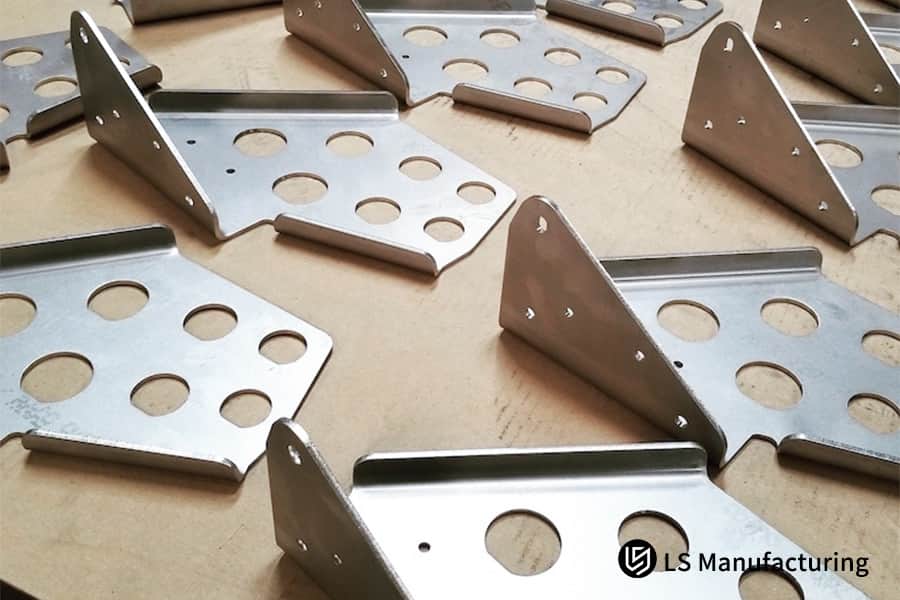
그림 2: 다양한 구멍 패턴이 있는 정밀 판금 브래킷.
게이지 차트 번호가 낮을수록 구조적 미세 균열을 방지하기 위해 훨씬 더 큰 굽힘 반경이 필요한 이유는 무엇입니까?
판금 두께 가이드에 따르면 판금 두께가 7-14게이지인 경우 내부 굽힘 반경이 판 두께의 1배 미만인 경우 판 외부 레이어의 인장 응력이 재료의 인장 강도 한계보다 높아 굽힘 능선을 따라 미세 균열이 형성됩니다. LS제조에서는 무거운 구조부품의 장기간 피로수명을 유지하기 위해 후판규칙 Rmin 1.5t을 적용하고 있습니다.
초소형 기계 두꺼운 판 굽힘 균열
<올>결 방향 및 레이아웃 최적화 방법
<올>결론은 나무판을 구부리는 것과 유사하며, 결 방향을 따라 구부리면 균열이 발생하기 쉽고, 결 방향을 가로질러 구부리면 더 큰 변형을 견딜 수 있다는 것입니다.
의료 기기 프레임 인클로저에 대한 장기 판금 제조 ROI를 벤치마킹하는 방법
의료 장비 캐비닛의 판금 제조 ROI를 파악하는 가장 기본적인 측면은 판금 두께를 합리적으로 선택하는 것입니다. 내진성을 보장하는 주요 하중 지지 프레임으로 11게이지 시트를 추가하고 외부 덮개 패널로 20게이지 얇은 시트를 사용합니다. 항공 물류 비용 절감으로 총 중량을 25% 줄일 수 있습니다.
수명주기 비용 분석
- 초기 제조 비용: 여기에는 원자재 처리 표면 처리 및 테스트 비용이 포함되며, 이는 총 수명주기 비용의 40%를 차지합니다. 이 제조 비용 구성 요소는 판금 제조 ROI 계산의 기본 입력 요소이자 판금 제조 수명 주기 비용의 주요 요소 중 하나입니다.
- 물류 및 창고 비용: 상품 총 중량이 10% 감소하면 국제 항공 운임이 약 12% 감소하는 경우가 많습니다.
- 운영 및 유지 관리 비용: 두께를 줄여 구조물을 가벼워지면 장비 부하도 줄어들 수 있으며, 이는 장기간 유지 관리의 필요성이 줄어듭니다. 이 측면은 전통적인 판금 두께 비용 추정을 수행할 때 종종 무시됩니다.
벽 두께 최적화의 이점을 계산하는 접근 방식
- FEA(유한 요소 분석) 소프트웨어를 사용하여 다양한 하중 시나리오를 시뮬레이션하고 구조적 무결성과 강성을 유지하면서 비내력 부분의 두께를 줄일 수 있는 기회를 찾습니다.
- 박판 샌드위치 구조의 처리 시간은 실제로 더 깁니다. 그럼에도 불구하고 운송 및 에너지 비용 절감 효과는 12개월 이내에 초기 불이익을 충당하기에 충분합니다. 전문적인 판금 제조 회사는 판금 제조에서 중량 최적화를 위한 솔루션 구현을 다루는 철저한 계산 모델과 지원을 제공할 수 있습니다.
- 고가의 의료 장비의 경우 두꺼운 판금과 얇은 판금 가공을 함께 사용하면 전체 수명 주기 투자 수익률(ROI)을 22% 이상 높일 수 있습니다.
수명주기 비용 최적화는 프로젝트의 장기적인 수익성을 크게 향상시킬 수 있습니다. 장비의 무게와 운송 시나리오 매개변수를 제공할 수 있으며 최적의 벽 두께 조합을 찾기 위해 다양한 판금 두께 비용 옵션에 대한 수명주기 ROI를 무료로 계산해 드립니다.
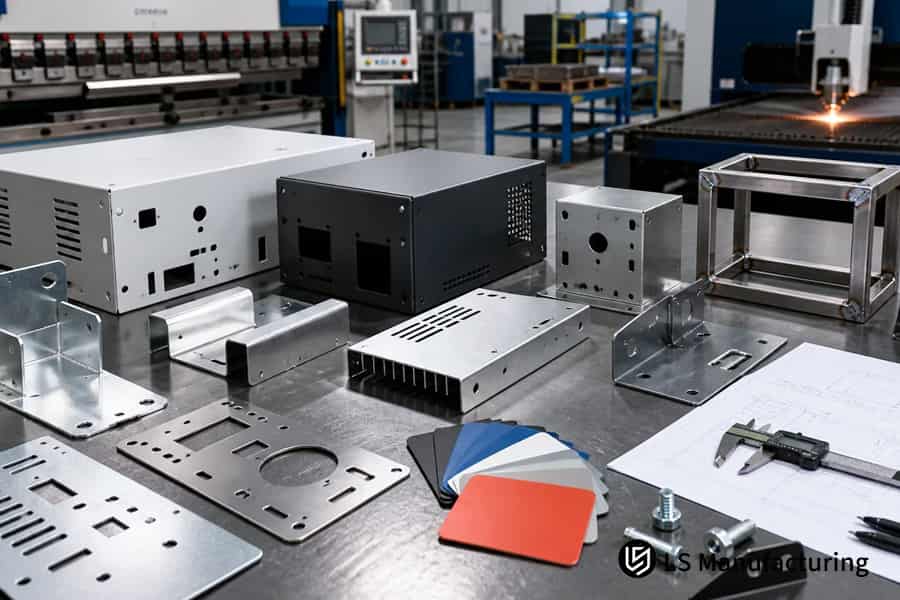
그림 3: 작업대에 있는 다양한 판금 인클로저 및 브래킷.
What Strict Welding Methodology Updates Are Vital For Heavy Machinery Parts Utilizing 7 To 14 Thick Gauge Blanks?
At sheet metal fabrication service for heavy-duty sheet metal parts, In particular for heavy engineer structural parts over 11 Gauge, a multi-pass pulsed MIG welding process using a V-groove beveling is necessary plus preheating at 150℃ to avoid welding defects such as lack of fusion and intergranular corrosion.
Welding Groove and Preheating Specifications for Thick Plates
Many purchasers, when designing heavy structural components with the factory, stress most about structural failures resulting from internal weld defects.
<인용문>As the ISO 5817:2023 clearly states in its rules: welds in load-bearing structures must be free from defects like lack of fusion and cracks.
To implement this standard to the letter, we have made this process specifications:
<올>Solution for Welding Quality Non-Destructive Testing
<올>At its simplest, this is the one example is joining thick wooden boards, before gluing, the edges have to be bevelled to make sure the internal surfaces are fully joined adherence and to ward off the risk of delamination. 내부적으로 빈틈이 없는지도 점검해야 합니다.
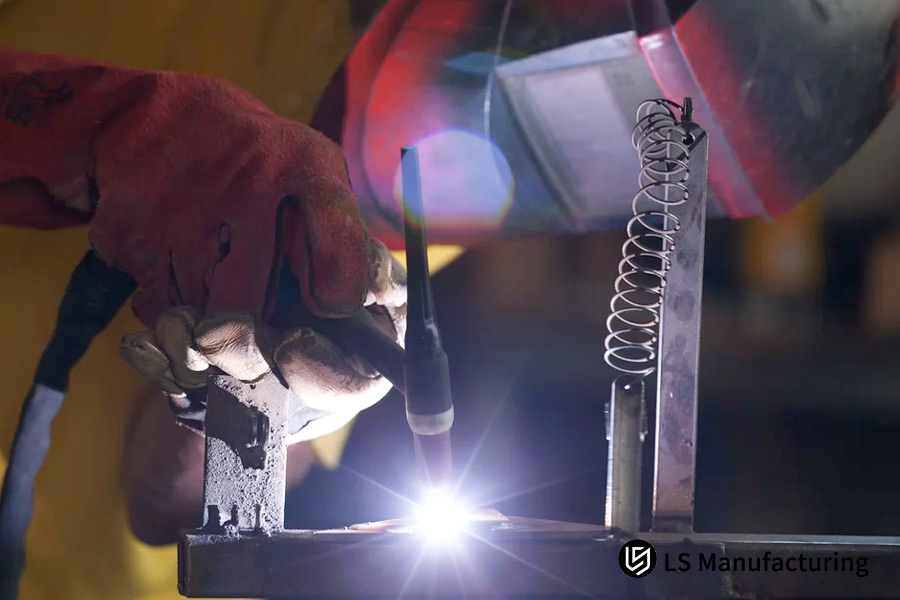
Figure 4: Worker welding a metal structure with bright sparks.
How To Eliminate Tolerance Stack-Up Bottlenecks During The Final Assembly Of Interlocking Enclosures?
맞춤형 게이지 판금 서비스에서는 판금의 다양한 두께 공차(일반적으로 0.2mm)는 말할 것도 없고 다층 적층 부품을 처리할 때 조립 구멍의 불일치로 이어집니다. LS Manufacturing unveils a 3D tolerance full-dynamic simulation software to be used at the prototyping stage to fix the interlocking and meshing gaps, guaranteeing 100% error-free assembly of mass-produced custom chassis at the final assembly line.
Comparison of Standard Thickness Tolerances for Commonly Used Metal Sheets
<몸>| Material | Standard | Sheet Size | Thickness Tolerance (mm) | Tolerance Percentage |
| Low Carbon Steel | Manufacturer's Standard | 16 Gauge | ±0.10 | 6.6% |
| Low Carbon Steel | Manufacturer's Standard | 11 Gauge | ±0.15 | 5.0% |
| Aluminum Alloy | Brown & Sharpe | 16 Gauge | ±0.08 | 6.2% |
| Stainless Steel | ASTM A480 | 20 Gauge | ±0.12 | 10.3% |
Core Sources of Tolerance Accumulation
- Sheet metal thickness tolerance can cause a direct impact on bending height and volume change of the stacked parts. This is the main issue for tolerance design in preparation for custom gauge sheet metals and why of sheet metal fabrication tolerance stackup.
- Tiny deviations on every layer will pile up when you are putting together multiple parts. Eventually, this leads to misaligned holes and failure in assembly.
- Fixed tolerance design of the old-fashioned kind overlooks material changes and causes the whole lot to be outside the limits of tolerance, which is a problem for batch production basically. Sheet metal thickness guide includes reference to typical values of tolerance ranges.
Dynamic Tolerance Design Method
- At the project initiation stage, DFM team converted fixed tolerance zones into dynamic tolerance designs that consider material fluctuations.
- The use of 3D tolerance simulation software made it possible to foresee assembly clearances under different sheet thickness deviations and mating dimensions were adjusted in advance.
- The new method brought about not only a raise in the first-pass yield of the chassis assembly from 85% to 100% but also completely removed the need for on-site rework, has efficiently improved overall sheet metal fabrication ROI, and has greatly up sheet metal fabrication assembly yield.
Case Study: How LS Manufacturing Optimized 12 Gauge Stainless Steel Laser Cutting and Bending for an EV Battery Medical Cooling Enclosure?
Customer Challenges
스마트 트랙리스 AGV 섀시를 개발하는 동안 R&D 팀은 전원 배터리 브래킷 어셈블리 구매에 대한 기술적인 장애물에 직면했습니다.
This was because the original supplier only used 11-gauge stainless steel for laser cutting and traditional bending methods but did not consider the springback angle of the high-hardness stainless steel (which was actually about 6.5°). As a result, since the holes got increasingly misaligned in a large batch of structural parts, the first-pass yield for the overall assembly got down to less than 72%.
On top of that, the welds that had a lot of tensile stress were not heat-treated, so when the 50G acceleration impact test was carried out, fatigue microcracks appeared at the edges of the welds, this way causing the project to be at risk of delay and penalties.
LS제조솔루션
LS Manufacturing senior DFM engineers' intervention led to a comprehensive technical overhaul.
<올>결과 및 가치
Following two microscopic metallographic inspections and 100% laser 3D scanning (CMM) dimensional confirmations, 500 sets of cold-formed thick plate structural parts were found with zero defects in assembly, besides all dimensions remained locked within ±0.10mm, way beyond 0.38mm industry standard, thanks to strict sheet metal fabrication inspection standards.
Battery bracket aced military-grade 100-hour triaxial high-frequency random vibration and fracture limit tests in the first go. The overall product assembly time was cut down by 40%, and the whole supply chain return on investment increased by 32% resulting in the customer immediately making an additional long-term strategic supply order.
The forming of complex thick plate precision structural components requires optimization of the entire process. You can upload detailed drawings and technical requirements to get a customized solution and accurate quote, maximizing the ROI of your sheet metal fabrication project.

FAQ
Q1: In the precision sheet metal processing stage of medical equipment prototype development, what are the key differences in core structure performance between thin and thick sheet metal products?
Thin sheets (16-24 Gauge) achieve their bending stiffness by the geometric cross-section formed by bending, so, they are very susceptive to local instability. Then again, thick sheets (7-14 Gauge) are able to carry heavy loads due to their yield strength and thickness, they have much greater fatigue limits and mechanical impact resistance compared to thin sheets.
Q2: What effects do changes in the material have on the physical thickness in the standard sheet metal thickness tables?
The same gauge number will mean different actual physical thicknesses for different materials. For instance, the nominal thickness of 16 Gauge carbon steel is 0.0598" (1.52mm), whereas aluminum alloy of the same grade is only 0.0508" (1.29mm). Clear absolute tolerance zones should be specified when ordering.
Q3: What is the underlying cause of a high spoil rate when processing 24-gauge ultra-thin sheet metal panels through traditional TIG welding?
24-gauge (about 0.6mm) ultra-thin sheets have very low local heat capacity. The arc energy of traditional TIG welding easily surpasses the melting point, which leads to perforation or grain coarsening and distortion. That means, pulsed micro-beam plasma welding or cold laser welding methods are required.
Q4: When manufacturing customized electronic product components that are frame-like, which sheet metal thickness offers the best overall cost-effectiveness?
For total life-cycle cost, 16-gauge (about 1.5mm) is the break-even point of stainless steel and carbon steel chassis in the aspect of cost-effectiveness. It is rigid enough to remove the need for anti-deformation fixture costs and at the same time it is very efficient for CNC high-speed cutting.
Q5: Can suppliers provide customized sheet metal services that achieve precision tolerance of 0.05mm for 11-gauge steel sheets?
Standard single-bending operations will not be able to deliver this level of precision. For instance, running key assembly surfaces and pin holes through a secondary precision milling process with a CNC gantry milling machine after laser cutting can control the core tolerance of an 11 Gauge structural component within ±0.02mm. Submit your drawings if you want a solution and a quotation.
Q6: What specific activities should be carried out to enhance investment returns when ordering custom pre-punched thin sheets from professional manufacturers?
In fact, carrying out the punching and layout operations in parallel right at the stage of raw material coil leveling can very much eliminate the waiting time for individual parts to be punched on the subsequent high-power laser cutting machine. This can actually result in batch stamping efficiency being increased by 45%, and simultaneously mass production per-piece costs being optimized effectively.
Q7: What is the standard of the minimum inner bending radius when processing O-state fully annealed aluminum alloy thin sheets so that springback deformation can be avoided after forming?
Since O-state fully annealed aluminum alloys are free from the work-hardening residual stress, they exhibit a springback rate close to 0°. So, the minimum inner bending radius is able to be narrowed down to 1.0 times the sheet thickness. That makes them perfect for precision customization of complex curved shell products.
Q8: Why do high-end engineering projects worldwide not get the direct off-the-shelf sheet metal shells of general standard specifications?
The heat dissipation ducts and precise sensor clearances of non-standard motherboards will not be accommodated by general standardized shells. This results in on-site rework and polishing times being tripled. So, a full-process DFM customization service is a must to secure a high ROI for long-term flexible manufacturing.
요약
Choosing just the right sheet metal gauge in a precise manner involves the systematic integration of engineering and material properties, processes, and total lifecycle costs. Randomly referring to the general parameters without proper calculations might cause defects like warping, cracking, and tolerance challenges at the time of mass production. For years, LS Manufacturing has been engaged in multi-field processing, helping customers technically from the outset stress simulation of drawings to actual inspection before shipment and making sure that design is carried out accurately.
Not considering proper sheet thickness tolerance design might lead to the loss of the very first delivery profit in new projects. In case you are looking for 7-14 Gauge heavy-duty plate machining or 20-24 Gauge high-precision thin plate welding with the help of our experts, LS Manufacturing's technical team will be at your disposal.
Just a 3-minute effort after which you will have uploaded your 3D assembly drawings(.STEP,.IGS, or.DXF) and tolerance control specifications to our secure inquiry system, and among other things, you will receive a price quotation within 24 hours besides a free of charge DFM assemblability and bending crack risk evaluation report that the engineers with 10 years of experience are signing.
📞전화: +86 185 6675 9667
📧이메일: info@lsrpf.com
🌐웹사이트:https://lsrpf.com/
면책조항
이 페이지의 내용은 정보 제공 목적으로만 제공됩니다.LS Manufacturing services정보의 정확성, 완전성 또는 유효성에 대해 명시적이든 묵시적이든 어떠한 진술이나 보증도 하지 않습니다. 제3자 공급업체나 제조업체가 LS Manufacturing 네트워크를 통해 성능 매개변수, 기하학적 공차, 특정 설계 특성, 재료 품질 및 유형 또는 제작 기술을 제공할 것이라고 추론해서는 안 됩니다. 구매자의 책임입니다.부품 필요견적 이 섹션에 대한 특정 요구사항을 확인하세요.자세한 내용은 문의해 주세요.
LS 제조팀
LS Manufacturing은 업계를 선도하는 기업입니다. 맞춤형 제조 솔루션에 중점을 둡니다. 우리는 5,000명이 넘는 고객과 15년 이상의 경험을 보유하고 있으며 고정밀CNC 가공,판금 제조, 3D 인쇄,사출 성형에 중점을 두고 있습니다.금속 스탬핑 및 기타 원스톱 제조 서비스.
저희 공장에는 ISO 9001:2015 인증을 받은 100개 이상의 최첨단 5축 머시닝 센터가 갖춰져 있습니다. 우리는 전 세계 150여 개국의 고객에게 빠르고 효율적인 고품질 제조 솔루션을 제공합니다. 소량 생산이든 대규모 맞춤 제작이든 24시간 이내에 가장 빠른 배송으로 고객의 요구를 충족시켜 드립니다. LS제조를 선택하세요. This means selection efficiency, quality and professionalism.
To learn more, visit our website:www.lsrpf.com