English



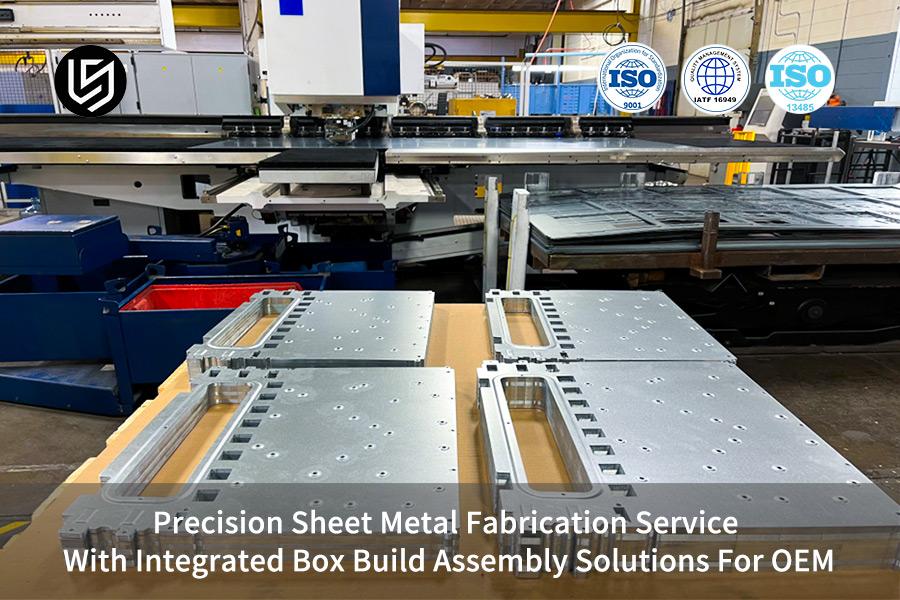
Precision sheet metal fabrication is a service that combines very accurate metal shaping and integrated assembly, mainly for industries like electronics electrical communications, and factory automation. It targets the main problems of things like total tolerance going beyond limits, very high waste rates in production lines, and issues with supply chains where responsibilities are divided among several suppliers because of segmented procurement. It can bring down the scrap rate at the production line to less than 0.1% and make the time to market for a product shorter by 35%. In making OEM equipment, there are lots of issues that can come up, like assembly misalignment of the screw holes, cumulative bending errors resulting in cover plates that don't fit, and structural changes due to temperature variations. The money spent on hidden scrap can be over 15% of the total budget for a project.
This article explains the technical audit standards covering the whole integrated service from angles of basic engineering, Cpk process control, and DFM optimization, making it easier for quality and supply chain personnel to identify suppliers who are very reliable.
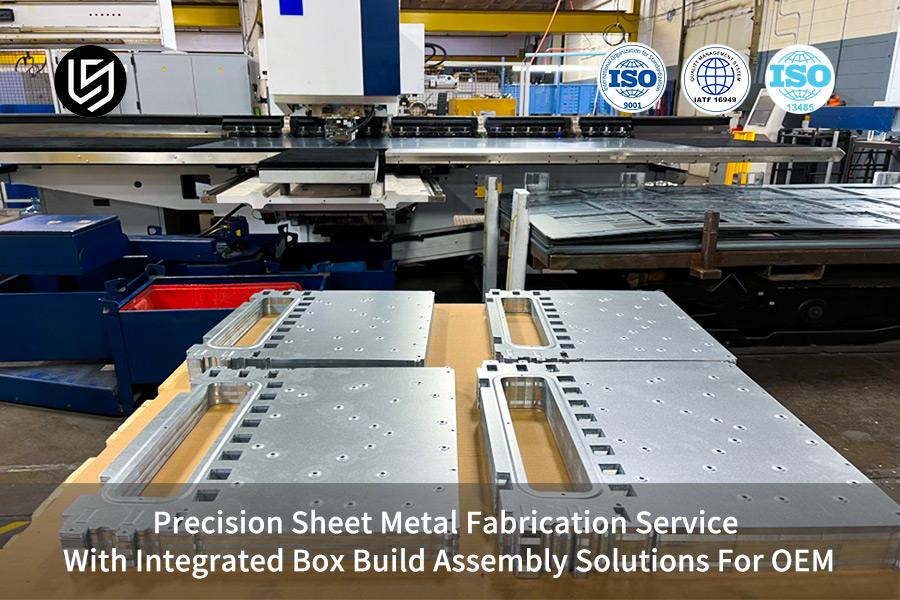
Precision Sheet Metal Fabrication Core Technical Indicators and Value Overview
The table below compares the performance differences between traditional models and integrated services from a core engineering perspective, quickly presenting the core value of a one-stop solution.
| Evaluation Dimensions | Traditional Multi-Factory Segmentation Model | Integrated Services (LS Manufacturing) | Industry Excellent Threshold |
| Bending Process Cpk | ≤1.0 | ≥1.33 | ≥1.33 |
| Post-Painting Dimensional Deviation | ±0.15mm | ±0.05mm | ±0.1mm |
| Production Line Assembly Scrap Rate | 8%-18% | ≤0.1% | ≤1% |
| Product Launch Cycle | Benchmark Value | Shortened by 35% | Shortened by 20% |
| Supply Chain Accountability | Multiple Factories Shifting Responsibility | Single Responsible Party | Single Responsible Party |
Key Takeaways:
- Getting rid of tolerance build-up: The main principle of integrated assembly is to keep the Cpk of the bending process as high as 1.33 or more, and to utilize a three-dimensional measuring machine (CMM) to check in real-time the accuracy dimensional tolerances of inserts and conductive surfaces after surface painting (thickness increase of 50-100μm).
- Managing Processing Stress: It is necessary to compensate for the residual mechanical stresses released from laser cutting and bending. So, an aging stress-relief treatment is introduced before welding or painting to avoid deformation of chassis structure during long-term operation.
- One-Stop ROI Conversion: Consolidating precision sheet metal and electronic assembly into one single purchase order (PO) not only simplifies the logistics movements among various factories but also brings down the scrap rate on production lines to less than 0.1%.
Why Trust LS Manufacturing’s Assembly Expertise in Precision Sheet Metal Fabrication?
Just how demanding integrated metal sheet assembly can get depends less on the accuracy of a single process and more on the capability of the closed-loop system to control the tolerance of different processes. Such control needs experience over the years of a project and system support.
In a high-end medical equipment integration project, based on our hands-on experience, 90% of the tolerance control problems in multi-factory collaboration were caused by each factory focusing only on the performance qualification of individual processes without considering their dimensional chain effects. Our team was involved in the entire process reconstruction of this project and built an end-to-end tolerance model starting from the stage of material preparation. Eventually, the client assembly yield was increased from 82% to 100% with our help.
The factory has been ISO 9001:2015 certified and all equipment for testing is calibrated and traceable on an annual basis. For fields that have very high requirements like medical and industrial control, we have set up our independent clean assembly workshops where full SPC statistical process control is implemented, so each batch of products has complete traceability to process parameters and testing records.
When it comes to medical device projects, our manufacturing system meets the specific quality standards of ISO 13485:2016 and never fails to guide clients to produce all quality documentation as is the requirement for FDA registration and compliance audits.
Our complete closed-loop process capabilities and compliance system help clients mitigate supply chain disruptions and compliance risks. You can contact our engineering team to obtain complete quality control case studies for precision sheet metal fabrication projects in the same industry, providing a direct demonstration of our integrated assembly service capabilities.

Why Choose a Precision Sheet Metal Fabrication Service That Offers Integrated Box Build Assembly?
Selecting a precision sheet metal fabrication service that offers full machine assembly capability will enable single-supplier accountability right from the start. The use of joint Design Factoring (DFM) along both mechanical and electronic processes during the design stage removes tolerance build-up conflicts, internal logistics costs, and the risk of a 15% assembly line scrap rate due to multi-factory and multi-stage transfers.
Hidden Costs of Multi-Supplier Segmented Procurement
- Logistics and Packaging Costs: Every time semi-finished products are transferred between factories, new packaging, logistics and transit warehousing costs are incurred. As our estimates, around 6%-8% of the total procurement amount for the precision sheet metal fabrication project is attributed to these costs, making this area a primary focus for optimizing sheet metal fabrication cost reduction.
- Tolerance Matching Costs: Differences in standards and the absence of a coordinated tolerance system among factories can easily cause misalignment at assembly, leading to rework and scrap losses.
- Costs of Shifting Responsibility: In case of quality problems, suppliers might shift the blame resulting in customers having to allocate additional manpower to investigations and losses from delivery delays.
- Delivery Time Loss Costs: Having multiple interconnected stages lengthens the overall delivery time. A delay in any stage will affect the time-to-market which is a typical problem of OEM sheet metal fabrication service projects and will also decrease the overall sheet metal fabrication delivery efficiency.
Quantified ROI Benefits of Integrated Services
The table below brings a quantitative comparison of cost and efficiency between the two procurement models. It highlights the main value of the integrated box build assembly solution:
| Comparison Dimensions | Multi-supplier segmented procurement | One-stop integrated box build assembly | Difference Range |
| Logistics and Packaging Costs | Baseline | Reduced by 60% | -60% |
| Production Line Assembly Scrap Rate | 12%-18% | 0.1% | -99% or more |
| Product Launch Cycle | Baseline | Shortened by 35% | -35% |
| Problem Troubleshooting Cycle | 7-15 days | Within 24 hours | -90% or more |
The integrated approach allows sheet metal forming, surface treatment, and electronic assembly to be carried out in the same factory area with a single unified Cpk standard. This largely eliminates tolerance mismatch issues in multi-factory collaborations and a lot enhances sheet metal fabrication process optimization. One single Purchase Order (PO) equates to one supplier, this way diminishing cross-factory coordination costs largely.
The costs hidden in multi-factory transfers often greatly exceed the price difference for a single metal piece. Just send us your purchase order and Bill of Materials (BOM), and our supply chain experts will offer you the total cost optimization potential of the integrated box build assembly model free of charge, plus a clear indication of the specific cost reduction margin.
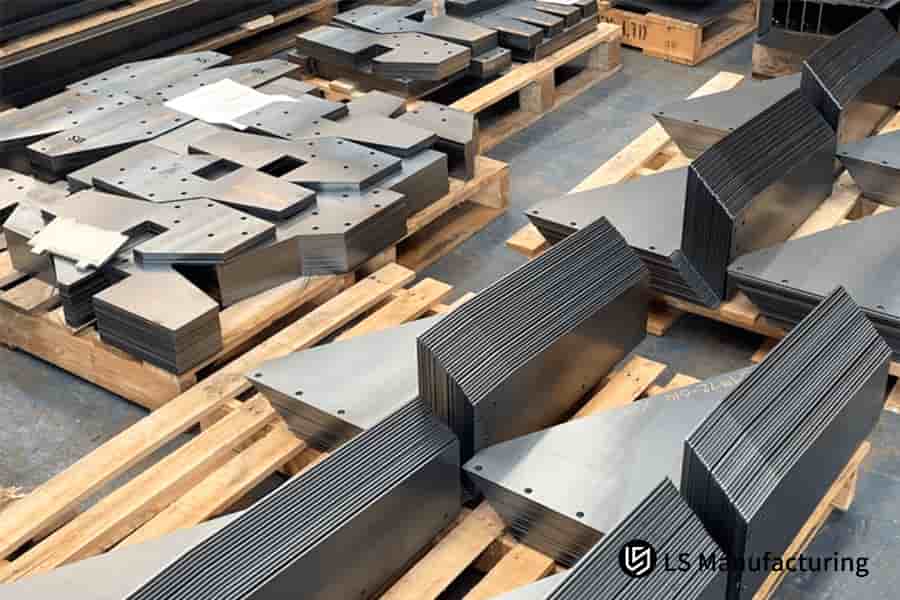
Figure 1: Custom-cut sheet metal plates and brackets on wooden pallets for fabrication.
How Do You Prevent Cumulative Tolerance Stack-Up In Customized Sheet Metal Box Build Services?
One of the ways to prevent tolerance buildup when doing custom sheet metal fabrication service is to implement statistical process control starting with Cpk of material cutting and bending equal or more than 1.33, appropriately leaving 50-100μm thick powder coating layer, and pre-compensating tolerance for precision-oriented hole and PEM threaded insert.
Statistical Process Control Scheme for Bending Process
- By using five-axis servo bending machine with high-precision molds, the single bending angle deviation can be controlled within ±0.1°, and the bending side length deviation is ≤0.05mm. This is the main process basis of custom sheet metal fabrication service, which basically decides the final highest level of sheet metal fabrication dimensional accuracy.
- The first piece is checked by a three-coordinate measurement to confirm the bending coefficient and unfolded dimensions match before each batch is produced. During mass production, key dimensions are randomly sampled and inspected every 20 pieces.
- A control ledger for SPC is set up to monitor bending process Cpk changes in real time. The production line will be immediately stopped for adjustment when Cpk is below 1.33. This is the primary operating criterion of sheet metal fabrication quality control.
In a nutshell, it's like stacking up blocks, tight control over each block's error guarantees the whole structure doesn't go out of alignment. Large accumulations of error will lead to very big deviations.
Surface Treatment Tolerance Pre-Compensation Mechanism
- In the powder coating operation, a 50-100μm coating thickness margin is initially set in the 3D model given the shape of the part. This is to ensure mating dimensions will be within tolerance after coating.
- Local masking is carried out for certain precision parts like PEM threaded inserts and conductive contact surfaces to control the coating thickness deviation smaller than ±10μm, and Because of this can guarantee assembly accuracy.
- An assembly positioning fixture with a dedicated design is used. Strict limits are employed to compensate dimensional variations after coating. During mass production, the part positional tolerance is controlled within ±0.08mm. This is a major route for ensuring batch consistency in precision metal assembly service and also works as a strong backup for sheet metal fabrication batch consistency process performance.
This knowledge is the base workshop for precision metal assembly services and a critical control point of sheet metal fabrication quality control.
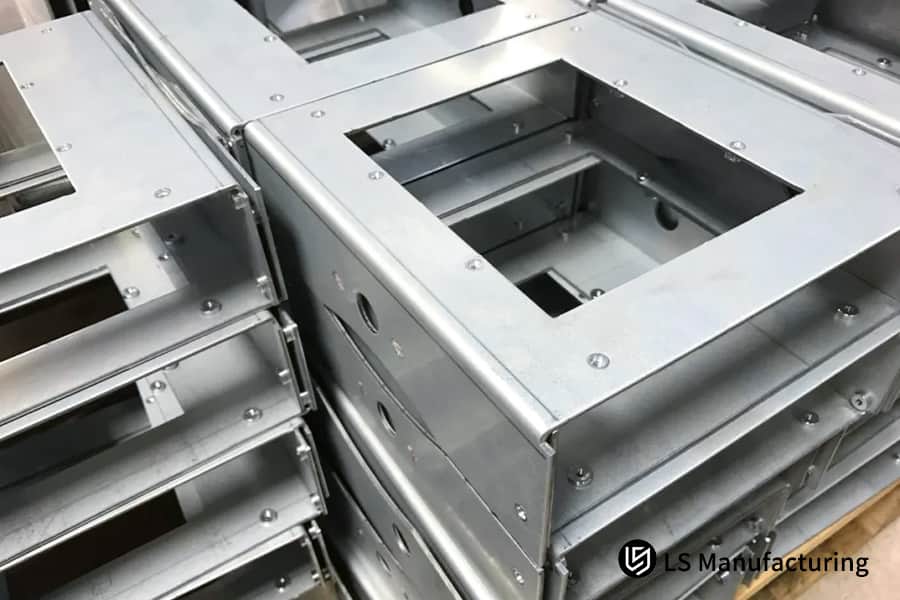
Figure 2: Assembled metal chassis and enclosures in a workshop, showing integrated box build.
What Criteria Matter Most When Conducting a Supplier Audit For An OEM Sheet Metal Fabrication Service?
Auditing OEM sheet metal fabrication service providers should not only focus on factory size, but also thoroughly examine the depth of first-article inspection, the configuration of automated measurement equipment, and the quality system certification status to verify their capability for providing complete SPC statistical control reports.
Key Points for Reviewing Quality Control Nodes Throughout the Process
- Incoming Material Inspection: Check the raw material material reports to ensure that the sheet metal composition, hardness, and thickness tolerances comply with the standards. This is the primary step in sustaining the quality of OEM sheet metal fabrication and a fundamental measure in confirming sheet metal fabrication material traceability.
- In-Process Inspection: Double-check the first-article inspection approach and SPC control system at each stage of production, and randomly perform inspections to determine that the Cpk values of key processes are always meeting the standards.
- Outgoing Inspection: Check the comprehensive dimensional inspection reports, visual, and performance test records of the products to ensure that all the products shipped satisfy customer requirements. This is the last step in the loop of sheet metal fabrication quality control.
Comparison of Laboratory Testing Capabilities
The table below gives a comparative snapshot of the different levels of testing setups among manufacturers from different tiers. The table will be the main reference for factory audits:
| Testing Items | Ordinary Small Workshop | Medium-sized Processing Plant | LS Manufacturing Top-Tier Configuration | Industry Standard Requirements |
| Core Dimensioning Equipment | Calipers, 2D | Coordinate Measuring Machine (CMM) | Blue Light Scanning + CMM | CMM |
| Salt Spray Testing Capability | None | 24-hour Standard | 96-hour Neutral Salt Spray | 48-hour |
| Coating Adhesion Testing | None | Cross-cut Adhesion Test | Cross-cut Adhesion Test + Impact Test | Cross-cut Adhesion Test |
| Non-destructive Testing | None | Sampling Visual Inspection | 100% Penetrant Testing | Sampling Inspection |
Precisely controlled testing is an essential component of a well-functioning quality system. exceptional custom sheet metal fabrication service is normally accompanied by complete testing capabilities, at a level corresponding to higher sheet metal fabrication inspection standards.
You can contact us to obtain a special audit checklist for OEM sheet metal fabrication suppliers, assessing the service provider's capabilities item by item to proactively mitigate supply chain quality risks.
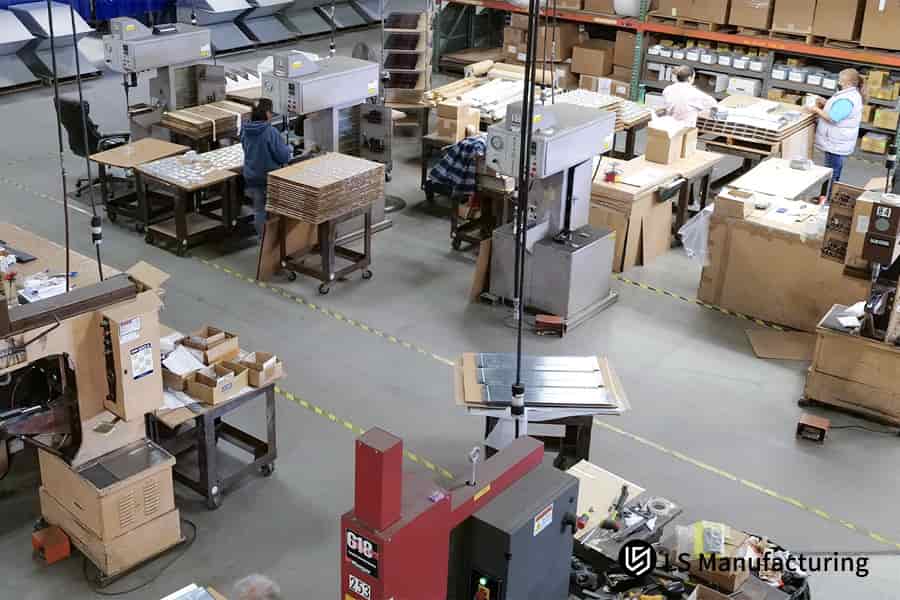
Figure 3: Wide view of an OEM facility with workers assembling components and operating machines.
How Does Sheet Metal Fabrication DFM Optimization Reduce Hidden Costs In Precision Metal Assembly Service?
Sheet metal fabrication DFM optimization can change the distances of hole edges, get rid of non-standard bending radii, and enlarge production gaps during the stage of drawing. While still maintaining the same level of structural stiffness, this change can cause a 25% reduction in mold and tooling amortization costs. At the same time, it can also prevent large-scale bending tearing.
Cost Reduction Paths of Structural Design Optimization
- The most fundamental sheet metal fabrication DFM optimization route and Because of this the central point of sheet metal fabrication structure optimization is to minimize the investment in dedicated punching dies while avoiding hole deformation leading to rework by simply adjusting the distance between holes and bending edges.
- Using standard bending radii and common mold specifications can help lower the expenses of making custom molds and the time of changing molds, because of this improving production efficiency.
- Allowing larger process gaps in a reasonable way can bring less material stretch and tear during bending, resulting in lower product scrap rates and thereby direct enhancement of custom sheet metal fabrication services yield.
To put it simply, DFM optimization is akin to pre-adjusting drawings based on the capabilities of the construction, Because of this avoiding changes on-site, saving time and costs, and at the same time, ensuring quality.
Cost Reduction Through Process Layout Optimization
This table highlights the cost differences between the conventional processing and the DFM optimization processes, thereby providing a clear picture of how much cost can be cut down:
| Cost Item | Traditional Processing Mode | DFM Optimized Mode | Reduction Amount |
| Mold and Tooling Amortization | Baseline | Reduced by 25% | 25% |
| Sheet Metal Utilization | 65%-70% | 80%-85% | Increased by 15% |
| Process Rework Rate | 5%-8% | 0.5% | Above 90% |
| Single-Piece Processing Time | Baseline | Reduced by 20% | 20% |
These changes lead to lower sheet metal processing costs and also reduce the problems of assembly during subsequent precision metal assembly service. They lower the total cost of ownership in the project's lifecycle and at the same time, improve sheet metal fabrication material utilization.
Irrational design can lead to significant hidden costs, often far exceeding the price difference of the parts themselves. You can upload your initial drawings, and our DFM engineers will provide you with a free sheet metal fabrication DFM analysis report, highlighting optimizable nodes and cost reduction potential.
How Do Suppliers Use Precision Sheet Metal Fabrication Technology To Control Residual Mechanical Stress And Thermal Deformation In Precision Manufacturing?
Nowadays, laser cutting path optimization, rigid tooling welding, and temperature-controlled aging stress-relief heat treatment are the major ways to control mechanical stress and thermal deformation in precision sheet metal fabrication.
Stress Source Control Solutions
- To reduce the inner stress caused by the uneven heating of the sheet metal, the laser cutting path should be optimized, and a symmetrical cutting process should be adopted. A heat-affected zone depth of 0.2mm achieved on the cut surface is a major detail in precision sheet metal fabrication and also a very important point for the sheet metal fabrication stress relief.
- To balance the stress resulting from a single bend and to stop the workpiece from overall warping first a reasonable bending sequence should be planned and then a symmetrical bending process should be carried out.
- By adjusting the bending speed and holding time the amount of work hardening as well as the level of residual stress concentration can be lowered, which is considered as the highest points in the sheet metal fabrication quality control.
Stress Relief and Deformation Prevention Measures
- Aging stress relief can be done after bending and before welding. The piece is kept at the target temperature of 180 for 4 hours after which it cools naturally and undergoes subsequent processing. Residual stress can be reduced by more than 90% this way.
- Welding and assembly involve the use of specialized hydraulic anti-deformation fixtures whereby the locked geometric dimensions of the workpiece are used to offset the effects of welding thermal deformation. This process is essential in controlling sheet metal fabrication thermal deformation.
- At the stage of finished product, that the product is dimensionally stable in the working of -40 to 85 without deformation is ensured by temperature cycling test. Reliable long-term service is guaranteed this way which is the main aspect of sheet metal fabrication assembly services.
This is a main point in sheet metal fabrication assembly services. Well-rounded stress control is the top-level indication of sheet metal fabrication quality control.
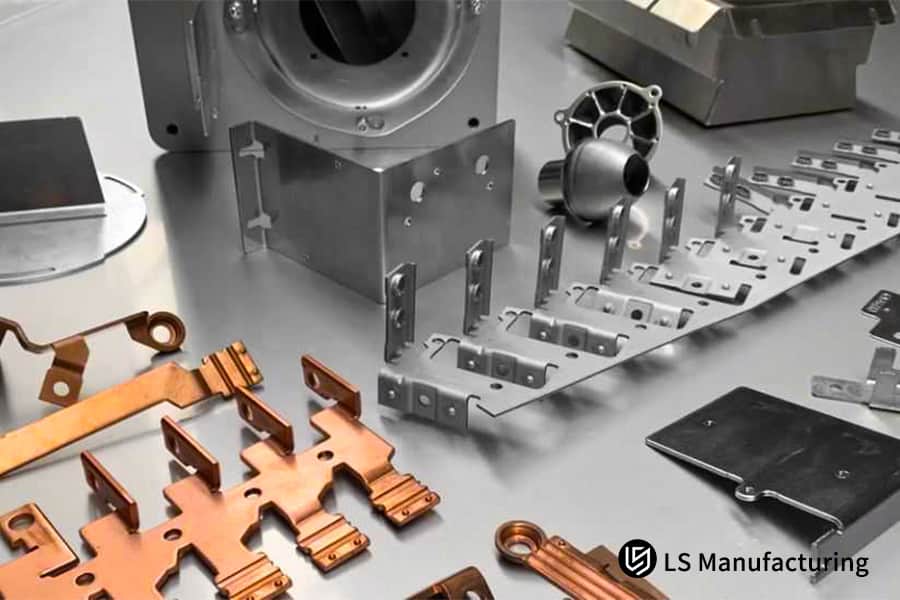
Figure 4: Stamped parts, copper contacts, and machined components for precision manufacturing.
What Testing Protocols Ensure Reliable Structural Integrity And EMC Shielding For Specialized Sheet Metal Fabrication?
The high-level requirements for sheet metal fabrication quality control are to ensure the structural integrity of the chassis and the effectiveness of EMC shielding. This requires comprehensive verification through 100% raw material testing, finished product protection level testing, and vibration and drop testing.
Testing the Structural Integrity System
- Raw Material Testing: Each batch of sheet metal is accompanied by material reports which are checked. To ascertain material strength and hardness, sampling for these tests is done. Compliance of the materials' mechanical properties with the standards is thereby ascertained. In fact, this is the principal condition for the precision sheet metal fabrication quality control and sheet metal fabrication structural integrity verification basis.
- Protection Level Testing: The chassis-level of sealing performance and the ability to adapt to different operating environments is examined by conducting air tightness and waterproof testing based on IP54/IP65 standards.
- Mechanical Reliability Testing: To confirm structural strength and assembly reliability, high-frequency vibration, and drop tests are done to mimic the effect of transportation and usage. This is a very important confirmation stage for sheet metal fabrication quality control.
Methods To Verify EMC Shielding Effectiveness
- Conductivity Continuity Test: Chassis panel grounding resistance is checked individually so that the resistance of the surface of conductive contact is 10μm. So the shielding effectiveness is assured.
- Gap Shielding Verification: To designing the chassis panel gaps, optimization was done and shielding effectiveness materials were used like conductive gaskets to guarantee 40dB level of shielding in frequency band of 10MHz-3GHz, which is a direct measure of the sheet metal fabrication shielding performance level.
- Overall Shielding Test: In a shielded chamber, the entire unit is tested for electromagnetic radiation and anti-interference capability to satisfy EMC compliance requirements for medical and industrial control fields. This element is one of the major items for integrated box build assembly services verification.
A broad testing system stands as one of the assurances of the quality of precision sheet metal fabrication and is a distinguishing characteristic that can be found in integrated box build assembly services but is missing in ordinary processing.
Case Study: How LS Manufacturing Solved a Critical Structural Tolerance Stack-Up Crisis For a Medical Device OEM Client?
A global top-five medical equipment original equipment manufacturer (OEM) was faced with a problem that was caused by the use of different sheet metal fabrication plants and assembly plants for new models of highly-precise blood analyzer chassis. Since these two plants were working separately, it caused the overall tolerance of ±0.8mm to be not in line with the standard specification. As a result, multiple batches of products would require partial disassembly before being used. In the end, LS Manufacturing saved the situation by carrying out a one-stop structural reconstruction.
Client Dilemma
The client used a multi-factory, segmented procurement model with different manufacturers responsible for the component manufacturing and final assembly. It has been collectively discovered that the previous supplier, while powder coating the medical-grade stainless steel chassis, had ignored the tolerance deterioration due to 80μm coating of internal fastening rails and PEM thread inserts. This is the typical hidden risk of segmenting custom sheet metal fabrication service and the root cause comes down to the lack of sheet metal fabrication tolerance control. As a result, misalignment during assembly and difficulty in sliding the guide rails happened.
The project's mass production scrap rate once reached 18.5%, which put the equipment's FDA certification and market launch seriously at risk, and exposed the client to supply chain disruptions as well as daily penalty of delay charges worth thousands of dollars.
LS Manufacturing Solution
When LS Manufacturing got the project, they quickly assembled a full-time Designing for Manufacturing (DFM) engineering team that remodeled the process utilizing precise multi-material tolerance cumulative analysis. We forcibly changed the statistical process control parameters for key bending operations to Cpk = 1.45, this way making a dimensional standard for precision metal assembly service.
Then we set a 0.08mm tolerance allowance during the sheet metal cutting stage for what comes next painting procedures and also designed and produced modular flexible welding and assembling fixtures having high repeatability. Custom sheet metal fabrication fixture at batch level has been showing precision.
At the same time, based on the integration of metal sheet processing, surface treatment and completing machine assembly with the internal process flow, the unified Cpk control standards have been used to closed-loop dimensional control during the whole process.
Results and Value
By process integration and one-stop dealings in a unified manufacturing, the first-pass rate of new customized medical chassis was 100%, assembly scrap rate has been reduced from 18.5% to 0%, total cost of OEM procurement for one Box-Build unit has decreased approximately by 22% after the change. This approach allowed the client to pass the ISO 13485 quality recertification audit, reduced the product launch time by 28 days, and eventually changed LS Manufacturing into the client's long-term OEM supplier for all four product lines, which is a highly commendable example of a core one-stop sheet metal fabrication assembly services.
If your project is also facing tolerance control issues and assembly scrapping problems caused by multi-factory collaboration, please contact our engineering team to submit project details and obtain a customized precision metal assembly service solution to quickly overcome quality bottlenecks.

Why Choose LS Manufacturing As Your Precision Sheet Metal Fabrication Service And Assembly Partner?
When you select LS Manufacturing for your precision sheet metal fabrication services, you acquire a lot more than just parts processing services. You get an engineering-level strategic partner with extensive experience of over 20 years in high-precision molding integration and full-cycle assembly.
Complete Production and Testing Hardware Setup
- Sheet Metal Processing: We have a high-accuracy five-axis servo bending machine, a fully automated flexible sheet metal line, and a high-power fiber laser cutting machine, which can process a minimum accuracy of 0.05mm. This is a hardware basis for precision sheet metal fabrication and it sets the maximum sheet metal fabrication equipment capability.
- Assembly and Testing: Besides having a Class 10,000 cleanroom for electronic assembly, we are also equipped with many testing equipment like coordinate measuring machines and blue light scanners, enabling us to offer complete testing from prototype to mass production.
- Surface Treatment: We have automated powder coating and anodizing lines and are capable of accurately controlling the coating thickness to 50-100m to meet different corrosion resistance and appearance requirements. This is the guarantee of our supporting abilities for OEM sheet metal fabrication service.
Full-Cycle Engineering and Service Capabilities
- Design Phase: Offer free Design Factor Analysis (DFM) to structure a product efficiently right from the source, lowering the manufacturing costs and assembly risks.
- Production Phase: Capable of making mass production from a small number of engineering prototypes to tens of thousands of units. Production lines are flexible so much that model switching can be done quickly, ensuring the balance between sheet metal fabrication production flexibility and batch stability.
- Delivery Phase: Offer 100% material traceability certification and a full set of quality reports. One single PO stands for one single responsible party, which is a sure way to have a worry-free experience all the way through the process.
We support production from a prototype to mass production and this is why we are considered a key service provider in the sheet metal fabrication assembly service industry.
FAQs
Q1: In projects for high-precision industrial control and medical device housing, what is the normal stable range of bending tolerances that your precision sheet metal fabrication service can guarantee?
Our usual bending tolerances can be reliably controlled within 0.1 mm. For positioning holes and precision fitting features, we can reach an extreme tolerance of 0.05 mm through the use of high-precision molds and pre-processing compensation techniques, this way completely satisfying the assembly needs of high-precision medical and industrial control projects.
Q2: In totally new equipment manufacturing projects, how can your integrated box build assembly solution support us in cutting down our overall supply chain procurement costs?
It is because we carry out all housing manufacturing and electronic assembly production on a single purchase order (PO), this way, eliminating secondary packaging, transit warehousing, and the additional logistics costs for transferring semi-finished products between multiple factories. Besides, through end-to-end DFM optimization, the assembly line scrap rates have been drastically reduced, this way cutting overall procurement costs.
Q3: In high-precision custom housing projects, how do you guarantee that the powder coating thickness does not impact the final assembly accuracy when offering custom sheet metal fabrication services?
To accommodate the powder coating thickness (usually 50-100m), we carry out pre-compensation of the dimensions of mating surfaces in the 3D model during material preparation and machining stages. Besides, for precision parts, we carry out local masking control so that after coating, fit for all PEM fasteners and inserts can be ensured accurately.
Q4: For mass production projects involving thousands of pieces, what quality consistency assurance methods does LS Manufacturing employ to provide precision metal assembly services at a large scale?
We design personalized welding and assembly positioning fixtures for all high-volume projects. We establish a statistical process control system with Cpk1.33 for the entire process. We utilize a high-precision three-dimensional measuring instrument for 100% critical dimension sampling inspection of each batch production to ensure that quality remains consistent in mass production.
Q5: Our company is willing to send you structural drawings for the product. So will your sheet metal fabrication DFM evaluation service charge our customer with extra service fees?
LS Manufacturing always offers all prospective OEM clients a detailed manufacturing-oriented design analysis report free of charge. This report thoroughly locates the points of structural optimization which allows you, on one side, to reduce the amortization cost of the non-standard molds. But to minimize the risks of rework after the issuance of the product stage, and at the same time, effectively shorten the overall project delivery cycle.
Q6: For export-oriented industrial equipment projects, what surface treatment processes do you support for OEM sheet metal fabrication to pass rigorous supply chain environment reliability testing?
We implement lots of surface treatment processes including powder coating anodizing electrophoresis, galvanizing, and chemical passivation. It is possible to carry out the entire procedure either in-house or outsource in a controlled supply chain. As for the finished products, they can withstand a standard neutral salt spray test for 48 to 96 hours qualifying them as meeting environmentally stringent reliability requirements.
Q7: Our company is planning to perform supplier onboarding audits. How should we run a sheet metal supplier audit process at LS Manufacturing, and also, what preparations are considered to be done beforehand?
You can always get in touch with our specialist team to get access to a complete quality system manual as well as a standardized factory audit checklist. Also, we welcome third-party testing agencies like SGS or TUV, or your own QE team for conducting on-site audits and FAIR (first-article inspection report) verification.
Q8: For one-stop complete machine assembly services, what are your specific requirements for minimum order quantity and inquiry quotation cycle, and what documents do we need to provide?
You may order a dozen engineering prototypes or mass production of thousands of units as we understand that the project requirements vary at different stages. Once you have uploaded 3D STEP/IGS drawings plus a full BOM list, a detailed tiered quotation plan for different batch sizes can be delivered to you within 24-48 hours.
Summary
This guide explores the basic engineering principles and supply chain management aspects of precision sheet metal processing, plus the complete machine integration assembly services. For global OEMs, the real cost reduction and efficiency enhancement do not come simply from lowering the unit purchase price of sheet metal parts. Rather, they come from completely removing the high hidden costs caused by assembly line failures through robust DFM optimization, strict Cpk process tolerance control, and single-supplier accountability.
It is a very important decision to select a technology-driven supplier with thorough engineering experience, who can integrate cold-work metal forming and electromechanical assembly without any issues, to prevent supply chain disruptions and speed up the introduction of next-generation products.
If you are facing problems like chassis distortion, dimensional variations after painting, or serious internal friction due to disorganized management of your current suppliers, then you should get in touch with the senior engineering expert team of LS Manufacturing without delay. Upload your 3D CAD drawings and full BOM (Bill of Materials). Our lead DFM quality engineer will send you a completely free, exclusive DFM evaluation report, including geometric tolerance stack-up analysis and processing feasibility improvement, with a tailor-made inquiry quotation within 24-48 hours, professional manufacturing capabilities protecting your product lifecycle.
📞Tel: +86 185 6675 9667
📧Email: info@lsrpf.com
🌐Website: https://lsrpf.com/
Disclaimer
The contents of this page are for informational purposes only. LS Manufacturing services There are no representations or warranties, express or implied, as to the accuracy, completeness or validity of the information. It should not be inferred that a third-party supplier or manufacturer will provide performance parameters, geometric tolerances, specific design characteristics, material quality and type or workmanship through the LS Manufacturing network. It's the buyer's responsibility. Require parts quotation Identify specific requirements for these sections.Please contact us for more information.
LS Manufacturing Team
LS Manufacturing is an industry-leading company. Focus on custom manufacturing solutions. We have over 20 years of experience with over 5,000 customers, and we focus on high precision CNC machining, Sheet metal manufacturing, 3D printing, Injection molding. Metal stamping,and other one-stop manufacturing services.
Our factory is equipped with over 100 state-of-the-art 5-axis machining centers, ISO 9001:2015 certified. We provide fast, efficient and high-quality manufacturing solutions to customers in more than 150 countries around the world. Whether it is small volume production or large-scale customization, we can meet your needs with the fastest delivery within 24 hours. choose LS Manufacturing. This means selection efficiency, quality and professionalism.
To learn more, visit our website:www.lsrpf.com.