한국어
한국어 



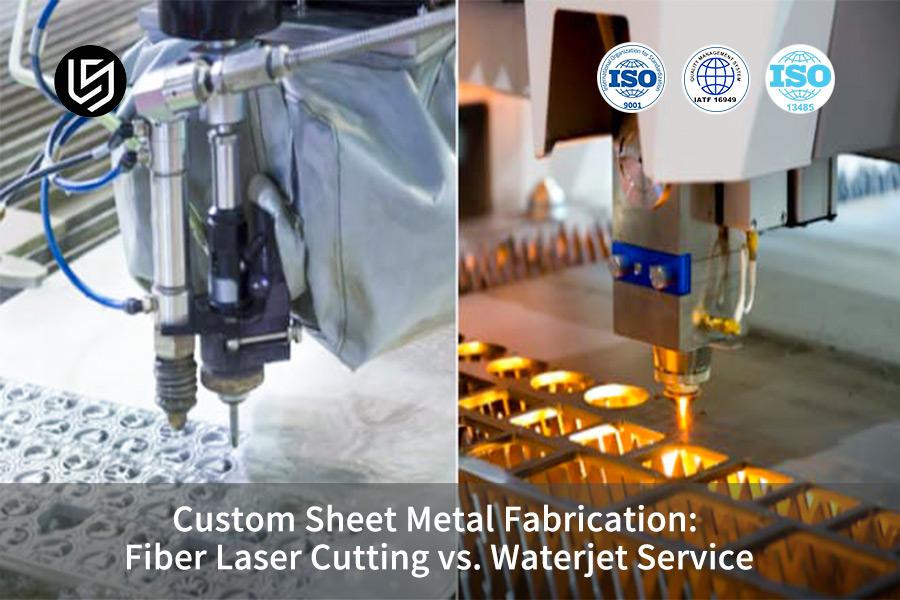
맞춤형 판금 제조는 파이버 레이저와 워터젯 절단 중에서 선택하여 부품 품질, 비용 및 배송 시간을 결정합니다.
파이버 레이저 절단은 0.1mm 정확도의 얇은 시트(1mm-12mm)에 가장 적합한 옵션이며, 워터젯 절단은 두꺼운 시트(30mm 이상) 또는 열에 민감한 재료(열 변형을 방지하기 위해, 0.05mm 직각도)에 가장 적합한 옵션입니다. 올바른 선택을 하면 비용을 최대 25%까지 줄일 수 있습니다.
구매 부서장과 엔지니어는 판금 절단 결정으로 인해 당황하는 경우가 있습니다. 잘못된 결정은 물질적 손실로 이어질 수 있으며, 프로세스를 정량적으로 비교할 수 없기 때문에 통제할 수 없을 정도로 비용이 증가할 수 있습니다.
이 기사는 LS Manufacturing의 측정 데이터를 사용하여 올바른 선택, 비용 절감 및 생산성 향상에 도움이 되는 기술적 한계를 설명하고 선택 가능한 표준을 제공합니다.

맞춤형 판금 제조 공정 선택에 대한 핵심 답변 개요
<몸>|
절단 과정
|
적용 가능한 재질 및 두께
|
공차 정확도
|
핵심 장점
|
적용 가능한 시나리오
|
|
광섬유 레이저 절단
|
탄소강, 스테인리스강 1-12mm, 알루미늄 합금 1-8mm.
|
±0.1mm
|
고효율, 좁은 절단, 낮은 재료 손실.
|
중박판 대량생산, 고정밀 표준부품
|
|
워터젯 절단
|
모든 종류의 금속 ≥30mm, 열에 민감한 합금.
|
±0.05-±0.15mm
|
냉간 가공, 열 변형 없음, 수직성이 양호함.
|
두꺼운 판, 열에 민감한 부품, 산화가 필요하지 않은 부품.
|
|
섬유 레이저(질소 보조)
|
스테인리스 스틸, 알루미늄 합금 1-6mm.
|
±0.08mm
|
산화층 없음, 부드러운 단면.
|
의료 및 항공우주 부품 등 요구사항이 높은 정밀 부품.
|
|
워터젯(정밀 등급)
|
특수 합금 20-100mm.
|
±0.05mm
|
열 영향부 없음, 재료 특성 변화 없음.
|
산업 구조 부품, 후판 정밀 가공.
|
|
복합 프로세스
|
복잡한 부품, 여러 두께의 결합 부품.
|
±0.08mm
|
효율성과 품질의 균형.
|
맞춤형 복잡한 판금 부품.
|
두 프로세스의 주요 차이점과 이상적인 시나리오를 명시적으로 자세히 설명했습니다. 후속 테스트 데이터, 사례 연구 및 의사 결정 도구와 함께 맞춤형 판금 제조 프로젝트 요구 사항을 빠르게 식별하고 오류 선택을 방지하며 품질과 비용의 성공적인 이중 최적화를 지원할 수 있습니다.
맞춤 판금 제작을 위해 LS제조를 선택하는 이유는 무엇입니까? 고효율, 고정밀 절단
판금 제조에서 귀하의 최우선 순위는 의심의 여지 없이 "정밀성, 효율성 및 저렴한 비용"이며, 이것이 바로 LS Manufacturing이 귀하에게 제공할 준비가 되어 있는 것입니다.
ISO 9001:2015 인증을 받은 당사의 서비스는 제품 일관성을 보장하고 재작업을 줄이며 추가 낭비를 줄이는 데 도움이 됩니다.
여러 개의 12kW 파이버 레이저와 고압 워터젯을 갖춘 LS Manufacturing의 통합 설정 덕분에 1mm에서 100mm까지 다양한 두께로 작업할 수 있습니다. 이는 더 이상 다양한 공급업체를 찾을 필요가 없으며 통신 비용이 절약된다는 것을 의미합니다.
12mm Q235 탄소강을 예로 들면, 단 0.1mm의 매우 좁은 절단으로 6000mm/분의 속도로 절단할 수 있습니다. 단일 4'x8' 시트에 8% 더 많은 맞춤형 금속 제조 부품을 넣을 수 있으므로 재료 낭비가 적고 조달 비용이 절감됩니다.
당사의 동적 주파수 보상 기술은 열에 민감한 알루미늄 합금 부품의 가장자리 슬래그 축적을 해결하여기존 워터젯보다 8배 더 높은 처리 효율성을 가능하게 합니다.
후판 가공의 경우 고정밀 워터젯을 사용하면 수직도를 0.05mm 이내로 유지하여 연삭 공정이 필요 없고 부품당 생산 비용이 15%-20% 절감됩니다.
이 외에도 LS제조는 항상 AWS D1.1 철골 구조 용접 표준, 최대한의 서비스 제공 열 영향부 및 후속 용접을 제어합니다.
<인용문>저희는 전 세계 500개 이상의 고객에게 맞춤형 솔루션을 제공하여 전체 조달 비용을 평균 20% 절감하도록 도왔습니다. 프로세스 선택에 어려움을 겪고 있다면 당사 엔지니어에게 문의하여 최적의 처리 솔루션에 맞는 무료 DFM 프로세스 평가를 받으세요.
파이버 레이저 절단이 왜 고정밀 맞춤형 판금 제조에서 효율성 우선 선택이 될 수 있나요?
얇거나 중간 두께의 시트(1mm-12mm)를 처리하는 작업은 맞춤형 판금 제작 작업의 약 70%를 차지합니다. 이 분야에서는 광섬유 레이저 절단이 효율성 측면에서 선두를 달리고 있습니다. 주로 고객의 소득 창출에 기여하는 주요 강점은 속도, 정확성, 비용입니다.
파이버 레이저 절단의 속도 및 에너지 밀도 장점
- Q235 탄소강 가공: 절단 속도는 1mm 두께의 경우 12,000mm/min, 6mm 두께의 경우 3,000mm/min, 12mm 두께의 경우 6,000mm/min으로 업계 평균을 크게 뛰어넘고 생산 능력을 크게 높입니다.
- 304 스테인리스 스틸 가공: 두께 6mm에 대해 절단 속도 2000mm/분, 에너지 밀도가 10^6 W/cm로 완벽하게 제어되어 소재가 과도하게 녹는 것을 방지하여 절단 품질이 좋습니다.
파이버 레이저 절단의 정밀도 및 비용 이점
- 정확도 및 손실 제한: 절폭은 0.1mm에 불과하며 일반적인 화염 절단 폭보다 50% 더 작습니다. 즉, 4'x8' 시트 하나에 맞춤형 금속 제조 부품을 5%~8% 더 많이 담을 수 있어 부품당 자재 비용이 3%~5% 낮아집니다.
- 기계화 및 배송: 자동 적재 및 하역 및 지능형 일정 관리 시스템과 결합하여 대규모 생산의 배송 시간을 40% 단축할 뿐만 아니라 수동 개입 및 인적 오류도 낮춥니다.
판금 레이저 절단 서비스는 생산 라인의 효율성을 크게 향상시킬 수 있습니다. 이러한 방식으로 대량 생산 고객은 생산 능력을 늘리고 단가를 줄일 수 있습니다. 프로젝트가 주로 중간 정도의 얇은 판에 초점을 맞추고 있다면 맞춤형 레이저 절단 서비스 백서를 다운로드하여 특정 처리 매개변수와 비용 계산 방법에 대해 알아볼 수 있습니다.

그림 1: 높은 정밀도로 금속판을 절단하는 파이버 레이저 빔을 보여주는 기술 다이어그램.
어떤 공정 과제에서 워터젯 금속 절단 서비스가 재료의 열 변형을 방지할 수 있는 유일한 솔루션입니까?
판이 매우 두껍거나 재료가 열에 매우 민감한 경우 맞춤형 판금 제작이 중단되는 경우가 있습니다. 이러한 경우 파이버 레이저 절단으로 인한 열 영향부(HAZ)가 공정을 방해하는 요인이 될 수도 있습니다.
워터젯 금속 절단 서비스는 냉간 가공 특성을 갖추고 있어 이 문제를 효과적으로 해결하며 실행 가능한 유일한 옵션입니다.
워터젯 절단의 가장 일반적인 응용 분야
- 후판 가공: 주로 두께가 30mm 이상인 금속판에 사용됩니다. 특히, 50mm 두께의 탄소강을 고압 워터젯으로 절단하면 직각도는 0.05mm 이내, 각도는 1이 되어 별도의 가공이 필요 없을 정도로 정확합니다.
- 열에 민감한 재료 가공: 이 방법은 가공 온도가 50도이므로 티타늄 합금, 내열 합금 등에 적합합니다. 열 영향부가 생성되지 않으므로 재료 경화가 제거되고 산화층이나 미세 균열이 형성되지 않습니다.
다양한 재료의 두꺼운 판에 대한 워터젯 절단 매개변수
<몸>|
자료 유형
|
두께
|
워터젯 절단 속도
|
수직성
|
2차 처리 필요
|
|
탄소강
|
30mm
|
300mm/분
|
±0.05mm
|
필요 없음
|
|
스테인리스 스틸
|
50mm
|
250mm/분
|
±0.08mm
|
필요 없음
|
|
티타늄 합금
|
20mm
|
200mm/분
|
±0.05mm
|
필요 없음
|
|
알루미늄 합금
|
40mm
|
350mm/분
|
±0.07mm
|
필요 없음
|
파이버 레이저와 파이버 레이저를 어떻게 비교해야 할까요? 복잡한 부품을 맞춤 제작할 때 워터젯 절단 균형 정확도와 단면 품질이 중요합니까?
복잡한 맞춤형 부품을 위한 맞춤형 판금 제작의 핵심은 정밀성, 단면 품질 및 비용의 3요소입니다.
파이버 레이저 절단과 워터젯 절단 방법 중 하나를 결정하는 것은 제작할 부품의 모양 및 크기와 관련된 대화의 일부여야 합니다. 우리는 실제 측정 데이터의 도움을 받아 이러한 타협에 대한 명확한 기준을 마련했습니다.
두 프로세스의 핵심 성능 비교
<몸>|
처리 기술
|
절단 속도
|
절단 표면 거칠기(Ra)
|
최소 커프 너비
|
미세공 처리 용량
|
복잡한 그래픽에 대한 적응성
|
|
광섬유 레이저 절단
|
6000mm/분
|
3.2-6.3μm
|
0.1mm
|
0.5mm 이하의 미세 구멍 가공 가능
|
높음, 좁은 피치 슬롯에 적합.
|
|
워터젯 절단(5등급 품질)
|
300mm/분
|
1.6-3.2μm
|
1.0mm
|
1.5mm 미만의 미세 구멍에는 적합하지 않습니다.
|
중간, 두꺼운 판의 복잡한 그래픽에 더 유리합니다.
|
복잡한 부품의 공정 선택 원칙
<올>요약하자면 파이버 레이저 절단은 매우 세밀한 부품을 만드는 데 적합하며, 워터젯 절단은 높은 단면 품질이 필요한 두꺼운 판에 더 적합하며, 이는 함께 부품의 정확한 품질을 보장합니다.

그림 2: 파이버 레이저와 워터젯 절단 기술의 주요 차이점을 강조하는 비교 차트.
판금 제조 서비스에서 절단 허용량을 최적화하여 자재 조달 비용을 줄일 수 있습니까?
커프 허용량을 정확하게 제어하는 것은 판금 제조 서비스에서 비용 최적화를 달성하는 가장 중요한 방법 중 하나입니다. 비용 절감 조치가 시행되는 동안에도 이 요소는 항상 어둠 속에 있었습니다.
파이버 레이저 절단에서 커프 여유의 유용성
<올>절삭 여유 최적화의 절감 공식
<올>최고의 부품을 생산할 수 있는 숙련된 판금 제조 회사를 찾는 것 외에도 기술 최적화를 통해 이러한 절감된 비용을 누릴 수도 있습니다. 일괄 맞춤화가 필요한 경우 엔지니어에게 문의하여 재료 최적화 후 무료 비용 계산을 통해 비용 절감의 새로운 가능성을 열어보세요.
사례 연구: LS Manufacturing이 어떻게 의료 기기 산업을 위한 정밀 스테인리스 스틸 프레임을 맞춤 제작하고 비용을 25% 절감했나요?
의료 기기 부문은 매우 정확한 제품 치수, 매우 미세한 표면 품질은 물론 의료 목적으로 사용할 수 있는 재료를 포함하여 맞춤형 판금 제조에 대해 매우 높은 표준을 설정합니다.
이 사례 연구를 통해 우리가 고객의 주요 문제를 어떻게 처리하고 동시에 가격을 절감했는지 확인할 수 있습니다.
고객의 문제
한 일류 의료 기기 제조업체는 가장자리에 산화층이 전혀 없어야 하고 열 변형이 없어야 하며 후속 코팅 처리에 대한 수요가 높아야 한다는 조건으로 6mm 두께의 316L 스테인레스 스틸 수술용 스텐트 프레임을 맞춤 제작하려고 했습니다.
클라이언트는 처음에 워터젯 커팅을 사용했고 월 생산량이 800세트에 불과해 2,000세트의 수요를 충족할 수 없었고 개당 비용이 120달러로 상당한 비용 압박을 겪었습니다.
LS제조의 솔루션
<올>결과 및 가치:
프로세스 변경은 생산 시스템 재작업에 도움이 되었습니다.
- 월간 생산량 2,500세트로 생산 효율성이 60% 향상되었습니다.
- 각 부품 비용이 $90(25% 감소)로 감소하여 연간 $72,000가 절약되었습니다.
- 이 외에도 모든 부품이 의료용 염수 분무 테스트를 100% 준수했으며 서비스 수명이 30% 연장되었습니다.
- 공정 수정 후 개당 제조 시간이 15분/개에서 6분/개로 단축되었으며 생산 효율성이 60% 증가했습니다.
- 월 생산량이 2,500세트 이하로 떨어지는 경우는 거의 없었으며 이는 고객 요구 사항을 훨씬 웃도는 수치입니다.
- 부품당 전체 조달 비용이 $120에서 $90로 25% 절감되어 고객이 연간 $72,000를 절감했습니다.
- Also, all parts underwent 100% medical grade salt spray test successfully and their service life was increased by 30%.
This is a clear case that proper process selection should be at the heart of matching customer's needs and our capabilities to switch processes can give the best solution for custom sheet metal fabrication in high end fields like the Medical Industry.
If you have needs for precision stainless steel frames or other medical-grade sheet metal parts customization, please contact our expert team for a customized solution and quote.

How To Accurately Select The Most Suitable Sheet Metal Laser Cutting Service Based On The Thickness And Material Hardness Of The Sheet Metal?
Knowing a sheet metal laser cutting service helps a lot after you find out what sheet thickness and material characteristics are. Actually, various materials and thicknesses will hardly be through by laser cutting parameters as well as by the resulting effects.
Just grabbing a model without paying attention may bring you quality problems and wastes of money very easily. We offer highly accurate matching solutions based on the very latest 2026 standards.
Laser Cutting Parameter Matching for Common Materials
- Carbon Steel and Stainless Steel:
For thoroughly working on Q235 carbon steel 1-12mm, 6-12kW power and oxygen assistance seem to be the perfect set of features to both control the speed and avoid slag formation.On the other hand, for 304 stainless steel 1-8mm, our recommendations are to use 8-12kW power and nitrogen assistance so as to effectively suppress oxidation.
- Special Alloys:
For aluminum alloy 1-6mm, 12kW power and nitrogen assistance are our suggestions, while anti-reflection technology being used for the protection of the equipment, for titanium alloy 1-4mm, 12kW power and argon assistance are our advice to help in balancing of energy and preventing thermal deformation.
Key Considerations for Laser Cutting
- Highly reflective metals processing:
Mixing anti-reflection technology (back-reflection protection) enabled us to solve the cutting problems of aluminum alloy and copper, so we can continuously cut and avoid breakdown of the equipment.
- Parameter adjustment:
It is crucial to change the power and feed speed according to the thickness of the sheet to be cut. For example, if you work with ultra-high strength steel (1-8mm), you will have to decrease the feed speed in order to keep the quality of the cut while also meeting the requirements of the industrial structural components.
<몸>|
Material Type |
Thickness Range |
Recommended Laser Power |
Auxiliary Gas |
Key Notes |
Adaptability to Custom Metal Fabrication Parts |
|
Q235 Carbon Steel |
1-12mm |
6-12kW |
Oxygen |
Control cutting speed to avoid dross. |
High, suitable for mass-produced standard parts. |
|
304 Stainless Steel |
1-8mm |
8-12kW |
Nitrogen |
Prevent oxidation and optimize focus position. |
High, suitable for precision parts. |
|
Aluminum Alloy |
1-6mm |
12kW |
Nitrogen |
Adopt anti-reflection technology to avoid equipment damage. |
Medium, suitable for lightweight parts. |
|
Titanium Alloy |
1-4mm |
12kW |
Argon |
Control energy density to avoid thermal deformation. |
Medium, suitable for high-end customized parts. |
|
Ultra-High Strength Steel |
1-8mm |
12kW |
Nitrogen |
Reduce feed speed to ensure cutting quality. |
High, suitable for industrial structural parts. |
Our anti-reflection technology is a powerful solution to the tough problem of cutting highly reflective metals like aluminum alloys and copper. Besides ensuring continuous cutting without interruption, this technology also prevents equipment failure. If you don't know what laser parameters suit your sheet metal, just upload your CAD drawings and you will get free process selection advice.
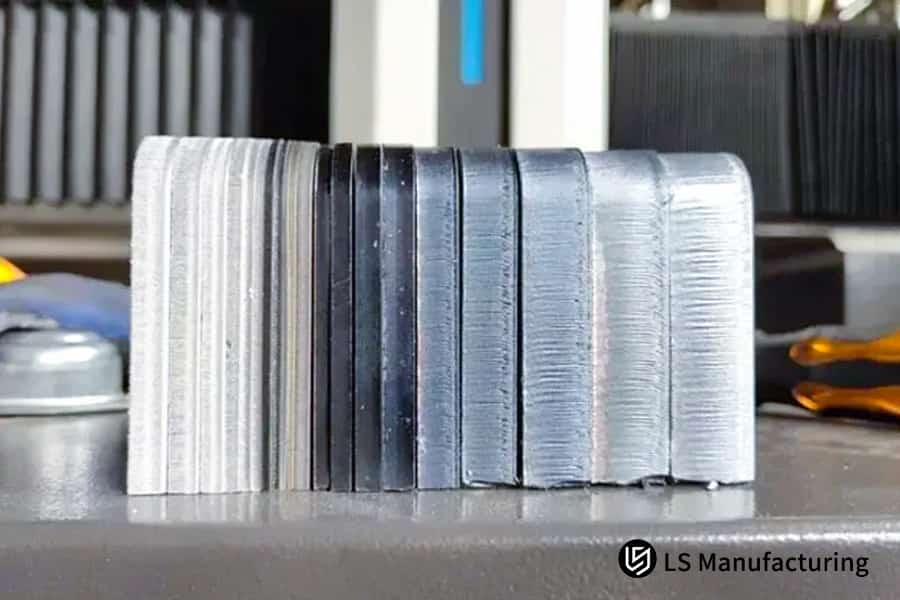
Figure 3: Several metal samples with cut edges, showcasing results from different cutting processes like laser and waterjet.
Why Is It Necessary To Strictly Control The Heat Affected Zone In Industrial Sheet Metal Fabrication To Ensure Subsequent Welding Strength?
In the field of industrial sheet metal fabrication, the laser cutting stage has a major impact on how the parts will be bent and welded later on. Controlling the heat-affected zone (HAZ), i.e. the small surface layer that is altered by being heated, is critical for weld strength and is something that is commonly neglected.
Potential Hazards of the Heat-Affected Zone
Fiber laser cutting creates a 0.1-0.3mm thick surface layer with different mechanical properties (i.e. a heat affected zone or HAZ) that if uncontrolled can cause:
<올>Heat-Affected Zone Control Scheme
<올>How Can Professional Industrial Sheet Metal Fabrication Manufacturers Ensure Stable Delivery Time Through Equipment Redundancy?
Stable delivery times are a fundamental customer requirement in industrial sheet metal fabrication. Delivery delays are mainly caused by equipment failures and maintenance downtime. We implement an equipment redundancy strategy to provide a "zero delay" delivery guarantee.
Equipment Redundancy System Construction
Our company has several 12kW laser cutting machines and high pressure water jets of the same specifications to set up an "equipment hot backup" system.
In case a single piece of equipment is broken down or is under maintenance, the production line can be immediately switched and the backup equipment can be running within 10 minutes, thus completely avoiding the downtime and ensuring uninterrupted production.
Auxiliary Measures for Delivery Time Guarantee
We implement a 24/7 lights out production mode, along with an intelligent scheduling system aimed at unattended continuous production, thus not only improving efficiency but also reducing the risks of delivery time. Heavy asset investment is turned into a "zero delay" brand promise, satisfying the requirements of high value procurement.
FAQ
Q1: What are the achievable tolerances for laser cutting and waterjet cutting in sheet metal processing?
Our fiber laser is capable of achieving a positioning accuracy of 0.1mm (ideal for 1-12mm thin plates). However, precision waterjet cutting can consistently maintain a tolerance of 0.05-0.15mm when working on thick plates.
Q2: Why do you suggest giving fiber laser cutting a higher priority when producing high precision aluminum alloy parts?
By combining fiber laser with our dynamic frequency compensation technology, we have achieved a method of eliminating the issue of the accumulation of slag on aluminum alloys after processing. The processing speed is 5-10 times faster than that of waterjet cutting, resulting in a drastic increase in efficiency and a reduction in costs.
Q3: How does LS Manufacturing ensure the perpendicularity of the cut for ultra thick carbon steel plates exceeding 25mm?
LS Manufacturing's solution to the problem is to utilize a powerful waterjet or a laser head, which is compensated for bevel. By lowering the speed and raising the gas flow, we can guarantee that the bevel angle is kept within 1 therefore fulfilling the requirements of thick plates.
Q4: Does fiber laser cutting change the chemical properties of the edges of stainless steel parts?
In some cases when cutting with oxygen, the metal surface can be oxidized. We usually cut the metal with high pressure nitrogen to protect the metal color naturally and also make it easier to weld without doing any extra work.
Q5: My drawing requires extremely small micro holes. Will waterjet cutting cause chipping?
Waterjet cutting micro holes smaller than 1.5mm may cause chipping. To prevent damage in the weak parts of the material, we advise laser pre-drilling or usage of a complete laser setup.
Q6: When customizing sheet metal parts in bulk, which process can help me obtain a more competitive quote?
For large volume workpieces with thickness less than 10mm, fiber laser cutting has such a high production rate per hour that a price of only 40% higher than waterjet cutting would significantly lower your bulk purchase costs.
Q7: If my parts require mirror polishing, what are the considerations for choosing the cutting process?
It would be best if you consider laser cutting together with our surface finishing procedure so that you can minimize grinding after processing, get a surface roughness of around Ra1.6, and be ready for mirror polishing.
Q8: Will LS Manufacturing allow uploading of CAD drawings for a free evaluation of the DFM process?
Yes, Our engineers will give you process recommendations and price quotes based on your drawings in 24 hours to help you achieve a balance between manufacturability and cost.
요약
Fiber laser cutting is a good way to cut medium or thin plates in custom sheet metal fabrication and Waterjet cutting is a good choice for thick plates and heat sensitive materials (quality assurance). Material thickness tolerances, and post processes should be considered when deciding both methods.
The right process can save 20%-25% of costs and speed up delivery times. With top notch equipment and technology, LS Manufacturing assists customers in choosing the best balance of cost, quality, and delivery time.
Upgrade your precision sheet metal supply chain. Get in touch with one of our experts now or upload your STEP/DXF files to receive a personalized DFM evaluation and price. Take advantage of our 24-hour rapid quote service and get a cheap custom sheet metal fabrication solution.
📞Tel: +86 185 6675 9667
📧Email: info@lsrpf.com
🌐Website: https://lsrpf.com/
면책조항
The contents of this page are for informational purposes only. LS Manufacturing services There are no representations or warranties, express or implied, as to the accuracy, completeness or validity of the information. 제3자 공급업체나 제조업체가 LS Manufacturing 네트워크를 통해 성능 매개변수, 기하학적 공차, 특정 설계 특성, 재료 품질 및 유형 또는 제작 기술을 제공할 것이라고 추론해서는 안 됩니다. It's the buyer's responsibility. Require parts quotation Identify specific requirements for these sections.Please contact us for more information.
LS 제조팀
LS Manufacturing은 업계를 선도하는 기업입니다. 맞춤형 제조 솔루션에 중점을 둡니다. We have over 20 years of experience with over 5,000 customers, and we focus on high precision CNC machining, Sheet metal manufacturing, 3D printing, Injection molding. Metal stamping,and other one-stop manufacturing services.
Our factory is equipped with over 100 state-of-the-art 5-axis machining centers, ISO 9001:2015 certified. 우리는 전 세계 150여 개국의 고객에게 빠르고 효율적인 고품질 제조 솔루션을 제공합니다. 소량 생산이든 대규모 맞춤 제작이든 24시간 이내에 가장 빠른 배송으로 고객의 요구를 충족시켜 드립니다. LS제조를 선택하세요. This means selection efficiency, quality and professionalism.
To learn more, visit our website:www.lsrpf.com.