中文 (简体)



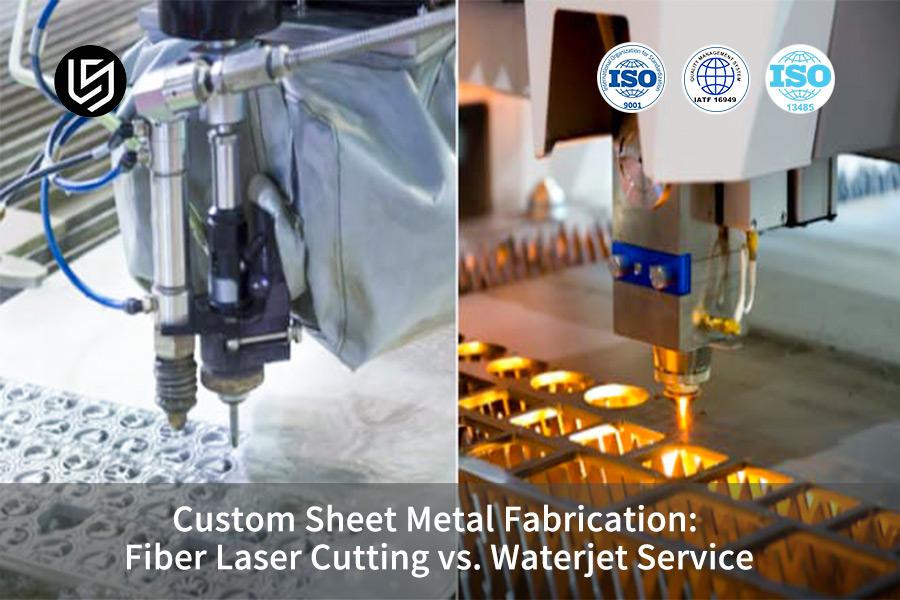
定制钣金制造通过选择光纤激光切割和水射流切割来确定零件质量、成本和交货时间。
光纤激光切割是薄板(1mm-12mm)的最佳选择,精度为0.1mm,水射流切割是厚板(30mm及以上)或热敏材料(为了防止热变形,0.05mm垂直度)的最佳选择。 做出正确的选择可以降低高达 25% 的成本。
采购部门主管和工程师有时会对钣金切割决策感到困惑。错误的决策可能会导致物质损失并使成本上升到无法控制的程度,这主要是因为没有对流程进行定量比较。
本文使用 LS Manufacturing 的测量数据,描述了技术限制并提供了可选择的标准,以帮助您做出正确的选择、降低成本并提高生产率。

定制钣金制造工艺选择的核心答案概述
<正文>我们已经明确详细描述了两个流程的主要区别和理想场景。连同后续测试数据、案例研究和决策工具,我们可以帮助您快速识别定制钣金制造项目需求,避免选择错误,并成功实现质量和成本的双重优化。
为什么选择 LS Manufacturing 进行定制钣金制造?高效率、高精度切割
在钣金制造中,您的首要任务无疑是“精度、效率和低成本”,而这正是 LS Manufacturing 准备为您提供的服务。
通过ISO 9001:2015 认证,我们的服务可保证产品一致性、减少返工并帮助减少额外浪费。
得益于 LS Manufacturing 的集成装置,配备了多个 12kW 光纤激光器和高压水射流,您能够处理从 1 毫米到 100 毫米不同的厚度。这意味着您将不再需要寻找各种供应商,并且节省了沟通成本。
以 12mm Q235 碳钢为例,您可以以 6000mm/min 的速度进行切割,切缝非常窄,仅 0.1mm。在一张 4'x8' 板材中,您可以多获得 8% 的定制金属制造零件,这意味着更少的材料浪费和更低的采购成本。
我们的动态频率补偿技术可解决热敏铝合金零件上的边缘熔渣堆积问题,使加工效率比传统水射流高出 8 倍。
在厚板加工时,高精度水射流有助于将垂直度保持在0.05mm以内,从而无需磨削工序,从而使每个零件的生产成本降低15%-20%。
除此之外,LS Manufacturing 始终遵守AWS D1.1钢结构焊接标准,为您提供最大限度的控制在热影响区和后续焊缝上。
我们已为全球 500 多家客户提供定制解决方案,帮助他们平均降低 20% 的总体采购成本。如果您在工艺选择方面遇到困难,请联系我们的工程师进行免费的 DFM 工艺评估,以匹配最佳的加工解决方案。

为何光纤激光切割能够成为高精度定制钣金加工的高效首选?
处理薄到中厚板材 (1mm-12mm) 大约占定制钣金制造工作的 70%。在该领域,光纤激光切割在效率方面名列前茅。其主要为客户创收做出贡献的关键优势是速度、精度和成本。
光纤激光切割的速度和能量密度优势
- Q235碳钢加工:切割速度1mm厚度12,000mm/min、6mm厚度3,000mm/min、12mm厚度6,000mm/min,大幅超越行业平均水平,产量大幅提升容量。
- 304不锈钢加工:6mm厚度切割速度2000mm/min,能量密度完美控制在10^6 W/cm,防止材料过度熔化,从而保持良好的切割质量。
光纤激光切割的精度和成本优势
- 精度和损耗限制:切口仅为 0.1 毫米,比火焰切割中常见的宽度小 50%。这意味着一张 4'x8' 板材可多容纳 5%-8% 定制金属制造零件,从而使每个零件的材料成本降低 3%-5%。
- 机械化出货:可与自动化上下料、智能调度系统相结合,将大规模生产的交货时间缩短40%,并减少人工干预和人为错误。
钣金激光切割服务可以很大程度上提升生产线的效率。这样,批量生产的客户就可以提高产能,降低单位成本。如果项目主要以中薄板为主,您可以下载我们的定制激光切割服务白皮书,了解具体的加工参数和成本核算方法。

图 1: 光纤激光束高精度切割金属板的技术图。
在哪些工艺挑战下,水射流金属切割服务是避免材料热变形的唯一解决方案?
有时,当板材非常厚或材料对热非常敏感时,定制钣金制造就会卡住。 在这种情况下,光纤激光切割产生的热影响区 (HAZ) 甚至可能成为该过程的致命因素。
水射流金属切割服务凭借其冷加工特性完美地解决了这个问题,是唯一可行的选择。
水射流切割最典型的应用
- 厚板加工:主要用于厚度超过30mm的金属板材。特别是用高压水射流切割50mm厚的碳钢,垂直度在0.05mm以内,角度为1,精度很高,无需额外加工。
- 热敏材料加工:此方法适用于钛合金、高温合金等,加工温度为50℃。由于不产生热影响区,消除了材料硬化,而且不会产生氧化层或微裂纹。成立。
不同材质厚板水刀切割参数
|
剪切过程
|
适用材料和厚度
|
公差精度
|
核心优势
|
适用场景
|
|
光纤激光切割
|
碳钢、不锈钢1-12mm、铝合金1-8mm。
|
±0.1mm
|
效率高,切缝窄,材料损耗低。
|
量产中薄板、高精度标准件。
|
|
水刀切割
|
各类≥30mm的金属、热敏合金。
|
±0.05-±0.15mm
|
冷加工,无热变形,垂直度好。
|
厚板、热敏部件、无需氧化的部件。
|
|
光纤激光器(氮气辅助)
|
不锈钢、铝合金1-6mm。
|
±0.08mm
|
无氧化层,断面光滑。
|
高要求精密零件,例如医疗和航空航天零件。
|
|
水刀(精密级)
|
特殊合金20-100mm。
|
±0.05mm
|
无热影响区,材料性能无变化。
|
工业结构件、厚板精密加工。
|
|
复合流程
|
复杂零件、多厚度组合零件。
|
±0.08mm
|
平衡效率和质量。
|
定制复杂钣金零件。
|
光纤激光与激光应该如何比较定制复杂零件时,水射流切割如何平衡精度和横截面质量?
复杂定制零件的定制钣金制造的核心是精度、截面质量和成本三要素。
在光纤激光切割与水刀切割方法之间做出决定应该是与要制造的零件的形状和尺寸相关的对话的一部分。我们借助实际测量数据为这种妥协制定了明确的标准。
两种进程核心性能对比
|
材质类型
|
厚度
|
水刀切割速度
|
垂直度
|
需要二次处理
|
|
碳钢
|
30mm
|
300毫米/分钟
|
±0.05mm
|
不需要
|
|
不锈钢
|
50mm
|
250毫米/分钟
|
±0.08mm
|
不需要
|
|
钛合金
|
20mm
|
200毫米/分钟
|
±0.05mm
|
不需要
|
|
铝合金
|
40mm
|
350毫米/分钟
|
±0.07mm
|
不需要
|
复杂零件工艺选择原则
- 结构精细的零件:如果零件有非常小的孔(小于0.5毫米)或超细间距光纤激光切割是最好的方法。 0.05mm最小聚焦光斑尺寸不仅有助于获得更高的分辨率,还可以防止材料受到损坏。
- 具有大横截面特征的零件:当零件要达到Ra3.2m并且厚度也很大时,水射流切割是最好的方法。由于是冷加工,断面光滑美观,不会氧化,甚至不需要后续打磨。
总而言之,光纤激光切割非常适合制作非常精细的零件,而水射流切割更适合需要高横截面质量的厚板,两者共同保证了零件的精确质量。

图 2:对比图突出了光纤激光和水射流切割技术之间的主要差异。
您的钣金加工服务能否通过优化切削余量来降低材料采购成本?
精确控制切缝余量是钣金制造服务实现成本优化的最重要方法之一。即使正在实施成本削减措施,这个因素也一直处于黑暗之中。
光纤激光切割中切口余量的用途
- 切口宽度是一个主要因素:光纤激光切割切口宽度仅为 0.1mm。使用光纤激光切割可以减少材料浪费并显着提高板材的利用率。另外,它与传统方法中0.2-0.3mm的切缝宽度不同。
- 利用布局系统嵌套软件与 0.1 毫米切口相结合,以最有效的方式进行零件布局。这些使得每 4'x8' 或 5'x10' 板材的定制金属制造零件数量增加 5%-8%。
切削余量优化节省公式
- 每批次节省费用:例如,如果一家公司每月以每张 200 美元的价格购买 100 张 4'x8' 304 不锈钢板,并在系统优化后减少 8 至 10 张,他们将节省 1600 至 2000 美元每月一次。
- 长期价值:除了每年节省 19200-24000 美元之外,这笔资金还可以用于缓解原材料价格波动的风险,从长远来看,可以降低成本并提高效率。
除了找到一家技术精湛、能生产出最好零件的钣金加工公司外,这些节省下来的成本还可以通过技术优化来享受。如果您有批量定制需求,联系我们的工程师进行材料优化后的免费成本计算,释放成本降低的新潜力。
案例研究:LS Manufacturing 如何为医疗器械行业定制精密不锈钢框架并降低 25% 的成本?
The medical device sector sets a very high standard for custom sheet metal fabrication, including extremely accurate product dimensions, very fine surface qualities, as well as materials that can be used for medical purposes.
Through this case study, you will see how we have dealt with the client's main issues and, at the same time, reduced the price.
Client's Problem
A top-notch medical device manufacturer was looking to customize 6mm thick 316L stainless steel surgical stent frames with the condition that the edges should have absolutely no oxide layer and in addition, there should be no heat deformation, and the subsequent coating treatment with high demands.
The client had initially employed waterjet cutting and had a production of only 800 sets per month which could not satisfy the demand of 2,000 sets, and the cost per piece was $120, which brought quite a bit of cost pressure.
LS Manufacturing's Solution
- Pain Point Analysis: Main client desires were "no oxide, high efficiency, and low cost." Confirming the current waterjet cutting process not only was inefficient, high cost but also could not provide the features needed by the client.
- Process Selection: To meet the medical-grade requirements of no oxide and high precision, changing the process to "10,000-watt high pressure nitrogen fiber laser cutting, " was the best solution.
- Parameter Optimization: Auxiliary gas pressure was increased to 25 Bar and focal point was -3.0 mm. A specially designed anti-oxidation cutting head was used to completely eliminate the oxygen in the cutting area thus preventing oxidizing the metal surface.
- Sample Testing:Tests on 100 parts showed that the part cut surface roughness Ra was 1.6μm and there was no oxide layer, so there was no sandblasting requirement. The perpendicularity limitation was 0.08 mm, which is medically acceptable.
- Layout Optimization: The nest layout was improved. Number of parts from a 4'x8' 316L stainless steel sheet load was increased from 12 to 14 leading to less material waste and cost reduction.
Results and Value:
Process changes helped to rework the production system.
- The production efficiency was improved by 60%, with a monthly output of 2500 sets.
- The cost of each part dropped to $90 (a 25% decrease), which led to an annual saving of $72,000.
- Besides that, all parts were 100% compliant with the medical grade salt spray test and their service life was extended by 30%.
- After process modifications, the manufacturing time per piece was cut from 15 minutes/piece to 6 minutes/piece, production efficiency was increased by 60%.
- The monthly production output seldom fell below 2,500 sets, which was well above the customer requirement.
- The overall procurement cost per part was reduced from $120 to $90, a 25% cut, resulting in the customer saving $72,000 annually.
- Also, all parts underwent 100% medical grade salt spray test successfully and their service life was increased by 30%.
This is a clear case that proper process selection should be at the heart of matching customer's needs and our capabilities to switch processes can give the best solution for custom sheet metal fabrication in high end fields like the Medical Industry.
If you have needs for precision stainless steel frames or other medical-grade sheet metal parts customization, please contact our expert team for a customized solution and quote.

How To Accurately Select The Most Suitable Sheet Metal Laser Cutting Service Based On The Thickness And Material Hardness Of The Sheet Metal?
Knowing a sheet metal laser cutting service helps a lot after you find out what sheet thickness and material characteristics are. Actually, various materials and thicknesses will hardly be through by laser cutting parameters as well as by the resulting effects.
Just grabbing a model without paying attention may bring you quality problems and wastes of money very easily. We offer highly accurate matching solutions based on the very latest 2026 standards.
Laser Cutting Parameter Matching for Common Materials
- Carbon Steel and Stainless Steel:
For thoroughly working on Q235 carbon steel 1-12mm, 6-12kW power and oxygen assistance seem to be the perfect set of features to both control the speed and avoid slag formation.On the other hand, for 304 stainless steel 1-8mm, our recommendations are to use 8-12kW power and nitrogen assistance so as to effectively suppress oxidation.
- Special Alloys:
For aluminum alloy 1-6mm, 12kW power and nitrogen assistance are our suggestions, while anti-reflection technology being used for the protection of the equipment, for titanium alloy 1-4mm, 12kW power and argon assistance are our advice to help in balancing of energy and preventing thermal deformation.
Key Considerations for Laser Cutting
- Highly reflective metals processing:
Mixing anti-reflection technology (back-reflection protection) enabled us to solve the cutting problems of aluminum alloy and copper, so we can continuously cut and avoid breakdown of the equipment.
- Parameter adjustment:
It is crucial to change the power and feed speed according to the thickness of the sheet to be cut. For example, if you work with ultra-high strength steel (1-8mm), you will have to decrease the feed speed in order to keep the quality of the cut while also meeting the requirements of the industrial structural components.
|
处理技术
|
切割速度
|
切割表面粗糙度 (Ra)
|
最小切口宽度
|
微孔处理能力
|
对复杂图形的适应性
|
|
光纤激光切割
|
6000毫米/分钟
|
3.2-6.3μm
|
0.1mm
|
可加工0.5mm以下的微孔。
|
高,适合窄间距槽。
|
|
水射流切割(5 级质量)
|
300毫米/分钟
|
1.6-3.2μm
|
1.0mm
|
不适合 1.5mm 以下的微孔。
|
中,对于厚板的复杂图形更有优势。
|
Our anti-reflection technology is a powerful solution to the tough problem of cutting highly reflective metals like aluminum alloys and copper. Besides ensuring continuous cutting without interruption, this technology also prevents equipment failure. If you don't know what laser parameters suit your sheet metal, just upload your CAD drawings and you will get free process selection advice.
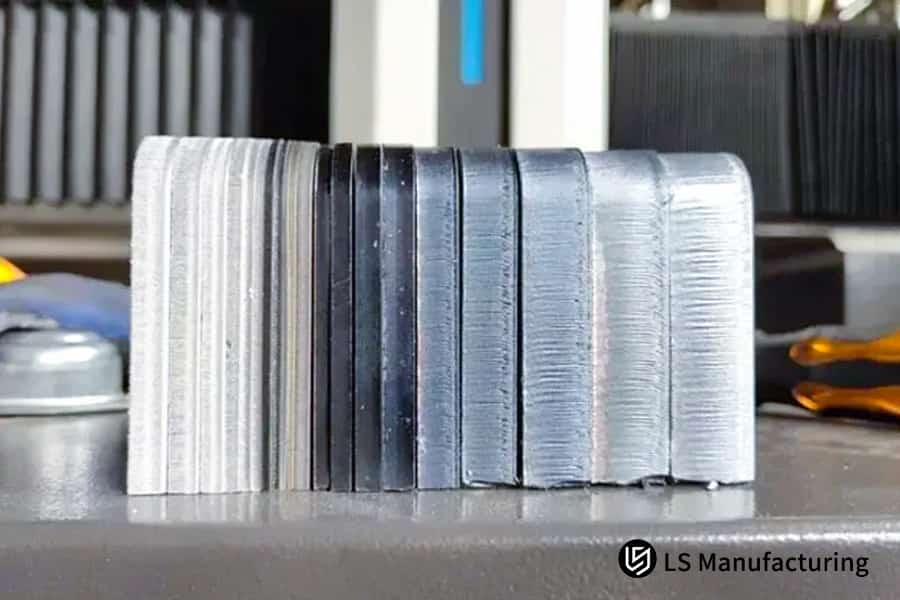
Figure 3: Several metal samples with cut edges, showcasing results from different cutting processes like laser and waterjet.
Why Is It Necessary To Strictly Control The Heat Affected Zone In Industrial Sheet Metal Fabrication To Ensure Subsequent Welding Strength?
In the field of industrial sheet metal fabrication, the laser cutting stage has a major impact on how the parts will be bent and welded later on. Controlling the heat-affected zone (HAZ), i.e. the small surface layer that is altered by being heated, is critical for weld strength and is something that is commonly neglected.
Potential Hazards of the Heat-Affected Zone
Fiber laser cutting creates a 0.1-0.3mm thick surface layer with different mechanical properties (i.e. a heat affected zone or HAZ) that if uncontrolled can cause:
- Too much springback during CNC bending leading to bending accuracy deviations of up to 0.2mm, thus impacting assembly.
- Lowering the weld toughness of the structural components that will be welded, thus increasing the chances of microcracks and failure to meet the AWS D1.1 requirements for steel structure welding.
Heat-Affected Zone Control Scheme
- Parameter Optimization: To limit the HAZ to 0.1mm, reduce energy density and increase cutting speed, which will also keep the weld strength at least 95% of the base metal.
- Auxiliary Processing: For very high demand projects, a 0.2mm machining allowance is left for subsequent precision grinding to remove the hardened layer, areas of critical welding are processed by the water jet method to completely eliminate the HAZ.
How Can Professional Industrial Sheet Metal Fabrication Manufacturers Ensure Stable Delivery Time Through Equipment Redundancy?
Stable delivery times are a fundamental customer requirement in industrial sheet metal fabrication. Delivery delays are mainly caused by equipment failures and maintenance downtime. We implement an equipment redundancy strategy to provide a "zero delay" delivery guarantee.
Equipment Redundancy System Construction
Our company has several 12kW laser cutting machines and high pressure water jets of the same specifications to set up an "equipment hot backup" system.
In case a single piece of equipment is broken down or is under maintenance, the production line can be immediately switched and the backup equipment can be running within 10 minutes, thus completely avoiding the downtime and ensuring uninterrupted production.
Auxiliary Measures for Delivery Time Guarantee
We implement a 24/7 lights out production mode, along with an intelligent scheduling system aimed at unattended continuous production, thus not only improving efficiency but also reducing the risks of delivery time. Heavy asset investment is turned into a "zero delay" brand promise, satisfying the requirements of high value procurement.
FAQs
Q1: What are the achievable tolerances for laser cutting and waterjet cutting in sheet metal processing?
Our fiber laser is capable of achieving a positioning accuracy of 0.1mm (ideal for 1-12mm thin plates). However, precision waterjet cutting can consistently maintain a tolerance of 0.05-0.15mm when working on thick plates.
Q2: Why do you suggest giving fiber laser cutting a higher priority when producing high precision aluminum alloy parts?
By combining fiber laser with our dynamic frequency compensation technology, we have achieved a method of eliminating the issue of the accumulation of slag on aluminum alloys after processing. The processing speed is 5-10 times faster than that of waterjet cutting, resulting in a drastic increase in efficiency and a reduction in costs.
Q3: How does LS Manufacturing ensure the perpendicularity of the cut for ultra thick carbon steel plates exceeding 25mm?
LS Manufacturing's solution to the problem is to utilize a powerful waterjet or a laser head, which is compensated for bevel. By lowering the speed and raising the gas flow, we can guarantee that the bevel angle is kept within 1 therefore fulfilling the requirements of thick plates.
Q4: Does fiber laser cutting change the chemical properties of the edges of stainless steel parts?
In some cases when cutting with oxygen, the metal surface can be oxidized. We usually cut the metal with high pressure nitrogen to protect the metal color naturally and also make it easier to weld without doing any extra work.
Q5: My drawing requires extremely small micro holes. Will waterjet cutting cause chipping?
Waterjet cutting micro holes smaller than 1.5mm may cause chipping. To prevent damage in the weak parts of the material, we advise laser pre-drilling or usage of a complete laser setup.
Q6: When customizing sheet metal parts in bulk, which process can help me obtain a more competitive quote?
For large volume workpieces with thickness less than 10mm, fiber laser cutting has such a high production rate per hour that a price of only 40% higher than waterjet cutting would significantly lower your bulk purchase costs.
Q7: If my parts require mirror polishing, what are the considerations for choosing the cutting process?
It would be best if you consider laser cutting together with our surface finishing procedure so that you can minimize grinding after processing, get a surface roughness of around Ra1.6, and be ready for mirror polishing.
Q8: Will LS Manufacturing allow uploading of CAD drawings for a free evaluation of the DFM process?
Yes, Our engineers will give you process recommendations and price quotes based on your drawings in 24 hours to help you achieve a balance between manufacturability and cost.
Summary
Fiber laser cutting is a good way to cut medium or thin plates in custom sheet metal fabrication and Waterjet cutting is a good choice for thick plates and heat sensitive materials (quality assurance). Material thickness tolerances, and post processes should be considered when deciding both methods.
The right process can save 20%-25% of costs and speed up delivery times. With top notch equipment and technology, LS Manufacturing assists customers in choosing the best balance of cost, quality, and delivery time.
Upgrade your precision sheet metal supply chain. Get in touch with one of our experts now or upload your STEP/DXF files to receive a personalized DFM evaluation and price. Take advantage of our 24-hour rapid quote service and get a cheap custom sheet metal fabrication solution.
📞Tel: +86 185 6675 9667
📧Email: info@lsrpf.com
🌐Website: https://lsrpf.com/
免责声明
The contents of this page are for informational purposes only. LS Manufacturing services There are no representations or warranties, express or implied, as to the accuracy, completeness or validity of the information.不应推断第三方供应商或制造商将通过 LS Manufacturing 网络提供性能参数、几何公差、具体设计特征、材料质量和类型或工艺。 It's the buyer's responsibility. Require parts quotation Identify specific requirements for these sections.Please contact us for more information.
LS 制造团队
LS Manufacturing 是一家行业领先的公司。专注于定制制造解决方案。 We have over 20 years of experience with over 5,000 customers, and we focus on high precision CNC machining, Sheet metal manufacturing, 3D printing, Injection molding. Metal stamping,and other one-stop manufacturing services.
Our factory is equipped with over 100 state-of-the-art 5-axis machining centers, ISO 9001:2015 certified.我们为全球150多个国家的客户提供快速、高效、高质量的制造解决方案。无论是小批量生产还是大规模定制,我们都能以最快的24小时内交货满足您的需求。选择LS制造。 This means selection efficiency, quality and professionalism.
To learn more, visit our website:www.lsrpf.com.


|
Material Type |
Thickness Range |
Recommended Laser Power |
Auxiliary Gas |
Key Notes |
Adaptability to Custom Metal Fabrication Parts |
|
Q235 Carbon Steel |
1-12mm |
6-12kW |
Oxygen |
Control cutting speed to avoid dross. |
High, suitable for mass-produced standard parts. |
|
304 Stainless Steel |
1-8mm |
8-12kW |
Nitrogen |
Prevent oxidation and optimize focus position. |
High, suitable for precision parts. |
|
Aluminum Alloy |
1-6mm |
12kW |
Nitrogen |
Adopt anti-reflection technology to avoid equipment damage. |
Medium, suitable for lightweight parts. |
|
Titanium Alloy |
1-4mm |
12kW |
Argon |
Control energy density to avoid thermal deformation. |
Medium, suitable for high-end customized parts. |
|
Ultra-High Strength Steel |
1-8mm |
12kW |
Nitrogen |
Reduce feed speed to ensure cutting quality. |
High, suitable for industrial structural parts. |