中文 (简体)



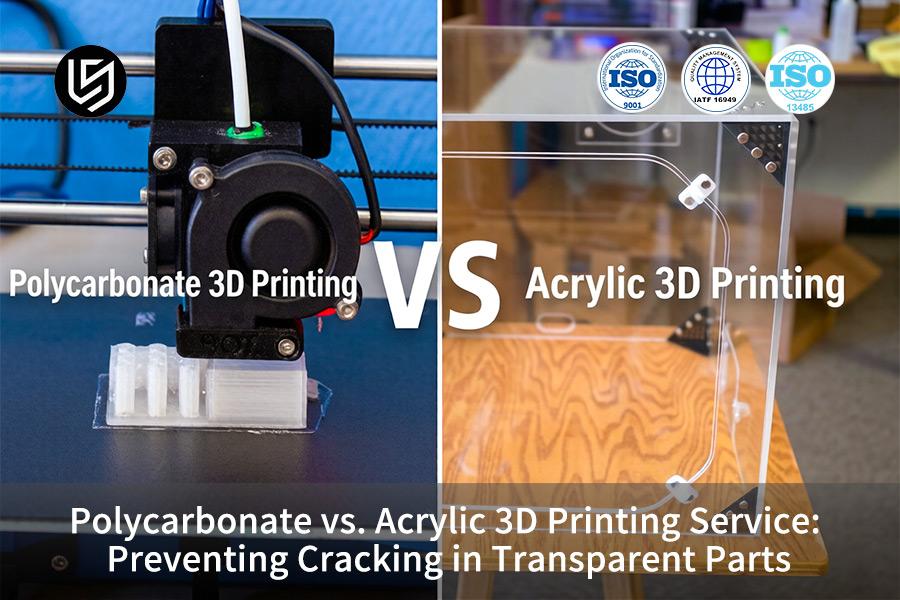
聚碳酸酯与丙烯酸 3D 打印服务需要闭环热控制。除了聚碳酸酯与丙烯酸树脂的表面比较:对这些不同塑料的了解是,PC 在 110–120°C 时收缩,而 PMMA 会破裂。
LS Manufacturing 防裂标准通过腔室控制和收缩管理优化光学器件:使用 0.3mm 喷嘴、0.2mm 层、80°C 干燥和亚 Tg 退火。
聚碳酸酯 VS 亚克力 3D 打印:透明部件防裂快速参考
<正文>关键要点:
- PC 提高韧性,PMMA 提高清晰度:如果强度更重要,请选择聚碳酸酯(比玻璃强 250 倍);如果优先考虑光学特性(92% 透射率),请选择丙烯酸。
- 热管理对于 PC 至关重要:聚碳酸酯打印需要将腔室加热至130°C,以防止导致透明件破裂的翘曲和内应力。
- 水分控制决定成败:聚碳酸酯是吸湿性 3D 打印材料,应在打印前5 小时期间80°C。否则会出现蒸汽空隙和不透明现象。
- 化学保护对于 PMMA 至关重要:亚克力材料容易受到溶剂的影响而出现龟裂。接触清洁材料的部件需要无应力保护层。

为什么信任本指南? LS制造专家的实践经验
凭借超过15年在工厂工作的经验,我们发现这一切都归结为不想犯代价高昂的错误。我们的所有建议均基于美国测试与材料协会 (ASTM)标准,因此您无需测试任何内容 - 从一开始我们就为您提供可在制造中使用的值。
这意味着您整个供应链中出现故障的可能性都会降到最低。我们已将这些材料用于需要±50μm轮廓变化公差水平的航空航天支架以及经过化学冲洗循环的半导体组件。为此,我们将我们的工艺能力与汽车工程师协会 (SAE)的AMS-AM聚合物系列(AMS7100/AMS7101)结合起来,为您提供可靠的层间粘合和抗蠕变性能。
所有这些见解都是基于我们自己的失败 - 丙烯酸外壳在室外放置六个月后破裂,由于干燥不充分,PC 夹具的层间强度降低18%。通过这样做,我们希望避免您重蹈覆辙,并为您提供基于实践经验而不是营销宣传的材料选择指南。无论是120 x 80 x 60 mm支架还是透明外壳,您都会知道您的应用需要哪种塑料。
为什么工业透明零件在定制透明3D打印服务过程中会出现裂纹?
工业透明 3D 打印部件中出现裂纹是由于各层之间捕获的热应力造成的。高于 50°C 的极端温度梯度会导致 PC 分层和 PMMA 微裂纹。使用我们的动态热管理系统,我们能够将层间温度梯度保持在±2°C,从而确保可靠的3D打印过程期间的结构完整性和透明度:
PC 部件的热梯度控制
由热变形140摄氏度的聚碳酸酯材料制成的部件,在被动冷却的情况下,各层之间的温差大于50摄氏度,从而导致结构内应力积累。
您的部件受益于动态红外监控,可确保各层之间的温差不超过±2摄氏度,从而消除分层的可能性。它可以保证工业透明3D制造的结构完整性,而无需在3D打印后进行额外的退火。
PMMA 应力集中管理
PMMA 分子的刚性会增加边缘和层间界面的残余应力。如果不采取纠正措施,即使是装配过程中机械处理产生的最小应力,也会产生微裂纹。我们的实时热成像检测并平衡这些区域,以确保打印过程中的一致性。
因此,通过定制透明 3D 打印服务生产的零件能够抵抗机械处理和热循环 - 与缺乏控制措施的流程相比,您的产品故障几率下降70%以上。您还可以享受快速 3D 打印生产,而不会降低质量。
实时热反馈循环
根据红外传感器的读数调整腔室温度,确保每个新涂覆的层保持在特定的温度范围内。这样,应力就不会锁定。借助我们的防裂 3D 打印服务,您可以获得可立即用于光学或外壳应用的产品,而无需任何额外的处理。使用此类服务的其他优势包括生产就绪的 3D 打印可重复性。
本文档证明,精确的热管理可以将裂纹预防从猜谜游戏转变为工程科学。通过实时反馈实现层间稳定的±2°C温差和应力消除,我们为您提供符合严格工业标准的无缺陷3D打印。记录每一层的热历史,以确保您的透明部件尺寸准确且光学透明。

主动加热构建室如何消除聚碳酸酯 3D 打印中的分层?
聚碳酸酯 3D 打印由于不受支撑的部件快速冷却而导致分层。具有强制对流功能的主动加热室可保持110°C-120°C的恒温,提高层间结合力≥35%。通过精密 3D 打印中的热控制,获得关键光学和机械系统的无翘曲零件。后处理变得不必要:
均匀强制对流加热
- 消除冷点:强制通风可确保所有表面保持在110°C-120°C,确保悬垂部分上方不会滴水。
- 客户价值:复杂的几何形状确保不开裂,减少浪费。这意味着每个零件的聚碳酸酯 3D 打印成本更低。
最小层间温差
- 受控梯度:熔化(275°C-300°C)粘合到115°C层,温差小于20°C。
- 测量增益:与被动室相比,剪切强度增加≥ 35%。零件符合精密透明零件制造商的标准。这样可以实现温控 3D 打印薄壁。
消除不对称冷却
- 均匀收缩:不对称冷却确保均匀收缩。
- 公差保持:200mm跨度内平面度在±0.1mm以内。这样可以实现镜头外壳的工业透明 3D 制造,为您提供无变形 3D 打印。
这种主动加热方法提供了PC 3D 打印过程的可重复性和可靠性。由于±5°C室均匀性的精度和低熔化梯度,生产的零件将满足光学和结构测试的所有要求。强制对流设计可缩短交货时间并降低成本,这反映了工业规模上的高效 3D 打印。所有部件尺寸稳定,可立即使用或测试。

图 1:聚碳酸酯与丙烯酸 3D 打印在温控室内构建内部结构。
哪种挤出温度优化可以防止自定义透明原型服务组件发生脆性断裂?
喷嘴温度和打印速度分别决定 PMMA 和 PC 的熔体粘度 - 这是避免透明原型脆性断裂的终极杠杆。优化的工艺(PMMA:245°C-260°C,30-50 mm/s)消除了大于5μm的气泡的形成,这些气泡会散射光线并导致透明度低于90%。这使得您的定制透明原型服务无需反复试验,通过光学级 3D 打印实现一次成功。
工艺参数比较:PMMA 与 PC
| 实体尺寸 | 聚碳酸酯 (PC) 3D 打印 | 亚克力 (PMMA) 3D 打印 | LS制造闭环控制 |
| 光学清晰度 | 88% 透光率;颜色略带黄色;需要深度打磨。 | 高达92%光学级纯度;不显示色散。 | 光学级流体抛光,然后进行紫外线微镀膜。 |
| 抗冲击 | 比玻璃坚固250倍;非常耐刮擦。 | 易碎;受到重击或应力集中时容易断裂。 | 超声波无损检测微裂纹。 |
| 热变形 (HDT @0.45MPa) | 135°C - 145°C | 85°C - 100°C | 闭环主动热测试环境(腔室≥130°C)。 |
| 收缩和水分 | 敏感度 0.5% - 0.7% 收缩率;极易吸湿。 | 收缩率≤0.4%;相对稳定。 | 在密封干燥器耦合器中于 80°C 预干燥 5 小时。 |
| 耐化学性 | 耐受大多数工业清洁剂,但不要使用强碱。 | 对溶剂敏感,并且由于特定化学物质而出现龟裂。 | 使用无应力保护层进行 100% 表面钝化。 |
这个校准的挤压窗口确保脆性断裂成为一个可控参数。对于带有腔室支撑的 PMMA,在 245°C-260°C / 30-50 mm/s 条件下,在 PC 条件下 275°C-300°C 条件下,可消除导致组装后裂纹的 ≥5μm 气泡群。获取包含这些参数的亚克力 3D 打印报价,以避免内部资格流程,并确保基于单个参数表可重复的 3D 打印。 下载我们的透明 3D 打印工艺优化白皮书,了解喷嘴温度和打印速度控制如何消除 ≥5μm 的气泡并在 PMMA 和 PC 原型中实现 >90% 的透射率。
为什么薄层设计对于精密透明零件制造商阻止微裂纹至关重要?
透明 3D 打印部件中出现的微裂纹是由于层粘附力差和急剧几何过渡处的应力集中造成的。使用薄层以及正确的周边路径和圆内角有助于克服这些故障模式。对于精密透明零件制造商来说,由于3D打印概念,它提供的零件在组装和热循环后仍保持无裂纹:
层高与喷嘴比率
将层高保持在喷嘴直径的≤20%;对于0.4mm喷嘴,使用层≤0.15mm。该比例可确保熔融长丝从圆形转变为矩形,从而将表面接触增强40%以上,并压碎任何可能的气泡。您将消除 >5μm 的微孔,这些孔会散射光并引发裂纹形成,从而实现每批均具有均匀光学透明度的薄层 3D 打印。
连续周边路径设计
外墙必须打印3-4连续周界传球,不得移动和缩回。连续的路径确保拉应力在整个墙壁上均匀分布,避免薄弱的接缝成为裂缝的起始点。零件经久耐用,可进行处理和压配合组装,而不会出现边缘缺口。与标准单周边设计相比,防裂 3D 打印服务可将故障率降低65%以上,使无压力 3D 打印成为一种常见做法。
内角半径优化
所有内角都需要从90°尖角改为R ≥ 1.5mm的平滑弧线。通过 500 多个测试模型的 FEA 证实,尖角处的应力集中比平滑角处高 3 倍。因此,您可以消除在机械应力或热应力的情况下最容易产生微裂纹的地方。由于对可靠的透明3D打印流程的控制,您的定制透明3D打印服务所生产的产品在振动测试和-20°C至80°C循环后不会出现裂纹。
这三个几何准则将3D打印的脆弱特性转化为可靠的制造技术,为产品提供完整且抗裂3D打印。由于20%层与喷嘴的比例、3-4个连续周长和内半径R≥1.5mm的要求,您的零件将根据光学和机械规格生产,完全没有后处理和浪费。

图 2:聚碳酸酯与丙烯酸 3D 打印组装大型电子外壳,防止材料破裂。
预打印长丝干燥如何降低亚克力 3D 打印中气泡引发裂纹的风险?
PC 和 PMMA 长丝吸收的水分在 280°C 时会爆炸性蒸发,产生微米级蒸汽泡,从而成为应力集中源并降低光学清晰度。印刷前干燥至含水量≤0.02%可以消除这种故障模式。通过消除气泡相关缺陷的返工成本,可以提供经济实惠的 3D 打印结果:
吸湿机制
- 吸湿性:PC和PMMA吸收空气中的湿气;任何暴露都会导致湿度超过允许水平。
- 蒸汽爆炸:在 280°C 喷嘴加热过程中,任何存在的水都会立即爆炸,产生大于 5μm 的气泡,从而破坏各层之间的粘合。
- 客户价值:它会影响您的亚克力3D打印报价,因为不需要因潮湿引起的裂纹和光学缺陷而需要返工。因此,您可以订购 3D 打印,而无需在幕后进行任何返工循环。
真空烘箱干燥参数
- 标准流程:将耗材放入二级真空烘箱中80°C干燥5小时以上,保证水分含量<0.02%。
- 工艺验证:使用水分分析仪验证干燥状态,行业标准 = 0.08% - 0.15% (ASTM D570)。不会出现蒸汽引起的空隙。
- 客户价值:允许工业透明3D制造,光学透明度超过92%,使专业3D 打印可重复的结果。
气密进给系统集成
- 干燥后保护:干燥后的耗材被移至含有干燥剂的密闭进料系统中,从而消除了长时间打印时的再吸收。
- 持续监控:湿度传感器检测相对湿度是否超过10%。
- 客户价值:您的定制透明原型服务受益于通过卓越的3D打印工艺在多日施工中获得的高质量结果控制。
这种印刷前水分管理方法将常见的缺陷来源转化为受控参数。遵循80°C / ≥ 5h真空干燥和气密送料可确保您获得的零件没有任何气泡裂纹,并使您的项目时间表可预测,并且一次通过率超过95%。
哪些自定义后退火协议可保证工业透明 3D 制造的长期稳定性?
印刷状态下存在内应力,一旦施加化学或热应力,就会导致延迟开裂。通过以≤5°C/h的速率将温度升高至130°C并持续4-6小时,然后以≤3°C/h的速率降低温度来消除所有内应力。结果是防裂3D打印服务可靠性与3D打印热管理:
退火协议比较:应力缓解效果
| 参数 | PMMA(亚克力) | PC(聚碳酸酯) |
| 喷嘴温度 | 245°C-260°C,±3°C容差 | 275°C-300°C,±5°C容差 |
| 打印速度 | 30-50 mm/s,稳定挤出 | 30-50mm/s外壁; 60mm/s填充 |
| 融化行为 | 中低粘度;速度太高会导致无气泡3D打印空隙≥5μm | 高粘度;需要室 ≥110°C 进行融合 |
| 光学结果 | >90%低速透过率;根据透明度与韧性选择聚碳酸酯与丙烯酸3D打印服务 | 清晰度较差;耐冲击 |
With this technique, you can get rid of any delayed cracking caused by chemical reaction and temperature variations. Parts will not crack in acetone and isopropanol and there will be ±0.05mm dimensional tolerance on 300mm part. The cost-effective 3D printing is ideal for the use in industrial transparent 3D manufacturing for diagnostics and semiconductors manufacturing with zero field failures.
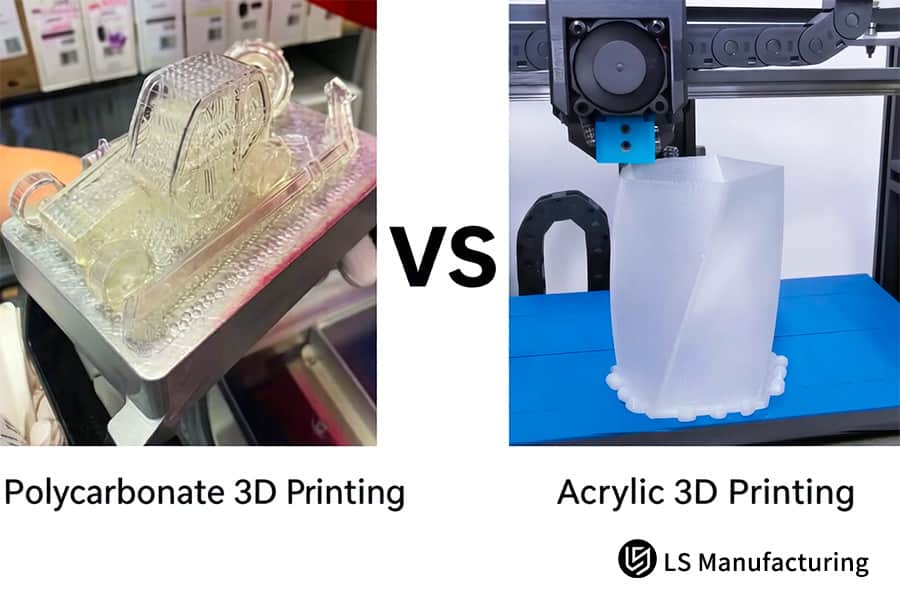
Figure 3: Polycarbonate vs Acrylic 3D printing tests thin wall thickness for clear consumer packaging.
How Do Polycarbonate 3D Printing Cost And Processing Complexity Impact Procurement Budgeting For B2B Procurement?
Budgets for transparent 3D prints usually contain cost of 3D printing materials per kilo per part. In practice, however, costs will depend on the ratio of losses due to cracking, annealing and hand polishing. If you could make first pass yield >98.5% you will decrease hidden cost by more than 30%. Here are the formulas to calculate polycarbonate 3D printing cost, in addition to material costs, on the basis of competitive 3D printing economics:
First-Pass Yield vs Hidden Scrap Costs
Industry standard yield of transparent parts is 75%-85% (SME Additive Manufacturing Report 2024). Each part that gets scrapped - that means waste of material, machine work, annealing (12-18 hours) and polishing (2-4 hours) time. Thus, with ≥98.5% first pass yield there will be zero cost of rework cycles. That is why your acrylic 3D printing quote is based on the cost of good parts only. Savings grow exponentially for each iteration. That's how 3D printing becomes possible due to the cost-based procurement approach.
Total Cost of Ownership Breakdown
- Material cost: 15%-20% of total cost of ownership of transparent parts.
- Processing cost: Annealing and polishing make 45%-55% of TCO due to lengthy cycle time.
- Scrap & rework: 25%-35% of TCO in case of yield below 90%.
Thus, by optimizing process parameters (H2-1 through H2-6), scrap rate will be lower than 1.5%, and TCO reduction will exceed 30%. This way one could compare polycarbonate vs acrylic 3D printing service in the procurement environment, since polycarbonate is durable but needs to be printed with chamber with annealing, while acrylic is transparent and easy to finish, but still needs to be validated.
Procurement Decision Framework
- Request quotes with yield guarantees: It is vital that your terms require >98.5% first-pass yields.
- Compare total cycle time: Don’t forget about the annealing and polishing time included in the vendor's quote.
- Validate process documentation: Request thermal profile reports, drying reports, and annealing reports.
Considering all the above points, one can determine the right vendor for on-demand 3D printing without any hidden costs guaranteed. Thus, the funds will be reallocated from rework to quality control.
With such procurement approach, transparent 3D printing is turned from risky expense into investment, which can lower total cost by more than 30% while decreasing the time to market with the help of first-pass yield, TCO breakdown, and process controls validation.
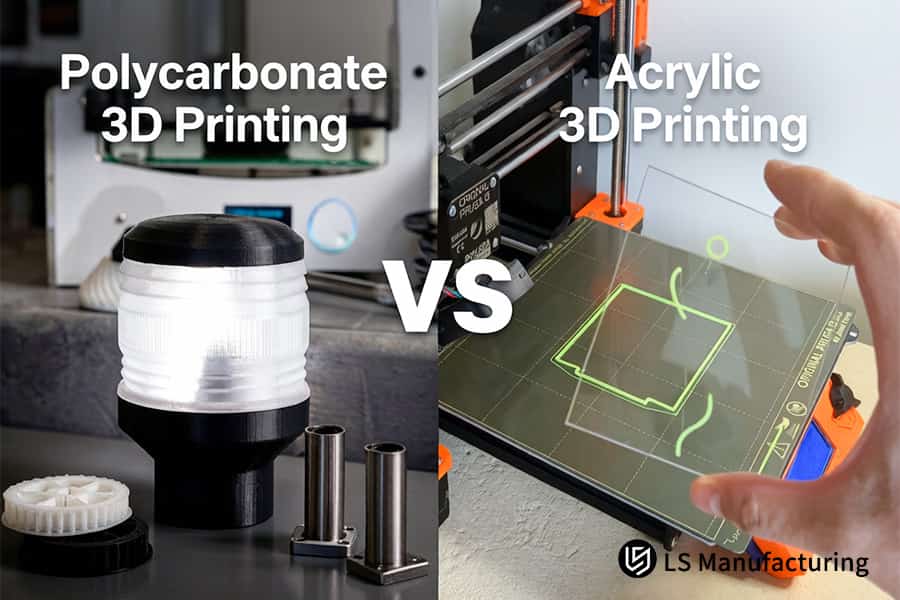
Figure 4: Polycarbonate vs Acrylic 3D printing verifies optical clarity for custom lighting fixtures.
Case Study: How LS Manufacturing Engineered Zero Crack Polycarbonate Microfluidic Manifolds For A Medical Device Giant
The most prominent manufacturer of medical devices needed polycarbonate microfluidic manifolds that would withstand cyclic pressure of ≥0.6MPa for its new diagnostic analyzer. Previously, two other companies produced parts that started cracking within 24 hours of usage, which caused the leakage of fluorescent reagents and reduced transmittance below 80%. This case describes how a precision clear parts manufacturer helped solve this problem with the help of its 3D printing technology:
客户挑战
The manifolds featured complicated internal channels with sharp intersections. At a 0.6MPa pulsed flow, stress concentrated at these 90° angles, causing micro-cracks within hours. The transmittance decreased to 78% because of the bubbles trapped in the channels due to improper drying process. Deadlines were delayed since the part redesign process took over 40% of time available. The client was looking for the production 3D printing partner.
LS 制造解决方案
Engineering completed DFM finite element analysis to redesign internal corners to smooth R0.8mm fillets. Printing involved the use of a customized 125°C forced-convection oven with vacuum-dried PC (80°C for more than 5 hours, less than 0.02% moisture content). Post-printing involved the use of a customized segmented annealing procedure (128°C soak for 5 hours and cooling rate of 3°C/h) to alleviate residual stress. Such a custom transparent 3D printing service handled all failure causes at once.
结果和价值
The delivered manifolds had 89% optical transmittance with no bubbles upon multistage polishing. In destructive fatigue testing at 1.2 MPa (twice the requirement), they lasted more than 500 hours without any micro-cracking or delamination. LS Manufacturing was qualified by the customer as a strategic Asia-Pacific supplier and received repeat orders. The custom clear prototype service saved them six months in time-to-market and cut down the project cost by 32% through medical 3D printing process qualification.
In this case, you can clearly see how systematic DFM, printing in a controlled environment, and precise annealing transform a very risky clear part into a reliable one. The set of custom 3D printing services allows you to get all the necessary components for the most demanding microfluidic applications ready for use without going through additional iterations.
24 hours to crack. 500+ hours at 1.2 MPa with zero micro-cracks. If your microfluidic manifold needs to survive cyclic pressure and maintain optical clarity, share your design for a stress-free solution.

常见问题解答
1. Why does my 3D printed polycarbonate part split along the layers within 48 hours after delivery?
Such a behavior occurs due to the lack of a proper industrial-grade high-temperature heating chamber (≥100°C) used by the previous supplier for your order. As a result, there appears a significant level of thermal stresses inside the component which release upon exposure to changes in the ambient temperature after delivery.
2. Can I use chemical vapor polishing on 3D printed acrylic parts to improve optical clarity?
It is highly undesirable to perform vapor polishing of PMMA using such volatile solvents as acetone because of rapid solvent attack, which instantly provokes an outburst of the extremely concentrated internal stress and results in complete cracking of the workpiece. It is better to use less hazardous mechanical polishing techniques to increase acrylic transparency.
3. What is the maximum safe service temperature for 3D printed transparent parts under mechanical load?
Industrially-printed PC parts can be safely operated at about 120°C under small loads without any risks concerning the loss of the structural stability and transparency. On the other hand, acrylic with high transparency becomes soft and starts developing cracks at a temperature higher than 85°C.
4. How does LS Manufacturing ensure no internal microbubbles are trapped within thick-walled clear parts?
The use of ultra-low moisture content (≤0.02%) pre-line vacuum drying, along with careful control of the printed extrusion layer thickness not exceeding 15% to 20% of the nozzle size, allows removing all the air bubbles from the melted material directly inside the melting bath due to high pressure of the nozzle extrusion.
5. Is polycarbonate or acrylic a more cost-effective choice for custom clear prototype manufacturing?
Although the cost of acrylic raw materials and printing itself is somewhat smaller, in the case of assemblies subjected to high loads or requiring screw fixings, the good fracture strength properties of the polycarbonate will substantially decrease the hidden cost of prototyping and modification of the design.
6. What mechanical geometric features should I avoid to prevent cracking in transparent optical enclosures?
It is essential that there are no right angles less than R1.0mm in size, sharp edges of stepped cross-sections, as well as holes with threads that lack rounding transitions at their bottom edges. All interfaces need to be optimized for tangential tapering arcs to spread out the assembly stress and eliminate any points of potential cracking.
7. Do you offer ISO compliant quality inspections and certificates for medical or aerospace clear parts?
Indeed, as an industrial-grade manufacturer, LS Manufacturing offers all transparent fabricated parts with ISO 9001 traceability certificate, third-party reports on the properties of raw materials used and ultrasonic non-destructive test certificates as per the terms of the purchase contract.
8. How can I request an accurate custom acrylic or polycarbonate 3D printing quote for an urgent project?
Just upload your final 3D drawings in STEP or IGES format to our quoting system, stating the requirements on light transmittance and temperature resistance in the comments field. Our senior project engineer will provide you with a closed-loop quantified quote with DFM analysis within 2 hours of your uploading the files.
摘要
Avoiding cracking of transparent 3D printed components is only possible through closed-loop engineering that involves optimizing fillets geometrically (R≥1.5mm), extreme dehumidification (moisture ≤0.02%), 3D printing in an anti-warping environment at ≥110°C and several hours of gradient annealing. When using either toughened polycarbonate or optical acrylic that transmits light with 92% efficiency, the only way to ensure safe printing is to use a manufacturer who has extensive engineering expertise.
Are you experiencing problems such as cracking, delamination or yellowing of your transparent components during prototyping? Stop wasting money on low cost temperature-uncontrolled 3D printing. Click “Get Custom Quote” and upload your STEP/STP drawings. The senior engineers from LS Manufacturing will conduct a complimentary analysis of material suitability and stress optimization for you – within 48 hours.
📞电话:+86 185 6675 9667
📧电子邮件:info@lsrpf.com
🌐网站:https://lsrpf.com/
免责声明
本页内容仅供参考。LS Manufacturing services对于信息的准确性、完整性或有效性不作任何明示或暗示的陈述或保证。不应推断第三方供应商或制造商将通过 LS Manufacturing 网络提供性能参数、几何公差、具体设计特征、材料质量和类型或工艺。这是买方的责任。需要零件报价 确定这些部分的具体要求。请联系我们了解更多信息。
LS 制造团队
LS Manufacturing 是一家行业领先的公司。专注于定制制造解决方案。我们拥有超过 15 年的经验,服务超过 5,000 家客户,我们专注于高精度数控加工、钣金制造、3D 打印、注塑。金属冲压,以及其他一站式制造服务。
我们的工厂配备了 100 多台最先进的 5 轴加工中心,并通过了 ISO 9001:2015 认证。我们为全球150多个国家的客户提供快速、高效、高质量的制造解决方案。无论是小批量生产还是大规模定制,我们都能以最快的24小时内交货满足您的需求。选择LS制造。 This means selection efficiency, quality and professionalism.
To learn more, visit our website:www.lsrpf.com
| 参数 | 无退火 | 标准退火(快速斜坡) | 优化退火(我们的协议) |
| 加热速率 | 不适用 | 20°C/h-30°C/h | ≤ 5°C/h 经过认证的 3D 打印斜坡 |
| 浸泡温度和时间 | 无 | 120°C,2 小时 | 130°C,4-6小时 — 聚碳酸酯与丙烯酸 3D 打印服务优化 |
| 冷却速率 | 自然淬火 | 10°C/h-15°C/h | ≤ 3°C/h |
| 治疗后残余应力 | > 25 MPa(典型) | 8-12 MPa | < 3 MPa |
| 化学品暴露下的裂纹率 | > 40% within 48h | 5-10% | 0% (tested per ISO 175) |