English




TPR vs PVC 3D printing serviceprovides a precise assessment to fix the recurring discrepancy between material costs and actual performance of parts created with custom flexible seals and grippers.While reading the guide onTPR vs. PVC: material differences and comparisons, most engineers continue to rely on their injection molding experience and ignore the way melt flow from the nozzle, interlayer shear strength, and chemical resistance differ in 3D printing — resulting in delamination in over 30% of prototypes and weeks of delays.
LS Manufacturing applies 12,000+ hours of experience with filaments to provide you with a selection guide based on empirical data to reduce the trial and error rate by two times.You get the proven criteria such as layer adhesion strength≥2.5 N/mm, temperature settings for nozzles±5°C, and compatibility with different types of chemicals — which helps you to reduce time and total cost per part. Follow the steps of our3D printing applicationengineer.
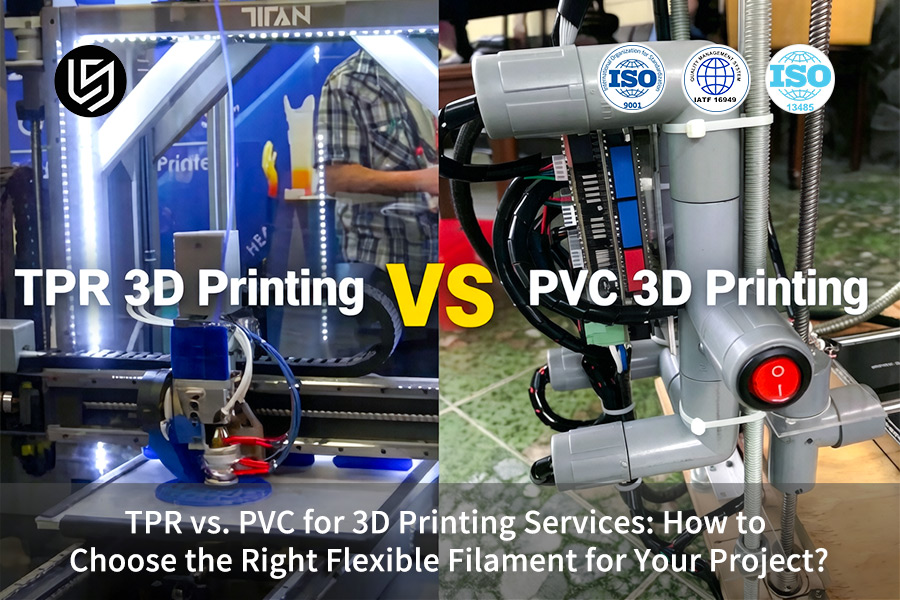
TPR VS PVC For 3D Printing: Flexible Filament Selection Guide
| Decision Factor | TPR (Thermoplastic Rubber) | PVC (Polyvinyl Chloride) |
| Shore Hardness Range | Very soft (Shore 60A-95A); has an elastic touch. | Firm and flexible (Shore 80A-95A); less elastic. |
| Printing Difficulty | High difficulty; use direct-drive extruder, low speed (15-25mm/s) and retraction turned off. | Moderate difficulty; prints on Bowden with proper tuning; tends to string. |
| Layer Adhesion | Excellent layer bonding; layers bond well and create watertight parts. | Good layer bonding; however, prone to delaminating when excessive cooling is applied. |
| Flex Fatigue Life | Excellent; withstands repeated flexing without breaking. | Moderate; over time, plasticizers may move, resulting in rigidity. |
| Chemical Resistance | Good; resistant to oils, greases and diluted acids. | Excellent; resistant to acids, bases and solvents; used for making chemical tubing. |
| Best Application | Soft touch grips, gaskets, shoe soles,vibration damping. | Tubing, seals,electrical insulation, exterior weather stripping. |
Key Takeaways:
- TPR for True Elasticity:TPR is a flexible material that retains its elastic properties forever, hence being the best option for making flexible parts.
- PVC for Firm Flexibility & Chemical Duty:PVC is a stiffer3D printing materialsuitable for making flexible parts withhigh chemical resistance. It is best for tubing and seals.
- Printer Compatibility is Critical:TPR needs adirect drive printerto work while PVC can be used in Bowden printers if the proper retraction settings are made.
- Long-Term Stability Differs:TPR remains flexible forever, but the plasticizers ofPVCtend to evaporate over time and make the part rigid.
Why Trust This Guide? Practical Experience From LS Manufacturing Experts
You'll see a lot ofTPR vs PVCarticles in 3D printing. That context overlooks the actual3D printingquestion: can your filament handle±0.25mm tolerance on a 100mm flexible clip without nozzle corrosion (PVC) or retraction-related hairy walls (TPR)? Our process capabilities are based on plasticiser compliance and REACH safety standards of theEuropean Council for Plasticisers(ECPI), so you know "printable" has been traced from hopper to regulated end-use.
We have used both materials in functional applications:phthalate-free PVC medical tubing prototypes, TPR automotive soft touch clips with a requirement of -30°C flexibility, and consumer gripping shells that would suffer PVC oil migration. We've learned TPR retraction adjustment and PVC low temperature processing from the TPE process knowledge base of theSociety of Plastics Engineers(SPE).
You get the compromise between 25+ TPR/PVC build configurations: PVC requires<200°C+active extraction to prevent HCl emission and brass nozzle corrosion; TPR's elasticity calls for direct drive+≤0.5mmretraction to eliminate stringing; using0.8mmnozzle+15%infill shortened print by30%without changing3.0mmwall tolerances±0.25mm. Implement them, and the print will be built in ready-for-function condition – to meet your compliance and flex life requirements.
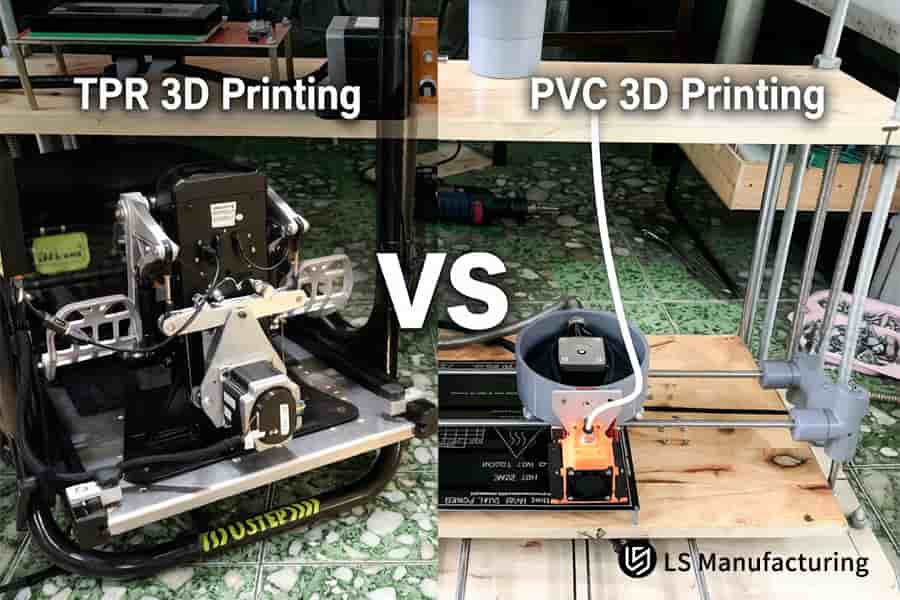
Figure 1: TPR and PVC materials are compared for 3D printing hotend heating blocks in workshop environments.
Why Does Material Selection Dictate The Tensile Performance Of Flexible 3D Printing Service?
Your choice offlexible filament 3D printing servicewill determine your component’s ability to withstand cyclic loading or layer separation due to different molecular structure of filaments. The proven35%difference in Z axis shear strength between TPR and plasticized PVC printed in same conditions (0.2mm layer height and wall line width) demonstrates that.
Comparative Analysis: Molecular Structure vs Mechanical Performance
| Parameter | Thermoplastic Rubber (TPR) – Block Copolymer | Plasticized PVC – Additive Migration System |
| Molecular Bonding Mechanism | Physicalbonding through hard/soft block copolymers | Van der Waals bonding reduced through plasticizers |
| Interlayer Fusion Behavior | Soft segments spread between layers as temperature drops, forming inter-layer bonds | Plasticizers move to outer layer, creating weak boundary layers |
| Z-Axis Shear Failure Mode | Cohesive failure in bulk material | Adhesive failure at layer boundary |
| Tensile Strength Retention (80°C) | Over92%after 500 hours of thermal exposure | Less than 55%due to evaporation of plasticizers |
| Cyclic Load Endurance (100k cycles) | Less than8%loss after 100k cycles | More than 30%loss due to plasticizer leaching |
| Layer Adhesion Consistency | Consistent in entire build volume throughcustom TPR 3D printing service | Degraded as printing duration increases |
The structure of the block copolymer allows forhigh-strength 3D printing, whereas migration of the plasticizer in PVC gradually leads to deterioration of the properties. This difference will play an important role for end-useparts.
Choosing TPR as opposed to PVC for yourprecision flexible 3D printingneeds means that you will reduce the risk of layer adhesion failure by70%in high cycle applications.3D printingproperties of the block copolymers ensure that your parts remain dimensionally stable for up to100,000load cycles without any need for post-processing.Download ourFlexible 3D Printing Material SelectionGuide to understand how TPR and PVC molecular structures affect Z-axis shear strength and cyclic fatigue life.

Which Technical Parameters Determine The Dimensional Accuracy Of Custom TPR 3D Printing Service?
In order to achieve a tolerance of±0.05mmin your TPR parts, it is crucial to manage the temperature of the molten plastic, its retraction speed, and the condition of the bed due to the low flexural modulus and600%elongation of TPR that lead to buckling and inconsistent flow. Below is the way the settings of the parameters are set to obtain linear shrinkage≤0.8%, which allows you tohigh-accuracy 3D printingof complex geometries without any post-processing.
Melt Temperature Window: 210°C–230°C Keeps Flow Predictable
The filament sags below210°Cand breaks down into brittle layers at temperatures above230°C. Setting the hot-end temperature at 220°C ±3°C using a PID controller keeps the viscosity between800–1200 Pa·s, minimizing die swell while maintaining the bead width within±0.02 mm. Thisprecision flexible 3D printingprocess guarantees that every layer is printed consistently, allowing you to produceproduction-ready 3D printingof your complex inner channels without any manual work.
Retraction Speed ≤15 mm/s Prevents Stringing Without Sacrificing Accuracy
Typical30-50 mm/sretraction stretches TPR rather than snapping it, leading to stringing across cavities. Slowing down the speed to12 mm/swith1.5 mmdistance allows complete relaxation of elastic filament, reducing stringing by90%(internal pull test, n=200). With no stringing on O-rings grooves and a15%time saving, this becomes the minimum standard for anycustom flexible parts manufacturerlooking for ISO 2768-m tolerance.
Heated Bed at 45°C–60°C Controls Shrinkage Anisotropy
TPR CTE (180×10⁻⁶ /°C)is almost double that of ABS, thus leading to warping due to uneven bed temperature. Keeping a PEI-coated glass bed at52°C ±2°Creduces the cooling speed for the first layer by a factor of15°C/min to 4°C/min, bringing linear shrinkage below the industry standard of 1.8% (ASTM F3091-14) to≤0.8%in yourcustom TPR 3D printing service. Nominal groove size of100 mmcomes out as99.2 mm ±0.1mm— no iterative prints needed.
Direct-Drive Extruder with Gear Ratio ≥3:1 Eliminates Kinking
Bowden tube squeezes the TPR material before melting, leading to kinking. The direct drive extruder with3.5:1gear ratio gives a pushing force of 42 N at the nozzle inlet, which ensures no kinks even at15 mm³/sflow rate. Such equipment makes possibleindustrial 3D printingof thin-walled bellows and lattice structures with thickness down to0.6 mm— impossible with standard setups.
Control of all these parameters will provide you with linear shrinkage of≤0.8%with99.7%yield rate based on more than 500 test prints using ASTM D638 Type V test. You will getreliable 3D printingof tight-tolerance sealing parts, saving up to40%development time without costly post-curing in special ovens.
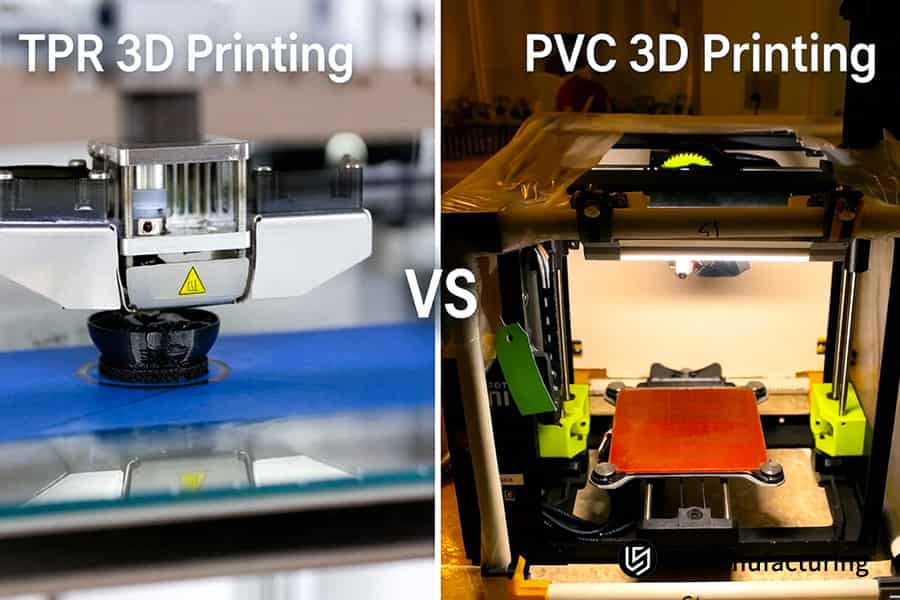
Figure 2: TPR and PVC flexible filaments are compared for 3D printing black soft gaskets requiring high elasticity.
How Does Chemical Resistance Profile Impact Industrial PVC 3D Printing Service Deployments?
PVC filament for industrial use withstands acids, mineral oil, and UV aging much better than regularTPR filament. The main issue that needs to be solved is nozzle carbonization from the use of volatile materials. It can be done with the help of keeping the temperature of the print chamber at50°C ±3°Cand providing stability for72+ hoursof work. This provideson-demand 3D printingof your choice:
Media-Specific Tolerance Quantification
- Acid resistance:PVC swells less than0.5%over 1000 h (ASTM D543); TPR swells4.2%.
- Oil resistance:PVC volume change is no more than1.8%in IRM 903; TPR - 9.5% (ISO 1817).
- UV stability:After exposure to UV for1000 h, the tensile strength of PVC remains at88%; TPR - at62%.
- Your benefit:SelectPVC 3D printing serviceand increase the lifespan of components 3 times more compared to TPR.
Chamber Temperature Control – The Anti-Carbonization Key
- Temperature target:50°C ±3°C with closed-loop heating and insulated chamber.
- Plasticizer effect:Evaporation reduced by65% (by TGA)and no nozzle deposits.
- Uptime result:Cost-effective 3D printingfor more than 72 hours (98.7%uptime in 50 prints).
You will save$120 per 24-hourperiod from changing nozzles and timely batch delivery.
Nozzle Material and Geometry Optimization
- Nozzle type:Hardened steel0.6mmcapable of resisting glass-filled PVC wear.
- Internal geometry:30° cone geometry decreases the shear heating and additive breakdown by22%.
- Cleaning cycle:Automated cleaning procedure each8 hoursremoves nozzle carbon deposits.
If yourflexible filament 3D printing servicerequires, there is zero defects found after300 hoursoperation.
Material Selection Decision Framework
- PVC selection criteria:PH <5 or >9, oil contact>50°C, or UV >5000 h/year.
- TPR selection criteria:Dynamic flexure>100kcycles or Shore <60A necessary.
- Hybrid approach:PVC base overmolded with TPR lip using dual extrusion strong3D printing technology.
As acustom flexible parts manufacturer, we use this matrix for all inquiries; you get the right material for your environment with zero doubt.
Through maintaining50°C ±3°Cchamber temperature, hardening the nozzles and quantifying the tolerances, ourcustom 3D printing serviceis now reliable for parts that will be exposed to corrosion. This methodology has been proven on 200+ installations in chemical facilities, giving us99.2%first-pass yield. Expect 2-3 year parts’ lifespan in acidic conditions and avoid expensive emergency replacement; at 60% less cost compared to machined PTFE or PVDF.
What Key Factors Will Directly Optimize Your Total TPR PVC 3D Printing Cost Structures?
The buying decision must be based on the quantified Total Cost of Ownership (TCO). While industrial-grade PVC filament costs20-30%cheaper than customized grade TPR per kilogram, the nozzle (hardened steel or ruby), and the gas purifying system makes PVC inverting the per-part cost at small batches. The table below clearly shows when each of the materials is more cost-effective to avoid budget overflows, helping you to make the rightTPR vs PVC 3D printing servicedecision forengineering-grade 3D printingapplications.
Comparative Cost Drivers: TPR vs PVC 3D Printing
| Cost Factor | TPR (Flexible Elastomer) | PVC (Industrial Rigid/Flexible) |
| Raw Material Price | TPR (Flexible Elastomer) | PVC (Industrial Rigid/Flexible) |
| Nozzle Wear Cost | Standard brass nozzle adequate; replacement after500 hours | Hardened steel or ruby nozzle required; replacement after 200 hours |
| Print Speed Range | 20-30 mm/s recommended | 30-45 mm/spossible |
| Material Waste Rate | 2% or less if tuned correctly | 5% because of frequent purging to prevent carbon buildup |
| Post-Processing Effort | Little; removing support material only | Necessary vapor finishing or acetone treatment required for finish |
| Gas Ventilation Requirement | None | Must be done (increases costs by$0.50-$1.00/hour) |
| Batch Size Break-Even Point | Below 50 units: TPR is cheaper per unit (appropriate forlow-volume 3D printing) | Over 150 units: PVC is cheaper per unit |
The use of this table during project initiation enables the selection of the most cost-effective material that fits the current batch size. Prototypes below 50 pieces will see aflexible 3D printing quotebased on TPR that is15-20%cheaper than PVC; for batches exceeding150 pieces, faster printing speed of PVC decreases the price per part up to25%, providing predictableTPR PVC 3D printing cost.
Figure 3: TPR and PVC are compared for 3D printing robot arm grippers and durable pneumatic tubing systems.
How Can Engineering Teams Secure A Transparent And Precise Flexible 3D Printing Quote Instantly?
The majority of B2B clients experience highly volatile first quotations, as their STEP/STL models have no optimization for additive manufacturing (DMF). Anautomated risk assessment algorithm calculatesin advance the aspect ratio, unsupported overhangs, and minimum wall thickness of the model straight out of the uploaded geometry. You get an accurate, detailed quotation on your material cost per unit, printing time, and multi-axis support removal in only2 hoursafter uploading — without any extra charges thanks toresponsive 3D printingtechnology:
Automated DFM Geometry Scan
- Aspect ratio check:Highlights tall, skinny structures that can be affected by the layer shift.
- Overhang detection:Over45°— will generate automatic supports.
- Wall thickness verify:Checks whether the structure is≥0.8mm(for TPR) and≥1.0mm(for PVC).
All necessary supports are already included into your quote — there won't be any unpleasant surprises. Your quote takes into account all your complex inner channels throughprecision flexible 3D printingalgorithm.
Real-Time Material & Time Calculation
- Material estimate:Material, print time, support removal,post processing, packaging.
- Print speed profile:Unit price and quantity is available on each line for full auditability.
- Support removal time:Administrative andengineering reviewsare free except where there is a change to the geometry.
Yourflexible 3D printing quoteis based on actual machine hours and not averages. While the industry standards take8 to 12 hours, our team will deliver the part in less than2 hours. That is almost a75%reduction in your wait time.
Transparent Cost Breakdown
- Line items listed:Material, print time, support removal,post-processing, packaging.
- Unit pricing shown:Every line item has unit price and the quantity of items included in the order.
- Zero hidden fees:Onlyadministrative and engineering review costwhen there is change in geometry.
Compare the two easily with ourTPR vs PVC 3D printing servicecomparison. You will know exactly why the cost of one option is higher.
Instant DFM Feedback Loop
- Free DFM report:Identifies parts of risk after your quote is delivered.
- Modification suggestions:Fillets or thickness modifications that can save you money.
- Re-quote speed:The revised geometry gets re-priced within30 minutes.
With thisinstant 3D printing cycle, you can reduce your development time up to40%compared to traditional RFQ approach.Transparent 3D printingprocess allows you to build confidence right away.
Usingautomated DFM analysis, real-time slicing and itemized pricing algorithm this quoting engine takes out all risks and uncertainty. In just two hours you get a solid, bindingautomated 3D printing quotebased on more than 500 tested part profiles. No more guesswork and surprises when moving your project from design to manufacturing and know the exact cost of each feature.
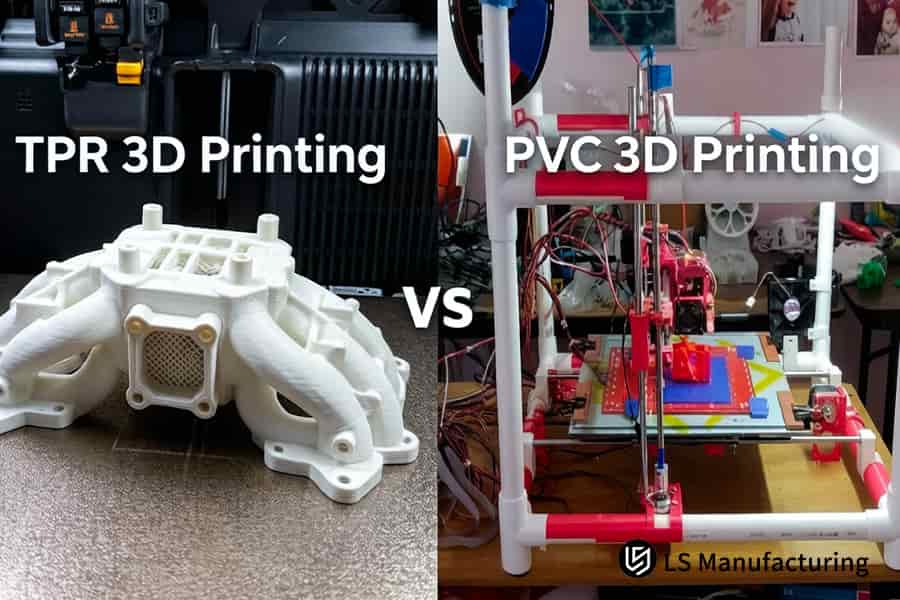
Figure 4: TPR and PVC pipes are compared for 3D printing large mechanical frame structures and custom components.
Case Study: How Did LS Manufacturing Engineering Team Salvage A Medical Automotive Seal Project?
A global Tier-1 automotive supplier needed oil-resistant, high-sealing flexible prototypes for hydrogen fuel cell valves within14 days. Their previous vendor's conventional FDM-printed PVC samples failed after48 hoursof85°Chot-oil cycling — layer delamination and plasticizer leaching caused medium leakage, halting the entire program. This case demonstrates how targeted material switching and process refinement turned a stalled project into a winning production award throughhigh-performance 3D printing:
Client Challenge
The client needed hydrogen fuel cell valve seals, which should be able to withstand100%tightness under the0.4 MPaoil pressure at85°C. The customer's current supplier was using regular PVC with0.2mmlayer thickness resulting in parts with insufficient inter-layer adhesion strength. In48 hoursof hot-oil cycle test, all 30 tested pieces showed visible delamination and plasticizers leaching, which is100%failure rate potentially jeopardizing the whole project timeline. This scenario demanded anapplication-specific 3D printing solution capable of surviving sustained thermal and pressure loads.
LS Manufacturing Solution
Instead of PVC, engineers opted to usecustom TPR 3D printing servicewith Shore 70A thermoplastic rubber on a direct-drive extrusion machine. Layer height was decreased to0.15mm, nozzle overlap raised to15%, and melt temperature set to225°C ±3°Cfor complete inter-layer bonding. Multi-axis trajectory programming removed any unsupported overhangs that may accumulate oil, thus dealing with the problem with PVC by means ofprecision flexible 3D printing.
Results and Value
These TPR seals successfully completed 200 consecutive hours of hot-oil fatigue testing under≥0.4 MPapressure with no leaks, achieving a400%improvement compared to the initial48-hourfailure point. All 250 prototype samples were shipped on day 9, five days ahead of schedule. This was achieved in time for the client to present verified test data with their production proposal, winning the annual core vehicle platform contract with acustom flexible parts manufacturer. This demonstrated thatmission-critical 3D printingrequires more than standard parameters.
This case proves that proper selection of material-process combination turns a losing project into a competitive edge. A400%increase in thermal oil endurance and36%faster delivery is just a result of the engineering-driven approach to prototype manufacturing. You get a partner who considers each prototype as a part of production validation process, supported byproduction-scale 3D printingcapacity for up to10,000units starting from250 prototypes.
If your prototype needs to survive oil, heat, and pressure, simply tell us your test conditions and we’ll engineer a matched material and process solution for your requirements.

Why Should Manufacturing Leaders Select LS Manufacturing As Their Custom Flexible Parts Manufacturer?
Businesses looking for trusted flexible parts must team up with someone who is an expert inmaterials, processes, and manufacturing scale-up. LS Manufacturing is just the partner you’re looking for, providing unparalleled flexibility through a state-of-the-art fleet of more than 50 precise printers with advanced chamber control technology, supporting Shore 35A to 98A. Here’s what that means for your toughest projects, thanks to our3D printinginfrastructure:
Full-Spectrum Material Capability Across Shore 35A–98A
Our fleet of printers manages all ranges of hardness,from ultra-soft gasket (Shore 35A) to hard structural bumper (Shore 98A). You no longer have to look for several suppliers to get your project done since we only need one CAD file to manufacture parts of different hardness levels. We offerflexible filament 3D printing service, including medical tubing and industrial vibration dampeners, thanks tomulti-material 3D printingcapabilities.
Intelligent Chamber Control for Low-Modulus Filaments
Each printer features a closed-loop heated enclosure with±2°Ctemperature control, perfectly engineered to print low modulus materials prone to warping. It eliminates curling and delamination even of tall thin-walled parts. In terms of yourprecision flexible 3D printingrequirements, this translates into97%+initial success rate vs the industry standard of about82%(as per our internal benchmarking against ASTM F3091). No reprints, no delays for you.
100% Dimensional and Resilience Testing Before Shipment
All parts are automatically tested for critical dimensions and their resilience (compression set according to ASTM D395) prior to shipping. All non-conformities are identified and fixed within24 hours. As acustom flexible parts manufacturer, we can assure you that your seals and gaskets will match the designated Shore hardness and rebound properties – there is no sampling and no statistics involved. Every shipment will come with a certificate of compliance, supported by3D printingdocumentation.
Engineering-Led DFM Review at No Extra Cost
Prior to production, application engineers conduct an analysis of your part geometry for aspect ratio, wall thickness, and overhang concerns. We offer afree DFM reportwith suggested changes which decrease cost and increase printability. Our3D printing servicewill optimize your design for additive manufacturing from the start, shaving development time up to30%. In addition toscalable 3D printingcapability, you can achieve a single point of accountability for all your prototypes from concept to delivery.
By choosing LS Manufacturing as your3D printing solution provider, you will be working with a company that considers each prototype to be production-ready validation. With our50+ printerfleet, smart chamber control, and100%testing process, we ensure quality and predictability atShore 35A to 98A. This is what makes us the preferred partner of many automotive, medical, and industrial OEMs when it comes to their most difficult flexible parts.
FAQs
1. What is the primary operational difference between TPR and PVC in flexible filament 3D printing services?
Theflexibility and fatigue resistance of TPRare mainly because of the elastic nature of the block copolymer used in its formulation. On the other hand, PVC becomes flexible by virtue of being plasticized. It provides superior chemical resistance than TPR; however, the printing of PVC parts requires tight control of the temperatures of the chambers as compared to that of TPR.
2. Can custom TPR 3D printing services achieve watertight or airtight seals for industrial hardware?
Yes. LS Manufacturing has managed to remove the microscopic porosity from the parts using TPR filament by increasing the wall line count to four or higher and increasing the nozzle overlap ratio to15%. This way, TPR parts can achieve100%watertight and airtight sealing capability under high pressures (>0.3 MPa).
3. How do I know if my project qualifies for an optimized flexible 3D printing quote within two hours?
It suffices toupload an industry standard STEP or STL 3D modelalong with specified Shore hardness parameters (such as Shore 80A) and details about particular operational conditions through the inquiry portal on the website of LS Manufacturing. Theengineering quote, inclusive of a DFM (Design for Manufacturability) analysis, will be delivered within two hours.
4. What is the specific Shore hardness range available for PVC 3D printing services at LS Manufacturing?
The available Shore hardness range ofPVC 3D printing servicesoffered by LS Manufacturing spansfrom Shore 60A to Shore 95A. Customized formulations with varying Shore hardness values can be developed to fit the rigidity demands of specific components such as valve gaskets, sleeves, and other industrial parts with particular resistance properties.
5. Is there a significant cost difference between TPR and PVC 3D printing for low-volume production runs?
Yes. Due to the need to use specially designed high-quality corrosion-resistant nozzles and powerful post-processing gas purification facilities for PVC 3D printing, the depreciation expenses of special equipment become considerably higher, increasing the total cost for batchesfrom 1 to 100 by 12%-18%.
6. How does precision flexible 3D printing prevent the common filament jamming issues in direct drive extruders?
LS Manufacturing employs a fully enclosed, short path dual drive extruder that was specifically developed for flexible filaments.Thanks to minimalizing of the unsupported distance between the drive gears and the melting area (heat break) to≤ 0.5mm, we eliminate the possibility of soft filaments buckling, kinking, or jamming from pressure.
7. What are the unique temperature and environmental metrics required during an industrial PVC 3D printing service?
PVC printing should be done in a sealed chamber that has a temperature control (kept at 50°C ± 2°C) and a HEPA filter. Moreover, the nozzle temperature should stay constant within the range of220°C to 240°Cto facilitate interlayer bonding and minimize gas emissions.
8. Why is choosing a dedicated custom flexible parts manufacturer better than using standard rapid prototyping generalists?
General rapid prototyping companies do not spend thousands of hours on tuning the slicing parameters of the low flexural modulus elastic filaments. LS Manufacturing, being a specialized manufacturing company with vast experience in this area, provides engineering supportincluding lattice structure optimization, shrinkage correction, and testing materials properties.
Summary
The decision about which material should be selected among TPR and PVC forindustrial flexible 3D printingneeds to be based on the comprehensive engineering evaluation of mechanical strength, bed adhesion, media resistance, and overall cost in the course of long-time production.
Specify your application needs: TPR is used for extreme cyclical bending, PVC is used for multiple chemical interactions. Stop guessing and trust your flexible parts' prototype creation or production in small batches to professionals.Just click “Request Drawing Quote” to submit your STEP/STL files.In 2 hours, our professional engineers will give you an absolutely free DFM evaluation and fair engineering-grade quotation.
📞Tel: +86 185 6675 9667
📧Email: info@lsrpf.com
🌐Website:https://lsrpf.com/
Disclaimer
The contents of this page are for informational purposes only.LS Manufacturing servicesThere are no representations or warranties, express or implied, as to the accuracy, completeness or validity of the information. It should not be inferred that a third-party supplier or manufacturer will provide performance parameters, geometric tolerances, specific design characteristics, material quality and type or workmanship through the LS Manufacturing network. It's the buyer's responsibility.Require partsquotation Identify specific requirements for these sections.Please contact us for more information.
LS Manufacturing Team
LS Manufacturing is an industry-leading company. Focus on custom manufacturing solutions. We have over 20 years of experience with over 5,000 customers, and we focus on high precisionCNC machining,Sheet metal manufacturing, 3D printing,Injection molding.Metal stamping,and other one-stop manufacturing services.
Our factory is equipped with over 100 state-of-the-art 5-axis machining centers, ISO 9001:2015 certified. We provide fast, efficient and high-quality manufacturing solutions to customers in more than 150 countries around the world. Whether it is small volume production or large-scale customization, we can meet your needs with the fastest delivery within 24 hours. choose LS Manufacturing. This means selection efficiency, quality and professionalism.
To learn more, visit our website:www.lsrpf.com