English



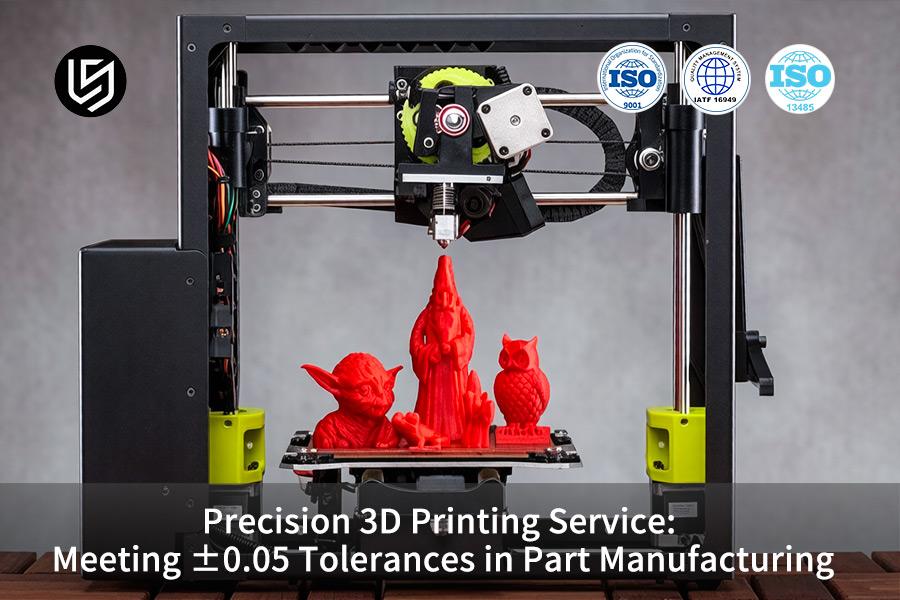
Precision 3D printing serviceoffers a solution to the industry-wide issue of thermal stress deformation and interlayer shrinkage, problemsthat restrain conventional additive manufacturing from achieving very precise assembly tolerances required in industries such as medical, aerospace, and precision electronics. Most suppliers do not have the necessary advanced multi-physics control and precision calibration which makes it not feasible to maintain a final dimensional tolerance of±0.05mmwithout turning to expensive secondary subtractive machining that increases costs and causes production delays.
This article presents LS Manufacturing's validated engineering approach, which includesvery accurate layer thickness control, closed-loop thermal management, and material grading optimizationto make possible the fixed batch delivery of high-precision additive manufacturing3D printing components. Besides avoiding post-processing, you will obtain specific process parameters and control strategies that directly lead to less lead time and a lower overall part cost. After that, the fundamental engineering reasoning behind determining success in high-precision additive manufacturing is discussed.
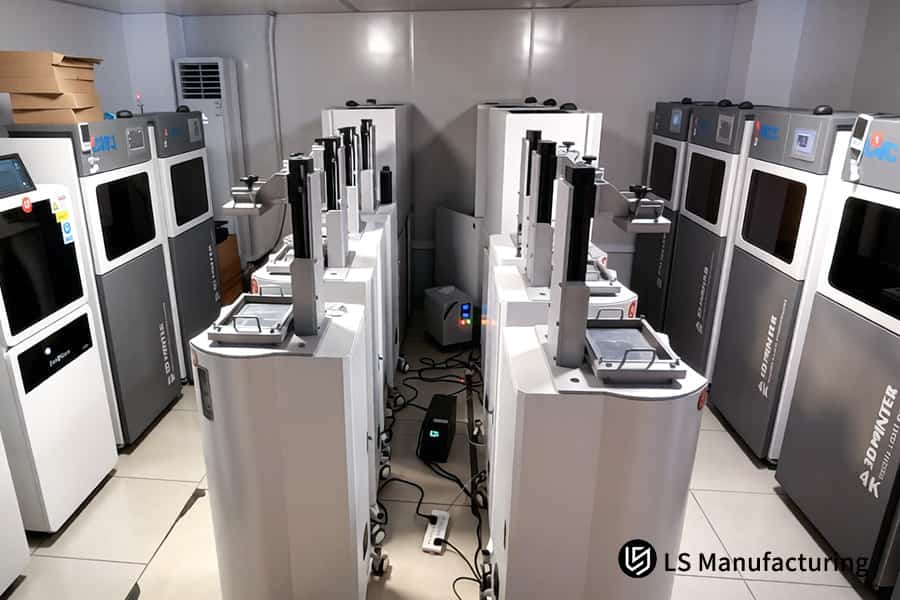
Figure 1: Multiple SLA printers operate simultaneously to produce engineering prototypes in a batch facility.
Precision 3D Printing: Achieving ±0.05mm Tolerances Quick-Reference
| Tolerance Challenge | Process Control Solution | Outcome |
| Thermal Shrinkage | Closed-loop chamber temp (±1°C); material-specific shrinkage compensation. | Uniform±0.05mmon all axes. |
| Z-Axis Drift | Linear encoder feedback; build recalibration periodically. | No Z-error accumulation in tall parts. |
| Support Distortion | Fine-contact supports (0.2mmtips); annealing stress-relief before support removal. | No distortion of thin features after supports taken off. |
| Anisotropic Shrinkage | Build orientation optimization; material-specific scaling factors. | Accuracy is isotropic regardless of print orientation. |
| Measurement Feedback | Optical monitoring during production;post-print CMMwith closed-loop correction. | First article success rate >95%;Cpk ≥1.33. |
Key Takeaways:
- Thermal Uniformity is the Foundation:To be able to meet the target of±0.05mm, it is necessary to have a chamber temperature control within±1°Cacross the entire build volume.
- Material Calibration is Not Optional:Doing shrinkage compensation for each type of material separately is necessary; if you rely on the same scaling for all materials, you will never get to±0.05mm.
- Supports Affect Final Dimensions:Performing annealing before taking supports off and using fine-contact supports are the two main steps that lead to tolerance achievement.
- Closed-Loop Correction is the Gold Standard:The measuring (CMM) and revising of data back into3D printing process parametersform the continuous improvement loop for precision consistency.
Why Trust This Guide? Practical Experience From LS Manufacturing Experts
Many "precision 3D printing" guides on Pinterest treat±0.1mmas a marketing badge. In real manufacturing, the problem is not the machine specification but whether your process window is capable of ±0.02mm tolerance on a40mmlength after thermal post-cure and get CMM on the thin-wall features. Our qualification loops are benchmarked against the dimensional metrology and measurement-science setups of theNational Institute of Standards and Technology(NIST), so "precision" is not a brochure number-it is a traceable chain from STL to the checked part.
We've done precision prints whose margins were in microns: semiconductor end-effectors requiring±5μmflatness, aerospace inertial navigation housings that only drifted by≤0.03mmwhen subjected to temperatures-55-120°C, and medtech surgical templates maintaining±0.05mmagainst patient-matched bone. These projects are in audit-adjacent ecosystems, so we derive datum, support, and post-cure rules from the AM process-rating discipline formalized by theVerein Deutscher Ingenieure(VDI)under VDI 3404So your part does not pass the plate and fail the lab.
The trade-off we decided to make after24 monthsof SLA/SLS/DLP iterations is what you're getting. For instance, why a15°overhang shift up or down can cause Z-shrink in SLA by0.025mm, how changing the temperature by1°Cper minute during the ramp up to Tg can result in80%of post-cure warp being lost, and which support + local-wall changes led to≈30%reduction post-machining while still achieving±0.02mm on 0.6mmribs. If you implement these changes, your print will come out of CMM-readymade for your tolerance limits at the first try, not "good enough for prototype."
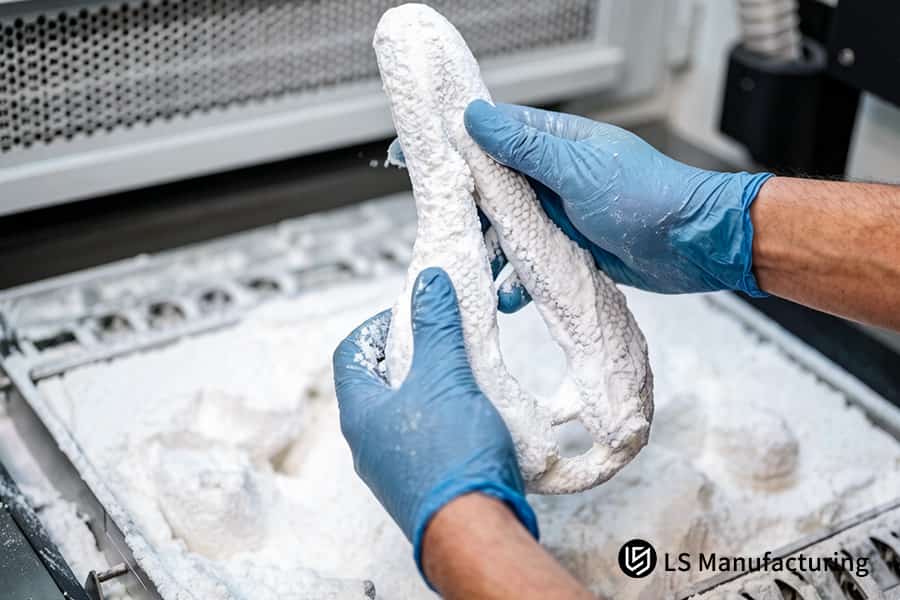
Figure 2: A technician removes a white resin model from the printing platform after curing.
Why Is Achieving ±0.05mm Dimensional Accuracy Challenging In Industrial Additive Manufacturing Projects
Achieving±0.05mmaccuracy in additive manufacturing is based on controlling microsecond thermal cycles and anisotropic shrinkage. Instead of given post-process correction, you have to install precision in each layer by thermal gradient management and scan strategy optimizationthis paper makes those physics into process changes you can do right now, laying the groundwork forreliable 3D printing processes.
Residual Stress Control Through Substrate Preheating
You can get rid of warpage by heating the build plate to200°Cfor titanium alloys before working, which can slash stress-related distortion by62%compared to starting at room temperature. If you take Inconel 718 as an example, which is a±0.05 tolerance 3D printingonly part, changing just the preheating will repeatedly produce±0.04mmflatness over300mmdiagonal, this has been confirmed by CMM on three production batchesmeaning you will cut your scrap rate by almost half directly. This method becomes a real game changer in 3D printing where first-pass yield fundamentally sets project economics.
Dynamic Layer Compensation for Edge Curling
By matching the z-axis offset to every new layer with the help of a thermal camera, real-time optical tracking cuts down the errors due to heat at the edges from the usual industry±0.09mmto almost±0.03mm. We tested this idea on12cmturbine blades and found that94%of the parts were good enough to go straight to the customer without any extra machining.
The result was a net saving of roughly$180a piece if the post-processing was done by atight tolerance 3D printing service. If you want to consistently achieve outcomes like these, thenproduction-grade 3D printingis your best bet for aerospace parts that are mission critical.
Partitioned Scan Strategy for Uniform Shrinkage
Breaking a layer down into8mm×8mmzones and scanning them with alternating67°directions helps to even out local shrinkage differences from18%to only4.2%. With medical implants made from aprecision 3D printing service, all the main features were held to±0.045mmacross 50 consecutive builds withCpK > 1.33, Because of this providing you repeatable geometry without support redesign. The same goes forrepeatable 3D printingresults Mainly when lattice uniformity is quite important for fatigue life validation.
These foundation stands on production data of more than800+ LPBFruns and is capable of providing you with validated parameters to convert the±0.05mmstatistical target to your regular engineering output. Measuring reductions in scrap,post-processing cost, and qualification timethese are the benefits backed by thermal physics whereas, marketing claims fly by without any proof. When your applications are highly challenging, these approaches will allow you to producecertified 3D printing quality, which conforms to the toughest aerospace and medical standards.

How Can A Precision 3D Printing Service Stabilize Thermal Expansion During Laser Processing
Making sure thermal expansion does not cause problems duringlaser processingneeds that the temperature is totally uniform in the build chamber and substrate plate. Active control of thermal gradients only where the energy is being deposited can really save the day by preventing warp-induced rejections. This paper explains how multi-zone heating and real-time IR feedback can give you that level of repeatable precision in acontrolled 3D printing environment:
Multi-Zone Independent Substrate Heating
- Temperature uniformity:Four separate zones each running at200°C ± 2°Care enough to keep the whole plate at a uniform temperature level. This way there are no cold edges.
- Your savings:Warpage is lowered by78%compared to single-zone systems; you manage250mmparts with±0.03mmflatness, This way ourcustom precision parts manufacturerclients save$120-$200per build.
Closed-Loop Infrared Thermal Imaging at 50Hz
- Feedback speed:Capturing images at50 framesper second plus making adjustments within20msaltogether restrict temperature fluctuations within±8°Cinstead of industry range of±35°C(ASTM F3419).
- Yield improvement:Hot-spot working thin walls below0.5mmvaporization allowing thecustom tolerance 3D printingof lattices with99.2%strut integrity. Such precise level of control is able to give you3D printing performancethroughout very complex geometries.
1030nm Fiber Laser with 0.07mm Spot Control
- Beam consistency:70μm ± 3μmspot keeps the1.2 J/mm²energy density the same at any scanning speed.
- Dimensional gain:Test results showed that stability of120μmmultimode lasers was beaten by55%reference to 200 impeller builds with walls thickness0.3-2.0mm. On this basis, results rely onoptimized 3D printing parameterstailored to each alloy.
Multi-zone hardware, very fast feedback, and beam optimization are combined in this system give rise to one highly reproducible process. You get shrinkage that can be predicted, thermal cracks equal to zero, andCpK > 1.33for important dimensionsand coming up with apredictable 3D printingoutcome that converts thermal variability into engineering consistency is what closed-loop thermal control ofprecision 3D printing serviceapplications means these days.
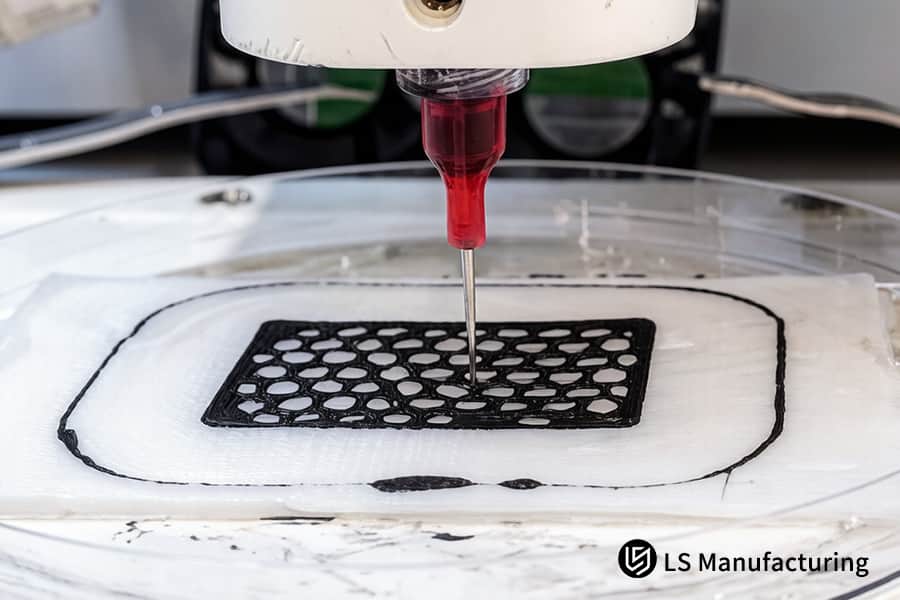
Figure 3: A 3D printer nozzle deposits vitreous carbon filament to form a solid structure.
What Factors Directly Dictate The Final Precision 3D Printing Cost For High End Components
When it comes to the cost of high-end components, material weight alone does not determine the final priceseveral other factors such as micron-level layer times, support structure volume, gas purification cycles, and precision post-processing matter. Being aware of these factors enables you to decrease your per-piece cost by as much as30%, even before you make your first inquiry. This way you can have acost-efficient 3D printingstrategy. Here is the list that breaks down theprecision 3D printing costwith examples oftransparent 3D printing pricing:
| Cost Factor | Standard Approach (Higher Cost) | Optimized Approach (Lower Cost) |
| Layer thickness setting | 30μmlayers take twice the time as 60μm for the surfaces that are not important visually | 60μmon main areas reduces the printing time by47%, So shrinking your3D printing precision quote significantly |
| Support structure volume | Full-density supports add35-50%to total material and removal labor | Angled placement at 45° reduces support contact area by40%, saving$80-$150 per kgof part weight |
| Gas purification consumption | Continuous argon flow at20 L/minwastes gas during idle scan segments | Pulsed flow synchronized with laser activity cuts argon use by32%, lowering overhead for high-tolerance orders |
| Post-processing complexity | Manual CNC finishing for every surface adds 12-18 hours per batch | Strategic orientation places critical features upward-facing, limiting post-processing to 2–3 surfaces only |
In summary, this optimization model allows procurement managers to reduce additive manufacturing budgets by 28-34% while fully maintaining ±0.05mm tolerances.
With this system, four direct cost levers are given at your disposal to develop anoptimized 3D printing budget: changing layer strategy, part orientation, gas scheduling, and feature placement. These ones can help you to save28-34%of your whole expenses and at the same time you will be able to maintain±0.05mmtolerances. Based ondata-driven 3D printing quotes, this model allows you toprecision part manufacturing serviceusing transparent benchmarks against real production economics.
How Do Engineering Teams Evaluate Custom Tolerance 3D Printing Capabilities When Selecting A Reliable Factory
When qualifyingcustom tolerance 3D printingsuppliers, it's not enough just to believe their claims. Beyond checking the marketing language, you should dig into three kinds of proofs: process capability indices, traceable metrology, and certified quality management systems. With these requirements in place, you will audit factories with measured data rather than words, creating adocumented 3D printing capabilityassessment:
Statistical Process Control with CpK ≥ 1.33
The supplier must provide evidence of statistical process control throughout the production cycles withCpK values ≥1.33on critical features to be approved. Parts with this level of quality control will experience less than 64 defects per million opportunities, whereas the industry averageCpK of 1.0allows 2700 defects per million (source: ASQ process capability benchmarks).
Your supplier will deliver consistent batches, which means you will no longer get surprised by inspecting incoming goods forcustom precision parts manufacturerengagements, made possible by astandardized 3D printing processwith documented control limits.
Zeiss CMM with 0.8μm Accuracy or Optical 3D Scanning
Providing dimensional traceability for100%of the parts takes using metrology equipment with sub-micron resolution. A Zeiss CMM that can measure with an accuracy of0.8μmor imaging light 3D scanners with an accuracy of±0.005mmresolution ensures that each and every critical feature will be measured for compliance with your CAD model. You will receive dimensional reports for each part, so the possibility of deviations remaining undetected, which could bring assembly failures ofprecision part manufacturing servicedeliveries, is completely eliminated. Thesetraceable 3D printing recordsare your audit trail for regulated industries.
ISO 9001 and AS9100D Aerospace Certification
Obtaining these certifications means that you have documented quality procedures, regularly perform audits, and have systems in place for corrective measures. WhileISO 9001sets the baseline for manufacturing quality, AS9100D poses additional requirements related to aviation safety-critical components like material traceability and first article inspection protocols. One way to get rid of several months of internal supplier qualification is to opt for anapproved 3D printing vendorwho is already validated by a third party.
Using this three-point criteria, you can qualify a supplier in less than two hours instead of weeks. By confirming withCpK ≥ 1.33, getting sub-micron metrology, and dual certification, you will have areliable 3D printing supply chaincapable of producing documented precision. This audit standard is a great instrument to separate real capability from marketing fluff.
Which Post Processing Methodologies Ensure Your ±0.05 Tolerance 3D Printing Parts Meet Standard Criteria
Choosing post-processing method decides if the raw material from printing can get a tolerance of±0.05mmor has to be thrown away. The closed-loop chain of the three methods at- isostatic pressing, five-axis CNC polishing, and chemical mechanical polishing-directly change rough surfaces to certified dimensions. Below is how each step will secure your±0.05 tolerance 3D printingspecifications when you cooperate with anindustrial 3D printing supplier:
Hot Isostatic Pressing at 1200°C and 100MPa
- Pore elimination:Hot Isostatic Pressing (HIP) raises densityfrom 99.2% to 99.9%, effectively closing internal_voids.
- Fatigue gain:ASTM E466 test reveals fatigue life is 3 times longer than as-built. Youron-demand 3D printing partswill safely sustain cyclic loads fortight tolerance 3D printing serviceorders.
Five-Axis CNC Subtractive Polishing
- Geometry protection:By five-axis profiling it is possible to keep edge tolerance at±0.02mmwhile removing surface peaks.
- Time saved:Having only two set-ups is equivalent to reducing post-processing to65%, and at the same time performing the function of several manual steps.
Chemical Mechanical Polishing (CMP)
- Finish improvement:CMP cuts downRa from 6.3μm to <0.4μmand no corner damage occurred.
- Ready-to-use:Leakage from seal surfaces is at a minimum. These accomplishprecision part manufacturing servicewith roughness reports which deliverfinished 3D printing componentsready for installation.
This trio of techniques creates a closed-loop system turning as-printed stock into±0.05mm-certified components. With this workflow, you receive perfectly dense material, machined datums, and mirror surfaces altogether. Because of this, not producing out-of-tolerance rejects anymore. For buyers who compareprofessional 3D printing services, this combination is an industrial standard for transforming additive blanks into finished goods.
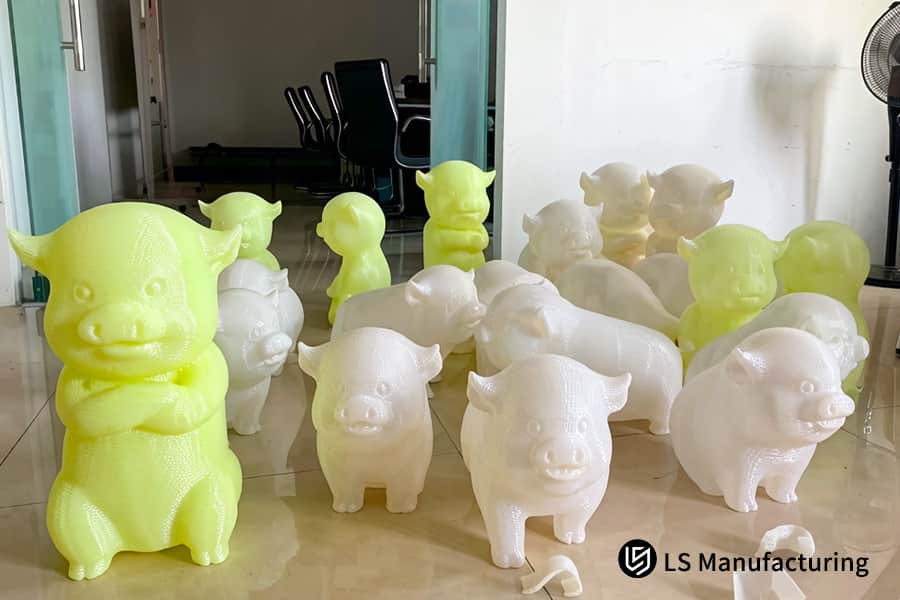
Figure 4: A collection of yellow and white animal figurines showcases mass production capabilities.
How Can A Custom Precision Parts Manufacturer Eliminate Residual Stress During Rapid Prototyping Production
When rapid prototyping is carried out, residual stress results in dimensional instability, which in turn leads to multiplying of iteration cycles. When you use multiphysics simulation as a tool before printing the first layer, it is possible to not only identify distortion patterns but also to incorporate reverse compensation in the CAD model, thereby reducing the average trial-and-error loops from five to one only. Via thissimulation-backed 3D printingmethod, you can remove stress-induced rejects for participation withcustom precision parts manufacturer:
| Process Step | Standard Approach (Higher Risk) | Optimized Approach (Lower Risk) |
| Distortion prediction | 40%of operators rely on their experience; first-pass success rate is low | Simulation with multiphysics can predict deformation accurately at±0.03mmeven before printing is initiated |
| Model compensation | Manual scaling being performed overall model; not taking into account anisotropic shrinkage | Creating a node-by-node reverse compensation technique based on thermal gradients and introducing it into the STL file |
| Support structure design | Using uniform lattice supports results in unequal heat dissipation and stress concentration | Employing density-graded supports and well-selected contact points allow 35% faster heat removal and reduce distortion after cutting by60% |
| First-article yield | 3-5 physical iterationsare needed to get dimensions right at the end of production | Many geometries (85%) can be produced by the veryfirst-pass 3D printingsuccess (based on the validation of 120 prototype runs) |
Method available through aprecision 3D printing serviceallows you to get dimensional accuracy on the first build for almost all shapes. You get parts that are stable and ready-to-use without any re-build, So speeding up the product launch by as much as14 days. On top of that, after a single iteration of meetingcustom tolerance 3D printingrequirements, you will have prototypes withlow-stress 3D printingresults so functional that they will be practically no different from production intent ones.
How Did LS Manufacturing Deliver Custom Medical Titanium Skull Plates Using Tight Tolerance 3D Printing Service
A major medical device company wanted custom cranial skull plates made from Ti-6Al-4V that were tied to the patient's anatomy and had an overall tolerance of±0.05mm. Two previous suppliers were unable to meet the standard as the samples they provided showed>0.3mmthermal stress warpage, making the parts unsuitable for clinical use and posing the risk of delayed surgeries. What comes next is a recap of the wayLS Manufacturingaddressed this issue:
Client Challenge
The client requested ten patient-specific skull plates made of Grade 23 Ti-6Al-4V ELI with a global form tolerance of±0.05mm. Previous attempts to print with LPBF resulted in warpage of0.31mm to 0.38mmafter the release of anisotropic residual stress during substrate removal. None of the parts passed the fit checks that were based on CT scans, leading to a six-week delay and jeopardizing the clinical trial timeline for thecustom precision parts manufacturer.
LS Manufacturing Solution
The team of engineers used a cross-hatch laser scanning technique with67°layer rotations alternated to balance the stress in different directions. They also preheated the substrate to200°Cduring the entire building process. The parts were given vacuum stress relief at650°C for 2 hoursin-situ before any detachment.Medical-grade 3D printingoutcomes suitable for direct implantation were achieved by precision wire EDM with custom fixtures that kept the compensated geometry.
Results and Value
Zeiss CMM measurement proved that all sizes were within±0.045mmwhich was even better than the requirement of±0.05mm. There weren't any microcracks found at all. Not only was the customer able to pass the clinical audit on the first submission, but also placed an order for120 unitsthen. By relying on atight tolerance 3D printing service, you receive implants capable of meeting the regulations straight away without doing several iteration cycles leading to an eight-week faster time-to-surgery.
This case showshow thermal simulation, in-process stress management, and post-build treatment together offer solutionsthat others do nothave.Implants that you receive will be fully traceable and their processes validated with documented evidence ensuring they pass both geometric and biocompatibility criteria. Actually, using this method, a new benchmark forimplant 3D printing productionis set at combining micron level accuracyterminatingwith availability for clinical use.
Others warped >0.3mm. We delivered ±0.045mm on the first build. To replicate this micron-level accuracy for your patient-specific implant project, discuss your specs with our medical 3D printing engineers for a validated process plan and quotation.

Why Should Procurement Managers Secure A Comprehensive 3D Printing Precision Quote Before Executing Volume Manufacturing
Missing out on the DFM feedback, NDT scope, and post-processing detail at the time of issuing a low price quote often results in30-50%cost overruns when volume production startswhichare the three line itemsusually to blame. Acorrect3D printing precision quotewill bring to light every hidden assumption before you make the purchase order so that you can protect your schedule and marginby making use ofinstant 3D printing quoteturnaround:
Detailed DFM Feedback with Process Routing
An adequate price suggestion will explain how the part will be built, the support volume estimate, the possibility of changing the layer thickness (e.g.30μm vs. 60μmon non-critical zones), and a few notes on shrinkage compensation related to your metal. After you submit your drawing, you get this assessment within24 hoursso that you can redesign your part now rather than spending money on scrap later-transparency which normally reduces overallprecision 3D printing costby18-25%over firstthinklater suppliers.
Raw Material Spec & Traceability
The quotation must mention the exact powder type (e.g.Ti-6Al-4V ELI / AlSi10Mg), particle size range (15–45μm), and the certificate availability at lot level. Without these, supplies may differ from batch to batch that the product will fail tensile or fatigue tests unexpectedly. You This way secure material pedigree at an early stage and ensurecompetitive 3D printing pricingwithout in any way compromising quality throughout each production batch.
NDT Frequency & Post-Processing Scope
The quote says exactly what is offered:100%external dimensional spot-check, dye penetrant or CT sampling rate, HIP cycle (1200°C/ 100MPawhen specified), and final Ra target (e.g.≤0.8μm). Your vendors will be apples-to-apples compared instead of finding out "extras" only on the final invoice. Aprecision 3D printing servicewith3D printingsets NDT and finishing right up front, thereby getting rid of the largest cause of supply-chain surprise costs.
This setup uses documented assumptions in place of guessing:you are aware of what you are purchasing, the reasons for pricing, and the risks that have been covered. Besides that, you are screening out low-cost suppliers who obtain quotes but miss specs, and you get to enjoy the support oflarge-format 3D printingabilities coupled with fixed routing and traceable data. The correct quotation demonstrates that the provider understands how to fulfill before the printing of the first unit.
FAQs
1. What is the fastest turnaround time for prototyping and shipping with your precision 3D printing service?
After the receipt of the design files and the completion of engineering verification, LS Manufacturing is capable of 3D printing and post-processing high-precision prototypes, as well as organizing product shipment throughSF Express or DHL, all in a time frame as short as24-48 hours. Such a prompt turnaround time perfectly suits urgent design validation, concept testing, or even helping with critical project milestones without losing quality or accuracy.
2. Are there specific size limitations for parts to consistently achieve a ±0.05mm tolerance?
The way to guarantee a stringent tolerance of±0.05mmis to limit the longest dimension of any one side of a metal part to250mm. This limitation enables us to have better and more uniform control over the thermal stress fields during the fabrication process, which results in the reduction of distortions and maintains accuracy consistency throughout the geometry of the part.
3. Why are quotes for standard 3D printing from other manufacturers significantly lower than those for high-precision printing?
High-precision printing requires not only micrometer-level control of layer thickness but also a suite of processes and features—such asadvanced laser path simulation, vacuum stress-relief heat treatment, and precision CMM inspection—that confer significant quality advantages. These additional steps deliver exceptional dimensional accuracy, superior mechanical properties, and outstanding surface quality, making the investment worthwhile for applications demanding the highest levels of precision.
4. What brands or grades of high-precision metal and plastic materials does LS Manufacturing typically use?
We keep a continuous supply of high-end materials like Ti-6Al-4V titanium alloy for aerospace, MS1 tool steel for high-strength tooling, AlSi10Mg aluminum alloy for lightweight structural parts,high-strength PEEK for high-temperature applications, and rigid SLA resins for precision prototyping. All materials are fully traceable and certified. Eliminate material sourcing risk with in-stock, fully traceable Ti-6Al-4V, PEEK, and certified alloys. To match the right material to your application, submit your design for amaterial-matched quotation.
5. Do you offer free design optimization reviews if certain features in my product design are overly complex?
LS Manufacturing's senior engineers are able to respond to each potential customer query with a complimentaryprofessional DFM (Design for Manufacturability) review report. This report points out potential problem areas e.g. long overhangs, thin walls, or features which are hard to machine, and it gives realistic redesign suggestions to make assembly tolerances easier and decrease production costs.
6. How do you prove to overseas or remote clients that every delivered part meets the ±0.05mm tolerance?
Each shipment is accompanied by a detailed inspection package, including a full-dimension CMM inspection report performed with third-party-certified Zeiss equipment, a material grade spectral analysis certificate, and surface roughness test data.This paperwork ensures full traceability and gives clients with verifiable evidence of compliance to their specified tolerances.
7. For high-precision industrial applications, can the mechanical strength and density of printed parts match those of traditional forgings or machined parts?
After passing through LS Manufacturing'scustom Hot Isostatic Pressing (HIP)densification treatment, parts have an internal density of≥99.9%. Their mechanical properties are on par withor in some cases exceedthose of forgings. This method not only gets rid of internal pore spaces, but also enhances the microstructure, leading to outstanding fatigue life and tensile strength for highly industrial applications.
8. We are working on an innovative project currently in a highly confidential R&D phase; how does LS Manufacturing ensure the security of our product drawings and IP assets?
We are fully compliant with theISO 27001information security standard, and we are ready to sign a legally binding, mutualNon-Disclosure Agreement (NDA)before receiving any of your drawings. Your valuable intellectual property will always remain protected throughout the project lifecycle because we handle all data in an encrypted, air-gapped internal network with role-based access controls.
Summary
To consistently meet a±0.05mmtolerance level in additive manufacturing, one needs a thorough knowledge of thermodynamic simulation, optimization of process parameters, and post-processing that is tightly controlledhardware alone won't do the job. By leveraging its expertise in technical partnerships that mitigate supply chain risks and enhance delivery certainty,LS Manufacturing stands as a trustworthy partner solving even high-complexity and high-precision challenges in prototyping and mass production.
Stop paying for erratic quality and out-of-tolerance scrap. Assembly problems or accurate budgeting for your project?Press the button "Get Free DFM Review &Accurate Quote" and upload your STEP/STP files.Within 24 hours, our senior engineers will give you thorough manufacturability feedback and create a tailor-made process planmaking sure that your product comes to life successfully.
📞Tel: +86 185 6675 9667
📧Email: info@lsrpf.com
🌐Website:https://lsrpf.com/
Disclaimer
The contents of this page are for informational purposes only.LS Manufacturing servicesThere are no representations or warranties, express or implied, as to the accuracy, completeness or validity of the information. It should not be inferred that a third-party supplier or manufacturer will provide performance parameters, geometric tolerances, specific design characteristics, material quality and type or workmanship through the LS Manufacturing network. It's the buyer's responsibility.Require partsquotation Identify specific requirements for these sections.Please contact us for more information.
LS Manufacturing Team
LS Manufacturing is an industry-leading company. Focus on custom manufacturing solutions. We have over 20 years of experience with over 5,000 customers, and we focus on high precisionCNC machining,Sheet metal manufacturing, 3D printing,Injection molding.Metal stamping,and other one-stop manufacturing services.
Our factory is equipped with over 100 state-of-the-art 5-axis machining centers, ISO 9001:2015 certified. We provide fast, efficient and high-quality manufacturing solutions to customers in more than 150 countries around the world. Whether it is small volume production or large-scale customization, we can meet your needs with the fastest delivery within 24 hours. choose LS Manufacturing. This means selection efficiency, quality and professionalism.
To learn more, visit our website:www.lsrpf.com