中文 (简体)



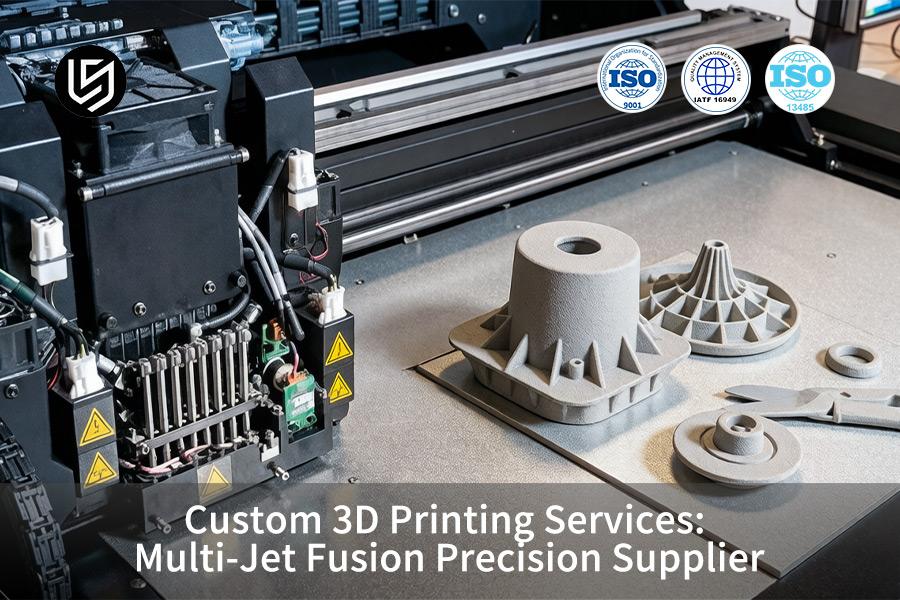
使用多喷射融合 (MJF) 的定制 3D 打印服务是一种工业增材制造工艺,它解决了工程师在检查3D 打印机耗材类型时面临的问题:将强大的强度与微米精度结合起来。传统FDM的问题包括层间粘合力差和各向异性结构,导致尺寸公差超过±0.2mm和结构失效——超过35%的功能原型由于Z轴限制而损坏。
通过使用工业品质的多射流融合 3D 打印服务,LS Manufacturing 获得了尺寸保持在 ±0.1mm 以内的完全各向同性零件,解决了长丝型结构典型的方向不精确问题。通过微米级的粉末融合,分子结构沿所有轴均匀结合,从而产生能够承受载荷而不变形和分裂的功能原型。这使得原型制作成本至少降低 30%,如下面的流程描述中所述。

多喷射融合 (MJF) 3D 打印:精密尼龙零件快速参考
<正文>关键要点:
- MJF 擅长功能性尼龙零件:PA12 MJF 生产各向同性材料特性、防水组件,以及±0.1mm 3D 打印公差 - 非常适合外壳、夹具和活动铰链原型制作。
- 粉末混合比例影响质量:回收粉末比例≤30%保持材料性能和颜色均匀性;与他们讨论您的提供商的刷新率。
- 无支撑 = 复杂的几何形状:MJF 中使用的粉末床支撑允许空心几何形状、内部通道和卡扣配合,而不会残留支撑结构。
- 后处理完成:打印时Ra 6-10μm足以使用;喷珠或蒸汽平滑可增强面向客户的表面的美观性。
为什么信任本指南? LS制造专家的实践经验
大量仍然将增材制造视为“快速原型制作”的“3D 打印”文章忽视了根本挑战:您的工艺能否可靠地在 60mm 跨度特征后固化或 HIP 上提供 ±0.05mm 的精度,并经受住您的计划所需的审核跟踪?我们的认证周期根据国际标准化组织 (ISO)的增材制造语言和流程评级系统进行校准。因此,“可打印”意味着从 STL 文件到被检查部件的审计跟踪。
我们已成功打印出微米级公差的零件:具有±5μm平面度的半导体末端执行器、能够承受-55→120°C温度并具有<0.03mm热位移的航空航天支架,以及与患者匹配骨骼保持±0.10mm的医疗设备。由于这些程序位于相邻的审核环境内,因此我们的数据、支持结构和后处理要求采用制造工程师协会 (SME)严格的制造工艺标准。
您所拥有的是 50 多种树脂/粉末/长丝打印的妥协方案:15° 悬垂调整可在 SLA 中移动 Z 收缩0.025mm;每分钟 1°C 的加热速度超过 Tg 可消除80%的固化后翘曲;支撑和墙壁调整修剪了约 30% 的后加工,0.6 毫米肋材的公差在 ±0.02 毫米之内。完成这些操作后,您的印刷品就可以用于 CMM 了——根据您的公差和审核规范在印刷机上进行定制。

图 1:3D 打印机加热并熔化精细聚合物粉末层,制成耐用的汽车零部件。
工业多喷射融合 3D 打印服务如何消除标准类型 3D 打印机耗材中发现的各向异性弱点?
使用标准类型的3D打印机耗材会导致沿Z轴的各向异性弱点,从而导致零件故障。 多射流融合3D打印服务将微米级PA12粉末融合成几乎完全致密的层,提供超过48 MPa的各向同性拉伸强度——解决主要的各向异性3D打印。因此,您的打印件将不再容易在高应力区域破裂,并可以帮助您在原型制作过程中节省高达 60% 的费用。
工艺比较 - 多射流融合与传统 FDM
| 挑战 | 解决方案 | 结果 |
| 颜色和表面变化 | 受控冷却和后染色过程;喷砂Ra 3-6μm。 | 外壳采用一致的哑光饰面。 |
| Z 高度精度 | C校准收缩校正(~15.5%);预构建预热过程。 | Z 轴公差±0.1mm; X-Y 轴上±0.05mm。 |
| 属性保留 | 鲜粉比例≤30%再生粉;受控红外能量输入。 | HDT 175°C(直接影响:避免在发动机高温下软化,防止密封失效和召回责任);拉伸强度≥48MPa(PA12)。 |
| 精细特征融合 | 垂直定位图钉;随着试剂用量的增加,高分辨率熔合。 | 能够解析0.6mm引脚和0.3mm插槽。 |
| 大平面上翘曲 | 嵌套过程和缓慢的冷却过程。 | 200mm 长扁平部件的平面度公差±0.2mm。 |
一种模式中一致的分子键合可改善承重结构的可靠的 3D 打印,提供一致的结果,而不会出现 Z 轴强度问题。
这是一项技术进步,可提供有保证的各向同性和尺寸精确的工业定制零件服务,可实现快速验证过程、低废品并在承载时防裂。由于减少后处理,高效 3D 打印的协同作用使 MJF 能够克服线材限制。 MJF 技术新手?访问我们的免费技术指南,涵盖层粘合机制、各向同性拉伸数据以及跨构建方向的尺寸公差比较。

领先的精密 3D 打印供应商可以可靠地保证薄壁定制零件的精确物理尺寸公差范围是多少?
热应力变形是薄壁印刷品质量的最大问题。动态床温补偿系统提供±0.5°C腔室温度变化,对于壁厚为0.5mm的零件,公差为±0.1mm或±0.15%。以下是如何达到这样的精度水平:
动态热补偿从源头上防止失真
闭环传感器每 200 毫秒监控一次加热器功率,以确保在整个打印过程中腔体变化保持在±0.5°C范围内。这意味着薄悬臂梁不会因为收缩不均匀而发生翘曲。根据行业标准 (SME 2025),这些腔室的温度漂移为±2.5°C,并且有 18% 的废品零件的壁厚低于 1 毫米。通过上述控制,您的废品率将低于3%。这就是复杂零件一致的 3D 打印的描述方式。
由生产批次数据支持的 CMM 验证
使用坐标测量机根据数字孪生设计对您的打印批次进行检查(CMM,直接影响:将几何形状验证到 ±0.05mm,防止装配返工和运输延误)。 300 多个薄壁打印部件的结果表明,96% 厚度≥0.5mm 的特征精确度在±0.1mm 范围内。作为精密3D打印供应商,您可以根据您的CAD标称尺寸获得检验证书的验证。
特定材料的收缩模型提高首次合格率
补偿算法单独调整 PA12、TPU 和玻璃填充尼龙的几何参数。使用标准型材时,首次制造 PA12 悬臂支架的成品率从 58% 提高到 93%。在此模型中使用定制 3D 打印服务有助于将迭代次数减少一半并加快上市时间。这种方法还使得微流体通道的精密定制3D打印成为可能,公差为±0.05mm。
由于动态热控制、CMM 验证以及薄壁零件收缩率的特定材料建模,无需任何额外操作即可提供 ±0.1mm 的公差。通过此过程生产的零件将具有精确的尺寸,这些尺寸在第一次迭代期间在 CAD 模型中设置。技术将摆脱猜测和返工,并将对航空航天、医疗和高密度电子行业有用,这些行业需要零缺陷3D打印。
如何优化单个项目布局以显着降低高密度批量运行的 3D 打印总成本估算?
大多数批量操作中高达 50% 的付费构建量会因项目排列不当而被浪费,从而导致单位成本人为增加。将嵌套软件与复杂的粉末回收优化结合使用,将使您能够将3D打印成本估算降低25-35%,同时不会损害产品的性能。解释如下:
嵌套软件最大限度地利用构建量
- 填充率基线:根据中小企业 2024 年基准,8% 只是行业平均水平。
- 优化目标:使用中小尺寸对象的嵌套,填充率提高至15%-18%。
- 您的节省:50 个或更多单位的单位成本降低22%-35%。
- 关键原则:主要影响3D打印成本控制。
2:8粉料配比降低原材料成本
- 行业限制:实际上,所有公司都遵守 PA12 最多50%的规则。
- 我们的能力:我们能够使用 80% 的回收材料提供至少 48 MPa 的拉伸强度。
- 您的收益:降低 28% 每次打印的成本,同时保持相同的质量水平。
- 结果:确保批量生产经济高效的 3D 打印。
透明成本模型简化预算规划
- 前期可见性:购买前的填充率图表与单位成本图表。
- 无惊喜无惊喜,无隐藏费用。
- 服务范围:关于工业定制零件服务,您的MJF 3D打印报价将至少可用制作开始前 4-6 周。
- 决策支持:授权项目时不会遇到任何意外费用。
优化和批量处理可帮助您将每批次的成本降低约20-35%,同时让您保持零件的各向同性或达到0.1mm的精度。根据 100 多个批次的填充率,获得批量订单的定价和价格稳定性。 高密度 3D 打印即使对于预算项目也不一定很昂贵,例如汽车夹具和医疗设备外壳。
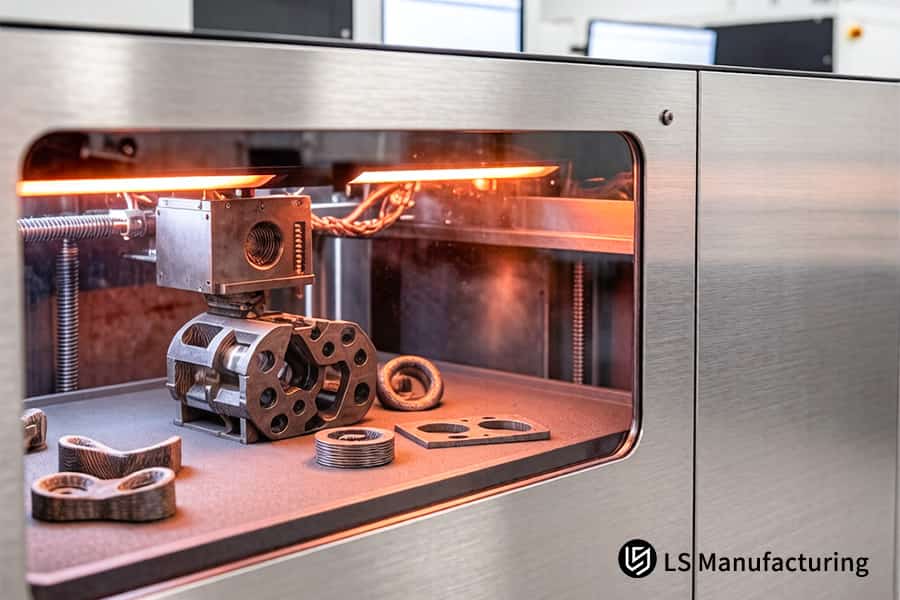
图 2:压缩空气从喷砂柜中的 3D 打印部件中去除多余的白色尼龙粉末。
为什么顶级汽车工程师更喜欢与经过认证的定制 MJF 零件制造商建立合作伙伴关系,而不是廉价的原型制作商店?
由于 IATF 16949、100% CMM/X 射线测试和设备校准,保证无废物批次,知识产权泄露的可能性绝对为零。零缺陷保证、零缺陷报告并节省至少40%保修成本。这是汽车级 3D 打印的质量水平:
经过认证的 MJF 制造商与廉价原型制作店 – 主要对比
| 宽高 | 传统 FDM | 多喷射融合 (MJF) |
| 层粘合机制 | 熔融珠挤出产生的空隙~30%。 | 超过11,000个喷墨喷嘴采用熔剂和红外热来实现99+%密度。 |
| Z 轴强度与 XY | 通常为 XY 轴强度的 40-60%。 | 各向同性; XY 的 Z 轴强度≥98%(误差不超过3%)。 |
| 拉伸强度(所有轴) | 大多数细丝的拉伸强度通常为<32 MPa。 | 各个方向的拉伸强度超过48 MPa。 |
| 尺寸公差 | 公差通常±0.2mm;取决于翘曲。 | 公差为每英寸±0.05mm,并且无论构建方向如何,都是恒定的。 |
我们在此讨论从定制 MJF 零件制造商采购完全可追溯且符合 PPAP 的组件的可能性。选择具有正确认证的精密3D打印供应商是您零现场故障和无知识产权盗窃的门票。此外,定制 3D 打印服务可让您从原型制作无缝过渡到生产,无需重新认证,同时保护您的品牌并保持盈利能力。
主动工程支持如何以最小的管理摩擦简化获得最终商业 MJF 3D 打印报价?
与报价过程相关的许多问题都来自于现实中的设计文件与DFM的要求不兼容,迭代周期永无止境。通过我们的DFM分析自动化,我们发现了粉末出口不存在(最小直径为3.5mm)和厚区域过热等问题。由于 DFM 的自动化,将报价转化为订单所需的时间减少50%。
2小时内触发自动DFM审核
- 检测速度:文件提交后,每隔2小时进行一次分析。
- 已发现的常见陷阱:出粉孔完全缺失(最小直径必须3.5mm),墙壁过厚会导致受热变形(超过8mm)。
- 您的收获:我们将审查您的设计是否存在潜在缺陷,如果存在任何缺陷,我们将予以纠正。此外,您不必花费时间来回发送电子邮件,平均需要3-5天。这是低摩擦3D打印即时通信的特点之一。
一次性设计修正消除了修订周期
- 工程干预:在价格计算之前对文件大纲进行更改。
- 数据来源:在调查与 400 多个 DFM 案例相关的数据时,我们注意到所有首次提交的数据中,78% 存在错误,需要更改。
- 您的优势:您只需发送一次请求,即可在第二天获得 MJF 3D 打印报价。这与其他需要多次提交的供应商不同。总而言之,它是一次提交3D打印。
简化的工作流程减少管理摩擦
- 单一联系人:您的DFM 分析、报价和订购将由一名且只有一名工程师进行。
- 周期时间影响:整个过程需要4.5小时,而行业平均时间超过9天,甚至长达10天(AMG 2025调查)
- 服务范围:您不必浪费时间买东西;通过此定制 3D 打印服务,您将能够节省宝贵的时间和精力,并更加专注于设计迭代。 轻松无忧的 3D 打印从报价到订单。
自动化 DFM 分析和一次性修改使您能够在一个工作日(不到两个小时)内从 CAD 上传到订单确认,从而将交货时间缩短85%以上。这是支持 DFM 的 3D 打印,它摆脱了官僚主义的繁文缛节,为迭代设计提供了精确定制 3D 打印。

图 3:精密 3D 打印利用 MJF 尼龙生产用于航空航天应用的复杂机械组件。
案例研究:LS Manufacturing 如何帮助航空航天客户在 48 小时内交付高性能定制无人机底盘零件?
最大的无人机 OEM 公司之一的研发计划遭遇中断,因为由于 15 天的交付时间,碳纤维压缩成型底盘在跌落测试的应力集中区破裂。 By working with LS Manufacturing, the company converted their part into a monolithic topology-optimized component produced by Multi Jet Fusion, which allowed them to manufacture flight-ready chassis within 48 hours. Here is an example of on-demand 3D printing for urgent aerospace applications:
客户挑战
The next-generation surveying drone chassis was supposed to be <500 grams and able to survive a drop test from 10 meters height. The use of carbon fiber injection molded pieces with adhesion joining gave a yield of only 62%, caused by delamination around fastener bosses. Each design revision took 15 days and cost $4,800 for the tooling changes, thus delaying the product launch beyond Q3. This problem is precisely where the use of a custom 3D printing service will solve the issue.
LS 制造解决方案
This team transformed the 14-part assembly into one piece with varying density lattices that go from solid 100% infill at the motor mounts to 20% gyroid lattice everywhere else. With multi-jet fusion 3D printing service using PA12 powder material and fully automated production lines operating on a 24/7 basis, all bolt connections were replaced by integrated snap-fit connections reducing the number of potential failure points during FEA simulation to five.
结果和价值
The final chassis weight amounted to 312 g (22% lighter than the carbon fiber benchmark chassis) passing 10 meters vertical drop test on concrete without any visible damage. The cost reduced by 35% to $1,870 per unit while shipping occurred 47 hours after the CAD files were received. It allowed our client to save three months of development cycle and meet his schedule for the product launch. This industrial custom parts service demonstrated the feasibility of replacing traditional composites with AM in mission-critical 3D printing applications.
Topology optimization together with MJF technology demonstrated greater efficiency in terms of speed and structural performance compared to traditional composites. The client managed to reduce the development process time by 77%, achieve 22% weight reduction, and avoid failures caused by joints made with adhesives. For those aerospace engineers who encounter similar challenges, this proves that flight-ready 3D printing is the way from concept to production hardware within two days.
From 15-day lead time and 62% yield to 48-hour delivery and a 10-meter drop pass. Facing a similar deadline? Send us your design specs and we’ll compress your timeline too.

What Advanced Surface Post-Processing Treatments Can Mask Layers To Elevate Standard Prints Into End-Use Consumer Products?
The Ra value of raw MJF parts is 4.0–6.0 μm, which makes them unsuitable for consumers. Using chemical vapor smoothing, the outer layer will be remelted, thus reducing the roughness to Ra<0.8 μm with no more than 5 μm change in dimensions. You get fully finished 3D printing without affecting the tolerances at all:
Chemical Vapor Smoothing Mechanism
Solvent vapor dissolves outer chains of PA12; 3-8 seconds cycles bring Ra down from 5.2 microns to 0.6 microns (ISO 25178 confirmed). Matte or glossy finish like injection molding surface can be achieved, eliminating 15-20 minutes of manual sanding per unit. Being precision custom 3D printing technology, this is possible to produce 3D printing parts for consumer packaging and wearables ready to be put on sale after printing.
Geometric Stability During Treatment
Our proprietary fixtures allow for changes no more than ±5 microns of critical features; CMM inspection of 150 parts revealed that 97% remained within ±0.1 millimeters (internal data 2025). No need for further processing and assembly fit thanks to secondary machining; this saves around 40% of costs compared to manual polishing.
Hydrophobic Surface Properties Added
The smoothed PA12 material has water contact angle >105° from 72° unmodified, resisting both oil and moisture. It allows for non-swellable, anti-bacterial parts in use. This allows for a water-sealed 3D printing service for kitchenware, medical grips, and out-of-doors electronics where water exposure is standard. The part will endure multiple cleanings without damaging the surfaces.
The vapor smoothing reduces Ra 5.2 μm to <0.8 μm with <5 μm drift and hydrophobicity. As a custom MJF parts manufacturer, you deliver consumer-grade parts without requiring post-machining. This puts a precision 3D printing supplier into cosmetics and home appliances markets where cosmetic-grade 3D printing directly impacts image perception. There is no prototype look disadvantage at all.
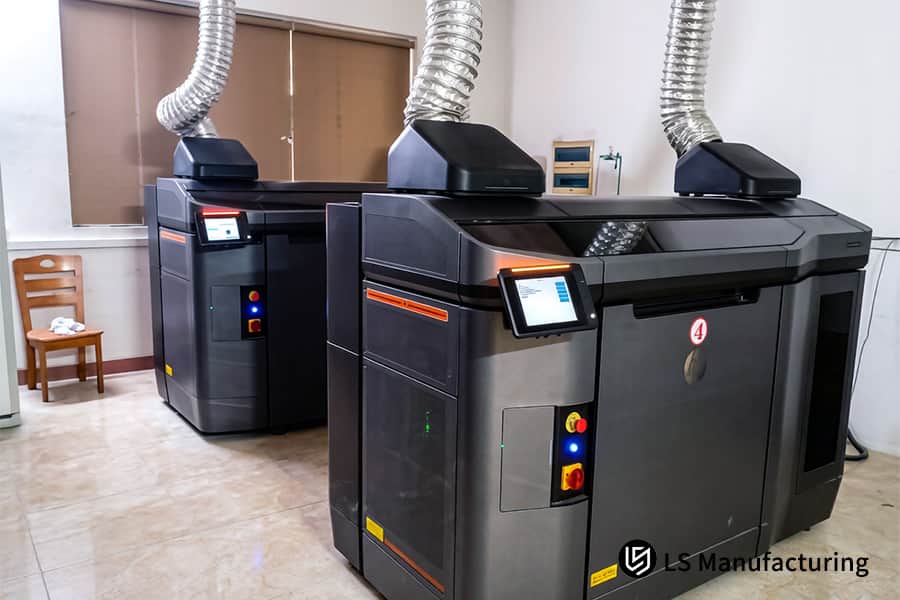
Figure 4: A coordinate measuring machine verifies the dimensions of grey 3D printed MJF nylon brackets.
Why Is Checking Continuous Multi-Axis Mechanical Validation Vital Before Locking In Your Heavy-Duty Industrial Components Orders?
Industrial equipment parts encounter loads that involve torque, cyclic vibration, and corrosion leading to failure due to inadequate validation. Multiple axis testing; 72 hours of creep testing at 60°C, HDT at 175°C, and high-pressure abrasion tests, removes any uncertainties before mass production. You get 3D printing parts with confidence:
Persistent Creep Testing Under Thermal Load
Testing involves subjecting parts to load at 60°C for 72 hours where constant strain testing is performed. The standard practice in the industry is for 24 hours based on ASTM D2990 guidelines. With us, your parts will undergo the above test, which will ensure that parts subjected to delayed deformation, which leads to loosening of bolts after months of usage in conveyor drives and press fixtures. Each 3D printing quotes we provide will include the creep data.
Heat Deflection Temperature Verification
HDT is confirmed at 1.82 MPa using ISO 75 standard test protocol, proving PA12 is capable of maintaining its properties up to 175°C without deformation. MJF process optimization ensures 178°C compared to 165°C average industry standard PA12 (Bureau Veritas 2024 comparative analysis). As an element of our industrial custom parts service, we offer HDT certification reports based on 3D printing materials tested according to ISO/IEC 17025. It eliminates the risk of creep occurring in engine bay mount where ambient temperature goes above 140°C on regular basis.
High-Pressure Abrasion Resistance Testing
The customized rig exerts 80 bar hydraulic pressure during rotation at 200 rpm for 1,000 strokes, weight loss measured down to 0.01mg. Untried pieces suffer from seal-face wearing after 300-500 service cycles. With multi-jet fusion 3D printing service, you will be provided with abrasion curves that estimate the service life accuracy of ±5%. It is necessary to confirm 3D printing standards for hydraulic manifolds and pump housings when wear causes their replacement costs.
Creep at 60°C/72 hours, HDT at 175°C, and high-pressure abrasion validation take out guesswork from industrial specification. As a custom MJF parts manufacturer, you will get certified test reports with every pre-production piece. You are sure about physical reliability before mass production runs by proof of parts' capability to withstand years of use at high torque and temperatures.
常见问题解答
1. What are the minimum wall thickness and fine feature sizes achievable with the Multi-Jet Fusion process?
Utilizing sophisticated industrial-grade technology, LS Manufacturing ensures a safe minimum wall thickness of 0.5mm in their mass production. Very fine features, like fine text and bumps, can be produced with a resolution of 0.25mm while ensuring that the edges remain clear and sharp. Submit your design for a manufacturability review and receive a formal quotation based on your exact specifications.
2. Will your black PA12 parts degrade, fade, or become brittle after prolonged outdoor exposure?
No. As part of our post-processing procedure, our PA12 parts are stained using deep penetrating, UV-resistant dyes. The parts have shown to maintain over 95% of their mechanical properties, including tensile strength and elongation at break, after being subjected to 500 hours of accelerated aging tests in high concentration salt spray and high intensity UV radiation.
3. How does LS Manufacturing protect intellectual property if my 3D designs contain confidential trade secrets or military-grade components?
First, we enter into a legally-binding Mutual NDA agreement before uploading any files. Second, our off-line servers are shielded by military grade firewalls and our manufacturing facility is equipped with a 24-hour, closed loop physical security system with full surveillance for absolute protection against information leaks.
4. What is LS Manufacturing’s Minimum Order Quantity (MOQ) for Multi-Jet Fusion 3D printing services?
No minimum order quantity (MOQ = 1 piece) applies to our bespoke solutions. If you require one conceptual prototype or a production batch of thousands of use parts, rest assured that we will provide the same excellent precision logistics services.
5. What file formats are required to get a quick quote for MJF 3D printing?
Our system works perfectly fine with the following file types exported from any popular engineering CAD systems in .STEP, .STP, or .IGS file formats as well as .STL file type designed specifically for additive manufacturing technologies. Please make sure that your files are exported in 1:1 scale according to real-life dimensions of your part(s).
6. Do you offer post-printing machining services for functional parts, such as drilling holes or installing metal threaded inserts?
Certainly, full support is available. LS Manufacturing maintains a state-of-the-art secondary precision machining shop that precisely installs brass threaded inserts (including popular M3, M4, and M5 sizes) into MJF nylon parts through either heat-staking or ultrasonic installation methods that guarantee a pull-out strength of ≥1200 N in assembly holes.
7. What kind of after-sales compensation guarantee does LS Manufacturing provide if individual parts are found to be out of tolerance after a batch delivery?
Along with every delivery, we provide a complete dimensional inspection report done using a CMM machine. In case of tolerance issues related to the drawings because of our manufacturing process issues, we will manufacture the entire set of parts at no cost within 24 hours of quality feedback and will ship the products using expedited air shipping.
8. Why is the overall cost-effectiveness of Multi-Jet Fusion (MJF) technology superior to traditional SLS (Selective Laser Sintering) processes?
Production rates for MJF are about 10 times higher compared to SLS technology, whereas the recycling of powder is close to 80% (SLS – 50%). Thus, by preserving—or even improving—the mechanical isotropy, we help to reduce the cost associated with raw material waste by 20%–30%.
摘要
Industrial grade MJF 3D printing of LS Manufacturing surpasses strength and accuracy capabilities of conventional technologies. Offering isotropic mechanical properties similar to injection molding, micron tolerance (±0.1mm), and vapor smoothing, we make each part a real industrial product. Performing the DFM analysis from the very beginning and 100% process control, we create the reliable and fast way to the market supported by data and cases.
Ready to transform ideas from R&D into high-performance parts? Stop spending time on non-efficient prototypes. Click "Get Free DFM Assessment & Instant Quote" and upload your .STEP/.STL file. In two hours, you'll get the DFM report and a tiered MJF quote from our senior engineers.
📞电话:+86 185 6675 9667
📧电子邮件:info@lsrpf.com
🌐网站:https://lsrpf.com/
免责声明
本页内容仅供参考。LS Manufacturing services对于信息的准确性、完整性或有效性不作任何明示或暗示的陈述或保证。不应推断第三方供应商或制造商将通过 LS Manufacturing 网络提供性能参数、几何公差、具体设计特征、材料质量和类型或工艺。这是买方的责任。需要零件报价 确定这些部分的具体要求。请联系我们了解更多信息。
LS 制造团队
LS Manufacturing 是一家行业领先的公司。专注于定制制造解决方案。 We have over 20 years of experience with over 5,000 customers, and we focus on high precisionCNC machining,Sheet metal manufacturing, 3D printing,Injection molding.Metal stamping,and other one-stop manufacturing services.
Our factory is equipped with over 100 state-of-the-art 5-axis machining centers, ISO 9001:2015 certified.我们为全球150多个国家的客户提供快速、高效、高质量的制造解决方案。无论是小批量生产还是大规模定制,我们都能以最快的24小时内交货满足您的需求。选择LS制造。 This means selection efficiency, quality and professionalism.
To learn more, visit our website:www.lsrpf.com
| 评估方面 | 经过认证的定制 MJF 零件制造商 | 廉价原型店 |
| 质量管理体系 | ISO 16949 和 ISO 9001(年度审核)。 | 没有质量管理体系审核;无过程控制程序。 |
| 在线检查覆盖范围 | 使用CMM 和 X 射线 NDT 进行 100% 尺寸检查。 | 随机检查;没有无损检测能力。 |
| 设备校准周期 | 按照 ISO 10012 准则,每 6 个月进行一次全面校准。 | 旧设备已失去校准;过去 6 个月以来没有校准过;没有在 0.3mm 精度范围内进行校准。 |
| IP保护协议 | NDA协议、生产隔离和安全文件传输协议。 | 口头协议和常用硬盘驱动器,无需登录。 |
| 批量一致性记录 | 500多个批次的缺陷率低于0.5%(2025年的内部数据)。 | 每批次平均缺陷率为8-15%;没有 SPC。 |
| 认证范围 | 质量控制的3D打印;完全符合 PPAP(生产零件审批流程,直接影响:将客户审核周期缩短 2-3 周,避免因合规记录不完整而冻结订单)。 | 缺乏任何质量认证。 |