English



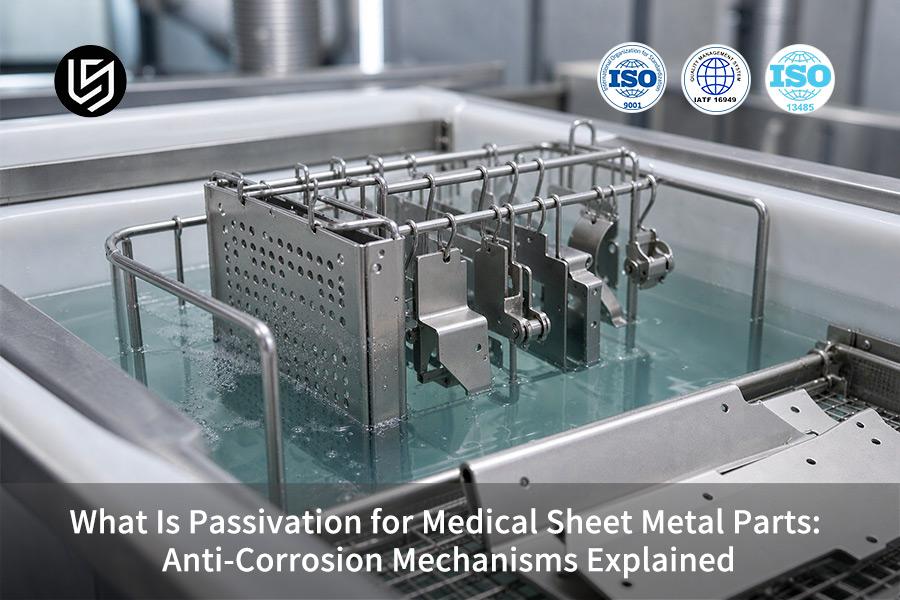
TL;DR: Medical sheet metal parts passivation is an immersion procedure carried out post-fabrication to eliminate free iron (ferrous impurities present on the surface). Chemical passivation strips surface free iron so the alloy rebuilds its own Cr₂O₃ film, and it holds dimensional tolerances at ±0.005 mm because the acid never touches the bulk metal. Even stainless steel parts will eventually rust as a result of residual impurities.
Junior design engineers and procurement trainees will often find rust marks on medical stainless steel parts and perceive them as material failure. Iron impurities present from bending, shearing, and laser cutting affect alloy properties, causing misperceptions. To put it differently, rust protection and medical suitability can be tested before production.
Key Takeaways
- No coating, but chemical transformation. Weak acid gets rid of the free iron on the surface. Chromium appears on the surface and bonds with the oxygen present in the air to form chromium oxide (Cr₂O₃, which is a film produced from the basic material and is neither sprayed nor electroplated).
- Maintains dimensional stability. Acid passivation only works on traces on the surface, stampings for tight tolerance housings in the medical field remain unaffected by acid passivation. The process of electroplating increases the thickness, and the design must take into consideration that extra thickness.
- Dependent on surface chemistry. Cr/Fe ratio (chromium to iron atom ratio on the surface layer) trumps the name of the stainless steel grade. Machining and welding lower the surface Cr/Fe ratio below the bulk value on 316L, which is why the bath is applied after forming rather than relying on the alloy's own passivity.
- Choosing acid is a compromise. Citric process eliminates the free iron via chelation but does not release any poisonous gas. On the other hand, nitric acids contain stronger oxidizing properties, and eliminate the sulfide-loaded stock in a shorter time period. In practice, the citric acid process is more applicable in medicine.
About the Author Behind This Guide
Gloria, Rapid Prototyping and Rapid Manufacturing Specialist at LS Manufacturing, possesses more than 15 years of experience in precision engineering and surface chemistry. Checklists located on Gloria's desk turn acid passivation chemistry into a design decision. Follow Gloria's engineering insights on LinkedIn.
LS Manufacturing’s Principle Engineering Review Board verifies each acid concentration, bath temperature, and tolerance grade with respect to a particular source line. ISO 13485:2016 (quality management systems for medical devices) defines the scope of documentation for sterile device components, which differentiates medical passivation documentation from the industrial one. Sources cited to Project #MED-2026-408 (n>800 components, 2025-2026).
Junior engineer learns how to do one specific thing: read the passivation specification to find the clause that controls the free iron removal process. ASTM F86 specifies surface preparation for metallic surgical implants, and it lists the passivation practices accepted for implant-grade parts alongside those accepted for general commercial parts.

What Is Passivation For Precision Medical Sheet Metal?
Medical sheet metal passivation is an acid bath treatment that dissolves the free iron and enables the stainless steel to re-form its chromium oxide layer. The processes such as blanking, bending, and welding leave the contamination of carbon steel on the surface of the stainless steel, while the medical sheet metal passivation process helps to clean the contamination. The process of passivation cleans up the free iron and leaves the substrate unchanged; the dimensions of the part are still in the original range. The chromium oxide (Cr₂O₃) forms from the substrate, and medical passivation follows ASTM A967/A967M, which covers both the citric and the nitric route and defines the free-iron test.
Chemical Stripping Versus Deposited Coatings
Acid is more aggressive towards iron, hence more chromium remains on the surface. Low iron area (which is the acid-washed area free of iron) is beneath the oxide film and reduces pitting. As per the standard specification ASTM A967/A967M-17 for chemical treatments of stainless steel parts, the thickness of the oxide film is 1.5 nm to 3.0 nm. Plating further adds to this thickness, making edges which can chip off. A medical sheet metal fabrication guide includes passivation after forming.
Free Iron Sources in Medical Enclosures
Die made of carbon steel, press brake tooling, laser cutting equipment transfers iron on stainless surfaces; welding causes heat tinting. Thin gauge medical enclosures collect contaminations at every forming step with narrow interior channels concealing them from wiping.
- What: Stainless steel is rust-resistant inherently, the need for the passivation bath is non-existent.
- Why: Free iron acts as the anode adjacent to the chromium-rich substrate with moisture completing the circuit.
- How to detect: Copper sulfate swab test will show a dark spot where still iron that could not be cleaned.
In simple terms, bath removes the contamination formed during the manufacturing process and not the alloy.
Section Takeaways
- Passivation forms a film from the base metal, the layer cannot fall off.
- Contamination is the starting point for sheet metal fabrication corrosion basics.
Related keywords: passivation definition for stainless steel / chromium oxide film formation / free iron removal process
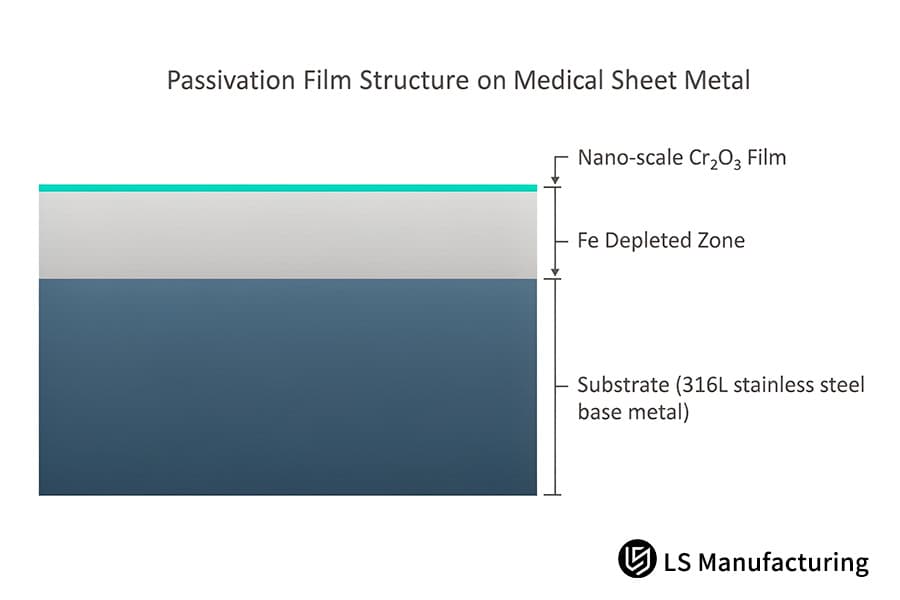
Figure 1: Passivation film structure on medical sheet metal: substrate, iron-depleted zone, and nano-scale Cr2O3 film.
How Does Passivation Stop Corrosion On Medical Metal Parts?
Passivation is a selective chemical de-ironing step: it removes surface free iron and does not etch the bulk alloy. Principle of galvanic cells explains how passivation works. As documented in ASM Handbook, Vol. 13A – Corrosion (ASM International, 2003), the as-received Cr/Fe ratio of a 316L surface sits between 0.5 and 0.7. In other words, no available metal for the chloride ions to attack since all that remains is an inert oxide film, ddescaling comes before the passivation bath, but the two steps are not interchangeable.
Galvanic Drive Behind Surface Rust
Free iron particles located on the surface become micro-anodes, while the chromium rich particles near the surface become cathodes. Moisture serves as the conductor of electricity and causes the dissolution of the iron particles. Anode location is the point at which the pit is created. Single particle serves as the source of the rust. Carbon steel tooling creates most of the free iron particles during blanking. Sheet metal fabrication passivation chemistry involves starting with cleaning rather than alloy modification.
Chromium Oxide Film Continuity
After the iron is separated by the use of the acid, the next step is when the chromium reacts with oxygen to produce the continuous film of Cr₂O₃. Film continuity plays an important role in determining the passivation anti-corrosion mechanism, whereby any discontinuity in the film provides opportunity for the metal to come into contact with chloride. Heat tint (oxidized discolored consequence of welding) acts as an obstacle in making continuous films, which is why grinding needs to take place before the bath on seams. Continuous film protects the metal from coming into contact with the chloride.
Sterilization Cycle Endurance
Involvement of repeated steam sterilization processes in hospitals entails cycles where hot and wet chloride is involved, continued existence of the chromium film after these repetitive cycles is possible due to oxidation that takes place through exposure to steam. Time does not cause thickening of films since passivation is limited, and extra time spent in the bath causes rough grain boundaries. In the given cycle, copper sulfate swab comes out clean. Sheet metal fabrication oxide film integrity, rather than bath duration, determines sterilization endurance. Simply put, cleanliness triumphs duration.
Corrosion Mechanism Takeaways
- Acid assists in the removal of free iron, while chromium enrichment protects from chloride attack.
- Continuity of film maintains the sterilization cycle but not the bath time.
Related keywords: passivation corrosion mechanism / chromium enrichment process / free iron removal chemistry
How Do Medical Passivation Workflows Maintain Base Tolerances?
Workflow tolerance control in medical passivation is made up of staging of cleaning and limited acid exposure, as described by Groover in his book titled "Fundamentals of Modern Manufacturing," (5th Edition, Surface Treatment). Medical passivation enclosures maintain the dimensional range consistent during forming. Medical sheet metal passivation process stations are carried out in line with passivation standards for medical devices: alkali degreasing, water rinse, acid immersion, deionized counter-flow rinse, drying, and validation.
Degreasing and Acid Immersion Stations
Sheet metal fabrication degreasing stage determines if the acid will make the contact with bare metal. Alkaline degreasing removes drawing oil and fingerprints, and the reaction takes place on an even surface. Citric acid bath held within the range of 45 °C to 65 °C is suitable for 316L medical enclosures; the lower bath temperature leads to slower de-ironing, and the higher one causes grain boundary attack.
Rinsing Drying and Verification
Deionized counterflow rinse controls the conductivity (conductivity measures ion contamination of the rinse water) and prevents chemistry carry-over from one bath to another. Hot-air drying follows. Copper sulfate test (a swab turns black in locations where there is free iron) ensures de-ironing in accordance with ASTM A967 Practice D, and the inspectors measure the dimensions of gauged features.
Workflow Boundary Against Stock Removal
- What: Acid bath can remove stock and bring the out-of-band dimension to be within band.
- Why: Acid removes iron selectively but not uniformly; the oversize features are not removed.
- How to verify: Readings for the pre-bath and post-bath gauges should be identical, and out-of-band features remain out-of-band.
Sheet metal fabrication tolerance stability does not rely on bath changes but on the upstream forming operation. Put it simply, passivation does not change what forming process created.
What This Section Establishes
- Staged cleaning and selective acid contact result in minor stock removal.
- Swab and gauge readings verify the unchanged feature geometry.
Related keywords: passivation workflow stages / stainless acid immersion control / medical enclosure tolerance stability
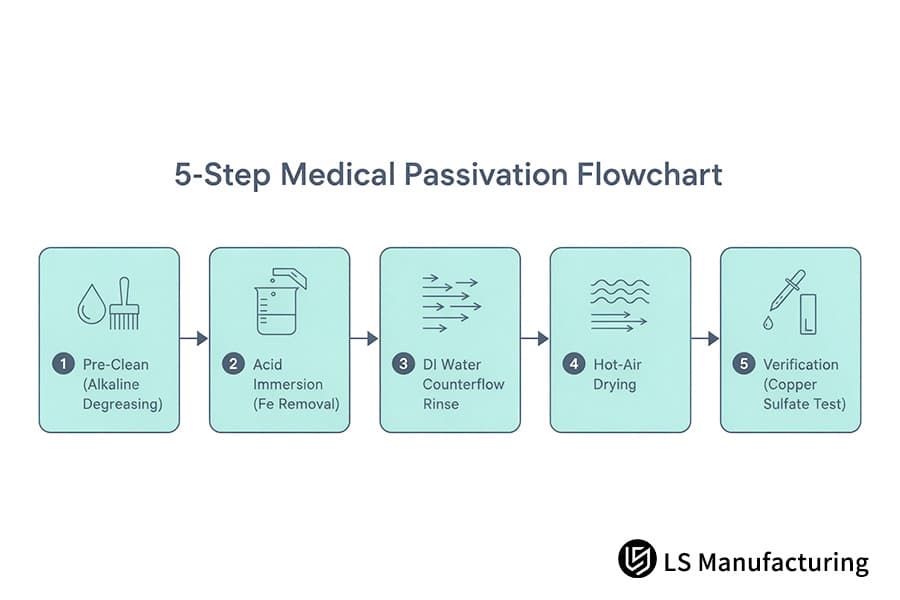
Figure 2: 5-step medical passivation flowchart: pre-clean, acid immersion, DI water counterflow rinse, hot-air drying, and copper sulfate verification.
4×N Basic Comparison Table
Surfaces modification techniques vary by reaction type, bath type, dimension reduction, and the medical application for which they are used. Both citric acid and nitric acid remove free iron, but electropolishing removes base metals. New engineers will be able to identify one type of bath for one kind of instrument out of four studied reaction types. Simply put, the choice of mechanism determines stock depletion.
| Surface Treatment | Reaction Mechanism | Bath Medium | Dimensional Change | Typical Medical Application |
| Citric Acid Passivation | Reaction removes free iron from the surface to provide conditions for the formation of Cr₂O₃ film | 4%–10% citric acid bath solution, bath temperature 45 °C – 65 °C | Change ≤0.001 mm, tolerance ±0.005 mm | Handles of surgical instruments, implant accessory devices, endoscope enclosure panels |
| Nitric Acid Passivation | Oxidizing agent acts on the surface and removes iron debris | A substantially higher acid concentration nitric acid bath solution, bath temperature a lower temperature window than the citric route | Change ≤0.001 mm, tolerance ±0.005 mm | Parts of washer chamber assemblies, analyzer frames, surgical trays |
| Electropolishing | Electrochemical smoothing removes micro-projections but deposits chromium | Phosphoric acid/sulfuric acid electrolyte, direct current field, and temperature-controlled bath | Uneven removal 5.0 μm to 15.0 μm | Blood centrifuge impeller housings, blood stents, sterile catheter connectors |
| Chemical Conversion Coating | Chemical reaction creates synthetic oxide or chromate film | Alkaline or oxidizing salt bath, anodizing or blackening process | Film formation a micrometer-scale film | Aluminum analyzer panels, diagnostic counterweights, outer brackets |
Citric passivation is appropriate for medical cabinets where the fit window must remain the same, but electropolishing is preferred for implants when the drawings allow for stock removal.
Why Compare Citric VS Nitric Passivation For Devices?
The difference between citric acid passivation and nitric acid passivation is that there is a different approach in one method of action: chelation extracts free iron only, whereas mineral oxidation extracts the entire surface layer. Chelation does not affect nickel and chromium, which means that biocompatibility testing will be performed successfully without the risk of contamination of any kind. Despite the higher oxidation potential of nitric acid, over pickling is brought about by alloys having low concentrations of chromium as well as insufficient rinsing. Citric vs nitric passivation depends on alloy chemistry, and passivation standards for medical devices allow both processes according to ASTM A967. Causes of passivation failure trace to bath control, not acid identity.
Chelation And Oxidation Pathways
Chelation using citric acid extracts the iron out while nickel and chromium are still left in the alloy. On the other hand, nitric acid attacks everything on the surface, including the alloying elements. Overpickling occurs after chromium depletion when grain boundaries are roughened by excessive acid action. Sheet metal fabrication acid chemistry will determine if the film formation starts on the chromium-bearing surface.
Hydrogen pickup from plating or pickling is the real embrittlement risk for spring-tempered clips; citric passivation does not introduce hydrogen. The most hazardous form of hydrogen embrittlement (hydrogen entering into the metal and leading to delayed fractures) is possible with spring-tempered clips, and citric acid treatment makes hydrogen treatment unnecessary. Austenitic stainless steel prevents such damage, but martensitic ones do not.
Salt Spray Parity And Bath Verification
- What: A more effective oxidizing agent creates a thicker, tougher protective layer.
- Why: Passive film creation is self-limiting in both acids; the two solutions end up with similar chromium content.
- How can it be proven: Two coupons are processed concurrently by the ASTM B117 Salt Spray Fog Test (a test chamber test in terms of time to first pit appearance), and the inspectors assess exposure time.
Sheet metal fabrication chelation mechanism benefits from regulatory considerations as well. EPA (United States Environmental Protection Agency) and OSHA (Occupational Safety and Health Administration) regulate nitric fumes and acid concentration, and as a result, clean medical workshops prefer citric baths. Scrubbing the fumes involves additional hardware but provides no corrosion protection advantages. In other words, acid concentration is irrelevant compared to bath control.
What Readers Can Now Judge
- Chelation saves metal components; oxidation spends them.
- Salt spray equivalence shows that bath control wins, not acid concentration.
Related keywords: citric acid passivation mechanism / nitric acid oxidation risks / medical passivation bath selection
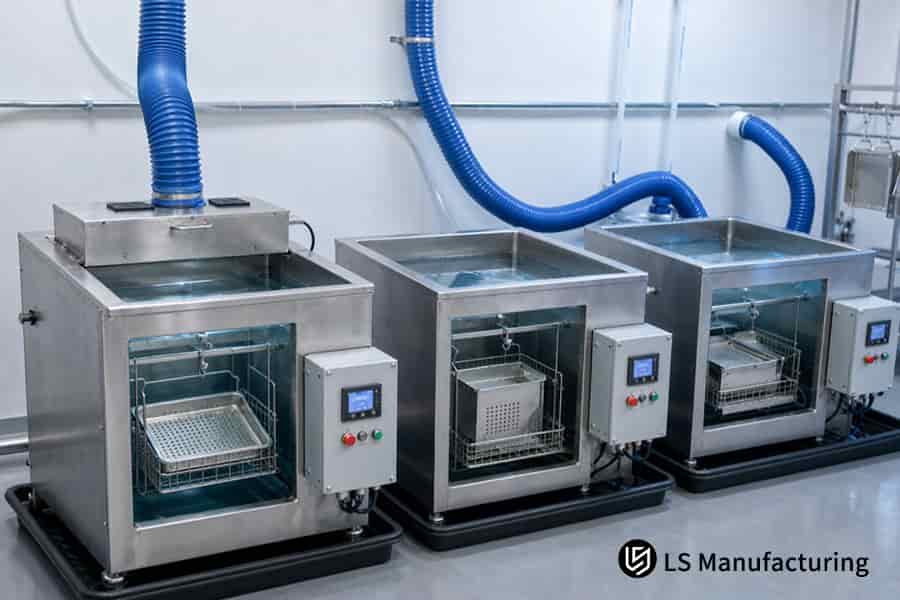
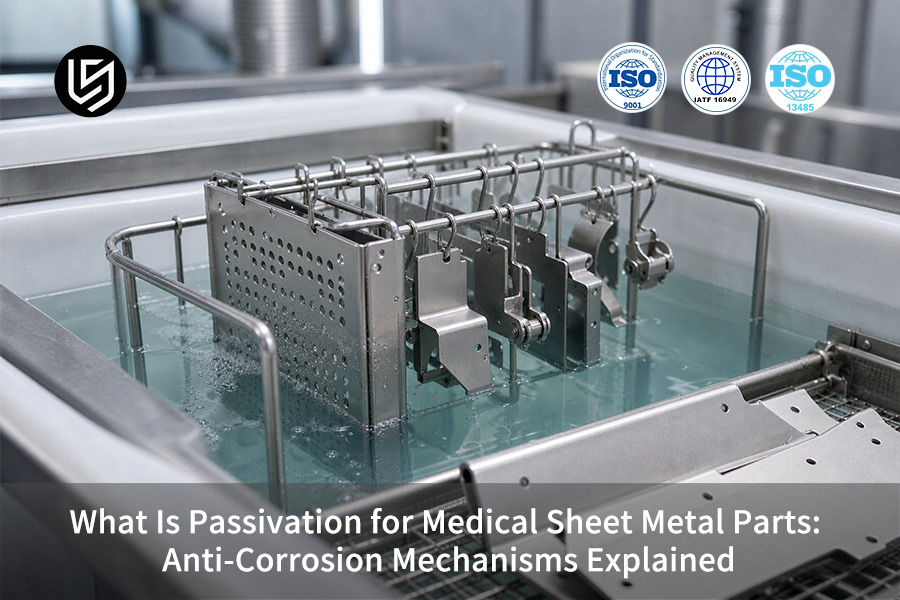
Figure 3: Bath stations hold 316L trays in citric passivation solution at 45 °C to 65 °C for clinical use.
Which Causes Of Passivation Failure Compromise Sheet Parts?
Sheet metal fabrication passivation failure is the contamination that occurs in the bath or recurs in the process of rinsing, resolving the issue of rusting of stainless steel components after being passivated. According to the three primary causes by ASM International: Corrosion Failures in Stainless Steel Components, there is a problem with the cleaning process. The lubricant coating on the component acts as a shield from the acid, but dissolved iron from the used bath gets redeposited on the component, and the acid trapped within the seams gets dried to leave behind the chlorine-based deposits. Pitting occurs because of the chlorine-based deposits when the component undergoes steam sterilization.
Oil Films And Barrier Formation
Sheet metal fabrication degreasing residue is the determinant if acid ever touches the substrate at all. Hydrocarbon lubricant can resist weak alkali soak, and become a film (an oil film which stops acid from reaching substrate). The acid attacks the bare patches of metal; thus, the film forms patchily. Patchy oxide means that the chloride can reach the substrate via gaps. Alkaline degreasing and water break test removes film prior to soaking.
Aged Bath Iron Redeposition
Iron will precipitate in an old bath until the solution becomes saturated and cannot take any more. Iron redeposition (deposition of dissolved iron back to the substrate as a smut layer) covers all substrates apart from those leaving the bath. Fresh rinse water cannot remove smut layers, and the substrates emerge dirtier than they went into the bath.
Cross Contamination From Carbon Steel Tooling
- Failure Mode: Salt spray test failure shows poor bath chemistry.
- Explanation: Carbon steel press brake dies and usual blasting media, which pressurize iron onto the stainless surface after the bath process; the cause of failure wasn't poor bath chemistry.
- Method to prove it: Copper sulfate swab will change its color immediately when there is any free iron.
Weld seams form crevices that collect rinse water, and humidity test (cabinet testing that makes contaminated particles to form rust) shows poor rinsing. How passivation works requires clean contact and not bath strength. Usually, in actual situations, the failures occur prior to the tank.
Failure Modes Worth Remembering
- Oil film resists acid attack, and old baths leave iron behind.
- Carbon steel tooling causes iron to come after treatment.
Related keywords: passivation failure modes / stainless surface contamination sources / acid bath iron saturation
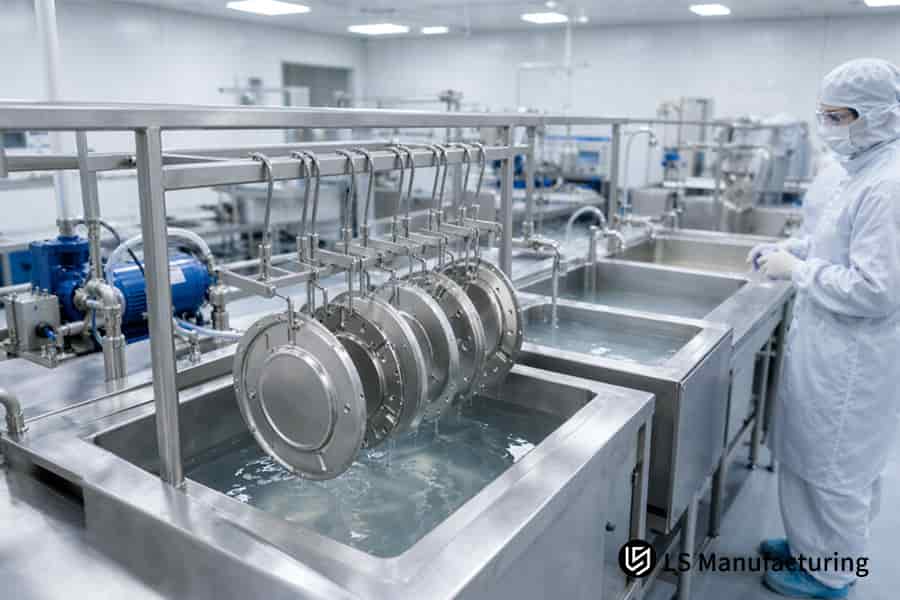
Figure 4: Immersion lowers 316L medical enclosure panels through a passivation bath holding ±0.005 mm for sterile service.
How Sheet Metal Passivation Works In Practice: A Medical Enclosure Example From LS Manufacturing
Sheet metal fabrication passivation inside a surgical fluid handling enclosure is done through a citric acid passivation process that will remove free iron ions from the stamped 316L brackets whose tolerance level is of ±0.005 mm. Prior to immersion, ultrasonic alkaline cleaning will help remove the drawing oil, and iron will be able to get attacked by citric acid. Citric cycle within ASTM A967 in a concentration range of 4%-10%, and middle temperature bath will remove the iron ions without affecting the parent austenite leaving the Cr/Fe ratio to be more than 1.5 and retaining the geometry.
Application Scenario
Surgical fluid handling equipment uses stamped 316L stainless brackets positioned within the peristaltic pump channels. Tolerance level is ±0.005 mm, and therefore any additional coating will increase the profile dimension which is not tolerable. Junior engineers may wrongly think stainless steel is safe from autoclave chemistry alone and micro pitting at bend radii contradicts this.
Principle in Practice
Ultrasonic cavitation (bubbles bursting for extracting oils from the hard-to-reach spots) takes away the drawing oil first, as the oil film inhibits acids and causes formation of patches. Concentration of citric acid stays within the range 4%–10% as per ASTM A967, and the bath temperature is medium. High-temperature solution corrodes the grain boundaries poor in chromium of the cold-rolled steel, and extra dwell time does not produce extra film.
Results and Insights
Percentage of pitting rejections was brought down from 16% to 4% in the autoclave corrosion resistance testing. Turnaround time of the prototype was cut by 14%. Without ultrasonic cleaning, the film of oil will protect iron and bring the percentage of rejection up to 16% – beyond the allowable level. Frozen cleaning conditions and bath parameters, but not acid concentration, define the resistance of the stainless enclosure to sterilization.
Data source: LS Manufacturing Internal Inspection Database, Project #MED-2026-408 (sample size >800 components, 2025–2026).

FAQs
1. What is the fundamental difference between passivation and electropolishing?
Passivation vs electropolishing is a choice between growing a film and cutting stock: acid converts surface iron into a nanometer-thin oxide, while anodic dissolution removes 5.0 μm to 15.0 μm of base metal. Sheet metal fabrication passivation chemistry leaves parent metal intact, and ASTM A967 governs citric and nitric routes at LS Manufacturing. Designers reserve stock-removal allowance for electropolishing, since passivation holds assembly geometry unchanged.
2. Does passivation alter the tight dimensional tolerances of sheet metal stampings?
Passivation will not impact the dimensions of the stamped parts because the acid reaction will strip iron from the surface to leave an oxide layer with a thickness between 1.5 nm to 3.0 nm, losing less than 0.001 mm of the bulk metal, according to ASTM A967 specifications. Your original tolerances of ±0.005 mm will still be valid after the process of bath immersion. LS Manufacturing takes geometric measurements before and after bathing.
3. Why can stainless steel medical parts still rust even if they are naturally passivated?
A popular misconception among engineers new to stainless steel, but the process of stamping and laser cutting brings about carbon-steel impurities causing disruption of uniformity on the surface. Young engineers run tests for contamination prior to confirming that the issue lies in the alloy composition since corrosion takes place when there are iron sites and not chromium content.
4. Which international standard governs medical device passivation verification?
Passivation of medical device production includes ASTM A967/A967M and AMS 2700 standards that require free-iron test in stainless steel parts. Sheet metal fabrication requires swabbing using copper sulfate or high humidity and LS Manufacturing ISO 13485:2016 specifies geometry within ±0.005 mm. The quality auditor pairs one standard number with one test method since ASTM standards contain chemistry while ISO 10993-1:2018 has biology.
Summary
Acidic passivation of stainless enclosures is possible due to the ability of the process chemistry to eliminate iron and regenerate the protective chromium oxide layer on formed surfaces. Design geometry helps in ensuring that fit windows are maintained after immersion since the acid substitutes surface atoms but does not strip stock metal. Corrosion prevention process eliminates contaminants from the areas where the coatings would be deposited.
Medical Sheet Metal Surface Engineering & Technical Support Desk
Engineers and design apprentices investigating Cr/Fe ratio optimization, galvanic behavior near laser welded joints, or tolerancing of thin gauge enclosures questions about passivation specification interpretation are answered by the LS Manufacturing surface engineering desk at info@lsrpf.com. Baseline conditions of experimental studies are accessible at https://lsrpf.com/, and LS Manufacturing, +86 185 6675 9667.
Further Reading: Medical Sheet Metal Fabrication Services: ISO 13485 Certified Component Manufacturer