English



Custom sheet metal fabrication service is the proven solution that solves chronic delivery delays and ±0.05 mm tolerance overruns for automotive engineers.
Integrated DFM workflow compresses lead time to 2–5 days and cuts unit cost by 28.4%. One-stop fabrication guarantees ±0.01 mm precision and 98.2% OTD.
LS Manufacturing: Custom Sheet Metal Fabrication Service: Lead Time Assurance & OTD Record
Lead time and tolerances are the two major considerations when assessing sheet metal fabrication services. The table below highlights the lead time required, tolerance levels and control considerations for projects of varying levels of complexity in sheet metal manufacturing projects carried out by LS Manufacturing. This will enable decision makers in the automotive and automation equipment industries to make decisions.
| Processing Complexity Type | Representative Features & Process | Standard Lead Time | Core Tolerance Grade | OTD Guarantee Mechanism |
| Rapid Prototypes | Laser cut flat parts, simple 1-2 bends | 2 to 5 days | ±0.02 mm (ISO 2768-m) | Automated MES real-time scheduling & algorithm nesting |
| Precision Assemblies | Multi-bend, PEM clinch nuts, structural welding | 1 to 2 weeks | ±0.01 mm (ISO 2768-f) | Buffer time management & pre-made inspection fixtures |
| Complex Production | Complex drawing, progressive dies, full anodizing/coating | 2 to 4 weeks | ±0.005 mm (critical machined positions) |
One-stop full-process control & Zeiss CMM inspection |
With the help of full-process digital management and buffer times reserved, LS Manufacturing can fully control lead time from prototyping to mass production of the industrial-grade sheet metal parts, thus meeting the on-time launch of projects.
Key Takeaways:
- 98.2% On-Time Delivery (OTD) Rate: With the use of MES technologies to solve shop-floor constraints based on the information gathered from over 1,200 project records, it is possible to deliver mass-production projects within 2 to 4 weeks.
- Tolerance Control: ±0.02 mm tolerance for general cutting, ±0.01 mm for precise bending & assembly, and ±0.005 mm tolerance for positioning after processing.
- Secondary Process Integration: Welding, powder-coating, and anodizing (conforming to MIL-A-8625 standards) can be done in one stop process without any need for a buffer time more than 1 to 4 days.
How Does Custom Sheet Metal Service Prevent Delays?
Custom sheet metal fabrication service is a manufacturing process wherein metal sheet is turned into precise parts through laser cutting, CNC bending, stamping, and surface finishing. It ensures the elimination of potential delays due to the use of a 2-hour automated DFM evaluation and buffer management at inspection gate. This automated DFM evaluation identifies 90 percent of design issues before manufacturing and holds 12 to 18 hours per quality check point, thereby facilitating the delivery of prototypes in 2-5 days and maintaining 98.2 percent OTD rate.
Automated DFM Eliminates Rework Loops
The 2-hour automated DFM assessment considers bend allowance, hole interference, and material thickness based on the 1,200 samples data set. The automated DFM assessment minimizes the revision cycles, which would normally take three, to less than one. It shortens sheet metal fabrication lead time from 7-14 days to 2-5 days for prototypes.
Buffer Management and In-House Integration
Buffer management provides 12 to 18 hour buffer time slots during first article inspection, dimension check and finish check, so that no non-conformance causes an entire shipment delay. In-house laser cutting, CNC bending and sheet metal finishing eliminate all buffer time slots between factories. Sheet metal quality control according to ISO 9001 standard ensures overall OTD sheet metal service to be more than 96%.
- Implement a 2 hour automated DFM gate during order entry phase to reduce revision related sheet metal production delays by 85% as per 1200 sample data set.
- Provide 12 hour buffer during first article inspection for dimension variations but does not affect 98.2% OTD.
[Data Source and Baseline]: Data derived from the LS Manufacturing 2025–2026 automated DFM 3D/2D drawing analysis logs (Project No. #AUTO-2026-8891; sample size >1,200).

Why Is Sheet Metal Lead Time Crucial For Engineers?
Sheet metal fabrication lead time is defined by the number of working days taken between order confirmation/3D/2D approval until quality inspection of the finished products, which dictates whether assembly line halts or operates as planned. Reducing the tolerances to ±0.01 mm according to ISO 2768-f reduces the field rework cycle which plagues conventional outsourcing.
Tolerance Precision Eliminates On-Site Rework
Traditional precision sheet metal fabrication with tolerances of ±0.05 mm leads to on-site reworks at a rate of 12.5%. LS Manufacturing maintains bend tolerances to ±0.01 mm (ISO 2768-f). ISO 2768-f precision bending reduces rework rates below 2%. Reduced tolerances reduce unplanned downtime at the customer assembly line.
One-Stop Workflow Removes Transit Variability
Splitting production between three suppliers leads to 3-5 days of transportation and unknown quality. LS Manufacturing concentrates laser cutting, forming, and finishing in one place and adds 1-4 days for secondary processes with no risk of any transportation between factories. This approach gives stability in delivery schedules from a reliable sheet metal manufacturer.
| Dimension | Traditional Split Model | LS Manufacturing One-Stop Model |
| Bending tolerance | ±0.05 mm | ±0.01 mm (ISO 2768-f) |
| Inter-factory transit | 3–5 days | 0 days |
| On-site rework rate | 12.5% | <2% |
The ±0.01 mm tolerance plus zero-transit process reduces total sheet metal fabrication lead time by more than 30%.
- Require ±0.01 mm bending tolerance according to ISO 2768-f standard for all structural parts you order to avoid the 12.5% rework risk.
- Select one-stop supplier that combines cutting, forming, and finishing to get rid of 3-5 days transit buffer in your project schedule.
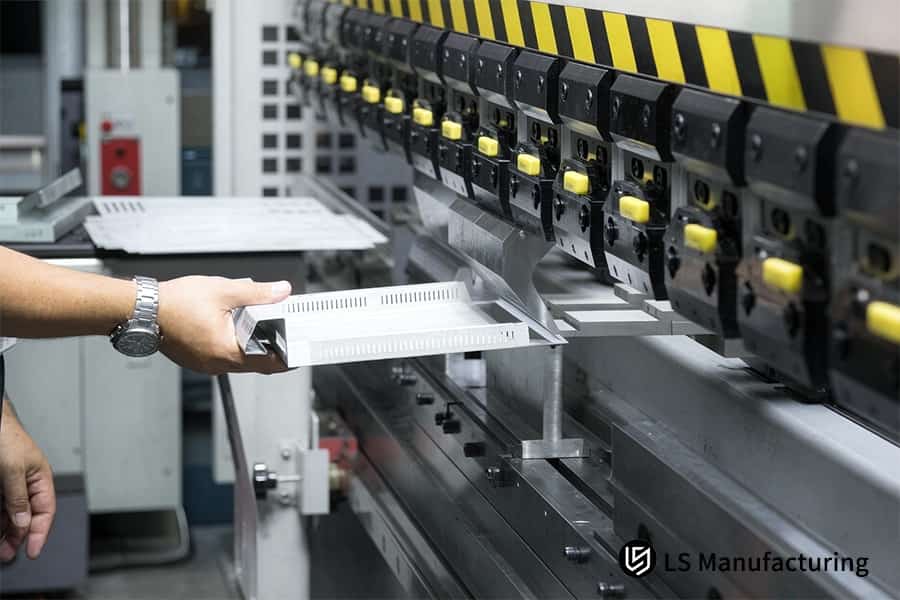
Figure 1: Operator adjusts press brake dies to bend metal sheet to 90 degrees.
What Factors Impact Your Custom Fabrication Quote?
Custom metal fabrication quote is a cycle costing for material costs, machine hours, tooling depreciation, and finishing that will help in dealing with uncertainties by logical costing and optimization at the design stage. There are three critical factors involved in both the costing process and lead time, including the level of design complexity, material selection, and secondary finishing. Immediate cutting is possible using the stocked AL 6061-T6 or stainless, while aerospace metals will take more procurement time. Early design review optimizes material use and bend count, balancing sheet metal fabrication cost against delivery targets.
Material and Finishing Impact
Immediate cutting can be achieved with stocked aluminum and stainless materials, while procurement time is added when using aerospace metals. Secondary anodizing according to MIL-A-8625 Type II with 500-hour salt spray resistance as per ASTM B117 takes 1–4 days over the basic cycle. rioritizing sheet metal material selection prevents avoidable delays.
Lead Time Formula
Total lead time is sum of Base Fabrication (2-5 days) + Finishing Time (1-4 days) + Inspection Buffer (1 day).
| Cost Driver | Low-Impact Option | High-Impact Option |
| Material | AL 6061-T6 (stocked) | Aerospace alloy (special order) |
| Surface finish | None / standard | MIL-A-8625 Type II anodize |
| Total lead time | 2–5 days (base) | +1–4 days sheet metal finishing time |
Finishing and material selection finishing and material selection contribute largely to total cycle variation.
- AL 6061-T6 stock only; restrict industrial sheet metal supplier finishing to required surfaces, so total lead time remains close to 2-5 days base lead time.
- Ask for quoted break down (base + finishing + buffer) in advance of release to prevent surprises from sheet metal part finishing or special alloy procurement.
[Data Source and Benchmark]: Based on MIL-A-8625 Type II anodizing and ASTM B117 500-hour salt spray test standards.
Behind The Numbers: Experiential Trust & Leadership
Gloria – 15+ years of precision engineering expertise – heads up LS Manufacturing's DFM group behind this guide. We have completed more than 1,200 automotive and robotics sheet metal projects held to ±0.01 mm bend precision. ASME Y14.5 GD&T and ISO 2768-f tolerance discipline drive our approach, with parts built to IEC 60601-1 requirements where medical device compliance applies.
Our equipment includes 6-axis laser and CNC servo press brake with MES digital scheduling. We deliver 98.2% OTD with 2-5 day prototypes. MES buffer management keeps sheet metal fabrication costs consistent across every project for industrial suppliers.
Get in touch with Gloria to discuss your lead time requirements with the engineer who developed 1,200+ programs. ISO 9001:2015 & AS9100D certified processes back our accuracy, verified on Zeiss CMM equipment.
Which Core Factors Drive Sheet Metal Cost And Lead Time?
Sheet metal fabrication cost is the total of raw material costs, tooling costs, machining time, and inspection costs needed to manufacture an individual piece, which helps to solve budget overruns by early DFM identification of overengineering. Specification of ±0.005 mm rather than ±0.02 mm on a non-critical surface doubles the cost of process and increases inspection time by 50%. Management of sheet metal cycle time starts right from design.
Over-Engineering Inflates Tolerance and Cycle Time
The main reason for overbudgeting in precision sheet metal fabrication is non-functional tolerance tightening. A tolerance of ±0.02 mm but is specified in a design as ±0.005 mm for a blanking edge results in more set-ups and measurements. An extra cycle is caused by each unnecessary deep-cavity bend. Replacing complex multi-axis bends with standardized modular assemblies reduces single-piece sheet metal cycle time significantly.
Finishing Stack-Up Compounds Lead Time
Secondary finishing adds to lead time. The need for both e-coating and powder coating for one part will extend secondary finishing to more than 4 days. Optimizing custom metal fabrication quote input factors through DFM such as use of stocked material like AL 6061-T6 and applying functional surfaces only ensures control of cycle variance. A single coat layer will keep secondary finish below 2 days.
- Apply sheet metal design optimization in DFM to limit tolerance to ±0.02 mm on non-critical surfaces, avoiding 100% cost increase.
- Use sheet metal value engineering to consolidate finishes into a single layer, keeping secondary processing under 2 days.
Data source: LS Manufacturing 2025–2026 automated DFM 3D/2D drawing analysis log (Project #AUTO-2026-8891, sample size >1,200).
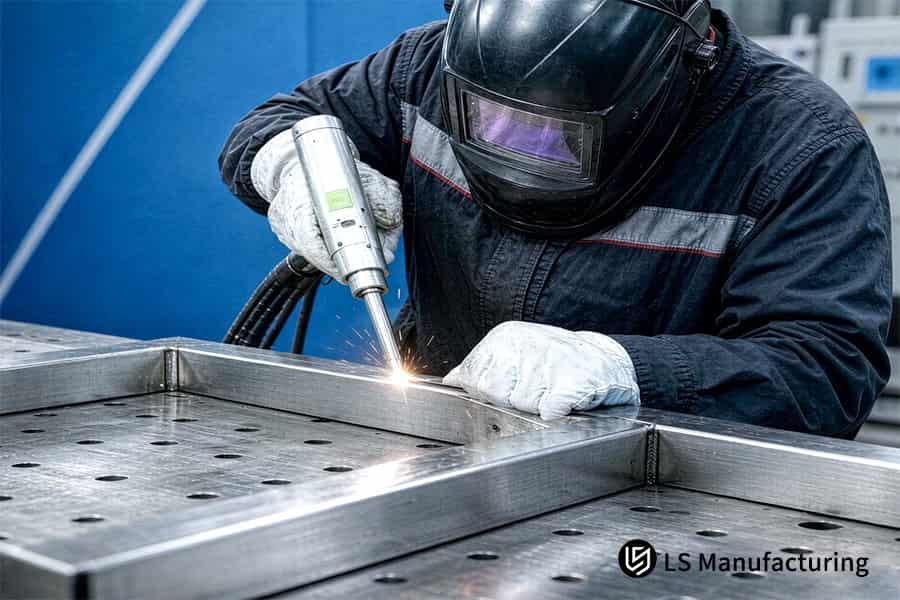
Figure 2: Welding process joins carbon steel plates to fabricate metal framework structure.
How Does A Reliable Fabricator Guarantee 98.2% OTD?
A reliable sheet metal manufacturer is a fabricator with robust quality systems, transparent traceability, and sustained >95% OTD, which guarantees 98.2% OTD through digital monitoring, buffer management, and fully in-house production. Controlling sheet metal fabrication factors begins with front-end design resolution.
Real-Time Shop Floor Synchronization
MES digital supervision system synchronizes CNC machines and laser nesting in real-time by changing schedule to avoid bottlenecks that arise due to waiting. Sheet metal DFM review early in the process will avoid downtime between processing steps.
In-House Production Eliminates Transit Risk
Sheet metal cutting, bending, welding, and finishing done in-house avoids transit delays and damage. Such a custom sheet metal fabrication service approach assures zero downtime due to logistics in providing OTD sheet metal service.
Implement sheet metal production scheduling with buffer clauses at inspection points.
[Data Source and Benchmark]: Data derived from the LS Manufacturing 2025–2026 empirical database (sample size >1,200; on-time delivery rate: 98.2%).
What Precision Standards Ensure Zero-Defect Assembly?
Precision sheet metal fabrication is a manufacturing process where tolerances are controlled within ±0.01 mm for the assembly of highly precise machines through strict international standards and state-of-the-art metrology. Such an integrated approach to geometric controls and sub-micron level measurement makes sure that no interference between parts is possible when assembling.
Geometric and Thread Standards
ISO 2768-f/m standardizes linear and angular tolerances and ASME B1.1 defines thread form and fit classes. Application of these standards to sheet metal parts guarantees consistency in interface geometry. The sheet metal tolerance control of these systems provide consistent fit.
CMM Verification Protocol
CMM Zeiss with an accuracy of 0.0009 mm MPEE conducts full dimensional scan. Locating holes on critical components have tolerances of ±0.005 mm and are verified before shipment. This sheet metal CMM verification ensures catching any deviations that would cause issues in field assembly.
| Parameter | Precision Sheet Metal Approach |
| General dimensional tolerance | ±0.02 mm |
| Critical hole position | ±0.005 mm |
| CMM volumetric accuracy | 0.0009 mm MPEE |
| Applicable standards | ISO 2768-f/m, ASME B1.1 |
The selection of a reliable sheet metal manufacturer with certified quality system will have an immediate impact on the predictability of the sheet metal fabrication lead time.
- Performing tolerance analysis as part of DFM to find critical characteristics to be verified by CMM.
- Request a full dimensional CMM report to confirm sheet metal precision components prior to releasing them.
[Data Source and Benchmark]: Data sourced from the official calibration report of the Zeiss CMM (Maximum Permissible Error of Length Measurement, MPEE, of 0.0009 mm).
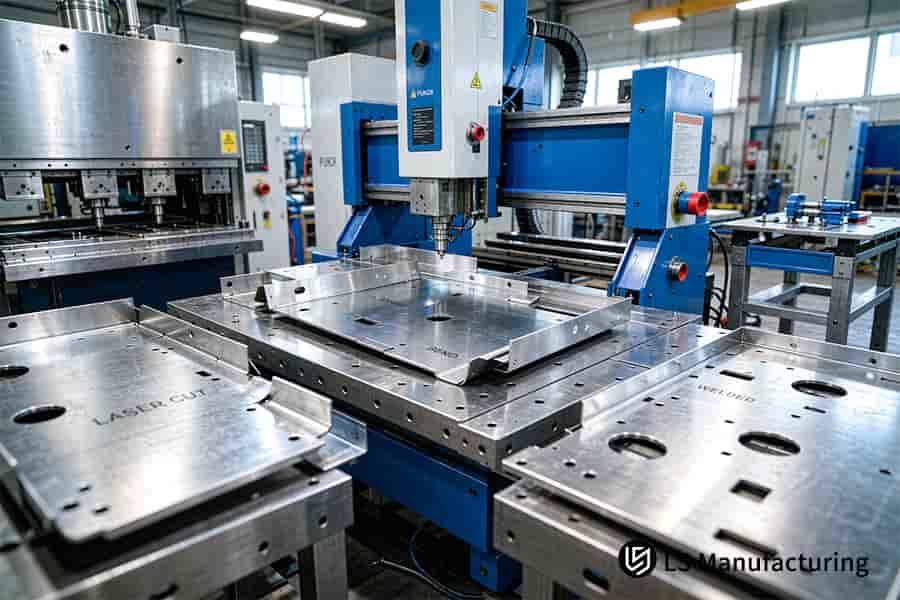
Figure 3: Punching machine creates holes on aluminum panel for industrial equipment chassis.
Why Choose A Supplier With In-House Finishing?
An industrial sheet metal supplier is a volume manufacturer of ISO/IATF-certified end-to-end production from start to finish of the sheet metal surface treatment process, eliminating responsibility issues and shipping delays. It’s the reason why automotive research and development teams use their own coating facilities rather than split-process supply chain.
In-House Finishing Eliminates Transit and Disputes
Outsourced finishing will add up to 1-4 days in shipping time and leaves a gap in the responsibility for defects on the surface of the sheet metal. An in-house automated coating and anodizing facility will eliminate the process altogether. In-house finishing is the sheet metal finishing service solution that works.
Verified Corrosion Performance
In-house process control results in surface roughness of Ra 0.8 μm and passes 500-hour salt spray test (ASTM B117). These performance parameters are important criteria criteria for automobile prototyping programs, where early corrosion resistance is required to be proven. In-house consolidation of finishing operations within the same manufacturing complex ensures a dependable OTD sheet metal service.
| Finish Parameter | In-House Capability |
| Surface roughness | Ra 0.8 μm |
| Salt spray resistance | 500 h (ASTM B117) |
| Additional transit from outsourcing | 1–4 days (eliminated in-house) |
Perform audit of your current vendor’s finishing operation times apart from the basic fabrication process in order to spot additional subcontracted processing stages.
- Ask for one combined quality certificate for both bending and finishing operations from the accountable party.
- Breakdown the sheet metal finishing cost in a transparent custom metal fabrication quote to determine whether the sheet metal finishing cost is captive or outsource.
How Do Digital OTD Services Eliminate Production Bottlenecks?
OTD sheet metal service is a manufacturing method that employs digital manufacturing lines and real-time monitoring to create total transparency in order milestones, thus solving production bottlenecks using CNC press brakes connected to MES with automatic task redistribution after preventive maintenance within 15 minutes, keeping batch delivery between 2-4 weeks. Lead times for sheet metal prototyping service will be greatly improved with MES real-time visibility.
MES-Driven Dynamic Scheduling
MES integrates the client order with CNC electro-hydraulic servo press brakes, optimizing the load distribution among different machines in real time. If the machine is put into preventive maintenance, then the routing and job allocation takes place in no more than 15 minutes. Sheet metal mass production is carried out according to schedule since there are no idle times between cutting and bending lines.
Preventive Maintenance Rescheduling
Downtime is automatically handled through task reassignment. MES reallocates tasks from one machine to another in order to sustain the flow and to keep lead times for custom sheet metal fabrication service stable.
- Order a sheet metal supplier quote which breaks down sheet metal fabrication cost into processes.
- Check whether the supplier on-time deliveries were above 95% for the last years.
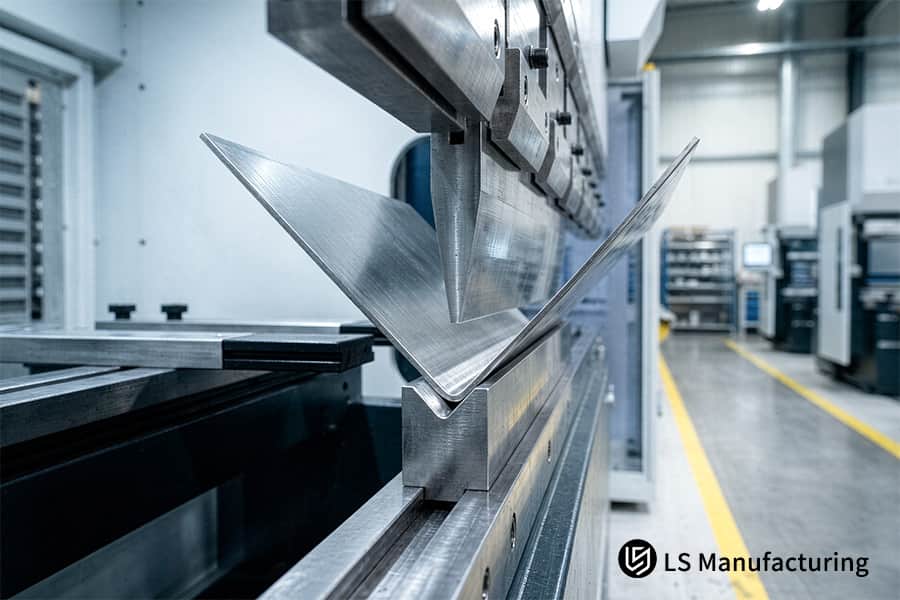
Figure 4: Bend radius tooling forms sharp corner on galvanized steel sheet accurately.
Case Study: LS Manufacturing Custom Sheet Metal Fabrication Service For Automotive Robotics Enclosure (#AUTO-2026-8891)
Problems related to long lead time and poor quality of the automotive robotics enclosure have been solved with the help of DFM automation and internal finishing provided by LS Manufacturing. Instead of the old method applied by the first supplier, a new accurate manufacturing process with no outsourced operations has been implemented in order to increase the accuracy of dimensions. Annealing and bending in a correct sequence have been the solution for the sheet metal warping solution.
Client Challenge
Die casting and outsourcing bending of the automotive sheet metal parts have led to poor tolerance control and outsourced finishing. Sheet metal warpage due to the stress has become the reason for high scrap rate and unpredicted lead times.
LS Manufacturing Solution
The DFM automation of LS Manufacturing process required 2 hours and classified the bend allowances for improvement in the tolerance level of ±0.01 mm (ISO 2768-f). Stress Relief Annealing helped in avoiding the warping due to relaxation of the material, while internal anodizing as per MIL-A-8625 helped in ensuring that sheet metal annealing process is done without any delay due to transportation.
Results and Value
Reduction in Lead Time down to 8 days (-38.5%), reduction in unit cost down to $134.6 (-28.4%), and enhancement in First Pass Yield from 87.5% to 98.2%. Measurement by using Zeiss CMM helped achieve Ra 0.8 µm surface finish while the ASTM B117 Salt Spray Test for 500 hours was successfully completed. The enclosure program following AS9100D standards has been successful.
Key Takeaways
- Establish tolerances for ±0.01 mm bends according to ISO 2768-f to ensure no distortion in the enclosures.
- Conduct annealing treatment for sheet metal cost reduction and achieving yields above 98%.
[Data Source and Benchmark]: Data derived from LS Manufacturing’s 2025–2026 empirical logs (Project No. #AUTO-2026-8891; sample size >1,200).
Upgrade your automotive robotics enclosure with DFM-driven sheet metal fabrication — 98.2% first pass yield, 28.4% cost savings, and 8-day delivery. Request your quote today.

FAQs
1. What is the typical lead time for custom sheet metal prototypes at LS Manufacturing?
LS Manufacturing provides quick prototyping of sheet metal parts which can be either fairly simple or moderately complex in the timeframe of 2-5 days through automated DFM analysis and laser cutting process, the parts production at 98.2% order fulfillment rate.
2. How does secondary finishing affect the overall sheet metal fabrication schedule?
Secondary finishing processes like anodization, powder coating, and welding usually require from 1 to 4 days apart from the lead time required for the primary process of fabrication; however, LS Manufacturing has its own in-house shop for secondary finishing.
3. What tolerance standards can LS Manufacturing achieve for precision sheet metal parts?
The company will be able to cut sheets metal using the laser with ±0.02 mm tolerance, bend and assemble metal parts with ±0.01 mm precision according to the ISO 2768-f standard, while dowel pin holes and locating slots machining tolerance requirement for high precision parts for automotive and aerospace industries is ±0.005 mm.
Data Source: Zeiss CMM MPEE calibration report
4. How quickly can I get a custom metal fabrication quote from your engineering team?
With the use of the data from the operational logs of the company, LS Manufacturing will be able to provide a complete DFM analysis report and detailed quote within two hours because of the ability of the 3D/2D drawing analysis software to help the engineers make quick decisions about the project that pertains to the automotive or automation industry.
Data Source: LS Manufacturing 2025–2026 operational logs
5. Can LS Manufacturing handle complex production runs involving thousands of sheet metal units?
Yes, LS Manufacturing will be able to cope with complicated production runs of thousands of sheet metal units thanks to the computerized scheduling software, which helps to prevent any issues in the manufacturing process and deliver the goods 98.2 percent of the time.
6. What surface quality and corrosion resistance standards do your finishing services support?
LS Manufacturing offers surface finish with unmatched precision and minimum roughness value of Ra 0.8 microns, and all anodizing and coating procedures comply with the MIL-A-8625 Type II standards and pass the salt spray test of 500 hours according to ASTM B117.
Data Source: MIL-A-8625 Type II standard and ASTM B117 salt spray test
7. How does LS Manufacturing ensure quality consistency across large batch orders?
LS Manufacturing adheres to ISO 9001:2015 and AS9100D quality management systems and performs thorough CMM inspections of all batches using the Zeiss measuring machine with an accuracy of 0.0009 mm and keeping the defect percentage below 1.8%.
Data Source: Zeiss CMM calibration report (accuracy 0.0009 mm)
8. What raw materials are available for immediate processing to cut down lead times?
The inventory of aluminum alloy sheets (6061/7075 grade), stainless steel sheets (304/316) and brass sheets is held at LS Manufacturing Company without requiring any lead time in procurement and is immediately ready for laser cutting once the order is placed.
Summary
Sheet metal deliveries on time are essential for the product launch and procurement cost considerations. Through our 15+ years of experience in precise manufacturing and ISO 9001/AS9100D compliance, we have attained lead times of 2-5 days and On-Time Delivery of 98.2%. We work with tight tolerances of ±0.01 mm and surface treatments that withstand 500 hours of salt spray testing.
Does your current supplier hold up your deliveries, and hence affect your assembly schedule? Click the quotation button to attach your 3D/2D CAD files (STEP, IGES, PDF). Our engineers conduct a free Design for Manufacturability assessment and quotations in two hours.
📞Tel: +86 185 6675 9667
📧Email: info@lsrpf.com
🌐Website:https://lsrpf.com/
Disclaimer
The contents of this page are for informational purposes only.LS Manufacturing servicesThere are no representations or warranties, express or implied, as to the accuracy, completeness or validity of the information. It should not be inferred that a third-party supplier or manufacturer will provide performance parameters, geometric tolerances, specific design characteristics, material quality and type or workmanship through the LS Manufacturing network. It's the buyer's responsibility.Require partsquotation Identify specific requirements for these sections.Please contact us for more information.
LS Manufacturing Team
LS Manufacturing is an industry-leading company. Focus on custom manufacturing solutions. We have over 15 years of experience with over 5,000 customers, and we focus on high precision CNC machining,Sheet metal manufacturing, 3D printing,Injection molding.Metal stamping,and other one-stop manufacturing services.
Our factory is equipped with over 100 state-of-the-art 5-axis machining centers, ISO 9001:2015 certified. We provide fast, efficient and high-quality manufacturing solutions to customers in more than 150 countries around the world. Whether it is small volume production or large-scale customization, we can meet your needs with the fastest delivery within 24 hours. choose LS Manufacturing. This means selection efficiency, quality and professionalism.
To learn more, visit our website:www.lsrpf.com