English



TL;DR: CNC vs 3D printing EV enclosure is about selecting the method of material removal versus additive layer process. While CNC machining can achieve fit tolerance of ±0.008 mm, 3D printing can maintain ±0.010 mm fit tolerance with a reduced development time of 3 days as compared to 6 days.
Tooling spend and scrap risk drain EV enclosure budgets before a single part ships. Rigidity requirements and IP67 specifications will determine if an EV Enclosure project passes the validation stage. Four dimensions — tolerance, material, thermal conductivity, and unit cost — feed one 4x4 matrix plus a five-minute decision tree. Sourcing teams make their decision up-front and avoid tooling issues and waste surprises. Budget team gets one comparison and not two suppliers’ proposals.
Key Takeaways
- Employ 3D printing for R&D iterations from 1 to 5 units with conformal cooling features. Additive manufacturing produces parts within 3 days and lowers early stage costs by 16.0%. Purchasers secure budget during design lock-in period.
- Transition to CNC machining if the fit surfaces require ±0.008 mm. Mass production decreases unit price from $1,280 to $320. Sourcing managers ensure budget prior to tooling evaluation.
- Specify CNC-machining of 6061-T651 for thermal and IP67 sealing service. Wrought aluminum alloy offers 276 MPa yield strength and Ra 0.8 µm groove surfaces. Print metal requires finishing before pressure test.
Why Trust This Manufacturing Comparison? Practical Insights From LS Manufacturing
Gloria, senior process engineer at LS Manufacturing with 15+ years of experience making precision enclosures, authored each section. Second review came from the shop floor: chief process engineer verified every number prior to publication. Examine Gloria's engineering decision framework for sourcing criteria. You benefit from two rounds of verification for every published tolerance and cost.
Limit & fit classes from ISO 286 underpin every tolerance statement, and ASM Handbook Vol.2 gives mechanical and thermal values for 6061-T651 aluminum alloy. Zeiss coordinate measuring machines verify every ±0.008 mm sealing face dimension together with Ra 0.8 µm groove finishes. Engineers can independently verify every published number against a standard source.
Validation consists of >1,500 cross-process tests including 1,000 hour ASTM B117 salt spray exposure and ISO 16750-3 vibration fatigue testing cycles. CNC machining and 3D printing are validated under identical fixturing, your choice of enclosure type is based on test data. Your volume level becomes the first filter: above 35 units, CNC machining safeguards both unit costs and IP67 seals. LS Manufacturing operates 5-axis CNC machining centers, industrial metal and engineering-polymer 3D printing systems, and precision sheet-metal lines in-house, so this comparison rests on process characteristics rather than on a preferred route.
Quick Reference: 4×4 Engineering Comparison Matrix
CNC machining and 3D printing vary in 4 key areas of EV battery enclosure manufacturing. Industry standard inspection standards and real-world production environment back all the below comparisons. Buyers have technical and economical comparative figures for EV battery enclosures.
| Dimension | Option A: CNC Machining (6061-T651) | Option B: 3D Printing (SLS / PBF-LB/M) | Threshold / Recommended Scenario |
| Dimensional and Fit Tolerance | Precision fit ±0.008 mm; ultra-precision hole position ±0.003 mm | Precision fit ±0.010 mm; ultra-precision hole position ±0.005 mm | Fit-face tolerance ≤±0.008 mm or IP67 sealing requires CNC machining |
| Unit and Batch Cost | Prototyping $1,280/pc; batch ≥100 pcs: $320/pc | Prototyping $860/pc; batch ≥100 pcs: $680/pc | Breakeven 35 units: below favors 3D printing, above favors CNC machining |
| Surface Roughness | As-machined surface Ra 0.8 μm; finish-milled channel Ra 0.4 μm | As-sintered surface Ra 6.3 μm; ground finish Ra 1.6 μm | Ra ≤0.8 μm seal grooves or terminal faces require CNC machining |
| Prototyping and Delivery Lead Time | Prototyping 1–5 pcs: 6 days; 100 pcs batch: 14 days | Prototyping 1–5 pcs: 3 days; 100 pcs batch: 26 days | 3D printing wins for 72-hour harness and packaging space validation |
With fewer than 35 pieces, 3D printing wins regarding cycle time and geometrical complexity; with more than 35 breakevens, CNC machining dominates tolerance consistency, seal performance, and cost-per-piece.
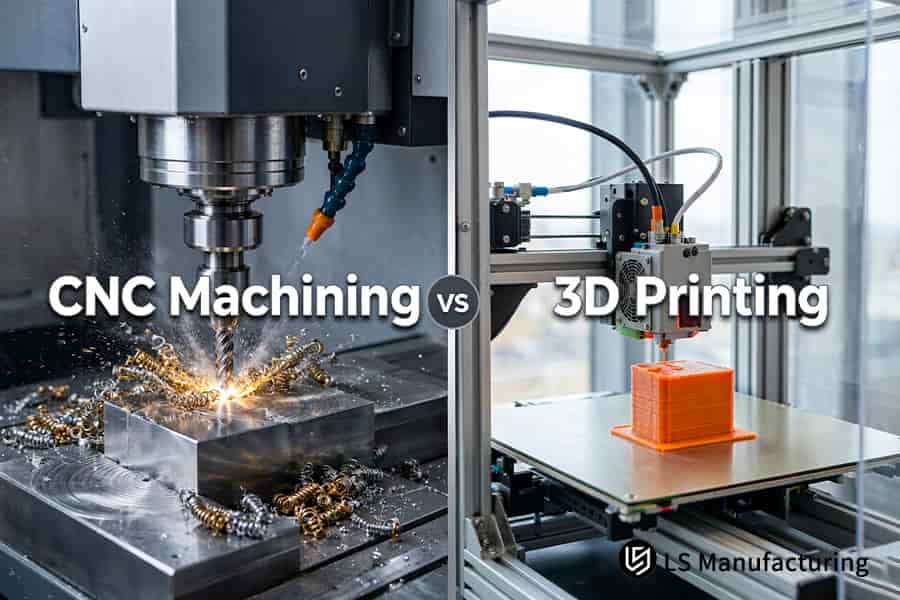
Figure 1: 3D printed enclosure lightweighting builds lattice walls while CNC cutting removes 6061-T651 stock at Ra 0.8 μm.
Which Process Delivers Tighter Tolerance For Enclosures?
CNC machining offers the smaller tolerance band for EV enclosures because it comes with a ±0.008 mm tolerance on the mating surfaces and cell mount holes. Rigid tool path and on-machine probe calibration guarantee that fit tolerance window is reached according to the ISO 286-1:2010 fit classes. Powder-bed frame sintering results in higher tolerances since it does not distribute heat evenly, making sure there will be no leakage of your high-voltage seals.
Rigid Cutting and Probe Calibration on Mating Faces
Combination of rigid cutting and on-machine probing keeps terminal bores within ±0.003 mm accuracy. Ffeedback from the on-machine probing compensates for the wear of the tool in between bores, allowing all bores to stay within the ultra-precision range 0.002–0.005 mm. Zeiss CMM (coordinate measuring machine) inspects each bore before shipment.
- 5-axis simultaneous cutting allows access to seal grooves in a single setup.
- On-machine probing recalibrates bore datum point after each finish cut.
CNC vs 3D printing EV enclosure considerations hinge on the bore datum. 3-axis mill cannot fix drifted part from 3D printing due to changed datum after each stress relieving pass.
Drift Sources Across Powder-Bed Enclosure Frames
Frames from PBF-LB/M (laser powder-bed fusion of metals) technology have tolerances from ±0.010-0.050mm range way above 0.005-0.01mm range due to different sintering temperatures, long sections bend. EV battery enclosure selection should consider stackup tolerance.
- Keep printed parts for conformal cooling channels.
- When to choose CNC for EV parts: use finish cut after applying IP67 sealing to a surface.
Action Items
- Tolerances on mating surfaces according to 8-micron tolerance band; the more stringent tolerances require additional machining time.
- Request orientation of sintering before providing a quotation for printed enclosures frames.
Data source and benchmark: ISO 286-1:2010 limits-and-fits standard and Zeiss CMM coordinate measuring machine spatial indication error calibration report.

How Do Thermal Properties Diverge Between CNC And 3D Printing?
6061-T651 wrought aluminum has a thermal conductivity of 167 W/(m·K), while printed AlSi10Mg has only 120 W/(m·K). With isotropic grain flow in the forged billet, you have room left over for any thermal runaway of the cells in your liquid-cooled trays because of lateral conduction of heat. Your charging speed is limited by your cooling capability.
Isotropic Conductivity in Wrought 6061-T651 Trays
Forged billets of 6061-T651 have 167 W/(m·K) thermal conductivity and yield strength of 276 MPa in all directions. Solid billets make sure that the continuity of heat paths throughout the entire tray surface is ensured, avoiding local overheating of cell peaks.
- Grain structure of wrought alloy ensures no porosity, which blocks cross-plane conduction.
- Flatness of milled tray surface ensures the gap pad’s contact under the clamp pressure of the module.
- Thermal management: CNC machining vs 3D printing considerations begin with conductivity orientation.
Aluminum CNC machining services turn conductivity into known pack temperature. ASM Handbook Vol.2 (1990) describes the numbers for wrought alloys.
Roughness Penalties Inside Printed Micro-Channels
AlSi10Mg is printed at 120 W/(m·K) and has yield strength of 195 MPa. Conformal channels produced with laser powder bed fusion are not machinable with a 3-axis CNC due to impossibility of making straight-line tool path within curves inside the parts. Thermal management: CNC vs 3D printing come into play when channels are sealed.
- Quote 6.3 microns of as-printed wall roughness.
- Allocate finishing before pressure drop test.
EV battery enclosure selection relies more on resistance to flow than on availability of shapes. CNC machining EV battery trays offer thermal surface with Ra 0.4-micron finish. Simply put: printed walls give shape and milled floor gives heat.
Bottom Line
- Ask for steady-state thermal conductivity certificates for all heats of 6061-T651 at cost quote time.
- Develop model peak discharge hot spots before selecting the tray material.
Data source and benchmark: ASM Handbook Vol.2 wrought aluminum alloy mechanical properties chapter and measured steady-state thermal conductivity testing.
Figure 2: CNC machining EV battery trays removes 6061-T651 chips under coolant while a head stacks AlSi10Mg layers.
What Drives EV Battery Enclosure Cost Across Different Volumes?
Unit cost is determined by quantity and not process capability – crossing the 35-unit mark shifts the less costly method from printing to cutting. Programming and set up are accounted for in the first quotations, but EV battery enclosure cost decreases with larger quantities. Customer benefits by 26.5% per unit when the crossover quantity mark is crossed.
Fixed Programming Cost Inside Early Cutting Quotes
Programming labor and first article proving (first program prove-out on part one) set the first quotes of cutting. Printing does not use tooling and costs $860 per one to five parts.
Cost of program for a one time run is reduced per unit with increased volume.
- Proven methods of cutting programs function independently for several hours.
- Billet material costs less per kg than gas atomized powder (round shaped).
High volume CNC machining leads to decreased fixed cost per unit. ISO 2768-1:1989 general tolerances for non-critical dimensions result in no need for finishing process. Your order of 100 pieces becomes about a quarter of the initial estimation.
Linear Laser-Hour and Powder Cost in Additive Builds
Cost per laser-hour and per powder invoice remains linear for each additional unit.
When to choose CNC for EV parts: crossing 35 units and the numbers flip. EV battery enclosure selection during pilot phase is preferable over printing after this threshold.
When Does 3D Printing Outperform CNC In Prototyping Speed?
Faster for one to three unit checks of concept: 72 hours versus 6 days in machining. Both direct metal and nylon parts go straight from the CAD file, route checks can start before the fixture design is completed. More than 100 units make powder-bed builds slower; 26-day build and depowder cycle takes the second place after 14-day multi-axis cuts.
EV battery enclosure prototyping at A-sample stage is better with 3D printed nylon or metal housing. Powder-bed builds come directly from CAD geometry without blanking and flipping process of re-fixturing. Powder-bed fusion needs no fixtures, blanks, or tool libraries, first-part delivery skips all tooling prep.
- Coolant-line prototypes are delivered before architecture freeze-out.
- HV connector clearance is checked physically.
3D printed enclosure lightweighting allows you to evaluate wall thinning variants before crash targets. You still need to ask for lead times of 3 units and 100 units in CNC machining RFQ checklist.
Schedule Reversal at Pilot Batch Scale
CNC vs 3D printing EV enclosure timing depends on the quantity, not complexity of the part. Powder bed fabrication time is 26 days for 100 units since there will be multiple build plates. Cutting lines finish processing equal amount of material in 14 days.
- Print A-sample housings in nylon for clearance of package.
- Migrate B-sample parts into cutting once datums stabilize.
CNC machining surface finishing removes roughness after printing in preparation for leak testing. Fixturing design and tool path prove-out prevent 3-axis mills from being as fast as the printed samples. Buyer scheduling calls for nylon printed early and aluminum cuts at B-sample.
Pilot-Batch Rules
- Ask for quotes for early concept housings without fixturing.
- Estimate per unit depowdering time vs hourly rate before B-sample commitment.
Figure 3: CNC vs 3D printing EV enclosure prototyping shapes metal with sparks while powder forms a nylon housing.
Which Process Provides Superior Structural Rigidity and Crash Safety?
Solid block cutting takes the crash protection job: Monolithic 6061-T651 aluminum tray provides 100% internal density, while printed aluminum has layer-by-layer anisotropic properties. Forged billet distributes impact forces throughout continuous grain structure, saving your luggage in case of side-pole and underbody scrapes. Tensile tests on MatWeb specify minimum 0.2% offset yield strength of 276 MPa.
Continuous Grain Structure in Monolithic Trays
Monolithic 6061-T651 blanks eliminate internal porosity before cutting takes place. Impact energy in the tens of kN range passes through unbroken grains, preventing cell collapse. CNC machining EV battery trays prevail in structural underbody chassis.
- Uninterrupted grains eliminate porosity before crack initiation occurs.
- Scrape loads on the underbody affect the entire floor of the tray.
- CNC thin wall machining supports 2-3 mm ribs without vibration.
Forced grain flow ensures consistent yield strength in all three directions. In other words, metal is structurally strong while printing gains mass efficiency.
Anisotropy and Porosity Risks in Printed Metal
Laser powder bed parts exhibit strength discrepancies in the XY plane and Z axis. Porosity in printed metal walls initiates fatigue cracks due to chassis vibration. 3D printed enclosure lightweighting remains suitable for non-structural applications.
- Printed metal must be removed from all primary load paths.
- EV battery enclosure selection should use printed metal only in cover-level cuts.
- CT porosity levels near cell must be limited.
Z-direction bonds in printed metal fail first in cyclic chassis loads; milled billet stock has no weak plane. CNC machining design errors typically begin with load paths assigned to printed metal.
Crash-Duty Rules
- Forged billet with mill certificates for each load-bearing tray.
- Impact performance certified to ISO 16750-3:2012 vibration profiles prior to PV sign-off.
Data source and benchmark: MatWeb database 6061-T651 forging mechanical tensile fracture limit specification.
EV Battery Enclosure Manufacturing Decision Tree
Any EV battery pack enclosure goes through five consecutive gates to arrive at one specific manufacturing route: geometry, seal-face texture, batch number, fit class, and delivery time frame. Program designers and sourcing executives have an understandable manufacturing solution route without relying on any guesses made by suppliers. Delivery times less than 72 hours are the final criteria for differentiation. Hybrid solutions entail a combination of printing a channel core and milling of a seal face.
Geometry and Seal-Face Gates
Conforming geometry (internal channels along the shape of the cells) sends a program to gate 2. If the face has to be textured as groove-grade (Ra 0.8 μm or finer), a combination of a printed channel core and milling of a seal face is required. Coarser wall surfaces can be completely printed.
- Highlight channel geometry before requesting quotes.
- Specify groove texture and verify it with a Mitutoyo Surftest SJ-210 roughness tester.
- CNC machining applications span hybrid and pure cutting routes.
3-axis CNC machines cannot produce conforming internal channels, since they can move only along one axis.
Volume, Fit-Class, and Delivery Gates
Batch sizes that are 35 pieces or higher are directed into high-speed cutting.
- Verify the batch size before quoting two.
- Small batch CNC machining is up to 35 pieces.
- Check out the high-pressure die cast (molten aluminum injected quickly) tooling for 500 pieces.
Route-Lock Actions
- Allow for 1.5 to 2.0 mm machining stock on printed mating surfaces.
- Die casting tooling check at 500 pieces, not at 100 pieces.
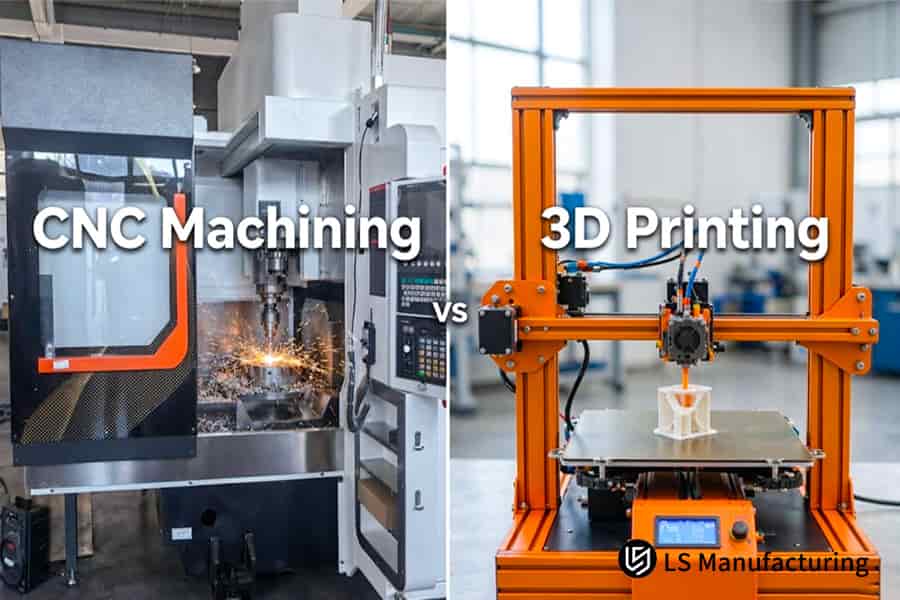
Figure 4: CNC vs 3D printing EV enclosure machining cuts 6061-T651 under coolant while a nozzle extrudes polymer layers.
LS Manufacturing CNC Machining VS 3D Printing For Automotive EV Battery Enclosure: Tolerance And Thermal Sealing Optimization
Precision CNC machining of 6061-T651 stock material resolves problems of thermal warpage and seal leaks in large EV battery enclosures. Change to manufacturing process reduced per-tray cost by 26.5% for batch of 40 units. Third party lab reports validated IP67 sealing and AS9100D compliance. Sourcing staff avoided exceeding pilot program budget without procuring new tooling costs. Crash and weight reduction goals weathered process change.
Client Challenge
One-piece liquid cooled enclosure measuring 950 mm was needed for light commercial truck program. SLS (selective laser sintering) printed trays warped 0.45 mm in total extent. Walls of seal grooves were 6.3 μm; 0.3 MPa pressure testing exhibited severe leakage. Pilot budget exceeded $860 per-tray estimates; 22 days additively manufacturing process timelines were tight for validation purposes.
Engineering Solution
Review boards redirected all enclosures to aviation aluminum blanks. Trial cut deformations amounted to 0.12 mm mid span since 2.5 mm walls released residual stress. Secondary artificial aging secured blanks. LS Manufacturing process engineers substituted rigid clamping with multi-point vacuum suction. Tool overhang reduced from 85 mm to 45 mm due to light depth multi-pass cutting.
Results and Value
Cost per tray came up to $420 after rerouting. Seal faces were tolerant with geometric tolerances within ±0.008 mm at Ra 0.8 µm. Defect ratio was reduced from 12.5% to 1.8%. Batch delivery time was shortened down to 14 days or 36.3% faster than in additive manufacturing plans. ISO 16750-3 vibration fatigue and 1,000-hour ASTM B117 salt-fog exposure was passed. CNC machining vs 3D printing judgments approve cutting over 35 units.
"Toolless print was priced lower until pressure testing failed. Trays machined out of 6061-T651 were IP67 seal rated in PV assembly." — Mechanical Design Lead, new-energy light commercial truck program, Project #AUTO-2026-041A
Data source and benchmark: LS Manufacturing cross-process measured database, Project #AUTO-2026-041A (CNC route) and #AUTO-2026-041B (3D printing route), sample size >1,500.

FAQs
1. Which process achieves better IP67 sealing for battery enclosures?
Seal grooves are machined with a 0.8-micron finish in ±0.008 mm tolerance, sealing off any leakage routes prior to assembly. 3D-printed walls capture inter-layer porosities that expand when tested under pressure holding. Inspection staff passes incoming inspection teams pass IP67 ingress tests on first submission, since groove datums are defined without ambiguity.
Data Source: ASME Y14.5-2018 geometric dimensioning and tolerancing (GD&T) standard and in-machine airtightness pressure testing standards.
2. What is the cost breakeven point between CNC machining and 3D printing?
Cost parity is at 35 units where development costs through printing are 16.0% less per unit. LS Manufacturing amortizes setup hours beyond breakeven, reaching 52.9% lower unit cost at 100 units. Purchase professionals set piece price before volume increases, and ISO 9001:2015 documentation tracks each quoted line.
Data Source: LS Manufacturing 2025–2026 cross-process empirical database, covering Project #AUTO-2026-041A (CNC route) and #AUTO-2026-041B (3D printing route).
3. Can 3D printing replace CNC for thin-wall aluminum cooling trays?
Metallic prints cannot substitute for cutting in weight-bearing trays that have 2.5 mm wall thickness since residual thermal stresses bend thin walls. Micro-conformal channel cores can be printed while thermal faces and load frames require finish milling to reach 276 MPa yield strength. Assemblers get straight mounting faces, and ASME Y14.5-2018 callouts separate machined datums from as-printed geometry.
4. How does dimensional repeatability compare between both methods?
Machined batches repeat within a 3-micron band, but printed builds grow up to 10 microns over long distances. Multi-layer laser scanning builds up thermal drift; constant temperature machining eliminates accumulated thermal drift errors in each batch. Enclosure assembly line by OEM does not require shimming, and general tolerances from ISO 2768-1:1989 apply to the rest.
Data Source: Zeiss CMM spatial measurement accuracy acceptance records.
5. How to quickly decide between CNC and 3D printing for your battery pack?
Two checks control sourcing: sample runs of five parts with fit tolerances looser than 0.01 mm are sent for printing. Batches larger than 35 pieces move to cutting, and do seal face surfaces requiring 8 microns control. Timelines get squeezed if non-tooling options are first considered, and precision CNC machining services are used for AS9100D process control.
6. Why is 6061-T651 CNC machining preferred for structural crash trays?
Forged 6061-T651 stock contains highly aligned fiber flow lines with tensile and impact behavior guaranteed 100% consistent in all directions. Metal lattice structures will break apart along Z-direction bondings during fast crash loading. Warranty remains safe during crash events, and ASM Handbook Volume 2 fatigue data for wrought aluminum confirms the material choice.
Data Source: ASM Handbook Vol.2, fatigue parameters for wrought aluminum alloys.
Summary
Process match, not ranking, dictates enclosure success throughout EV battery initiatives. Additive processing provides topology freedom during the fluidity of design processes, but multiaxis processing ensures that sealing effectiveness is preserved once loads become structural. The capital budget is secure when route switching occurs after volume gates.
Submit 3D/2D design files to info@lsrpt.com, or contact LS Manufacturing senior engineers at +86 185 6675 9667, for a free process route comparison and DFM analysis within 2 hours.