English



TL;DR: Cast iron vs CNC steel hydraulic manifold is choosing between casting near-net flow path versus machining from solid material process: CNC steel can accommodate ±0.003 mm tolerances and resist up to 70 MPa whereas cast iron can accommodate ±0.004 mm tolerance and costs 39.3% less than CNC steel per each piece beyond break-even point. Above 45 pieces the pattern cost is fully amortized, so cast iron becomes the lower-cost route; below 45 pieces steel remains cheaper per unit because it carries no tooling.
Fluid power engineering and procurement teams both weigh pattern cost before releasing a manifold design, and the wrong route choice forces a redesign plus schedule slip. Duty pressure above 25 MPa and gallery geometry decide whether a cast iron or CNC steel block keeps its seals leak-free. Four factors, a 4x4 matrix and a decision tree return the answer in minutes. High-pressure cycling above 25 MPa and flow path geometry will indicate whether cast iron or CNC steel manifold will ensure no leaks sealing. Four factors, 4x4 matrix and decision tree provide you with answer within minutes. In other words, volume and pressure limits choose cast iron vs CNC steel prior to tooling investments.
Why trust this manufacturing process comparison?
Gloria, senior process engineer at LS Manufacturing, with more than 15 years of experience in prototyping and precision machining, designed Gloria's cross-process engineering decision framework. Both routes are quoted on the same drawing set. The review by the senior fluid power tooling engineer has been completed. All numbers trace back to the one database.
Tolerances are based on ISO 2768-1:1989, class m (medium), Table 1. Mechanical properties data is gathered from ASM Handbook Vol.2, Properties and Selection: Nonferrous Alloys and Special-Purpose Materials (ASM International, 10th ed., 1990), p. 1455.(ASM Digital Library) where is only one volume both for cast iron and for steel. Data on cast iron and billet steel is measured with the same instruments, revision number, and testing period. Procurement staff double-checks every number against one specific clause.
ISO 9001:2015 pressure hold leak tests and Zeiss CMM geometric measurements are performed on all manifold shipments. Rapid prototyping stations are located on one floor along with the cast iron and billet steel stations. Incoming inspection staff will be able to find a test report trace for each block. Sample size is more than 1,500 units tested.
Data source and benchmark: LS Manufacturing internal machining measurement database, last updated September 2026.
Key Takeaways
- Choose CNC machined forged steel (Option B) in cases where: high pressure, fast prototyping, and time delivery schedule justify Option B. Porosity removal via solid stock machining leads to the fact that the first batch of products is provided within 7 days.
- Choose ductile iron (Option A) in cases where: regular orders beyond the breakeven point, and intersecting flow channels justify Option A.
- Where ultra-fine tolerance is required: high accuracy grinding and boring of steel blocks (Option B) have single-digit micron bore tolerance and Ra 0.4 μm finish on cartridge cavities. Continuous cast iron (Option A) has bigger bore tolerance and Ra 0.8 μm finish on cartridge cavities.
- Shock absorbing and protection from leaking: continuous-cast iron graphite is capable of dissipating the energy of hydraulic shock waves; thin walls are subject to certain requirements to avoid chipping of edges. Forged steel is fatigue resistant; significant material removal is necessary.
Quick Reference: 4×4 Engineering Comparison Matrix
Continuous cast iron and billet CNC steel are distinguishable through four engineering considerations. Tolerance, pressure rating, unit cost, and turnaround lead time are each allotted pairings for both manifold types. Pairings enable purchasing managers to identify one threshold for each measure.
| Dimension | Option A: Continuous Cast Iron | Option B: Billet CNC Steel | Threshold / Recommended Scenario |
| Tolerance & Surface | Precision ±0.008 mm; limit ±0.004 mm; Ra 0.8 μm | Precision ±0.006 mm; limit ±0.003 mm; Ra 0.4 μm | Servo valve spool bores at ±0.005 mm and below prefer Option B |
| Pressure Rating | ≤25 MPa working pressure | 35 MPa–70 MPa working pressure | Duty above 25 MPa requires Option B |
| Cost Trade-offs | Prototype $420 including tooling; volume $68/pc | Prototype $260 no tooling; volume $112/pc | Breakeven at 45 units; volume then selects Option A |
| Turnaround Lead Time | 24 days sampling period inclusive of pattern; casting; aging; volume production stability | 7 days sampling; quick production scheduling | Quick R&D and fewer than 45 piece volume iteration should use Option B |
Pattern and core-box cost for this manifold family is $1,980; against a $44/pc unit differential, that is recovered at 45 pieces. Manifold programs that need low pressure high volume use cast iron at $68/pc and manifold programs needing high pressure above 25 MPa use CNC steel.
Note for mobile users: Matrix table can scroll left-right or toggle to card-view mode in mobile devices. Not sure which column applies to your block? Upload your 2D drawing and the LS Manufacturing engineering team returns a free route comparison across both materials within two hours.
Data source and benchmark: LS Manufacturing internal machining measurement database, last updated September 2026.
How Do Cast Iron And CNC Steel Manifold Pressure Ratings Differ Under Cyclic Stress?
Difference in cast iron vs steel manifold pressure rating depends on one figure: cast iron works under cyclic operation, while CNC steel forgings work at 35 MPa to 70 MPa. Cast iron works well under cyclic duty up to 25 MPa pressure and CNC steel forgings work at high pressures. CNC steel billet ingots are free of any micro-porosity after forgings and have yield strength of 550 MPa based on ASTM A108 standard. Ductile iron meets ASTM A536, it has tensile strength of 500 MPa to 700 MPa and this is another value tested not like yield strength. Pressure class, not tensile ranking, dictates manifold choice once CNC machining tolerance standards are checked.
Fatigue life differentiates cast iron vs CNC steel hydraulic manifolds under cyclic duty conditions.
Duty-Based Selection Rules
- Low duty cycle pressure: ductile iron withstands pulsation shocks.
- High duty cycle pressure: forged steel removes porosity leak paths.
High volume CNC machining after breakeven volume is also divided into pressure classes. Different burst fatigue values are needed for ductile iron vs aluminum hydraulic manifolds. For a customer, duty pressure determines hydraulic manifold material before the tensile chart.
Data source and benchmark: tensile and yield strength data verified against ASM Handbook Vol.2 mechanical property database and MatWeb material property database, Ductile Iron grade 80-55-06, accessed September 2026.
Related keywords: hydraulic manifold pressure rating / cast iron manifold fatigue limit / forged steel manifold burst pressure

When Does Cast Iron Become More Cost-Effective Than CNC Machining Steel?
Cast iron vs CNC steel manifold cost depends on tooling amortization rather than material cost, because pattern cost becomes advantageous after many orders. Cast iron is 39.3% less expensive per part compared to billet CNC steel beyond breakeven quantity; initial quantities remain advantageous for tooling-free steel parts. Prototyping requires pattern cost and casting cost for cast iron; each cast in volume production carries a share of pattern cost. Near-net-shape casting that has cast blanks to be finish machined only for valve bores uses 85% of metal melted, whereas cutting out holes from solid billets wastes 65% of metal as scrap. Interestingly, the higher prototype cost becomes the lower volume cost because pattern costs are paid once. Hydraulic manifold prototyping vs production volume precedes multi-axis CNC machining services schedule.
Unit Cost By Build Stage
- Early Prototypes: Cost of cast iron was $420 while that of steel was $260 without tooling costs.
- Order repetitions after the break-even point: Cost of cast iron goes to $68 while steel remains unchanged at $112 as stock removal is non-decreasing.
Hybrid Route Planning
When to choose cast iron hydraulic manifolds is based on design stability, where order repetitions warrant pattern costs while design evolution doesn’t. Steel validation followed by cast iron tooling reduces lifecycle costs as changes in geometries are inexpensive before the pattern is made. Stable versions that are run using automotive CNC machining services programs will benefit the most from steel validation without tooling.
Related keywords: cast iron manifold unit cost / CNC steel manifold tooling amortization / hydraulic manifold breakeven volume
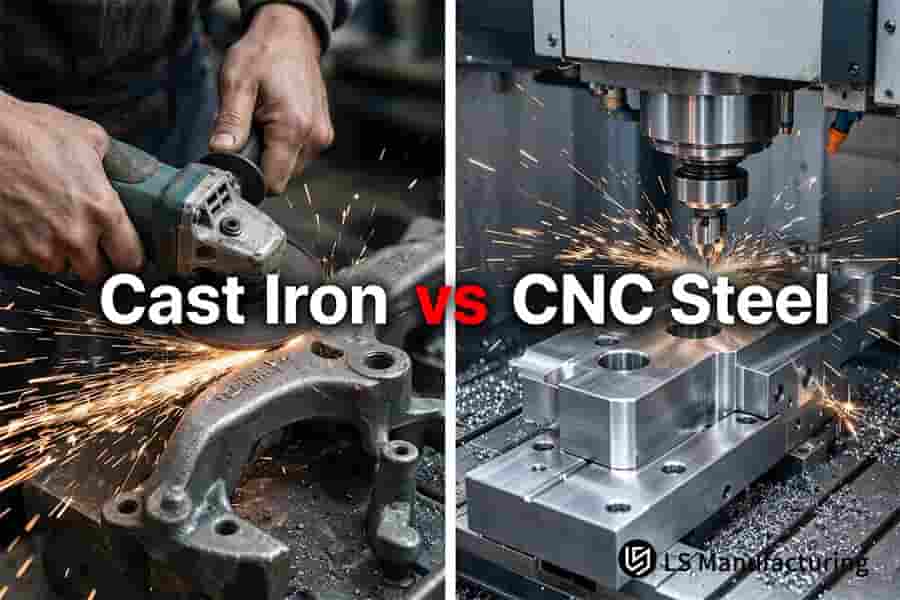
Figure 1: Hand grinding clears rough cast iron faces while CNC finishes a steel manifold at Ra 0.4 μm.
When To Use CNC Steel Hydraulic Manifolds For Accelerated Prototyping?
When to use CNC steel hydraulic manifolds depends on schedule risk, not on unit price: forged steel manifolds are available in 7 days whereas cast iron manifolds will take 24 days for pattern fabrication, casting and annealing reducing the sampling loop time by 70.8%. Sand casting and lost foam casting (foam pattern burned off during casting) require preparation of pattern, molding, annealing and surface treatment before sample shipment. Billet AISI 1045 steel does not require tooling development, and machining in five axes begins upon completion of design. In case of change in channel routing and addition of sensor ports, modified samples will arrive within 48 hours.
Cast iron performs well for shapes which do not need to be altered anymore at high volumes; steel helps retain scheduling flexibility for changing shape. Gains in new model design come from prototype hydraulic manifold prototyping vs production volume control in principle development and road tests, due to higher cost in tooling expense prior to design lock-in.
Schedule Risk Across Design Iterations
Precision CNC machining removes the need for tooling lead-time in each loop. Engineering changes can then be processed and integrated into the manufacturing process within 48 hours completing the validation loop in one sprint cycle.
Cost Boundary And Handover Point
Cast iron vs CNC steel manifold cost switches once design is frozen. Steel may cost more per piece but has no risks of tooling costs. Casting uses patterns on repeat orders. CNC machining DFM before machining removes unnecessary pieces which add to machining time.
- Pre-frozen design: steel accepts channel rerouting and addition of sensors without having to change the tooling.
- Post-geometry freeze above break-even volume: cast iron recovers the cost of patterns through low-cost per piece.
Related keywords: cnc steel manifold lead time / hydraulic manifold design iteration / cast iron manifold tooling cycle
Why Is Internal Channel Cleanliness And Deburring Critical In Both Processes?
Internal cleanliness influences spool life, and cast iron vs CNC steel hydraulic manifolds differ in failure modes because ductile steel creates burrs that stick after cross drilling whereas graphite fines generated in cast iron are trapped in blind holes. Billet CNC steel showed a 12.8% rework rate on cross-drilled galleries, while continuous cast iron held 9.6%; both were measured on the same database revision. Manifold body contains slant bores, deep holes, and oil galleries that intersect at right angles; therefore, drilling causes secondary reverse burrs at port intersections.
Burrs of forged steel are ductile and stick inside bore wall, and cannot be removed using high-pressure water washing which necessitates either TEM (thermal energy deburring) or AFM (abrasive flow machining). CNC machining surface finishing scope needs to specify one deburring process for each material.
Defect Mechanisms Inside Cross-Drilled Passages
Properties of burr influence the selection of the removal method: steel burrs bend and cling, while cast iron burrs disintegrate into particles and dust. Cast iron vs steel manifold machining tolerances interact with burr anchoring, as tighter bore bands allow less clearance for edge breakout. Chip shape alone cannot predict the probability of assembly and hence requires an entirely different cleaning strategy for each metal.
Inspection And Cleaning Controls
Endoscopic inspection of manifolds combined with multistage ultrasonic cleaning reduces the percentage of defective assemblies to 2.4% for cast iron and 1.2% for forged steel. Parts from CNC machining are highly susceptible to deformation during deburring; cycle settings have to be conservative in the vicinity of thin ribs. Measurement of roughness with Mitutoyo Surftest SJ-410 and NAS 1638 cleaning classes validates each lot.
When to choose cast iron hydraulic manifolds is based not only on pressure and flow but on the level of cleanliness as well, since cast iron needs coolant filtration, while forged steel – thermal or abrasive flow cleaning.
Data source and benchmark: internal wall cleanliness inspection and micro-roughness measurement executed under Mitutoyo Surftest SJ-410 roughness instrument verification procedure and NAS 1638 fluid cleanliness standard.
Related keywords: cast iron vs CNC steel manifold / internal channel cleanliness / manifold spool seizure prevention
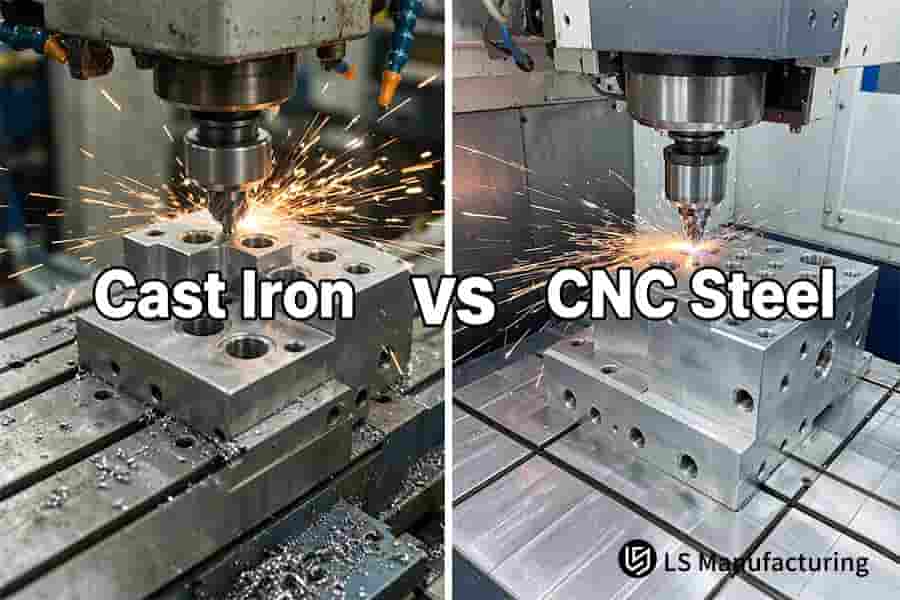
Figure 2: A cast iron manifold throws dense chips under drilling while CNC leaves brighter steel ports.
What Are The Environmental And Weight Trade-Offs Between Iron And Steel Blocks?
Cast iron vs CNC steel hydraulic manifolds weight trade-offs start with density: density of ductile iron is equal to 7.1 g/cm³, and carbon alloy steel - to 7.85 g/cm³. For applications that demand vibrations reduction and weight reduction of machinery, ductile iron is used. Graphite structure helps to increase the damping capability 2.5-4 times and reduce the weight of the block for 9.5 %. Pump ripple and water hammer (increase of pressure after the valve closure) lose energy when interacting with graphite. Steel scrap is fully recyclable back to steel mills, while milling of solid billets uses power and coolant for processing of the scrap that has no loading. Near-net cored casting needs minimal milling of the stock and reduces generation of the swarf by 60%+, while milling of solid billets generates 65% of swarf.
Mass And Noise Behaviour In Service
Shock waves are transmitted through all galleries of oil passages due to the ripple discharge of the pump and abrupt closing of spool valve. Ductile iron dissipates a part of energy of the ripple effect of the pump in graphite. Forged steel transmits larger vibrations but demonstrates better fatigue strength compared to ductile iron of equal dimensions. Aluminum CNC machining services programs oriented towards weight saving will have different densities due to changing of weight and pressure restrictions for aluminium alloys. Ductile iron vs aluminum hydraulic manifolds comparisons need different data of tests, not numbers received from tests of iron and steel.
Energy Footprint And Chip Discharge
The difference in chip recycling is much more important than density of material: cast iron chips contain graphite particles that need filtration of the coolant while steel chips are fully recyclable in mills without any filtration. Cast iron vs steel manifold pressure rating is a much harder barrier. Purchasers of robotic CNC machining services consider both characteristics, since robotic arm integrators weigh both characteristics, because a robot pays for manifold mass on every cycle it accelerates — and it pays for damping every time the pump ripple reaches the arm.
Related keywords: hydraulic manifold weight comparison / cast iron vs CNC steel manifold / manifold chip discharge reduction
Selection Decision Tree: Rapid Determination of Hydraulic Manifold Process Routes (Decision Tree Framework)
Hydraulic manifold routing starts with the highest pressure of the system, not the cost per unit. The termination of pressure branch routing is done first, then batch branches, and finally tooling and flowpath branches last. Cast iron vs CNC steel hydraulic manifolds decisions is done after taking into account the physical safety constraints before any economic benefits. Terminal boxes have one fixed route for each branch.
- Peak system pressure > 25 MPa, Opt for B, CNC forging of Steel cutting from 35 MPa to 70 MPa rated, process selection done.
- Peak system pressure ≤ 25 MPa, move on to batch size; batch ≤ 45 pieces, opt for B, CNC forged steel rapid prototyping in 7 days without tooling cost.
- Batch above 45 pieces with normal flow paths: choose cast iron tooling, $68 per piece.
- Batch < 45 pieces with 3-D curved internal passages which can’t be achieved by drilling (blind drilling), either metal 3-D printing (additive manufacturing) or cast preform option, but no deep hole boring.
Both routes lose on one case: when a single block carries more than three intersecting galleries and the order is under 20 pieces, drilled steel wastes 65% of stock and cast iron tooling cannot be amortized. Additive manufacturing of the block in 17-4PH stainless is then the cheaper route, although its Ra 6.3 μm cavity finish excludes servo spool bores.
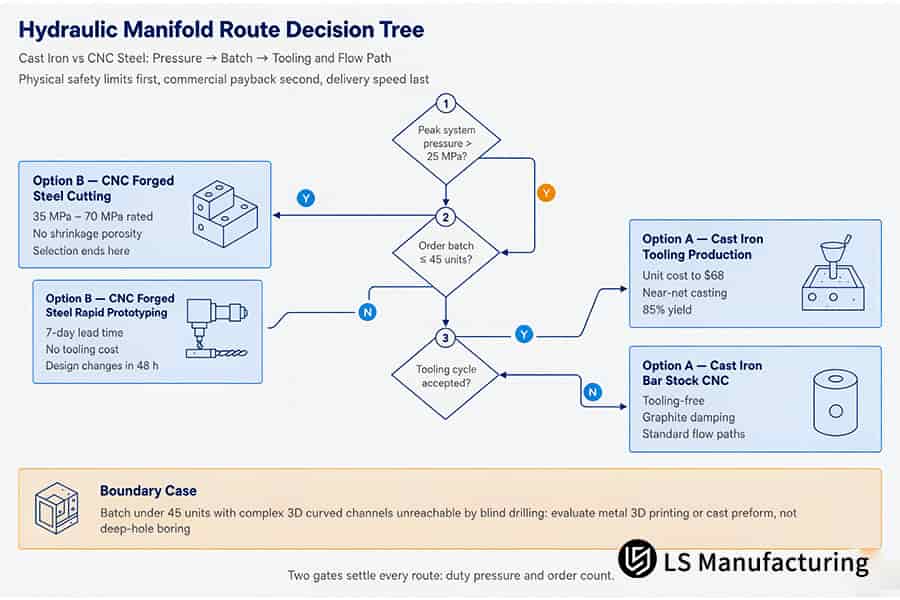
Figure 3: Decision tree comparing cast iron routes with CNC steel routes across hydraulic manifold pressure, batch count, and tooling cycle.
- High pressure duty: comparing the maximum pressure in the system against 25 MPa before considering any economic considerations; above 25 MPa makes it possible to consider CNC forged steel regardless of the volume.
- Volume duty consideration: comparing volume in the order of 45 units before considering any economic considerations; volume that does not exceed 45 units makes it possible to consider tool-free CNC steel, whereas volume above 45 units makes it possible to use cast iron tools at $68.
- Inner geometries: confirming the success of blind drilling of all 3D channels before considering boring since it is subjected to breakthrough.
Related keywords: hydraulic manifold decision tree / cast iron vs CNC steel selection route / manifold pressure batch threshold
LS Manufacturing [Cast Iron VS CNC Steel] For Industrial Robotics Hydraulic Manifolds: Machining Stress Relief And Leak Reduction
Cast iron vs CNC steel hydraulic manifolds selection is based on safety allowance of pressure versus tooling investment value: QT500-7 continuous cast iron cuts cost and damps pump ripple, but its shrinkage porosity can stay hidden until the finish machining pass exposes it. Billet CNC steel covers 35 MPa to 70 MPa working pressure. Low batch production and high pressure duties are for forged steel manifolds; mature batch production and low pressures - for cast iron tooling. Leak scrap reduction from 12.8% down to 1.2% was achieved by change of tooling approach. Near-net casting should be chosen for pressure up to 25 MPa and batch size enough to cover the cost of pattern. CNC thin wall machining assessment before machining ensures thin wall integrity above burst pressure level.
Initial Route and Pain Points
A university engaged in R&D of robots chose QT500-7 continuous cast iron for multi-circuit servo arm valve block due to low cost and damping characteristics of graphite. Peak pressures up to 28 MPa exceeded capacity of cast iron. Porosity defects associated with shrinkage could withstand 5-axis machining and caused leaking of oil at 30 MPa through thin wall from spool bore to an inlet gallery.
Route Switch and Process Fix
Criteria for replacing cast iron by Project #ROBOT-2026-042B forgings include: pressure ranging between 35 MPa and 70 MPa against 25 MPa; tolerance of bore accuracy of ±0.003 mm to ±0.004 mm; cycle-time of 1 week against 24 days including making the pattern and annealing; chip rate is 65% compared to 85% of casting yield. Rough machining removed the stress, resulting in ovality of 0.008 mm in one spool bore. Relief annealing at 560°C along with correct clamping returned the roundness to ±0.003 mm tolerance.
Measured Outcomes
Five test blocks were delivered as a result of the route change. The sampling time was reduced from 24 days to 7 days. The cost of the prototype decreased from $420 to $260 (-38.1% according to the project documentation). Above 200 test blocks production, the cast iron tooling was used for manufacturing at the cost of $68 per unit with less rated pressure.
Validation and Lessons
ISO 9001:2015 pressure hold testing and leak testing and Zeiss CMM 3D geometrical testing were done on all five test blocks. Blocks are assembled by OEM lines without stoppage for inspections. Precision CNC components will be purchased with bore information available for assisting in filing warranty cases.
“Forging made the spool bores non-leaky up to 30 MPa, and five test blocks have been manufactured in just seven days.” — Mechanical Design Engineer, Robotics R&D Institute, Project #ROBOT-2026-042B
Data source and benchmark: LS Manufacturing cross-process measured database, Project #ROBOT-2026-042A and Project #ROBOT-2026-042B, sample size >1,500.

FAQs
1. Which material withstands higher operating pressures for hydraulic manifolds?
For high duty capacity, forged steel is preferable over continuous cast iron: forged steel can operate under service pressures from 35 MPa to 70 MPa, while cast iron can operate up to 25 MPa. The strength reports reveal that steel has a yield strength of 550 MPa, and cast iron has a tensile strength of 500 to 700 MPa. Duty capacity and fatigue life, rather than tensile strength, should decide on materials.
Data Source: ASM Handbook Vol.2.
2. How do costs compare between cast iron and CNC steel manifolds?
Cost of prototypes prefers forged steel at $260 per block to ASTM A536 cast iron at $420 per block because the process doesn't require tools and thus eliminates expense of making patterns. Above 45 pieces volume, cast iron becomes more economical at $68 per unit versus $112 per unit for steel—a margin of 39.3%. Tooling is paid only when orders are certain from procurement departments, and CNC steel manifold cost is always cheaper below breakeven.
Data Source: LS Manufacturing 2025–2026 cross-process comparison database, sample size >1,500.
3. When should I choose ductile iron over aluminum for hydraulic blocks?
Regarding the comparison between ductile iron and aluminum, ductile iron is suitable for hydraulic blocks with system pressure above 21 MPa; aluminum blocks can be used for duty not exceeding 21 MPa, which is different from the pressure of 25 MPa used when selecting from cast iron and steel. Iron has greater elastic modulus, which means that bore expansion due to pressure will be lower and spool seizing will occur less frequently. Resistance to thread pull-out increases due to compact design and compliance with ISO 286-1:2010 fits tolerances under pressure cycling. Project schedules are not affected by potential stripping of port threads.
Data Source: ISO 286-1:2010, Table 1 bore tolerance grades (accessed September 2026).
4. Which process offers superior internal vibration damping?
ASTM A536 ductile iron has better vibration damping compared to forged steel blocks due to free graphite at more than 2.5 times of steel blocks. The mass of blocks favors iron at 7.1 g/cm³ against 7.85 g/cm³. When the envelope is tight, steel carries more load per mm of wall thickness, so it fits compact designs; iron needs thicker walls for the same duty.
Data Source: MatWeb physical properties database.
5. What are the typical machining tolerances for cast iron vs. steel manifolds?
Forged steel maintains spool bores at ±0.003 mm, Ra 0.4 μm; cast iron maintains spool bores at ±0.004 mm, Ra 0.8 μm. Standard external mounting holes go to ±0.020 mm on both routes per ASME Y14.5-2018, position tolerance at MMC. Quality auditors get Zeiss CMM reports on per lot basis, so verification is done before assembly release. Servo fits prefer steel; general galleries prefer iron.
Data Source: Zeiss CMM calibration report.
6. How can I quickly decide between cast iron and CNC-machined steel for my project?
Two gates determine manifold route. Pressure greater than 25 MPa or order lower than 45 units goes to ASTM A108 forged steel; moderate pressure greater than 45 units goes to ASTM A536 cast iron tooling. LS Manufacturing 2025-2026 cross-process comparison data, sample size >1,500 determines both thresholds. When to use CNC steel depends on duty class first; fleet commissioning teams then consider tooling costs against fatigue life.
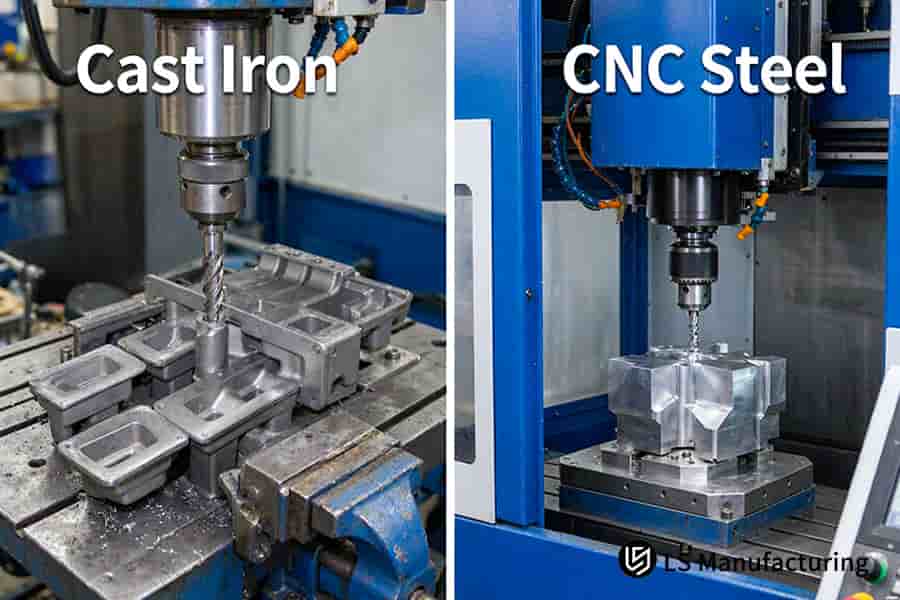
Figure 4: Cast iron blanks take multiple drilled ports while CNC cuts a steel block from solid stock.
Summary
Pick by pressure class first, then by volume. Above 25 MPa, use billet CNC steel whatever the order size. At 25 MPa or below with fewer than 45 pieces, stay with tooling-free steel. At 25 MPa or below with more than 45 pieces on a frozen design, cast iron tooling is the lower-cost route.
Technical Discussion & Process Consultation: +86 185 6675 9667
Engineering Drawing Inquiries: info@lsrpf.com
Official Manufacturing Technology Website: https://lsrpf.com/