English



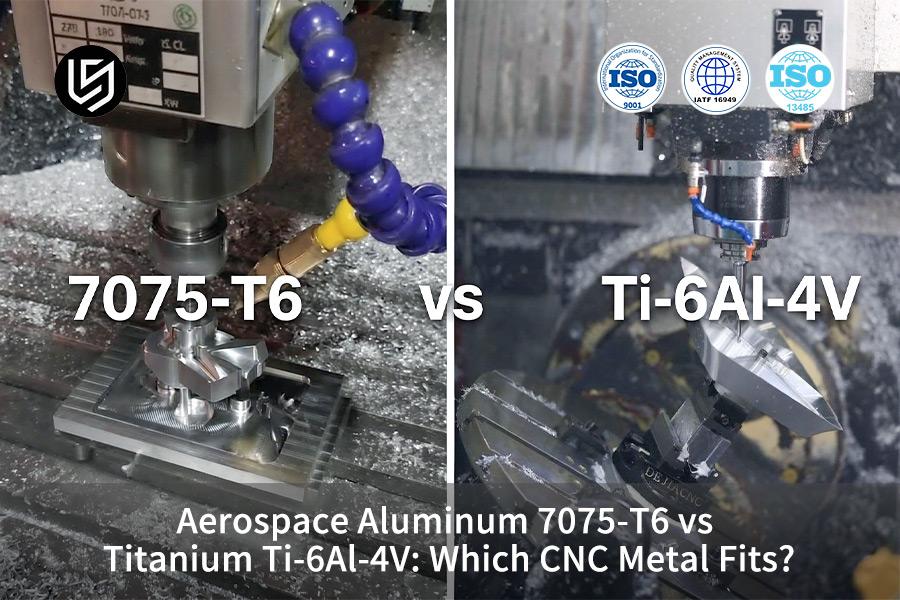
TL;DR: 7075-T6 vs Ti-6Al-4V CNC machining is a subtraction between mass and heat tolerance — pick by peak service temperature, budget by cycle time. 7075-T6 aluminum can hold ±0.005 mm tolerance, and Ti-6Al-4V has ±0.005 mm tolerance. The determining factor is the operating temperature rather than strength: 7075-T6 aluminum alloy is suitable for sections exposed to ambient temperatures.
Engineers and purchasing specialists often allocate funds for tooling without verifying thermal loads and later incur costs for fixing brackets moving closer to heated areas. The raw material is processed into its flight-ready form via multiple-axis tooling, while thermal conductivity and elastic modulus determine the speed of completing cycles. A 4×4 grid with 5 nodes makes 7075-T6 vs Ti-6Al-4V CNC machining decision making quick and easy in four factors. Simply put, operating heat sets your alloy, and cycle time sets your budget.
Why Trust This Beginner's Guide?
Author Gloria, a specialist in rapid prototyping and rapid manufacturing who is a veteran of 15+ years producing flight-grade components, wrote all material recommendations in this paper. Follow Gloria's engineering insights on LinkedIn quarterly for data updates. First, turn to ASM International handbooks that will provide you with baseline values: 2.81 g/cm³ for 7075-T6 aluminum compared to 4.43 g/cm³ for Ti-6Al-4V, making your bracket 36.5% lighter where applicable. Approved by Senior DFM Precision Machining Specialists at LS Manufacturing. LS Manufacturing machines both alloys daily; this comparison reflects process behavior, not preference.
Design tests for brackets for avionics #AERO-2026-T881 show under what conditions 7075-T6 fails: aluminum brackets were near the 165°C motor while Ti-6Al-4V ensured correct bore positioning in accordance with ISO 286 tolerance classes with Vc = 60 m/min machining in 80 bar coolant. You will get the advantage of 18.2% less cycle time, 11.8% lower setup and tooling costs, and scrap rate reduction from 16.5% to 4.2%.
Tolerances for undimensioned elements will be based on ISO tolerances according to ISO 2768-m and ISO 286 standards. AS9100D process updates that will occur in March 2026 will ensure that you have ±0.005 mm bore sizes on both materials, including MIL-A-8625 anodizing for 7075-T6 material instead of Ti-6Al-4V wherever Ti-6Al-4V can withstand salt fog without anodizing. CMM reports will accompany each shipment. Please provide STEP files for DFM analysis.
Key Takeaways
- Weight reduction depends on density difference: 7075-T6 aluminum has ≈36.5% less dense (2.81 vs 4.43 g/cm³) compared to Ti-6Al-4V and 7075-T6 aluminum beats Ti-6Al-4V in case of sufficient envelope dimensions.
- Difference in thermal conductivity generates bottleneck effect for wear resistance and cutting speed: 7075-T6 aluminum has thermal conductivity 130 W/(m·K), while Ti-6Al-4V has thermal conductivity 6.7 W/(m·K). Difference ratio is ≈20x.
- Rigidity control becomes crucial for precise dimensions of fit: 7075-T6 aluminum and Ti-6Al-4V provide the same fit class tolerance band after removal of deformation using symmetrical toolpaths and stress relief stages.
- Operating temperature range is the one thing that clearly indicates the material’s ability to be replaced: 7075-T6 aluminum would start to deteriorate at 120°C, while Ti-6Al-4V demonstrates high specific strength at the operating temperature of 400°C.
Is 7075-T6 Aluminum Lighter Than Ti-6Al-4V In CNC Frames?
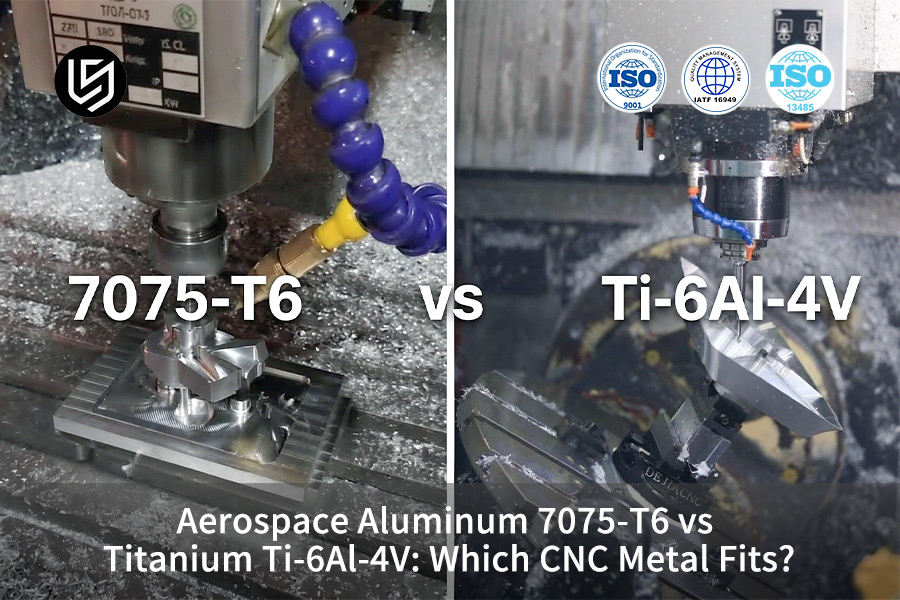
7075-T6 alloy is 36.5% less dense compared to the Ti-6Al-4V, which has a density of 4.43 g/cm³ against 2.81 g/cm³ at identical parts volumes. Airframe components driven solely by mass considerations prefer 7075-T6 alloy while the components constrained in space, subjected to structural loading extremes, use Ti-6Al-4V. Buyers asking is 7075-T6 aluminum lighter than Ti-6Al-4V must consider next the tensile strength, which is 570 MPa and 950 MPa, respectively. Both the 7075-T6 alloy and Ti-6Al-4V have the tolerance of ±0.05 mm, which means that mass, not accuracy, is what drives the material choice. 7075-T6 alloy is good for avionics enclosures when the envelope space is abundant, while the Ti-6Al-4V is better in thin-wall bays where specific strength (tensile strength/ density) matters for survival. Simply put, extra wall thickness beats lower density once space runs out.
Density vs Yield Strength Ratio in Structural Design
Titanium vs aluminum CNC machining requires running the following computations before choosing a material for a frame:
- 7075-T6 aluminum at 2.81 g/cm³ maintains 63.4% of Ti-6Al-4V weight at 4.43 g/cm³.
- Strength-to-weight ratio crossover: 7075-T6 aluminum achieves ≈203 MPa per g/cm³ (570 ÷ 2.81), whereas Ti-6Al-4V achieves ≈214 MPa per g/cm³ (950 ÷ 4.43).
- Crossover scenario: 7075-T6 vs Ti-6Al-4V CNC machining is preferable until wall thickness has unlimited volume; Ti-6Al-4V dominates when spatial constraints limit wall thickness.
- Envelope evaluation: An aerospace CNC material selection guide compares 7075-T6 aluminum on account of its spacious bays to Ti-6Al-4V on the account of its narrow bays.
Lightweight aluminum CNC machining is effective only where the wall thickness allows compensating for the loss of rigidity due to decreased density.
Source attribution: ASM International, Materials Properties Handbook: Titanium Alloys and Aluminum Systems (2024).
Related keywords: 7075-T6 vs Ti-6Al-4V CNC machining / titanium vs aluminum CNC machining / lightweight aluminum CNC machining

What Is 7075-T6 Aluminum Machining Behavior Under High Loads?
7075-T6 aluminum alloy is a precipitation-hardened alloy for aerospace machining at Vc = 600 m/min and stripping bulk material from stock faster than any other grade from structural alloys. Ti-6Al-4V cuts at 40–80 m/min; cycle time favors 7075-T6 aluminum machining, but heat loads above aluminum limits prefer Ti-6Al-4V machining. Roughing removes anisotropic rolling stress (stresses aligned with crystal grain orientation) from 7075-T6 aluminum, deforming the wall of 7075-T6 aluminum.
Stress-relieving toolpath, together with aging, returns the alloy to ±0.005 mm within ASME Y14.5-2018. 7075-T6 aluminum is suitable for frames, whereas Ti-6Al-4V is preferred in bays exceeding aluminum limits. Buyers comparing 7075-T6 vs Ti-6Al-4V CNC machining must allow additional aging cycles prior to finishing. Thin wall CNC machining of 7075-T6 aluminum will be successful through mirrored toolpaths across depth of cut.
7075-T6 aluminum sheet retains stress in the rolling direction, and grain alignment dictates the path of pocket walls once bulk removal stops. Engineers researching what is 7075-T6 aluminum machining behavior under load meet corner lift after bulk removal, not during the cut itself. Machinists use symmetric roughing cycles switching between opposite walls and subsequent aging cycles relaxing the grains to overcome the corner lift problem. Residual stress must be controlled on Ti-6Al-4V prior to tight bores too.
Faster spindle speeds on thin-wall 7075-T6 aluminum tend to decrease final tolerance since fast bulk removal increases the amount of milling stress per minute. Process engineers consider stress relief as an item on their production schedule, not as an emergency measure in aerospace CNC material selection guide. 5-axis CNC machining brings roughing and finishing operations into one operation, reducing the interval between bulk removal and aging cycles.
Source attribution: Groover, Fundamentals of Modern Manufacturing, 7th Edition (Chapter 26).
Related keywords: 7075-T6 aluminum machining behavior / thin-wall CNC machining / residual stress in CNC machining
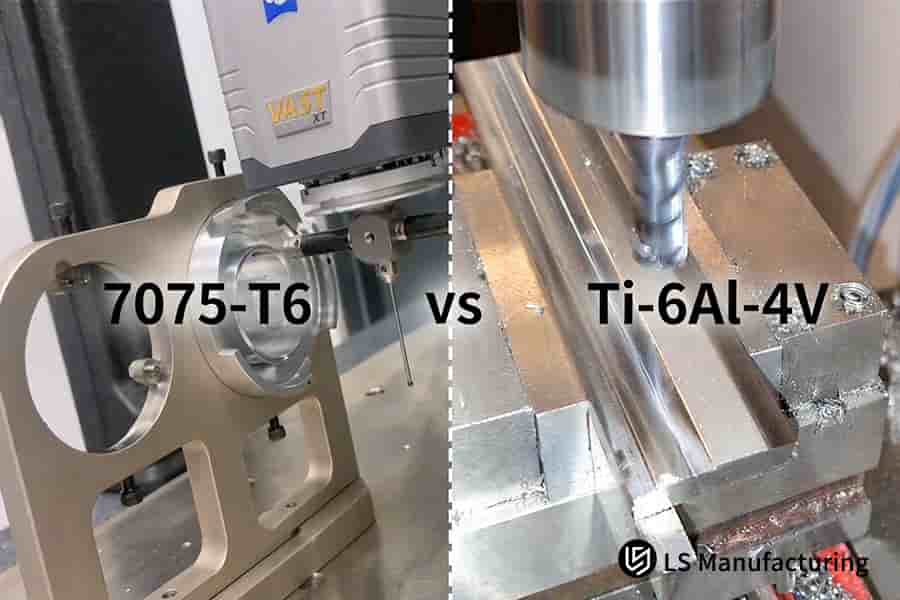
Figure 1: Machine probes measure 7075-T6 aluminum part edges while clamps hold Ti-6Al-4V titanium under a cutter.
Comparison Table of Basic Engineering Properties: 7075-T6 vs. Ti-6Al-4V
An empirical property baseline provides guidance for the initial allocation of aerospace materials in four dimensions of engineering. Aerospace-grade 7075-T6 aluminum and aerospace-grade Ti-6Al-4V (Grade 5) titanium provide all comparable values according to ISO 2768-1:1989 class m. Customers get density, thermal conductivity, cutting speed, and tolerance limits in one table for initial material selection.
| Dimension | Option A: aerospace-grade 7075-T6 aluminum | Option B: aerospace-grade Ti-6Al-4V (Grade 5) titanium | Design guideline |
| Density | 2.81 g/cm³ | 4.43 g/cm³ | More generous envelopes prefer aluminum; tighter high-load bays prefer titanium |
| Thermal conductivity | 130 W/(m·K) | 6.7 W/(m·K) | Aluminum dissipates heat rapidly; titanium captures local heat |
| Typical cutting speed (Vc) | 500–800 m/min (Vc = 600 m/min) | 40–80 m/min (Vc = 60 m/min) | Aluminum processes in fewer machine hours; titanium processes more hours |
| Achievable tolerance range | Precision grade ±0.005 mm; general grade ±0.05 mm | Precision grade ±0.005 mm; general grade ±0.05 mm | ISO 2768-1:1989 class m governs both on precision machine tools |
7075-T6 aluminum provides weight savings from volume production and quick machining, whereas Ti-6Al-4V is in place in turbine-related heat zones within less than 10 microns according to ISO 2768-1:
Mobile note: swipe horizontally to view all columns, or switch to card layout.
Data source and benchmark: empirical property baseline verified by LS Manufacturing
7075-T6 vs. Ti-6Al-4V Aerospace Alloy Decision Path
Start at the top node and answer each question with measured, not assumed, values. Follow one branch per node until you reach an endpoint card. Four inputs drive the path: peak service temperature, salt-fog exposure, envelope space, and minimum wall thickness.
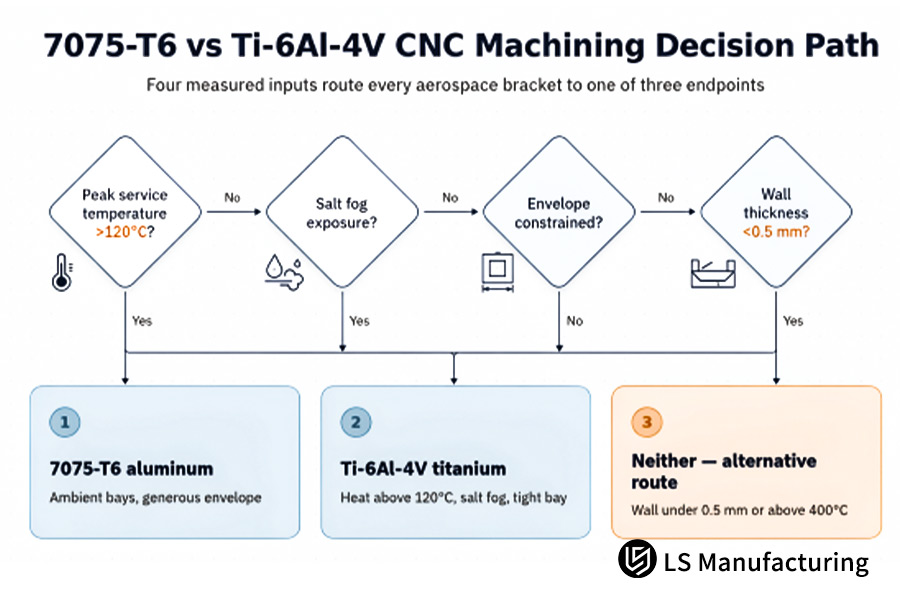
Figure 2: 7075-T6 vs Ti-6Al-4V CNC machining decision path runs from peak temperature through salt fog to three endpoints.
- Use measured or simulated peak service temperature taken before design freeze; ambient bay temperature underestimates heat-zone loads.
- Where wall thickness drops below 0.5 mm inside a constrained envelope, both grades need dedicated fixtures, so compare non-metallic or additive routes.
- Above 400°C neither grade holds stiffness; move to heat-resistant alternatives outside this tree.
How Does Heat Dissipation Affect Titanium Machining Speeds?
Ti-6Al-4V removes the cutting heat at 6.7 W/(m.K), 1/20 of the 7075-T6 aluminum value; heat is trapped in the micro-zones of the tip of the tool. Temperature of the tool tip goes above 800 °C when cutting Ti-6Al-4V, resulting in coating peeling, while 7075-T6 aluminum stays at a lower temperature due to its ability to dissipate the heat into the chips. When considering the machinability of titanium vs aluminum, buyers have to budget tool monitoring for Ti-6Al-4V and machining hours for 7075-T6 aluminum. High volume CNC machining favors 7075-T6 aluminum in terms of cycle time, while Ti-6Al-4V works better where the service heat is important in the design. Tool wear in titanium vs 7075 aluminum is what determines the cost to produce each piece in Ti-6Al-4V. Ti-6Al-4V material is good at keeping heat away from the thin walls, whereas the 7075-T6 aluminum brings more heat into the work material.
Thermal Barrier and Tool Wear Progression
Engineers inquiring how does heat dissipation affect titanium machining face three connected phenomena at the cutting edge:
- Heat partition – Ti-6Al-4V chips dissipate less than 20% of cutting heat, which leaves tool tips at temperatures higher than 800°C; 7075-T6 aluminum dissipates most of the cutting heat into chips.
- Coating damage – edge heat causes built-up edge (material from workpiece is welds to rake face), while 7075-T6 aluminum prevents both, operating at ≈10x higher speed.
- Coolant action – delivery of coolant through the tool body at pressures of ≥70 bar (high-pressure internal coolant) destroys the heat barrier of Ti-6Al-4V; 7075-T6 aluminum works with standard flood coolant.
Tool wear on Ti-6Al-4V bores crosses ISO 2768-1:1989 class m bands before flank wear looks severe to operators; CNC machining tolerance standards govern scrap more than spindle speed does. Pushing Vc past stable Ti-6Al-4V bands adds heat faster than ≥70 bar coolant removes heat; cycle-time savings then reverse into tool spend.
Source attribution: Machinery's Handbook, 30th Edition (Section: Machining Speeds and Feeds for Titanium Alloys).
Related keywords: titanium thermal conductivity machining / carbide tool wear titanium / 7075 vs titanium cutting speeds
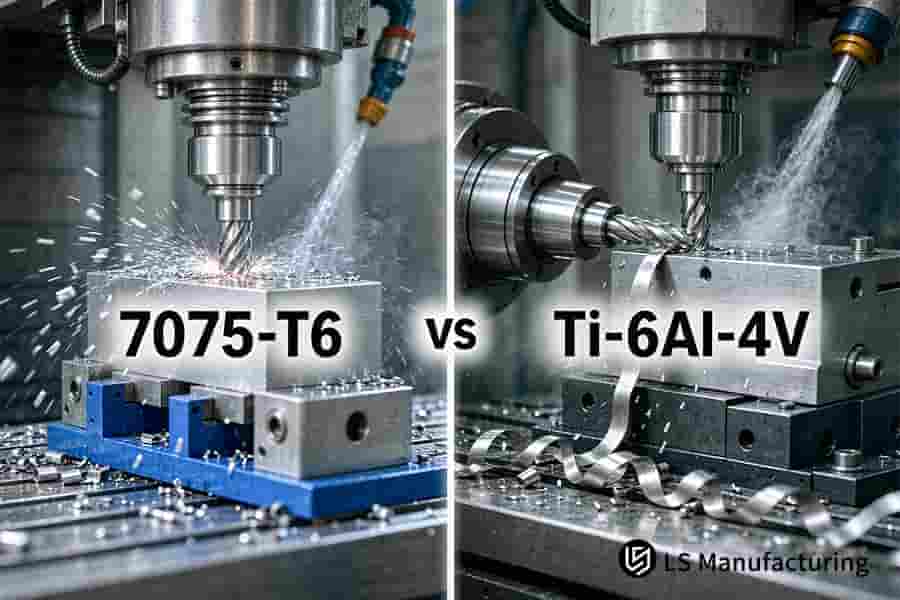
Figure 3: Coolant sprays 7075-T6 aluminum as fine bright chips fly while long ribbons curl off Ti-6Al-4V titanium.
Why Does Machinability Of Titanium VS Aluminum Diverge Sharply?
Machinability of titanium vs aluminum differs because Ti-6Al-4V combines a 114 GPa modulus of elasticity with a high-temperature affinity of the alloy. In other words, the machining of 7075-T6 aluminum takes place at around 10 m/s with a multi-hour tool life, while Ti-6Al-4V is cut at close to 1 m/s with the need for honing and reduced back engagement to maintain Ra 0.8 μm. When selecting a material based on tool wear in titanium vs 7075 aluminum, the user will experience flank wear and chatter when working with Ti-6Al-4V due to the elastic rebound of the workpiece off the cutting edge. 7075-T6 aluminum produces sharp chips and maintains cool edges during machining. Grade 5 titanium CNC machining sacrifices cycle time for surface integrity, with rigidity, rather than horsepower, determining the stable cutting range. Sharp corners and rigidity are important, not added torque on Ti-6Al-4V.
Ti-6Al-4V CNC machining process explained starts with modulus, not hardness. Low modulus in Ti-6Al-4V creates springback; flank rubbing leads to chatter, while high stiffness of 7075-T6 aluminum reduces springback effects. Machining methods for managing springback include honing of sharp edges, positive rake, and low back engagements. Multi-axis CNC machining involves tilting of tools rather than dwelling in corners so as to keep cutting forces consistent. High speed machining of Ti-6Al-4V increases chatter rather than increasing rate of material removal; slower passes might result in faster finishing.
7075-T6 aluminum is best used in ambient conditions where tool life and cycle time become important factors, while Ti-6Al-4V is suitable in heated bays where modulus and surface finish become more important criteria. In situations where wall thickness falls below 0.5 mm, special fixtures will be required in both alloys, while non-metallic or additive methods may be cheaper alternatives. Fit class according to ISO 286-1 applies to bores of both materials.
Source attribution: ISO 286-1 Geometrical Product Specifications (GPS) — Limits and fits.
Related keywords: Ti-6Al-4V elastic modulus machining / springback in titanium machining / aluminum vs titanium tool life
When Is Ti-6Al-4V CNC Machining Process Indispensable For Parts?
Ti-6Al-4V CNC machining is absolutely necessary when flight hardware is subject to continuous heating to a level of 150°C combined with the presence of corrosive salt-fog environment. 7075-T6 aluminum softens when operating temperature reaches 120°C, whereas the Ti-6Al-4V is stiff within 350-400°C adjacent to turbines, and, thus, it becomes irreplaceable in such cases. Turbine casing CNC machining programs meet both thresholds at once.
7075-T6 aluminum over-aging coarsens strengthening precipitates above 120°C and drops tensile strength steeply, whereas Ti-6Al-4V holds stiffness through 400°C airflow. Corrosion splits grades as well: 7075-T6 aluminum needs MIL-A-8625 anodizing, while Ti-6Al-4V grows a titanium oxide film resisting salt fog bare. Buyers following Ti-6Al-4V CNC machining process explained guidelines protect ±0.005 mm fastener bores across thermal cycles.
Ti-6Al-4V suits bays near turbines, bleed-air ducts, and decks facing salt spray. 7075-T6 aluminum remains correct below 120°C where mass and cycle time dominate. 7075-T6 vs Ti-6Al-4V CNC machining reviews should log peak service temperature before density or price. Aerospace CNC material selection guide tables can then rank both grades against corrosion exposure. In simple terms, heat plus salt fog forces titanium, and ambient bays stay aluminum.
Environmental Temperature and Corrosion Thresholds
Service temperature and salt fog exposure create two tough boundaries in terms of aerospace alloys. The following table shows four rows of comparison between both alloys based on ASTM B117 (neutral salt spray corrosion practice).
| Threshold | 7075-T6 aluminum | Ti-6Al-4V |
| Service temperature limit | 120°C | 400°C |
| Corrosion protection | MIL-A-8625 anodizing | Self-forming oxide film |
| Fastener bore tolerance | ±0.005 mm | ±0.005 mm |
| Coating before service | Required | Exempt |
Beyond 120°C service temperature and salt fog environment, Ti-6Al-4V becomes the right alloy to go with; whereas for ambient storage, 7075-T6 aluminum is less costly and faster.
At 400°C, neither of the alloys possesses stiffness, and heat-resistant replacements become the focus of study. Low volume CNC machining services encounter heat-based cost divisions at temperatures lower than 120°C because of titanium alloys' increased price.
Source attribution: MIL-A-8625 / ASTM B117 Environmental Standard Assessments.
Related keywords: Ti-6Al-4V service temperature limit / titanium salt spray corrosion resistance / 7075-T6 anodizing requirement
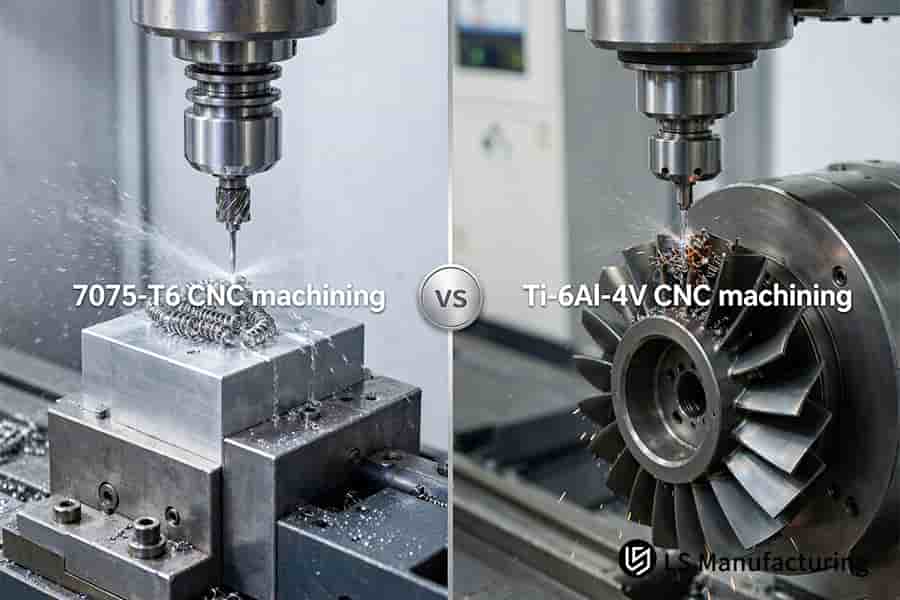
Figure 4: Curled chips leave 7075-T6 aluminum blocks under coolant spray while Ti-6Al-4V impeller blades shed short fragments.
How Ti-6Al-4V Machining Works In Practice: An Avionics Mounting Example From LS Manufacturing
In precision avionics brackets, switching to Ti-6Al-4V CNC machining is not an arbitrary upgrade over 7075-T6 aluminum—it is a mandatory response to localized motor heat exceeding 120°C. At temperatures higher than 120°C, 7075-T6 aluminum loses geometric accuracy due to creeping and loses bore alignment under torque; Ti-6Al-4V maintains stiffness until 400°C and ensures bore alignment. 7075-T6 aluminum prevails in cycle time and mass; Ti-6Al-4V prevails in dimensional stability in heated zones; further choice is made based only on sustained service temperature. Both alloy's bores in both approaches fall under ISO 286-1:2010 tolerance and fit rules, and both possess precision class bores when conditions of rigidity and stress are met.
Initial Route and Pain Points
A startup microsatellite R&D group chose 7075-T6 aluminum alloy to be used in the drive base of an antenna turntable based on low density and fast cycle times compared to thermal stability. Combination of torque loading and thermal solar cycling caused the temperature in the local bay to increase to 165°C. Thermal creep (gradual dimensional shift due to long-term exposure to heat and loading) then moved ±0.1 mm bushing bores of the existing design and locked up the bearing fit. Thin wall CNC machining of aluminum bases leaves no residual wall thickness to regain stiffness when heat is increased. Assembly interference then made antenna pointing test impossible.
Route Switch and Process Fix
Comparison of material properties considered 7075-T6 aluminum of 2.81 g/cm³ density and 130 W/(m·K) thermal conductivity vs. Ti-6Al-4V of 4.43 g/cm³ density and 6.7 W/(m·K) thermal conductivity. Cutting speed was divided as 600 m/min vs. 60 m/min and tolerance ±0.1 mm legacy vs. ±0.005 mm. In the LS Manufacturing titanium route, 5-axis micro-feed machining was used and cutting speed was limited to Vc = 60 m/min. First attempt to bore titanium parts caused drifts due to low modulus that caused the walls to move under cutting force.
Measured Outcomes
Titanium cut slower per pass, but eliminating creep-related rework and scrap shortened overall delivery by 18.2%.
Delivery cycle reduced by 18.2% on Project #AERO-2026-T881B due to replacement of aluminum by titanium. Batch trial defective product decreased from 16.5% to 4.2%, while individual part cost and set-up consumption reduced by 11.8%. Core bearing tolerance fits were manufactured within 5 micron fit band at Ra 0.4 µm. Assembly interference was eliminated and antenna orientation test passed first go. CNC machining DFM guidelines followed before milling resulted in the major measurable savings. Sourcing groups restored schedule buffer, while incoming inspection groups reported less bore rejects.
Validation and Lessons
Inspection documents per AS9100D and geometric tolerances per ISO 2768-1:1989 class m were used for validation of both processes from the first article to batch release. Reports on first-article bore validated the geometry before the assembly of antenna. Aluminum is the right choice in ambient bays when mass and delivery cycle time matter; titanium is worth the cost saving only in case of heat exposure. Project #AERO-2026-T881A findings can be applied to ambient bays in >800 builds recorded. Put simply, let service temperature select your alloy and let cycle time establish your budget.
"Switching to Ti-6Al-4V removed assembly interference, and antenna pointing tests cleared on first run after bore fits held through thermal cycling." — Mechanical Design Lead, microsatellite R&D startup, Project #AERO-2026-T881
Data source and benchmark: Project Tracking #AERO-2026-T881A (7075-T6 aluminum route) and #AERO-2026-T881B (Ti-6Al-4V titanium route); Database Reference: LS Manufacturing 2025–2026 measured database (sample size >800).

FAQs
1. Why is 7075-T6 aluminum considered stronger than common commercial alloys?
7075-T6 aluminum alloy attains a tensile strength of 570 MPa after solution treatment and aging, whereas Ti-6Al-4V attains a tensile strength of 950 MPa and 6061 alloys still attain lower values. With zinc precipitation hardening, procurement departments get carbon steel strength at 2.81 g/cm³. Ambient temperature brackets employ one strength range, while the heat zones switch to Ti-6Al-4V. Material certificates from LS Manufacturing and ASM International (2024) support 7075-T6 aluminum vs titanium CNC machining under ISO 6892-1:2019.
2. Can Ti-6Al-4V titanium achieve the same precision tolerances as aluminum alloys?
Ti-6Al-4V achieves complete tolerance equivalence with 7075-T6 aluminum in LS Manufacturing 5-axis machining centers within climate-controlled rooms. Bore locations of Ti-6Al-4V as well as 7075-T6 aluminum maintain within a tolerance of ±0.005 mm, with both grades having equivalent fit classes under ISO 286-2:2010 standard. Within LS Manufacturing 2025-2026 cross-process measured data set (number of measurements >800), both grades retain one single bore tolerance band. Incoming inspection staff can use one single bore tolerance for aluminum as well as titanium parts.
3. Why does cutting tool wear accelerate significantly when machining titanium?
Ti-6Al-4V drives tool tips past 800°C and kills tool life prematurely; 7075-T6 aluminum diverts cutting heat to chip and leaves tool edges cooler. ISO 3685:1993 sets the standards for single-point tool-life testing for both material types, and LS Manufacturing cutting data indicates high-pressure internal coolant increases Ti-6Al-4V tool edge life. Budget for downstream tooling has more titanium spending compared to aluminum operations.
4. Is surface anodizing mandatory for CNC-machined Ti-6Al-4V aerospace components?
Ti-6Al-4V develops a self-repairing oxide layer in air and is shipped uncoated; 7075-T6 aluminum has to undergo MIL-A-8625 Type II or III anodizing to protect against corrosion. ISO 7599:2018 standardizes anodic coating of aluminum whereas Ti-6Al-4V ships uncoated. Bare Ti-6Al-4V aerospace parts are cleared by quality auditors without undergoing plating; aluminum parts can take coating cost and schedule.
5. How should beginners balance material costs against CNC cycle times?
Ti-6Al-4V costs more per billet and cuts slower; titanium programs spend more spindle hours and more tool edge per part. Aerospace CNC machining cost of Ti-6Al-4V pays off only above the heat of 120 degrees Celsius. Both grades' cutting speeds are provided in Machinery's Handbook, 30th Edition. Schedules are shorter on aluminum material, according to LS Manufacturing CNC machining time cycles.
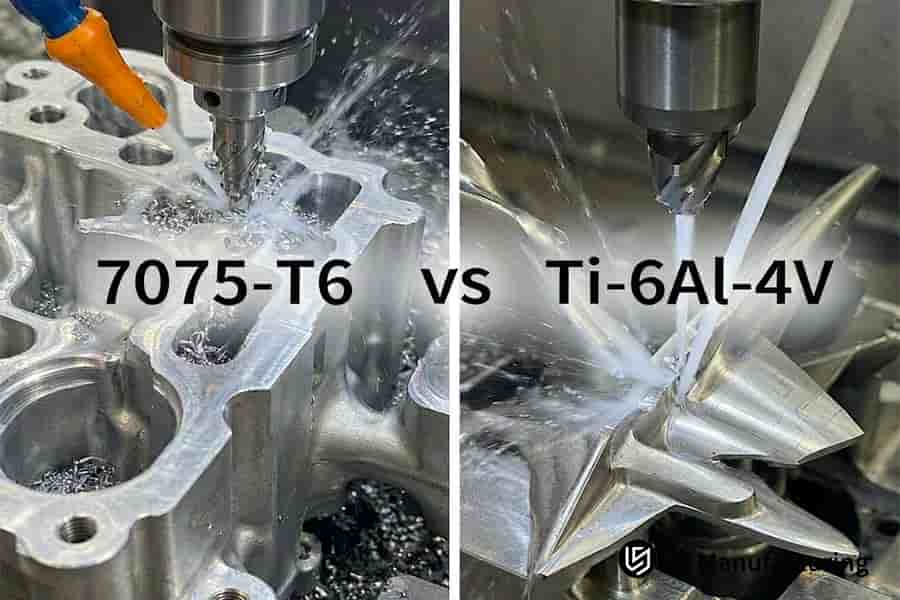
Figure 5: 7075-T6 vs Ti-6Al-4V CNC machining diverges as cutters mill 7075-T6 walls while tools shape Ti-6Al-4V fins for brackets.
Summary
Aerospace flight grade component design process involves choice of alloy type – 7075-T6 aluminum or Ti-6Al-4V titanium. Ambient parts have faster cycle times and less finished mass on 7075-T6 aluminum, whereas heat-zone parts gain thermal stiffness on Ti-6Al-4V. Temperature range of use determines your alloy before designing process starts.
Aerospace Alloys Machining Insights Desk
Engineers at LS Manufacturing discuss GD&T (geometric dimensioning and tolerancing), chatter elimination techniques and high temperatures limitations for machining complex thin-walled aerospace components. Junior R&D staff check machining parameters and tolerance chains via Phone: +86 185 6675 9667, Email: info@lsrpf.com, Website: https://lsrpf.com/.
Further Reading: Aerospace Industry Services Page