English



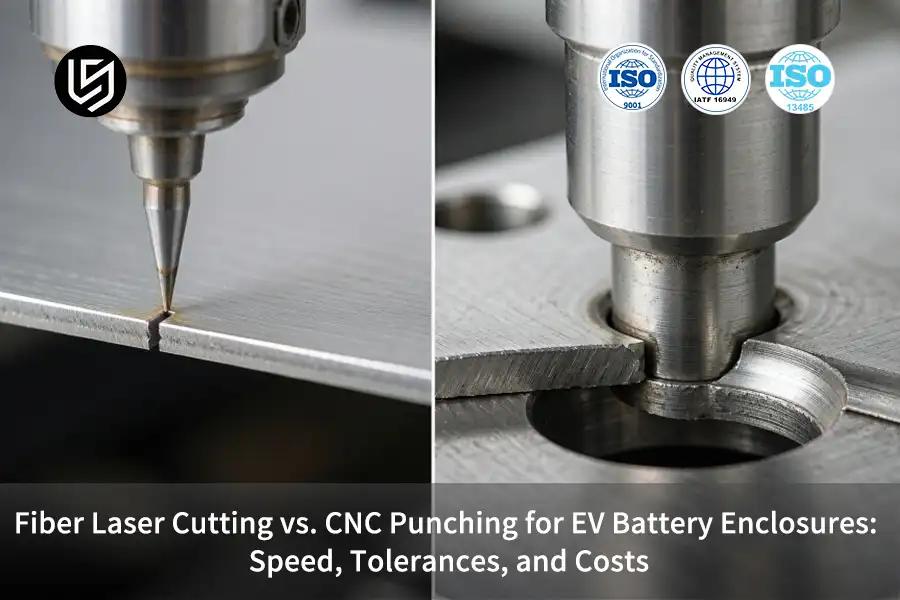
TL;DR: Although the fiber laser cutting process provides ±0.005mm precise tolerance without tooling cost for complex profiles, CNC punching reduces cycle time by 40% and offers over 1,000 HPM. The breakeven is at 1,200 pieces.
Engineers and sourcing managers developing electric vehicle projects on strict budgets always face a dilemma in deciding on tooling cost versus part efficiency of their manufacturing process. Depending on the volume of the parts and precision tolerance required, it is decided whether fiber laser cutting or CNC punching should be done to manufacture the enclosure efficiently without any scrap generation in the production process. In this engineering guide, the pros and cons of both processes are compared across 4 major criteria with engineering benchmarks provided, along with a practical step-by-step checklist in 5 minutes to complete the manufacturing process decision-making process.
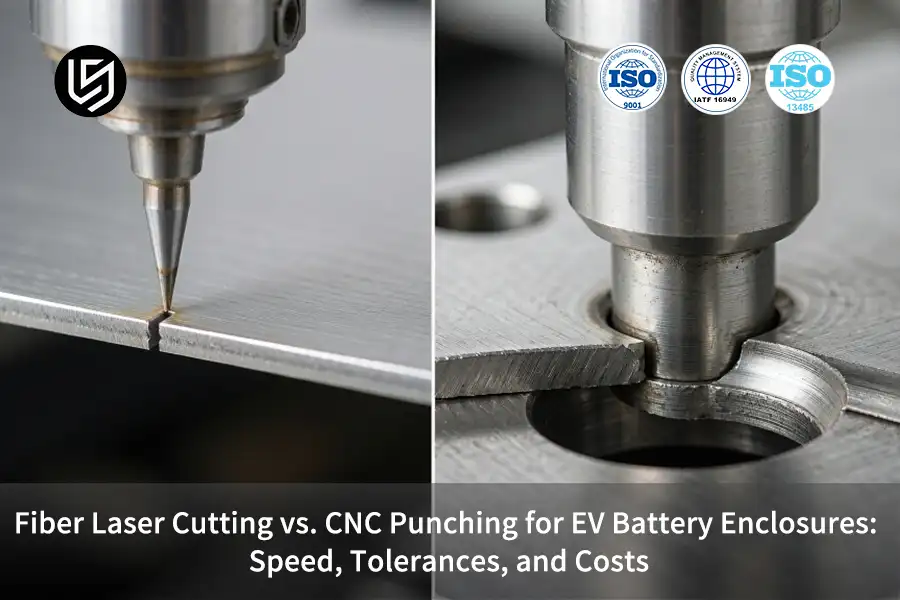
How Do Fiber Laser and CNC Punching Compare Side by Side?
Table 1 below compares fiber laser cutting with CNC turret punching on four main engineering criteria in EV battery tray and enclosure cover manufacture:
|
Comparison Dimension |
Option A: Fiber Laser Cutting |
Option B: CNC Punching |
Breakeven Threshold / Best Fit |
|
Tolerance & Surface Roughness (Ra) |
Linear tolerance ±0.01mm to ±0.05mm; roughness Ra 1.6 μm |
Linear tolerance ±0.08mm to ±0.15mm; shear edge roughness Ra 3.2 μm |
Select fiber laser cutting when sealing interface requires ≤±0.05mm |
|
Forming Features |
Strictly 2D planar profile cutting; cannot produce 3D forms or louvers |
Integrates louvers, countersinks, grounding dimples, and stiffener ribs |
CNC punching is essential when structural stiffeners or louvers are required |
|
Tooling & Unit Economics |
$0 tooling cost; steady unit part pricing ($18.50/unit baseline) |
$4,800 hard tooling investment; drops unit cost to $11.20/unit at volume |
Threshold sits at 1,200 units: laser is cheaper below 1,200; punching wins above |
|
Prototype & Volume Lead Times |
Rapid prototype parts delivered in 2 days with zero tooling lag |
Requires 14 days for die setup; mass production hits exceed 1,000 HPM |
Choose laser for fast iteration; choose punching for high-volume perforated panels |
As proven empirically through shop-floor analysis, fiber laser cutting is better suited for contour flexibility and extremely tight tolerance control, whereas CNC punching offers unmatched cycle-time and cost efficiency in high-density thermal perforations and structural forming.
Key Takeaways
- Go with fiber laser cutting for rapid design iteration cycles, prototype runs under 1,200 pieces, and flanges and high-voltage connector cutouts where tolerances range from ±0.01mm to ±0.005mm.
- Go with CNC punching when battery trays feature cooling vents, embossing ribs, or ground screw extrusion, and production volume is expected to surpass 1,200 pieces and break into the $11.20/piece amortization zone.
- Key engineering trade-offs: Fiber laser cutting avoids $4,800 in hard die costs and slashes first-piece production time to 2 days; CNC punching surmounts cycle-time challenges through 1,000+ holes per minute strokes on repeating holes.
The Process Behind the Numbers: LS Manufacturing Cross-Process Engineering Evaluation Approach
With capabilities for in-house high-power multi-axis laser centers, CNC turret punch presses, and multi-axis CNC milling machines, LS Manufacturing achieves total multi-process capability within one roof, allowing for a fair engineering evaluation backed up by unbiased data.
This engineering decision guide was written by Gloria (Senior Rapid Prototyping and Rapid Manufacturing Specialist with 15+ years of cross-process precision manufacturing experience) and technically reviewed by LS Manufacturing shop floor process engineers.
Which Process Provides Better Tolerances for Enclosures?
When evaluating laser cutting vs punching tolerances, fiber laser cutting ensures precision tolerances of ±0.01mm and a clean Ra 1.6 μm cut edge on EV battery enclosures, while CNC punching provides ±0.08mm precision tolerance plus significant mechanical shear rollover. Understanding these mechanical laser vs punching limitations is critical: for IP67 protection gaskets and high-voltage pin clearance holes, non-contact laser processing ensures there is no sheet metal deformation due to impact of mechanical punching tools. LS Manufacturing suggests that if the panels contain only standard clearance holes, then CNC punching using standard cluster dies with a tolerance of ±0.15 mm is more than enough.
Data Source & Benchmarking Reference: Inspected according to ASME Y14.5 Geometric Dimensioning and Tolerancing standards and validated by Zeiss CMM Spatial Indication Error Inspection of 3.0 mm AL 5052-H32 series.
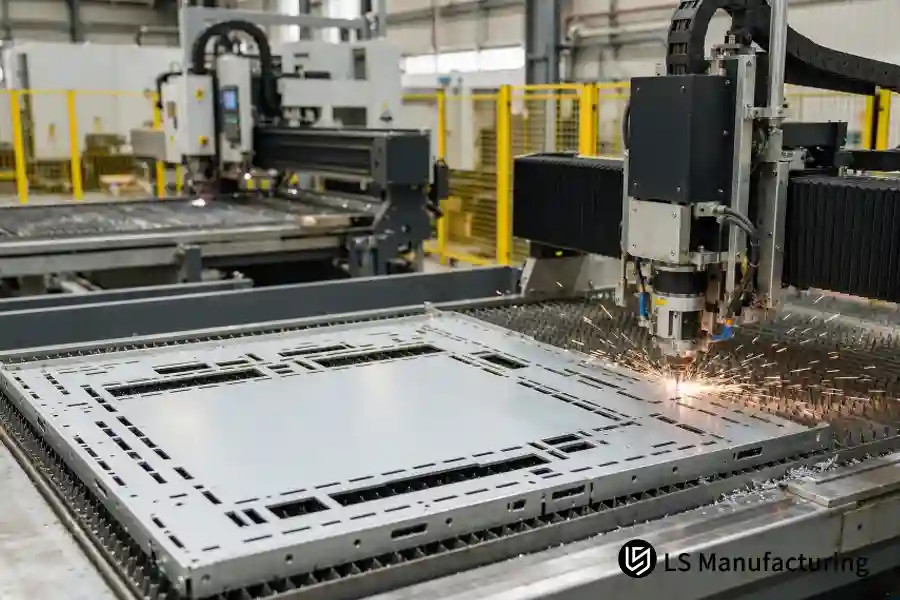
Figure 1: High-power fiber laser cutting center precision-profiling a 3.0mm aluminum EV battery enclosure at LS Manufacturing, holding ±0.01mm linear tolerance without mechanical distortion.
Dimensional Variance Across Precision Tiers
|
Precision Tier & Feature Target |
Fiber Laser Cutting Realized Tolerance |
CNC Punching Realized Tolerance |
Enclosure Structural Component |
|
Standard Grade |
±0.05 mm |
±0.15 mm |
Perimeter clearance slots, weight-reduction cutouts |
|
Precision Grade |
±0.01 mm |
±0.08 mm |
Module locating dowel holes, high-voltage pass-throughs |
|
Ultra-Precision Grade |
±0.005 mm |
±0.04 mm |
Liquid cold plate alignment datum holes (secondary calibration) |
Typically, legacy baseline design calls for a ±0.1mm tolerance on standard sheets. In battery enclosure panels that are larger than 1,500mm in length, mechanical punching may result in distortion up to 0.5mm, while laser profiling retains ±0.05mm total surface flatness.
How Does the Processing Speed Differ Across Battery Hole Patterns?
Analyzing laser vs CNC punching speed reveals significant performance gaps depending on feature density. During production of EV thermal management panels with more than 500 holes, CNC punching takes more than 1,000+ holes per minute (HPM) to complete one piece in 35 seconds, while laser perimeter profiling requires 190 seconds to process. Turret punch presses with cluster tooling are able to produce several holes in one mechanical stroke; however, as soon as geometry changes to dynamic curvilinear patterns, fiber laser vectoring beats turret punch press stroke time. When weighing laser cutting vs CNC punching for battery tray fabrication, LS Manufacturing recommends processing dense hole patterns via turret punch presses and irregular wiring harnesses via fiber laser cutting.
Structural Speed Test Method
1. Count holes and check geometry uniformity: If there are more than 300 identical circles or rectangles on each panel, CNC punching has a 5 times higher productivity rate.
2. Determine material thickness and mechanical deflections: In aluminum material at 3.0mm thickness, repetitive punches with high tonnage will induce oil-canning and camber deflection, necessitating an additional leveling step.
3. Routing hybrid optimization: For large-pack cover panels, using CNC punching for interior holes with laser cutting for exterior contouring is optimal for increased speed.
When geometries have irregular contours, the use of fiber lasers will not leave mechanical nibble marks through dynamic motions that trace out tight radii.
When Does CNC Punching Tooling Become Cheaper Than Laser Cutting?
Total lifecycle laser vs punching cost shifts dramatically as order sizes expand. The unit manufacturing cost of CNC punching at $11.20 per unit pays off the $4,800 cost of tooling and becomes cheaper than the fixed unit cost of fiber laser cutting at $18.50 when production of EV battery enclosures exceeds 1,200 units annually. Below 1,200 units, fiber laser cutting reduces upfront cost by bypassing standard punching tooling cost lead time and die setup expenses, saving 39% in early development expenditure. LS Manufacturing advises using fiber laser cutting for vehicle testing to avoid tooling obsolescence and switching to hard turret punch tooling after the battery CAD has been solidified.
Data Source and Benchmark: LS Manufacturing Cross-Process Manufacturing Database 2025–2026 (Project IDs #AUTO-2026-042A / #AUTO-2026-042B, sample size >1,500 parts).
Procurement managers tend to underestimate risks in fast battery engineering cycles. Moving the cell arrangement just a few millimeters makes hard punch press dies obsolete, but with fiber laser cutting, the programmer can tweak 2D CAD nesting design in a few minutes.
What Are the 3D Forming Constraints of Laser Cutting vs CNC Punching?
CNC punching machines produce cooling grilles, rib structures, and extruded grounding pilot holes all in one pass in a machine, while fiber laser cutting is strictly a thermal cutting process needing separate setups for any formed feature. In integrated top covers, where torsional strength and burst disk reliefs are needed, in-die punch forming saves two setups on a press brake and reduces processing time by 28%. According to LS Manufacturing, panels with embossed standoffs or threaded extrusions should be routed straight to CNC turret punches in order to avoid tolerance stackups from extra secondary operations.
Stamped pockets in pack crash-resistant underbody shields protect the battery management system (BMS) wiring connectors. In punch forming, these pockets are drawn into the metal in a matter of milliseconds, while using a laser cutter would need secondary hydraulic press tooling or fasteners.
How Does Enclosure Production Volume Dictate CNC Punching vs Laser?
Evaluating projected laser cutting vs punching volumes is the most reliable method to forecast per-part amortization. If the production volumes of trials are low, ranging from 5 to 200 pieces, laser cutting allows quick production within 2 days and saves on tooling costs that results in 35% lower development costs than hard die tooling processes. In case the production exceeds 5,000 units, CNC punching will cost $11.20 per piece while laser cutting will cost $18.50 per piece, resulting in 39% lower overall costs. Frequent changes of vehicle platforms create an increased risk of tooling obsolescence; therefore, evaluating fiber laser vs CNC punching across each lifecycle phase allows LS Manufacturing to smoothly transition orders from fast laser prototypes to mass-production turret punching.
Production Volume and Cost Trade-offs
|
Volume Tier |
Recommended Routing |
Laser Cutting Economics |
CNC Punching Economics |
Strategic Production Focus |
|
1 – 300 Units (Rapid Prototyping) |
Fiber Laser Cutting |
2-day delivery; $0 tooling cost |
Heavy tooling expense amortized across too few parts |
Maximizes iteration speed and design flexibility |
|
301 – 1,200 Units (Pilot Run) |
Fiber Laser Cutting |
Total cost matches punch tooling baseline |
Tooling expenditure represents major unit cost share |
Mitigates scrap risk from mid-trial design changes |
|
1,201 – 5,000+ Units (Production Run) |
CNC Turret Punching |
Tracing cycle times cap daily throughput; steady $18.50 unit cost |
Tooling fully amortized; unit part price drops to $11.20 |
Minimizes cycle time and scales unit savings |
Not only does the volume dictate how tooling is depreciated for accounting purposes, but it also dictates the efficiency of the shop floor scheduling. Early phase validation using dedicated punch tooling is capital intensive, whereas utilizing laser cutting alone for higher volume perforated covers is machine capacity-intensive and increases costs per part.
How Do Engineers Select Between Laser and Punching in Three Steps?
In order to help engineering teams to determine process routing within minutes, ensure that part criteria meet these 3 steps in sequence:
• Step 1: Forming and 3D Geometry
- Action: Review 3D CAD drawings for any louvers, dimples, or stiffener ribs.
- Rule: If there is 3D forming required for the enclosure, then CNC Punching should be used to avoid multi-step offline press tooling; if there is no 3D forming at all, move to step 2.
• Step 2: Inspect Critical Interface Tolerances
- Action: Assess perimeter seal flange flatness and cell module alignment dowel tolerances.
- Rule: In cases where mating surfaces require tight tolerances of ≤±0.01mm and Ra 1.6 μm cut edges, Fiber Laser Cutting must be utilized to eliminate distortion from punching stress; if general tolerances fall between ±0.08mm and ±0.15mm, go to Step 3.
• Step 3: Determine Annual Volume and Hole Density
- Action: Correlate forecasted annual volume with panel thermal venting patterns.
- Rule: For pilot runs below 1,200 pieces with 2-day deliveries, use Fiber Laser Cutting (zero tooling); for volumes above 1,200 pieces that feature over 300 grid holes, switch to CNC Punching in order to leverage higher than 1,000 holes per minute speeds and $11.20 unit price savings.
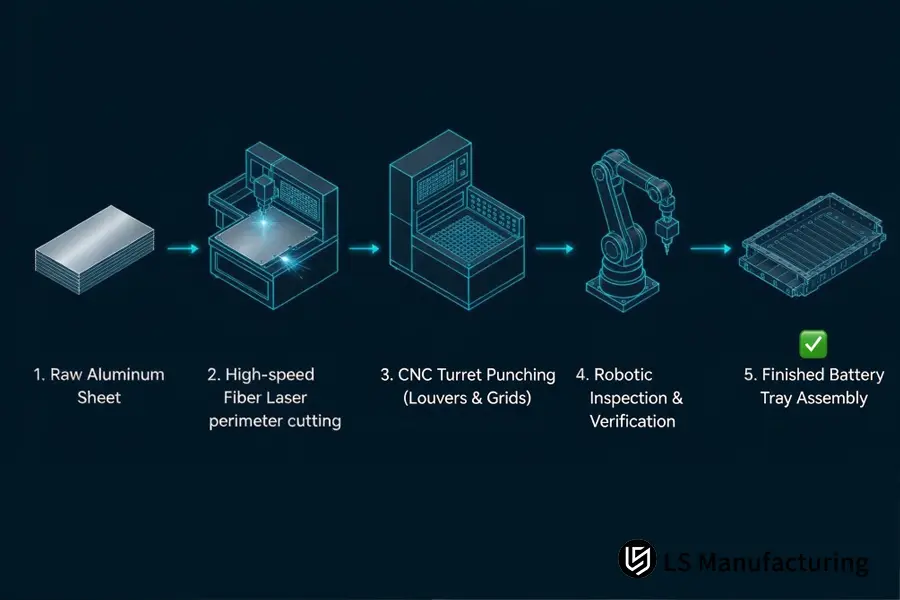
Figure 2: Five-step manufacturing workflow for EV battery enclosures: From raw sheet and laser perimeter cutting to CNC turret punching and automated inspection.
Hybrid Routing Guide: Whenever the battery covers need critical sealing interface tolerances (≤±0.01mm) and hundreds of cooling louver holes, LS Manufacturing employs a hybrid strategy: stamp out the venting patterns and forms using CNC turret punch, and then cut the perimeter seals using fiber laser.
LS Manufacturing Fiber Laser vs. CNC Punching for Automotive EV Battery Enclosures: Process Trade-Off Optimization
An industrial automotive EV battery system engineering team working on a 120 kWh lightweight pack cover project was originally planning full progressive punching tools. The sheet material used in this case was 1,800mm x 1,200mm made of 3.0mm thick AL 5052-H32. During the first trial of punch operation, excessive residual stress due to mechanical punching impacted the aluminum sheet and resulted in 2.8mm diagonal deformation. This out-of-flatness did not meet ISO 2768-m standards, affecting the IP67 environmental seal, increasing the scrap rate to 14.5%, and causing serious tool re-work delays.
LS Manufacturing's application engineers worked with our customer to implement an A/B process improvement methodology:
1. Engineering Failure Root-Cause Analysis: According to the scanning done by the optical CMM, it is clear that the punch caused hardening and the residual stresses in the large panel. The DFM team segmented the process by applying high-power fiber laser cutting of the sealing flange and dowel holes in the perimeter with a tight tolerance of ±0.01mm linear tolerance.
2. Hybrid Manufacturing Re-sequencing: The cluster die punch with micro-tabs and louvers formation in the same set up without any distortion of the large sheet.
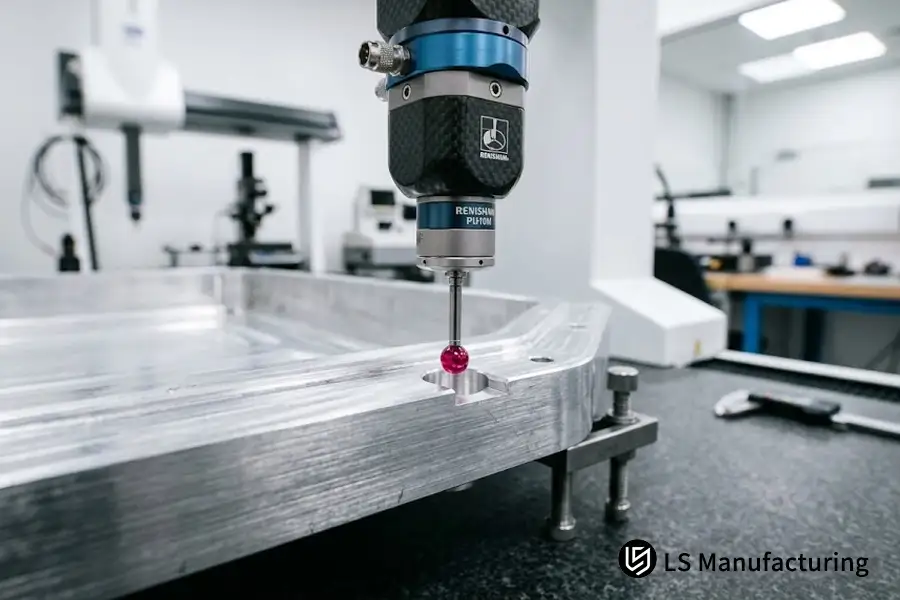
Figure 3: AS9100D CMM metrology inspection verifying perimeter sealing flange flatness and ±0.01mm datum hole accuracy on a finished EV battery enclosure.
The benefit in the above hybrid manufacturing process includes:
- Unit Part Cost: Initially it was estimated to be at $18.50 but reduced to $12.80 per part costing; overall cost reduction of 30.8%
- Scrap and Defects Rate: Initially 14.5% to 2.2%
- Delivery Time: First article time was initially 14 days due to the die problem and after re-segmentation it is 5 days, with prototype testing increased by 64%.
- Tolerance Precision: Tolerance of sealing perimeter was initially ±0.1mm but now reduced to ±0.01mm and cut edge roughness of Ra 1.6 μm.
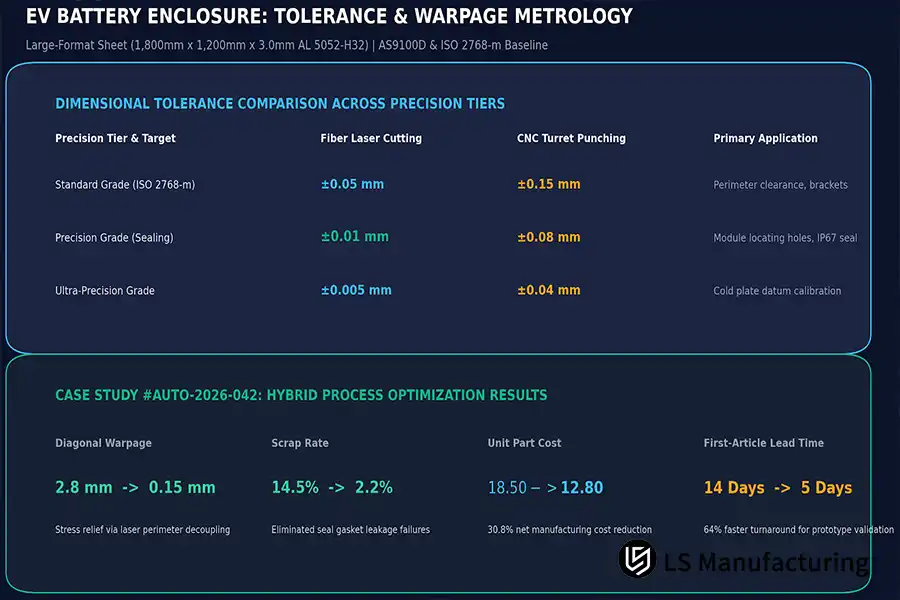
Figure 4: Dimensional tolerance tiers and Case Study #AUTO-2026-042 optimization benchmarks, demonstrating a 30.8% cost reduction and warpage drop from 2.8mm to 0.15mm.
These last parts have passed the testing phase and got approval for air-decay helium leak test and AS9100D FAI before the start of mass production in batches of 5,000. The case study above shows that the division of punching operations from laser-cut precision perimeter eliminates tolerance and costs problems in large gauge EV sheet processing.
Data Source: LS Manufacturing Production Database, Projects #AUTO-2026-042A / #AUTO-2026-042B, sample size >1,500 parts.
FAQs
Q1:What technique provides higher cut edge quality for EV battery seals?
The fiber laser cut can reach Ra 1.6 µm cut edge with no rollover and burrs at 3.0mm aluminum sheet, providing airtight seal compression; CNC punching leaves rollover and fracturing zones (Ra 3.2 µm), which usually require extra edge deburring steps. Proven by LS Manufacturing roughness profilometer tests.
Q2: Where does the break-even occur regarding costs?
The breakeven point is somewhere around 1,200 pieces. If below 1,200 pieces, fiber laser cutting will be less costly due to $0 tooling cost, but if above 1,200 pieces, CNC punching at $11.20 per piece will be better than $18.50 per piece from the laser cutting process. Data from LS Manufacturing cross-process accounting.
Q3: Is it feasible to manufacture embossing or louvers through fiber laser cutting?
No, since fiber lasers are purely 2D thermal separation technology only. Louvers, ribbed stiffeners, and countersunk dimple features are manufactured via CNC punching or press brake forming processes.
Q4:What can help me to know quickly whether to go with laser cutting or punching for battery trays?
Follow these three requirements: geometry check (punching needed due to the formed features), tolerance check (tolerances less than ±0.01mm require laser cutting), and batch size (laser cutting is preferable if the batch size is less than 1,200 pieces). Contact LS Manufacturing engineering desk for specific project recommendations.
Q5:Why is the punching process complicated for heat-treated aluminum sheets?
The alloy heat-treatment such as AL 6061-T6 demonstrates brittle mechanical properties; therefore, the tools get worn out quickly and micro-cracks occur along sheared edges at high tonnage; fiber lasers are able to cut hard alloys without any tool wear thanks to non-contact technology.
Q6:What is the difference between lead time for prototyping of samples in both cases?
Fiber lasers are capable of making prototypes in 2 days according to digital drawings; CNC punching requires 10-14 days for prototype creation in case of ordering custom tooling or dies alignment. LS Manufacturing order dispatch data.
Conclusion & Technical Guidance
In the area of EV battery enclosures, fiber laser cutting process and CNC punching process are supplementary processes to address different engineering challenges. In the case when small tolerance of ±0.01mm sealing flanges is required, in the case of trials of low production volumes and quick prototyping, then the fiber laser cutting process should be chosen. In case of high-volume production, ventilation system with dense patterning and three-dimensional stamped parts, then the CNC punching is suitable.
EV Battery Enclosure Engineering & Technical Support Desk
Looking for process trade-offs for your upcoming battery enclosure project? Submit your 2D/3D CAD data for a full DFM evaluation and cost comparison report by LS Manufacturing engineers within two hours.
To ask our cross-process application engineers about sheet metal tolerances planning, thermal warping avoidance, or volume breakeven point, contact us via:
📞Tel: +86 185 6675 9667
📧Email: info@lsrpf.com
🌐Website: https://lsrpf.com/