English



TL;DR: Five medical grade plastics cover almost every CNC machining job: PEEK, UHMWPE, POM MT, polycarbonate and PTFE. All five meet ISO 10993-1:2018 biocompatibility, and none of them is dimensionally stable by default — cutting heat and residual stress, not certification, decide whether a machined bore holds its band. PEEK machines to ±0.008 mm once annealed; UHMWPE, which trades rigidity for low friction, sits at ±0.05 mm.
Two ISO 10993-certified resins can behave nothing alike on the same machine. Crystallinity decides chip formation, the tolerance band you can hold, and which sterilization cycles survive — and it is the reason a certified resin can still produce a bore that drifts out of band.
About the Author Behind This Guide
Gloria, an experienced rapid prototyping consultant at LS Manufacturing, has more than 15 years' experience in mechanical engineering for medical polymer machining. Notes for Gloria's Engineering Insights begin with DFM (design for manufacturability - design parts so cutting setups stay simple), a topic that is relevant since the design geometry is determined at an early stage and determines fixture long before the cutting process begins. Follow Gloria's engineering insights on LinkedIn.
ISO 13485:2016 (medical device quality management systems) directs medical manufacturing control. Every claim below traces to a named source — ISO 10993-1:2018, ISO 13485:2016 clause 7.5.1, or Machinery's Handbook (30th ed., Machining Plastics).
A biocompatibility certificate is often read as covering dimensional stability as well. It does not. Polymer blanks have a low conductance but high expansion, hence, because of the heat generated by friction, springback occurs. Dimensional acceptance follows ISO 2768-m and the drawing tolerance band; the test house performing the first-article CMM (coordinate measuring machine) check holds ISO/IEC 17025 accreditation.
Key Takeaways
- Biocompatibility and structural inactivity: Polymers used for medical applications must meet biological evaluation criteria. High-pressure sterilization using steam assesses the ability of the molecules to withstand this pressure without breaking.
- Thermal management: Polymers have only a fraction of metal's electrical conductivity, which results in frictional heat remaining at the cut. Tolerance bands have to remain tight enough to prevent spring back once the workpiece is unclamped. In other words, thermal control, not machine torque, determines the possible range.
- Material selection: PEEK (polyetheretherketone, a stiff implantable thermoplastic) prefers creep resistance, whereas UHMWPE (ultra-high-molecular-weight polyethylene, a tough sliding-grade polymer) prefers low friction. Surfaces milled from either material end up close to the fine finish. Mix-up between the implantable grade and the industrial extrusion grade leads to certification issues.
- Deformation defense: Unannealed blanks deform with residual stresses through continuous milling and lose flatness. A subsequent homogenization after roughing ensures stability of geometry before finishing.
What Is Medical Grade Plastic In Precision Machining?
Medical grade plastics for CNC machining are engineering thermoplastics, biocompatible and approved for tissue contact. Precision machined medical grade plastics rely on two names – ISO 10993-1:2018 for biological assessment and USP <88> Class VI (a class of plastics with criteria for both systemic and implantation endpoints) for pharmacological testing .Internal records from the LS Manufacturing medical polymer test batch (Project #MED-2026-804, n > 800) put the routine fit band for annealed barstock at ±0.05 mm. Medical grade plastic is used for enclosures, surgical guides, and fluid connectors. A low glass transition temperature, denoted as Tg (the point where the polymer begins to soften), leaves a narrow window between a clean shear cut and a smeared edge — which is why PEEK, with its 143 °C Tg, is cut dry with an air blast rather than flooded with coolant. Beginners asking what is medical grade plastic face a certification question.
Three Biological Endpoints Behind Certification
Three endpoints examined through ISO 10993-1:2018 before tissue contact include cytotoxicity, sensitization, and hemolysis. The same three endpoints apply to a non-implantable resin such as acrylic, which is why an acrylic part still needs ISO 10993-1 data.
- Cytotoxicity measures damage of the cells by leachable chemicals; an extract that fails this test is not clinically usable.
- Sensitization measures an allergic reaction following repeated exposure.
- Hemolysis measures red blood cell lysis — the rupturing of red cell membranes — after a device contacts blood.
All of the three endpoints are disregarded in food-contact regulations; a food-grade resin cannot replace a medical resin.
Where Heat Closes the Process Window
Datasheets list melting points much higher than Tg, and the cutter run above Tg smears rather than shears the resin. CNC machining materials guide lists the values of Tg and the melting point for each resin.
Biocompatibility certification is often read as the dimensional stability certification – the former is concerned with biology alone, while the latter relies on the control of heat and stress. Anneal the roughed blank and re-measure the same datum: a dimensionally stable blank holds its size through the soak.
Takeaways From This Section
- Certification applies to biology, not size management.
- The cutting threshold temperature is Tg, not melting point.
- Fit bands comply with process requirements, not certification.
Related keywords: what is medical grade plastic / medical grade plastics for CNC machining / medical plastic machining standards
Source reference: Conceptual clauses from ISO 10993-1:2018, "Biological evaluation of medical devices – Part 1".

What Are Common Types Of Medical Plastics For Machining?
Medical plastics for CNC machining are the five thermoplastics grades that have been certified based on their crystallinity (the degree of ordering of molecular structure defining stiffness and chemical resistance). Medical plastics for machining include PEEK, UHMWPE, POM MT (medical-grade polyoxymethylene, i.e. stiff acetal), polycarbonate, and PTFE. Creep resistance makes it possible to differentiate PEEK from UHMWPE, and usually in peek vs uhmwpe for medical devices comparisons are limited to only stiffness. Inadequate chip evacuation leads to local softening, hence soft plastics are suitable for seals rather than loaded fits.
The table below compares the five resins across four dimensions: mechanical behaviour, achievable tolerance band, sterilization and chemical resistance, and typical clinical use.
| Resin | Physical and mechanical attributes | Tolerance grade | Sterilization and chemical resistance | Typical clinical use |
| PEEK | High tensile strength, high Tg, self-lubricating | Precision ±0.008 mm | Excellent; repeated 134 °C steam and radiation | Implant trial sleeves, minimally invasive handles |
| UHMWPE | Ultra-low friction, high impact strength | Routine ±0.05 mm | Good; gamma sterilization, moderate heat resistance | Joint replacement liners, positioning blocks |
| PTFE | Near universal chemical resistance, low dielectric constant | Routine ±0.05 mm | Excellent; resistant to almost all cleaning products | gasket valves seats, catheter connection joints |
| POM MT | High rigidity, dimensional stability, negligible water absorption | Tolerance Narrow band | Moderate; chemical immersion, do not clean using hot acid solutions | Prototype test pieces, drive gears |
| Polycarbonate | High transparency, high impact resistance | Regular tolerance Standard band | Moderate; EtO and low-frequency steam | Transparent fluid chambers, diagnostic unit housings |
Tolerance bands are typical values for annealed barstock from Project #MED-2026-804 (n > 800); bands tighten or widen with wall thickness and fixture rigidity.
Rigid plastics such as PEEK and POM MT have good fit tolerances, while UHMWPE and PTFE perform well as sliding and seal materials.
Crystallinity Differences Across Resin Grades
Resin rigidity results from the ordering of molecular structure as per Groover's Fundamentals of Modern Manufacturing (7th edition, 2020). Semi-crystalline resin PEEK CNC machining yields clean chips, while amorphous resin will smear if the heat generated by the cutting action approaches the Tg.
- Polycarbonate (a transparent amorphous resin) gives visibility in sight chambers; acrylic is also transparent but breaks much more easily.
- PTFE (polytetrafluoroethylene, fluorinated resin) is chemical-resistant; UHMWPE slides smoothly and does not creep under load.
- Chips made of semi-crystalline resin will remain brittle and maintain consistent chip load for final machining.
Sterilization And Load Boundaries
Medical device novices normally believe that once resin certification is done, all sterilization cycles become feasible for it. Polycarbonate fails to withstand multiple cycles of steam sterilization at 134 °C because of water degradation of carbonate bonds, according to the resin supplier's datasheet (grade PEEK 450G, 2024 revision), cross-checked against the polymer chapter of ASM Handbook Vol.16 (Machining). Resin datasheets include information about sterilization capabilities, so procurement teams check cycle limitations prior to specification. CNC machining materials charts indicate EtO (low temperature gaseous sterilization) as an alternative option. A USP Class VI or ISO 10993-1:2018 certificate documents biological safety. It says nothing about which steam or radiation cycles the resin survives.
Key Points From This Section
- Chip formation results from crystallinity rather than certificate grade.
- PEEK and POM MT are ideal choices, while UHMWPE and PTFE provide sliding and sealing.
- Sterilization cycle depends on resin chemical composition.
Related keywords: types of medical plastics for machining / peek vs uhmwpe for medical devices / medical polymer machinability basics
Source citation: Groover, M. P. (2020). Fundamentals of Modern Manufacturing: Materials, Processes, and Systems (7th ed.).
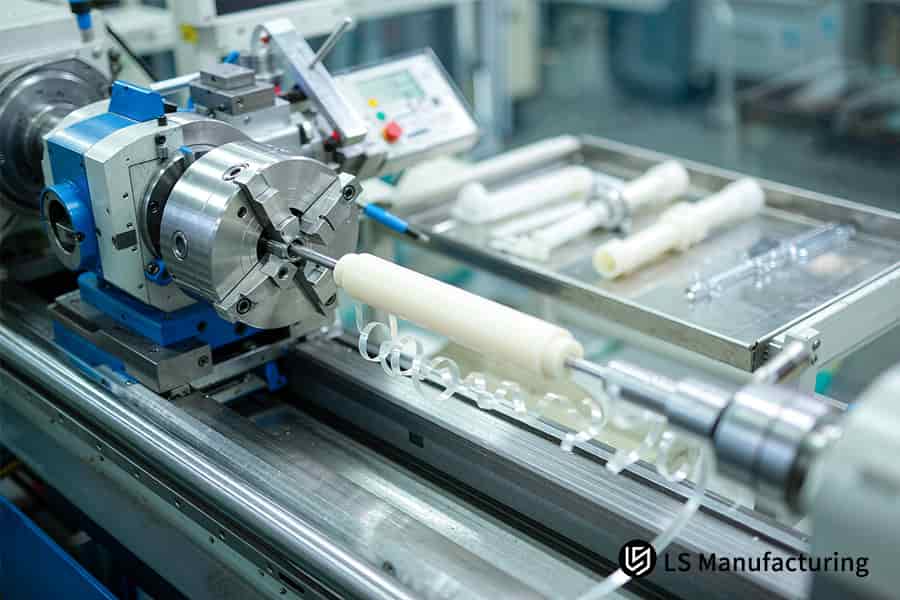
Figure 1: CNC machining forms UHMWPE rod stock into joint replacement liners holding ±0.05 mm for orthopedic use.
Why Do Medical Plastics Deform During Machining Runs?
Medical plastic deformation in CNC machining is the occurrence of size drift following de-clamping due to the phenomenon of thermal expansion in combination with asymmetric stress relief. Heat of friction expands the area being machined as the part remains fixed on the machine table, meaning that measurement during the process is not the same as in the free state. Engineers asking why medical plastics deform during machining must handle heat and stress together. Heat of frictional shear brings the temperature of the area close to its softening temperature, while the rate of polymer growth per unit increase in temperature is much higher than that of aluminum alloy, according to the Machinery's Handbook (30th Edition, Machining Plastics section).
Figure 2 plots the interface temperature of a PEEK blank as frictional shear heat crosses the 143 °C glass transition point, and shows the springback that follows unclamping.
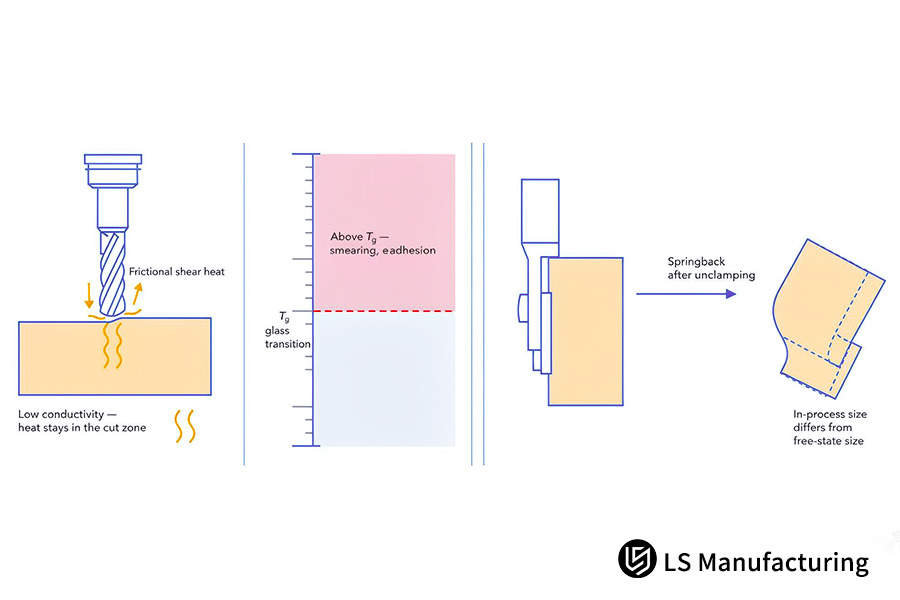
Figure 2: Schematic of frictional shear heat crossing the Tg threshold and causing springback after unclamping in medical plastic CNC machining.
Interface temperature, not machine torque, sets the achievable band — which is why heat control starts at the cut rather than at the inspection bench.
Metal chips lose energy from shedding; this energy remains within the resin blank because polymer conductivity is only a fraction of metal conductivity. CTE (coefficient of thermal expansion, expansion per degree controlling spring-back) changes the heat to movement. CNC thin wall machining is most affected by this issue because these structures do not have enough rigidity to fight against the stress that gets freed.
Extruded stock is produced stressed from the process itself, and irregular cutting destroys the equilibrium of internal stresses. Annealing is a soak procedure at or just above Tg, when frozen segments acquire mobility to relax. Guides on how to machine medical plastics treat annealing as an early step, and a missed one results in warped roughed blanks beyond the standard ±0.05 mm range.
The intuitive assumption is that a tight clamp holds everything still. Clamping forces store up elastic energy, which changes the geometry more when the stored energy is released than the cutting forces. CNC plastic machining common defects such as melt smear and spring back relate directly to stored energy. You can verify that stress relief, not clamping force, drives the drift: measure the same datum after roughing, anneal the blank, then measure it again.
CNC machining tolerance standards have been described for metals, but not for polymers because the heat keeps changing the geometry after measurement. Bore tolerance in polymer parts is set by two variables: interface temperature and residual stress release.
Three Points to Remember
- Strain energy (heat) generates size change in most polymers.
- Anneal between roughing and finishing removes stored strain.
- Clamping creates strain energy, which appears after release.
Related keywords: why medical plastics deform during machining / CNC plastic machining common defects / how to machine medical plastics
Source: Machinery's Handbook (30th edition, Machining Plastics chapter).
How To Machine Medical Plastics Without Defect Risks?
Defectless medical plastic machining is a process of low-heat machining with positive-rake single-flute tools and oil-free air stream. Positive rake geometry and a chip lifting hook angle make resin shear rather than scrape. Cutting force stays low and how to machine medical plastics without burrs begins with tool shape. Medical grade plastics for CNC machining are machined at a speed range of 60 m/min to 90 m/min, according to the same project batch (n>800). A feed per tooth is kept in the range of 0.05 mm/z to 0.12 mm/z, eliminating swirl marks and leaving sealing faces with surface finish from Ra (arithmetic mean roughness of the machined surface) 0.4 μm to Ra 0.8 μm.
Tool Geometry Behind Low Cutting Force
Chips have a wider evacuation pathway in single flute tools, and re-cut chips reheat the resin. Rake angle determines whether a cutter cuts or scrapes, and a negative rake angle causes the cutter to rub against resin to cause heat generation. CNC machining tolerance standards such as ISO 2768-1:1989 (general tolerances for linear dimensions) define metal measurement in CNC machines.
Three Common Defects And Their Fixes
CNC plastic machining common defects are divided into three categories:
- Burrs tearing: Sharp single flutes with chip loads greater than 0.05 mm/z prevent fiber pulling.
- Heat softening adherence: Oil-free air spray with Vc (cutting speed — the surface speed of the tool against the resin) less than 90 m/min keeps the edges cold.
- Clamp creep: Wider soft clamps distribute the load and prevent resin flow laterally.
Cooling Route And One Common Misread
Oil-free air carries heat and clears chips, while emulsion coolant risks residue in polymer pores. In discussions of how CNC machining works, use of coolant is presented as an option.
Lower spindle speed feels like a cooler cut. It is not: at low spindle speed with a light feed, the edge rubs more than it cuts. A controlled shop trial cut POM MT at three feed rates — 0.05, 0.08 and 0.12 mm/z — holding spindle speed constant holding spindle speed constant. Burr height fell from 0.18 mm to 0.06 mm as feed rose.
Points Worth Keeping
- Shape of the tool determines cutting force, while oil-free air determines cutting temperature.
- Resin in semi-crystalline form works well for low-heat cutting, while extruded resin that is unannealed will not.
Related keywords: medical plastic cutting parameters / polymer milling burr control / resin CNC machining heat limits
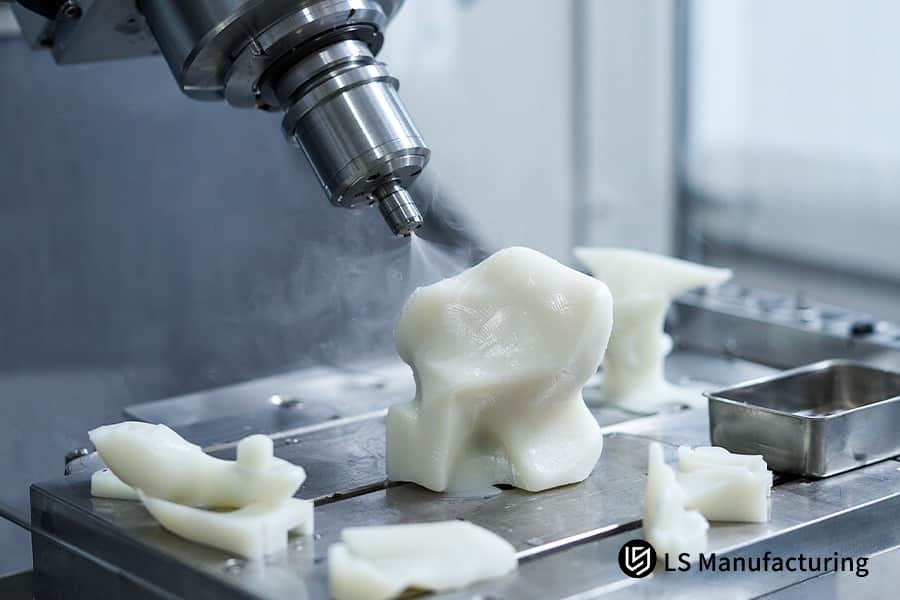
Figure 3: A CNC machining spindle finishes a medical polymer trial sleeve holding a fine surface for implant use.
Which Machining Standards Govern Medical Grade Parts?
Medical plastic machining standards form a controlled chain based on ISO 13485:2016 manufacturing process and ISO 2768-m general tolerances. ISO 13485:2016 deals with manufacturing process controls through clause 7.5.1, and ISO 2768-m, being the medium general tolerances of ISO 2768-1:1989, is the framework for undimensioned size. Oil-free compressed air and deionized water replace metalworking fluid. Emulsified oils may form cross-links in the plastic matrix and resist cleaning. The novices in medical devices who want to know what is medical grade plastic encounter an established process, not a single certificate. Tolerance bands on polymer drawings should therefore name the annealing step, not just the numeric limit.
ISO 13485 medical CNC machining cells keep polymer stock apart from metal lines as resins absorb liquids more quickly than metals. Types of medical plastics for machining share one shop rule: dedicated tooling, dedicated chip removal, and coolant-free machining.
- Coolant system: oil-free compressed air or certified deionized water is used instead of emulsion because residues don’t rinse well.
- Machine cleanliness: dedicated polymer cells prevent metal particles from entering soft plastic parts.
- Fit testing: gauging and CMM measurement ensure mechanical fit, whereas resin purity documents contain toxicology data.
Novices think that if ISO 13485 certification solves process controls, then one certificate covers toxicology of long-term implants as well. Quality audits control the process, but toxicology depends on purity of resin material provided upfront, which machining documents cannot provide. Procurement personnel could easily check the separation by comparing a resin lot number with machining traveler. CNC machining DFM rules list purity documentation as drawing release. In other words, a certificate controls process, whereas raw material documentation controls biology.
What to Take Away
- ISO 13485:2016 regulates production control; ISO 2768-m regulates undimensioned sizes.
- Fluidless cutting conserves resin; dedicated cells conserve surfaces.
- Toxicology comes from raw material data, not from machining certifications.
Related keywords: medical plastic machining standards / medical CNC machining compliance rules / polymer cutting cleanliness requirements
Source citation: Clause 7.5.1 of ISO 13485:2016 "Medical devices - Quality management systems".
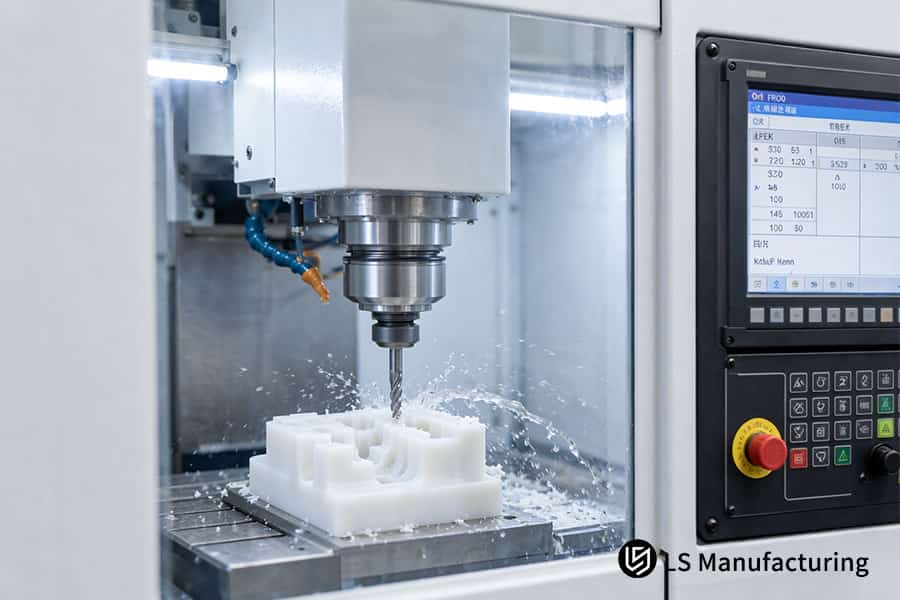
Figure 4: CNC machining cuts a PEEK surgical guide blank and clears chips for orthopedic trial fit.
How PEEK Polymer Works In Practice: A Surgical Positioning Guide Example From LS Manufacturing
PEEK CNC machining is an annealed process that keeps the surgical guide bores within ±0.008 mm fit tolerance. A surgical device team requested minimally invasive knee osteotomy positioning guides that are machined out of medical-grade PEEK barstock. Orthopedic applications of this kind use polymer guides with locating bores that accept guide pins without clearance. Mating faces held a surface roughness of Ra 0.4 – 0.8 μm, the band required for a sealing face; the dimensional tolerance was a separate ±0.008 mm spec.
Application Scenario
Minimally invasive knee surgery pushes requirements for osteotomy guides made out of PEEK blanks. Bore diameters have to accommodate guide pins without clearance; the tolerances required by the drawings correspond to precision fit bands. Novices frequently inquire into the reasons for why polymer blanks are deformed after cutting.
Principle in Practice
Annealing homogenization at 160 °C is located above PEEK’s glass transition temperature, which provides enough mobility for frozen pieces before further processing. The LS Manufacturing machining-data table for semi-crystalline resins lists soak times by wall thickness. Low soaking temperature leaves strain locked, causing deformation of blanks after removal from the clamp.
Measured Results
Unregulated initial runs exceeded the usual ±0.05 mm range; annealed parts retained dimensions. Scrap on the first unannealed lot ran 16%; after the soak step was inserted between roughing and finishing it fell to 4%. Principle takeaway: bore tolerance in PEEK is set by residual stress release, not by the machine's positioning accuracy. Any spec that names a tolerance without naming the annealing step is incomplete.
In the absence of annealing, springback occurred and bores exceeded the ±0.05 mm range.
Data source: LS Manufacturing 2025–2026 medical minimally invasive test log (Project #MED-2026-804, sample size >800).

FAQs
1. What is the main difference between PEEK and UHMWPE during CNC cutting?
ISO 10993-1:2018 certified implant resins for PEEK and UHMWPE, yet PEEK chips shatter and UHMWPE chips deform. In the same project batch (number of samples >800), PEEK can be within ±0.008 mm, whereas UHMWPE is close to ±0.05 mm. Subsequently, junior engineers match their resin selection based on assembly stiffness rather than thinking that one ISO certified polymer performs similarly.
2. Why is liquid coolant often avoided when milling medical plastics?
Emulsion coolant is a metal working fluid, in which the oil phase penetrates the free volume (gaps between molecules of polymer chains). Clause 7.5.1 of ISO 13485:2016 covers clean production control, LS Manufacturing employs oil-free air blast at the same speed range. Quality auditors review coolant reports prior to biological testing, as the residue cannot be detected visually.
3. Can CNC machined plastics completely replace metal implants?
PEEK has comparable stiffness to cortical bone but titanium alloys have superior fatigue strength under cyclic loads according to ASM Handbook Vol.2 (nonferrous alloy information). In evaluating design reviewers compare the risk class of the medical device under consideration and the cyclic load before selecting a polymer; in simpler terms the load case determines the material type.
4. What is the most critical factor to prevent thin-wall plastic deformation?
Stress-relief annealing soaks extruded stock at or just above Tg. LS Manufacturing heats their blanks to 160 °C followed by machining of thin wall using symmetrical shallow passes using oil free air. The standard explanation of how CNC machining works does not mention annealing. ISO 13485:2016 clause 7.5.1 requires soak cycles to be audited, so the omission matters.
Summary
Medical polymer machining balances biological inertness of the device with accuracy of fitting, which require different sets of controls. Thermal properties of the resin and optimal cutting parameters define the possible size range, and annealing determines whether a blank is able to keep the range when removed from clamps. In simple terms, beginner engineers determine where polymers are suitable for manufacturing and where metals or molding should be used instead.
Medical Polymer Machining Insights Desk
Process inquiries regarding feed windows, minimal wall thickness, and deformation under sterilization conditions can be asked through three contacts. Medical polymers data are available on LS Manufacturing knowledge base at https://lsrpf.com/, while e-mail info@lsrpf.com and telephone +86 185 6675 9667 are used for sketch checking. Beginner engineers will compare the sizes from the drawing with the benchmark data.
Further Reading: Precision Medical CNC Machining Services & Device Solutions