English



Custom sheet metal fabrication quote is the main tool for cost management in sheet metal R&D projects. They help resolve the issue of R&D and procurement teams not being able to estimate hidden mold and engineering costs accurately at the beginning of the project, enabling you to minimize the increase in unnecessary secondary expenditures by as much as 68%. Typically, most R&D engineers are only concerned with individual material and processing costs when obtaining quotes. So, they overlook hidden costs like non-standard tools and progressive die NREs, which then cause them to suffer from the major budget overruns when the final bill is delivered.
These article reveals the way specification mistakes can be avoided, and negotiation tactics can be developed starting from the basic manufacturing rationale of material properties, bending limits, and layout optimization, without negatively impacting product performance, but still assisting in achieving cost control.
Sheet Metal Fabrication Service Cost Overview: Key Pitfalls
| Influencing Dimensions | Standard Design Scheme | Optimized Design Scheme | Unit Cost Reduction |
| Bending Radius | Non-standard Custom R-value | Matching Standard R0.5/1.0/1.5mm | 15%-25% |
| Forming Process | Progressive Hard Die Stamping | Laser + Standard Turret Stamping Combination | 30%-60% |
| Feature Spacing | Less than 4 times sheet thickness | Greater than or equal to 4 times sheet thickness | 10%-20% |
| Contract Terms | No Mold Lifecycle Agreement | Locked Mold Trial Numbers and Cycle | 8%-15% |
Key Takeaways:
- The bending radius should be compatible with the material elongation to prevent hardening cracking and repeated mold repair costs.
- For multi-feature sheet metal components, choose CNC laser + CNC flash stamping combination over hard die NRE (Non-Renewable Equipment) to avoid high cost.
- By including the tooling lifecycle and number of mold trial/revisions in the contract, you are protecting yourself against unexpected costs.
Why Choose LS Manufacturing for Transparent Custom Sheet Metal Fabrication Quotes?
Opting for a pricing service provider who openly shares their pricing and is equipped with full-process Design for Metal Fabrication (DFM) capabilities can be your key to the avoidance of more than 90% of the hidden sheet metal tooling costs that usually remain undisclosed in the design stage.
The ISO 9001:2015 standard for quality management systems unambiguously states that:"Organizations must implement a control mechanism that can be traced for the cost and quality of products throughout the entire process."
So, we have developed our pricing model based on this requirement, thoroughly analyzing every cost component, and without any hidden fees.
From our direct involvement in a three-month cross-sector pricing benchmarking exercise, data shows that on average, around 22% of the quoted price by traditional suppliers is made up of hidden costs, whereas our break-down pricing method restricts this figure to only about 2%.
Our technical personnel gets involved in DFM consultation at the earliest stage of the design, so they are able to efficiently locate the risks coming from non-standard mold, we have a standard mold repository available which accounts for over 95% of all the sheet metal requirements of the civilian and industrial sectors, so usually, there is no need for a special mold, our end-to-end digitized production system allows us to run flexible production, which in turn sharply cuts the costs of mold changes and machine adjustments.
Transparent pricing is the foundation of a stable supply chain, and proactive DFM (Design for Manufacturing) audits help you control costs from the source. You can download our "Sheet Metal Pricing Pitfalls Avoidance White Paper" to systematically understand cost control points throughout the entire process.

Why Do Non-Standard Bend Radii Inflate Your Custom Sheet Metal Fabrication Quote?
If you have non-standard bending radii, the processing plant will have to make special upper punches and lower V-groove dies, which will cost you directly with non-standard tooling procurement and machine tool debugging, resulting in your custom sheet metal fabrication quote costing you hundreds of dollars.
Springback Coefficients and Minimum Bending Radii of Different Materials
When it comes to metal materials, their properties such as elongation rate can vary a lot. This results in the springback amount and risk of cracking during bending differ vastly and they usually impact quite directly the final outcome of sheet metal fabrication tolerance control. A design R-value lesser than the material's minimum bending radius leads to the occurrence of micro-cracks on the outer side of the sheet metal that are so tiny that it's difficult to recognize them with the naked eye.
These micro-cracks so cause the failure of the product and also necessitate multiple trial moldings. You can expect the related costs to be directly included in the custom sheet metal fabrication quote.
Common Sheet Metal Material Bending Parameter Comparison Table
| Material Grade | Supply Status | Recommended Minimum Inner Radius (t is sheet thickness) | Springback Compensation Angle | Recommended V-groove Width |
| Al 5052-H32 | H32 | 0.8t | 1°-2° | 6t |
| SUS304 | Annealed | 1.0t | 3°-5° | 8t |
| SECC | Cold Rolled | 0.5t | 0.5°-1° | 6t |
| Q235 | Hot Rolled | 0.6t | 1°-1.5° | 7t |
This can be simply explained as bending a wire. If the radius of a bend is very small, the wire will easily break. Selecting a standard radius that corresponds to the characteristics of the material is a way of ensuring that the structure is strong and that special cutting tools are not needed. Sheet metal design that conforms to material properties can fundamentally reduce subsequent process adjustments and cost losses.
Key Points for Cost Reduction via Standard Die Selection
If you follow these points for selecting and proper sheet metal fabrication tooling matching, you can efficiently prevent additional sheet metal tooling costs:
- Consider factory-stocked bending dies with radii of 0.5, 1.0, and 1.5 millimeters as your first option. They will help you avoid the expenses of buying and debugging custom tools.
- Ensure that the ratio of the V-groove width to the sheet thickness is typically kept in the range of V=6t to V=8t. This will help in making the bending stable and/or will reduce the number of trial runs.
- While designing, at the same time review the die library of the supplier and plan to convert non-standard R values to corresponding standard values. Such a minor change often means a saving of hundreds of dollars in tooling costs.
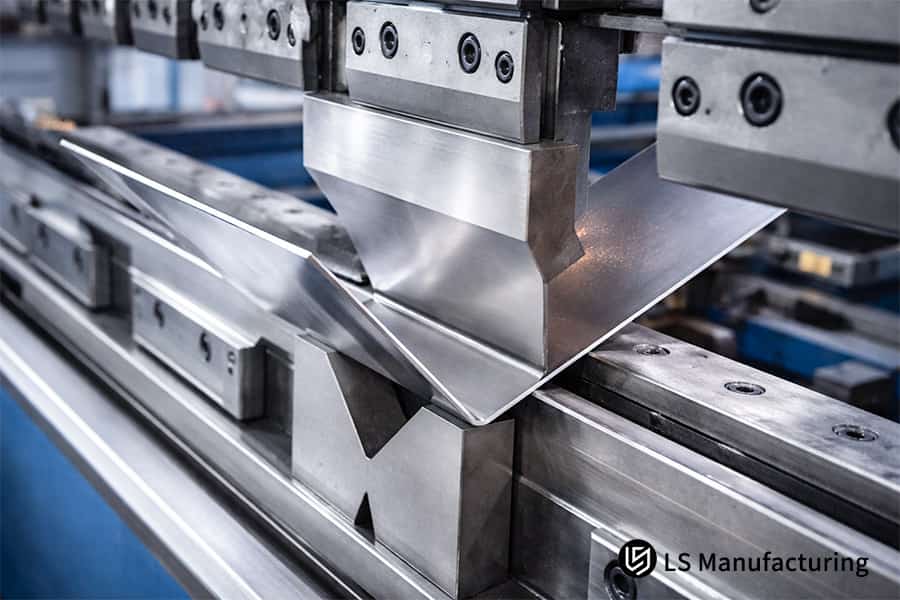
Figure 1: Precision CNC press brake bending a stainless steel sheet with a non-standard radius.
Can CNC Punching Achieve Low-Cost Sheet Metal Fabrication Without Progressive Dies?
The core path to achieve low-cost sheet metal fabrication without the need for progressive die investment is to disassemble the complex internal hole array and external contour into high-precision fiber laser cutting and CNC turret punch standard mold combination step punching.
Cost Comparison for Medium-Batch Production
When the scale of production reaches medium scale, more than 1000 units but less than 5000 units, the advantages of the laser cutting without molds combined with turret punching process are much greater than those of traditional progressive die solutions, resulting in a very high level of sheet metal fabrication efficiency. This process is a perfect fit for low-cost sheet metal fabrication targets during the R&D iteration cycle phase.
Cost Comparison of Two Processes for 1000-5000 Piece Batches
| Cost Dimensions | Progressive Die Stamping Process | Laser + Turret Stamping Combination Process | Cost Difference Rate |
| Pre-production Die NRE | $3500-$5000 | $0 | -100% |
| Single Piece Processing Fee | $1.2-$1.8 | $2.0-$2.8 | +40% |
| Delivery Cycle | 20-25 days | 5-8 days | -70% |
| Design Modification Cost | $800-$1500/time | $50-$200/time | -90% |
Applicable Boundaries and Optimization Methods of the Combination Process
Mastering these boundaries and methods can reduce sheet metal fabrication lead time while eliminating significant sheet metal tooling cost, ensuring overall processing efficiency:
- We choose fiber laser cutting for the sheet metal outer contour and irregular holes. The control of cutting accuracy can be kept within 0.05mm, so it is possible to comply with any complex contour requirements.
- Standard round holes, countersunk holes, and other regular features are machined using standard turret punch molds, achieving an accuracy of 0.1mm and higher processing efficiency.
- For forming features like louvers and drawn bosses, standard punches at stations A, B, and C are preferred to avoid designing non-standard formed parts with excessive strokes.
Mold-free combination processes are the optimal solution for small-to-medium batch R&D projects and are the core advantage of our sheet metal fabrication service. They can significantly shorten the cycle time and control upfront investment. You can contact our process engineers for a free calculation of the cost reduction for your product when switching to this process.
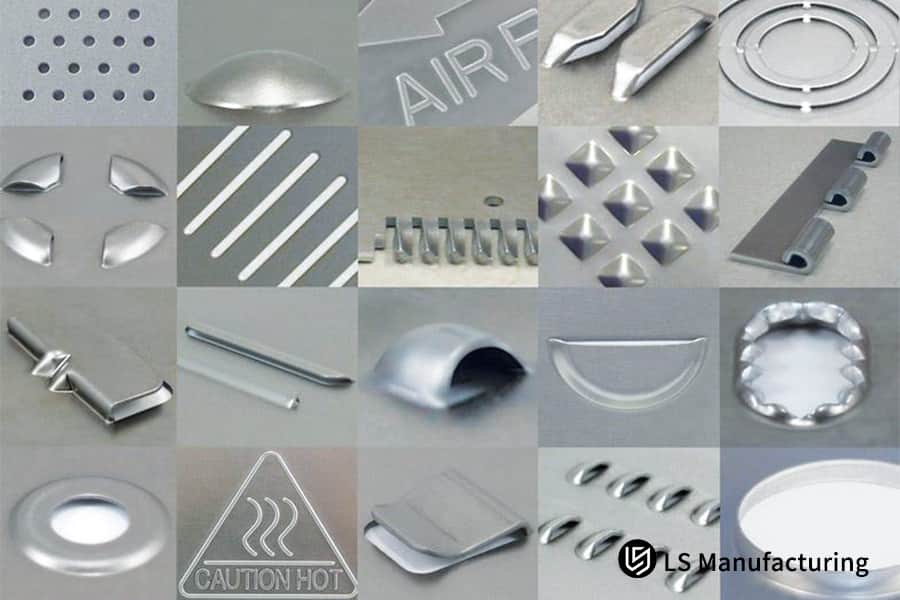
Figure 2: Various sheet metal parts including perforated grids and embossed text.
Which Sheet Metal Design Boundaries Prevent Custom Tooling Mold Fabrication Charges?
The technical basis for steering clear of pruchasing non-standard forming tools and multi-stations interferences in sheet metal design is strictly following the edge safety clearance boundaries for louvers, dead edges, and closely spaced drawn bosses.
Geometric Manufacturing Limits of Core Forming Features
Indirectly, sheet metal design that is pushing the geometric manufacturing limits will definitely require factories to invest in non-standard forming tools, which results in higher implementation costs for structural optimization of sheet metal fabrication. Besides, multi-station interference can happen which will increase the tooling mold fabrication cost much.
Geometric Limit Parameters of Commonly Used Sheet Metal Forming Features
| Feature Type | Geometric Parameter | Recommended Minimum Value | Consequences of Substandard Design |
| Villar | Height to Sheet Thickness Ratio H/t | ≥2t | Forming cracking, custom mold required |
| Villar | Distance to Bending Line | ≥3t+R | Bending deformation, secondary correction required |
| Extension Boss | Spacing between Adjacent Bosses | ≥4t | Material flow interference, feature deformation |
| Closed Dead Edge | Flattening Gap | ≥0.5t | Mold breakage, increased mold repair costs |
Cost Optimization Logic of Dead Edge Design
Dead edges can be categorized as open dead edges, teardrop dead edges, and closed dead edges. Open and teardrop-shaped dead edges can be achieved in one step using standard molds, whereas completely flattened closed dead edges need the work of special molds for multiple pressings. This is one of the main reasons for cost overruns in tooling mold fabrication.
To put it simply, closed dead edges are like completely flattening and folding paper, requiring additional tools and processes, open dead edges with a small gap can be done with conventional tools at a lower cost.
- In the case no sealing is required, it is better to use open or teardrop-shaped dead edges which are processed directly from standard molds.
- When closed dead edges are a must, provide a gap of at least 0.5t to prevent the damage that may be caused by the hard contact between the mold and the die.
- To avoid material flow during punch pressing that can affect deformation of adjacent features, the distance between tension bosses should be 4 times at least the sheet thickness.
Adhering to these design rules will not only keep the sheet metal fabrication quality but also massively raise the sheet metal prototyping service first-pass yield while cutting down the extra costs of mold modifications that have to be done repeatedly.
How Do Scheduled Batch Releases Reduce Costs For On-Demand Sheet Metal Service Users?
Batch release scheduling enables processing plants to optimize the consolidation of tooling during a single flexible mold change really reducing the high costs of repeated machine tool setup and adjustment for the users of on-demand sheet metal service.
Cost-Sharing Principle of Batch Production Scheduling
Every individual order in the on-demand sheet metal service shall be charged setup fees for the machine tool setup and adjustment. Merging different parts of the same material and thickness into the same batch, by the way, of optimizing sheet metal fabrication batch production scheduling, the setup cost can be shared, which will have a significant impact on reducing the cost per part.
In a nutshell, this is similar to group buying, where the unit price is naturally lowered because the cost of starting up the machine is jointly shared by producing similar orders together in a batch. The batch-merging production model is a great way to get low-cost sheet metal fabrication.
Implementation Methods for Flexible Procurement
- Align monthly demand plans beforehand so that factories can schedule orders of sheet metal with the same specifications into the same production batch for sharing mold changeover expenses.
- Different parts of the same product can use a single thickness of sheet and material to merge processing steps and reduce mold changeovers.
- Negotiate with service providers on a modular mold changeover mechanism to batch similar tooling without incurring additional machine adjustment charges.
Such measures will help in the reduction of sheet metal fabrication costs, as a result, a better batch allocation price can be obtained in the final custom sheet metal fabrication quote, leading to further procurement cost compression.
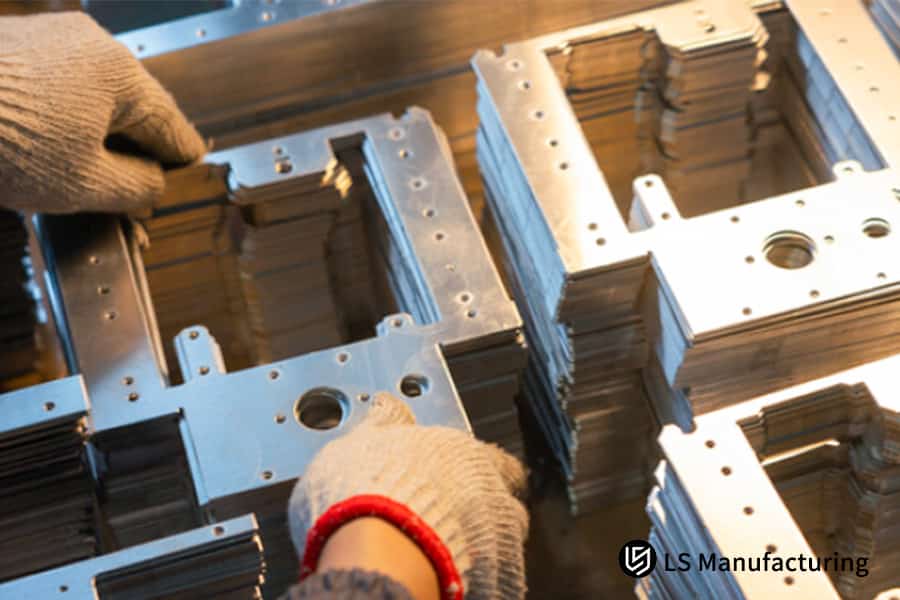
Figure 3: Gloved hands sorting through a stack of freshly fabricated sheet metal parts.
Why Do Intricate Hardware Features Multiply Your Internal Sheet Metal Tooling Cost?
One of the main reasons for increasing the sheet metal tooling cost is the introduction of non-standard fastener hole diameters, custom-made press-fit nut posts, or highly localized stretching structures that are deeply incised in drawings.
Cost Differences in Formed Hardware Comparison
Simply forces standard shaping punches to stretch and tap the sheet metal allow a direct reduction of sheet metal tooling cost and at the same time much furbishing fabrication assembly reliability of the sheet metal. Besides being much more stable in their processing, they are also less costly and less risky, than special blind hole riveting solutions. This latter process needs custom punches and fixtures that increase costs 2-3 times and besides it is risky since the rivet can be loosened or even break.
Design Boundary Specifications for Press-fit Parts
Optimize sheet metal design and ensure sheet metal fabrication precision control simply by following these boundary specifications to avoid quite a few hidden mold costs:
- To prevent the bending tensile stress of the press-fit hole from causing deformation, the distance from the centerline of the press-fit portion to the bending edge is required to satisfy L≥2t + Rbend.
- It is always better to use standard-specification press-fit nuts and studs that can be directly matched to the factory's readily available press-fit dies.
- If there is the need for threaded connections, the priority should be given to direct sheet metal stretching and tapping processes, leaving customized blind-hole riveting solutions still behind.
Standardized hardware feature design is one of the core optimization directions of our sheet metal fabrication service, helping you eliminate significant hidden mold costs and improve product mass production stability. You can submit your design drawings to receive a free hardware selection optimization plan.
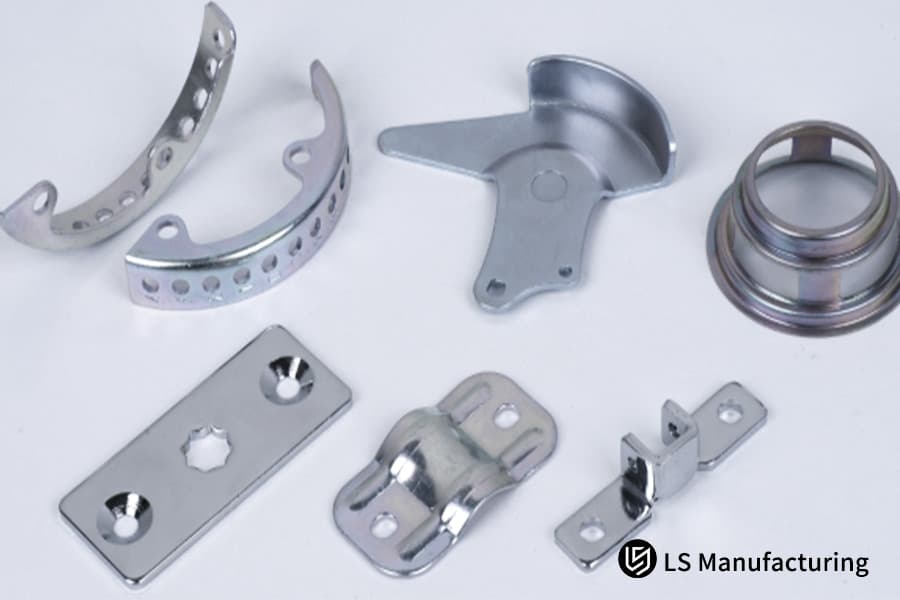
Figure 4: Various custom sheet metal brackets, clasps, and hardware components.
Do Cumulative Tolerance Stack-Ups Generate Extra Sheet Metal Prototyping Service Fees?
Disregarding tolerance accumulation and 3D unfolding correction in multiple consecutive bends results in significant deviations in the first batch of samples, this way generating extra sheet metal prototyping service fee.
How the Accumulation of Tolerance Works
Sheet metal bending K-factor and bending compensation value vary from one machine tool (e.g. Amada and Trumpf) and material to another. For a part with four or more consecutive bends, each size with a linear tolerance of 0.1mm, the cumulative tolerance will be geometrically magnified, which will directly impact the accuracy of metal fabricating sheet dimensions. In the end, this may result in the part being non-assembleable and a great increase in repeated sheet metal prototyping service costs.
It can be compared to a relay race: small errors of each leg cause large errors of the final leg, the more the bends, the bigger the cumulative dimensional deviation will be. Properly distributing tolerances in the sheet metal design is the main condition for controlling cumulative deviations.
Ways to Approach Tolerance Optimization
Non-standardized tolerance marking for precision sheet metal components is a frequent problem that may bring about the extra cost resulting from repeated prototyping and mold modifications.
The international standard ISO 2768-1 specifies that: "Dimensions without stated tolerances shall be treated per the respective tolerance class for general tolerances."
In the DFM (Design for Manufacturing) review stage, we check this standard together with the client for their helping tolerance marking schemes' optimization and saving them from unnecessary cost losses.
- With the aid of the GD&T geometric tolerance datum selection method, stringent requirements for precision are mostly focused on mating hole locations, with tolerances being maintained at 0.1mm.
- The tolerances of non-mating surface types of both appearance and structure are eased to 0.3mm or 0.5mm, which cuts down the development expenses of mass production calibration tooling.
- During the design stage, the machine tool K-factor parameters are reached that allow constant confirmation, this way making it easy for the correction of unfolded dimensions to be implemented at an early stage and decreasing the chances of deviation in the first prototype.
Through the means of tolerance-controlled sheet metal fabrication process optimization, low-cost sheet metal fabrication can be carried out without compromising the functionality, i.e. balancing standards of precision and manufacturing costs.
Which Hidden Technical Parameters In An RFQ Secure An Accurate Sheet Metal Fabrication Service Contract?
Clarifying core process parameters and requiring transparent itemized quotations during the RFQ inquiry stage is the strongest defense line to ensure the accuracy and no markup of sheet metal fabrication service contracts.
RFQ Must Clearly Define Core Process Parameters
If you want quotation from sheet metal fabrication service providers to be accurate and clear, it is necessary to clearly define these core process parameters, mostly those which are related to sheet metal fabrication surface treatments:
- Deburring Standards: Specify whether roller polishing, vibratory grinding, or manual wire drawing is used to avoid later price increases under the guise of "upgrading deburring processes."
- Electroplating Parameters: Specify the plating material and thickness, for example, zinc-iron alloy electroplating ≥8μm, and specify salt spray resistance test requirements of 72h or 96h.
- Powder Coating Parameters: Specify the Pantone/RAL color code and that the outer coating hardness must meet the 2H pencil hardness standard.
Risk mitigation and contract terms
One of the reasons why suppliers charge for small-batch orders is that they usually do not include the batch minimum fees few in the contracts. To prevent sheet metal fabrication risks along the whole process, you must first properly represent and fix the costs of post-processing, testing, and other auxiliary processes in the initial contract so that you can avoid post custom sheet metal fabrication quote increases.
In general, clear RFQ parameters and fixed contract terms comprise the key ways to stop inevitable price increases later, in particular if they are combined with on-demand sheet metal service scenarios. We offer our standardized RFQ template which you can obtain and apply directly to secure a quote throughout the entire process.
How Did LS Manufacturing eliminate initial NRE Charges In a Medical Robotics Chassis Project
Witness how LS Manufacturing carved out a cosmetic sample with zero mold fees through a fully digital process chain and a mold-free high-speed prototyping solution and also delivered it within 8 days to an international high-end medical robot customer.
Customer Challenge
Research & Development team of a medical exoskeleton robot was in a rush for prototyping a batch of SUS304 chassis frame supports with high strength, and plate wall thickness was 2.5mm. The parts have 35 irregularly shaped heat dissipation holes and 5 high-precision tensile countersunk holes and multiple continuous curved bends. The product is in the early modification stage, so the single batch requirement is only 60 pieces.
Traditional supply chains often take custom sheet metal fabrication quotes with delivery times as long as 25 days which is not feasible to meet the rapid R&D pace required for sheet metal fabrication sample delivery. Besides, they charge an additional $4,500 progressive die prototyping fee (Tooling NRE) that the R&D iteration schedule of the client is not matching and project budget is greatly exceeded.
LS Manufacturing Solution
- Our senior DFM engineering team is able to intervene within 2 hours of receiving the drawings. They recalculate the K-factor and bending compensation values by using a self-developed intelligent unfolding algorithm via a fully integrated sheet metal fabrication digital workflow. A fully digital fiber laser cutting system that replaces the original hard punching die will be set up, which will completely eliminate the development cost of the punching die.
- At the same time, our CNC multi-axis high-precision bending machine is equipped with a fully automatic real-time online springback detection system and uses a standard segmented combination tool to flexibly process 35 features. So the need for customized tooling will be eliminated and all tooling mold fabrication costs will be avoided.
- At the post-processing stage, we have our in-house fully automated ultrasonic cleaning line and dehydroembrittlement electroplating process to provide end-to-end one-stop closed-loop processing, that means the need for outsourcing is eliminated. This is what makes our sheet metal fabrication service stand out.
Results and Value
In the end, we not only produced but also delivered 60 sheets within 8 days. We kept the tolerance of the key hole spacing within 0.02mm, which is one of the strictest sheet metal fabrication precision guarantees that even meet fully medical-grade manufacturing requirements.
Successfully completing this project has helped us gather extremely valuable experience in medical-grade precision parts required by the sheet metal prototyping service. The tooling NRE cost was $0 for this project, thereby not only that the client's overall procurement costs were cut by 68%, but also that LS Manufacturing's technical strength in flexible sheet metal manufacturing was fully validated.
Based on what we have learned from this project, for small-batch sheet metal parts at the R&D stage, the overall advantages of using mold-free flexible processes are quite a bit more than those of traditional hard-mold solutions.
A rapid prototyping solution with zero mold costs can significantly reduce your R&D cycle and upfront investment. You can upload your 3D drawings now to get a customized sheet metal processing quote with no hidden fees.

FAQs
Q1: What are the main reasons for sheet metal tooling cost changes between prototype and production phases?
Mainly changes in costs result from where the processes move from individual prototypes to high volume production. A change in design from a single-piece laser cutting to mass stamping can be a culprit of additional charges if material layout utilization, mold selection, and double-bending tooling are not done the right way beforehand since these will require minimum post-processing costs which would have to be paid.
Q2: How can I refine my sheet metal design to avoid mold making charges when using stamping dies?
You are allowed to coordinate the bending radius with the standard thicknesses of sheet metal at very early stages of product development, make sure that the distance between the forming bosses inside is at least 4 times the thickness of the sheet, consider first those features which can be processed by standard station punches, or simply upload your drawings for customized optimization solutions and accurate quotations.
Q3: Which one is more cost-effective - opting for laser cutting, or getting a hard tooling mold for a mid-volume production?
In fact, for small and medium size batches with less than 5000 pcs, laser + turret stamping, which takes no molds, involves no upfront NRE (Non-Renewable Equipment) investment, and offers flexible modification options, is the best cost-effectiveness solution. However, the marginal cost advantage of hard-die stamping only gets visible at a production volume well above 20,000 pieces per item.
Q4: What aluminum and stainless steel gauges should I choose for cheap sheet metal fabrication?
We would advise you to go for standard sheet thicknesses that have extensive global supply chains like 1.0mm, 1.5mm, and 2.0mm for 5052 aluminum alloy, or 1.2mm and 1.5mm for SUS304 stainless steel. This will not only save you from the increased cost of custom thicknesses but will also save you from delivery delays.
Q5: How can LS Manufacturing so accurately control precision tolerances without having to include precision check fixture charges?
We use top-of-the-line fully imported precision CNC bending machines, and inspection instruments like coordinate measuring machines and blue light optical scanning to do real-time calibration. We employ digital inspection instead of rigid physical fixtures, so we don't have to rely on charging high inspection fixture development fees.
Q6: Can you change the product drawings of welded assemblies that are presumed to be expensive into sheet metal bent components which are cheaper?
Absolutely. Our DFM team uses 3D flattening segmentation techniques to convert multi-piece welded components into a single-piece, continuously bent structure, which not only saves the time for grinding and shaping but also gets rid of costly arc welding weld inspection costs, while enhancing structural stability.
Q7: Do secondary surface treatments like powder coating cause standard minimum batch setup fees at your location?
Not at all. We operate self-spraying and passivation production lines fully integrated, through them, we carry out smart parallel processing of orders of the same colors and process, sharing start-up and pre-processing costs, so basically, we are able to get rid of minimum order requirements imposed by traditional outsourcing with rapid prototyping of small to medium batches.
Q8: How safe is my secret CAD file data after uploading it to an on-demand sheet metal service platform?
Our information security protection system complies completely with ISO 27001. We use military-grade encryption on all 3D CAD drawings. Also, a two-way confidentiality agreement is signed before quoting and sample provision, so that time and process wise, your data is safe from beginning to the end.
Summary
You can avoid hidden molds and secondary engineering costs related to custom sheet metal parts without compromising product functionality. The core approach is to integrate the factory-standard tooling boundaries, material springback characteristics, and flexible forming strategies right from the design stage. Plus the notion of optimizing welding and assembly into full-plate bending, providing clear RFQ parameters and contract terms enables both R&D and procurement teams to focus their budgets on core function improvements, so fundamentally controlling the risk of hidden premiums in the supply chain.
How about no more hidden supplier charges throwing off your project budget? Send your 3D sheet metal design drawings (.STEP,.IGES,.SLDPRT formats supported) to LS Manufacturing today. Our senior hardware DFM engineering specialists will get back to you with a detailed manufacturability analysis report within 24 hours, with an absolutely transparent, no-hiddentooling-fees customized sheet metal processing quotation for free.
📞Tel: +86 185 6675 9667
📧Email: info@lsrpf.com
🌐Website:https://lsrpf.com/
Disclaimer
The contents of this page are for informational purposes only.LS Manufacturing servicesThere are no representations or warranties, express or implied, as to the accuracy, completeness or validity of the information. It should not be inferred that a third-party supplier or manufacturer will provide performance parameters, geometric tolerances, specific design characteristics, material quality and type or workmanship through the LS Manufacturing network. It's the buyer's responsibility.Require partsquotation Identify specific requirements for these sections.Please contact us for more information.
LS Manufacturing Team
LS Manufacturing is an industry-leading company. Focus on custom manufacturing solutions. We have over 20 years of experience with over 5,000 customers, and we focus on high precisionCNC machining,Sheet metal manufacturing, 3D printing,Injection molding.Metal stamping,and other one-stop manufacturing services.
Our factory is equipped with over 100 state-of-the-art 5-axis machining centers, ISO 9001:2015 certified. We provide fast, efficient and high-quality manufacturing solutions to customers in more than 150 countries around the world. Whether it is small volume production or large-scale customization, we can meet your needs with the fastest delivery within 24 hours. choose LS Manufacturing. This means selection efficiency, quality and professionalism.
To learn more, visit our website:www.lsrpf.com