English



Precision sheet metal fabrication cost is the key factor to evaluate the economics of custom sheet metal parts processing. It solves the problem of R & D and procurement teams not having a quantitative view of tolerance premiums. Smaller tolerances from ±0.2mm to ±0.05mm will most likely raise the unit cost by more than 40%, whereas well-thought-out reforms can result in a 35% cost reduction. In precision sheet metal processing, the R & D department often, without adequate information, go for very strict tolerance standards to guarantee assembly, which is what results in cost overruns and delays in delivery.
Unfortunately, most industry standards only give general, high-level recommendations and do not explain deeper reasons such as bending springback and heat-affected zone compensation. So this article will first unravel the cost domino effects of tolerances and processes then, suggest optimized solutions based on actual site parameters.
Precision Sheet Metal Fabrication Cost: Key Conclusions Overview
| Tolerance Grade | Typical Process Route | Unit Cost Increase | Delivery Cycle Multiple | Applicable Scenarios |
| Standard Grade (±0.2~0.5mm) | Ordinary Laser Cutting + CNC Bending | Baseline Value | 1x | General Chassis, Non-Matching Structural Parts |
| Precision Grade (±0.1~0.2mm) | Compensated Laser Cutting + Closed-Loop Bending | +15%~25% | 1.2~1.5x | Ordinary Assembly and Positioning Parts |
| Ultra-Precision Grade (±0.05~0.1mm) | Slow Precision Cutting + Springback Correction Bending + First Piece Full Inspection | +40%~60% | 1.8~2.2x | Sealed Fit, High-Precision Mounting Surfaces |
| Micron Grade (within ±0.05mm) | Sheet Metal Forming + Secondary CNC Milling + CMM Inspection | +120% or more | 2.5x or more | Aerospace, Medical Core Components |
Key Takeaways
- If you reduce the tolerance from the standard ±0.2 mm to a very tight ±0.05 mm, the time to perform laser cutting compensation and bending correction will be doubled. As a result, the cost of producing one unit will increase by more than 40%.
- One of the main factors that contribute to hidden scrap rates in precision bending is springback variation. If advanced 3D optical CMM inspection is implemented, the per-unit quality control cost will increase.
- High-rigidity and high-demand parts should be processed through a laser forming and precision secondary machining combination to optimize the overall BOM cost while still satisfying the assembly accuracy requirements.
Why Rely On The Precision Of LS Manufacturing’s Sheet Metal Fabrication Service For Price Quotations?
LS Manufacturing has calculated their quotations by breaking down all the production steps, so we are able to pinpoint the real cost hidden behind the tolerances and exclude the risk of being charged extra after winning a bid with a very low price.
As my comprehensive three-month cross-process benchmarking and testing, most manufacturer's quotations only count the times for the basic material cutting and bending and leave out the machine setup time losses, scrap allocation, and quality control costs resulting from the tightening of tolerances. Often the final price is settled to be more than 30% higher than the original quote.
IATF 16949:2016 states that organizations shall require suppliers to have the necessary process capabilities to supply products and services.
To comply with this standard, our quotation system instantly and automatically finds the process capability requirements for the respective tolerance grade, thereby changing each process limitation into a measurable cost component. This way, the difference between the quote and the final production cost is kept within 5%. We have witnessed, for example, the use of accurate tolerance cost breakdown early on in a European Tier 1 new energy vehicle on-board charger housing project saved the client almost $120,000 in mass production rework costs.
The transparency of tolerance pricing directly determines the controllability of the project budget. You can send your existing part drawings to our engineering email address, and we will provide you with a free cost calculation for precision sheet metal fabrication under different tolerance levels, quickly pinpointing the optimal balance between performance and cost.

Why Precision Sheet Metal Fabrication Cost Escalates Exponentially With Tight Tolerances?
The precision sheet metal fabrication cost goes up with tighter tolerance requirements. High precision requirements mean that the equipment has to slow down the feed speed, and the anisotropy of materials resulting in excessive bending springback directly lead to longer production times and higher equipment wear and tear costs.
Some cutting speed limitations imposed by fiber laser
- Even lower rate of work: To keep the width of the HAZ under control, if the tolerance range is reduced to 0.05mm, the workpiece moving speed of the fiber laser cutting machine has to be decreased by 35%, which will be a direct step towards making the precision sheet metal manufacturing cost more high.
- Laser focusing will have to be readjusted regularly: Various thickness and types of metals will require focus readjusting frequently, and because of this the workpiece set up time for one batch goes up from 5 minutes to 20 minutes. This type of cost behavior is quite common in the thick plate sheet metal fabrication process.
- Using more Auxiliary Gas: Slow-cut mode needs higher purity nitrogen to protect the cutting surface, which means the gas cost increases by 25% for each sheet.
Newly introduced delays in CNC Bending Machine Setup
- Pressure Parameter Fine-tuning: Yield strength varies by 5% between different batches of sheet metal. With tight tolerance requirement being a condition, each batch undergoes several trial bends to adjust the punch pressure, which is In fact the main reason why tight tolerance fabrication service is pricier than usual.
- Angle Closed-Loop Correction: A sampling with an angle meter, for checking and correcting compensation parameters, has to be done every 10 bends, this way affecting directly CNC bent sheet metal fabrication output per unit.
- First Piece Full Inspection Procedure: For batches where tight tolerances are specified, the first piece is subjected to a comprehensive dimensional check before the start of mass production, so the normal prep time is multiplied by three. This trend has been proven time and time again in tolerance vs cost sheet metal analyses.
Tightening of tolerances is the core process reason for the exponential increase in precision sheet metal fabrication costs. If you want to quickly understand the relationship between tolerances and costs, you can download industry white papers for free and systematically understand the process cost reduction logic.
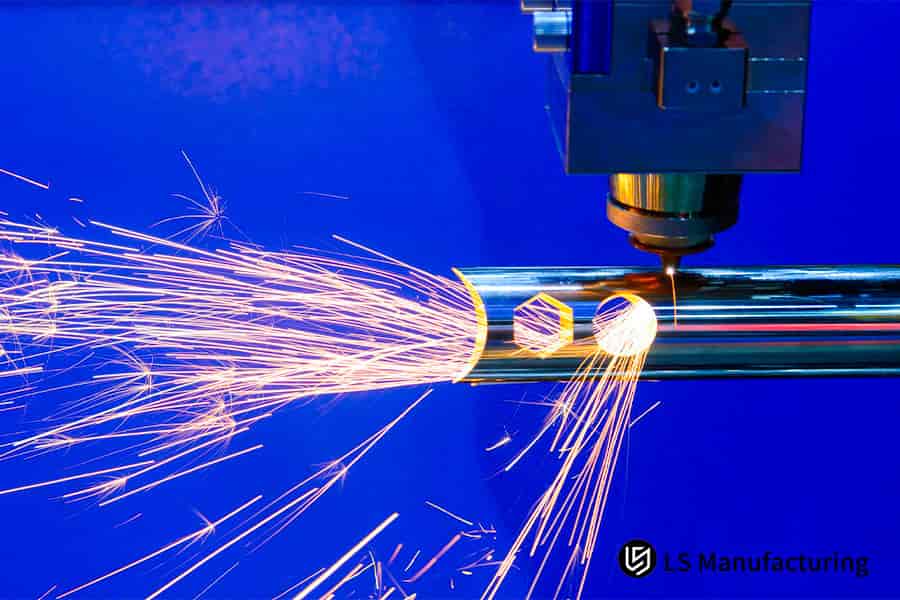
Figure 1: CNC laser cutting machine in action with sparks flying.
How Does Sheet Metal Fabrication Service Define Engineering Standard Versus Ultra Precision Tolerances?
In the sheet metal fabrication service, standard tolerance levels are generally held within the range of 0.2 mm and 0.4 mm. But, achieving ultra-precision tolerances at 0.1 mm and below needs the use of advanced multi-axis CNC bending machines that are combined with closed-loop angle measurement systems. With each increment of 0.05 mm in the tightening of the tolerance, the level of difficulty involved in both the selection of machinery and the implementation of quality control measures increases.
Metric Quantification Standards for General Tolerance Grades
ISO 2768-1:1989 delineates: Unspecified tolerances are categorized into four levels of precision, which may be applied to metal cutting and forming parts.
- Standard Grade (ISO 2768-m): This corresponds to linear dimensional tolerances in the range of 0.2~0.5 mm. This is the standard precision grade for common sheet metal fabrication service and is appropriate for sheet metal structural parts that do not require mating.
- Fine Grade (ISO 2768-f): This corresponds to linear dimensional tolerances in the range of 0.1~0.2 mm. Apart from being a precision grade that is also frequently used during the prototyping phase of sheet metal fabrication, this level is deemed suitable for parts that are to be located during assembly.
- Ultra-fine grade: This corresponds to linear dimensional tolerances of 0.05~0.1mm. If the tolerances are not listed, it is necessary to specify process requirements.
Comparison of Process Configurations for Different Tolerance Levels
| Tolerance Level | Blanking Equipment | Bending Equipment | Springback Control Methods | Quality Control Tools | Mass Production Scrap Rate |
| Standard Level | Ordinary Fiber Laser Cutting Machine | Ordinary CNC Bending Machine | Experience Compensation | Vernier Calipers, Angle Gauges | ≤3% |
| Precision Level | Laser Cutting Machine with Knife Compensation | Bending Machine with Angle Encoder | Automatic Database Compensation | 2D Image Analyzer | ≤1.5% |
| Ultra-Precision Level | Low-Speed Precision Laser Cutting Machine | Closed-Loop Control Multi-Axis Bending Machine | Part-by-Part Bending Correction | Portable Coordinate Measuring Machine | ≤0.8% |
| Micron-Level | Laser Precision Cutting + Stamping Finishing | Servo Precision Bending Machine + Finishing Die | Finishing Stamping and Shaping | Constant Temperature Coordinate Measuring Machine (CMM) Measurement Room | ≤0.3% |
Updating equipment throughout the whole supply chain forms the basis for a reliable supply of micron-level accuracy in high precision sheet metal service. Such schematic tiered costing is very obvious in the tolerance vs cost sheet metal quantitative analysis and is mostly pronounced in the automotive sheet metal fabrication sector.
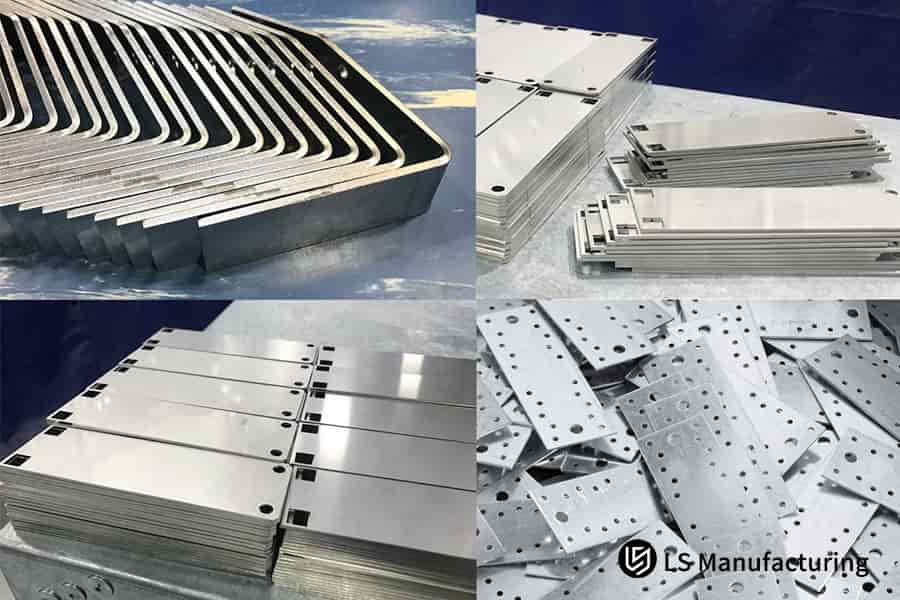
Figure 2: Stacked sheet metal parts with various holes and cutouts.
Why Material Elastic Recovery And Thermal Distortion Drive Up Your Custom Part Unit Price?
The main factor that drives up the custom part unit price is the bending springback caused by the anisotropic elasticity of metal materials, and the localized deformation due to thermal stress by the high energy density input of lasers. If the precision limits are exceeded, one has to go for correction processes that involve more time and effort.
Cost Transmission Mechanism of Bending Springback
- Springback Fluctuation Range: The springback angle after bending AL6061-T6 aluminum alloy is 2°/5°, while the springback angle of the 304 stainless steel can reach 3°/7°. The stronger (harder) the material, the bigger the springback change, and because of this the increase of the custom part unit price becomes easier.
- Process Downgrade Costs: If the drawing specifies a bending angle tolerance of ±0.5°, free bending has to be excluded and correction bending or finishing stamping will be used instead, resulting in production efficiency gets decreased by 60%. The effect of springback is highly noticeable in the aluminum sheet metal fabrication.
- Scrap Loss: Pieces that have too much springback are directly considered as material loss. When tolerances are very close, the scrap cost per unit is multiplied by 2-3 times.
Additional Costs of Laser Hot Deformation Processes
- Residual Stress Relief: Large-area thin sheets are laser cut and the localized high temperatures cause uneven residual stress in the material, leading to bending deformation and deviations in flatness. This is an element of the precision sheet metal fabrication cost that remains hidden.
- Leveling Process Cost: Parts that are deformed have to undergo roll forging leveling or stress-relief annealing, with a single process costing about $0.8~$1.5 per piece.
- Secondary Clamping Loss: After leveling, parts need to be re-positioned and inspected, which results in longer turnaround time and a higher possibility of making positioning mistakes. This kind of additional process is not included in the basic sheet metal part pricing guide, such losses are more in thin gauge sheet metal fabrication.
How Does Precision Fabrication Quote Service Evaluate Secondary Machining For Ultra Tight Tolerances?
Within the precision fabrication quote service, if the hole spacing tolerance or flatness is restricted to ±0.02 mm, the system will automatically categorize the component as a hybrid process of sheet metal forming + secondary precision machining. Achieving this degree of precision solely by sheet metal processing is not reliable; CNC machining added will increase the cost several times.
Direct Costs of Secondary Machining
- Custom Tooling Costs: Special clamping fixtures have to be designed to hold the formed sheet metal parts during the machining processes. One set of tooling costs about $1500-$3000 USD. This is an indispensable cost item for precision fabrication quote service that are assessing parts with extremely tight tolerances.
- CNC Machining Time Costs: Vertical milling centers (VMCs) charged about $60-$80 USD per hour. Operations like milling and reaming take around 8-15 minutes per part.
- Tool Wear: High-precision reamers, boring tools, etc. are very costly and need to be changed after every 1000 parts are machined. The cost per part is estimated to be around $0.3-$0.8 USD. The cost of tool wear in stainless steel sheet metal fabrication is higher than that of ordinary carbon steel.
The formula for calculating the unit cost of hybrid processes is: Hybrid Process Unit Price = Sheet Metal Forming Unit Price + Machining Time Cost × Unit Labor Hours + Tooling Cost / Batch Output + Turnover and Scrap Cost Allocated.
| Cost Items | Pure Sheet Metal Process (±0.1mm) | Hybrid Process (±0.02mm) | Unit Cost Increase |
| Skimming and Forming Time | $2.5/piece | $2.5/piece | 0% |
| Secondary Machining Time | $0/piece | $10/piece | - |
| Tooling Allocation Fee | $0.2/piece | $1.8/piece | +800% |
| Quality Control and Inspection Fee | $0.3/piece | $1.2/piece | +300% |
| Scrap Allocation Fee | $0.4/piece | $1.5/piece | +275% |
| Total | $3.4/piece | $17/piece | +400% |
Hidden Costs of Multi-Process Flow
- Process Turnover Cost: For parts to move around, they have to be transferred back and forth between the sheet metal and machining departments. The cost per unit turnover is about $0.5, which forms part of the total cost of high precision sheet metal service.
- Cumulative Tolerance Risk: Errors in positioning after several processes are added up, reaching a scrap rate that is more than 3 times that of a single process when cumulative tolerances are beyond the allowable limits. The risk is even greater for low volume sheet metal fabrication.
- Extended Delivery Cycle: Hybrid processes lead to the creation of two production schedules resulting in an overall delivery cycle time that can be 1.5 to 2 times longer than that of pure sheet metal processes, because of this increasing the custom part unit price even more.
Ultra-tight tolerances require secondary CNC machining, and hidden costs such as tooling, working hours, and quality control increase significantly, driving up the overall customization unit price. If you have high-precision processing requirements, you can submit drawings to calculate accurate precision fabrication quote service cost details for free.
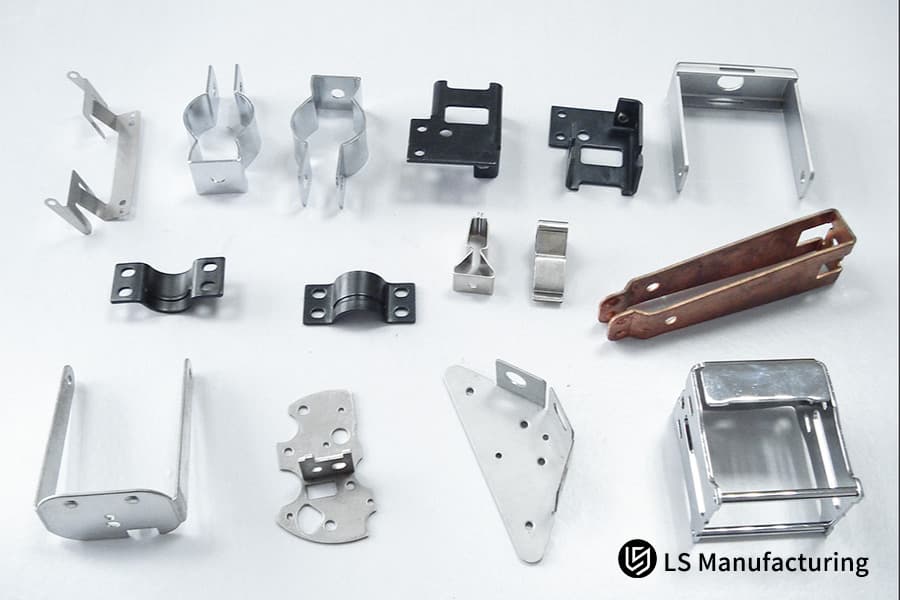
Figure 3: Various sheet metal brackets and components on white background.
How Can Engineers Optimize Laser Kerf Compensation To Lower Sheet Metal Part Pricing Guide Layouts?
Optimizing laser cutting kerf compensation and process overflow groove design can significantly reduce material discharge loss, directly lower the material base cost in the sheet metal part pricing guide, and increase sheet utilization from 72% to 88%, making it the fastest cost reduction method.
The Physical Characteristics of a Thick Plate Kerf Taper
- Kerf Taper Causes: A fiber laser cutting thick plates will cause the kerf to be wider at the top and narrower at the bottom, because of this, a taper is formed. The greater the plate thickness, the more obvious the taper. This is a small point that conventional sheet metal part pricing guide hardly ever mention.
- Tolerance Impact: The more the kerf perpendicularity tolerance of ±0.03mm is mandated, the more the focal point has to be lowered and the cutting speed reduced, leading to an increment of the processing time per sheet by 40%.
- Method of Compensation: By pre-setting kerf compensation values in the layout software, it is possible to offset kerf width deviations without a reduction in the cutting speed. This is a widespread practice for bettering material utilization in heavy gauge sheet metal fabrication.
LS Manufacturing Labs' exclusive research indicates that, when a 6mm thick carbon steel is being cut, a 0.02mm reduction in kerf taper can be achieved by lowering the focal point position by 0.5mm. Yet, the cutting speed will need to be reduced by 12%.
Material layout optimizing techniques:
- Shared edge cutting design: This is a cost-reduction process where adjacent parts share a single kerf, thereby reducing the number of kerfs and the spacing between sheets leading to improved utilization and shortened processing time. Mature sheet metal fabrication service, which is the main part of sheet metal industry, have been using this method.
- Sharp corner process holes: This design allows that process holes are drilled in advance at the sharp corners of parts to avoid localized overheating and burning, which in turn helps reducing the subsequent trimming processes. Also, custom sheet metal fabrication frequently uses this type of design to drawing optimization.
- Safety spacing optimization: A further improvement in the sheet metal utilization can be made by decreasing the safety spacing between parts from 10mm to 3-5mm, which in turn, may directly lead to a reduction in the material percentage of precision sheet metal fabrication cost.
What Practical Design For Manufacturing Tips Balance Tight Tolerance Fabrication Service And Bottom Line Cost?
By adopting a manufacturing feasibility design approach, applying very fine tolerances only to the core mating surfaces and simultaneously loosening the tolerances on free-floating surfaces, the company could effectively reconcile the extremely tight tolerance fabrication service with the minimum company's BOM cost. This might cause a more than 20% reduction of the overall running costs without any deterioration of the assembly performances.
Dimension Chain Annotation Optimization Rules:
- Unified Datum Surface: Declaring only one datum surface and shifting from progressive continuous annotation to center datum annotation results in the elimination of cumulative bending deviations, which is a fundamental design principle for reducing tight tolerance fabrication service costs.
- Graded Tolerance Allocation: Tight tolerances are maintained on the core mating surfaces, whereas the tolerances on the non-mating and surface appearance surfaces are relaxed up to standard levels to avoid high precision over the entire surface area.
- Dimension Chain Calculation: Assembling feasibility can be ascertained by the method of tolerance superposition analysis, this way avoiding over-design of the parts.
Structural Tolerance-Enclosed Design Methods
- Hole Type Optimization: For the high-density mountbing holes, a through holes + slot holes combination is adopted, which makes use of the structural tolerance feature to accommodate the hole spacing offsets due to bending. Since there is no need to increase the hole position tolerance levels, this directly results in lowering the base price of the sheet metal part pricing guide.
- Bending Margin Control: By employing the minimum safety margin formula L 2t + R, no hole deformation takes place during bending operation. This is a standard design parameter considered in punched sheet metal fabrication.
- Relaxed Tolerances on Non-Locking Surfaces: The tolerances on non-core positioning areas have been loosened from ±0.1mm to ±0.3mm. Since such a change cannot be judged as a functional impact but rather as a cost reduction, this principle has been fully validated in tolerance vs. cost analysis for sheet metal.
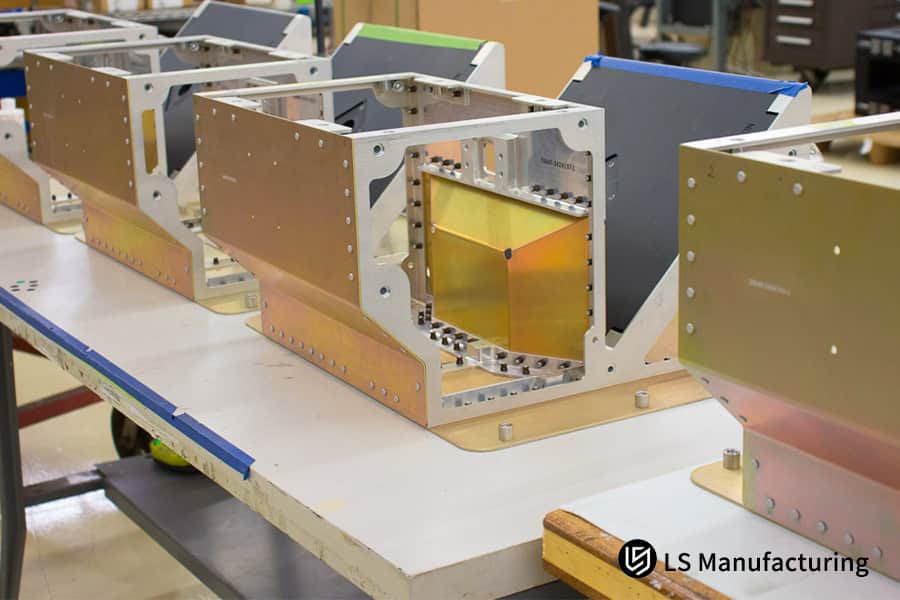
Figure 4: Electronic enclosures and metal boxes in assembly line production.
Why Choosing LS Manufacturing For Precision Fabrication Quote Service Eliminates Hidden Rework Losses?
LS Manufacturing offers an engineering DFM review mechanism and full-process SPC control capabilities that can be used to get precision fabrication quote service. Starting with a well-designed drawing without any unreasonable features will help avoid repeated mold modifications and reduce potential rework and production downtime losses. Hidden rework costs that could have otherwise ranged from 15% to 20% of the total cost can be curtailed to less than 2%, which is a huge reduction in the total lifecycle cost.
Pre-DFM Review Risk Interception Mechanism
- Drawing Compliance Review: It is the core value of a professional precision fabrication quote service to make sure the reasonableness of the tolerances and the process feasibility are checked before quoting and further designs that cannot be implemented through sheet metal processes are identified.
- Forming Simulation Verification: The use of digital simulation software to simulate the forming limits of sheet metal helps to predict cracking and springback risks and, at the same time, reduce the initial trial and error costs of complex sheet metal fabrication.
- Optimization Suggestion Output: Modification solutions for unreasonable designs that help in reducing process difficulty and costs without affecting the functionality are given.
Quality Stability Through Full-Process SPC Control
- Process Capability Management: Key mold process capability index (CPK) 1.33. The statistical process control method keeps a monitoring of the process fluctuations at real time, which helps to reduce scrap rates and so to bring custom part unit price down.
- Intelligent Springback Database: Built-up data of tens of thousands of material springback sets that are automatically matched with compensation parameters, now 1st piece yield exceeding 98%.
- Full-Dimensional Traceability: Dimensional inspection records are kept for each batch of parts, so that the processing parameters at each stage of the production can be traced. Quality problems are located quickly. High precision sheet metal service calls for this control capability and medical-grade sheet metal fabrication calls for even stricter ones.
Case Study: How LS Manufacturing Re-Engineered an EV Power Electronics Inclosure to Save 34% In Custom Part Unit Price
Through structural decomposition and tolerance-based design, the custom part unit price of high-precision parts can be significantly reduced while meeting high-end sealing requirements.
Customer Dilemma
A European Tier 1 supplier for new energy vehicles was developing an aluminum alloy housing for a high-voltage on-board charger (OBC). To ensure proper fit between the water-cooling plate and the IGBT module and achieve IP67 sealing, the flatness tolerance of the 450mm long housing was set at ±0.08mm. Multiple manufacturers failed to meet the tolerance due to thermal stress deformation, resulting in a 38% scrap rate in mass production, months of delivery delays, and custom part unit prices far exceeding the budget. This is a common technical challenge faced by EV component sheet metal fabrication.
LS Manufacturing Solution
After our engineering team intervened, we initiated dimensional chain collaborative optimization. Through multiphysics simulation, we disassembled the part into a welded structure consisting of a general-purpose deep-drawn housing and a core assembly with positioning blocks:
- Non-core assembly surfaces used conventional laser cutting and gas shielded welding, with tolerances relaxed to ±0.3mm, controlling basic processing costs while maintaining the economic efficiency of conventional sheet metal fabrication service.
- Customized pneumatic anti-deformation fixtures are used for the core mating surfaces. After a single clamping in a gantry machining center, local precision milling is performed to stabilize the fit tolerance within ±0.03mm.
- Vibration aging is used after overall welding to eliminate residual stress, preventing deformation during subsequent use and ensuring IP67 sealing performance. This is also one of the core technological points of waterproof sheet metal fabrication.
Results and Value
- Unit procurement cost reduced by 34.2%, saving nearly $180,000 per batch.
- First-time production yield increased from 62% to 99.4%, significantly reducing scrap and fully demonstrating the technical advantages of professional high precision sheet metal service.
- Delivery cycle shortened from 6 weeks to 14 days, ensuring the customer's new project implementation schedule.
- This customer has subsequently entrusted us with the long-term manufacturing of powertrain metal structural components for two core vehicle models.
Through structural splitting and tolerance classification optimization, the custom part unit price can be greatly reduced, taking into account product sealing accuracy and mass production cost-effectiveness. If you have similar precision sheet metal processing needs, you can upload drawings to quickly obtain accurate quotations, and implement efficient cost reduction solutions.

FAQs
Q1. In a precision sheet metal fabrication project, what is the usual range for the increase in total delivery cycle time when a standard part is upgraded from a standard tolerance to a tight tolerance fabrication service?
Conversion to tight tolerance usually increases the total delivery cycle by 1.5 to 2 times because the factory has to add process qualification tests, slow feed machining time will be increased, and there will be a waiting time for testing in the CMM (Cyclic Dimension Machine) temperature-controlled measurement chamber.
Q2. Along which paths will changes in the yield strength of sheet metal work direct the final calculation of precision sheet metal fabrication cost?
Even a 5% change in the sheet metal yield strength will cause the bending springback angle to be different from the design, which means machine operators will have to frequently stop the machine for trial bending adjustments, thereby increasing machine setup labor costs and trial cut scrap losses for each batch.
Q3. Would fiber laser cutting be a viable option to completely replace CNC machining if custom sheet metal parts require a dimensional tolerance of ±0.05 mm?
No, it cannot completely replace it. Due to the presence of a high-energy heat-affected zone, fiber laser cutting typically only guarantees a stable edge accuracy of ±0.1 mm for thick plates. Achieving ±0.05 mm requires additional CNC milling or precision punching processes.
Q4. Why do the low sheet metal part pricing guides of very cheap processors usually result in a drastic increase in the overall assembly failure rate of the customer's final product?
Rather than gaining orders through an open competition, low-end manufacturers rely on offering low prices and unlimited tolerances. They do not practice dimensional chain control during manufacturing, so the errors in parts that exceed standards accumulate. This leads to very expensive rework issues on the customer's assembly line, e.g. inability to align holes, jamming, and leaks.
Q5. How do I check if a manufacturer actually has the delivery capability for high-precision sheet metal services before issuing a formal processing order?
Request two technical confirmations:
- SPC quality control charts and CPK process capability reports for key molds from the production site.
- Find out if they have an internationally accredited temperature-controlled coordinate measuring machine (CMM) center.
Q6. Which materials are the most economical for sheet metal fabrication services for sheet metal parts that require high strength but with moderate tolerances?
SECC cold-rolled electro-galvanized steel sheet or 5052-H32 aluminum alloy are recommended. They possess excellent tensile strength and stable springback prediction, are easy to CNC form at low cost, and do not require expensive advanced heat treatment.
Q7. Will maximizing the inner bending radius R in sheet metal part design contribute to lowering basic processing costs in precision fabrication quoting services?
Definitely. A bigger bending radius R angle can help a lot in avoiding micro-grain tearing and very thin regions at the bending spot. Factories can just rely on regular universal V-shaped bending dies when mass-producing, because of this no need to spend on custom dies for special narrow-radius punches.
Q8. What is the reason LS Manufacturing needs 3D CAD STEP format files to offer accurate and dependable precision fabrication quote service responses?
Due to our 3D smart cost estimation system and engineers take the wall thickness information from the STEP model and compute the material development factor (K-Factor) for each bend automatically, you only have to upload your drawings to get a quote within 24 hours. The quote is completely free of tolerance-related markups so you can be sure of transparency and accuracy.
Summary
Determining the unit cost of precision sheet metal machining depends largely on how each tolerance marking on the drawings impacts the sequence of operations, plus factors like cutting feed, springback correction, and multiprocess machining at the workshop level. Just going for high precision everywhere indiscriminately won't give you performance gains, instead, it will produce high scrap rates, long delivery cycles, and budget overruns. If you explore the physical characteristics of materials, redesign the dimension chain, and use DFM (Design for Manufacturing) for cost-cutting, then assembly functionality will be guaranteed and procurement costs will be kept at a reasonable level.
Rather than endlessly changing drawings and sufferingmold scrap costs after product launch due to assembly tolerance conflicts or over-budget, a better way is to get professional manufacturers in the loop from the very first design stage. LS Manufacturing has an experienced B2B engineering team to give, among other things, deep DFM support reviews. Now, send your 3D drawings (can be.STEP or.IGS format) to our official engineering email and get a free tolerance dimensional chain optimization analysis report and also a quick factory direct quote, within 24 hours, turning professional manufacturing processes into the core pillar of your market competitiveness.
📞Tel: +86 185 6675 9667
📧Email: info@lsrpf.com
🌐Website:https://lsrpf.com/
Disclaimer
The contents of this page are for informational purposes only.LS Manufacturing servicesThere are no representations or warranties, express or implied, as to the accuracy, completeness or validity of the information. It should not be inferred that a third-party supplier or manufacturer will provide performance parameters, geometric tolerances, specific design characteristics, material quality and type or workmanship through the LS Manufacturing network. It's the buyer's responsibility.Require partsquotation Identify specific requirements for these sections.Please contact us for more information.
LS Manufacturing Team
LS Manufacturing is an industry-leading company. Focus on custom manufacturing solutions. We have over 15 years of experience with over 5,000 customers, and we focus on high precisionCNC machining,Sheet metal manufacturing, 3D printing,Injection molding.Metal stamping,and other one-stop manufacturing services.
Our factory is equipped with over 100 state-of-the-art 5-axis machining centers, ISO 9001:2015 certified. We provide fast, efficient and high-quality manufacturing solutions to customers in more than 150 countries around the world. Whether it is small volume production or large-scale customization, we can meet your needs with the fastest delivery within 24 hours. choose LS Manufacturing. This means selection efficiency, quality and professionalism.
To learn more, visit our website:www.lsrpf.com