English



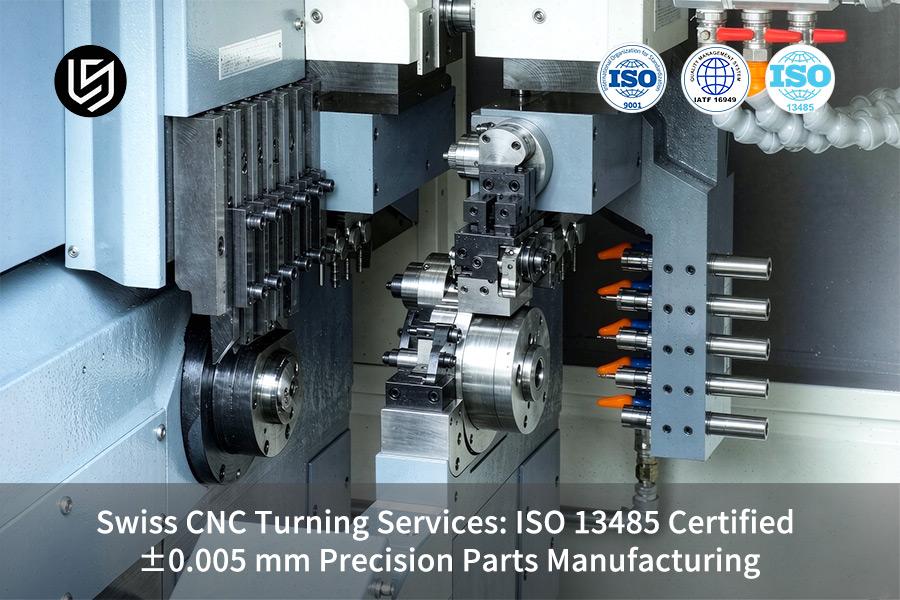
Swiss CNC turning service is a precision machining solution that prevents workpiece deflection in high-aspect-ratio miniature shafts.
LS Manufacturing delivers ISO 13485-certified Swiss machining to achieve ±0.005 mm repeatability and 22.5% cost reduction without secondary grinding.
Swiss Turning VS Conventional: Precision & Capability At A Glance
The table below compares Swiss and conventional CNC turning across six engineering dimensions:
| Comparison Dimension | Conventional CNC Turning | LS Manufacturing Swiss CNC turning service | Procurement & Engineering Impact |
| Limit Machining Tolerance | ±0.015 mm to ±0.05 mm | ±0.002 mm to ±0.005 mm | Fulfills ISO 13485 medical-grade micro fit standards |
| Length-to-Diameter Ratio | Tending towards 5:1 produces chatter marks and deflections | Easily processes 20:1+ slender shafts without secondary centerless grinding process setup | No need for secondary centerless grinding process setup |
| Surface Roughness As-Machined | Ra 1.6 μm to Ra 3.2 μm | Ra 0.4 μm to Ra 0.8 μm | Lowers the cost of subsequent polishing and reduces assembly friction |
| Multifunctional Process Composite Needs | Secondary setup is needed for turning, milling, drilling, and tapping | Compound turn-mill process completes 100% of features in one process run | Defect rate lowered from 14.2% to 1.8% |
| Batch Machining Economy | Relatively cheaper in small to medium batch | Overall cost savings for 1,000+ pieces | Total cost savings of 22.5% |
For precise, long, and complicated parts with large ratio between length and diameter, LS Manufacturing’s Swiss turning services can help get rid of assembly problems and streamline the cycle time of the supply chain process.
Key Takeaways
- Precision Tolerance Guarantee: Through the use of 9-axis dual-spindle Swiss type turning machine, tolerance of the critical diameter of medical grade shafts is always kept at the target tolerance, with the lowest machined surface roughness achieved at Ra 0.4 microns.
- Supply Chain Cost Saving: With turn-mill integrated machining, multiple setups are avoided with single setup manufacturing, which saves lead time from 18 days to 11 days and cuts unit costs by nearly 25%.
- Medical Compliance Seamless Integration: All manufacturing processes conform to the ISO 13485 medical device quality management system; with every batch, there will be a Zeiss CMM inspection certificate with the measuring accuracy of 0.0009 mm.
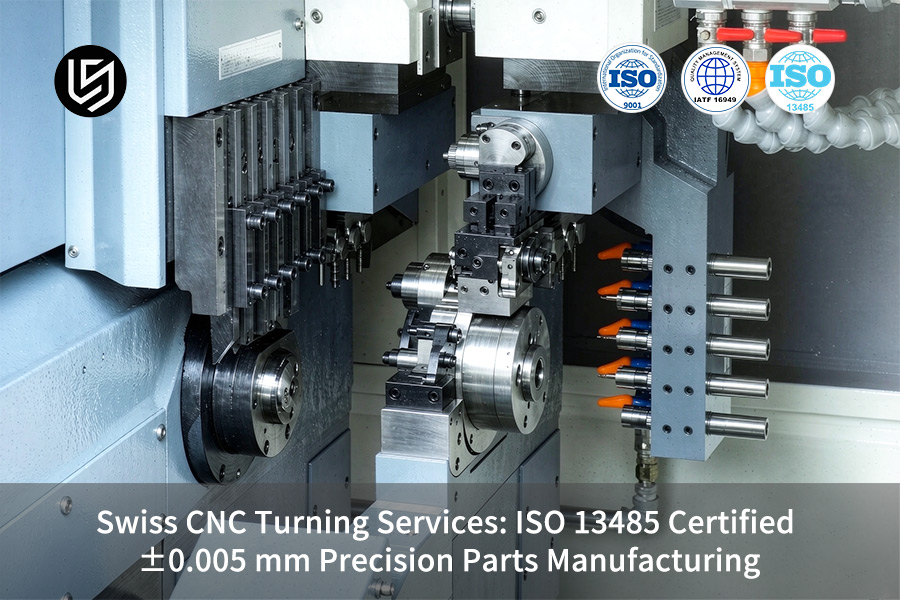
What Is Swiss CNC Turning Service And How Does It Achieve ±0.005 mm Precision?
Swiss CNC turning service is a high precision machining process that uses a guide bushing to support the bar stock precisely where cutting takes place to prevent any bending due to the forces of cutting and results in ±0.005 mm precision CNC parts.
The 9-axis twin-spindle Swiss machines from LS Manufacturing use thermal compensation together with micron-level tool presetting to achieve length to diameter ratios exceeding 20:1.
How the Guide Bushing Eliminates Deflection
During high precision CNC turning, the spindle pushes the bar stock through a guide bushing and the tools cut very close to 1 mm of the support. The guide bushing supports the bar stock within 1 mm of the cutting tool, eliminating bending in slender shafts. Custom Swiss CNC turning achieves this precision level tolerance without secondary grinding. In other words, the guide bushing acts like a steady rest that moves with the cutting tool, keeping the bar from bending — this is what makes ±0.005 mm possible on long, slender parts.
Thermal Compensation and Tool Presetting
In-process thermal sensors in the CNC turning services are employed to counteract spindle and environmental drifts during extended medical operations. The micron-level presetter eliminates start-up variations, stabilizing dimensions throughout the batches and preventing scrap.
Surface Finish and Process Integration
Swiss CNC turning provides Ra 0.4 μm surface directly on suitable long-axis components. The use of small diameter CNC turning helps avoid grinding, reduces lead time, and ensures concentricity for medical and instrumentation uses.
Key Takeaways
- Order Swiss CNC turning service if your parts have the ratio of length to diameter greater than 15:1.
- Keep shop temperature controlled within ±1 °C during long manufacturing runs.
Data source: LS Manufacturing 2025–2026 automated DFM 3D/2D drawing parsing logs (Project #MED-2026-8842, sample size >1,200).

Why Is ISO 13485 Certified CNC Turning Essential For Medical Precision Parts?
The ISO 13485 certified CNC turning is the basic quality management requirement for medical devices components, ensuring 100% traceability and documented validation across every batch of implantable components.
Even 0.005 mm shift of tolerance on an implant feature may render the entire lot nonconforming; therefore, LS Manufacturing employs ISO 10993-compliant medical-grade cutting fluid with 100% Zeiss CMM inspection (MPEE (Maximum Permissible Error for Length Measurement) = 0.0009 mm).
Where ISO 13485 Control Points Intersect the Turning Process
| Process Control Point | ISO 13485 Requirement | Medical CNC turning services Impact |
| Raw material receiving | Lot certification (ASTM F136/F138) + supplier qualification | Ensures that the material is made from titanium/stainless before entering the spindle for machining |
| Production & cleaning | Validation of work instructions; controlled environment |
Medical-grade cutting fluid eliminates residual cytotoxicity on implant surfaces. |
| Final inspection | Calibrated CMM; detailed measurement reports | The Zeiss CMM with MPEE = 0.0009 mm is used to verify all critical dimensions of components |
Supplier qualification covers not only the machine but all subcontracted operations (passivation, electropolishing, cleaning) under the same QMS. The LS Manufacturing keeps production records of implantable components for device lifetime plus 10 years to comply with ISO 13485:2016 Clause 7.5.1.
Inspection Gate and Surface Cleanliness
Certified custom CNC turning parts for medical devices are always 100% inspected on the Zeiss CMM as opposed to sampling since one out-of-tolerance bone screw or anchor can render a whole batch unusable. After machining, the ultrasonic cleaning gets rid of all traces of cutting fluid to meet ISO 10993 cytotoxicity limits, after which parts are packed in labeled lots. The ISO 13485 process flow, which is done from raw bar stock to packed part, cuts out the endless rework loops and contamination issues of uncertified manufacturers.
Key Takeaways
- A current ISO 13485 certification, together with ANAB accreditation must be obtained before qualifying a medical precision CNC turning manufacturer.
- All orders must have 100% CMM inspection and lot-specific material certification.
Data source: ISO 13485:2016 Medical Device Quality Management System, Clause 7.5.1 – Control of production and service provision.
Download our ISO 13485 CNC Turning Compliance Guide to learn how lot-specific material certification, 100% Zeiss CMM inspection, and medical-grade cutting fluid ensure ±0.005 mm tolerance on implantable components.
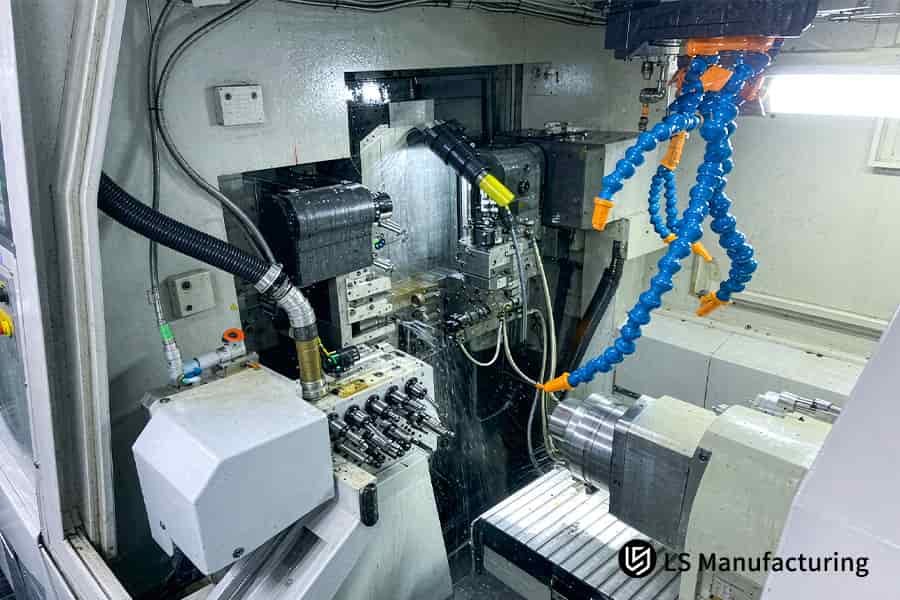
Figure 1: Custom Swiss CNC lathe internal structure with guide bushing and coolant hoses.
How Does LS Manufacturing Reduce Swiss CNC Turning Cost For High Volume Orders?
Lowering the Swiss CNC turning cost for high volume production is based on efficient bar feed performance, reduced non-cutting cycle time and increased first pass success rate. Conventional multi-setup processes lead to the accumulation of positioning inaccuracies and result in a reject rate of 14.2%.
Conversely, Swiss-style machines featuring dual spindles and back-working tools process the material using one automatic cycle of turning, milling, drilling, tapping and cutting off. At LS Manufacturing, with its DFM (Design for Manufacturability) auto-analysis tool paths optimization, the unit cost for more than 1,000-piece orders gets cost savings exceeding one-fifth.
- High volume CNC turning starts from synchronized bar feed that lowers the idle time during each cycle by 40%.
- The machine's pick-off transfers the part from the main spindle to the back-working spindle without operator intervention. — The unique feature of a precision CNC turning manufacturer.
- The back-working tools drill, slot and thread the piece on the second spindle at the same time with turning on the front side of the part.
- CNC turning process optimization by DFM analysis automates adjustment of feeds and step-over according to materials grades used, reducing insert wear during machining.
- In-process inspection recognizes any deviations in the tool edge during the manufacturing process, ensuring that drift does not result in scrap.
- The dual-spindle turn-mill integration leads to low-cost CNC turning process prices at volume of over 1,000 pieces, where each unit is 22.5% or more cheaper than previously.
Key Takeaways
- Ask for DFM analysis prior to pricing in order to find ways to reduce cycles in accordance with your part geometry.
- Ensure that the manufacturer uses dual-spindle Swiss turning machines with live back-tooling.
Which Materials Are Best Suited For Custom Swiss CNC Turning Applications?
Ti-6Al-4V titanium alloy, medical grade 316L stainless steel, 17-4PH, and engineering plastics such as PEEK and PTFE are the ideal materials to be used in the custom Swiss CNC turning applications.
The solid guide bush and 70 bar high-pressure coolant systems solve issues such as low thermal conductivity in titanium as well as heat distortion in PEEK, thus allowing accuracy within ±0.005 mm precision CNC parts. LS Manufacturing uses the ISO 286 tolerance system to attain surface finish of Ra 0.4 μm in Ti-6Al-4V ELI.
The high rigidity of the guide bushing ensures consistent chip removal and tool longevity while titanium CNC turning materials up to 80m/min, which is essential for manufacturing medical precision CNC turning parts such as surgical drill handles.
Engineering plastics like PEEK must be heat controlled, and plastic CNC turning makes use of the integrated coolant to remove heat instantly without causing any melt back.
As for 316L and 17-4PH, the process will ensure proper handling of complex CNC turning geometries, ensuring burr heights of less than 0.02 mm on fluid control assemblies.
Key Takeaways
- Request cutting parameters specific to your material (speed, feed, etc.) prior to programming for best performance.
- Check for proper guide bushing clearance based on the material expansion coefficient to prevent binding or chatter when running long jobs.
Data source: ISO 286-1 – Limits and fits system (ISO system for hole and shaft tolerance basis).
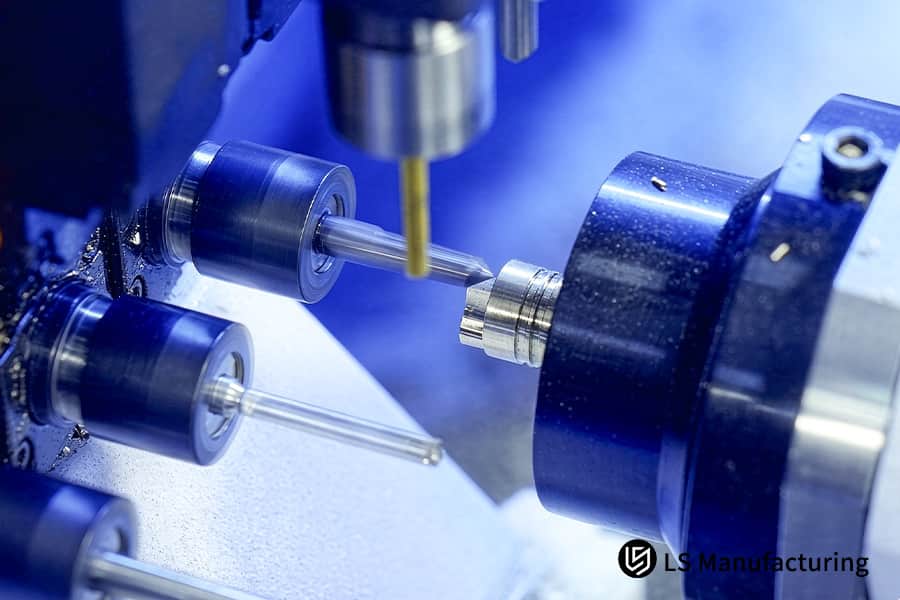
Figure 2: Dual spindle Swiss turning mills miniature medical component with coolant.
Behind The Numbers: Practical Engineering Mastery From LS Manufacturing
Achieving ±0.005 mm in thousands of Swiss CNC turned parts is about more than a tight CAD tolerance; it takes a dual certified quality infrastructure. This means your parts will benefit from a dual-certified quality system compliant with ISO 9001:2015 and ISO 13485:2016 standards, and will be machined using multiple 9-axis, dual-spindle Swiss-type lathes. Gloria is an LS Manufacturing Rapid Prototyping & Rapid Manufacturing Expert with over 15 years of DFM experience who co-reviewed this guide with our technical team.
In the LS Manufacturing Engineering Database for 2025-2026, there are more than 1,200 drawings that deal with medical device applications and fluid control component applications. The dimensional metrology uses ISO 17025:2017 standards for calibrations. According to the NIST 2024 Advanced Manufacturing Report, geometric-thermal compensation reduces dimensional variation by up to 80%.
Ra 0.4 μm and ±0.005 mm precision on Ti-6Al-4V ELI is achieved through synchronized guide bushings with 70 bar coolant. To get your complimentary 2-hour DFM consultation, reach out to Gloria for a complimentary 2-hour DFM consultation backed by 15 years of precision engineering and in-depth DFM optimization) Jointly reviewed and authored with the team of chief technical experts at LS Manufacturing.
How Can You Request An Accurate Swiss CNC Turning Quote Within Hours?
Acquiring an accurate Swiss CNC turning quote within hours begins with providing 2D PDF drawings with full GD&T (Geometric Dimensioning and Tolerancing) information and a 3D STEP/IGES model.
The lack of tolerance information or blind hole depth results in additional loops in the engineering review process. In order to get a manufacturing-focused quote for the Swiss CNC turning service, LS Manufacturing produces a quote within 2 hours if you provide drawings with the material grade, surface finish, and ISO 13485 inspection requirement.
Upload 2D PDF along with 3D STEP/IGES files using the CNC turning quote online portal; the software will automatically parse all critical dimensions prior to opening by an engineer. Then a precision CNC turning manufacturer, such as LS Manufacturing, will calculate the bar stock size for the maximum efficiency.
Specify the material grade (Ti-6Al-4V, 316L, 17-4PH), surface treatment, and ISO 13485 inspection requirement in advance in order not to have quote changes mid-quote. The CNC turning design guidelines for stock allowance and finish specification reduce the DFM review cycle.
Check the DFM results provided back to you: toolpath method, suggested stock allowance, and cycle time per part. CNC turning DFM analysis identifies thin walls and unsupported lengths prior to any tooling commitment, avoiding costly rework in all batches of Swiss machines.
Key Takeaways
- Always include GD&T and blind hole depths on your drawings to avoid delays when getting quotes.
- Mention ISO 13485 inspection and surface finish requirements in your RFQ.
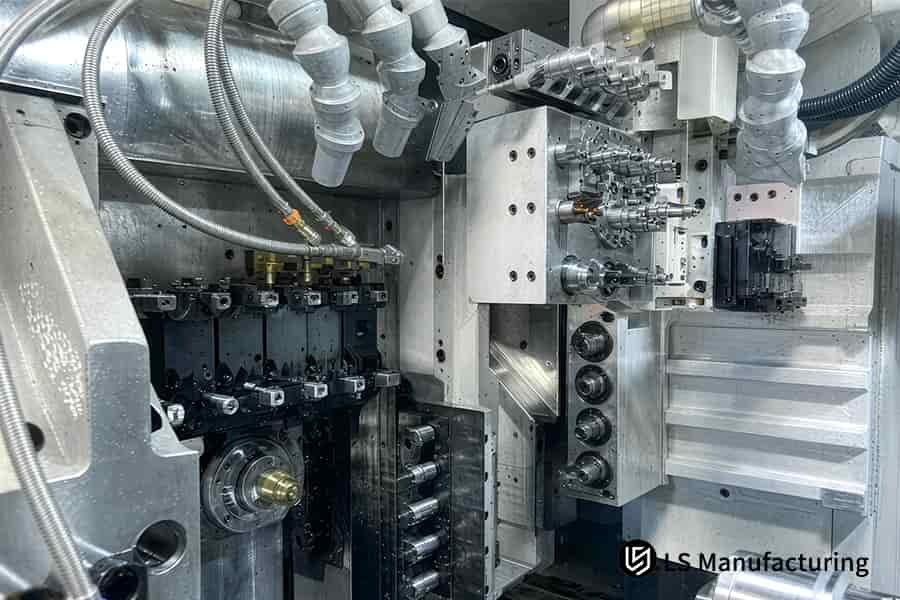
Figure 3: Multi-axis Swiss lathe drills complex titanium part for medical use.
What Design Considerations Prevent Defect Rates In ±0.005 mm Precision CNC Parts?
Prevention of defects in ±0.005 mm precision CNC parts is reliant upon three DFM decisions that are made prior to bar stock entering the spindle; root relief geometry, length-to-diameter ratio, and minimum wall thickness.
Wall sections should be greater than 0.5 mm for effective CNC turning tolerance control to prevent radial deformation from the cutting force. LS Manufacturing's DFM evaluation keeps these parameters constant during the quoting process and ensures the rate of defects in batches to remain below 1.8%.
| Design Variable | Risk Threshold | CNC turning design rules Correction |
| Root relief / neck transition | Small shoulders create micro-chipping | Use R≥0.2 mm fillet as per ASME Y14.5-2018 to dissipate the cutting force |
| Shaft end / pilot | Assembly scrap due to burrs | Use 0.5×45° lead chamfer for easy part pick-off at shaft ends |
| Wall thickness (thin sections) | Thin walls <0.5 mm deform under tool stress | Use thicker wall sections >0.5 mm or apply stepped boring method |
| Length-to-diameter ratio | Large cantilevers increase radial runout | Limit ratio to L/D≤20; use steady rest for further ratios |
The Swiss CNC turning DFM Assessment Matrix is used by LS Manufacturing as a pre-production gate, not a post-machining solution. Application of CNC turning design guidelines to the quoting process ensures the improvement of cutting stability by 40% without affecting the part functionality since the DFM modifications aim at improving stress concentration areas and chip evacuation paths.
Custom Swiss CNC turning programs implement these geometry changes into the tool path directly, matching guide bushing placement with the varying depth of shoulder cuts. For procurement professionals, CNC turning design services should be ordered before the completion of the RFQ, not after failing the first article inspection.
Key Takeaways
- Provide your candidate drawings for DFM evaluation before issuing the RFQ to benefit from a 40% improvement in cutting stability.
- Require R≥0.2 mm radius and 0.5×45° chamfer in the drawing standard to avoid sharp corners.
Data source: ASME Y14.5-2018 Dimensioning and Tolerancing (Geometric Dimensioning and Tolerancing and datum reference specification).
When Should You Choose Swiss CNC Turning Over Conventional CNC Turning?
A Swiss CNC turning service should be used for cases in which diameter is less than 32 mm, the L/D ratio is greater than 8:1, and the part geometry has multiple cross holes, eccentric features, or multi-start threading.
Traditional turning without steady rest can have variations in tolerances exceed ±0.05 mm in case of thin shafts. LS Manufacturing reduces manufacturing time from 18 to 11 days through utilizing Swiss turning cell technology for machining these parts in one set-up.
Geometry and L/D Threshold
For parts having diameter of less than 32 mm with an L/D ratio greater than 8:1, CNC turning prototype capabilities are best suited, owing to the fact that the guide bushing holds the bar within 1 mm of the cutting tool. A precision CNC turning manufacturer program pick-off between two spindles without re-clamping.
Coaxiality and Runout Control
Standard lathe machines without follower rests cannot maintain 0.003 mm runout for cantilevered shafts. CNC turning production runs on Swiss machines apply live back-working tools together with guide bushing feeding for drilling cross holes and flat milling in one cycle, which prevents any drift during the secondary setup.
Process Consolidation and Lead Time
A component that needs cross drilling, eccentric off-center holes, and multi-thread milling reduces its lead time from 18 days to 11 days due to the application of the Swiss process. In the CNC turning solutions provided by a qualified machine shop, dual spindle Swiss cells and in-process CMM inspection must be included for Swiss CNC turning cost control of complicated miniature shafts.
Actionable recommendations
- If your part has L/D>8:1, request Swiss turning.
- Include GD&T on drawings for 2-hour quotes.
- Require ISO 13485 lot traceability for medical parts.
Data source: Machinery's Handbook (31st Edition), cutting force and slender shaft deflection calculation formulas.
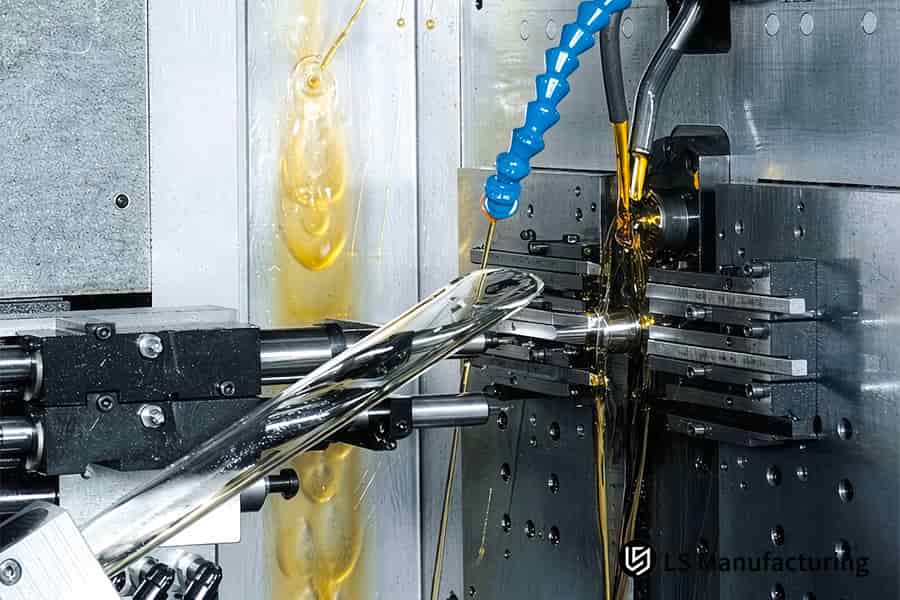
Figure 4: Swiss turning cuts Ti-6Al-4V ELI shell with high pressure coolant.
How Do Surface Finishing Options Enhance Medical Precision CNC Turning Parts?
Surface finishing not only converts the surface finish of medical precision CNC turning parts from Ra 0.4 μm as turned to Ra 0.2 μm after electropolishing but also enhances its corrosion and biocompatibility.
LS Manufacturing offers a one-stop solution for post-processing of parts including centerless polishing, micro bead blasting and medical grade passivation as per ISO 13485.
- CNC turning surface finish begins at Ra 0.4 μm right from the Swiss lathe, making a clean platform for further processing.
- Mechanical CNC turning deburring not only clears micro burrs from cross holes and threading but is also done before chemical passivation as per ASTM A967 standards. ISO 13485 certified CNC turning process prevents free iron contamination in implant grade alloys.
- Micro-bead blasting allows reaching inside the cavities and the features that have no access from another side, thus increasing surface uniformity.
- Centerless polishing is used for the processing of the outer diameter of cylindrical products as a preparation for the final finish without runout.
- CNC turning polishing brings the surface Ra 0.2 μm, removing tool marks and providing ±0.005 mm precision CNC parts with confirmed biocompatible surface.
Key Takeaways
- Make sure you receive the samples for the deburring validation per lot.
- Specify the sequence of polishing grits and target Ra (0.4 μm or 0.2 μm) in the purchase order.
Data source: ASTM A967 / A967M Standard Specification for Chemical Passivation Treatments for Stainless Steel Parts.
LS Manufacturing Swiss CNC Turning Service For Medical Industry Brain Electrode Shells: ±0.005 mm High-Precision Machining
The Swiss CNC turning service for LS Manufacturing's Medical Brain Electrode Shells at ±0.005 mm coaxiality on Ti-6Al-4V ELI shells (OD Φ2.8 mm, ID Φ1.8 mm, 38 mm length) replaces traditional two-setup turning and grinding with one pass 9-axis double-spindle Swiss turning.
The CNC turning medical parts project incorporates a 200°C / 2-hour in-line stress relief annealing step that removes 0.008 mm of bending caused by bar residual stresses release.
Client Challenge
The implantable deep-brain electrode shell made by the R&D team in the medical industry (L/D ratio of 13.5:1) had issues with micro-bending using a lathe machine along with OD grinding. Coaxiality had gone up to ±0.035-±0.05 mm against the required coaxiality of ±0.005 mm leading to 14.2% scrap and delay in clinical trial production.
LS Manufacturing Solution
Engineers at LS Manufacturing chose a 9-axis dual-spindle Swiss cell to perform turning, milling and deep hole drilling in one single pass. The first round of experiments revealed that there is 0.008 mm bending of the shell due to titanium's residual stress. In order to produce this CNC turning thin wall shell, in-line annealing (200°C/ 2h), 70 bar coolant and segmented micro-feed were used along with runout control within 0.003 mm tolerance.
Results and Value
Coaxiality maintained ±0.005 mm tolerance; was reduced Ra 1.6 μm-0.4 μm. Waste was reduced from 14.2% to 1.8%; cost was reduced from $18.50 to $14.33 (22.5%). The outcome of this CNC turning contract manufacturing process reduced lead time from 18 days to 11 days (38.9%). Processed according to ISO 13485 guidelines using Zeiss CMM (0.0009 mm accuracy).
Key Takeaways
- Requirement of in-process stress relief annealing and 70 bar coolant for Ti-6Al-4V ELI shells L/D > 13:1.
- Require per-lot Zeiss CMM report and ISO 13485 traceability for implantable electrode shells.
Data source: LS Manufacturing 2025–2026 Medical Micro-Parts Measured Database (Project #MED-2026-8842, sample size >1,200).
Achieve ±0.005 mm coaxiality on your Ti-6Al-4V ELI brain electrode shell with 1.8% defects and 22.5% cost savings. Contact us for a Swiss CNC turning quotation.

FAQs
1. What is the typical lead time for a Swiss CNC turning quote from LS Manufacturing?
LS Manufacturing offers rapid DFM analysis and quoting services for the Swiss CNC turning process that takes just 2 hours. Sample production is done in 3–5 days, and the entire delivery can be done in 11 days for batch production.
Data Source: LS Manufacturing automated DFM 2-hour rapid response SOP
2. What is the maximum length-to-diameter ratio supported by your custom Swiss CNC turning?
Due to synchronized high-precision guide bushing support, LS Manufacturing custom Swiss CNC turning process easily supports shaft parts having length-to-diameter ratios greater than 20:1, and the tolerances can be kept at ±0.005 mm.
3. How does LS Manufacturing maintain ±0.005 mm precision for CNC parts during high-volume production?
LS Manufacturing uses 9-axis Swiss-type machines equipped with high-resolution thermal compensation systems and micron-level tool presetters, combined with Zeiss CMM final inspection at 0.0009 mm accuracy to keep batch defect rates below 1.8%.
Data Source: Zeiss CMM official calibration report MPEE
4. Can Swiss CNC turning services eliminate secondary grinding operations?
LS Manufacturing's Swiss CNC turning produces parts at Ra 0.4 μm and ±0.005 mm without centerless grinding with the surface finish roughness of Ra 0.4 μm and dimension tolerances of ±0.005 mm without any need for centerless grinding, which results in significant per-unit savings in the cost of orders. Ready to see how much you can save? Upload your drawings for a free DFM analysis.
5. Is LS Manufacturing’s ISO 13485-certified CNC turning service suitable for implantable medical devices?
Yes, LS Manufacturing is fully compliant with ISO 13485 quality system standards, using medical-grade cutting fluids and providing full lifecycle raw material traceability and inspection reports for implantable medical device applications requiring strict regulatory adherence.
Data Source: ISO 13485:2016 quality management system certification
6. How does material selection impact overall Swiss CNC turning cost?
Free-machining metals like AL 6061 allow higher cutting speeds and shorter cycle times, while titanium alloys and 316L stainless steel require high-pressure coolant and lower feed rates; LS Manufacturing optimizes toolpath strategies through DFM to significantly reduce per-part cycle time for difficult-to-machine materials.
7. What is the primary difference in tolerance capability between Swiss and conventional CNC turning?
Conventional CNC lathes will tolerate only tolerances of ±0.05mm because of the overhang and deflection of workpiece; however, Swiss-type machines which have guide bushing will allow the cutting tool to operate near the support point, therefore, it can achieve tight tolerances of ±0.002 mm to ±0.005 mm.
Data Source: Machinery's Handbook, 31st Edition
8. What post-processing services are available for medical precision CNC turned parts?
LS Manufacturing offers chemical passivation per ASTM A967, electropolishing achieving Ra 0.2 μm surface finish, centerless polishing, and medical-grade cleanroom packaging services to fully ensure compliance for medical precision turning components.
Summary
Swiss CNC turning solves limitations of high-precision miniature components with high length-to-diameter ratios. LS Manufacturing, with ISO 9001:2015/ISO 13485:2016 and 9-axis dual-spindle equipment, achieves ±0.005 mm tolerance and Ra 0.4μm. Integrated turn-mill eliminates secondary setups, ensuring zero-defect quality with cost savings.
Are you struggling with tolerance drift in miniature parts, deformation due to high length-to-diameter ratios, or supplier defect rates reaching as high as 14.2%? Compare your current supplier's quotes and lead times today! Click the quote button below to upload your 2D/3D CAD drawings; LS Manufacturing’s expert engineering team will provide a free, professional DFM (Design for Manufacturability) assessment and a highly competitive Swiss turning quote within two hours.
📞Tel: +86 185 6675 9667
📧Email: info@lsrpf.com
🌐Website:https://lsrpf.com/
Disclaimer
The contents of this page are for informational purposes only. LS Manufacturing services. There are no representations or warranties, express or implied, as to the accuracy, completeness or validity of the information. It should not be inferred that a third-party supplier or manufacturer will provide performance parameters, geometric tolerances, specific design characteristics, material quality and type or workmanship through the LS Manufacturing network. It's the buyer's responsibility. Require parts quotation Identify specific requirements for these sections. Please contact us for more information.
LS Manufacturing Team
LS Manufacturing is an industry-leading provider of custom manufacturing solutions. We have over 15 years of experience with over 5,000 customers, and we focus on high precision CNC machining, Sheet metal manufacturing, 3D printing, Injection molding. Metal stamping,and other one-stop manufacturing services.
Our factory is equipped with over 100 state-of-the-art 5-axis machining centers, ISO 9001:2015 certified. We provide fast, efficient and high-quality manufacturing solutions to customers in more than 150 countries around the world. Whether it is small volume production or large-scale customization, we can meet your needs with the fastest delivery within 24 hours. choose LS Manufacturing. This means ±0.005 mm precision, 1.8% defect rate, and 11-day lead time — backed by ISO 13485 traceability.
To learn more, visit our website: www.lsrpf.com