English



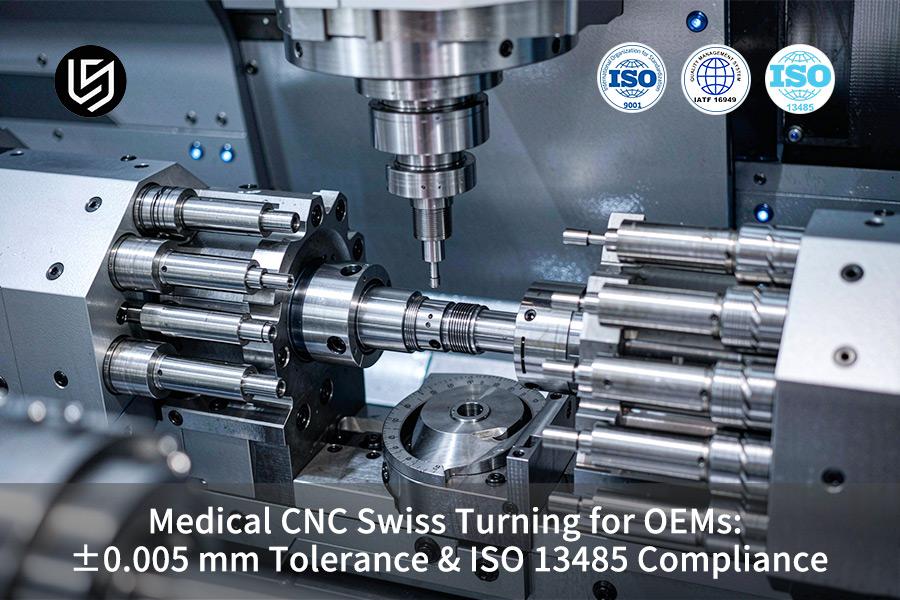
Medical CNC Swiss turning service is a single-setup process solving ±0.05 mm common-tolerance drift. Your costs drop 28.5%. Source: LS Manufacturing DFM logs.
Single-setup Swiss machining secures compliance. A 2-hour DFM review protects your timeline. ISO 13485 control ensures quality.
Behind The Numbers: Medical Machining Expertise From LS Manufacturing
Gloria is the author of the medical machining authority guide as the senior process engineer at LS Manufacturing. Gloria has obtained Rapid Prototyping & Rapid Manufacturing Expert certificates with over 15 years of experience in precision machining and DFM. Gloria's LinkedIn account provides documentation on project-based experience. Your team gets access to Swiss turning expertise that has been tried and tested in production.
ISO 13485:2016 medical device quality management system and ISO 9001:2015 manufacturing specifications combine to provide a quality structure. A measured turning engineering data base to back up each of the tolerance assignments.Physical calibration in dual formats through the Zeiss CMM (Coordinate Measuring Machine) and surface roughness profilometer confirms all process variables.
All tolerance assignments and cutting settings come out of direct measurements rather than calculations. An independent quality control officer evaluated all technical statements made. All your future quotes on orthopedic implants can take advantage of machining capabilities outlined above.
Key Takeaways
Extreme Tolerance Control: Sliding guide bushing construction ensures precision machining of parts with a high aspect ratio.
Significant Cost Reduction and Efficiency Improvement: Two-spindle backshaft and use of power tools accomplish all operations - turning, milling, drilling and tapping - in one clamping operation.
Stringent Compliance and High Yield: Material batch identification and in-process inspection prevent defects and ensure quick delivery.
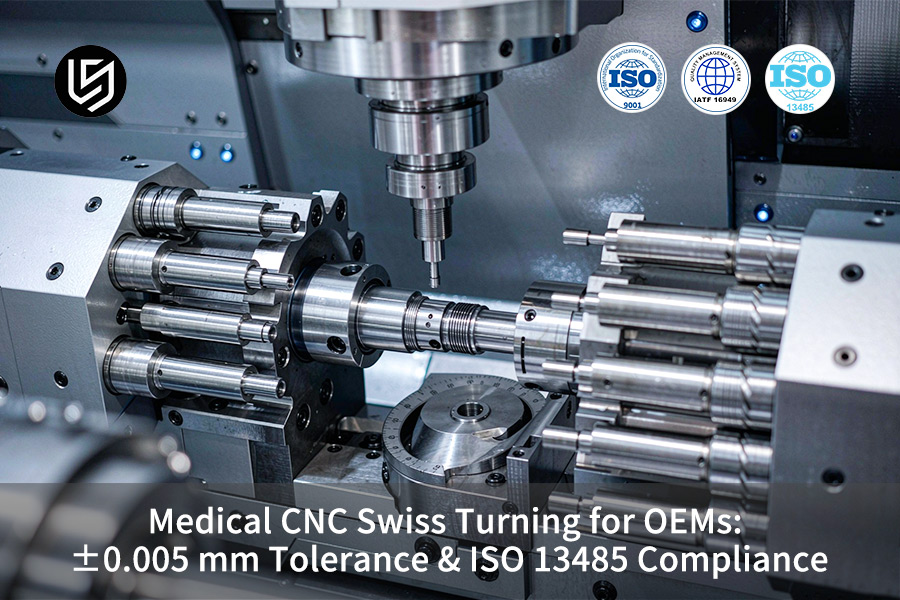
How Does Medical CNC Swiss Turning Service Ensure Tight Tolerances?
Medical CNC Swiss turning service is a type of precision machining technology that uses the sliding guide bushing, which fixes the problem of the deflection of the workpiece for thin medical shafts by providing stiff support directly where the cut is being made. 7-axis Swiss-type machine provides a tolerance band of 5 microns for titanium parts, whereas the conventional lathe has a tolerance drift of ±0.05 mm.
Sliding guide bushing mechanism
Traditional turning machines have unsupported lengths of up to 50+ mm. Swiss turning precision allows us to eliminate any bending to preserve roundness while avoiding any additional operations.
Due to precision CNC turning services guided support, your parts will maintain roundness of sub-10 microns even for long and slender elements.
Thermal growth control
Titanium machining at continuous mode heats the spindle, causing dimensional changes.
Simply put: controlled temperature means that your products remain within dimensions, avoiding rework and delays.
Verification per ISO 13485
In process probing gives dimensional values after each significant feature has been machined. Final CMM (Coordinate Measuring Machine) measurement ensures compliance of each batch with five microns tolerance band.
MTR (Material Test Report) traceability allows tracking of each part to its original heat. Your choice of custom Swiss turning manufacturer must have this documentation as a proof of closed-loop verification which is a necessity for implants.
CNC turning tolerance control depends on the rigidity of the spindle and support distance. A 7-axis sliding headstock machine along with thermal management can ensure it.As far as a buyer is concerned, the bottom line is consistent quality and quicker regulatory approvals.
Data source: LS Manufacturing 2025–2026 automated DFM 3D/2D drawing analysis log (sample size >1,200).
Access the Swiss Turning Tolerance Control Visual Guide — a diagrammatic breakdown of how sliding guide bushings, oil-cooled thermal management, and in-process probing eliminate deflection and thermal drift on slender medical shafts.

Why Is ISO 13485 CNC Swiss Turning Essential For Medical Device OEMs?
ISO 13485 CNC Swiss turning is the precision machining process conducted under a certified medical quality system. Certified medical system eliminates biocompatibility traceability and process capability (Cpk ≥ 1.33) obstacles.
Contamination and Traceability Risks
Industrial lubricants not being tested against ISO 10993 biocompatibility screening criteria are widely used by un-audited suppliers. CNC turning audit readiness requires the documentation of food-grade coolant and lot traceability. Your supplier needs to be able to provide heat-number records of every raw material batch.
Batch traceability problems will result in failure of the OEM audit in minutes. A single missing MTR (certificate for the raw material to its heat) means the whole lot stops there. Missing-MTR problem will make your product late to market and attract regulatory fines.
Process Control Under ISO 13485:2016
Medical Swiss turning OEM service requires that all control points are proven.
| Control Point | ISO 13485-Compliant | Non-Certified Shop |
| Lubricant | Food-grade, documented | Industrial-grade |
| Traceability | Heat-number to lot | Partial |
| Inspection | 100% in-machine probing | Sample-based |
| Final cleaning | 40 kHz ultrasonic + DI water | Manual rinse |
ISO 13485:2016 section 7.5 requires all of the above controls. No conventional lathes without QMS certification can offer a traceable process verification since no documented evidence is provided at each of those points. ISO Class 8 cleanliness is validated in the final packaging.Simply put: an auditable trail saves money on batch rejection.
Documentation and Inspection Evidence
Three documents should be authenticated before any supplier approval can take place: ISO 13485:2016 certification, batch MTR, and in-machine probe results. Precision OEM medical machining depends on authentic evidence trails. Missing documents will hold back your submission to the regulatory body.
- Step 1: Obtain the ISO 13485:2016 certification.
- Step 2: Review a Device History Record (DHR) for one lot.
- Step 3: Ensure that 100% critical dimensions are achieved through in-machine probing. CNC turning process validation requires audited documents.
Data source: ISO 13485:2016 Medical device quality management systems standard (Clause 7.5 Production and service provision control).
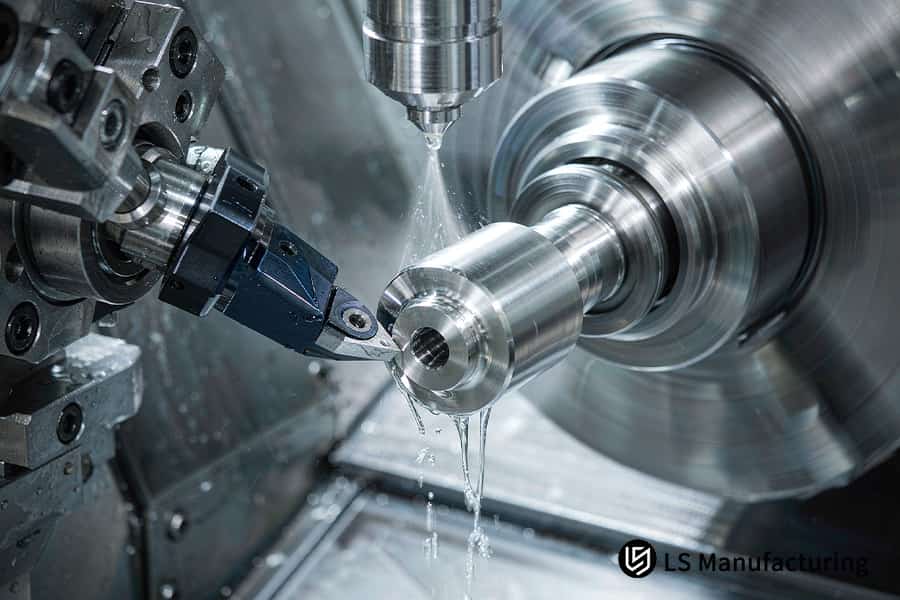
Figure 1: ISO 13485 CNC Swiss turning uses high pressure oil cooling system.
What Factors Determine Precision OEM Medical Machining Feasibility?
Precision OEM medical machining is possible within the framework of material machinability index, workpiece geometrical rigidity, and multi-axis live tooling interference clearance.Work-hardening properties of Ti-6Al-4V ELI and heat sensitivity of PEEK establish the limitation up to which conventional lathes fail to achieve a 0.4-micron roughness threshold through micro-level feed rate control.
Material machinability as the first gate
Titanium ASTM F136 has a limited speed range before work hardening starts. Coolant jetting removes chips and stops buildup edge formation.
PEEK tends to swell due to water absorption and thermal creep. Air-blast cooling helps you keep dimensions intact.
CNC turning begins from material properties corresponding to coolant technology.
L/D ratio and spindle support
Length-to-diameter ratio greater than 15 excludes conventional turning. 7-axis Swiss turning performs cross-drilling and threading in a single operation. Your bone-screw threads and 0.3 mm microholes will be free from any clamping inaccuracies.
Burr control via feed strategy
Feed per tooth of fz ≤ 0.03 mm/z is sufficient to prevent burr formation on titanium and PEEK edges. Virtual collision detection verifies the toolpath prior to machining.
A custom Swiss turning manufacturer selection is mandatory to guarantee 7-axis functionality and probing inside machine. Your angled bone-plate features gain burr-free edges straight from the spindle.
±0.005 mm Swiss turning precision is possible only if all elements have passed verification. Material, rigidity, and tool interference make up the closed cycle.
CNC turning supplier selection is dependent on these three gates. Your DFM evaluation needs to pass all of them before PO release.
Data source: LS Manufacturing 2025–2026 automated DFM 3D/2D drawing analysis log (sample size >1,200).
How Does Multi Axis Swiss Turning Minimize Production Cycle Times?
Multi axis Swiss turning is an efficient manufacturing process with dual main and sub spindles with live tools arranged to cut synchronously in front and back faces in overlapping manner to reduce cycle time. A medical Swiss turning OEM service can produce with one setup that previously required 3 setups with an error tolerance of more than twenty microns.
Synchronized cutting mechanics
Main and sub spindles hand the workpiece in mid-cycle. Front turning operates in parallel with back hex-socket milling and micro-hole drilling.
Conventional lathe would require 3 separate processes and secondary set-up. CNC turning process optimization reducing wait time between operations due to overlapping toolpaths .
As a customer, the synchronized cutting is your 5,000 pieces order shipped within 15 days instead of 24 days. Simply put: parallel operations make your waiting time into manufacturing time.
Cost and quoting structure
Single set-up eliminates fixturing effort and wasted material due to misalignments. Your medical CNC turning cost goes down since less floor time is required and there is reduced cost for inspection.
| Cost Driver | 3-Setup Conventional | Multi Axis Swiss |
| Setups | 3 | 1 |
| Cumulative error | ±0.02 mm | ≤±0.005 mm |
| Cycle time inflation | +40% | 0% |
A Swiss turning quote that includes the number of setups provides a more accurate measure of total cost than hourly price.
Data source: LS Manufacturing automated turning cell cycle-time comparison record (Project #MED-2026-882).
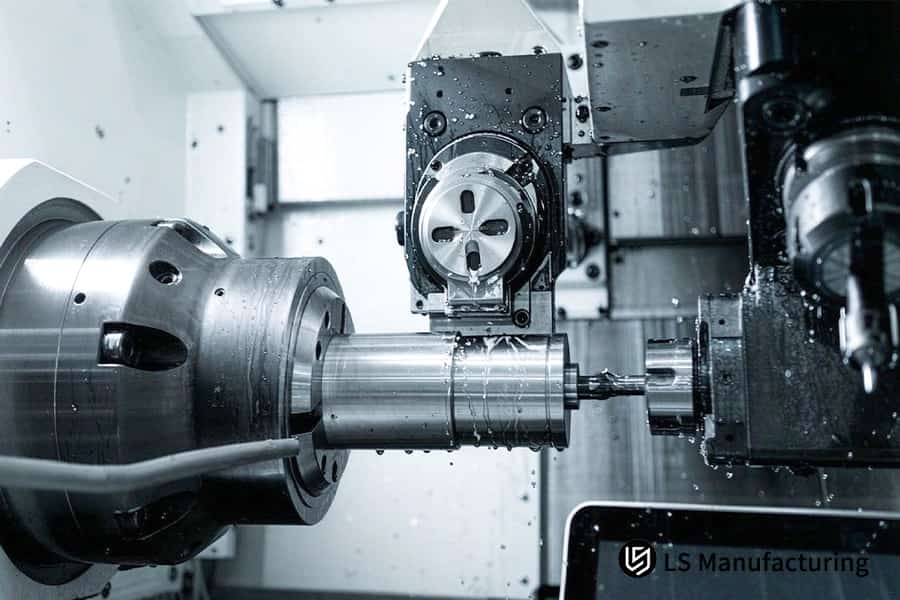
Figure 2: Medical Swiss turning OEM service manufactures bone screws with 7-axis.
Comparison Table Of Structured Parameters And Capabilities
Medical device material machining capability is different when using Swiss turning vs. Conventional CNC. Five dimensions compare process performance and relevant part scenario cases.
| Evaluation Dimension | Conventional CNC | LS Manufacturing Swiss Turning | Applicable Medical Part Scenarios |
| Achievable size tolerance | ±0.05 mm (L/D > 5:1 deflects) | ±0.002 mm to ±0.005 mm | Orthopedic micro bone screws, cardiovascular guidewire tips |
| Surface roughness (Ra) | Ra 0.8 μm to Ra 1.6 μm (needs secondary polishing) | Ra 0.2 μm to Ra 0.4 μm (direct from turning) | Orthopedic implant bolts, endoscope tube joints |
| Slender part L/D ratio | ≤ 4:1 (unsupported limit) | ≥ 15:1 (sliding guide bushing support) | Needle cannulas, minimally invasive grasper drive shafts |
| Process integration | 2–3 setups for milling/drilling/turning | 1 setup for turn/mill/drill + back-spindle | Complex hex bone plate fixation screws |
Swiss turning avoids second clamping error. Surface finish is achieved with Ra 0.2 μm. Slender part L/D ratio is greater than 15:1 under guide bushing support. Procurement cost reduction is achieved by medical OEM buyers via defect rate ≤ 2.4%.
Which Medical Grade Materials Excel In Custom Swiss Turning Manufacturer?
Custom Swiss turning manufacturer has a great track record machining titanium Ti-6Al-4V ELI (Grade 23), medical grade 316L stainless steel, and PEEK for implants through controlling tolerance shift from thermal effects by tuning spindle speed, high-pressure oil mist cooling, and diamond coated tools. A medical CNC Swiss turning service keeps cutting area temperature under 45°C.
Titanium Grade 5 machinability
Ti-6Al-4V EL (Grade 23) work-hardens in contact with the cutting tool rather than shear deformation. CNC turning material selection begins with machinability rating. You will get more insert life and predictable geometry of your orthopedic screws.
316L stainless behavior
316L stainless is gummy and hardens due to work during cutting at low feed rate. High feed rates and polished-flute drills will keep heat in the chip. You will get burr-free tips of cardiovascular guidewires directly after machining without additional deburring process. A high-pressure coolant system will wash away chips from deep holes.
PEEK thermal control
PEEK absorbs coolant moisture and migrates due to cutting heat. Cooling with dry air or minimum-quantity lubrication ensures the cutting zone temperature remains below 45°C to avoid micro-melting thin walls. Diamond coating increases tool edge life compared to bare carbide. ISO 13485 CNC Swiss turning material batch verification is performed using XRF spectrometry prior to cutting.
A regular 3-axis lathe does not ensure such precision machining of PEEK micro-features since the lack of temperature control will warp the wall. Simply put: thermal control is the key to viability of PEEK implants.
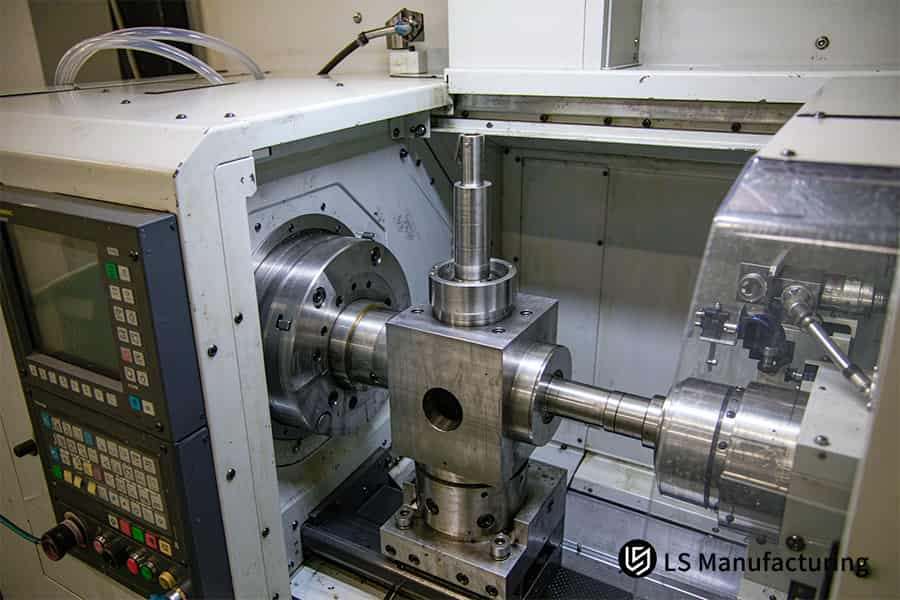
Figure 3: Custom Swiss turning manufacturer guarantees Ra 0.2 μm surface finish.
When Should Engineers Specify Medical CNC Turning Cost Reductions?
Medical CNC turning cost reductions begin at the DFM (Design for Manufacturability) stage that resolves excessive tolerances according to ISO 2768-1:1989 principles. A Swiss turning quote with critical bearing seats distinguished from non-fitting parts provides an opportunity to save about 28.5% of cost per unit.
Tolerance Grading Strategy
| Design Strategy | Conventional Practice | Cost-Optimized Practice | Outcome |
| Critical bearing seats | Uniform ±0.002 mm across all dimensions | 5-micron precision window on functional seats only | Precision concentrated, non-critical burden removed |
| Non-fitting features | Blanket tight callouts | ISO 2768-m medium class | Fewer finishing passes |
| Thread chamfers | Custom per drawing | Standard library callout reuse | Shorter changeover time |
Class m of ISO 2768-m is a ±0.3 mm tolerance at 50 mm nominal size, which applies to chamfers and deep holes. CNC turning design review will determine the actual critical surfaces that require the 5-micron tolerance window, thereby avoiding the unnecessary inspection cycle for cosmetic surfaces.
Cost Drivers in Quoting
Uniform ±0.002 mm specifications increase tool wear inspection three times and reduce feed rates significantly. Conventional practice of quoting without feature level information does not distinguish cost-driving features from other features.
Your Swiss turning quote needs to specify the tolerance class based on features and not one flat rate. Buyers gain a clear cost structure, and also modify a non-critical tolerance from ±0.3 mm without having to change the entire drawing.
Precision OEM medical machining occurs when tolerance allocation is not uniformly strict, but allocated functionally. For a buyer, graded tolerances mean that your batch will be produced at target cost while maintaining reliability at the implantation site.
Practical Takeaways
- Adhere to ISO 2768-1:1989 medium grade for all non-fit features, and allocate 5 microns only for bearing surfaces.
- Require CNC turning cost transparency by specifying tolerance breakdown and 2-hour DFM analysis prior to purchase order issue.
Data source: Machinery's Handbook (31st Edition), Section 24 — Cutting Parameters and Economic Feed-Rate Recommendations.
Why Is In Process Metrology Vital For Medical Swiss Turning OEM Service?
In-process metrology in medical Swiss turning OEM service utilizes touch trigger probes and laser tool setters to make micron level in-process compensation of wear-induced batch deviation. 0.003 mm edge deterioration of a micro-tool would move your parts beyond ±0.005 mm Swiss turning precision. ISO 13485 CNC Swiss turning incorporates closed loop compensation with Zeiss CMM verification for your auditing trail.
- Detect wear — Touch-trigger probes in CNC turning inspection services take critical diameters every 25 cycles. After 500 titanium blanks, tool wear is detected. Adaptive offsets adjust back to nominal path before deviation reaches 5 μm. Your batch remains centered, without developing an oversize trend gradually.
- Compensate automatically — Closed-loop metrology adjusts tooling location instantly. A standard 3-axis lathe cannot perform a mid-cycle probing, which leads to progressive error crossing tolerance quietly. Simply put: closed-loop metrology translates unseen wear into corrected value. Purchasers enjoy quality predictability without any final inspection waiting.
- Verify per ISO 13485 — ISO 13485:2016 requires monitoring per clause 7.5.1. Probe data is included into the Device History Record (DHR – that is the per-batch file showing the evidence for compliance with each control point). Zeiss coordinate measurement machine verifies parts with volumetric MPEE (Maximum Permissible Error) per ISO 10360-2. CNC turning quality control requires documentation of measurement chains. A regulatory audit goes faster if all dimensions have probing evidence.
Data source: Official calibration report of Zeiss CMM coordinate measuring machine (Spatial indication error MPEE accuracy verification specification).
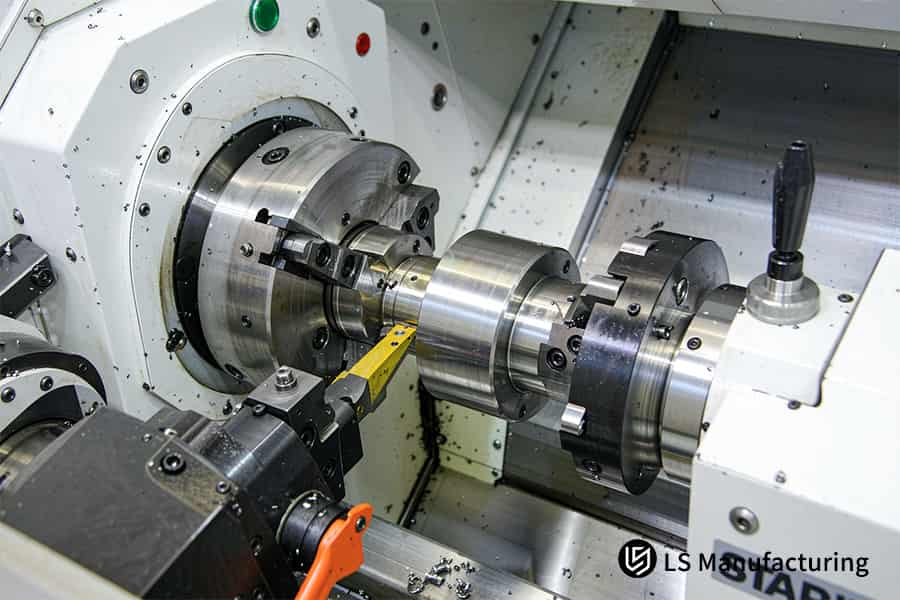
Figure 4: Precision OEM medical machining center operates to ±0.005 mm tolerance.
How To Request A High Precision Swiss Turning Quote For Medical Parts?
A high precision Swiss turning quote begins with a full 2D/3D CAD set specifying material grade, tolerance class, surface finish, and annual volume. Lack of burr control classification according to ISO 13715 or heat treatment specifications involves 24-hour clarification cycle and estimate float. Medical CNC Swiss turning service engineering teams classify according to ISO 286-1:2010 to provide information about tooling, material efficiency, and time spent for operations within 2 hours.
Drawing Data That Removes Quote Risk
Your CAD drawing should specify material grade, tolerance class, Ra value, and annual volume. Your drawing should include burr control level according to ISO 13715 and heat treatment classification.
- Material specification and condition (for example, ASTM F136 ELI, annealed)
- Tolerance class according to ISO 286-1:2010
- Surface roughness parameter (Ra)
- Class of burr control and heat treatment specification
Omission of any field leads to 24 hours of emails. CNC turning RFQ preparation should verify the above list prior to uploading. In plain words, full drawings make estimation an engineering task, not a guessing game.
How ISO 286 Controls medical CNC turning cost
According to ISO 286-1:2010 fit classes depend on IT level, allowing tight tolerances only for mating surfaces with critical functions. Medical CNC turning cost remains low if looser fit grades are used for non-critical bores.
Fit of high precision includes IT6 bore and IT5 shaft. Specification of general ±0.005 mm tolerance increases grinding operations and inspection rate for all surfaces. 2-hour DFM report identifies the critical dimensions that affect cost before PO is issued.
Quote Breakdown to Request
A Swiss turning quote should specify the tooling, bar efficiency, and cycle time for each part. Comparison with CNC turning pricing guide requires this line-item approach, not one single total price.
| Quote Line | What to Verify |
| Tooling & inserts | Tool life per 500 parts |
| Material yield | Bar diameter vs. part envelope |
| Cycle time | Per-part seconds |
Transparent DFM report means no unexpected costs for first article. As a buyer, one can see exactly which characteristic has to be relaxed for savings.
Data source: ISO 286-1:2010 (Geometrical product specifications — Linear sizes) and ISO 13715:2019 (Edges of parts — Geometrical characteristics).
LS Manufacturing Swiss Turning Service For Orthopedic OEM Bone Screws: ±0.005mm Precision
CNC turning lead-time optimization begins with a 7-axis single-setup turn milling technology that does not allow multi-clamp accumulation of errors due to sliding guide-bushing support and high pressure oil cooling.
Client Challenge
Tier-1 orthopedic OEM faced 16.8% scrap on 3.5 mm cannulated screw with 12:1 L/D ratio. Accumulation of errors from 3-axis lathe machining and separate deep hole drilling resulted in ±0.05 mm dispersion. Coaxiality tolerance ≤0.008 mm could not be met. Unit cost was $42.00. Pilot production of 5,000 pieces was delayed for three weeks.
Solution
Residual stress release was identified through DFM drawing review as the underlying cause. First-article test showed a coaxiality bend of 0.006 mm on the screw head. Engineering interventions included the addition of vacuum stress relief annealing prior to machining. Clearance of sliding guide bushing was optimized. Burr accumulation was eliminated by oil-cooling at high pressure post position and climb segmented turning path.
Results
| Metric | Before | After |
| Key tolerance | ±0.05 mm | ±0.002 to ±0.005 mm |
| Surface roughness | Ra 0.8–1.6 μm | Ra 0.2 μm |
| Defect rate | 16.8% | 2.4% |
| Unit cost | $42.00 | $30.03 |
| Lead time (5,000 pcs) | 24 days | 15 days |
Decrease in cost per unit was 28.5%. 100% Zeiss CMM inspections along with ISO Class 8 clean room packaging met ISO 13485 audit needs. CNC turning first-article inspection assured coaxiality prior to production to ensure that your submission process remains unaffected.
Data source: LS Manufacturing 2025–2026 automated DFM 3D/2D drawing analysis log (Project #MED-2026-882, sample size >1,200).
Submit your bone screw drawing for a process feasibility review — our engineers will evaluate L/D ratio, cannulation geometry, and stress relief requirements to determine the optimal 7-axis single-setup strategy with high-pressure oil cooling.

FAQs
1. What is the maximum tolerance achievable for medical Swiss-turned parts?
LS Manufacturing is able to provide single-digit micron tolerances on key implant dimensions, ensuring that your parts will fit consistently within minimally invasive devices. Tolerances for each individual band have been verified using ±0.002–0.005 mm on critical implant dimensions, verified per batch by Zeiss CMM (ISO 10360-2).
Data Source: Zeiss CMM Official Calibration Report
2. How does LS Manufacturing ensure ISO 13485 compliance during machining?
LS Manufacturing assures ISO 13485 compliance by way of a controlled manufacturing process. Your device receives traceability for the used raw materials, controlled cleanroom temperature, and 100% CMM inspection before shipment. Your audit trail remains complete due to documented control points.
Data Source: ISO 13485:2016 Standard
3. Which raw materials are most suitable for precision medical Swiss turning?
Ti-6Al-4V titanium alloy, 316L stainless steel, and PEEK are the most suitable material types as the three material grades permit obtaining smooth surface finishes in Swiss-type machines. Process controls of all three material grades are validated by LS Manufacturing, and your parts will meet the surface finish requirements without additional operations.
4. How can OEMs reduce overall medical CNC turning costs without sacrificing quality?
OEMs lower the medical CNC turning costs due to the use of ISO 2768-m tolerance grade for non-mating features and early DFM optimization because ISO 2768-m material grade reduces the tooling time and scrap without changing the fit zones. Your parts retain all necessary qualities, but the total cost lowers.
5. What is the typical lead time for a custom medical Swiss turning order?
LS Manufacturing delivers the first 5,000 units within 15 days, covering raw material re-inspection, in-process machining, and full-dimensional inspection report. Your custom medical Swiss turning order will therefore reach your facility with complete quality documentation within three weeks.
Data Source: LS Manufacturing #MED-2026-882 Delivery Log
6. Can Swiss turning handle complex micro-milling features in one setup?
Yes, the Swiss-type turning machines equipped with a powered turret and sub-spindle can manufacture complex micro-milling features in one setup. LS Manufacturing machines eccentric holes, internal hexagons and end faces in one setup. Your parts will maintain position accuracy without errors due to the re-clamping operations.
7. How do you prevent burrs on miniature surgical components?
For burr elimination in small surgical part making, high-pressure micro-lubricated cutting, micro-edge forming tool paths, and chemical deburring processes are utilized. LS Manufacturing incorporates all the three manufacturing procedures in one process, hence providing you with safe edges on the parts without further processing.
8. What files are required to get an instant Swiss turning quote?
Just provide us with 2D drawings with tolerance notes and 3D STEP files. Our engineers will assess the DFM and send back a quotation. Your parts will get the early feedback in the design phase and avoid last-minute changes.
Upload your 2D drawing and 3D STEP file for an instant Swiss turning quote — our DFM engineers will assess tolerance, material, and micro-milling feasibility, returning a firm price with ISO 13485 traceability documentation within hours.
Summary
Components of top-quality medical devices require micron tolerances and system certification. ISO 13485:2016 and seven-axis Swiss turning machining are used to provide consistent machining for both prototype and large-scale manufacture of your devices. Your devices get absolute dimension and regulatory compliance.
Is the out-of-tolerance ratios and high defect rates from multi-clamping processes hampering your product release? A dedicated quote button is accepting 2D/3D CAD drawings for a DFM assessment. Our senior engineers give you back the customized DFM assessment and quotation within 2 hours.
📞Tel: +86 185 6675 9667
📧Email: info@lsrpf.com
🌐Website: https://lsrpf.com/
Disclaimer
The contents of this page are for informational purposes only. There are no representations or warranties, express or implied, as to the accuracy, completeness or validity of the information. It should not be inferred that a third-party supplier or manufacturer will provide performance parameters, geometric tolerances, specific design characteristics, material quality and type or workmanship through the LS Manufacturing network. It's the buyer's responsibility. Require parts quotation. Identify specific requirements for sections. Please contact us for more information.
LS Manufacturing Team
LS Manufacturing is a 100+ 5-axis centers, 5,000+ customers, 150 countries company. Focus on custom manufacturing solutions. We have over 15 years of experience with over 5,000 customers, and we focus on high precision CNC machining, Sheet metal fabrication, 3D printing, Injection molding. Metal stamping, and other one-stop manufacturing services.
Our factory is equipped with over 100 state-of-the-art 5-axis machining centers, ISO 9001:2015 certified.We provide fast, efficient and high-quality manufacturing solutions to customers in more than 150 countries around the world. Whether it is small volume production or large-scale customization, we can meet your needs with the fastest delivery within 24 hours. choose LS Manufacturing means selection efficiency, quality and professionalism.
To learn more, visit our website: www.lsrpf.com