English



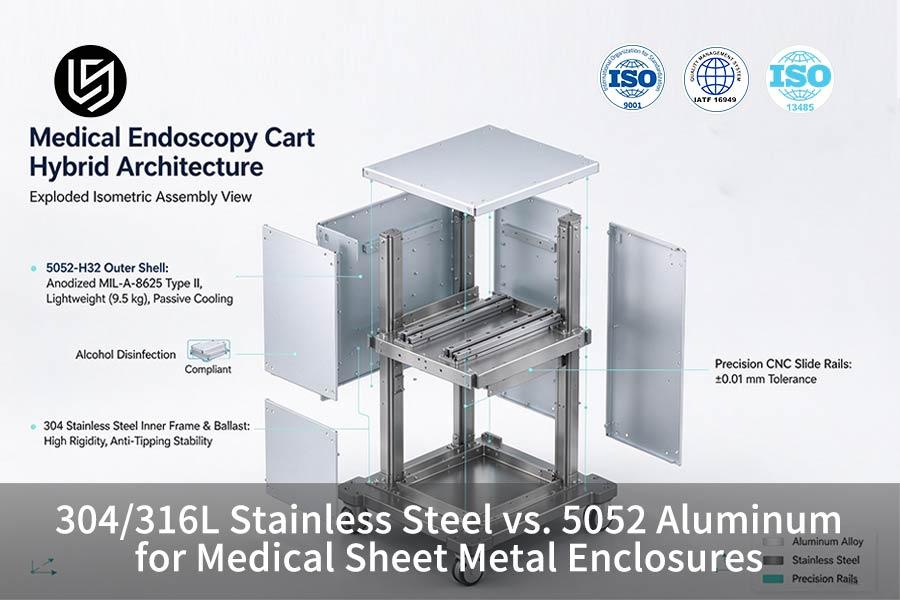
TL;DR: Stainless steel vs aluminum enclosure selection is a compromise for medical housings: 316L prevents pitting, 5052-H32 reduces weight. Stainless steel tolerates rail fits of ±0.005 mm; 5052-H32 aluminum tolerates ±0.01 mm precise fits. The cross-over point is 85 units, switching over to passivated stainless steel above ISO 14159 restrictions.
When selecting stainless steel vs aluminum enclosures for medical housings, design engineers and sourcing managers evaluate durability vs weight constraints prior to tooled parts. Many teams tend to believe that corrosion prevention only is the criterion for enclosure metal choice, forgetting about sterilization chemistry and maximum weight restrictions. Sterilization chemistry determines corrosion of stainless steel; weight capacity of parts determines maximum 5052-H32 aluminum limits. Four axes of comparison, one 4×4 matrix and a decision tree below follow.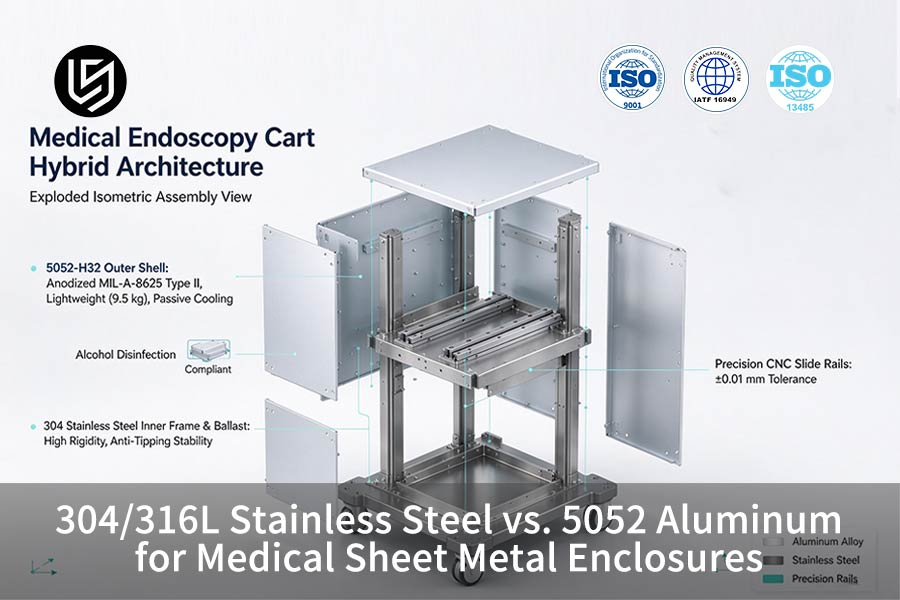
Behind The Data: Cross-Process Engineering Methodology At LS Manufacturing
Gloria — Rapid Prototyping & Rapid Manufacturing Expert — has 15+ years of experience in precision manufacturing and medical prototyping: Review the Engineering Decision-Making Process from Gloria. LS Manufacturing produces in-house 304/316L stainless steel and 5052-H32 aluminum sheet-metal lines, so any comparison is based on process measurements, not preferred process route. Procurement specialists compare each process route based on one database before tooling freeze.
ASTM B117-19 covers the corrosion test for each 304/316L and 5052-H32 coupon, while ASME Y14.5-2018 applies for GD&T (geometric dimensioning and tolerancing) inspection. One cross-process database contains >1,500 process measurements that were calibrated in March 2026 and provides results of each material on identical equipment, version, and statistical window. Quality auditors can check the published figures according to standards, not marketing claims of vendors.
A Class-100 electropolishing/passivation (free iron removal & chromium oxide formation) station is available for 316L; a single anodizing (Type III) line is available for 5052-H32. Laser-cutting and CNC servo bending of fiber laser cutting provide all enclosures with repeatable physical testing and production logs cleared under ISO 13485:2016 and ISO 2768-1:1989. Inspection crews are provided a single measured document for each enclosure rather than an assurance from the supplier.
Data source and benchmark: LS Manufacturing 2025-2026 measured database (sample size >1,500) | Calibration last performed: March 2026
Key Takeaways
- 304/316L Stainless Steel: Disinfection by means of chlorine-containing agents highlights the critical trade-off of 304 vs 316l for medical device designs. Presence of molybdenum in 316L prevents pitting corrosion at the grain boundaries. Surgical console slide rails retain ±0.01 mm precision fits under repeated wipe-down cycles.
- 5052-H32 Aluminum Alloy: Portable monitor housings and ward inspection carts illustrate what is 5052 aluminum sheet utilized for in clinical hardware. 5052-H32 weighs only about one-third of stainless steel of similar volumes. Panels can be shipped within a week rather than almost two weeks.
- Thermal Balance Point: Fan-less sealed enclosures view 5052-H32 panels as a single heat spreader material. Aluminum is an order of magnitude faster than austenitic stainless steel to conduct heat, hence copper heat pipes and additional vent grilles become unnecessary in the enclosures. Omission of heat pipes and vent grilles reduces costs by just above one-quarter.
Precision and Deformation Control: Old general tolerance bands allow for the binding of the cart guides during assembly. Closed-loop servo bending pressure control allows for the holding of both 304/316L and 5052-H32 at half the tolerance band of old standards. Precision fit work achieves a tenfold increase compared to the old standards.
Quick Reference 4×4 Selection Matrix
Four engineering parameters distinguish the use of 304/316L stainless steel sheet from 5052-H32 aluminum sheet in medical enclosures. Parameters include dimensional capability, corrosion resistance, thermal management, and unit price. Each parameter has associated numbers from one cross-process database.
|
Dimension |
Option A: 304/316L Stainless Steel |
Option B: 5052-H32 Aluminum |
Threshold / Recommended Scenario |
|
Machining Tolerance Gradient |
Ultra precision ±0.005 mm / Precision ±0.01 mm / Standard ±0.05 mm |
Ultra precision ±0.005 mm / Precision ±0.01 mm / Standard ±0.05 mm |
Extra precision for window joints; 304 needs to compensate for springback; 5052 bent along rolling direction |
|
Corrosion & Surface Quality |
ASTM A967 electrolytic passivation / Ra 0.4 μm / resistant to chlorine and peroxides |
MIL-A-8625 Type II anodizing / Ra 0.8 μm / no direct exposure to strong acids/alkalis |
316L is used for surgical site disinfections; 5052 – for ward and lab monitor enclosures |
|
Thermal Management & Self-Weight |
Temperature resistance up to 798°C; density 7.93–8.00 g/cm³; thermal conductivity 16.2 W/(m·K) |
Temperature resistance up to 816°C; density 2.68 g/cm³; thermal conductivity 138 W/(m·K) |
For mobile carts use 5052 (66.5% lighter); for heavy anti-tipping bases use 304 |
|
Cost & Lead Time |
Cost of the prototype is $148.00; volume cost decrease 22.5%; lead time 8 days |
Cost of the prototype is $112.00; volume cost decrease 28.5%; lead time 7 days |
Cost 24.3% lower for 5052; aluminum preferable for 85 units and below in case of no severe corrosion concerns |
Analyzing the pros and cons of aluminum helps teams balance a 24.3% lower prototype unit cost against harsh chemical exposure limits. Mobile carts see 5052-H32 cut prototype unit cost by 24.3% under MIL-A-8625 Type II anodizing, while surgical consoles facing chlorine disinfection keep 316L under ASTM A967 passivation.
Mobile rendering: matrix scrolls horizontally or converts to card layout.
Which Material Delivers Tighter Sheet Metal Tolerances?
Precision stainless steel vs aluminum enclosures meet ±0.05 mm standard tolerances and ±0.005 mm ultra-precision standards for use in the medical industry, but their tolerance for bending through press brakes is quite different. Maintaining tolerance differentiates between elastic stiffness and rolling-direction anisotropy (ductility dependent on direction); the stiffness of stainless steel is 193 GPa whereas that of 5052-H32 aluminum is 70.3 GPa. Springback correction for stainless steel is 3.0°–5.0° compared to 1.5°–2.5° for 5052-H32 aluminum, while sheet metal bending DFM review precedes tooling release. Wide mating windows of Ward carts make aluminum 5052-H32 more favorable than 304/316L stainless steel for surgical console rails once servo pressure control corrects springback. Slots in slide rail are made in 304/316L stainless steel, where the higher modulus keeps slot walls dimensionally stable through repeat insertion cycles.
Springback And Closed-Loop Compensation
Sheet metal bending limits explained through compensation: angle sensors adjust bottom dead center position, maintaining 304/316L stainless steel at 3.0°-5.0° and 5052-H32 aluminum at 1.5°-2.5°. Assembly teams enjoy slide rail slots that can be put on without hand reaming – harder metal, in other words, requires larger programmed overshoot. Zeiss CMM inspection per ASME Y14.5-2018 and ISO 2768-1.
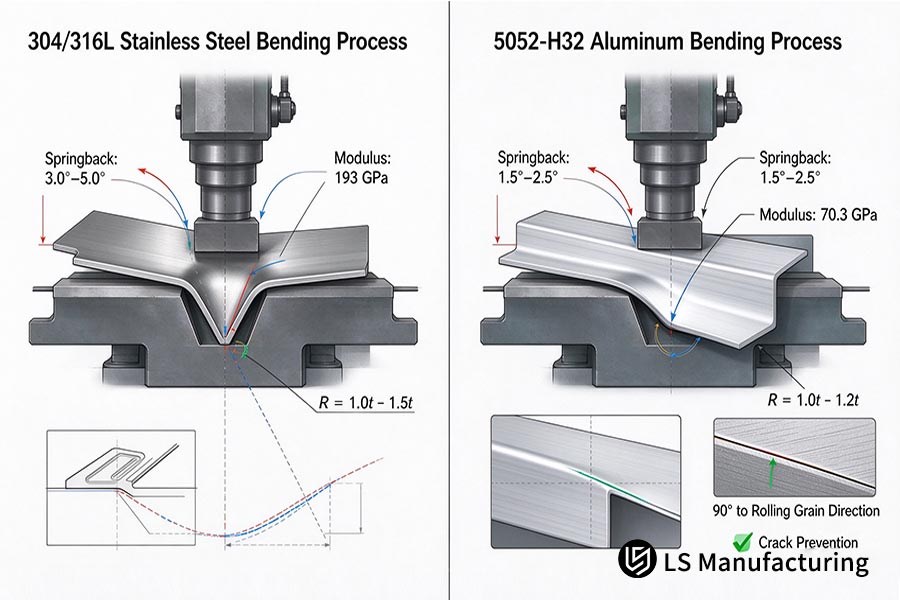
Figure 2: Press brake forming comparison and springback angle compensation for 304/316L stainless steel (3.0°–5.0°) and 5052-H32 aluminum (1.5°–2.5°).
Minimum Bend Radius And Grain Direction
Medical enclosure design guide practice specifies minimum inside radius in rolling direction:
- 304/316L stainless steel: 1.0t–1.5t, with higher deformation resistance
- 5052-H32 aluminum: 1.0t–1.2t, orthogonal to grain
Soft 5052-H32 aluminum is susceptible to fracture in rolling direction, therefore grain direction takes precedence over modulus. Laser-cut edges have tolerance of ±0.005 mm for 304/316L stainless steel and for 5052-H32 aluminum; one sheet metal gauge chart sets thickness.
Related keywords: stainless steel sheet metal tolerances / 5052 aluminum bend radius / medical enclosure tolerance design
Data source and benchmark: ISO 2768-m tolerance class and ASME Y14.5 geometric dimensioning and tolerancing; inspection based on a Zeiss CMM (space indication error MPEE calibration report).
What Is The Difference Between 316L And 5052 For Cleanroom Sanitization?
Cleanroom sanitization involves chemicals where NaOCl, H2O2 plasma or saline bath exposure is possible on 316L molybdenum-containing stainless steel while exposure of bare 5052-H32 results in micropitting under halides. Evaluating 304 vs 316l for medical use comes down to pitting resistance; 316L adds molybdenum to reach a PREN (Pitting Resistance Equivalent Number: Cr-Mo-N index) of 23-25 in comparison to 304 of 18-20.Citric acid passivation by ASTM A967 produces 1-3 nm chromium oxide layer, while MIL-A-8625 Type II anodizing of 5052-H32 maintains Ra 0.8 μm.
Exposure Halide Limits
Chemistry screening involves three tests before release of tools:
1. Available chlorine > 500ppm – only 5052-H32 pitted; 304/316L satisfactory.
2. 121°C steam saturation – 316L passes SCC; 5052-H32 wiping only.
3. 75% alcohol or quaternary ammonium only – anodized 5052-H32 satisfactory.
Ward monitor cart testing will cease after test #3, since anodized 5052-H32 passes inspection without the stainless price tag.
Passivation Oxide Film Formation
Understanding how does passivation protect stainless steel starts with the chemical reaction: citric acid under ASTM A967 strips away free iron at laser cutting sites and provides for the reformation of an oxide film 1-3 nm thick by chromium. Medical sheet metal passivation will make distinction between 316L and 304 in test; sealed 5052-H32 anodizing will have no healing oxide film, thus scratch will remain visible permanently. 316L coupons verified to survive >1,000 hours in ASTM B117-19 salt spray.
Surface Roughness And Sterile Hold
Surface roughness will establish sterile hold time limits: electropolished 316L can achieve Ra ≤0.4μm level while anodized 5052-H32 will be almost twice rougher than 316L. The corrosion resistance of 5052 aluminum sheet depends on sealed anodizing process, that increases oxide film thickness, instead of metal removal. Surface roughness of sheet metal defines cleanroom entry criteria before alloy type.
Related keywords: 316l vs 5052 corrosion / medical enclosure passivation / anodized aluminum enclosures
Data source and benchmark: Judgments on corrosion resistance are based on the ASTM B117-19 salt spray tests and ASTM A967 passivation; mechanical property data from ASM Handbook Vol.2.
How Do Thermal Management And Weight Constraints Impact Design?
Thermal management and weight concerns exert conflicting influence on the design of enclosures: 5052-H32 aluminum cuts weight and dissipates heat; 304/316L stainless steel adds weight and retains heat. Balancing the thermal and structural pros and cons of aluminum clarifies why fanless sealed carts adopt 5052 alloy for passive heat transfer. While density difference sets one constraint at 2.68 g/cm³ vs. 7.93 g/cm³, the other is thermal conductivity.Portable ultrasound enclosures exhibit a definite trend. Weight budgets and heat flow determine the metal used for an enclosure before strength considerations do. Fanless sealed carts with higher internal heat flux require 5052-H32 aluminum; vented floor-standing frames remain feasible in 304 stainless steel.
Weight Budget And Handle Load
Aluminum advantages and disadvantages manifest themselves right away on a cart handle. 5052-H32 aluminum reduces structural weight by nearly two-thirds compared to 304 stainless steel, allowing nurses to maneuver a lighter load. Understanding what is 5052 aluminum sheet ideal for—namely rapid heat dissipation and lightweighting—helps teams eliminate heavy copper pipes. The handle, thus, marks the beginning of sheet metal enclosure selection with a weight budget rather than stiffness study. Procurement departments benefit from lowered weight class and reduced caster capacity of a single material change.
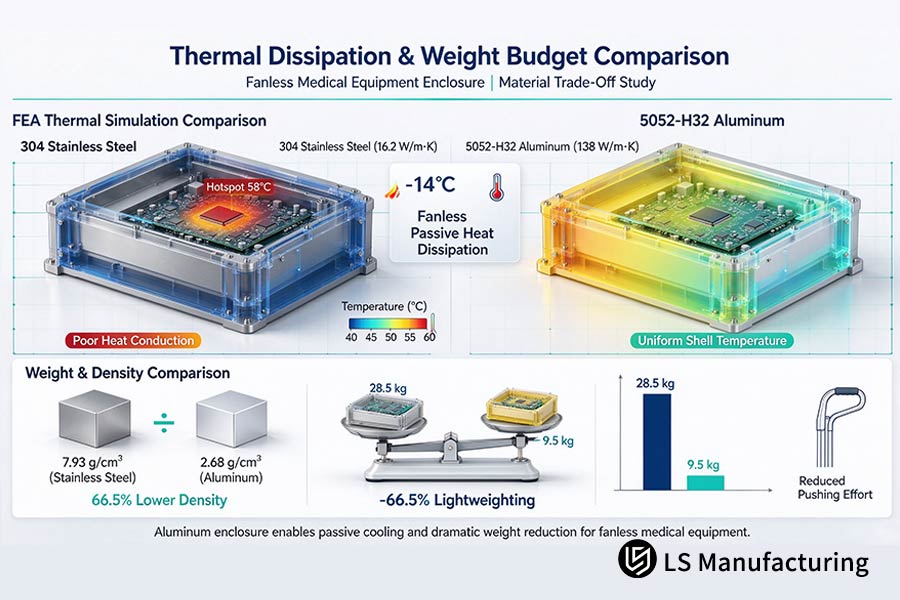
Figure 1: Thermal management and weight budget comparison: 5052-H32 aluminum provides 8.5x higher thermal conductivity while cutting housing weight by 66.5% compared to 304 stainless steel.
Heat Spreading Without Fans In Passively Cooled Systems
Fanless enclosures are treated as passive heat sinks according to practice of medical enclosure design guide. 5052-H32 aluminum heat spreader has 138 W/(m·K) thermal conductivity and spreads motherboard heat outwards, 304 stainless steel has 16.2 W/(m·K) thermal conductivity and traps hotspots with 8.5× difference. IP65 (dust-tight and protected against water jet impact) enclosure sealing prevents vent openings from working as heat sink and makes conduction as only way for heat dissipation. Design includes removal of grilles and copper pipes from sealed aluminum enclosure shells.
When Additional Mass Is Still Needed
Engineers often evaluate what is 5052 aluminum sheet capable of when structural mass is required at the base. What is additional mass value of 5052 aluminum sheets when carts stand still? Floor standing consoles make the opposite trade-off: 304 stainless steel brings needed ballast for anti-tipping stability, while vent grilles and copper heat pipes extract trapped heat. Simply put, wheeled fanless carts have preference to 5052-H32 aluminum, while standing heavy frames are better made from 304 stainless steel.
Related keywords: thermal conductivity aluminum vs stainless / medical cart lightweighting / fanless enclosure heat spreaders
What Are The Cost Trade-Offs Between 304 And 5052 Sheet Metal?
Cost trade-offs between 304 stainless steel sheet metal and 5052-H32 aluminum shift with batch size: 5052-H32 aluminum wins at prototype, 304 stainless steel catches up beyond 85 units. Quotes for stainless steel vs aluminum enclosures show that aluminum wins in early prototyping, while quoting comes out cheaper by $114.70 for each 304 stainless steel unit against $80.08 per 5052-H32 aluminum unit due to nesting (sheet layout optimization). Anodizing and wear-resistant coating become part of 5052-H32 aluminum quotes in volume, 304 stainless steel requires pickling passivation. Short-run mobile carts prefer 5052-H32 aluminum on price; chloride-washed surgical console applications favor 304 stainless steel.
Prototype Batch Forming Load
The manufacturing pros and cons of aluminum begin with forming loads: 5052-H32 aluminum is easier to form by 60% than 304 stainless steel press tonnage and wears down by 35% less in the early runs.304 stainless steel utilizes expensive high-purity nitrogen gas during fiber laser cutting; 5052-H32 aluminum does not require high flow nitrogen gas. Setup time savings get transmitted to procurement teams as earlier first article delivery. Sheet metal DFMA rules capture such load gaps before tooling release.
Finishing Costs At The Volume Crossover
Design guide costing for medical enclosure finishes comes before everything else. Sourcing teams assessing how does passivation protect stainless components note that automated chemical baths keep per-part costs at only 12% against 25% for anodized 5052-H32 aluminum, because the powder coating (heat cured polymer film) cannot be scratched easily. The lifetime costing graph lines coincide in the range of 85 to 120 units. For the budget controller, ward carts go on 5052-H32 aluminum while surgical consoles go for 304 stainless steel. Once the anodizing process is introduced into the sheet metal costs, they change again.
Related keywords: 304 vs 5052 enclosure cost / aluminum enclosure cost drivers / medical cart cost comparison
Why Do Sheet Metal Bending Limits Trigger Manufacturing Defects?
Defect formation in sheet metal forming depends on alloy type: cracking in 304 stainless steel at holes in bend line due to fast work hardening (increase in strength through cold working), and warping in 5052-H32 aluminum during unloading around sharp bends. The percentages of raw scrap differ right away: 16.5% for 304 stainless steel compared to 14.0% for 5052-H32 aluminum. Bend limit explanations for each material: ovality of holes for 304 stainless steel, orange peel for 5052-H32 aluminum. Scrap percentages are kept in 1.8% to 2.5% range for 304/316L stainless steel and 5052-H32 aluminum panels. Prevention of sheet metal defects begins with part geometry rather than alloy composition. Orientation of grains defines 5052-H32 aluminum part integrity, orientation of relief slots 304/316L stainless steel parts integrity.
Grain Orientation And Relief Slots
The medical enclosure design guide starts with grain orientation: 5052-H32 aluminum load-bearing bend lines orient at 45° or 90° from rolling grain because of tearing along grain when bend lines are parallel. 304/316L stainless steel enclosures have water drop and round laser relief slots at bend intersections. Relief slot design reduces stress transfer for 304/316L stainless steel; grain orientation prevents tearing of 5052-H32 aluminum.
Hole-To-Bend Gap Requirements
Hole location determines the most common defects found in stainless steel sheets. There are three criteria that help eliminate waste:
1. Hole edge to bend tangency point: d ≥ 2t + R.
2. Bend intersections: laser relief slots before bending.
3. Holes located next to a flange: form first and then machine.
The ovality defect in 304 stainless steel disappears after criterion 1 is satisfied; 5052-H32 aluminum warp defect disappears after criterion 3 is satisfied.
Finishing Of Secondary Holes
The balance of sheet metal forming versus CNC machining changes in favor of machining where holes are close together: preformed sheets are sent to the CNC machine shop where they are finished-milled to within the precision hole position tolerance band.Full CNC machining cancels out any savings due to laser and bending elsewhere.Simply put, close holes get machined; open sheets remain on the press brake.
Related keywords: 304 stainless steel bending cracking / 5052 aluminum orange peel / medical enclosure bend problems
Data source and benchmark: Forming data computed using sheet forming chapter of Machinery's Handbook, 31st Edition and tensile specifications of ASTM A240/A240M.
Decision Tree For Selection
Medical sheet metal forming analysis begins with chemical compatibility, moves on to cart mobility and heat management, and ends with first-run quantity. Chemical compatibility and fit considerations trump batch economics. Medical carts requiring heavy frame construction below and lightweight shell above must avoid single-metal fabrication: 304 steel frame and 5052-H32 aluminum shell.
1. Disinfection chemistry test - Enclosures exposed to high concentrations of acids, alkalis, sodium hypochlorite, and high-temperature steam proceed to chloride test; enclosures exposed to cleaning by pure alcohol go to mobility test.
2. Chloride test - In the choice of 304 vs 316l for medical enclosures, devices exposed to body fluids and chloride washes mandate 316L stainless steel sheets with ASTM A967 electro-polished passivation and surface finish of Ra 0.4 μm; all other general surgery operation room and laboratories use 304 stainless steel sheets with brushed passivation and tight fit accuracy of ±0.01 mm.
3. Mobility test and heat path test - Enclosures with portable, cart-mounted, or without fan heat dispersion shells move to fit-grade test; floor-based enclosures with heavy vibration damping interior frameworks proceed to batch testing in the 50-100 units transition range.
4. Fit-grade test - Enclosures with ultra-precision fits with accuracy of ±0.005 mm require 5052-H32 aluminum sheets with precision CNC secondary machining, removing 66.5% mass and resulting in 138 W/(m·K) thermal conductivity; general enclosures use 5052-H32 aluminum sheets laser cut, bent and anodized by MIL-A-8625 Type II specification with 24.3% unit cost reduction.
5. Batch screening — custom sheet metal enclosures below 85 units with tight lead time select 5052-H32 aluminum sheet metal at 7 days; runs at or above 85 units with long-term rigidity select 304 stainless steel sheet metal.
6. End boundary condition — carts requiring bottom anti-tipping ballast along with top lightweight design select hybrid approach: 304 stainless steel inner frame and anodized 5052-H32 aluminum outer frame.
Selection of stainless steel vs aluminum enclosure mapping to disinfection chemistry and weight limits before dimensions capability leads to use of hybrid construction for carts requiring ballast.
- Anodized 5052-H32 aluminum outer frames — will conceal conductive fastener grounding sites, leaving grounding resistance to be at ≤0.1Ω for RF shielding.
- Carts requiring bottom ballast along with top lightweight — combine 304 stainless steel inner frame with anodized 5052-H32 aluminum outer frame.
- Passivated 304/316L components — high humidity corrosion test prior to release to verify presence of chromium-based coating on the laser-cut edges.
Related keywords: medical enclosure material selection / 316l vs 5052 selection criteria / hybrid stainless and aluminum enclosure
LS Manufacturing 304 Stainless Steel Vs. 5052 Aluminum For Medical Endoscopy Cart Enclosure: Balancing Rigidity, Heat Dissipation, And Lead Time
The rigidity/heat dissipation/lead time trade-offs for medical endoscopy cart enclosures in medical sheet metal fabrication depend on the alloy selected, as this dictates the trade-off constraint that will be met. The density distinction between 304 stainless steel and 5052-H32 aluminum is 7.93–8.00 g/cm³ versus 2.68 g/cm³, with the thermal conductivity at 16.2 versus 138 W/(m·K). Enclosure panel tolerances follow ISO 2768-1:1989 standards. Chloride rinsed surgical consoles remain on 304/316L stainless steel; alcohol wiped mobile carts enjoy reduced weight and reduced lead times when using 5052-H32 aluminum. Servo bending springback control now follows ASME Y14.5-2018.
Initial Route And Pain Points
Engineers designing the minimally invasive surgery systems asked for all-304 stainless steel enclosures for endoscopy carts, for rigidity and cleaning reasons. The discussion comparing stainless steel enclosures and aluminum enclosures began following first batch quotations. Weight rose to 28.5 kg in this instance, thus raising tipping risks. Internal temperatures reached 58 °C; first batch price was $148.00/unit at 50 units, scrap was 16.5% and lead time reached 14 days in this instance.
Route Change And Process Correction
LS Manufacturing process engineers evaluated the thickness at 2.0 mm against 2.5 mm, the inside bend radius at 1.0t-1.5t against 1.0t-1.2t, and raw scrap at 16.5% against 14.0%. The initial bend trial relieved the internal stress at deep right-angle corners, resulting in 0.35 mm warpage is 5052-H32 aluminum. Water-drop laser relief slots and grain re-orientation removed the warpage; outer panels were changed to 5052-H32 aluminum at 2.5 mm.
Results Obtained
The unit cost reduced from $148.00 to $112.00; a reduction of 24.3% per enclosure at 1-50 units and an additional 28.5% more at volume level. Shell weight reduced from 28.5 kg to 9.5 kg; internal temperature was reduced by 14 °C. Guide rail hole tolerance improved from ±0.1 mm to ±0.01 mm; scrap reduced from 16.5% to 1.8%; the first article delivery was reduced from 12 days to 7 days. In other words, mobile carts got a cooler and lighter shell.
Compliance And Takeaway
- H32 aluminum shells passed ISO 13485:2016 quality system audits and liquid splash tests. Selection tip: mobile endoscopy carts requiring alcohol wiping call for 5052-H32 aluminum with precision bending DFM (design for manufacturability), and chloride fogged surgical consoles will continue using 316L stainless steel. Planning precision sheet metal fabrication processes begins from disinfection chemistry rather than alloy tradition.
"Shell weight and lead time decreased simultaneously after switching from 304 to 5052-H32 aluminum for the outer panels, and clinical validation began on time." — Mechanical Design Lead, minimally invasive surgery systems, Project #MED-2026-104B
Data source and benchmark: LS Manufacturing production delivery records, Project #MED-2026-104A (304 stainless steel baseline route) and Project #MED-2026-104B (5052-H32 optimized production route), measured in cross-process database (sample size >1,500).
Request An Engineering Review
The development of next-generation patient monitors, surgical carts and diagnostic enclosures involves material selection and tolerance allocation issues.
LS Manufacturing senior sheet metal engineers will provide an analysis of your 3D/2D drawings and give a process route comparison and DFM (design for manufacturability) assessment in two hours.
Bending crack limits, ASME Y14.5 geometric dimensioning and tolerancing, and electropolishing practice all stay open for discussion
- Direct engineering hotline: +86 185 6675 9667
- Official technical email: info@lsrpf.com
LS Manufacturing Engineering Center hosts further measured data.

FAQs
1. Which material gives better corrosion resistance?
Chloride washdowns prefer 316L stainless steel, whereas alcohol wipe ward housings work well on anodized 5052-H32 aluminum. Molybdenum 2.0% to 3.0% brings 316L stainless steel to a PREN 23-25 compared to 18-20 on 304 stainless steel. Anodizing in sealed MIL-A-8625 Type II shows reduced corrosion resistance for acids and alkalis on 5052-H32 aluminum. LS Manufacturing passivation production line allows incoming inspection teams to check 316L coupons after 1,000 h by ASTM B117-19 standard.
Data Source: ASTM A967 passivation specification.
2. What is the main breakeven point for selection between 5052 aluminum and 304 stainless steel?
Batch quantity determines a crossover point: 5052-H32 aluminum prevails before 85, 304 stainless steel approaches after 85. Quotes start from $112.00 for 5052-H32 aluminum against $148.00 for 304 stainless steel, saving 24.3% per enclosure up to 50 units. Budgets of capital equalize at 85-120 units range according to LS Manufacturing 2025-2026 cross-process database, sample size >1,500.
Data Source: LS Manufacturing cross-process database.
3. How does bending tolerance of 5052 aluminum compare with 304 stainless steel?
The bending tolerance of precision-grade 304 stainless steel and 5052-H32 aluminum is held within ±0.01 mm after calibration of the servo pressure compensator. Spring back values range from 3°–5° on 304 stainless steel to 1.5°–2.5° on 5052-H32 aluminum; modulus ranges from 193 GPa to 70.3 GPa. The ASME Y14.5-2018 callout facilitates the assembly of the slide rails without shims.
Data Source: Machinery's Handbook, 31st Edition.
4. Is 5052 aluminum able to substitute for 304 stainless steel in medical cart enclosures?
Alcohol-cleaned mobile cart enclosures are made of 5052-H32 aluminum; surgical carts exposed to chloride fogging are constructed of 304/316L stainless steel. The density drops from 7.93–8.00 g/cm³ to 2.68 g/cm³, while conductivity rises from 16.2 to 138 W/(m·K). Fleet management cites project #MED-2026-104B where the anodized aluminum shells met ISO 13485:2016 audit.
Data Source: LS Manufacturing Project #MED-2026-104B.
5. What is the purpose of chemical passivation as it relates to stainless steel enclosures after sheet metal cutting?
Regarding how does passivation protect stainless enclosures, the process removes free surface iron to allow a stable 1–3 nm chromium oxide layer to reform via citric acid as described in ASTM A967. 316L stainless steel forms its chromium film after sheet metal cutting. The 5052-H32 aluminum does not possess self-repairing characteristics. ASTM B117-19 sampling at LS Manufacturing shows film continuity on 316L stainless steel prior to shipment.
Data Source: Documentation for ASTM A967 standard.
6. How to make a quick decision on stainless steel versus aluminum for a new enclosure?
Disinfection requirements and payload weight determine new enclosure material selection; routing logic is shown in the decision-tree section above. Chloride washdown and weight requirements suggest stainless steel 304/316L, while mobility carts and low-volume prototyping suggest 5052-H32 aluminum. Project #MED-2026-104B reduced lead-time of endoscopy cart from 12 to 7 days.
Summary
The designers upload their 3D/2D sketches and get one route comparison process and one DFM analysis with response time frames not exceeding two hours in order to protect the validation plans. The bending tolerance limits, ASME Y14.5 geometric dimensioning & tolerancing, and electropolishing procedure remain for further debate.
The procurement team gets in touch with process review specialists via the toll free number +86 185 6675 9667 or the technical support e-mail info@lsrpf.com.