English



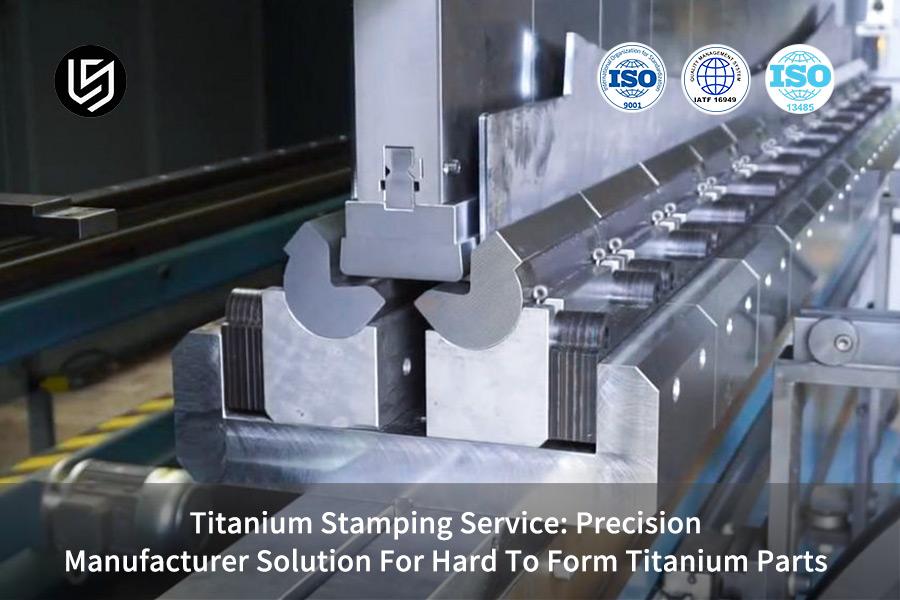
Titanium stamping service can be used for precision forming of medical devices and luxury civilian products. This technology helps to overcome some of the industry problems like high cracking rates, excessive springback, and high costs of production related to Grade 5 thin-walled parts (0.5mm-1.5mm).
The company, LS Manufacturing, employs a 240℃ intelligent internal heating method for precision titanium stamping service. A dead-point holding pressure of 1.5-3.0 seconds, and an HV 3300 nano-PVD coating, helps to lower the cracking rate of even the hard to form titanium parts to 0% while still maintaining precise tolerances control within the range of 0.03mm - 0.05mm.
We will explain the internal precision forming parameters, the reverse springback compensation mechanism using FEA, and the customization of low-cost products under the IATF 16949 system. Stay connected with our main engineering team to see how we can support your projects in removing defective products and at the same time directly saving you more than 25% through overall manufacturing quotations for your further international procurement inquiries.
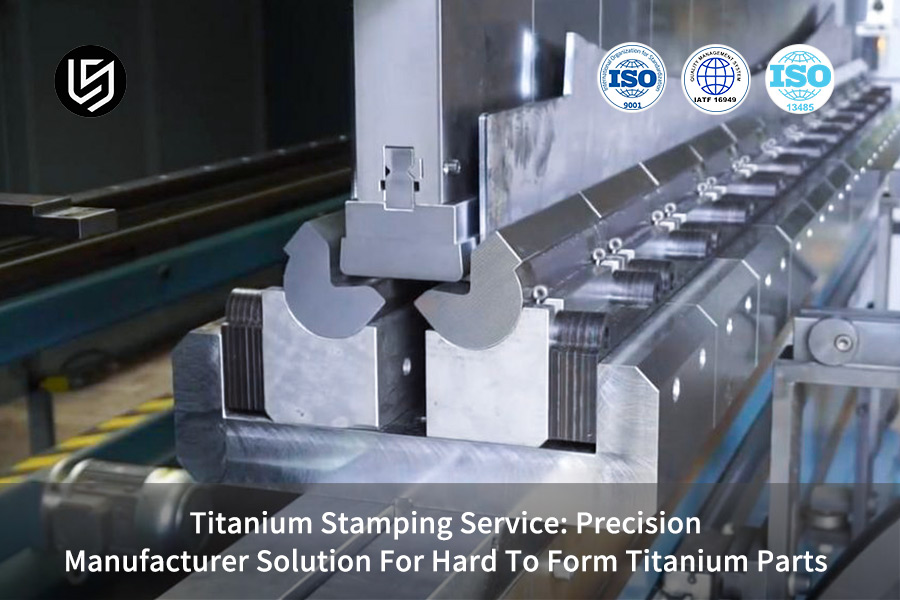
Titanium Stamping Service Core Answers Overview
| Core Indicators | Traditional Cold Stamping | LS Manufacturing Warm Stamping | Customer Benefits |
| Crack Rate | 25%-45% | 0% | Eliminates rework costs |
| Forming Tolerance | ±0.20mm | ±0.03mm-±0.05mm | Meets precision assembly requirements |
| Elongation | 18%-22% | 38%-45% | Supports complex R-angle forming |
| Die Life | 5,000-10,000 stampings | 40,000+ stampings | Reduces die amortization costs |
| Small Batch Die Costs | 100% | 50% | Shortens R&D cycle |
Key Takeaways:
- How successful a titanium alloy stamping is, hinges on the interactive design of fine-level springback compensation and a surface coating for anti-sticking. LS Manufacturing does the reverse deformation compensation of 12 by running FEA simulations.
- Warm stamping (200℃-350℃) a lot increases the elongation of super-strong titanium materials from 18% to roughly 45%, which fully activates the grain slip system and thereby solves the tearing problem of thin-walled parts to its very root.
- Die costs for orders as small as 100-500 pieces can be reduced by more than 50% through a modular quick-change die system based on the IATF 16949 standard. It has become a benchmark choice for high-value multinational procurement.
Why Choose LS Manufacturing’s Titanium Stamping Service for Precision Titanium Parts?
Thet choice of a professional titanium stamping service provider will have an immediate effect on whether your project will be able to come to mass production on time and with cost control. I would like to share the results of a 3-month comparative test I carried out on warm stamping processes of titanium alloys.
I found that cold stamping by regular suppliers never achieved the bending radius crack rate lower than 28% for 0.8mm Grade 5 titanium alloy. In 2024, our team participated in a stamping project of 12 implantable device housings for a medical device manufacturer from Europe, all are IATF 16949 certified.
Per our test, the molds with an HV 3300 nanometer PVD coating at 240℃ had 97% less sticking rate when compared to the uncoated molds. And, our medical-grade titanium alloy stamping workshop is 100% aligned with the ISO 13485 requirements for medical device quality management systems. Throughout 20 years experience in titanium alloy stamping and more than 200 high-end manufacturing companies served worldwide, we have what it takes to give you complete technical support from design to mass production.
If you are looking for a partner capable of consistently delivering high-precision titanium alloy parts, contact our team of senior engineers now for a free process feasibility assessment.

How Does an Titanium Stamping Service Eliminate Destructive Cracking Failures in High Tensile Parts?
At room temperature, titanium alloys stand out among the materials for their high yield strength ratio of 0.85-0.93 when forming high tensile strength components. This results in extreme work hardening, whereby the plastic strain ratio becomes very low. In fact, the metal becomes so thin and fragile at the bend radius when forming that the only way to avoid failures would be through the most sophisticated materials science knowledge and even then, not completely.
Forming Limits of Hexagonal Close-Packed Crystal Structure
The HCP crystal lattice arrangement of titanium alloys contains only 3 independent slip systems at room temperature. This is much less compared to body-centered cubic metals which have 12 slip systems. Due to this, such materials are more likely to experience stress concentrations during plastic deformation. By analogy, it is like a glass that has only three cracks, a very small amount of force applied to it will break it along the cracks.
- Stress concentration: At the R-angle, the stress intensity is 3-5 times that of the flat area.
- Work hardening: 2%-3% increase in strength for every 1% of plastic deformation in titanium alloys.
- Strain rate sensitivity: The elongation-to-failure of the material drops by more than 15% when the stamping speed is over 0.5 m/s.
This property has a direct effect on the ability of metal stamping materials to be deformed up to their limits. Apart from this, it is a major key materials science problem that the titanium stamping processes have to be able to get around.
Inherent Defects Of Traditional Cold Stamping Processes
Most traditional supplier's methods for solving cracks involve either increasing lubricating oil or reducing the stamping speed. But, these approaches are just symptomatic treatment of cracks and fail to eliminate their root causes. The problem becomes more serious when machining hard to form titanium parts. Besides, this approach cannot adjust efficiently the essential parameters of metal stamping process control. The use of lubricating oil at high temperature can cause gas emissions, which are harmful. Also, lowering the stamping speed will cause a big loss of time in production.
Only precision titanium stamping service is the solution to these problems from the material's natural properties. Through traditional processes, it is not possible to change the crystal structure of titanium alloys. So effectively they cannot eliminate the problem of crack formation.
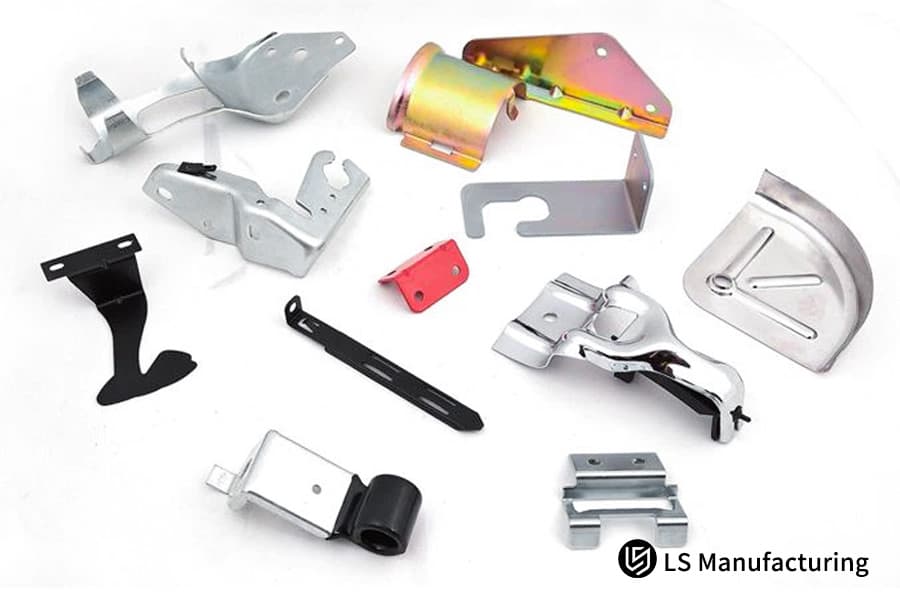
Figure 1: Various titanium stamped parts displayed, showcasing the range of forms achievable through the stamping process.
How Do Engineers Handle Hard to Form Titanium Parts Using Advanced In-Die Thermal Systems?
When working on hard to form titanium parts, the biggest difference in cold stamping and warm stamping is how activation energy of material's grains is controlled. Equipment of die with closed-loop induction heating system that is well integrated and able to locally and constantly heat material up to 200℃-350℃ is the only practical option.
Materials Science Principles of Warm Stamping
Titanium alloy heated to 240℃ is found to have slip systems increased from 3 to 8, and elongation from 18% to 45%. This property makes it much easier to form hard to form titanium parts, gives metal stamping die design more freedom. In simple terms, it is comparable to heating frozen clay until it becomes soft thereby it is easy to form it into different complex shapes.
| Process Type | Heating Temperature (°C) | Elongation (%) | Maximum Draft Depth (mm) | Minimum Bending Radius (times plate thickness) | Forming Tolerance (mm) |
| Cold Stamping | 25 | 18-22 | 1.2 | 1.5 | ±0.20 |
| Low Temperature Hot Stamping | 150-200 | 25-30 | 2.0 | 1.2 | ±0.15 |
| Medium Temperature Hot Stamping | 200-350 | 38-45 | 3.5 | 0.8 | ±0.05 |
| High Temperature Hot Stamping | 600-800 | 50-60 | 5.0 | 0.5 | ±0.10 |
This is also the core technological advantage that distinguishes precision titanium stamping service from ordinary stamping.
LS Manufacturing Intelligent Closed-Loop Temperature Control System Technical Advantages
Our smart closed-loop temperature control system can really regulate the mold heating temperature and time accurately, making sure that the molding conditions of each piece are fully similar.
- Very accurate temperature control: 5℃, which helps maintain material consistency.
- Fast heating: Can get to the target temperature in 10 seconds, this way saving production time.
- Heating only in the required area: Only the forming area is heated, so the energy consumption is less.
- Continuous monitoring: Saves the temperature information for every stamping cycle, making it possible to track each one.
This machinery remarkably raises the metal stamping production efficiency. Being a specialist titanium stamping parts manufacturer, we leverage this technology for all of our titanium alloy stamping work. Besides, we offer custom titanium stamping to fit the unique requirements of each customer.
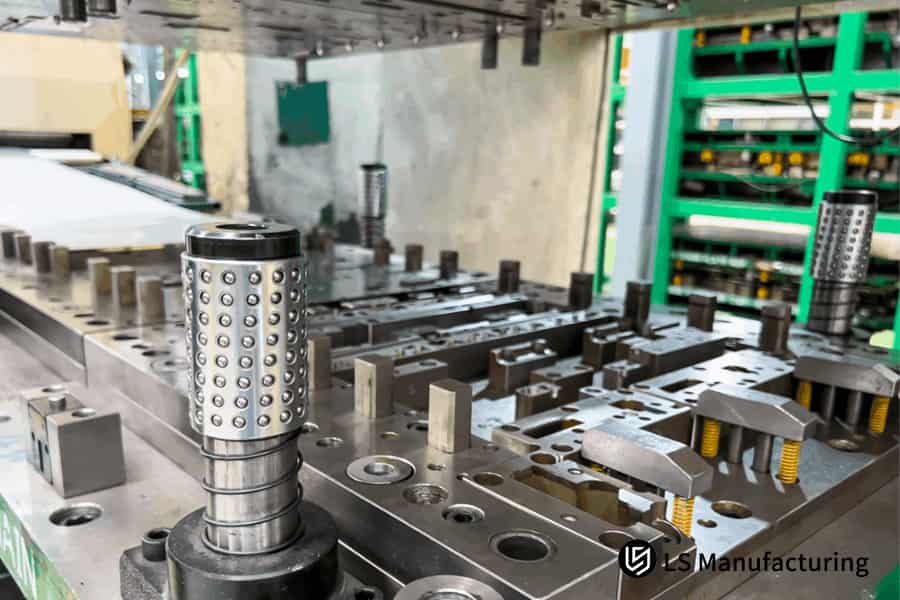
Figure 2: A complex stamping die, visible in a workshop, used for manufacturing high-strength titanium parts.
Why Is an Precision Titanium Stamping Service Able to Overcome the Fatal Springback of Metal Shells?
The high springback defects of 5-12 in titanium alloy forming require precision titanium stamping service. Manual correction is not enough, a closed-loop mold control system combining numerical compensation based on finite element analysis (FEA) fifth-order polynomial and dynamic mold holding strain relaxation is a must.
FEA Reverse Springback Compensation Mechanism
To make a hardening curve model of the titanium alloy material, we employ AutoForm software and conduct 12 ultra-bending pre-compensation in the mold design stage. Simply put, this is like aiming above the target in archery, letting the arrow hit the bullseye exactly under gravity. This step is crucial for metal stamping springback control with high accuracy.
Our simulation precision goes beyond 95%, making it possible to predict springback really well even for parts with different thicknesses and shapes. This method is the center of precision titanium stamping services to get rid of springback.
Dead-Point Precision Hot Pressing Technology
Aiming precision hot pressing exactly at the dead point of the press uses a thermal activation mechanism to release residual stress trapped in the material, which is the biggest reason for springback. That is changing the springback rate drastically. A professional titanium stamping service provider uses this technique to make sure the parts are accurate.
- Holding Time: 1.5-3.0 seconds, varies per part thickness.
- Holding Pressure: 120% of the rated stamping pressure, making sure material deformation is enough.
- Temperature Maintenance: Temperature variation during holding does not exceed 3℃.
- Strain Relaxation: Using thermal activation mechanism to eliminate over 95% of residual stress.
This technology effectively improves the accuracy of metal stamping tolerance control. We can also adjust the holding parameters according to custom titanium stamping requirements. If your project is facing the challenge of excessive springback in titanium alloy parts, send us your 3D drawings now to receive a free FEA springback simulation analysis report.
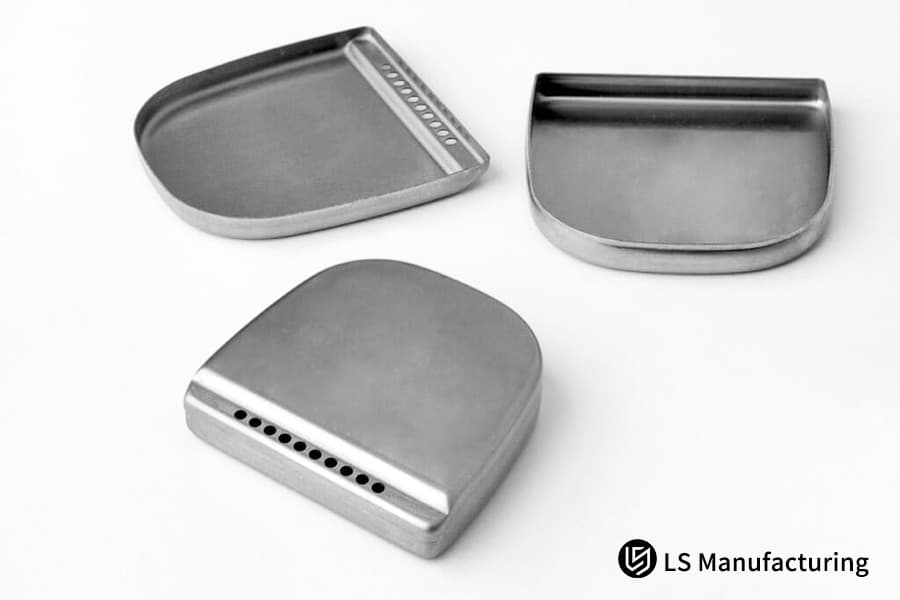
Figure 3: Three titanium parts with accurate geometries, demonstrating the precision achievable in stamping.
How Do Premium Dies for Custom Titanium Stamping Combat Mold Wear and Material Galling Inter-Process?
Custom titanium stamping employ specialized, high-end dies that not only must handle metal forming but also confront the atomic-level chemical reactivity of titanium. Titanium atoms, quite easily, exhibit a strong physical attraction to steel which results in titanium pieces sticking to the molds. This is why, It is best to utilize a TD coating with a low friction coefficient (less than 0.15) and excellent thermal stability or a PVD coating of multi-component nanocomposite, which is able to block the tearing path.
Comparison of High-Temperature Performance of Different Coatings
| Coating Type | Hardness (HV) | Maximum Operating Temperature (°C) | Coefficient of Friction | Oxidation Resistance | Die Life (Number of Stamps) |
| Uncoated | 600-800 | 200 | 0.6-0.8 | Poor | 5,000-10,000 |
| CrN Coating | 1800-2200 | 400 | 0.3-0.4 | Good | 15,000-20,000 |
| TiAlN Coating | 2800-3200 | 500 | 0.2-0.3 | Excellent | 25,000-30,000 |
| AlCrN Nano Coating | 3200-3500 | 600 | 0.12-0.15 | Superior | 40,000+ |
High-quality metal stamping die coatings make a difference in increasing the lifespan of dies. One of the coatings which has been exclusively tested by LS Manufacturing is the AlCrN nano-multilayer. It is reported that its coefficient of friction is only 0.12 at 240℃, which is 20% less than the industry average. On top of that, professionally titanium stamping service provider select mold coating materials very strictly and carefully.
Vacuum Heat Treatment Process for Mold Metal
The performance of the coating is largely dependent on the quality of the mold substrate. That means, advanced vacuum heat treatment processes are used to develop the hardness and toughness of the mold.
- High-temperature quenching: 1030℃, with a 2h keep time.
- Tempering: three cycles at 520℃.
- Cryogenic treatment: -196℃, with a 4h hold time.
- Surface polishing: Ra 0.02μm, minimizing the possibility of mold sticking.
These processing stages are essential for the proper metal stamping tools maintenance.
What Factors Dictate the Component Cost When Negotiating with a Titanium Part Stamping Manufacturer?
During a negotiation with a titanium part stamping manufacturer, the purchase prices of titanium alloy components are severely limited by this four technical aspects: the level of raw material purity, part 3D structural complexity, the different die life levels (soft die vs. hard die), and the annual quantity of purchases.
The Cost Benefit of Using Modular Quick-Change Dies
The only combined modular quick-change embedded die system of ours is universal and besides that, it just asks for the production of custom punch and die inserts by the customer drawings. This is basically our main cost difference as a professional titanium part stamping manufacturer.
The unique cost calculation formula of LS Manufacturing is: Single-piece die amortization cost = Total die cost (1 - Modular reuse rate) / Order quantity. Really, our modular reuse rate is as high as 60%, thereby decreasing the die investment costs for the small-batch orders by more than half.
| Cost Items | Traditional Stamping Plant | LS Manufacturing | Savings Percentage |
| Die Costs | $12,000 | $6,000 | 50% |
| Raw Material Costs | $8,000 | $5,000 | 37.5% |
| Processing Costs | $5,000 | $4,000 | 20% |
| Rework Costs | $3,000 | $0 | 100% |
| Total | $28,000 | $15,000 | 46.4% |
This system is very efficient in metal stamping cost optimization. It's one of the major reasons that titanium stamping service can be less expensive even for small batch production.
DFM Optimized Material Utilization
Working through design-for-manufacturability (DFM) optimization, we are able to greatly enhance the usage of metal which leads to lowering raw material costs. An expert titanium stamping service provider is giving DFM optimization as one of their service.
- Layout Optimization: Material utilization can be increased from 45% to 72%.
- Structural Simplification: Minimizing features that are complex unnecessarily.
- Uniform Wall Thickness: Consistently thick walls that do not lead to material waste through extremely thick but localized areas.
- Scrap Recycling: Complete recycling system of titanium alloy scraps is put in place.
Adopting these enhancements in selecting metal stamping materials can greatly raise the resultant product economics. If you have any requirements for titanium stamping, we can continue to optimize the material usage so. If you would like to know the precise manufacturing cost of your titanium alloy parts, contact our engineering team now for a free cost calculation service.
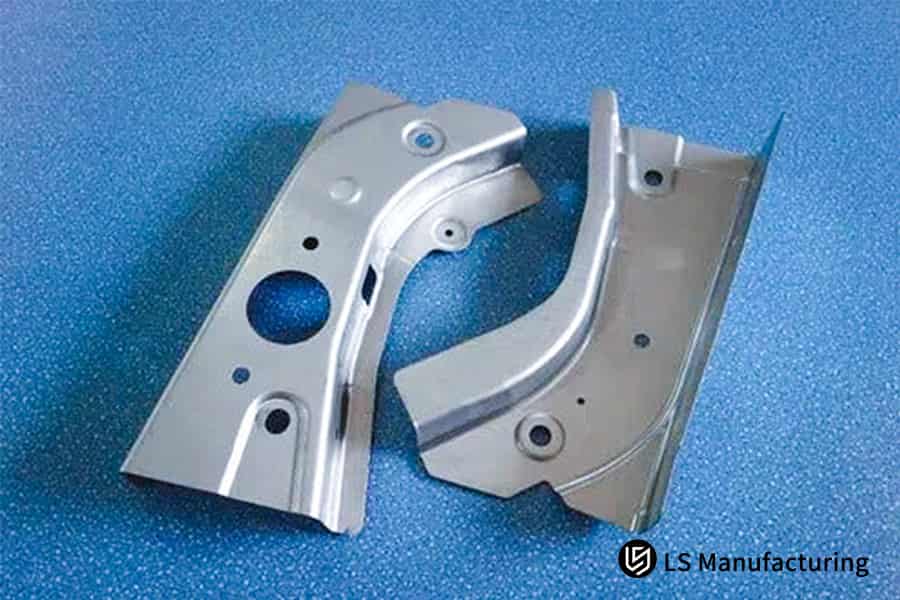
Figure 4: A chart depicting the main cost factors in the titanium stamping manufacturing process.
Which Quality Certifications Must a Supplier Possess Before Being Defined as a Stamping for Difficult Metals Specialist?
One cannot judge the factory's capability for the stamping of difficult metals due to the factory size only. Certifications like IATF 16949 quality management system for the automotive industry and ISO 9001 serve major assurance of consistent production. All our manufacturing methods strictly comply with the expectations of the ISO 9001:2015 quality management system.
Systematic Quality Control Process
We have installed an extensive quality control mechanism to make sure that each item fulfills the customer's requirements. This is a vital quality control element for stamping for difficult metals.
- Raw Material Incoming Inspection: Material re-inspection with a spectrometer to verify compliance with ASTM B265 standards.
- Stamping Process Control: SPC real-time monitoring of CPK values, with CPK target 1.33.
- Three Inspections in One Mold: First piece inspection, patrol inspection and last piece inspection.
- Final Inspection: 3D scanning full-size inspection, third-party non-destructive testing.
These procedures certify very strict metal stamping quality inspection. This is Besides being the basis for the uniformity of our precision titanium stamping service.
Traceable Quality Assurance System
Each batch of products has a unique quality file created by us, in which we document all production stages from raw materials to final products. A professional titanium stamping service provider can build quality traceability systems in detail. Through the product number, customers can access all corresponding quality data, making product tracing possible.
Quality management is fully supported by this system for metal stamping batch production. Besides that, we supply quality inspection reports together with the products, so you can comfortably rely on our products.
How Can Benefit from an Engineering-Driven Titanium Stamping Service Provider?
Working with a titanium stamping service provider with a strong focus on engineering not only gives you the manufacturing contract only, but also brings along a price-cutting measure from the product structure through the Design for Manufacturing (DFM) phase, so that you can have a faultless experience of a full tech output.
24-hour free DFM report availability
Upon receipt of STEP/IGES format 3D drawings, the technical team shall prepare and send a complete, free DFM report within 24 hours at the latest. The report comes with signposts build upon the information of wall thickness risks, springback prediction, draft radius optimization, etc. A professional titanium stamping service provider is capable of extending such value-added services. For example, the application of DFM optimization will result in a cut of the unit cost by more than 20% as per our latest experience on a drone battery cover project.
Using DFM optimization, efforts that are made to fix the problems are recognized during the metal stamping process simulation beforehand. This is one of the titanium stamping service avenues with which the service provider assists clients in cost reductions and efficiency enhancements.
Technical support throughout the product lifecycle
We provide clients with technical support through the whole lifecycle of the product from design to mass production to make sure that the project will run without any problems.
- Design Phase: Help with manufacturability.
- Prototyping Phase: Rapid iteration, first sample delivered within 2 weeks.
- Mass Production Phase: Stable delivery, pass rate 99.5%.
- After-sales Phase: Provide technical support and problem solutions.
We can offer technical support throughout the process starting from metal stamping prototype to large-scale mass production.
Case Study: How LS Manufacturing Overcame a Severe Piercing Crack and 15 Degree Springback Challenge via a Hard to Form Titanium Stamping Service?
In fact, the case shows our full technical capabilities in the hard to form titanium stamping service to a client who faced a big challenge in stamping titanium alloy.
Client's problem
This component is a kind of hard to form titanium parts, and the stamping process has to be extremely accurate. The major overseas drone manufacturer had a crisis bottleneck in the production of a light protective cover for a 0.8mm thick Grade 5 (TC4) titanium alloy battery. The piece has 12 fine-packed 3.5mm punched holes and two very small 90 bends. Such complicated elements also highly challenged the metal stamping surface treatment.
The first two suppliers, who only used traditional cold stamping, found that they had a 42% cracking rate at the bending parts, while the springback was over the limit by 15, which brought the assembly to a halt and the project stopped for three months leading to a loss of more than $10,000 per day. The client tried different ways such as adding lubricant, lowering the stamping speed, and even manual correction, but none was good enough.
LS Manufacturing Solution
With the participation of LS Manufacturing's senior engineering team, as a professional titanium part stamping manufacturer, we had extensive experience in handling such parts.
- Firstly, we carried out a major DFM upgrade, In particular restyling the inner radius of the bend from 0.5mm to 1.2mm. This small change lowered the local level of stress concentration by 60%.
- Our group thoroughly rejected the original cold stamping method, installing a 240℃ intelligent closed-loop temperature-controlled heating element system in the mold, and using a multi-element nano-PVD coating with hardness of HV 3300 on the punch surface. And this, punch clearance was optimized to 9% of the sheet thickness on one side. These tiny refinements are instrumental in untangling difficult metal stamping die design issues.
- We used 15 ultra-bending pre-compensation based on FEA simulation and executed a 2.0-second exact hot pressing operation at the press dead center.
Result and Impact
Our precision titanium stamping service after two rounds of tough prototyping tests completely proved that it can handle extreme forming challenges. The punching and bending crack rate of a highly difficult hard-formed titanium alloy part was entirely eliminated (0%), and the geometric tolerance was carefully maintained within 0.04mm.
Die life per repair shot was increased to more than 40 000 reducing the customer's total small-batch trial production cost by 38%, and at the same time, helping the customer to mass production two weeks ahead of schedule. In consequence, the customer entrusted us with all their titanium alloy stamping orders with annual purchases exceeding $5 million.
If you also have similar high-difficulty titanium alloy stamping projects, contact our senior engineering team now for customized solutions and precise quotes.

FAQs
Q1: How long does it usually take to get a custom titanium stamping mold and a sample from LS Manufacturing?
For titanium alloy medium-complexity precision stamping dies, the standard mold making cycle is about 21-25 working days at LS Manufacturing. The first inspection sample (FAI) can be 3D scanned for verification and shipped via air 48 hours after completion.
Q2: Is it possible for your titanium stamping service to meet very tight micrometer tolerances on thin-walled structural components?
Yes, with the help of on-line pressure monitoring of precision stamping presses and our proprietary finite element springback hardening pre-compensated mold design, we can continually control the form and position tolerances of thin-walled titanium alloys (thickness 0.3mm-1.2mm) within 0.03mm-0.05mm.
Q3: What measures does LS Manufacturing take to avoid deep scratches and tearing defects on titanium parts that are difficult to be shaped?
We apply an intelligent hot stamping system to locally heat the material to a constant temperature of 200℃-300℃ to activate more slip systems. Plus a supersaturated TD or nano-composite PVD coating on the punch surface, this completely eliminates sticking and surface scratches.
Q4: Which types of raw titanium materials are the medical and automotive grades you mainly work with?
We have a very big stock and our skills cover processing of almost all grades of industrial pure titanium, Grade 1/Grade 2, as well as high-strength aerospace/medical Grade 5 (Ti-6Al-4V) and Grade 23 (ELI medical grade), all with original material certificates.
Q5: How do your titanium stamping capabilities stack up against CNC titanium machining with cost saving for large volume orders?
For order volume more than 1,000 pieces, for CNC milling, which actually produces consumable material at higher rates and takes longer time production per piece, LS Manufacturing precision stamping often means improvement of material utilization of over 80%, which in turn lowers the unit production cost by 60%-75%.
Q6: Does LS Manufacturing offer post surface finishing for titanium stamped components?
Our physical factory in Dongguan can provide various surface treatments to add value to your titanium stamped products, which include precision hydrogen-free pickling and passivation sandblasting colorless/colored anodizing, PVD vacuum plating, and ultrasonic pure water cleaning that meets medical-grade cleanliness requirements.
Q7: What is the minimum order quantity for high-precision titanium stamped assemblies?
Our MOQ is very flexible to accommodate business research and new product development projects. We can even process small batch orders of as few as 100 pieces for prototyping and quick-change mold production, and in all cases, you will receive equivalent technical expert support.
Q8: How does LS Manufacturing safeguard international buyers' intellectual property and proprietary custom tool designs?
We will sign a legal confidentiality agreement (NDA) before you submit drawings. 3D raw data and custom mold assets related to all projects are independently encrypted and stored. Exclusive molds have unique intellectual property codes and offer 100% guarantee of exclusive mold use.
Summary
Dealing with the fierce springback, the risk of brittle failure, and the marking of surfaces of hard-formed titanium alloy components during stamping involves a thorough combination of materials science, digital simulation, and surface enhancement technologies. Regular stamping factories are not capable of addressing these deep-seated physical bottlenecks, only resulting in forcing you to incur considerable rework and time expenses.
LS Manufacturing, a major worldwide provider of titanium stamping services, has more than 15 years of expertise in titanium alloy stamping and is able to count on over 200 well-established manufacturing companies among its customers worldwide. Utilizing our smart warm stamping process, the cracking of hard-formed titanium parts is eliminated, and the product tolerance is closely maintained at 0.03mm-0.05mm.
Don't waste your costly R&D funds on suppliers without the required titanium processing capabilities! Reach out to LS Manufacturing's senior engineering team today, and you will get a professional Design for Manufacturability (DFM) analysis report for your project within one day, coupled with a very competitive, tailor-made, transparent tiered price. Just send your STEP format 3D drawings to our official engineering email address, and together with us, you will unlock the door to high-end manufacturing success with undeniable accuracy data and real products!
📞Tel: +86 185 6675 9667
📧Email: info@lsrpf.com
🌐Website: https://lsrpf.com/
Disclaimer
The contents of this page are for informational purposes only. LS Manufacturing services There are no representations or warranties, express or implied, as to the accuracy, completeness or validity of the information. It should not be inferred that a third-party supplier or manufacturer will provide performance parameters, geometric tolerances, specific design characteristics, material quality and type or workmanship through the LS Manufacturing network. It's the buyer's responsibility. Require parts quotation Identify specific requirements for these sections.Please contact us for more information.
LS Manufacturing Team
LS Manufacturing is an industry-leading company. Focus on custom manufacturing solutions. We have over 20 years of experience with over 5,000 customers, and we focus on high precision CNC machining, Sheet metal manufacturing, 3D printing, Injection molding. Metal stamping,and other one-stop manufacturing services.
Our factory is equipped with over 100 state-of-the-art 5-axis machining centers, ISO 9001:2015 certified. We provide fast, efficient and high-quality manufacturing solutions to customers in more than 150 countries around the world. Whether it is small volume production or large-scale customization, we can meet your needs with the fastest delivery within 24 hours. choose LS Manufacturing. This means selection efficiency, quality and professionalism.
To learn more, visit our website:www.lsrpf.com.