English



TL;DR: Medical grade stainless steel welding is a unique welding process which does not pose any risks of micro-crevice oxidization or biocompatibility. The technique provides crevice-free sterilized joints using shielded gases and localized heat sources with tolerances of ±0.008 mm and surface roughness (Ra) ≤ 0.4 μm.
For novice engineers and junior procurement managers, interpreting the criteria for sanitary welding poses challenges on what to consider in terms of discoloration and acceptable metallurgy. For instance, sanitary welds of austenitic alloys create sterile flow paths without localizing chromium loss and contamination of parent metal.
This simple guide explains hygiene criteria along with a practical process comparison chart for orbital GTAW and focused laser energy sources. In other words, understanding such engineering basics will guarantee structural compliance.
Key Takeaways
- Defect removal: Defect removal forms the crux of stainless steel welds used in medical applications. Local heat control and gas shielding ensure absence of porosity, lack of fusion, and oxide slag on inner wall, maintaining a sanitary flow path surface roughness of Ra ≤ 0.4 μm.
- Oxygen level: Purity forms the important index for cleanliness. During back purging using argon gas, argon shielding gas purity must reach ≥ 99.995% and the residual oxygen level inside the tube bore must remain ≤ 70 ppm to avoid sensitization corrosion and failure of passive film.
- Tolerance and HAZ: The tolerance capability is directly related to the heat-affected zone (HAZ). In the laser welding process, a heat-affected zone (HAZ) of 0.1–0.3 mm is achieved which is much lower than the TIG welding and maintains thin-wall catheter assembly dimension at an accuracy level of ±0.008 mm without thermal distortion.
Why Should You Rely on This Beginner’s Guide?
The guide is created by Gloria, a seasoned engineering professional with more than 15 years of experience in precision manufacturing and medical prototypes processes (Learn from Gloria’s Engineering Insights on LinkedIn through the mechanisms). The guide has been co-reviewed by LS Manufacturing Chief Medical Process Team based on the production database.
What Is Medical-Grade Stainless Steel Welding?
Medical grade welding refers to a precise welding procedure used in fusing austenitic stainless steels like 304L and 316L, under sterile and corrosion-resistant conditions.
- Key concept: Ultra pure inert gas creates an isolation from the environment and very little heat input ensures no oxidation and micro precipitation.
- Precise fit: Fit tolerance of ±0.008mm, with a surface finish of Ra ≤ 0.4um for a sterile flow path.
- Common applications: Implant encasement in vivo and surgical fluid tubing.
- Extreme case: Parts that are contaminated with heavy grease and fit up gaps exceeding 0.05mm fall out of the precise category.
The Sterile Engineering Boundary
- Unlike conventional industrial welding, sterile industrial welding should meet biocompatibility standards with respect to non-leaching of heavy metal ions and resistance to multiple exposure to high-temperature autoclaving.
- The weld joint must be crevice-less, as a microscopic crevice is a bacterial trap not amenable to clean-in-place (CIP).
Metallurgical Basis
Low-carbon grade 316L stainless steel is selected primarily for its resistance to sensitization during thermal cycles. In accordance with ASM Handbook Vol. 6, austenitic stainless steels undergo chromium carbide (Cr23C6) precipitation along grain boundaries within the critical sensitization temperature range of 425°C to 850°C. To prevent the parent metal and heat-affected zone from dwelling in this temperature zone during multipass welding, the inter-pass temperature must be strictly controlled at ≤ 175°C.
How Do Cleanliness Standards for Welding Apply?
Cleaning welding specification is a quantified quality specification that dictates the integrity of the antioxidant layer coating on the weld joint and the sterile liquid bonding capacity.
- Engineering principle: by maintaining constant flow of backing argon, the residual oxygen level on the rear part of the weld pool is controlled at a level ≤ 70 PPM, hence the elimination of the porous brittle oxide scale called Sugaring.
- Temperature control: inter-pass temperature maintained at ≤ 175 deg C.
- Value to industry: it defines the entry requirements of equipment used in the pharmaceutical industry and the tubing of endoscopes.
- Scope note: it does not apply to ordinary building structures, which have thick oxide scale allowed.
Key Clauses of AWS D18.1 and ASME BPE
1. Amount of oxygen present in the backing shield gas shall be ≤ 70 ppm, and this is applicable for the first three stages of the AWS D18.2 discolouration table.
2. Flow path media contact surface shall comply with Ra ≤ 0.4um and be chemically passivated.
3. Authority reference: ASME BPE (Bioprocessing Equipment) MJ (Material Joining) Weld Inspection Specification.
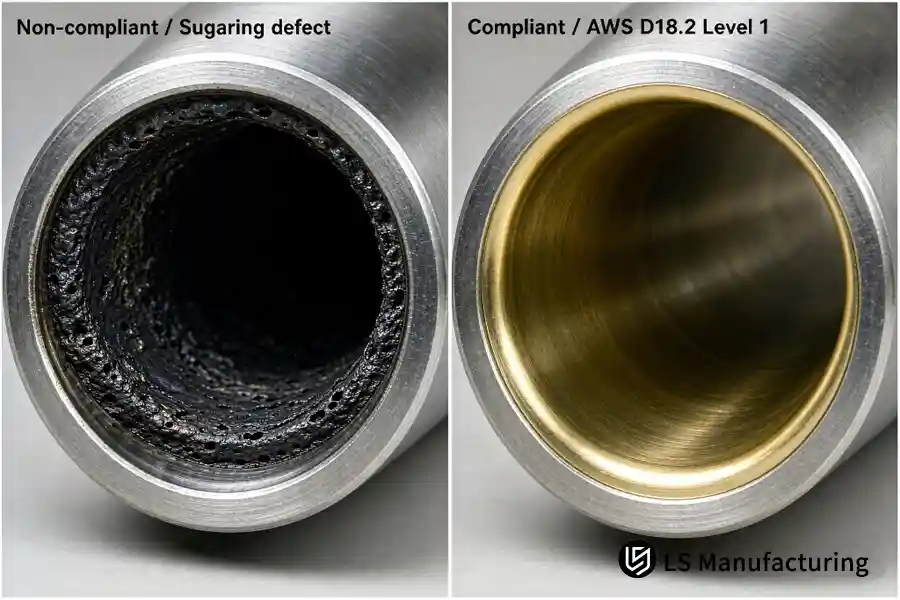
Figure 1: Inner bore visual comparison: non-compliant sugaring defect due to insufficient purging (left) versus compliant smooth bore meeting AWS D18.2 Level 1 discoloration criteria (right).
How Does TIG Welding Work in Medical Fabrication?
To appreciate TIG welding process operations in the medical manufacturing industry, begin with the heat source. Out of all the different kinds of stainless steel welding processes, the TIG process employs an arc from the use of a non-consumable tungsten electrode that forms a pool of molten material.
- Current & gas: low-pulse current along with continuous supply of pure argon results in consistent arc movement.
- Capability for precision: Machining accuracy of ±0.03mm concentricity.
- Heat affected zone: 1.0mm to 2.5mm, good for thin-walled components but needs control of distortions.
- Common use: medium-wall endoscope outer shafts.
- Restriction: wall thickness less than 0.15mm for micro-sensor packaging due to broad heat diffusion.
Process Parameters and Defect Avoidance
The following are necessary when creating an orbital TIG weld:
1. Clean the 1-inch region around the beveled edge using a stainless steel brush.
2. Start the arc and create a stable molten pool in less than 2 seconds.
3. Maintain steady speed during welding while observing the gas pre-flow, welding, and post-flow sequence.
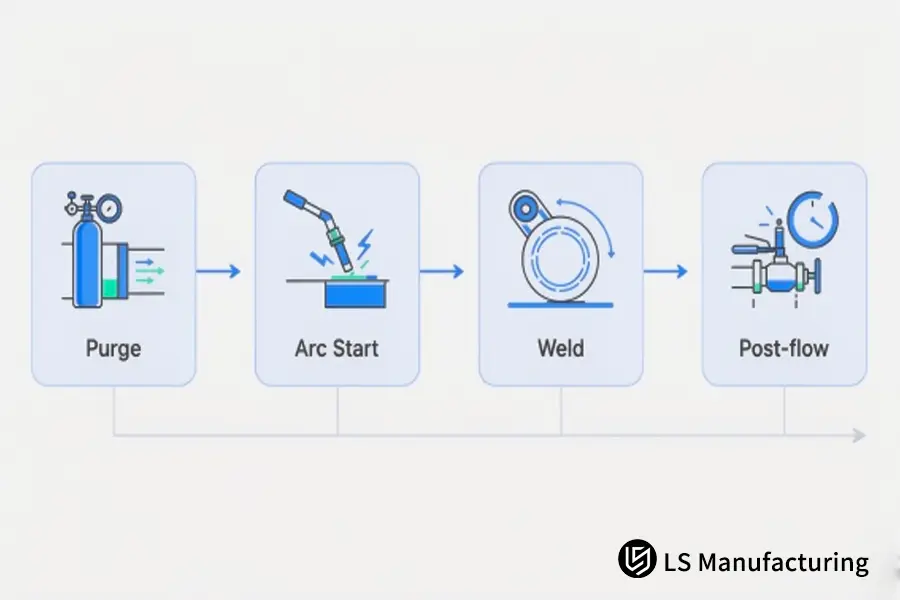
Figure 2: Key process control sequence for orbital sanitary welding: inert gas back purging, high-frequency arc start, controlled orbital welding, and protective gas post-flow.
To prevent the occurrence of defects in stainless steel welding, it is important to note the following issues:
- Tungsten inclusions: make sure that tungsten electrode does not touch molten pool or filler wire by using high-frequency start.
- Porosity: maintain cleanliness and dryness of both base material and filler wire by avoiding turbulent gas flow.
Source: Groover, Fundamentals of Modern Manufacturing, arc welding mechanism chapter.
Why Is Laser Welding Better Than TIG for Micro Parts?
The fundamental difference between laser welding vs TIG that makes laser welding perform superiorly in the fabrication of highly dense miniaturized parts is its ability to focus a very high amount of energy and autogenous melting.
- The coherent energy beam melts and vaporizes metal forming a keyhole, which results in a compressed HAZ of 0.1 – 0.3 mm.
- Due to no spatter, it ensures coaxial precision (±0.008mm) and Ra ≤ 0.4um weld.
- It clearly has an edge over micro pacemaker housing, and fine implant needle assemblies.
- Fit-up greater than 0.05mm on relatively machine parts often leads to undercuts.
The following comparative analysis evaluates orbital TIG welding and high-precision fiber laser welding across four core engineering benchmarks:
|
Comparison dimension |
Automatic / orbital TIG welding (GTAW) |
High-precision micro-beam laser welding (fiber laser) |
|
Energy input and HAZ |
Arc conduction and diffusion; HAZ approximately 1.0 to 2.5mm |
Focused-beam keyhole effect; HAZ strictly 0.1 to 0.3mm |
|
Achievable tolerance and distortion |
Conventional grade ±0.03mm; thin walls may show slight stress warpage |
Precision grade ±0.008mm; microscopic thermal distortion nearly zero |
|
Surface forming and spatter control |
Bead slightly convex; back shielding required to prevent back-side slagging |
Flat to slightly concave, zero spatter and no undercut, Ra ≤0.4um |
|
Typical medical applications |
Pharmaceutical piping systems, surgical forceps, medium-wall structural shafts |
Pacemaker titanium/steel housings, vascular clips, ultra-fine probes |
Conclusion: The choice is clear – TIG welding is suitable for pipe works and fluid structures that require wall thickness and fill and penetration, whereas laser welding is the perfect option for precision and no deformation medical parts.
Which Welding Defects in Stainless Steel Breach Hygiene?
Welding defects in medical stainless steel directly breach hygienic boundaries by disrupting the continuous chromium oxide (Cr2O3) passive film. When localized thermal oxidation, micro-porosity, or undercut occurs, the resulting microscopic voids harbor bacterial biofilms and organic proteins that resist standard clean-in-place (CIP) and autoclaving cycles.
- If shielding gas contains excess of oxygen and back-side slagging occurs or unstable current causes micro-porosity, micron size holes do not allow to clean the surface and promote intergranular corrosion and exceeding of surface roughness Ra > 0.8 um.
- Such defects create safety risks for interventional in-vivo medical devices and should be detected using 100% radiographic inspection and endoscopic visualization.
Which Three Stainless Steel Defects Compromise Hygiene Most?
Back oxidation slag (sugaring)
- Cause: absence of back-side argon purging.
- Consequence: intensive inner wall oxidation and delamination, corrosion resistance is lost.
Heat tint
- Cause: blue or straw color oxide layers.
- Consequence: chromium depletion; has to be eliminated by electropolishing or electrochemical passivation.
Undercut and micro-crevices
- Cause: nonuniform weld shape.
- Consequence: creation of fluid dead zones and protein colonization by pathogens.
Reference source: AWS D18.3 – welding inspection guidelines for sanitary stainless steel vessels.
How Laser Welding Works in Practice: A Medical Endoscope Example from LS Manufacturing
In designing the ultra-fine endoscope steering-shaft for a minimally invasive surgical device, the engineering group selected a 316L stainless-steel with an ultrathin wall of 0.25mm. The assembly drawing specified that there should be a positioning tolerance of ±0.008mm, and there must be absolutely no oxidation on the inner surface.
Initially, the method involved using manual TIG welding with machining tolerances of ±0.1mm. However, due to the excessive heat diffusion, out-of-roundness of the tube walls and internal oxidation made the roughness of the flow path exceeding Ra > 0.8um.
Afterwards, the application engineers at LS Manufacturing transformed the process into 1064nm pulsed fiber laser welding process based on a very tiny spot of 0.15mm and coaxial shielding with high purity argon gas of ≥ 99.995%. The amount of energy was limited while keeping HAZ to 0.2mm.
- There is no more thermal stress radial warpage.
- There is no more micro spatter and lack of fusion.
- Post weld citric acid passivation treatment recovered the passive layer of chromium oxide.
The finished product had the precision-grade overall coaxial tolerance of ±0.008mm, as measured by a coordinate measuring machine, and internal surface roughness of Ra ≤ 0.4um. Through the reduction in the need for cumbersome secondary mechanical grinding process in the traditional welding method, lead time was reduced by 15%, defect rate went down from 18% to 4%, and manufacturing cost decreased by 11%.
Data Source and Baseline Statement
- Case number in engineering: #MED-2026-409 (medical-grade ultra-fine stainless-steel endoscope shaft assembly)
- Baseline data source: LS Manufacturing 2025 to 2026 medical micro-welding measurement database, n>800
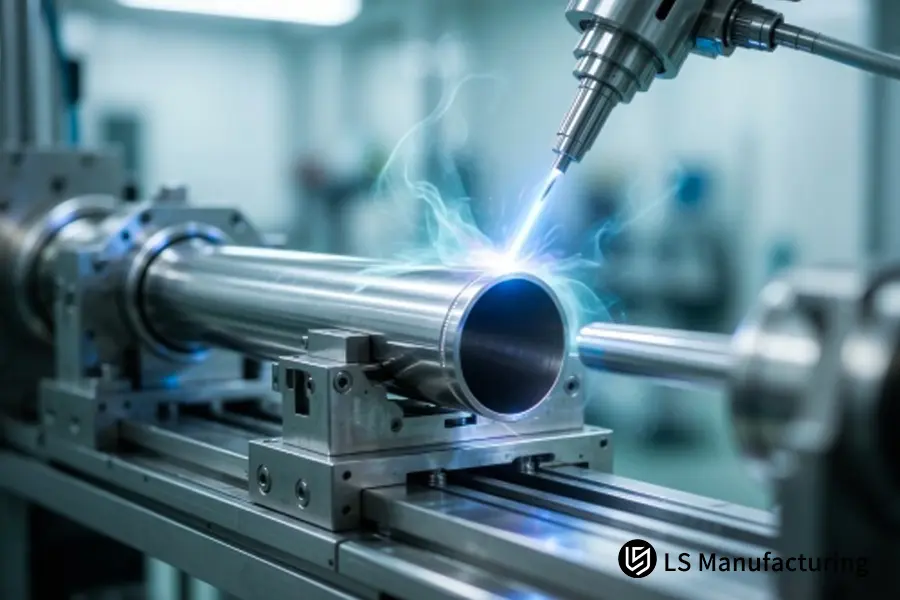
Figure 4: Automated precision micro-welding process applied to ultra-thin stainless steel medical tubing with rigid alignment fixtures.
FAQs
What separates medical-grade stainless steel welding from industrial welding?
The main thing that differentiates the two types of welding is biocompatibility; there should not be any porous micro-crevices or heavy metal ion release at the weld joint. During the process of such welding, LS Manufacturing ensures that we comply with ASME BPE sanitary flow-path specifications and maintain the surface roughness of Ra ≤ 0.4um.
Why is back purging necessary when doing TIG welding of stainless steel tubing?
Backside argon purging involves the use of an inert gas, ≥99.995% pure, to displace air within the tubing and to keep residual oxygen concentration at ≤70 PPM. This will prevent a violent reaction between the hot steel and oxygen in the atmosphere, leading to formation of porous, brittle, and rough slag.
Is post-welding cleaning necessary in case of laser welding?
Laser welding reduces the HAZ to 0.1 to 0.3mm and eliminates molten-drop spatter. However, light heat tint still needs to be cleaned after the welding thermal cycle either chemically through pickling or electrochemically through passivation.
Can 304 stainless steel be employed in medical grade welding?
Yes. 304L and 316L are the usual grades of austenitic stainless steels that are used in medicine. 316L with molybdenum content is more resistant to pitting and is used in precision parts in contact with saline solutions and highly aggressive medical fluids.
Summary, Technical Support and References
Acquisition of the knowledge regarding the requirements and techniques of cleanliness and heat affected zone control in medical grade stainless steel welding is the key technical base for young R&D engineers, which will allow to avoid cracking, corrosion or non-compliance with biocompatibility of medical tubing.
Regardless of whether automatic orbital TIG welds for medium wall thickness tubing or precise laser welds for micro components are selected, maintenance of strict purity of the shielding gas and control of inter pass temperature are the metallurgical keys.
Next-Stage Reading: Precision Medical Joining Options
Understanding sanitary boundaries and heat input thresholds is the first step toward flawless medical tube and component fabrication. To explore process trade-offs, thin-wall distortion control, and heat-affected zone minimization, continue reading our engineering guides:
- Process Comparison:TIG vs. MIG Welding Services: Selecting the Best Process for High-Precision Custom Projects
- Thin-Wall Fabrication: Precision Metal Welding Service: Achieving Zero-Distortion in Thin Parts
- Thermal Control Design: Custom Metal Welding Design: How to Minimize the Heat-Affected Zone (HAZ)

References & Standards
- ASME BPE, Bioprocessing Equipment, Part MJ, Material Joining, sanitary welding inspection specification.
- AWS D18.1, Specification for Welding of Austenitic Stainless Steel Tube and Pipe Systems in Sanitary (Hygienic) Applications.
- AWS D18.2, Guide for Welding of Austenitic Stainless Steel Tube and Pipe Systems in Sanitary (Hygienic) Applications, discoloration chart.
- AWS D18.3, Welding Inspection Practices for Sanitary Stainless Steel Tubing and Piping.
- ASM Handbook, Volume 6, Welding, Brazing and Soldering, welding metallurgy principles.
- Groover, M. P., Fundamentals of Modern Manufacturing, arc welding mechanism chapter.
- LS Manufacturing medical micro-welding measured database, 2025 to 2026, sample size >800.