English



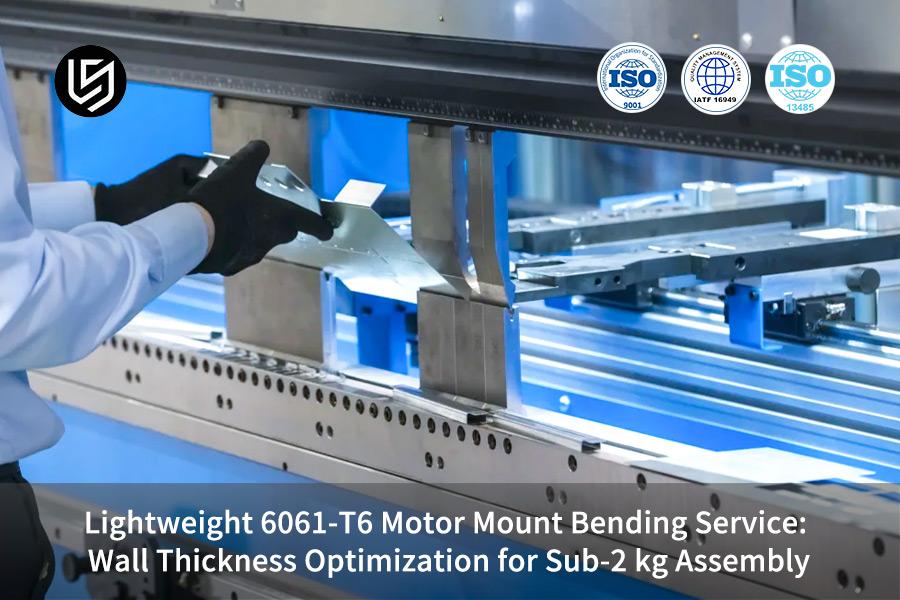
Metal bending serviceis a conventional forming process technique that is mainly used for thin-walled aluminum alloy components. It effectively addresses themain issues of bending cracking, excessive springback, and strength reductionof the 1.6mm 6061-T6 aluminum sheets which are being used as the sub-2 kg powertrains. By 3Tminimum bending radius control, vertical rolling grain arrangement, and O-state bending followed by aging, it is possible to achieve zero-crack forming without losing the strength of the material, i.e. 100% of the yield strength is maintained.
These methods are applicable to the lightweight motor bracket for robots, drones, and automated hardware since the bracket can withstand structural reliability under high-frequency vibration while weight reduction is so drastic thatit helps R&D teams to shun risks of prototype scrapping and project delays. See the high-quality motor bracket processing technology guide below, it is a compilation of insights by the chief bending engineers of LS Manufacturing.
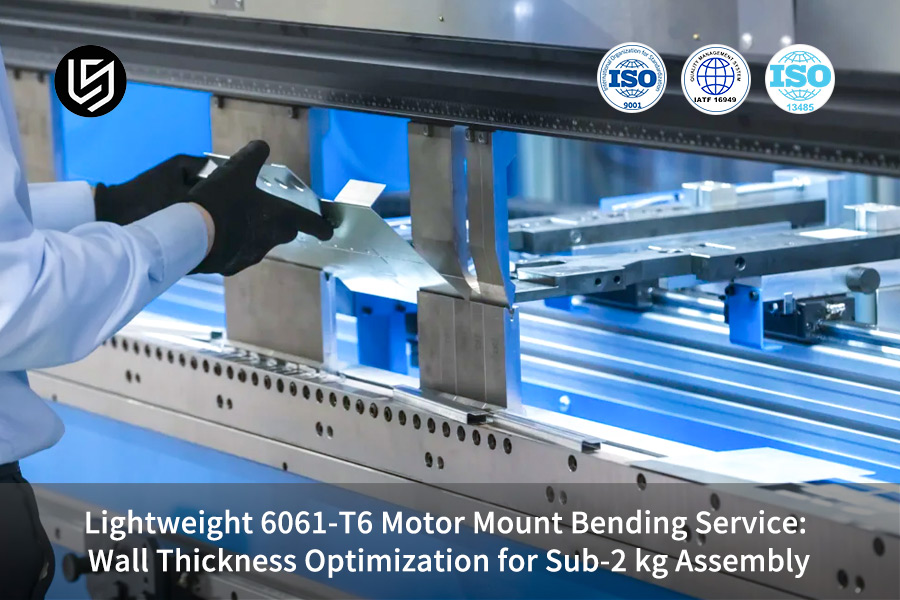
Precision Aluminum Bending Service Core Parameter Overview
| Process Dimensions | Standard Parameter Requirements | Structural Performance Benefits | Failure Risk Mitigation |
| Minimum Inner Bending Radius | ≥3T (4.8mm) | Stress Concentration Factor Reduced by 35% | Eliminates Outer Tensile Cracking |
| Rolling Grain Direction | Bending Line Perpendicular to Grains | Crack Resistance Improved by Over 40% | Avoids Grain Boundary Tearing Fatigue |
| Heat Treatment Process | O-state Bending + T6 Re-aging | Yield Strength Restored to 276MPa | Eliminates Hard Bending Cracks |
| Connection Method | Bending Edge Riveting / Mechanical Fastening | No Heat-Affected Zone Strength Loss | AvoidsWelding HAZ StrengthDrop |
Key Takeaways
- To avoid surface tension cracking completely, you should ensure the minimum inner bending radius of 6061-T6 aluminum sheets with 1.6 mm thickness to be 3T (4.8 mm). Also, the bending line must be perpendicular to the rolling grain direction.
- Before bending the material, fully annealing it to the O-state and then solution-aging it to the T6 state canhelp retain 100% of the stiffness of the original material.
- It is not allowed to do any welding in the load-bearing area. The yield strength may drop more than 50% in the heat-affected zone. Ideally, edge riveting or high-strength mechanical fastening are the solutions that should be considered first.
Why Trust LS Manufacturing’s Expertise In Wall Thickness Optimization For Precision Aluminum Bending Services?
With 15 years of industrial experience, LS Manufacturing has been leading the fight for improved mass production methodin particular in thin-walled aluminum bending field. Our process solutions have been proven through a number of projects to reliably tackle the forming of 1.6mm 6061-T6 challenges.
Taking an industrial AGV powertrain project as an example, our team of experts dedicated three months to complete twelve sets of comparative tests that methodically confirmedhow variations of bending radii, grain orientations, and heat treatment paths affect the fatigue life of components. Besides stringent raw material quality control, our sourcing system is compliant with theASTM B209aluminum sheet specification and gives full traceability and condition consistency for each batch.
To address the springback of 1.6mm thin sheets, we have developed a comprehensive database that includes eight typical aluminum alloy grades as well as twelve mold parameter variations. This could result inthe first-bending pass rate exceeding 98%and assist customers by eliminating at least two rounds of prototype iteration cycles, because of this, directly cutting the prototyping costs during the R&D phase. We conduct all forming capability tests in line with theISO 12004-2standard which meansthe test data is recognized by the industry and is authoritative.
A mature process system and experimental database can help you quickly avoid common pitfalls in thin-walled bending. For a complete white paper on thin-walled aluminum forming processes,please contact our technical engineers to quickly grasp the core design principles of lightweight supports.

Why Does 1.6 Mm Aluminum Sheet Crack Easily In 6061-t6 Bending Service?
In6061-t6 bending service, bending thin sheet cracking is the most frequent problem. The 6061-T6 aluminum alloy can achieve 276 MPa high yield strength in the hardened state,still its elongation at break is only 10%-12%. The problem is that when a 1.6 mm thin sheet is bent, the tensile stress on the outer surface of the material will most likely exceed the ultimate strain,causing tearing microcracks. This issue can be solved entirely by changing the material condition and optimizing the process.
Difference in Grain Deformation Between T6 and O Conditions
The maximum extent to which6061 sheet bendingform is dependent by the elongation of the material. T6 condition aluminum sheets are strong and contain densely packed strengthening phases within the grains, and resulting inlowered capability for plastic deformation, the O condition represents a fully recrystallized annealed state with uniform grains and no strengthening phases.The O condition extends elongation to over 25%, and is less susceptible to cracking during bending.
Comparison of Mechanical Properties of 6061 Aluminum Alloy in Different States
| Material State | Yield Strength (MPa) | Elongation at Fracture (%) | Bending Cracking Risk Level |
| O State (Fully Annealed) | ≤110 | ≥25 | Extremely Low |
| T4 State (Natural Aging) | ≥145 | ≥16 | Medium |
| T6 State (Artificial Aging) | ≥276 | 10-12 | High |
| T651 State (Tensive Straightening) | ≥276 | 9-11 | Extremely High |
This performance difference is amplified in thin wall aluminum bending scenarios.
Mechanism of Grain Direction's Influence on Cracking Risk
While rolling aluminum sheets, the grains get stretched mainly along the rolling direction. There are big differences in how well the material resists cracks when bent in various directions:
- If the bending line is aligned with the grain direction, the crack resistance threshold forgrain direction bendingis lowered to the minimum level. The tensile stress is directly applied to the grain boundary interface,making it very easy for the grain boundary to separate and the crack to occur.
- If the bending line is at right angles to the grain direction, the grain itself carries the tensile stress while the grain boundaries are compressed, which leads toan increase in crack resistance of more than 40%.
In fact, this is why precision aluminum bending service must identify the grain direction at the nesting stage.
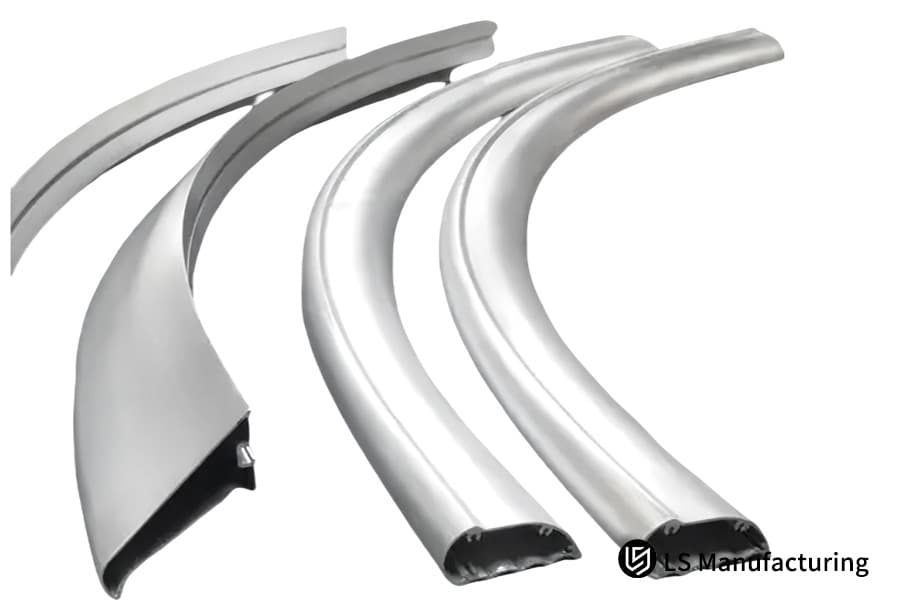
Figure 1: Bent 6061-T6 aluminum extrusions for lightweight housings.
How To Calculate The Precise Springback Angle For Thin Wall Aluminum Bending?
Springback angle compensation is the main way to control thethin wall aluminum bending. Springback angle after bending a 1.6 mm thin sheet of 6061-T6 (whose elastic modulus is quite low - around 69 GPa) is usually as high as 5° to 8°.For exact springback compensation, one has to take into accountnot only the bending radius but also the mold V-groove width and the actual yield strength of the material. A well-developed database can raise the first-pass yield to over 95%.
Springback data measured at different bending radii
The precision of thespringback compensated bendingis what finally sets the assembly tolerance. Production on a large scale but demands determining the compensation amount from measured data.
Measured Springback Angle of 1.6mm 6061-T6 90° Air Bending
| Inner Bending Radius | Die V-groove Width (mm) | Springback Angle Range (°) | Average Springback Value (°) |
| 2T (3.2mm) | 9.6 (6T) | 6.5-8.2 | 7.3 |
| 3T (4.8mm) | 12.8 (8T) | 5.2-6.8 | 5.9 |
| 4T (6.4mm) | 12.8 (8T) | 4.1-5.3 | 4.6 |
| 5T (8.0mm) | 16.0 (10T) | 3.2-4.2 | 3.7 |
The key to controlling angle deviations in precision aluminum bending service lies in having a comprehensive springback parameter database.
Nonlinear Springback Compensation Method for CNC Systems
In mass production,a blend of graded compensation and real-time calibration is necessaryto continuouslycontrol bending angle errors:
- Use the experimentally obtained yield strength and thickness data of the sheet as the basis for creating a springback computation model.
- Assign different levels of graded compensation coefficients for the bending radii,the smaller the radii, the greater the compensation.
- Once the initial piece is formed, perform an on-line bend angle measurement to recalibrate and automatically update the compensation parameters.
- Finalize three successive confirmations before production, employ the closed-loop control mechanism of the CNC servo bending tomaintain angle tolerance within the ±0.5° stability range.
Following this standardized compensation method could help custom motor mount manufacturergreatly cut down on first-piece testing time and enhance mass production productivity.
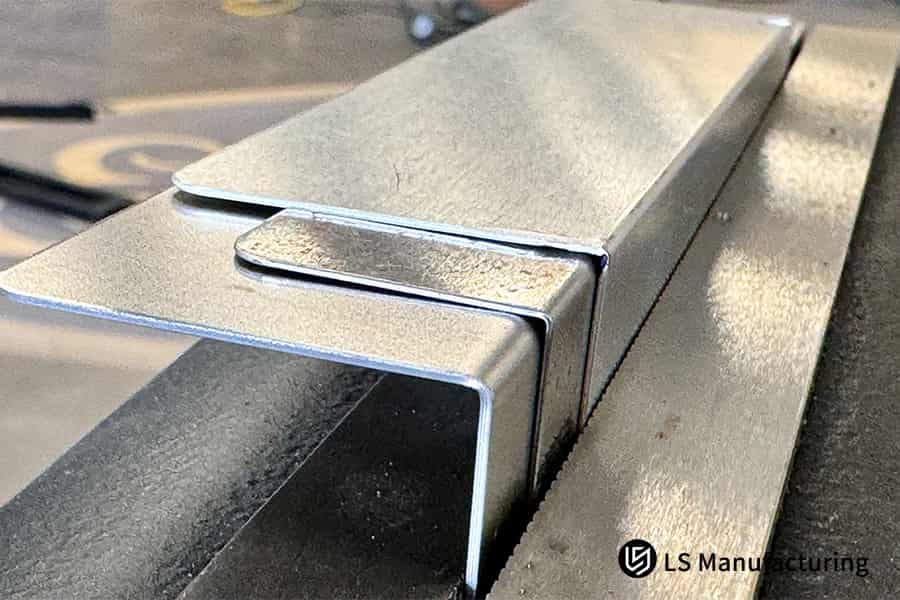
Figure 2: Close-up of thin-walled aluminum C-channels undergoing precision cold bending.
What Is The Optimal Minimum Bend Radius For An Aluminum Motor Mount Fabrication?
The primary geometric parameter in thealuminum motor mount fabricationis the minimum bending radius. The Aluminum Association advises a minimum inside bending radius of 3T for 6061-T6 (which is about 4.8 mm for a 1.6 mm thickness).Any bend tighter than this standard would lead to severe thinning of the outer zone. That means, a 3T bend radius is the best compromise between a lightweight design and structural dependability.
The Effect of Bending Radius on the Stress Concentration Factor
Minimum radius bending is a key geometric factor that influences the component fatigue life.LS Manufacturing exclusive fatigue test results reveal this radii performances:
- 2T (3.2 mm) radius:Outer thinning percentage is as high as 25%, stress concentration factor is 1.87, This way it is only fit for non-load bearing decorative parts.
- 3T (4.8 mm) radius:Outer thinning rate is around 15%, stress concentration factor is 1.36,the best choice for load-bearing structures.
- 4T (6.4 mm) radius:Outer thinning rate is less than 10%, stress concentration factor is 1.18, suitable for the cases of high impact load.
Principles of Matching V-groove Width in Dies
The size of the die's V-groove has a direct impact on the bending force and the inner arc's forming quality.The general rule of thumb for the selection is:
- 8T (12.8mm) V-groove: Bending force is lower, the probability of surface indentation is also less, which makes it the primary choice for 1.6mm thin plates.
- It is advised to use an 8T V-groove combined witha 3T inner radius for motor mount load-bearing structures, that is,air die bendingto balance strength and surface quality.
This selection standard must be strictly followed in sub-2 kg assembly bending scenarios. For a free DFM assessment of your aluminum motor mount fabrication solution, submit your design drawings, andan engineer will provide manufacturability optimization suggestions within 24 hours.
How Does Rolling Grain Orientation Affect The Reliability Of a Lightweight Bracket Bending?
Lightweight bracket bendingreliability is highly dependent on the orientation of the rolling grain. After rolling, an aluminum sheet's grain structure becomes anisotropic. The bending line should be perpendicular to the grain direction of the roll (i.e. a lateral bend).If bent in the same direction as the grain, crack resistance levels may be reduced by more than 40%.One can greatly extend the life of a part by simply changing the angle in the nesting process.
Grain Direction Control Method in the Nesting Stage
Strict control of the nesting direction is a fundamental condition for vibration-resistant bending.Specific control steps are as follow:
- When you receive the raw material, identify the rolling direction by checking the surface rolling marks and trimming marks on the edges.
- Make sure that the bending line is a 90° angle with the rolling directionwhen you are programming the laser cutting nesting.
- Indicate the rolling direction after the first piece is cut and conduct a second verification and confirmation before the bending operation.
Fatigue Life Differences Between Different Bending Directions
LS Manufacturing's exclusive 12,000 RPM fatigue test results have showed that samples bent at a right angle tothe grain exhibited no crack after one million cycles. Still, samples bent parallel to the grain experienced fatigue fracture at the bend after an average of 230,000 cycles, which corresponds to a difference in lifespan of more than four times.
Such a disparity in data works as a major parameter for the reliability evaluation ofmotor bracket bendingand asa principal control reference for a professional custom motor mount manufacturing facility.Grain orientation control is among the least costly yet most effective quality control methods for metal bending services.
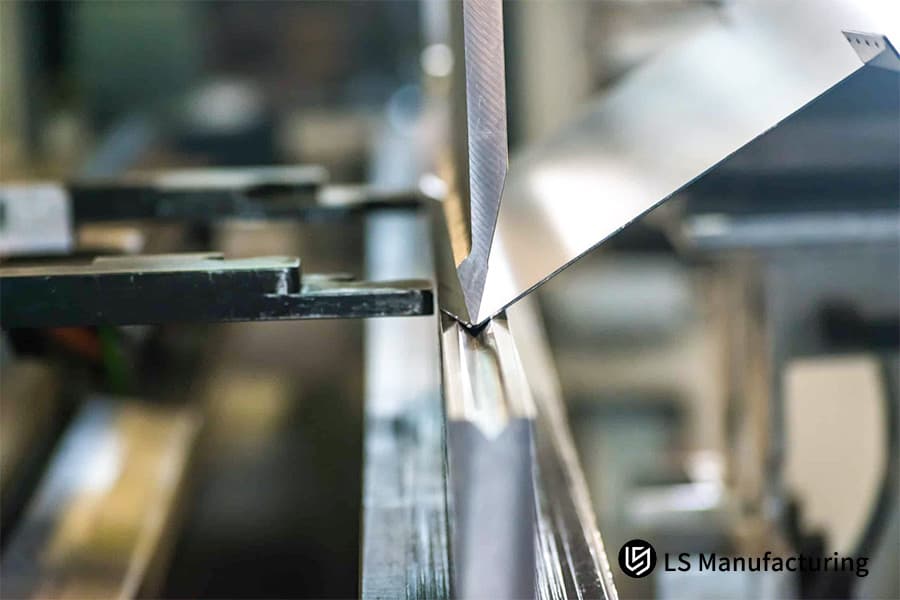
Figure 3: Macro view of a lightweight bracket bending process showing grain texture.
Why Should You Choose The Anneal & Re-Temper Method Over Warm Bending?
In 6061-t6 bending service, choosing the right annealing plus re-aging furnaces and warm bending method play an important role in determining the performance of the component. For example, warm bending carried out at 160℃-200℃ can increase the elongation capability, but at the same time,it also causes over-aging of the T6 state, resulting in a 20%-30% strength loss.By contrast, O-state annealing bending + re-T6 solution aging is the most effective way to keep the structural strength at 100%.
Full process flow of O-state bending + re-aging
In the advanced metal bending service system,anneal retemper bendingis the central operation that simultaneously improves the formability and strength.The detailed operation is like this:
- Buy 6061-O-state annealed sheets as the base metal that must havean elongation of ≥25% and be free of cracking risks during bending.
- After thelaser cutting, bending and forming should be done with the grain direction perpendicular for accuracy.
- The workpiece is placed in a special anti-deformation fixture and rapidly quenched after being held in a solution furnace at 530℃-535℃.
- Next, it is put into an aging furnace and held at 175℃ for 8 hours tofinish artificial aging and become like T6 again.
Comparison of the comprehensive performance of the two processes
| Comparison Dimensions | Comparison Dimensions | O-state Bending + Re-aging Process | Industry Best Level |
| Yield Strength Retention Rate | 70%-80% | 98%-100% | ≥95% |
| Bending Cracking Rate | 5%-12% | 0% | ≤1% |
| Dimensional Stability | Average (Easily deformed by over-aging) | Excellent (Fixture control) | Flatness: ±0.2mm |
| Batch/Unit Cost | Low | Medium | - |
The re-aging treatment of 6061-T6 during the bending operationleads to a good balance of formability and strength and is considered the best way based on data, with the hardness recovery bending yielding even better results. In fact, this closed-loop operation is at the heart of precision aluminum bending service technology.
To calculate the specific cost of using this process for your metal bending service project, please provide the part parameters, andwe will provide you with a detailed cost comparison plan.
How To Circumvent Heat-Affected Zone Strength Loss In Sub-2 kg Assembly Bending?
Sub-2 kg assembly bendingshould place special emphasis on eliminating the risk of strength deterioration brought about by the heat-affected zone. For instance, after 6061-T6 aluminum is subjected to TIG or MIG welding,the yield strength of the weld heat-affected zone (HAZ) will be reduced by more than 50%. To guarantee the absolute safety of ultralightweight motor mounts, the idea of welding must be completely excluded, and integrated bending combined with mechanical fastening should be employed to eradicate the weak points in the heat-affected zone from the very root.
Performance differences between welding and mechanical fastening
Weld-free bendingis the fundamental method for preserving the strength of metal in the heat-affected zone.The most common connection options can be listed like this:
- Riveting connection:Shear strength can be as high as 180MPa or more, no heat-affected zone produced, excellent for fast assembling of thin sheets.
- Bending Edge Interlocking:Through the use of interlocking bends and flanges, this method eliminates the need for additional connecting components andachieves the highest overall structural strength.
- Self-Tapping Sleeves:Suitable for motor mounting points that require regular maintenance, as they can be disassembled and assembled over and over again.
Cost and Efficiency Advantages of Bending Instead of Welding
In case of aluminum motor mount fabrication, integrated bending design leads to no welding fixture development, resulting incost saving of nearly $1200 per single fixture, at the same time, it decreases welding and grinding processes, raising production efficiency by more than 40%.
Besides, the concept is a perfectly viable solution for the connection of lightweight bracket bending without thermal damage, and is just as suitable forvery high load-bearing components like AGV bent components.
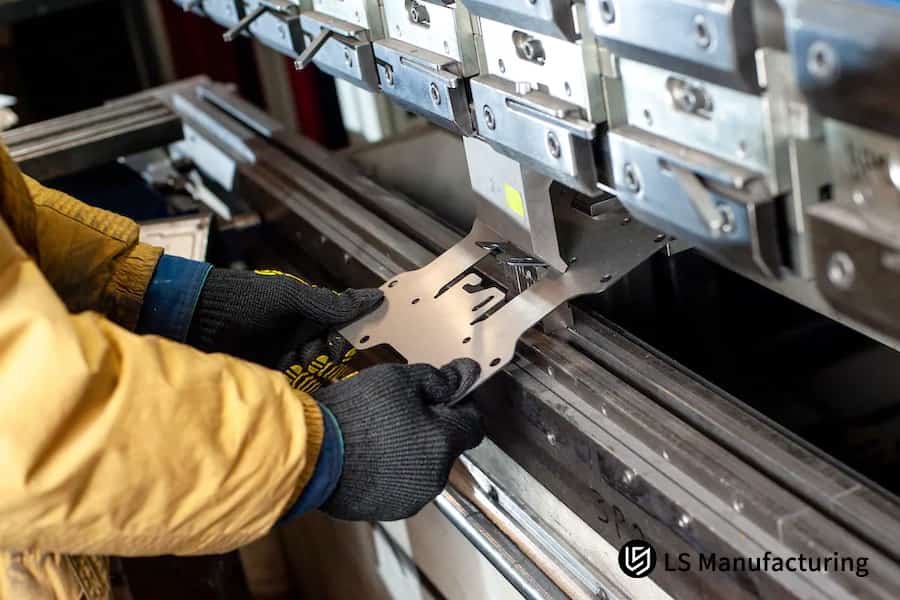
Figure 4: Robotic welding ensuring minimal heat-affected zone on aluminum assemblies.
What FEA Stress Limits Must You Apply Before Requesting a Metal Bending Service Quotation?
It's very important to decide the stress limits in finite element simulations before you send requests for quotations in metal bending service.For finite element modeling executed through software like ANSYS or SolidWorks Simulation, the motor bracket should operate under a full load with its peak equivalent stress (Von Mises Stress) held below 170 MPa to maintain a safety factor of 1.6 times since the yield limit is 276 MPa. Setting logical stress limits plus properly configuring modeling settings can be instrumental not only in spotting the structural risks beforehand but alsoin lowering the expenses of changing processes.
Core Settings for FEA Modelling of Bending Components
Validating in FEA bending layouts can be a great help incutting down on the expenses of process reiterations. The points outlined below are the ones that should be stressed in thebending part simulation:
- Mesh Generation:The bending region should have at least 3 layers of solid mesh with the size of each element staying below 0.2 mm to provide stress computation accuracy.
- Material Model:The use of anisotropic constitutive parameters of 6061-T6 that take into accountthe performance variations between rolling directions and cross directionsis advised.
- Boundary Conditions:Very strictly, constrain the conditions in such a way as to correspond with the actual state of assembly for the simulation of preload and motor installation live loads.
- Result Evaluation:First and foremost look at the stress concentration factor verification at the bend to be sure thatthe highest stress is the one kept under the safety limit.
Design Improvement Methods for Structural Stiffness Enhancement
Impeccably designed structure at the very beginning of precision aluminum bending service can enhance stiffness and fatigue resistanceeven without additional weight:
- Bending stiffness shall be increased by more than 25% through the simple addition of stiffeners running perpendicular to the bending direction.
- Vibration damping holes in the non-load bearing areaswill reduce the behavior of resonance.
- Gain in the bend flange height is the most direct way to disperse the stress concentration in the corner, so achieving the design effect of stress relief bending.
A well-rounded DFM simulation system is of great help to custom motor mount manufacturer by not only steering clear of process risks from the very beginning but also decreasing trial and error costs.For engineer assistance in verifying the rationality of your FEA settings,contact us for one-on-one technical consultation to proactively eliminate manufacturability issues.
Why Choose LS Manufacturing As Your Precision Aluminum Bending Service Partner?
Collaborating with a trustworthyprecision aluminum bending serviceprovider is a fundamental step towards the accomplishment of lightweight projects. LS Manufacturing has beendedicated to precision aluminum forming for more than 20 years, owning advanced CNC electro-hydraulic servo bending machines and dynamic pressure compensation systems. These facilities help us continuouslymaintain bending angle tolerance for 1.6 mm thin sheets within ±0.5°. Our production system adheres to IATF 16949 quality management standards.
End-to-End Quality Control System Guarantee
Tight tolerance bendingis a major requirement when dealing with high-end manufacturing environments. We use end-to-end quality control tomake sure each batch has a consistent level of performance:
- Control of Raw Materials:Only aluminum sheets from well-known manufacturers are used, further spectral sampling is done before warehousing, and MTC material reports are provided.
- Control of Forming Process:CNC electro-hydraulic servo bending machines coupled with a dynamic angle compensation system are utilized toobtain an angle tolerance of ±0.5°.
- Protection of Surface:Polyurethane non-marking bending dies are used to prevent surface indentations and scratches on thin sheets.
- Control of Final Inspection:Full-dimensional inspection is carried out usinga coordinate measuring machine (CMM), ensuring that assembly accuracy meets the requirements.
Capability of One-Stop Service
For the special process requirements for 6061-t6 bending service, we have an automated heat treatment production line that is fully capable ofcompleting the heat treatment process from O-state to T6. This means no outsourcing is necessary, and batch costs are reduced by 20% compared to those incurred when outsourcing heat treatment. We offer a complete service lifecycle from making of prototype to mass production with orders starting from 1 piece and canconcurrently provide heat treatment, surface treatment, and assembly processes.
This capability to provide lifecycle service completely covers the chain of needs for full process bending forcustom motor mount manufacturer.
LS Manufacturing Customized 6061-T6 Aluminum Motor Mount Fabrication For An Industrial AGV Manufacturer?
Customer Challenge
An industrial AGV manufacturer who was developing a new generation of compact drive modules, required customizinga lightweight bracket to support a high torque servo motor for a target assembly weightof less than 2Kg. The customer's original 1.6 mm 6061-T6 aluminium sheet samples had 100% micro-tears on the outer side during R=2T bending and unstable spring-back in small radius bending resulted in severe deviations in motor coaxiality. The workpiece repaired by the previous supplier's TIG welding showedmore than 50% drop in the yield strength of the weld heat-affected zoneduring AGV alternating torque testing, resulted in failure by fatigue after only 12,000 cycles that stopped the project for 6 weeks.
LS Manufacturing Solution
Our engineering team after intervening and completing the DFM review,immediately banned the risky approach of hard bending and welding.
- We got the customer original 6061-O grade sheet metal with MTC quality inspection certificates for them. We ensured that the bending line was perpendicular to the rolling grain direction at 90 during nesting.
- During the forming stage, to meet thescratch-free bendingrequirement and to avoid surface indentations, we useda safe inner bending radius of 3T (4.8 mm) and a special polyurethane moldwithout scratches.
- Finally, leveraging the internal automated heat treatment line, a 535℃ solution treatment and an 8-hour artificial aging at 175℃ were carried out, which enabled the workpiece to regain its T6 hardness while alsomaintaining accurate geometry.
Results and Value
By using the closed-loop process of O-state bending + post-aging to T6,the bending crack rate of the deliverable samples was reduced to 0%, and the angle tolerance was stabilized within ±0.5°. Per third party testing, the component's yield strength was restored at 278MPa, and it passed the AGV full-load million-cycle high-cycle bending fatigue test. This 195g customised motor mount assisted the customer inachieving a weight reduction target of 1.87kg, which is an 18% reduction. The customer placed the first order for 2500 sets in the same month and shortened the delivery cycle by 2 weeks.
If you have custom requirements for aluminum motor mount fabrication, please upload your 3D drawings, andwe will provide a customized solution and accurate quotation within 24 hours.

FAQs
Q1: What is your standard lead time for a Custom 6061-T6 Motor Mount Bending Service order?
Typically we take 3-5 working days for sample orders producing 1-10 sets. For batch orders involving the full O-state to T6 heat treatment process,the delivery cycle is normally 10-14 working days. If you need your order urgently, we can negotiate to expedite it given actual production schedules. We are very willing to cooperate completely with your project timelines.
Q2: Can LS Manufacturing achieve a bend tolerance tighter than 1 on 1.6 mm sheets?
Thanks to our CNC electro-hydraulic servo bending machine combining a dynamic angle compensation system and an online angle detection and calibration device, we canstably control the bending angle tolerance of 1.6mm 6061-T6 aluminum sheets within ±0.5°,satisfying the high-precision assembly needs of precision components.
Q3: How do you guarantee the raw 6061 aluminum material sheet doesn't contain sub-standard recycled scrap?
Our 6061 series aluminum sheets are always sourced from well-known original manufacturers.The mixing of non-standard recycled materials is preventedby conducting spectral material sampling for every batch before storing. You will receive a regular Mill Test Certificate (MTC) with every shipment.
Q4: Will the Anneal & Re-Temper method cause dimensional warping or twisting during quenching?
By usinga specially designed anti-deformation clamping fixture together with a polymer quenching agent, the thermal stress warping of thin-walled components during solution quenching is almost completely eliminated. We are able to control the flatness of the end product to within 0.15mm.
Q5: What is your Minimum Order Quantity (MOQ) for custom bracket fabrication?
We do not impose any strict minimum order quantity limits.With just one sample, custom processing is possible,so you can be fully supported from R&D and prototyping to mass production. Pleaseupload your product drawingsto receive a quote, and we will provide an accurate calculation.
Q6: How does LS Manufacturing protect the cosmetic surface of aluminum from press brake tool marking?
To prevent any indentations on the surfaces of parts that require high visual quality, we use special, non-marking bending dies and highly wear-resistant polyurethane cushioning pads during the whole bending operation. This ensures the sheet metal and the metal die donot undergo direct friction or scratching.
Q7: Could you furnish us with destructive and nondestructive testing reports for our use in compliance?
According to your industrial-grade quality control standards and compliance requirements, we will be happy to provide a complete set of testing reports and dye penetrant testing, Rockwell hardness testing, and coordinate measuring machine (CMM) full-dimensional inspection.All data is genuine and can be traced.
Q8: What is the cost difference when you include the entire O-to-T6 heat treatment cycle?
Our in-house fully automated heat treatment production line supports the batch production thatlowers the heat treatment cost by up to 20%when compared against outsourced heat treatment. While the heat treatment process definitely adds to the base processing costs, at the same time, we are offering performance and cost advantages.
Summary
For the powertrain weight goal of under two kg, a precise design and stringent process control are necessary, Mainly when the component under development is a 1.6mm 6061-T6 aluminum alloy motor bracket that is crack-free and has a high strength.Basic risks like cracking and heat-affected zone strength degradation can be essentially removedby strictly following the 3T minimum bending radius, making the rolling grain direction uniform, and finally to have closed-loop system of O-state bending + post-aging T6 heat treatment, which not only guarantees the mechanical lifespan of the parts but also greatly decreases the trial-and-error scrap costs.
Are you ready to take on the fast-paced development of your sophisticated robot and automation equipment?Don't let an improper bending process hinder you!LS Manufacturing's expert technical team is ready to provide you with one-stop engineering assistance no matter if you are in the prototype design phase or planning mass procurement.Upload your 3D drawings(STEP/IGS/DXF format) now, senior engineers will perform a free-of-charge DFM evaluation and give you a precise machining quotation within 24 hours to assist you with your lightweight project.
📞Tel: +86 185 6675 9667
📧Email: info@lsrpf.com
🌐Website:https://lsrpf.com/
Disclaimer
The contents of this page are for informational purposes only.LS Manufacturing servicesThere are no representations or warranties, express or implied, as to the accuracy, completeness or validity of the information. It should not be inferred that a third-party supplier or manufacturer will provide performance parameters, geometric tolerances, specific design characteristics, material quality and type or workmanship through the LS Manufacturing network. It's the buyer's responsibility.Require partsquotation Identify specific requirements for these sections.Please contact us for more information.
LS Manufacturing Team
LS Manufacturing is an industry-leading company. Focus on custom manufacturing solutions. We have over 20 years of experience with over 5,000 customers, and we focus on high precisionCNC machining,Sheet metal manufacturing, 3D printing,Injection molding.Metal stamping,and other one-stop manufacturing services.
Our factory is equipped with over 100 state-of-the-art 5-axis machining centers, ISO 9001:2015 certified. We provide fast, efficient and high-quality manufacturing solutions to customers in more than 150 countries around the world. Whether it is small volume production or large-scale customization, we can meet your needs with the fastest delivery within 24 hours. choose LS Manufacturing. This means selection efficiency, quality and professionalism.
To learn more, visit our website:www.lsrpf.com