English



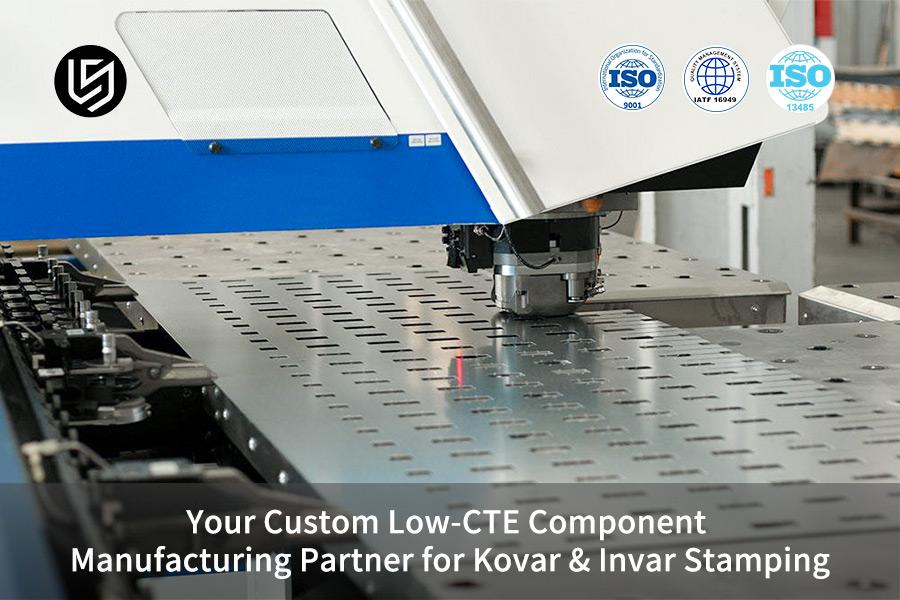
Precision metal stamping service is a core manufacturing service provided by LS Manufacturing to the optoelectronic communications, aerospace, and semiconductor industries. It directly tackles the most common issues of the industry like the very expensive CNC machining and the inefficiency of low mass production of parts made of low-CTE alloy. Through this service, the price per piece of Kovar/Invar parts can be dropped by as much as 60% even while keeping dimension tolerances of 0.01mm and CTE characteristics permanently low.
In this article let us touch on the main technical standards and specific processing aspects that one should take into account when looking for a Kovar and Invar stamping partner.
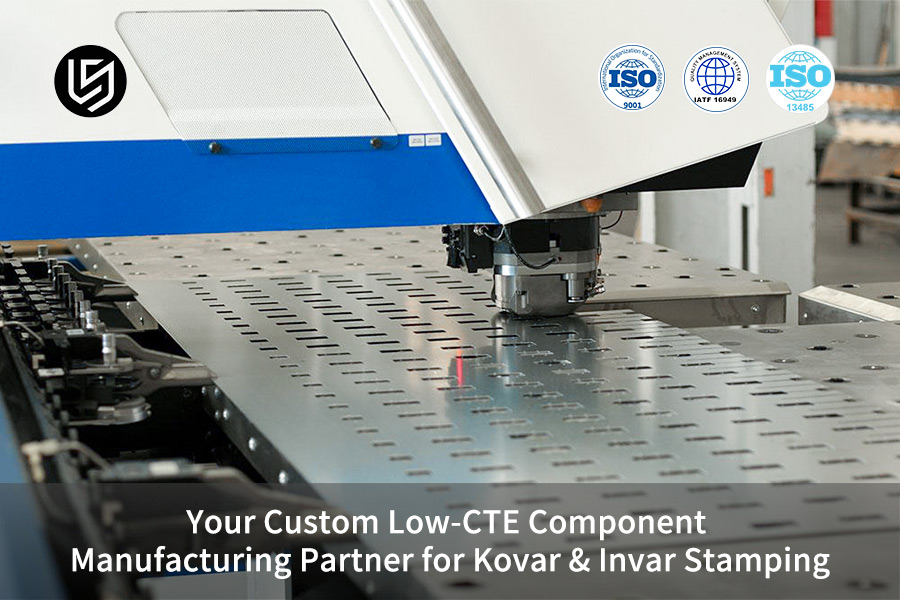
Precision Metal Stamping Service: Core Technology and Value Overview
| Core Evaluation Dimensions | LS Manufacturing Technical Performance | Industry Average Performance | End-Customer Core Benefits |
| Stamping Gap Control Precision | Strictly controls material thickness of 5%-8%, dynamic error ±0.002mm | Material thickness 10%-15%, gap error lacks precise control. | Completely eliminates micro-cracks and burrs on part edges. |
| Die Single-Stroke Lifespan | Continuous stamping up to 500,000 cycles or more | Conventional die lifespan less than 5,000 cycles. | Significantly reduces die replacement and amortization costs. |
| Part CTE Thermal Stability | Stable coefficient of thermal expansion ±0.2×10⁻⁶/K | Coefficient of thermal expansion fluctuation ±1.2×10⁻⁶/K. | Eliminates thermal failure issues under high and low temperature cycling. |
| Mass Production Dimensional Tolerance Accuracy | Stable locked high-precision tolerance of ±0.01mm | Conventional mass production tolerance ±0.03mm. | Fully meets semiconductor and aerospace high-end packaging standards. |
| Raw Material Utilization Rate | Overall material utilization rate >90% | Traditional processing utilization rate <30%. | Significantly Reduce Material Waste and Compress Raw Material Costs |
Key Takeaways
- Process Substitution: Precision stamping uses material more efficiently and results in smaller waste than CNC machining by 85%. That means, it is the most suitable method for producing large quantities of low-CTE parts.
- Core Control: To avoid stamping cracks, blanking clearance should not be more than 5%~8% of the thickness of the material, plus the use of DLC-coated dies.
- Performance Restoration: Only vacuum annealing at 950℃ following stamping can bring back the original properties of Kovar/Invar that are low-CTE and non-magnetic.
- Ultimate Choice: Equipped with IATF 16949 certification and a fully closed-loop process, LS Manufacturing should be your leading partner for high volume inquiries and high returns.
Why Choose LS Manufacturing as Your Stamping Service Partner for Custom Low-CTE Components?
LS Manufacturing has been in the business of stamping challenging, low-expansion alloys for more than two decades. It is one of the few manufacturers in the world that can offer a full-process service from DFM (Design for Manufacturing) design to vacuum annealing. We always operate under the strict guidelines of the IATF 16949 automotive industry quality management system, and digital traceability is a part of our production at every stage.
Due to our hands-on involvement in the aerospace microwave enclosure project, we realized that Kovar parts created by an average stamping plant are found to be defective at a rate of 22% after thermal cycling of 100 times, indicating that these parts are easily deformed and cracked. Contrarily, our Kovar products still demonstrated zero failures even after 500 cycles. That is because of our unique residual stress control technology combined with our full lifecycle tolerance management system that can be adjusted even to extreme temperature changes, and we can explain this geometry.
Material properties are completely in line with the design specifications since all products conform to the ASTM B753 low expansion alloy performance standard. Apart from supplying only defect-free parts, we deliver total engineering solutions that assist customers in designing better parts and in initial cost reduction.
Contact our engineering team now to receive a free low CTE parts DFM feasibility assessment report and proactively mitigate mass production risks.

Why is Controlling Clearance The Key To a Precision Metal Stamping Service For Kovar Alloys?
Controlling the punching gap is the core of Kovar alloy precision metal stamping service. In order to prevent microcracks and high burrs from occurring at the stamping edge, LS Manufacturing strictly controls the punching gap between 5% and 8% of the material thickness. Combined with high-speed shear stamping, it can ensure that the proportion of bright bands in the cross-section exceeds 60%, directly eliminating the process cost of secondary trimming in the later stage.
Effect of Varied Blanking Gaps on the Quality of Kovar Stamping
We conducted a series of comparative experiments to measure the variation in stamping quality resulting from the usage of different blanking gaps. The detailed figures are provided below:
Comparison of Kovar Stamping Section Quality with Different Blanking Gap
| Blanking Gap (Material Thickness Percentage) | Bright Strip Percentage | Tear Strip Percentage | Burr Height (μm) | Internal Stress Level (MPa) |
| 4% | 72% | 28% | <10 | 380 |
| 7% | 65% | 35% | <15 | 290 |
| 10% | 42% | 58% | >30 | 450 |
| 12% | 28% | 72% | >50 | 520 |
LS Manufacturing's Gap Control Technology
The core strength of the professional Kovar stamping service revolves around its precisely controllable blanking gap and reliable stamping process system, which is also the major factor differentiating them from ordinary metal stamping. We base our entire production detail on the mature precision stamping fabrication standards. To be able to perform stable narrow-gap stamping, we have implemented these main steps:
- Having a great stiffness closed-type stamping press so that the machine body deformation during the stamping is < 0.001mm.
- Employing a precision ball-bearing guide die to keep the die clearance error within 0.002mm.
- Doing die clearance calibration every 100,000 stamping cycles to maintain stability for a long time.
In brief, the blanking clearance is analogous to the blade clearance of scissors. If the clearance is too big, the edges will be rough, if the clearance is too small, the chipping will occur. The 5%-8% gap that we have discovered is the perfect proportion for Kovar stamping. Correct matching of the gap is, in fact, the main condition for the successful alloy stamping shaping, which is one of the most effective ways to prevent structural defects of parts.
Our regular precision metal stamping service can eliminate the possibilities of cracks and deformation of Kovar alloys shafts from the source of the process and is able to satisfy high-precision packaging parts' mass production.The low-CTE stamped components that are produced with accurate gap control can last through temperature cycling at different high and low levels for a long time without failure such as optical path misalignment or solder layer peeling.
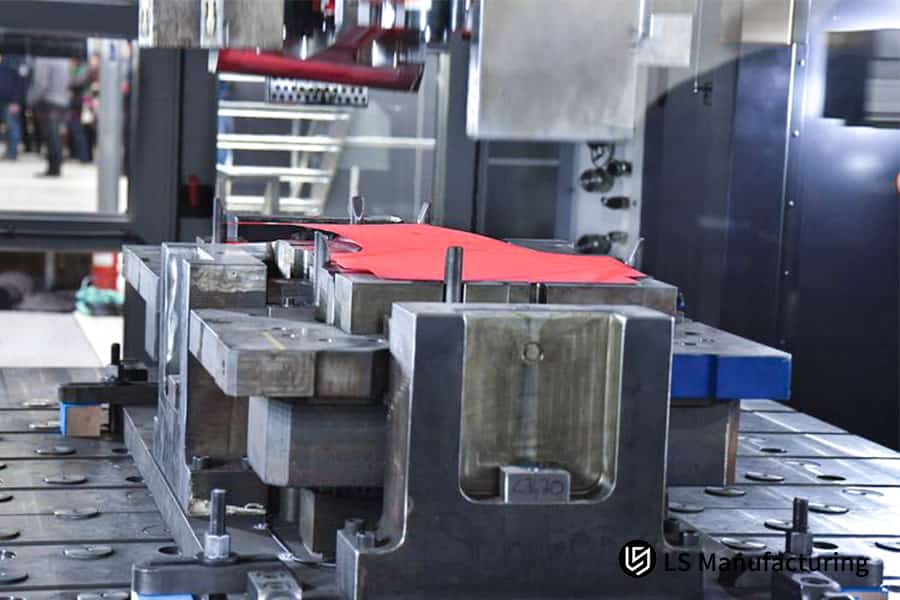
Figure 1: A red metal sheet on a large industrial mold, set up for precision stamping.
How Can Custom Invar Precision Stamping Eliminate Thermal Expansion Mismatch In Laser Diode Packaging?
Customized Invar precision stamping is the best solution to completely eliminate thermal stress mismatch in laser diode packaging by controlling the thermal expansion coefficient of parts within 1.2×10⁻⁶/K during the temperature change from -60℃ to +100℃. It is based on LS Manufacturing's very tight control of material lattice distortion.
Comparing the Thermal Expansion Coefficients (TEC) of Various Materials
The biggest reason causing the cracking of solder layer in laser diode packaging is the difference in thermal expansion between different materials. The detailed comparative data is as follows:
Comparison of Thermal Expansion Coefficients of Commonly Used Packaging Materials (-55°C to +125°C)
| Material | Average CTE (×10⁻⁶/K) | GaAs Chip Matching Degree | Thermal Conductivity (W/m・K) | Processing Cost Index |
| Invar 36 | 1.2 | Excellent | 11 | Medium |
| Kovar | 5.5 | Good | 17 | Medium |
| Copper | 17.0 | Poor | 401 | Low |
| Aluminum | 23.0 | Very Poor | 237 | Low |
Multi-pass Step-by-Step Stamping Technology
Stamping deformation may affect the austenitic lattice structure of Invar, resulting in a rise in CTE. Scientific process iteration is something important in the reliable custom stamping molding of low expansion alloys. We control lattice distortion in this ways:
- Divide the total deformation rate into 3-5 passes, keep the deformation rate of each pass within 15%.
- Conduct intermediate annealing between every two passes to release work hardening.
- Strictly limit the final deformation rate below 25% to preserve lattice integrity.
A standardized process for low expansion alloy manufacturing is the most important means of guaranteeing the deep stable mass production of Invar parts at a precision level.
Download our "Laser Diode Packaging Thermal Stress Solution White Paper" to learn more about the technical details of Invar stamping.
Which Tooling Materials Prevent Premature Wear During a High Precision Kovar Stamping Service?
One of the best ways to prolong the life of dies used for high precision Kovar stamping service is, by using dies made of ultra-hard Tungsten Carbide or Vanadis 4 Extra high-speed steel, which are further enhanced by a nano-level TiAlN coating. This can not only increase the cycles of a die till wear to over 500,000 but also maintain part dimensional consistency.
Inherent Problems With Traditional Die Materials
Both Kovar and Invar are highly viscous and are work-hardened very quickly. Using the conventional tooling, it is not possible to have a stable metal stamping finishing of hard alloy materials. Conventional die materials are highly flawed:
- Cr12MoV dies: Face severe adhesive wear, the service life is less than 5000 pieces.
- SKD11 dies: Show thermal instability, their dimensions drift after successive stamping.
- Ordinary high-speed steel: Their hardness is not enough and the punches get chip easily.
Most ordinary stamping plants available in the market are incapable of professionally stamping Kovar and Invar parts with the required dies. They do not have the professional hardware support for the high-standard professional stamping production of special alloys.
LS Manufacturing's Mold Material Solution
We've designed a dedicated mold system for Kovar stamping, which is exclusively tailored for high-precision micro stamping processing of low-CTE alloys:
- The punch uses super hard HRA 90-92 ultrafine grain cemented carbide, with wear resistance 20 times that of normal steel.
- Its surface is covered with a diamond-like 3μm thick DLC coating deposited by PVD technique, because of this the friction coefficient is less than 0.15.
- The die is designed with splitting features, so that replace the parts that are more exposed to wear is done separately, which means that costs of maintenance have been lowered.
Our Kovar stamping service is first and foremost supported by this dedicated mold solution, which ladies in the ability of the service to manufacture very high precision that meets the requirements of long-life mass production.
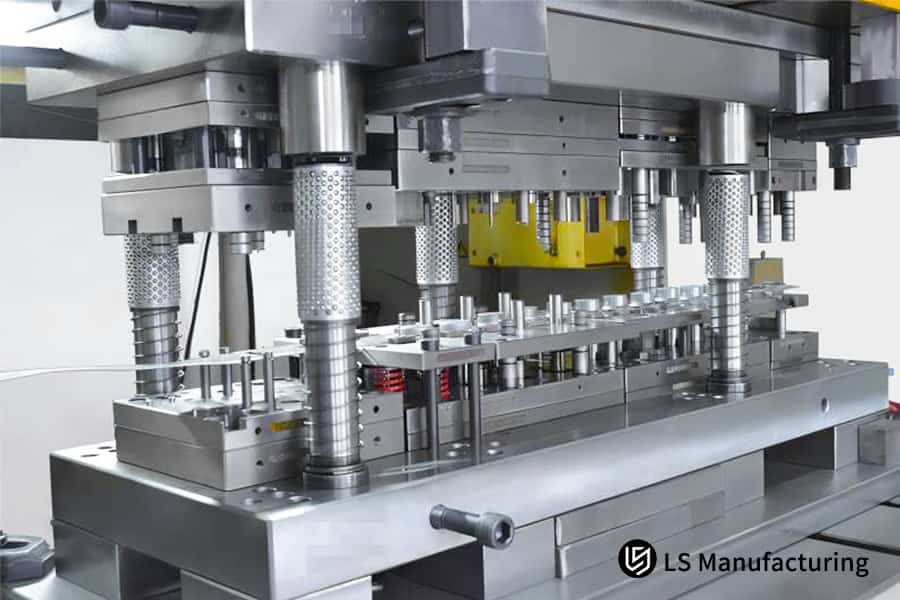
Figure 2: A large industrial stamping machine in a factory, prepared for processing Kovar parts.
Why Must Stamping Kovar And Invar Parts Include a Post-Stamping Vacuum Annealing Process?
Stamping Kovar and Invar parts demands post-stamping vacuum annealing to recover the parts low coefficient of thermal expansion (low CTE)and to remove the magnetism. LS Manufacturing performs a tough 950℃ hydrogen-protected vacuum annealing to fully eliminate the internal stresses of stamping.
Disadvantages of Stamping on Material Properties
Every stamping Kovar and Invar parts is plastically deformed during the stamping operation and so, the material properties are degraded. The scatter of deformation that is not controlled will break the stability of the alloy stamping manufacturing and will also lead to the change in the performance of the finished product. Because of this, annealing is the remedy. Stamped but unannealed parts exhibit the loss of the properties:
- Residual stress is at a level exceeding 500 MPa making the parts susceptible to permanent deformation.
- CTE rises really to more than 8×10⁻⁶/K leading to loss of the low expansion properties.
- Slight magnetism surfaces and this may affect the functioning of the semiconductor and microwave devices.
Vacuum annealing is one of the steps mandated in standardized Invar precision stamping processes for the prevention of material failure.
Process Parameter of LS Manufacturing's Vacuum Annealing
Having a complete heat treatment processing system becomes the basic criterion by which a professional low expansion alloy manufacturing manufacturer is identified as distinct from a mere stamping plant. Our superb heat treatment process guarantees the conformity of custom stamping fabrication even in mass production. We carry out a proprietary precision temperature-controlled annealing process characterized by these parameters:
- Vacuum level kept under 0.001 Pa, or the atmosphere is a high-purity hydrogen gas one.
- Heating pace at 10℃/min to 950℃ (Invar) or 1050℃ (Kovar).
- After 1 hour at the target temperature, the specimen should be cooled slowly by 2℃/min.
In brief, stamping is "twisting" the metal and annealing is "loosening" it back to almost the same state before stamping, and that is when it regains its original excellent properties.
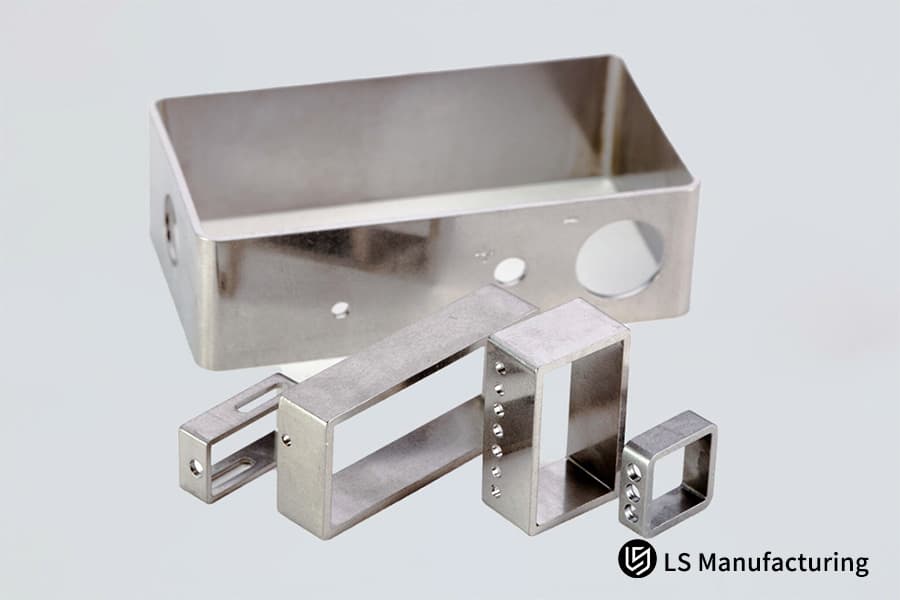
Figure 3: Kovar parts with a matte finish, a result of post-stamping annealing, arranged on a light surface.
How Does LS Manufacturing Secure ±0.01mm Tolerance For Complex low-CTE Stamped Components?
LS Manufacturing depends on a closed-loop SPC dynamic control system, +20℃ constant-temperature CMM inspection, and high-precision multi-station progressive dies that are so precise as to lock the dimensional tolerances of complicated low-CTE stamped components within 0.01mm during uninterrupted mass production.
Digital Springback Compensation Technology
To produce high-precision low-CTE stamped components on a large scale, the fundamental problem that must be overcome is the dimensional deviation issue springback that is caused by the stamping process. High-end stamping compositions of complex parts only get stable and successful, accurately designed compensations are critical. Below are the solutions we present about this:
- Performing completely digital DFM software to simulate the springback curve of Kovar.
- Micron-level compensation angles are added in die designing with the achievement of 0.001mm accuracy.
- The die is further developed based on the actual measurement data after the first trial molding.
This all-embracing digital forming control system is the only one that is needed as a core process for high-precision metal stamping service.
End-to-End Quality Monitoring System
We have created a hoarse quality control mechanism that has three levels. The most stringent quality inspection is always running in the whole process of the production of special alloy stamped parts:
- Online 200x optical CCD measurement, 100% real-time detection of critical dimensions.
- Five pieces are randomly selected from each batch for Hexagon coordinate measuring machine (CMM) full-dimensional inspection.
- An SPC statistical process control report with Cpk 1.33 is provided with each shipment.
By implementing such rigorous end-to-end quality inspection criteria, we have made ourselves a partners of stamping services that are both reliable and trustworthy and at the same time are capable of meeting the mass production requirements of various high-end precision parts.
Upload your 3D STEP drawings, and we will provide you with an accurate tolerance feasibility analysis and customized quotation within 24 hours.
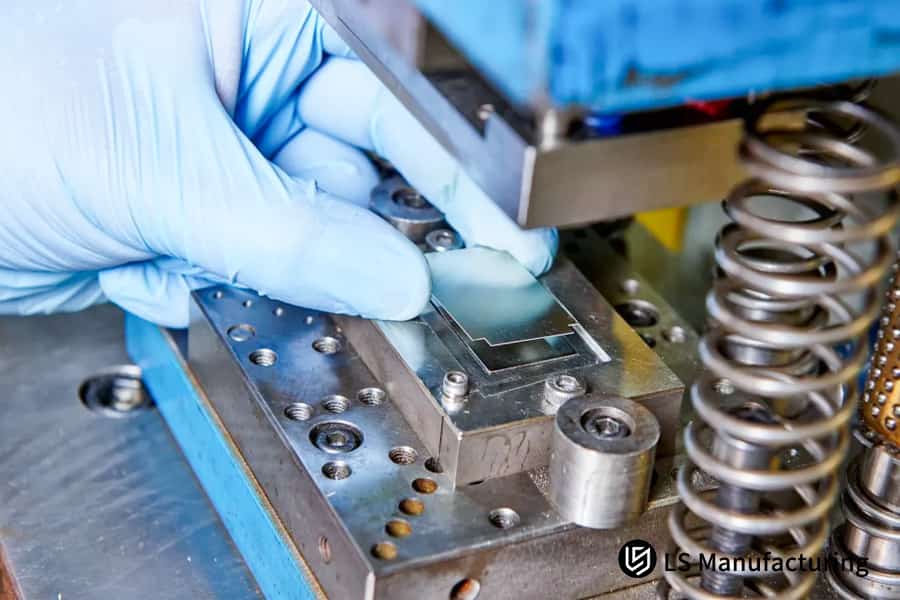
Figure 4: A gloved hand carefully handles a component on a metallic machine during a precise stamping operation.
What Custom Lubrication Strategies Eliminate Surface Deformation During a Heavy-Gauge Kovar Stamping Service?
Using high-viscosity fully synthetic stamping oil that is rich in extreme pressure additives (EP), and a micro-volume lubrication (MQL) system, is the ultimate technical solution to the elimination of surface scratches and localized tensile deformation during heavy-gauge Kovar stamping service.
Problems with Traditional Lubrication Methods
Traditional lubrication solutions are entirely at odds with process requirements of thick-plate Kovar stamping service and are very likely to cause part defects. Unlubricated or poorly lubricated workpieces of thick-plate stamping get damaged surfaces. When Kovar thickness surpasses 1.5mm, conventional lubrication shows a lot of limitations:
- Weak, easily broken emulsion oil film, resulting in direct metal-to-metal contact.
- Non-uniform lubrication, this way leading to localized high temperatures and surface scratches.
- Stubborn oil residue that is difficult to clean and later affects welding and electroplating.
This is the key point explaining why high precision Kovar stamping service require custom lubrication strategies.
LS Manufacturing Tailored Lubrication Solutions
We have done a different process of creating lubrication strategies for different thicknesses and formation difficulties. Lubrication matching by targeting leads to the enhancement of the surface of heavy-gauge stamping parts:
- Thickness < 1mm: Low-viscosity fully synthetic stamping oil can be used with mist lubrication.
- Thickness 1-3mm: The use of chlorinated extreme pressure lubricant with a viscosity of 150mm/s at 40℃ is recommended.
- Thickness > 3mm: The composite lubrication technique of oil film pre-coating + micro-spraying is capable of achieving a surface roughness Ra < 0.4μm.
The customized lubrication scheme we have designed has been more exactly targeted at the problem of surface damage during the stamping Kovar and Invar parts, and it ensures the surface precision and airtightness of the parts.
How to Evaluate Scaling Costs for an Invar Precision Stamping Project?
In order to measure the cost of mass production for Invar precision stamping. It helps to find a good mix between the high upfront investment in progressive dies and the cost of machining per piece. Generally, if the MOQ is set to 5000 pieces or more, stamping could cut the total cost down by 50% to 70% over the time-proven CNC machining.
Cost Structure Comparison of Different Processing Technologies
We have formulated a straightforward multi-level cost accounting model. A sensible choice at the process level can go a long way in controlling the all-inclusive cost of a stamping job.
Specific comparison data is as follows: (Unit: USD)
| Processing Technology | 500 Pieces | 5000 Pieces | 50000 Pieces | Material Utilization | Production Cycle |
| CNC Milling + Wire EDM | 125.0 | 98.0 | 85.0 | <15% | 4-6 weeks |
| Single Die Stamping | 42.0 | 28.0 | 22.0 | 65% | 2-3 weeks |
| Multi-Station Progressive Die Stamping | 68.0 | 18.0 | 12.0 | >90% | 1-2 weeks |
Professional Invar precision stamping technology can bring about remarkable cost and efficiency benefits when used for high-volume production versus traditional processing methods.
LS Manufacturing's Approach To Cost Optimization
We work with clients to ensure that every penny they invest translates into maximum returns. Scientific cost planning is a tool to increase the profit margin of batch stamping projects:
- Furnish detailed DFM cost cutting solutions, which typically bring about a 15% reduction in part costs.
- Give advice on proper mold investment strategies based on customers' life cycle projections.
- Provide mold installment payment plans that can help to release the capital burden upfront.
If you are looking for mass production of parts made from low-expansion alloys, high-performance, and high precision metal stamping service are clearly the best choice. Based on sophisticated cost optimization solutions and closed-loop processes, we are a reliable high-quality stamping service partner for cost-effective mass production.
How Do You Vet a Low Expansion Alloy Manufacturing Partner For Custom Kovar And Invar Progressive Stamping?
Choosing a dependable and capable low expansion alloy manufacturing manufacturer not just one supplier, but a thorough verification of three major criteria is needed: the dynamic clearance of the mold should be stably controlled within 0.002mm, the manufacturer must have a 1050℃ vacuum hydrogen annealing furnace independently, and the manufacturer must provide on-site SPC quality data reports with Cpk1.33.
Typical Capability Deficiencies of Regular Stamping Workshops
Generally, most of the regular stamping workshops are far from capable of low-expansion alloy processing. A lack of dedicated process experience results in substandard production of the special metal stamping:
- Using stainless steel stamping parameters, the stamping clearance is too large, because of this causing edge cracking.
- Due to the unavailability of vacuum annealing facilities, the manufacturers are compelled to outsource, which further results in loss of control over the quality.
- Absence of high-precision measuring instruments makes staying consistent with the dimensions a nightmare.
Only a fully closed-loop production process can ensure good-quality low expansion alloy manufacturing, merely the stamping step alone will not be able to result in a quality product. This is the main reason why it is obligatory to check the full chain process capability while choosing a reliable stamping service provider.
LS Manufacturing's Full-Chain Advantages
We bring all the main steps of our work into one factory. This way, we can guarantee high-precision and reliable stamped products delivery by using a closed production system:
- Mitsubishi wire EDM is our main tool, so we keep mold processing tolerance to 0.005mm.
- We have three independent vacuum hydrogen annealing furnaces capable of 1050℃, which gives us a large production capacity.
- We have digital full-process traceability, so any batch of products can be tracked back to the original raw material batch.
Having a well-developed closed-loop system of precision metal stamping service completely gets rid of the quality risks of outsourcing. Our keenly focused process R&D and manufacturing system enable our Kovar stamping service to be much better than usual manufacturers in the industry.
Case Study: How LS Manufacturing Rescued a Telecom Giant's Optical Transceiver Kovar Base Plate Project?
Customer Challenges
A reputable North American optical communication firm wanted to develop an 800G optical transceiver and because of this required a customized, high-precision Kovar base plate substrate with a thickness of 0.8 mm. At first, they went with a conventional stamping factory that resulted in large cracks at the edges of the parts due to huge blanking clearances and absence of a follow-up vacuum annealing procedure.
Even with a springback that was strong enough to cause a flatness deviation of as much as 0.05 mm, cracking at the solder joints of the chips came to 18.5% after the environmental testing at -40℃ to 85℃, which pushed the production to shut down and led to a more than $100,000 daily production loss.
One of the main issues with ordinary stamping manufacturers is their total lack of process control capabilities when it comes to high precision Kovar stamping services, and as a result, they fail to meet production standards of highly precise optical communication components.
LS Manufacturing Solution
Within two days, our R&D team managed to perform DFM analysis and undertake the mold redesign. We utilize a five-station precision progressive die, with carbide punches coated with DLC film (friction coefficient 0.1), allowing us to precisely lock the punching clearance at an incredibly refined golden ratio of 6%. At the same time, we rolled out our self-developed 1050℃ precision temperature-controlled hydrogen-protected vacuum annealing process, so completely eradicating work hardening and residual stress.
Results and Value
Upon the completion of three consecutive batches of mass production verification, containing 20,000 pieces each, the product's first-pass yield was 99.8%, and in the thermal cycling test, the solder layer cracking rate was brought down to zero. The flatness that was at 0.05 mm got better to within 0.01 mm, so fully complying with the optical transceiver's optical path coupling requirements.
By far, the biggest impact is that by using our stamping technology, the customer's unit processing cost got directly cut down by 64%, and the delivery time got shortened by a whole three weeks in comparison with the initially planned CNC machining solution. The very successful client, in the end, named LS Manufacturing as its only global strategic supplier of Kovar substrates.
The top-quality low-CTE stamped parts production solution on a large scale that was implemented this time had perfectly resolved the customer's mass production failure and cost issues, as a result, we became one of the main stamping service partner that the customer trusts for a long-term basis.
If you are also facing similar mass production difficulties, immediately schedule a one-on-one technical consultation with our senior engineering experts to quickly solve your project problems.

FAQs
Q1: What is the normal lead time for a tailor-made Kovar stamping service project at LS Manufacturing?
After you upload the drawings, we will complete the DFM evaluation and quotation within 5 working days. The time for delivery of one mold and the first batch of samples is 15-20 days and for high-precision multi-station progressive dies 25-30 days. Mass production delivery can be done within 7 days after sample approval.
Q2: Can Invar precision stamping material magnetization and if so, how do you get rid of it?
Yes, cold stamping of high stress can induce lattice transitions and produce weak magnetism. We perform a 900℃ hydrogen stress-relief vacuum annealing that gets rid of magnetism completely and at the same time, the original ultra-low coefficient of thermal expansion is restored to 100%.
Q3: What is the Minimum Order Quantity (MOQ) for high-precision Kovar stamping service parts?
We offer prototype production with a minimum of 100 pieces (combining precision wire cutting and single-shot die), the minimum order for progressive stamping with formal die opening is 2000 pieces to get the most out of the die costs through amortization.
Q4: How can LS Manufacturing ensure that production complies with IATF 16949 and ISO 9001?
Our companies' systems strictly follow IATF 16949 and ISO 9001 standard. For every batch, we carry out material spectral analysis, full-stroke SPC monitoring, and we also deliver full coordinate measuring machine reports and certificates of conformity.
Q5: Can you machine and stamp Kovar and Invar parts with selectively plated or cladded coatings?
Sure, we provide a comprehensive surface engineering solution that can be stamped and processed with pre gold-plated, nickel plated, or copper coated composite strips. The coating is protected from peeling or flaking through a special mold structure.
Q6: How does the raw material price fluctuation of Nickel and Cobalt affect my stamping project quotation?
The prices of Kovar and Invar fluctuate broadly in response to the international nickel and cobalt futures prices. To offset a part of these fluctuations, we put in place strategic procurement agreements with leading steel mills that allow us to fix the core material price and offer a price lock-in period of 3-6 months.
Q7: What are the maximum material thickness capabilities for your low-expansion alloy manufacturing lines?
With some of our presses capable of 300 tons, our precision stamping lines not only can handle simple stamping but also deep drawing and multi-angle bending of materials varying from 0.05mm super thin shielding foils to 4.5mm heavy-duty microwave waveguide substrates.
Q8: Why should I choose LS Manufacturing as my stamping service partner instead of a general stamping shop?
Besides general stamping shops not having the engineering knowledge necessary for stamping high-hardness alloys, at LS Manufacturing we have spent 20 years focused on 0.005 mm tolerance limits, low CTE material control, as well as having a complete proprietary vacuum annealing and testing closed-loop system.
Summary
At first Kovar and Invar precision stamping were, in fact, considered support processes and inducement price cuts by automakers only. When optoelectronics, semiconductors, and microwave packaging became high-end manufacturing industries, Kovar and Invar precision stamping as key business processes appeared for cost reduction, efficiency improvement, and product temperature stability guarantee. LS Manufacturing distinctively through the use of accurate blanking clearance control, wear-resistant dies with unique designs and a complete, closed-loop vacuum annealing process has solved the main industry issues such as part cracking, CTE failures, dimensional deviations by ensuring stable operation of precision components in extreme high and low temperature environmental conditions.
Don't allow old-fashioned processing methods and unreliable small workshop suppliers to slow down your new product launches or eat away your project profit margins. Call the senior, high-level difficulty materials engineering experts at LS Manufacturing now.
You just need to upload your 3D STEP drawings or 2D DFM design sketches with one click, and our professional staff within 24 hours will provide you with a very detailed technical quotation including process feasibility study, tiered mass production cost calculation, and a complete die amortization schedule.
Request your FREE DFM evaluation and customized stamping quotation now and we will be your most trusted and remarkable support in low-expansion alloy precision manufacturing!
📞Tel: +86 185 6675 9667
📧Email: info@lsrpf.com
🌐Website: https://lsrpf.com/
Disclaimer
The contents of this page are for informational purposes only. LS Manufacturing services There are no representations or warranties, express or implied, as to the accuracy, completeness or validity of the information. It should not be inferred that a third-party supplier or manufacturer will provide performance parameters, geometric tolerances, specific design characteristics, material quality and type or workmanship through the LS Manufacturing network. It's the buyer's responsibility. Require parts quotation Identify specific requirements for these sections.Please contact us for more information.
LS Manufacturing Team
LS Manufacturing is an industry-leading company. Focus on custom manufacturing solutions. We have over 20 years of experience with over 5,000 customers, and we focus on high precision CNC machining, Sheet metal manufacturing, 3D printing, Injection molding. Metal stamping,and other one-stop manufacturing services.
Our factory is equipped with over 100 state-of-the-art 5-axis machining centers, ISO 9001:2015 certified. We provide fast, efficient and high-quality manufacturing solutions to customers in more than 150 countries around the world. Whether it is small volume production or large-scale customization, we can meet your needs with the fastest delivery within 24 hours. choose LS Manufacturing. This means selection efficiency, quality and professionalism.
To learn more, visit our website:www.lsrpf.com.