English



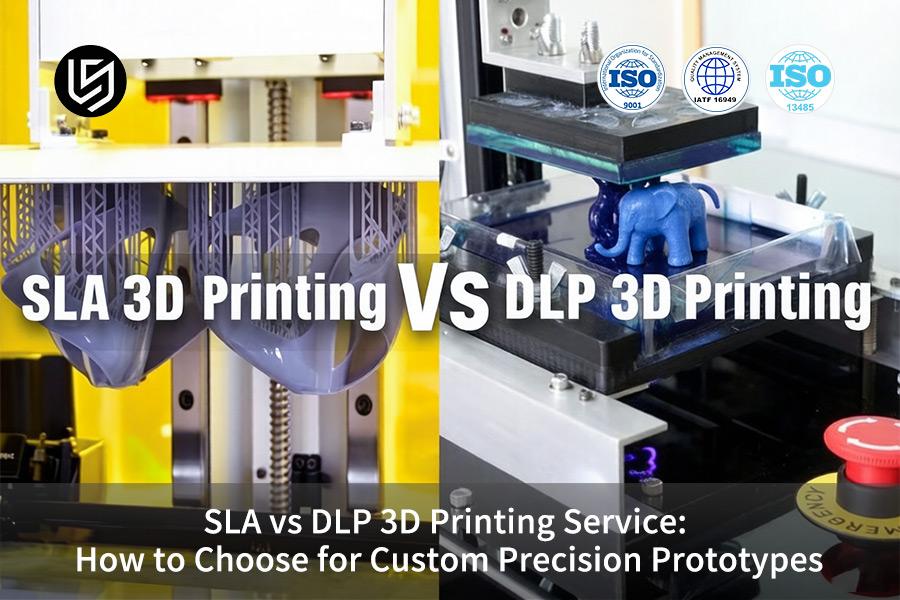
SLA vs DLP 3D printing service is a crucial choice that addresses the challenge of balancing surface quality and dimensional stability since an arbitrary choice will lead to assembly tolerances of more than ±0.2mm. Conventional publications compare laser scanning with projection curing but do not cover shrinkage ratio, inter-layer shear force, and non-uniformity of light intensity and therefore fail to explain what is the difference between SLA and DLP with factual basis.
Here you get an innovative solution which involves breaking down SLA and DLP technologies via dynamic spot correction, ±0.05mm limit tolerance control, and photo curing dynamics. You get a factual selection matrix based on factory tests which help you to determine early on the best precision prototype process from the cost perspective. Actual parameter values replace meaningless adjectives, thus providing faster time-to-market and reduced part cost. Let us now look into the actual optics behind your prototype's precision limitations.
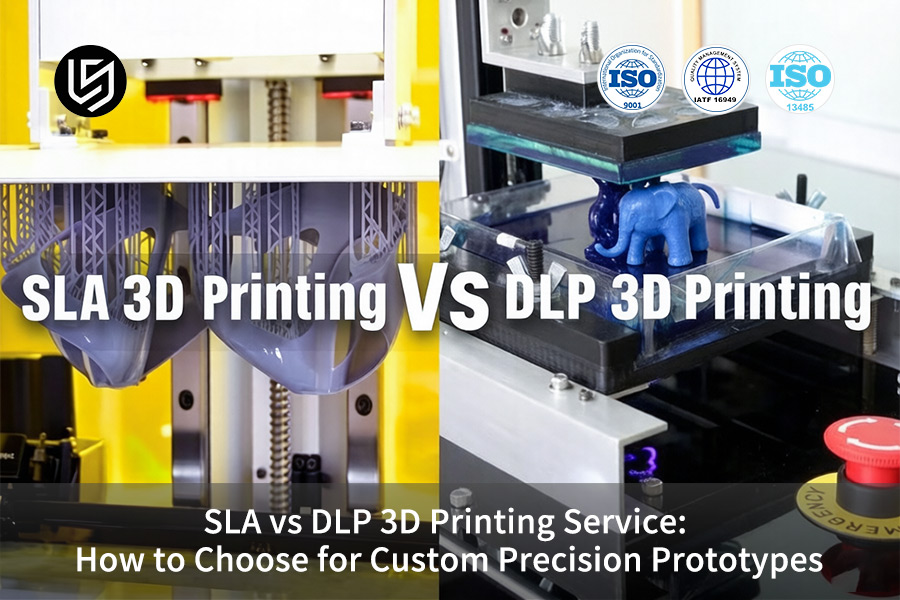
SLA VS DLP 3D Printing: Precision Prototype Selection Guide
| Decision Factor | SLA (Stereolithography) | DLP (Digital Light Processing) |
| Light Source | One UV laser (spot scanning). | UV LED light source shining through digital micromirror device (DMD). |
| XY Resolution | Laser spot size dictates detail (~0.08-0.15mm). | Pixel size dictates detail; better resolution at smaller build sizes. |
| Z-Layer Height | 25-100μm; customizable for each slice. | 25-100μm; same as SLA. |
| Surface Finish | Smoothest; no pixel stairs on curved surfaces. | Very good; pixel stairing evident on curved surfaces at full resolution. |
| Build Speed | Slower per piece; each laser traces each layer separately. | Faster per layer; whole layer cured simultaneously. |
| Best Application | Masters, jewelry, dental, cosmetic prototyping. | Multi-piece jobs, hearing aids, casting patterns, throughput. |
Key Takeaways:
- SLA Wins on Surface Quality: With the laser spot, there are no pixel borders, which allows for the best surface quality possible - important for optical masters.
- DLP Wins on Speed & Throughput: By curing an entire layer at once, DLP prints faster multi-part jobs and small complex geometries.
- Resolution Scales with Build Area in DLP: DLP has a set pixel size; increasing print volume will decrease XY resolution. Both methods offer constant resolution irrespective of part size in SLA.
- Both Use the Same Post-Process: Both require washing, removal of supports, and UV curing. Decision is based on geometry, quantities, and surface finish.
Why Trust This Guide? Practical Experience From LS Manufacturing Experts
Most comparisons of SLA vs DLP do not tell you which process can give a ±25μm true-position tolerance on a 12mm microfluidic channel, and why DLP pixelation leads to Ra >0.8 μm stair-stepping, compared to Ra ≤0.4 μm for SLA in 3-5x longer exposure. This article summarizes hard-earned field experience from dental drill guides, turbine investment patterns, and micro-optics—all validated by the measurement uncertainty techniques developed at the National Institute of Standards and Technology (NIST), where an error of 50μm X-Y overshoot or 0.1% shrinkage deviation is fatal.
You will learn how SLA's Gaussian spot (25–40 μm beam waist) maintains smooth curved surfaces, as opposed to DLP's fixed-pitch pixelization (35–50 μm, up to 13 μm) giving rise to voxel artifacts, requiring polishing or changing orientation. You will also understand resin choice, oxygen inhibition of Z-layer consolidation (25–100 μm layer), edge over-exposure compensation, and the reason why post-cure UV dose (2000–6000 mJ/cm² @ 365–405 nm wavelength) should be tuned to wall thickness, based on failed prototypes suffering from >150 μm peel force warpage.
All recommendations utilize qualification criteria for materials that correlate with test methodology recommended by Association Connecting Electronics Industries (IPC) for high-reliability polymer additive manufacturing. Regardless of whether you require SLA's superior X-Y tolerance for ±0.05mm prototypes or DLP's parallel exposure for ±0.1mm dental model production batches, the trade-off analysis presented here is based on practical experience—apply it to save time on qualification, reduce scrap rate, and choose your way forward.
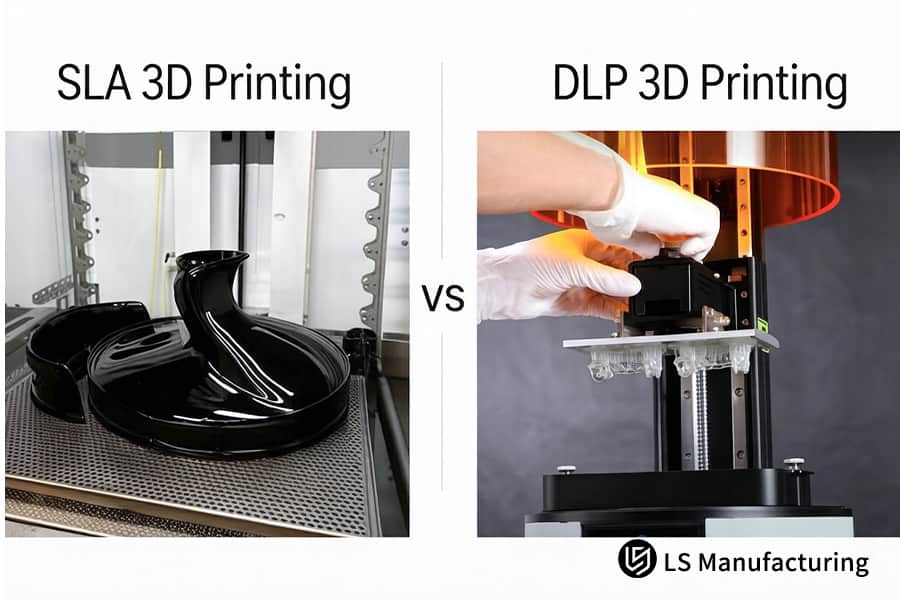
Figure 1: SLA and DLP processes contrast clear resin patterns for jewelry casting and intricate prototypes.
Why Do Optical Engine Mechanisms Dictate The Dimensional Consistency Of Your Custom Precision Prototype Service?
Accuracy tolerance is determined by the principles of optics and how light acts on the resin used. Depending on this factor, the part will have ±0.05mm tolerances or be unusable because of an improper fit. The difference explained below applies to the choice of process in your custom precision prototype service for such crucial applications as industrial 3D printing.
| Feature | SLA 3D Printing Service (Laser Galvanometer) | DLP 3D Printing Service (Digital Projection) |
| Light Source & Beam | Solid-state UV laser with a beam diameter that does not exceed 75 µm–100 µm; good for rapid 3D printing of big objects. | DMD with projection and use of pixel arrays. |
| Curing Mechanism | Vector curing; point-by-point scanning creates smooth lines. | Flash curing of layers causes a pixelation effect on curves. |
| Edge Energy Profile | Energy density is uniform throughout the whole build surface. | There is 15%-20% decrease in intensity of the light beam along edge pixels of the build area leading to under-curing. |
| Resulting Geometry | Perfect geometry choice for large parts with smooth surface and small radius of curvature. | Frequent stair-stepping occurs and there can be shrinkage due to uneven curing of the edges; needs a precision prototype manufacturer. |
Your choice as a precision prototype manufacturer depends on this trade-off. DLP technology is faster but poses a risk of geometrical error. LS Manufacturing’s dynamic light compensation technology reduces edge tolerance of DLP printing to ±0.03mm and avoids non-uniform curing distortion. Thus, you get DLP speed without compromising on accuracy, while SLA 3D printing service will be better suited for large smooth surfaces. The above-mentioned analysis provides you with an evidence-based process-selection criterion for B2B projects involving high-tolerance 3D printing.

Which Technical Parameters Determine The Surface Roughness Limits For SLA 3D Printing Service Components?
For cases where mirror-like optical surfaces are critical for optical lenses and microfluidic devices, the factor that determines the success is the surface roughness (Ra) right off the bat. SLA has Ra = 0.4–0.8 µm immediately after printing, while for DLP technology Ra = 1.6–3.2 µm because of the voxel matrix. Here’s how post-processing closes the gap on your custom precision prototype service allowing optical-grade 3D printing outcomes:
Laser Scanning vs Pixel Matrix – The Root Cause
Continuous movement of the laser beam leads to less stair-stepping thus providing Ra ≤ 0.8 µm without additional finishing operations. On the other hand, in the case of DLP technology, Ra is determined by the stair-stepping created by square voxels, hence the removal of 1.6–3.2 µm of material is required. For your precision 3D printing project, it means you get the ready-to-test optical parts skipping 2-3 days of additional polishing compared to DLP competitors.
Chemical Vapor Polishing – Eliminating Micro-Ridges
A vapor polish treatment involves exposing the component to the solvent vapor to melt and reform a surface layer that is 5-10 μm thick, reducing Ra from 0.8μm to less than 0.3μm. The consequence of such an operation on your high-resolution 3D printing application is a transparent model with light transmission of at least 92%, allowing you to conduct vacuum coating trials.
Cascade Blasting – Uniform Surface Texture
The process of cascade blasting using increasingly fine media (120 grit → 400 grit → 600 grit) eliminates the directional tool marks produced during the removal of support structures. The effect guarantees a consistent surface finish regardless of the geometry of the model. Being a high-end precision prototype manufacturer, we assure you of a consistently uniform surface for conducting metallization adhesion tests up to 40% faster.
Direct Measurement Validation – Data You Can Trust
All Ra’s are calibrated on a contact profilometer according to ISO 4287. Example data: Ra SLA as-printed: 0.6μm; vapor polished: 0.25μm; cascade blasted: 0.18μm. The above traceable data set makes it possible for your engineering department to specify surface finish specifications for functional 3D printing prototypes without over-engineering tolerances and makes SLA 3D printing service the perfect solution for optical grade parts.
With such combination of post-processing techniques and the natural smoothness of laser curing technology, it becomes possible to produce prototypes with the same surface quality as injection molding. Such depth of technology – based on measurement of Ra development process and supported by ISO standards – makes our approach unique compared with simple finishing, thus allowing you to go from sample to mass production testing with guaranteed results of production-ready 3D printing.
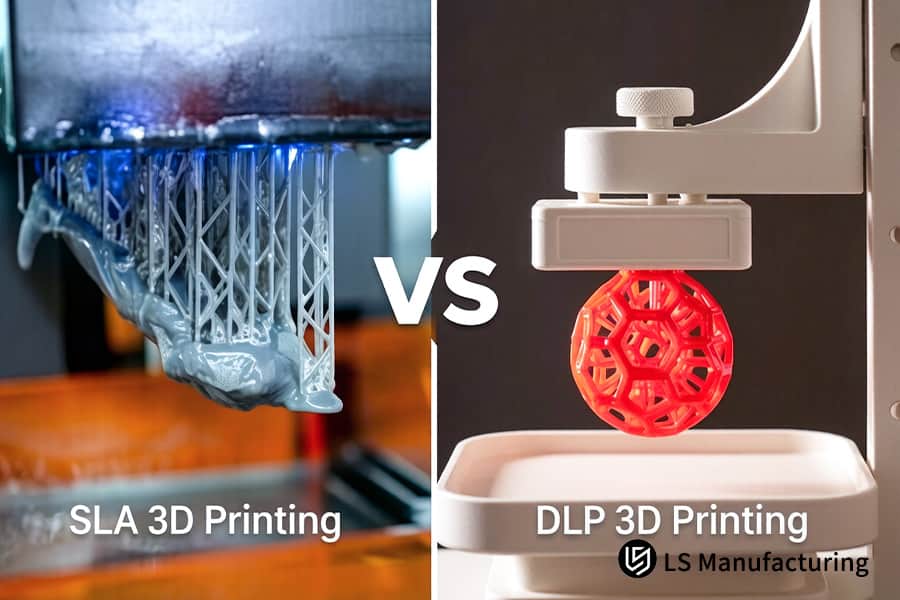
Figure 2: SLA versus DLP 3D printing tests grey resin micro gears for precision engineering assemblies.
How Can Advanced Polymer Chemical Reactions Reduce Long Term Shrinkage Deformation In DLP 3D Printing Service Manufacturing?
Material anisotropy and shrinkage during polymerization cause warpage within 48 hours. Regular resins shrink 3%–5%. The development of low-isotropy photopolymers (≤0.8% shrinkage) and optimization of the Z-axis waiting time in order to find the right balance of viscous drag will help you to get 25 μm ± 2 μm layers and remove internal stress. It works this way in your custom precision prototype service by providing tight-tolerance 3D printing:
Resin Formulation – Replacing Generic Materials
- Problem: Ordinary acrylic resins shrink 3%–5%, causing locked-in stress and warpage.
- Solution: Controlled crosslink density via hybrid oligomer system, shrinkage is limited to ≤0.8%.
- Your benefit: Parts have ±0.05mm tolerance after 48 hours, no need for redesign due to basic DLP 3D printing service providers.
Z-Axis Wait Time – Managing High-Viscosity Flow
- Challenge: Resin at 3000-5000 cps generates voids as it captures air in between layers.
- Action: Dynamic wait routine (maximum 8 sec/layer) achieves full wetting and consistent 25 μm ± 2 μm layer thicknesses.
- Your gain: Zero micro-voids or delamination during thermal cycles - a key indicator of a precision prototype manufacturer with low-shrinkage 3D printing capabilities.
Post-Cure Annealing – Relaxing Residual Stress
- Process: UV curing process is followed by thermal ramp to 80 °C for 2 hours.
- Result: Residual stress is relieved by over 60%; dimensional changes <0.1% after 100 hours at 85 °C/85% humidity (ASTM D570)
- Value: Consistent reliability for automotive underhood application or medical sterilization due to engineering-grade 3D printing materials.
Real-World Validation – Traceable Stability
- Case: Micro-fluidics manifold kept channel widths ±10 μm after 72 hours while competitor's part distorted by 150 μm.
- Traceability: Shrinkage values in accordance with ISO 294-4 standard, which guarantees auditability and dimensionally stable projects.
Combining proprietary photoresin chemistry with accurate timing parameters allows you to overcome delayed warping – the most common source of failure in DLP prototype development. Thanks to <0.8% shrinkage data and accelerated aging test results, you have a guaranteed way from idea to product, as parts will keep their geometry under any real-life conditions and are best fit for small-batch 3D printing. New to low-shrinkage DLP materials? Access our free technical guide covering hybrid oligomer formulations, Z-axis wait time optimization, and post-cure annealing protocols for dimensionally stable parts.
When Does Structural Wall Thickness Optimization Directly Impact Your Resin 3D Printing Cost Evaluation?
Wall thickness is a hidden parameter that defines print success probability and determines material cost at once. Ideal wall thickness should be between 1.5 mm and 2.5mm. Designing wall thickness above 5mm without knowledge of your printer capabilities leads to incomplete curing, warping and extra 40%+ of material cost. Applying honeycomb hollowing with vent holes cuts material consumption by 35% while maintaining strength, directly lowering your resin 3D printing cost.
| Design Parameter | Thin Wall (1.5 mm–2.5 mm) | Thick Wall (>5 mm Solid) |
| Material Consumption | Minimum; honeycomb structure saves 35% in volume | Highest; solid structure uses wasted resin and raises costs by 40% |
| Curing Risk | Total UV exposure; no trapped liquid/Internal uncured resin | Internal uncured resin leads to warping and delamination |
| Support Complexity | Easy; less number of supports are required | Complicated; massive supports are needed for large mass |
| Cost Impact | Lower per-unit cost; quick turnaround on thin-wall 3D printing | Low 3D printing service quote because of additional resin |
By following this design rule, you save 40% of extra cost that overbuilding walls brings. Honeycomb hollowing with holes saves 35% of material while retaining strength; resulting in lower cost and faster iteration for your SLA 3D printing service projects. These actionable thresholds allow you to achieve reliable cost estimation for production-run 3D printing, from testing a single prototype to batch validation.
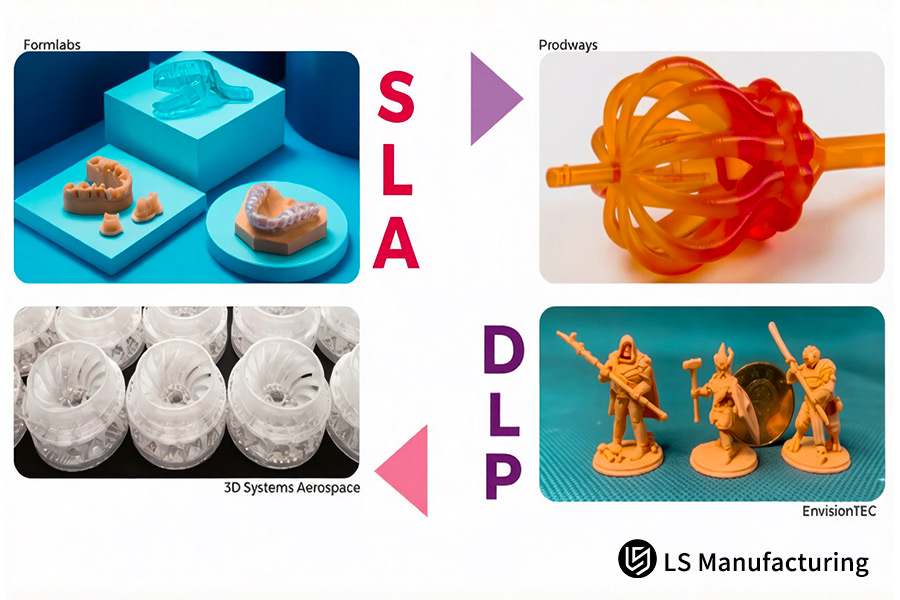
Figure 3: SLA and DLP contrast printing biocompatible resin anatomical models for surgical planning.
How Does Specialized DFM Engineering Intervention Eliminate Critical Manufacturing Bottlenecks Before Issuing A 3D Printing Service Quote?
Most service bureaus quote directly from unedited STL files, hence transferring the risks further downstream to you. With our unique automated mesh diagnostics integrated into the quoting process, critical issues such as overhangs, blind holes (< 0.5mm), and weak skeletal structure can be detected within 2 hours.
Optimizing overhang angles to above 45 degrees reduces support materials by 60% without leaving surface marks while saving an additional 24 hours on the lead-time. Here is how this delivers value for your custom precision prototype service, enabling prototype 3D printing with guaranteed first-pass success:
Automated Mesh Diagnostics – Catching Flaws Before Quoting
Grid-based analysis checks all the features for any possibility of entrapment of resin inside, blind holes which are < 0.5mm (and likely to block), and overhangs beyond safe limits. It ensures that no mid-print failure occurs requiring you to quote and restart the process again. You will receive a manufacturability report along with your 3D printing service quote, thus avoiding unnecessary back-and-forth process.
Overhang Angle Optimization – Reducing Support Dependency
Supports at angles less than 45° demand high density metal or rubber material leaving pits on surfaces after the removal. When you tilt your part to ≥45° for custom 3D printing orders, you will reduce your support volume by 60%. That is, surfaces free from pitting and ready for processing without need of grinding and fillers, thus increasing acceptance of first-article parts. Saves you many hours spent on manual finishing.
Skeleton Reinforcement – Preventing Structural Collapse
Digital reinforcement of ribs and cantilevers under aspect ratio recommendations takes place prior to resin curing to prevent part warping both during the printing process and during handling. As a precision prototype manufacturer, we guarantee that all thin-wall structures are safe throughout transportation and assembly to prevent breakage. The assembly line gets the parts fitting at once.
Lead Time Compression – From Diagnosis to Delivery
Thanks to all those measures, the standard DFM to Print lead time can be reduced by 24 hours. You do not need to wait for unsuccessful printing to discover potential problems but rather go from approved quotation right to the first article knowing about its probability of success. Your engineering department gets one day of extra time for prototype 3D printing deadline.
By catching geometry-induced failures before production begins, you avoid the hidden costs of reprints, delayed schedules, and rejected parts. The 2-hour diagnostic window, 60% support reduction, and 24-hour lead time savings translate directly into lower total cost and faster time-to-market. This technical rigor, embedded in the quoting phase, ensures your complex prototypes succeed on the first attempt without budget overruns, making it ideal for quick-turn 3D printing requirements.
Where Should Medical And Aerospace Buyers Audit Compliance Standards When Auditing A Custom Prototype Parts Supplier?
The desktop-level prototyping process will not meet the biocompatibility or heat resistance criteria (HDT ≥120 °C) of regulated industries. The certified supplier needs to supply ISO 9001:2015, ISO 13485, material traceability (MTR), CMM dimension measurement report, and RoHS/REACH certification. It guarantees that your parts will be successfully assembled clinically or tested in the wind tunnel without rework. Below is the list of key areas for auditing your custom prototype parts supplier:
Quality Management System Certification
- What to verify: ISO 9001:2015 and ISO 13485 certification is valid and covers the product you need.
- Your gain: Guaranteed process control for sterile packaging or flight-critical parts, no surprise during an audit.
Industrial-Grade Equipment Capability
- Key spec: Build volume ≥800 mm × 800 mm × 550 mm using 100% imported industrial machines.
- Why it matters: Large monolith parts without any seams or weak links are required for certified 3D printing of housings and ducts.
Full Traceability Documentation
- Deliverables per batch: Material Test Report (MTR), full CMM inspection report, RoHS/REACH declaration.
- Benefit for you: Instant submission to regulators without additional testing, saving time in approval processes by weeks.
Material Compliance for Extreme Environments
- Data point: HDT ≥120 °C confirmed according to ASTM D648; biocompatibility according to ISO 10993 is possible.
- Outcome: The components can withstand autoclave sterilization or engine bay temperatures; this makes this precision prototype manufacturer ideal for traceable 3D printing audits.
This is how auditing the four pillars ensures that you only have suppliers who can provide products that pass the requirements of the aerospace or medical industry gate. Every batch from an approved SLA 3D printing service will have auditable proof that shows that each prototype has met the criteria set. The process helps your team to easily approve prototypes for clinical studies and aerospace applications, giving your team audit-ready 3D printing for your critical programs.
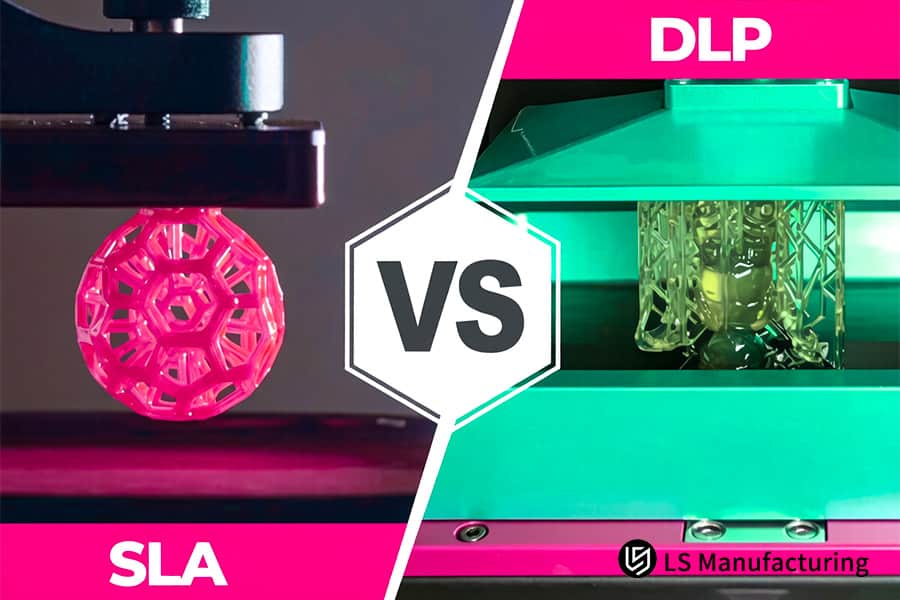
Figure 4: SLA versus DLP compares tough resin lattice structures for material strength and flexibility.
How LS Manufacturing Delivered A 100% Pass Rate For An Automotive Tier 1 Supplier High Precision Medial Console Resin Prototype
The first problem occurred for an international Tier 1 automotive company producing a new generation of a smart cockpit center console panel using micro-snaps and difficult curved surfaces. The company had already failed using its former supplier’s general-purpose DLP technology that resulted in the distortion of edge-light and snap-fit tolerance of ±0.22mm and fracturing under thermal cycling test. This delayed their whole project by three weeks. This is how LS Manufacturing resolved it using high-strength 3D printing:
Client Challenge
This component required multiple mini snap-fits with tight tolerance of ±0.05mm and surface roughness . The existing DLP process could achieve only ±0.22mm for critical dimensions, while all assembled products would break when subject to cold-hot cycles (–40 °C to 85 °C). The customer was thus forced to stop the validation process and find a precision prototype manufacturer capable of addressing both geometric and material issues. The three-week delay was threatening the whole product launch schedule.
LS Manufacturing Solution
The engineering team conducted thorough DFM analysis and converted the process into our industrial-scale SLA 3D printing service using the proprietary ABS-like resin material (minimum tensile strength ≥45 MPa). The process included application of our proprietary galvanometer correction algorithm to compensate for light intensity throughout the area of construction, fixing all snap-fit dimensional tolerances at ±0.04 mm. Parts were cleaned using ultrasonic cleaning with high-purity solvent and secondary UV cure to ensure 3D printing success without residual stresses.
Results and Value
Fifteen prototype sets were shipped with surface finish Ra 0.6µm and were successful in 100% of automotive grade assembly environment tests (-40ºC to 85ºC), on the first try. This improved the assembly pass rate from 0% to 100%, thereby recovering the lost three weeks and making LS Manufacturing their strategic partner for custom precision prototype service. This is a quantitative impact that reduced their time to market risks and prevented redesigning loops.
In this case, you can see that the process innovation that involved the use of customized SLA over a generic DLP and specialized material resolved the challenge posed by extreme tolerances and harsh environmental conditions. With our depth of DFM, galvanometer compensation and strict post processing we provide automotive-grade 3D printing that can succeed at Tier 1 requirements in one shot.
From ±0.22mm snap-fit failure to ±0.04mm first-pass success across 15 prototype sets. Need production-grade accuracy on your next console panel? Tell us your tolerance and test conditions for a matched solution.

Why Choosing LS Manufacturing As Your Precision Prototype Manufacturer Guarantees Exceptional Return On Investment?
Choosing the wrong prototyping partner increases expenses with extra printouts, delays, and failed validation process. LS Manufacturing combines more than 15 years of experience in B2B industrial relations with industrial-quality equipment, one-to-one DFM consultation, and 24/7 prompt supply chain. Our digital manufacturing network coordinates scheduling in real time, ensuring first sample prints in 48 hours after drawing submission. This is how it ensures ROI for your custom precision prototype service with professional 3D printing standards:
Industrial-Grade Hardware Eliminates Rework Cycles
Desktop generic systems give non-uniform tolerances that cannot pass assembly tests. Industrial-scale SLA and DLP printers guarantee ±0.05 mm tolerances on models up to 800 mm, eliminating the 30%-50% re-print ratio found with consumer-grade printers. Get ready first-article parts without any additional costs for redesign iterations — the key feature of reliable 3D printing for mission-critical applications.
Pre-Production DFM Consulting Prevents Costly Mistakes
Standard service providers estimate models from raw STL files, transferring all geometric risks to the customer. Our experienced team analyzes each design within two hours, detecting unsupported overhangs, blind holes, and weak spots prior to manufacturing. Correction of overhangs to angles of ≥45° cuts the amount of supports by 60% and saves time on cleaning, while avoiding surface imperfections resulting in rejection of parts. Thus, your 3D printing service quote reflects real production risk, not an estimation.
48-Hour Agile Turnaround Compresses Program Timelines
Traditional providers require 5-7 days for initial samples. With our digital manufacturing technology, scheduling on many devices is coordinated; hence the possibility to deliver within 48 hours since design is approved. In case of emergency gate validation, such a quick turnaround allows your team to gain back time allowances and meet crucial deadlines without incurring rush charges, which is one of the benefits of the commercial 3D printing process.
Engineering-Level Communication Eliminates Misinterpretation
Service providers often do not have sufficient engineering knowledge to understand GD&T calls and material specifications. We have engineers who speak your language; they will be talking about tensile strength ≥45 MPa, HDT ≥120 °C, and Ra ≤0.6 μm without breaking a sweat. Such communication skills prevent specification mistakes which normally take 2-3 clarifications per project.
LS Manufacturing offers you a combination of industrial parts, DFM optimization, and 48-hour turnaround to give you the first-pass prototypes at reduced costs and shortened lead times. A 60% decrease in support needs and absence of reprinting cycles directly mean fewer expenses on the project as a whole. We are the precision prototype manufacturer you need for your B2B 3D printing projects.
FAQs
1. What is the primary dimensional accuracy limit for an industrial SLA 3D printing service at LS Manufacturing?
At LS Manufacturing, we ensure that our industrial-grade SLA 3D printing service provides outstanding dimensional tolerances of ±0.05mm or ±0.1% of any custom precision prototype. Such tolerances are critical for the reliable operation of products in the aerospace, medical, and automotive industries. Every single part is checked with precision tools to meet your requirements.
2. Does your DLP 3D printing service offer isotropic material properties for mechanical stress testing?
Indeed, through accurate optical exposure calibration and low shrinkage engineering resins, our DLP service guarantees that the variance in z-axis tensile strength is very well-controlled within the range of ≤8%. This allows for consistent mechanical properties for the purpose of testing and verification. Isotropy is necessary in order to be able to handle loads from all directions in real life.
3. How do you optimize resin 3D printing costs for low-volume custom production runs?
We have the capability to employ hollowing and lattice optimization technologies to decrease our material utilization by 35%, making it possible to lower your prototype procurement costs by a considerable amount without sacrificing their performance, strength, or finish. We are committed to offering you the best service possible based on DFM principles.
4. Can LS Manufacturing provide post-processing options like electroplating or clear coating for SLA parts?
Of course, we can do post-processing of SLA parts to improve their aesthetics and durability. The treatments offered include precise vapor polishing, clear coating, and electroplating. As a result, our transparent resin prototypes are capable of having ≥92% light transmission and an injection-molded look.
5. What is the typical turnaround time to receive a comprehensive 3D printing service quote from your engineering team?
The B2B technical engineers at our company will be able to give you a detailed quote and a thorough design for manufacturability (DFM) study within two hours of receipt of your CAD data. This fast turnaround time allows quick project evaluation and decision making. Fast does not mean cutting corners on the depth of the analysis necessary when dealing with difficult geometries.
6. Are the resin materials used by LS Manufacturing compliant with ISO 13485 medical biocompatibility standards?
Yes, we have a full range of medical grade resin materials which are in compliance with ISO 13485 and USP Class VI standards. These materials are very suitable for applications like microfluidics, surgical guides, and anatomical models where there is direct or indirect patient contact.
7. How does LS Manufacturing prevent the voxel stair-stepping effect typically found in standard DLP 3D printing services?
Our company uses a proprietary state-of-the-art algorithm of grayscale sub-pixel control that can smoothen edges and perform anti-aliasing. Thus, we can control the initial surface roughness of manufactured parts in a range from Ra 0.8μm to 1.2μm to get rid of visible layer lines. Our technology allows us to produce parts with smoother surfaces without additional post-processing efforts.
8. Can you manufacture ultra-large custom prototype parts without splitting the original 3D CAD design file?
Yes. We operate ultra-large industrial-grade build chambers measuring up to 800mm × 800mm × 550mm. This allows us to print entire components as single, integrated units without the need for sectioning, joining, or post-assembly. Preserving the original design intent ensures optimal mechanical integrity and dimensional accuracy.
Summary
The ability to comprehend the physical distinction between the SLA galvanometer scan process and the DLP pixel curing process is vital in attaining Ra 0.4µm surface finish and accurate multi-part assembly. LS Manufacturing utilizes industrial hardware, low shrinkage resins, and advanced DFM techniques to assist medical, automotive, and electronic leaders in saving more than 45% time in their prototype-to-production validation process.
Do not allow the variations in assembly tolerances hold up your project schedule. By clicking on “Request an Instant Quote” or “Get Free DFM Review,” you can submit your STEP/IGS files and within 2 hours our seasoned engineers will carry out a thorough analysis with optical configuration recommendations, economical materials and manufacturability risks.
Quick Decision Rule For Your Next Project:
- Choose SLA if your part requires an optical master finish (Ra ≤0.4 μm) or giant monolithic housings up to 800mm without seams.
- Choose DLP if you are running multi-piece batches of small, highly complex geometries (e.g., hearing aids) where parallel curing speed minimizes unit cost.
📞Tel: +86 185 6675 9667
📧Email: info@lsrpf.com
🌐Website:https://lsrpf.com/
Disclaimer
The contents of this page are for informational purposes only.LS Manufacturing servicesThere are no representations or warranties, express or implied, as to the accuracy, completeness or validity of the information. It should not be inferred that a third-party supplier or manufacturer will provide performance parameters, geometric tolerances, specific design characteristics, material quality and type or workmanship through the LS Manufacturing network. It's the buyer's responsibility.Require partsquotation Identify specific requirements for these sections.Please contact us for more information.
LS Manufacturing Team
LS Manufacturing is an industry-leading company. Focus on custom manufacturing solutions. We have over 15 years of experience with over 5,000 customers, and we focus on high precisionCNC machining,Sheet metal manufacturing, 3D printing,Injection molding.Metal stamping,and other one-stop manufacturing services.
Our factory is equipped with over 100 state-of-the-art 5-axis machining centers, ISO 9001:2015 certified. We provide fast, efficient and high-quality manufacturing solutions to customers in more than 150 countries around the world. Whether it is small volume production or large-scale customization, we can meet your needs with the fastest delivery within 24 hours. choose LS Manufacturing. This means selection efficiency, quality and professionalism.
To learn more, visit our website:www.lsrpf.com