English




ABS vs PLA injection molding services face the engineers working in precision industries such as those dealing with medical devices and automotive electronics with uncertain process limits, resulting in expensive defects including weld lines and warpage beyond ±0.2mm. As per industry statistics, neglecting shear rate and cooling differences of ±5°C increase internal stresses, delaying market entry by 4-6 weeks, and questions such as is ABS plastic better than PLA highlight the common dilemma of material selection.
The following article offers you a unique set of parameter comparisons for engineering plastics, allowing you to realize tolerances of ±0.005mm and save on TPC up to 20% using our cavity-pressure analysis and 4-cavity cost calculations. We ensure a reduction in mold rework costs by 30% with our DFM review, giving you a smooth transition from prototyping to production with this expert guide.
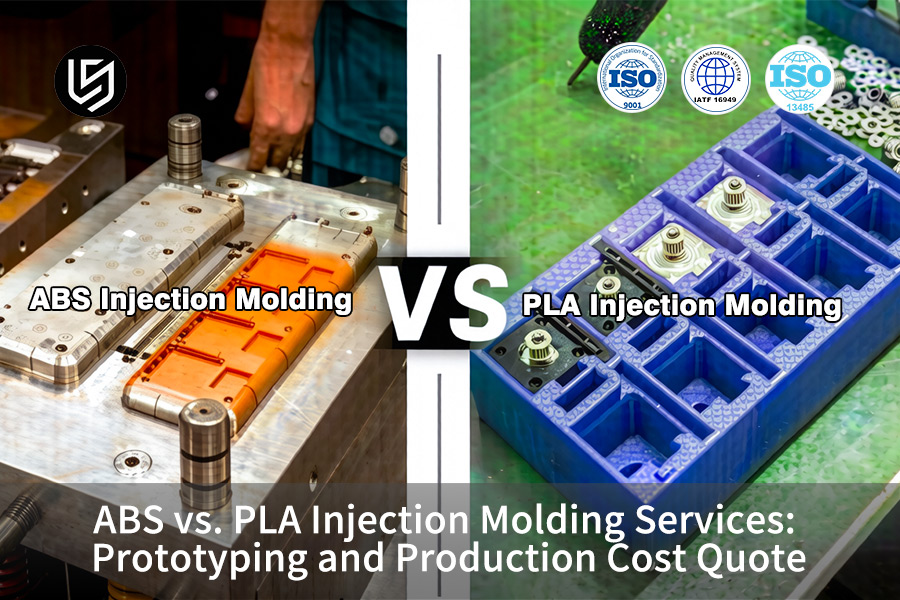
ABS VS PLA Injection Molding Services: Prototyping & Production Cost Guide
| Cost Factor | ABS (Acrylonitrile Butadiene Styrene) | PLA (Polylactic Acid) |
| Material Cost | Modest ($2-$4 per kg). | Inexpensive ($1.5-$3 per kg), although prices may vary. |
| Processing Temperature | High (melting point 210-250°C). | Lower (melting point 160-220°C). |
| Tooling Wear | Regular; little wear caused by abrasion. | Low; abraiding qualities are less than many fillers. |
| Cycle Time Potential | Regular; sufficient time for cooling. | Potentially faster because of reduced processing temperatures. |
| Part Performance | High impact resistance, heat resistant up to 80°C, durable. | Fragile, heat resistant only up to 50°C, biodegradable. |
| Our Quoting Advisory | For durable and heat-resistant functional prototype or production. | For non-functional injection molding prototype or application with cost being the key factor. |
| Result: Cost-Effectiveness | Better mechanical properties justify higher per-part cost for production. | Lower per-part cost, but restricted to non-structural, non-heat application. |
Key Takeaways:
- Performance Dictates Cost: PLA cheaper for appearance, ABS more expensive for functionality. But cost of part failure due to using the incorrect material could be high.
- Tooling is Material-Agnostic: Both parts could potentially run in the same mold, meaning injection molding cost will not drive material selection decision.
- Total Cost of Ownership: Part lifetime and application environmental conditions must be considered. Low initial cost of production will be offset if parts deform or crack.
- Prototype with Purpose: Use PLA when part is for aesthetics, use ABS for performance tests. Using ABS during prototyping ensures no additional design costs in the future.
Why Trust This Guide? Practical Experience From LS Manufacturing Experts
There are plenty of theoretical comparisons between ABS and PLA available. This guide, however, is unique. The guide has been prepared by our quoting and process engineers, who make the decisions every day about whether to use one polymer or another to produce a working prototype or run a profitable production lot. Our choices of materials and their pricing are based on testing techniques and standards defined by ASTM International.
Our company molds parts where the selection of material plays an important role. We produce parts such as snap-fit housing for portable medical devices which require sterilization resistance, interior automotive parts which do not warp at temperature above 85°C and working prototypes for consumer electronic products with required surface properties. Our testing results of plastic material characteristics and molding parameters have been verified in accordance with technical materials of Society of Plastics Engineers (SPE).
Cost experience comes from reviewing thousands of molds and quotes. We understand at what wall thickness PLA will become brittle and require a design change, where the higher melt flow index of ABS can reduce your molding cycle by up to 15%, and which gate design will not cause sink marks in thick ABS areas. We pass along our production-tested and financially tested knowledge to ensure accurate budget planning and eliminate unnecessary costs due to part failure, scrap generation, and mold adjustments.
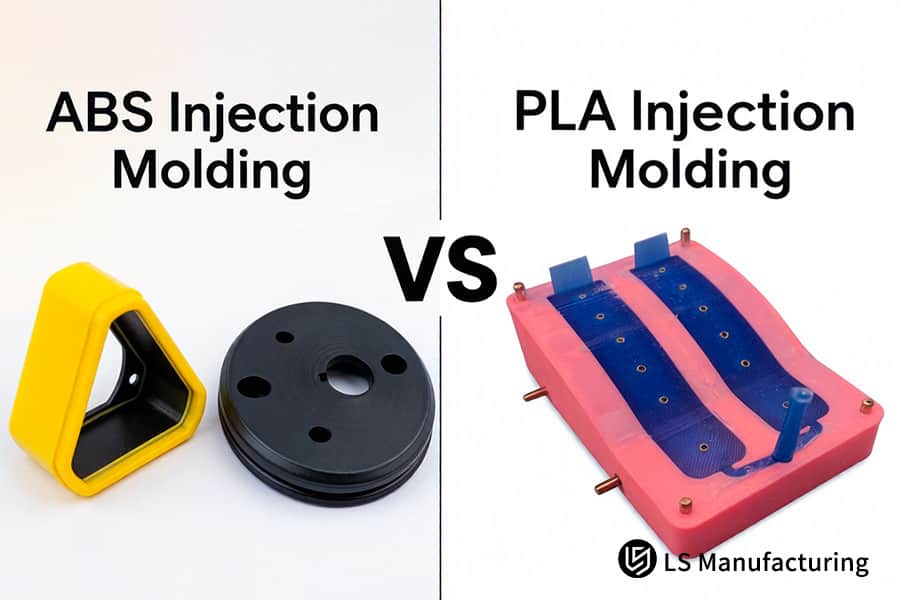
Figure 1: ABS vs PLA injection molding services form a dark ABS engine block and a clear PLA container for automotive.
Why Is ABS Injection Molding Cost More Effective For Functional End Use Parts Than PLA Prototypes?
The selection of materials plays a crucial role in the performance and cost of molded parts. Our technical analysis reveals important information regarding key differences between materials from both material science and manufacturing perspectives. The following information will serve as justification in your purchasing process and will show you why it pays to focus on value.
| Aspect | ABS (Amorphous Polymer) | PLA (Semi-Crystalline/Bio-based) |
| Polymer Structure | Amorphous, providing isotropic shrinkage and stability. | Crystalline and amorphous combination that experiences anisotropic shrinkage and is susceptible to warpage. |
| Thermal Performance | High glass transition temperature (Tg), ~105°C, with good heat resistance. | Low heat deflection temperature (HDT), ~55°C, and poor heat resistance. |
| Rheological Behavior | High melt flow rate (MFR) of 10-30 g/10 min ensures stability in filling, which is critical for high-volume injection molding. | Experience degradation and significant viscosity reduction when subjected to heat and shearing action. |
| Mechanical Properties | Impact resistant, able to withstand harsh environments due to its notched Izod impact strength of ~250 J/m, making ABS injection molding cost for durable goods. | Brittle, notched Izod impact strength rarely exceeds 50 J/m, making it useless functionally. |
| Process Robustness | Resistant to thermal degradation and able to handle high pressures, thus requiring a custom ABS molding service. | Susceptible to its thermal and shear history, and therefore not fit for precision injection molding of end products. |
| Final Application | The proven answer for reliable ABS vs. PLA injection molding services for automotive, industrial, and heavy-duty functional parts. | Tailored primarily to aesthetic prototypes requiring no mechanical or thermal requirements. |
The inherent superior thermal-mechanical characteristics of ABS make it the only option when it comes to functional parts that will not fail. Working with an expert partner on custom ABS molding service converts material expertise into successful performance. This paper supplies the technical expertise necessary for decisive purchasing, confirming that the ABS injection molding cost is a wise investment.

How Do Tooling Material Options Selection Criteria Influence Your Initial Injection Molding Prototyping Quote?
A technical approach is crucial in arriving at an accurate injection molding prototyping quote. Choosing an inappropriate material for tool construction results in excessively high start-up costs or, even worse, a disastrous production process. Our solution lies in tailoring your investment in tooling in a manner that optimizes its entire lifecycle, from initial prototype to final production:
Matching Tool Steel to Production Volume and Material
Tool steel selection is the crux of any reliable production cost quote injection molding prototyping. In cases where production will be less than 500 pieces, our choice is high conductivity aluminum such as QC-10 (≥160 W/m·K), costing no more than $2,000 - $10,000. If the number of parts is going to exceed 50,000, using hardened steel such as P20 or NAK80 (HRC 48-52) becomes inevitable, because of the material's susceptibility to abrasive wear (e.g., glass filled ABS).
Engineering for Cycle Time and Initial Cost Efficiency
The injection molding tooling strategy is optimized to be quick during all phases. During prototype development, the use of 3D-printed conformal cooling channels in an aluminum mold lowers the cycle time (cooler faster than 8 seconds), minimizing your cost per test unit. In production, we will make a tool that has optimized cooling channel lines for fast and consistent cycles. Thermal optimization is what gives you control of your cost-per-unit.
Ensuring Quality and Enabling Informed Material Choice
Tooling that is done properly makes sure that there is precision in size tolerance (+/-0.1mm). Additionally, tooling done properly ensures that there is no flash or other defects. This is necessary when making compare ABS PLA molding cost and properties. Aluminum is great for rapid iterations in form and fit. Steel tools are best used in production where consistency is required.
Delivering a Transparent, Stage-Gated Investment Roadmap
Our company gives you a straightforward injection molding cost analysis, comparing the tooling cost for prototypes and production. We eliminate any ambiguity by giving an exact justification of the budget for each phase of your project. You’ll get all the reasons why an aluminum tool should cost $8,000 and not $20,000 or more when talking about steel tools.
Our assistance will enable you to solve the important problem of allocating initial expenditures to successful production. In our case, you will receive an excellent injection molding procurement strategy. As we deliver you the appropriate technical evaluation, we help you avoid spending your budget in vain and prevent any tooling failure. It will be the best starting point for successful procurement.
Why Does PLA Injection Molding Service Present Hidden Processing Risks That Inflation Your Low Volume Production Cost?
An ostensibly lower material cost for PLA can mask significant processing inefficiencies that dramatically inflate your final per-part expense. Focusing solely on resin price per kilogram ignores critical injection molding cost drivers like extended cycle times and specialized tooling needs. This analysis exposes and quantifies these hidden risks, providing a framework for accurate total cost assessment before commitment:
Deconstructing the True Cost: Cycle Time Inefficiency
- Core Issue: Slow crystal growth rate adds extra 100% time for cooling in comparison with ABS.
- Our Action: We have improved the PLA injection molding process to assist in decreasing the influence of this problem on your injection molding cycle time and cost per piece.
Solving Ejection and Warpage: Beyond Standard Tooling
- Core Issue: Strong adhesion leads to sticking and more than 0.5% warping.
- Our Action: Special treatment during finishing is a must when providing PLA injection molding service, which is the major feature of a custom PLA molding service.
Managing Material Sensitivity: Precision Control
- Core Issue: A narrow processing window requires strict temperature and moisture control.
- Our Action: Drying material (<250 ppm) and temperature control are applied.
Delivering an Honest Total Cost Analysis (TCA)
- Core Issue: Cost savings associated with raw materials are counteracted by processing expenses.
- Our Action: We provide you with an open TCA taking into account machine time, waste percentage, and tooling in order to let you get the precise compare ABS PLA molding cost.
The true value comes with high-quality outcomes, rather than just with low production costs. Years of experience give us the ability to systematize the complicated nuances associated with PLA. The engineering expertise provided by us gives you the context necessary to develop your injection molding production strategy; it guarantees that your cost calculation is grounded on a fully formed concept of manufacturing.
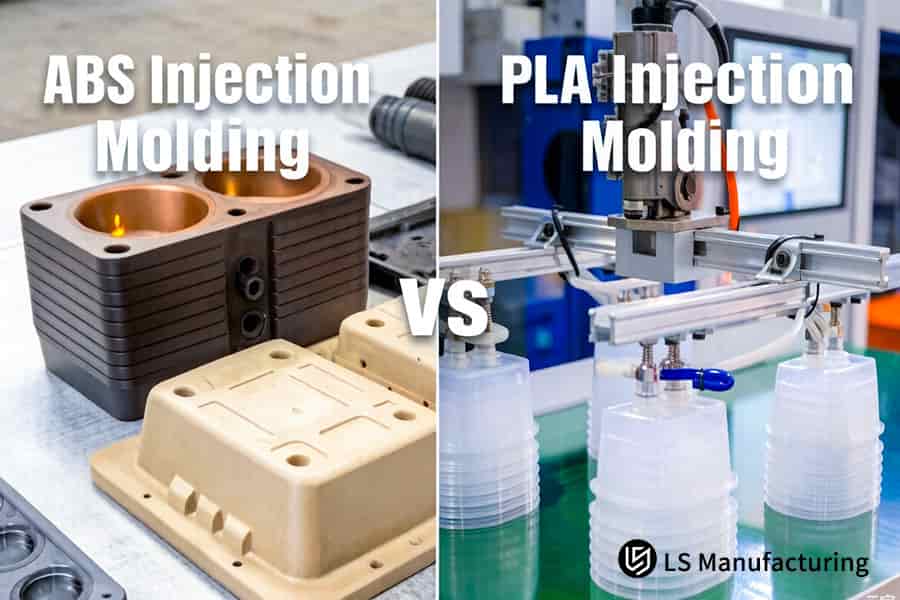
Figure 2: ABS vs PLA injection molding services mold an orange ABS part and multi-color PLA pieces on a steel table.
How Can Custom ABS Molding Service Achieve Precise Dimension Tolerance Control Within ±0.05mm?
We guarantee ABS injection molding tolerances within ±0.05mm by using predictable low-shrinkage materials (0.4%-0.7%) combined with real-time closed-loop packing pressure control (60-90 MPa). This ABS vs. PLA injection molding services document details the technical methodology behind a custom ABS molding service that leverages this stability through precise process control, demonstrating how to reliably meet the exacting specifications required for high-performance assemblies.
| Control Dimension | Method & Specification |
| Material Foundation | The material used has consistent shrinkage behavior (0.4%-0.7%) to provide a good foundation. |
| Process Precision | Packing pressure (60-90 MPa) and mold temperatures (60°C-80°C) are precisely controlled using a closed-loop injection molding system. |
| Advanced Control Strategy | Multi-staged injection and packing strategy to avoid any defects such as sink marks and voids. The strategy is very crucial in high-precision injection molding. |
| Validated Outcome | The process ensures that we have tolerances up to ±0.05mm, meeting the high needs of tight-tolerance injection molding. |
The attainment of precision is achieved through process control and not good fortune. The process employed, forming the basis of our bespoke custom ABS molding service, guarantees that stability is transformed into precision by controlling the thermal and pressure forces involved in automated injection molding.
Our solution solves the challenge of having to develop components that can function equally as efficiently as machine-produced components, hence providing enough technical justification for procurement activities. Achieve ±0.05mm precision in your ABS parts. To validate this process for your design, submit your ABS specifications for a tolerance compliance report and production-ready quote.
How Do Raw Material Grade Formulations Optimize Your Custom PLA Molding Service For Specific Eco-Friendly Medical Device Requirements?
Traditional PLA does not have the thermal stability and consistent processing properties necessary for manufacturing medical devices reliably. To address this, our custom PLA molding service uses material science and advanced process controls to create a highly effective and compliant engineering plastic from PLA, ensuring that both environmental sustainability and device reliability are considered:
Advanced Material Formulation: From Generic to Engineered Performance
We avoid general-purpose 3D printing grades and work with our compounding partners to engineer nucleating agents and hydrolysis stabilizers into PLA. This results in an increase in crystallization rates of up to 40% and raising Heat Deflection Temperature (HDT) to 90°C-110°C after annealing. The fundamental polymer modification allows for manufacturing rigid heat-stable components through injection molding, beyond prototyping.
Precision Process Control for Consistency and Compliance
Precision is required for accurate thermal control. We keep tight control on our injection molding temperature profile,, maintaining precise melt temperatures of 190°C to 210°C in our hot runner systems to avoid degradation caused by shear. This will allow us to keep the molecular weights and properties consistent, ensuring quality in any PLA injection molding service.
Validated Compliance and Performance
Our materials processing involves certified medical-grade PLA resins which conform to international standards such as the ISO 10993 biocompatibility requirements as well as FDA food contact specifications. Medical-grade injection molding requires detailed documentation and tracking to ensure the availability of the necessary information and compliance evidence for successful product submission and validation in terms of performance.
In essence, we address the underlying problem that involves creating medical grade PLA with consistent and high performance capabilities through an innovative combination of appropriate resin formulas and precise process engineering. The resulting knowledge base is the foundation upon which manufacturers can benefit from biopolymers without any adverse effects on device performance.
What Technical Audit Key Factors Evaluate The True Performance Of An Experienced B2B Injection Molding Manufacturer?
The choice of injection molding partners involves looking at their engineering approach rather than just the machines. Engineering capability lies in proactive problem-solving which eliminates risks and provides consistent results. This article outlines the critical technical auditing elements for choosing a capable injection molding partner offering a clear production cost quote injection molding at the onset:
Proactive DFM and Simulation
- Key Question: Do you offer free mold flow analysis?
- Our Action: We conduct 100% free Moldflow analysis on every injection molding prototyping quote in advance of potential fill problems, weld lines, and air entrapment.
Precision Process and Material Control
- Key Question: What is your approach towards managing the injection molding process and materials?
- Our Action: We employ our closed-loop injection molding processes and advanced material science knowledge to improve processes, which makes ABS vs PLA injection molding services very important.
Built-in Quality Assurance
- Key Question: Is quality inspected or inherent to the process?
- Our Action: We use SPC in real time and monitor processes where consistency is built into high-value injection molding so that zero defect targets and dimensional tolerances (±0.05mm) are achieved.
Total Cost Transparency
- Key Question: Is the quote based on the total cost of the project?
- Our Action: The quotes we provide take into account optimal cycle times, tool life, and precision injection molding procedures so that cost estimation is more accurate.
With a view to solving the dilemma of choosing an efficient manufacturing partner whose products have consistent quality, we provide an effective system that begins with predictive engineering and ends with precision control during production. This will give you a reliable foundation with which to choose a manufacturing partner who can reduce program risk, assure cost predictability, and guarantee flawless manufacturing through advanced injection molding technology.
Figure 3: ABS vs PLA injection molding services mold an orange ABS part and multi-color PLA pieces on a steel table.
Case Study: How LS Manufacturing Saved A Fortune 500 Automotive Electronic Supplier $35,000 In Custom ABS Molding Service Tooling Optimization?
In this case study, we illustrate how our engineering skills helped to save an important automotive electronics project from disaster. We show that the real value of a custom ABS molding service lies in solving problems proactively and applying technical knowledge rather than in simply providing a production cost quote injection molding:
Client Challenge
The client, an automotive supplier among Fortune 500 companies, was experiencing delays and potential penalties due to its smart cockpit gateway housing. Its attempt to create prototypes out of PLA had ended in a disaster because of the complicated geometry of the product, with thin walls as little as 0.8mm thick. Due to poor flow and thermal characteristics, the material had created weld lines, decreasing tensile strength of joints by more than 70%.
LS Manufacturing Solution
We quickly determined that moving to a high flow, flame-retardant ABS grade would be ideal. Our approach entailed the redesign and development of a symmetrical 2-cavity hot runner valve gate setup for uniform filling. Key high-pressure injection molding parameters were defined such as melting temperature of 235°C and injection pressure of 120MPa. The use of conformal cooling systems at 5mm from the cavity ensured even heating with a temperature variance of ±2°C to address material limitations.
Results and Value
In comparison to the previous process, which took 55 seconds per piece, our optimization lowered cycle time to just 28 seconds, a 49 percent increase in efficiency. All the ABS parts manufactured using our design survived numerous tough tests in accordance with automotive standards. Most importantly, we were able to avoid unnecessary expenses and launch delays thanks to our initial DFM and simulation efforts, which ensured that our mold did not require any changes during testing – the company saved $35,000 on tooling due to the initial ABS injection molding cost evaluation being done accurately.
The example highlights the importance of having profound knowledge about materials and precise engineering for overcoming problems associated with injection molding products. We have managed to save the project by employing the strategy of proper choice of materials along with mold engineering and the process itself.
Secure a similar $35,000 tooling savings and 49% faster cycles for your complex housing. Submit your ABS design for a flow simulation and a guaranteed production quotation.

How To Calculate The Real ROI Of Production Cost Quote Injection Molding When Scaling From 1,000 To 100,000 Units?
Accurate forecasting ROI in manufacturing demands going from simple part costs to more complex lifecycle costs. Lifecycle cost assessment creates a clear methodology that analyzes an investment in a production cost quote injection molding and shows why the investment in tooling becomes exponentially cheaper per unit when manufacturing at scale, giving the reasons why investing in tooling initially is worth it:
Deconstructing the Unit Cost Equation for Transparent Scoping
We outline in detail the calculation formula: Unit Cost = (Tooling Amortization / Volume) + Material + Machine Time + Post-Processing. The injection molding cost model clearly demonstrates that at low quantities (e.g., 1,000 pcs.), tooling amortization is the predominant factor that leads to an increase in the overall effective piece cost, which is very important when it comes to making an initial budgeting.
Modeling the Exponential Impact of Scale on Cost
Real return on investment is determined by the dramatic decrease of the cost of fixed asset tooling. We draw this curve in order to show that at 100,000 pieces, tooling cost per one piece becomes negligible. The efficiency of mass production injection molding combined with lower ABS injection molding cost will help achieve optimal prices per one piece ($0.35 - $1.20).
Quantifying Material and Process Stability's Financial Impact
Machine time and scrap rate are variable costs when it comes to material performance and ROI. The stable properties of the material allow increasing efficiency by minimizing cycle times and decreasing scrap rate. On the contrary, due to the natural sensitivities of PLA injection molding service, your cost saving potential may suffer from increased scrap rates and cycles.
Delivering a Dynamic Financial Model for Strategic Planning
We solve this issue through our innovative financial model, which allows you to plug in various volume numbers, thus validating the tooling cost as a depreciation expense that makes it possible to reduce costs dramatically, thereby enabling you to get to your desired ROI.
We support scalable decisions using data by switching from estimation to a precise and predictive injection molding model costs. From our research, we can conclude that the highest return on investment will be achieved through volume manufacturing because the process efficiency and stability of the material reduce total costs to their minimum.
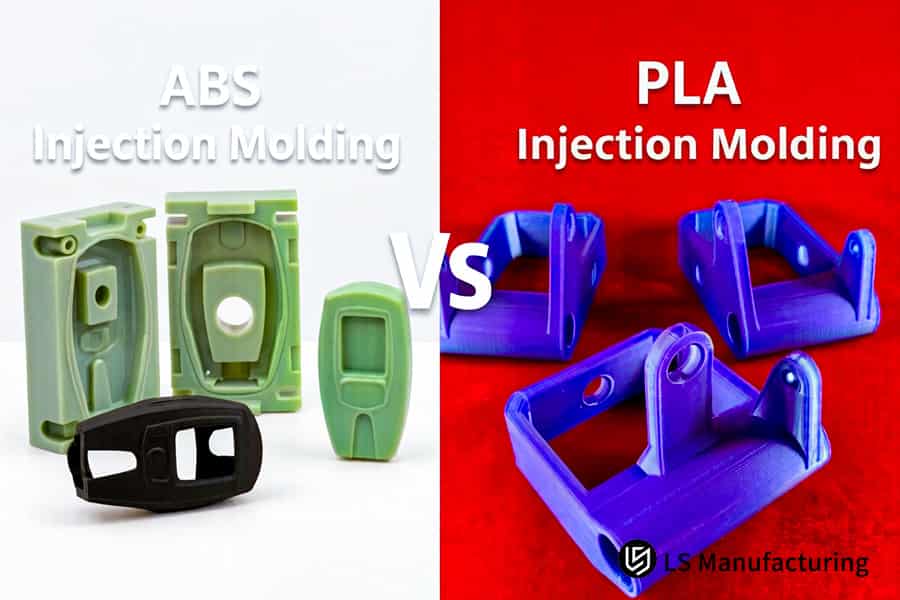
Figure 4: The chart displays and compares light green ABS samples with dark blue PLA samples for material selection.
FAQs
1. What is the exact lead time for an initial custom ABS molding service prototyping quote from LS Manufacturing?
Upon receiving your 3D CAD drawings (STEP/IGS formats supported), LS Manufacturing’s professional engineering review team will issue a detailed, customized commercial quotation—including an in-depth Design for Manufacturability (DFM) feasibility report—within 24 hours.
2. Can I use the same rapid steel mold for both ABS and PLA injection molding material validation?
We strongly advise against this. Due to fundamental physical differences in molding shrinkage rates between ABS (0.4% – 0.7%) and PLA (0.2% – 0.4%), using the same mold cavity for both materials will result in irreversible dimensional tolerance deviations in the final finished parts.
3. How does LS Manufacturing ensure color match consistency during high-volume ABS injection molding production runs?
We utilize fully automated, high-precision gravimetric color dosing units (accurate to ±0.1%) and employ industry-standard X-Rite spectrophotometers to inspect the color difference of finished parts. We strictly maintain the Delta E color difference value within an exceptionally tight tolerance of ≤0.8.
4. What is the Minimum Order Quantity (MOQ) requirement for a custom PLA molding service project?
To help innovative startups get their projects off the ground smoothly, LS Manufacturing imposes no rigid MOQ thresholds for rapid engineering prototyping and soft-tooling validation. Even for small-batch validation runs of just 100 units, we provide the same high-standard production line support.
5. How do you prevent cosmetic defects—such as sink marks and weld lines—on high-aesthetic ABS components?
Prior to injection molding, we use Moldflow software to conduct comprehensive simulations of runner balancing and venting. By applying multi-stage holding pressure switching techniques—a core principle of scientific molding—and utilizing high-end mold temperature controllers with a precision of ±1°C for localized dynamic temperature control, we effectively eliminate any visually perceptible cosmetic defects at the very source of the manufacturing process.
6. Is PLA environmentally friendly enough for medical packaging, and does your plant hold cleanroom certifications?
Yes, LS Manufacturing offers solutions utilizing 100% fully biodegradable, modified medical-grade PLA. Furthermore, our facility features a modern, dedicated cleanroom workshop—certified to ISO Class 8 (Class 10,000) standards—that meets rigorous international criteria, thereby fully satisfying the compliance and contamination-prevention requirements for medical and food-grade devices.
7. How do upfront steel tooling costs compare to aluminum molds for long-term injection molding production?
While the initial fabrication cost for high-grade imported P20 steel molds is approximately 35% to 50% higher than that of aerospace-grade aluminum molds, their overall fatigue life can easily exceed 500,000 cycles. In contrast, aluminum molds are prone to cavity deformation after just 10,000 cycles. Therefore, when evaluating the return on investment (ROI) amortized per mold cycle over the course of long-term, high-volume production, the comprehensive cost-effectiveness of steel molds far surpasses that of aluminum molds.
8. How does LS Manufacturing protect my proprietary intellectual property (IP) and 3D CAD file designs?
Data security is a cornerstone of LS Manufacturing's operations. Prior to project discussions, we sign a mutually binding Non-Disclosure Agreement (NDA)—enforceable under international law—with every client. All technical drawings and files are stored on fully isolated, local servers utilizing military-grade encryption; access is strictly restricted to core project engineers, ensuring that unauthorized personnel have absolutely no access privileges.
Summary
In high-precision plastic molding, choosing between ABS and PLA determines product performance, lead time, and supply-chain stability. ABS offers industrial-grade thermal resistance, impact strength, and mass-production economy. Modified PLA suits niches requiring sustainability or biodegradability. Partner with a manufacturer whose expertise and digital engineering ensure reliable outcomes, not just low price.
Skip lengthy manufacturer negotiations and achieve perfect molding yields. Click “Get Free DFM Review & Quick Quote” to upload your CAD files. Within 24 hours, our senior engineers will provide a competitive tiered quotation and a free moldflow report—including gate-placement advice and shrinkage-risk analysis—delivering predictable certainty to your supply chain.
📞Tel: +86 185 6675 9667
📧Email: info@lsrpf.com
🌐Website: https://lsrpf.com/
Disclaimer
The contents of this page are for informational purposes only. LS Manufacturing services There are no representations or warranties, express or implied, as to the accuracy, completeness or validity of the information. It should not be inferred that a third-party supplier or manufacturer will provide performance parameters, geometric tolerances, specific design characteristics, material quality and type or workmanship through the LS Manufacturing network. It's the buyer's responsibility. Require parts quotation Identify specific requirements for these sections.Please contact us for more information.
LS Manufacturing Team
LS Manufacturing is an industry-leading company. Focus on custom manufacturing solutions. We have over 20 years of experience with over 5,000 customers, and we focus on high precision CNC machining, Sheet metal manufacturing, 3D printing, Injection molding. Metal stamping,and other one-stop manufacturing services.
Our factory is equipped with over 100 state-of-the-art 5-axis machining centers, ISO 9001:2015 certified. We provide fast, efficient and high-quality manufacturing solutions to customers in more than 150 countries around the world. Whether it is small volume production or large-scale customization, we can meet your needs with the fastest delivery within 24 hours. choose LS Manufacturing. This means selection efficiency, quality and professionalism.
To learn more, visit our website:www.lsrpf.com