English



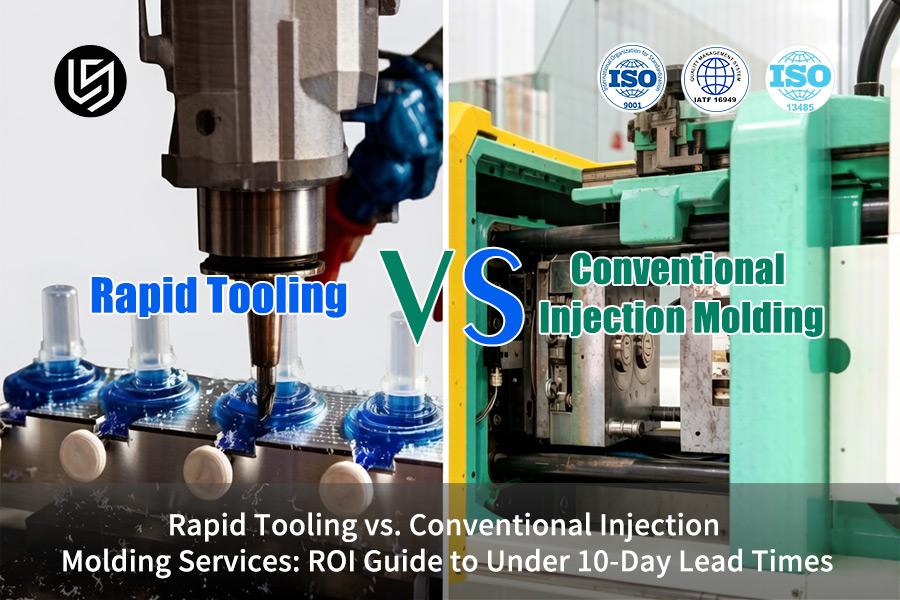
Rapid tooling vs. conventional injection molding services is exactly what LS Manufacturing fast tooling services address, which helps solve this critical pain point, whereby the NPI development director needs thousands of finished products in 10 days but has only four to six weeks to get this job done using a traditional steel mold, when 3D printing or urethane casting can never compete with injection molding's mechanical performance, air tightness, and surface roughness Ra 0.8µm.
This ROI Guide provides exclusive data on Alumec 89 rapid tooling service compared with conventional steel mold regarding cycle time, capital expenses, and operation expense per part. You will learn to have ±0.02mm core tolerance within 10 days at lower costs than those of a regular steel mold. With our engineers, you'll discover the specific technical and economic limits of achieving fast ROI through small batch production.
Rapid Tooling VS Conventional Molding: ROI Quick-Reference
| Decision Factor | Rapid Tooling (Under 10 Days) | Conventional Production Tooling |
| Initial Investment | Low (2k-10k USD for aluminum tools). | High (20k-100k USD+ for hardened steel). |
| Per-Part Cost | More (slower cycles, shorter tool life span). | Less (optimized cycles, up to millions). |
| Lead Time | 1-3 weeks (for first parts to be produced). | 8-16 weeks (for full production ready). |
| Tool Life | 1,000-10,000 parts. | 500,000-1,000,000+ parts. |
| ROI Break-Even | Beneficial for volumes under 5,000 or market validation. | Breakeven occurs at 10,000 - 50,000+ units. |
| Our Recommendation | Utilize for market validation and injection molding design validation prior to the expensive steel tooling. | Implement only after market demand, part pricing, and quality requirements are fully validated. |
Key Takeaways:
- Speed Has a Price: Rapid tooling sacrifices per-part pricing in order to achieve an accelerated time to market. The ROI is calculated by the number of months gained.
- Know Your Break-Even: The breakeven point where the traditional method becomes more cost-efficient is generally somewhere between 5,000 and 50,000 parts.
- Risk vs Reward: Rapid tooling is an investment that carries little risk but is effective for validating market opportunities. Traditional tooling, on the other hand, represents higher risk/reward investments.
- Strategy is Sequential: The best strategy involves using rapid tooling for market entry followed by traditional tooling for volume manufacturing.
Why Trust This Guide? Practical Experience From LS Manufacturing Experts
Many papers have already been published that theorize on the comparison between fast tooling and traditional tooling. However, the present guideline is a bit different. First of all, it was prepared by our experts, who use both technologies on a daily basis in order to complete production projects. Secondly, our recommendations are based on the practices of the National Tooling and Machining Association (NTMA).
We serve industries in which tool selection decides whether the project will succeed: aerospace prototype development, which needs FAA approval; sterile medical devices; and auto parts requiring consistency at high volume production. We validate processes for both methods using the stringent guidelines recommended by the Precision Metalforming Association (PMA). This way, we can assure the best quality regardless of the chosen manufacturing process.
Our experience comes from hundreds of projects in which we have found out what works best – whether a 500 piece part can be done with aluminum rapid tooling, how to design the part that will make it easy to convert to a steel tool in the future, and where the concealed costs lie in conventional tooling.
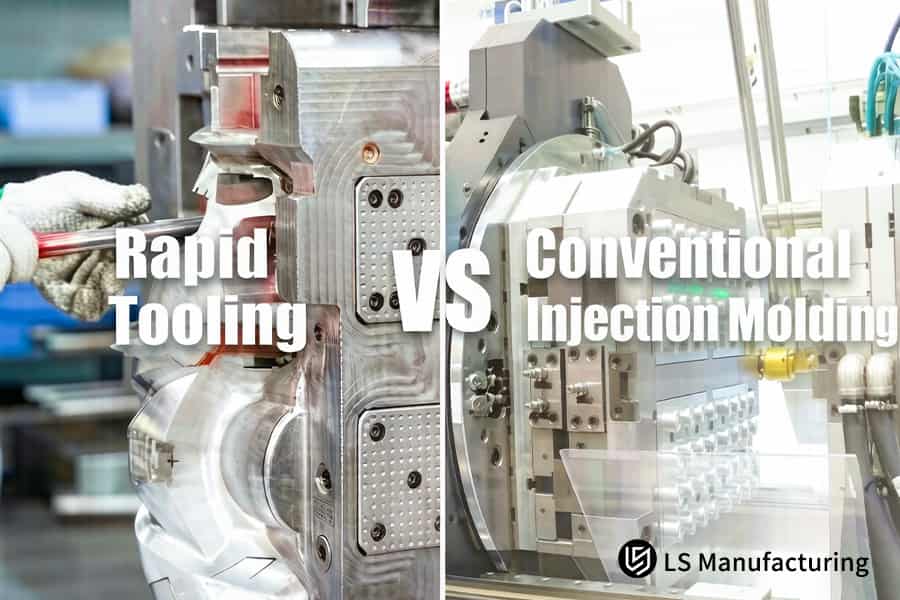
Figure 1: Rapid tooling versus conventional molding shows a prototype mold with plastic inserts beside a multi-cavity steel production mold.
Why Do Conventional Injection Molding Dervices Fail To Deliver Custom Parts Within 10 Days
Conventional injection molding services are unable to offer their custom-made parts in a period of fewer than 10 days due to the physical constraints inherent in the injection mold tooling process. The factors that affect speed and quality include thermal distortion, multi-stage machining, and multiple iterations in cooling design. They represent engineering challenges, as opposed to scheduling problems, based on material science principles.
Thermal Distortion from Heat Treatment
Heat treatment of multi-cavity molds that use NAK80 and H13 steel results in distortion on microns when aiming at HRC 48-52 hardening through quenching. The only way to fix it is by hard milling and many hours of EDM, making it impossible to stick to a schedule of 10 days while either forgoing heat treatment or tolerating deviations of more than ±0.05mm in high-speed injection molding.
Cooling Channel Design Limitations
Traditional cooling designs do not consider multi-physics conformal manufacturing techniques, resulting in poor heat distribution, which takes 3-5 days of tuning through trial-and-error. Injection molding lead time reduction results only from conformal cooling design done with computer simulations from day one. You benefit from injection molding first shot rates of above 85% without any mold modifications needed and shortened injection molding cycle time as well.
Risk Exposure Under Compressed Timelines
With ten days as a deadline for mold manufacturing, no stress relieving cycles and CMM checks are done, which makes mold failure more likely when running your injection molding process initially. Conventional molding cost comparison reveals that such rushed molds need to be modified after 500 shots, thus, negating time savings. Additional costs are incurred due to delayed product launch and higher injection molding defect rate.
A ten day limit is dictated by material science and physics and has nothing to do with the timeline. Our innovative approach involves parallel processed conformal cooling, predictive simulation, and hardened toolpaths to ensure that your mold will be production ready from the very beginning. You benefit from parts manufactured with injection molding prototype development. Break the 10-day barrier with physics-driven mold design. To validate a rapid timeline for your custom parts, contact our engineering team for a DFM review and a guaranteed delivery quotation.

How Can Rapid Tooling Manufacturer Balance Mold Lifespan And Precision Under Tight Schedules
Optimal mold longevity and accuracy in time-restricted environments require materials that have 300% better thermal conductivity and five-axis high-speed machining with the reduction of 80% of EDM usage. As a high speed tooling manufacturer, we supply production-ready molds within 4 days that ensure a tolerance level of ±0.015mm and have over 100k shots life:
Material Selection for Thermal Performance
- Aerospace-grade aluminum (Alumec 89/QC-10): Over 300% thermal conductivity compared to steel, 45% decrease in cooling cycles per each shot – reduces energy expenses.
- Pre-hardened P20 optimized steel: Not requiring additional heat treatment, prevents material distortion ensuring injection molding part consistency.
- Combined benefit: 100k+ shots lifetime with a positioning accuracy of ±0.015mm – important competitive advantage for rapid tooling vs. conventional injection molding services.
Five-Axis High-Speed Machining
- 24,000 rpm / 0.05 mm/tooth: Enables to reduce 80% of EDM operation resulting in a total of 2-3 days saved.
- Single-setup cavity work: Ensures accuracy of ±0.015mm without cumulative errors.
- Your gain: Mold construction is reduced from 30 to 4 days, allowing to validate production parts thanks to class 101 injection molding surface finish.
Predictive Engineering for Extended Lifespan
- Stress simulation pre-cutting: Ensures optimal angles, equal load distribution.
- CMM verification after single setup: Prevents errors during cutting process.
- Outcome: The same mold can be used for prototyping and low-volume manufacturing following the injection molding temperature control analysis.
Longevity and precision meet tight deadlines due to careful selection of materials and superior machine work – no sacrifices made to either attribute. Molds will provide you with parts of precise geometry produced during tens of thousands of operations proven by the injection molding material flow simulation. Each and every detail works to safeguard your schedule and final product at the same time.
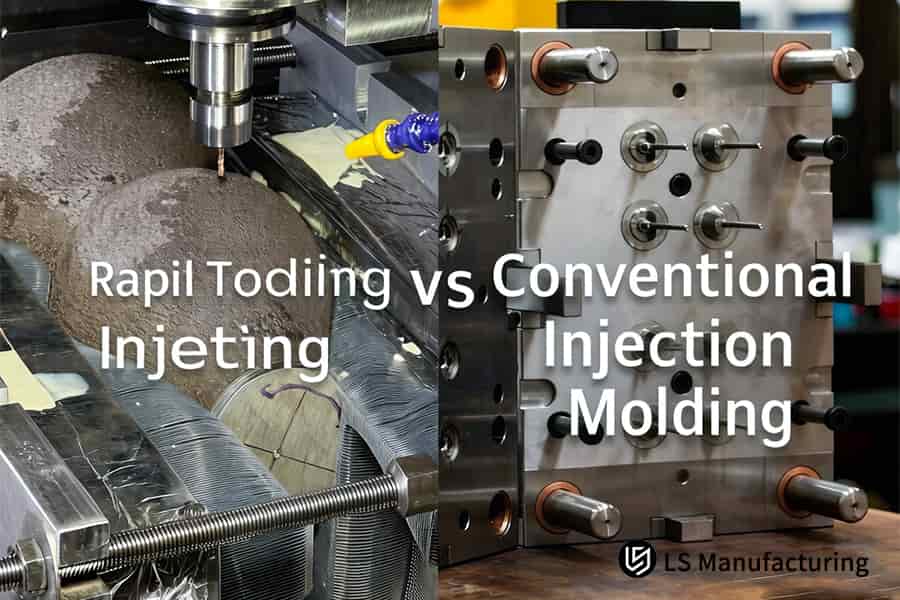
Figure 2: Rapid tooling versus conventional molding contrasts aluminum cavity inserts being machined with finished P20 steel mold bases.
What Are The Hidden Variables When Auditing A Rapid Injection Molding ROI Guide
Upon auditing a rapid injection molding ROI guide, some overlooked variables emerge: capital expenditure depreciation, operating expenses per piece, and break-even quantity. In cases where the demand goes between 1,000 and 10,000 units, it will be possible to realize up to 60% savings on the original fixed assets while ensuring three times faster capital turnover than the traditional process using steel tooling. Knowledge of your injection molding capital expenditure and injection molding cost analysis should come first.
| Variable | Conventional Steel Mold | Rapid Tooling (Aluminum/Soft Steel) |
| Tooling Cost (CapEx) | $8,000 – $25,000 | $2,000 – $6,000 |
| Lead Time | 20–35 days | 4–7 days (under 10 day lead time molding services) |
| Per-Part Cost (OpEx) at 5,000 pcs | $0.18 – $0.35 | $0.22 – $0.42 |
| Break-Even Volume | ~15,000 pcs | ~3,000 pcs |
| Capital Turnover Rate | 1x baseline | ≥3x baseline |
| Rework Risk | Moderate (heat treat distortion) | Low (no post-machining HT) |
ROI analysis demonstrates that fast tooling has financial advantages for volumes less than 15,000 pieces. You decrease CapEx by 60%, improve payback threefold, and protect yourself against rework issues. Apply the break-even numbers to analyze your specific injection molding batch size and injection molding break-even point. Your calculations will show that rapid tooling outperforms traditional molding in terms of cost effectiveness.
Which Design Factors Determine The Success Of Short Lead Time Injection Molding Quote
Design features like uniform wall thickness, draft angle, and geometrical design determine the efficiency of short lead time injection molding quote process. An early DFM assessment helps to determine these parameters within 2 hours, saving both money and time due to no need for redesign:
Uniform Wall Thickness (1.5 mm – 2.5 mm)
It ensures no differential shrinkage and warping when molded parts cool down. You prevent any problems associated with sink marks and voids in plastic parts which necessitate mold modification, decreasing injection molding design guidelines evaluation from days to hours. Products with uniform walls demonstrate more predictable molding process, reducing rejection rate by up to 65%.
Optimal Draft Angle (1.5° Minimum)
The use of a minimum 1.5° draft angle is essential when designing the geometry of vertical surfaces to ensure successful removal of the molded parts without any damage. Insufficient draft will result in scratches of the finish and increased cycle times because of prolonged demolding. In order to make custom injection molding fast turnaround possible, it is important to have appropriate designs of the draft angle.
Avoiding Deep Cavities and Sharp Corners
Deep sections and sharp inner edges induce stress and impede flow, resulting in partial filling or burnt traces. Using radiused transitions and reducing deep geometry helps injection molding shrinkage compensation better. Accurate quotations are provided initially because complexities of tooling and material are considered from the beginning in the analysis process.
Material Shrinkage and Side-Action Complexity
Materials have different shrinkage coefficients (for instance, 0.5% of ABS vs. 2.0% of POM), and side-action parts require more machining. Identifying the shrinkage properties of materials and side-action elements prior to designing allows performing injection molding tolerance analysis beforehand. No unexpected increases in quotation will occur, ensuring the budget and reducing negotiations by more than 40%.
This is ensured by incorporating DFM considerations upfront to manage aspects such as warpage, ejection, and material characteristics. This means getting your quote based on accurate manufacturing costs, rather than hypothetical scenarios. Implementing the principles discussed here will save up to 70% revision loops and shorten sample time significantly, allowing injection molding quality assurance to be achieved straightaway in the first submission.
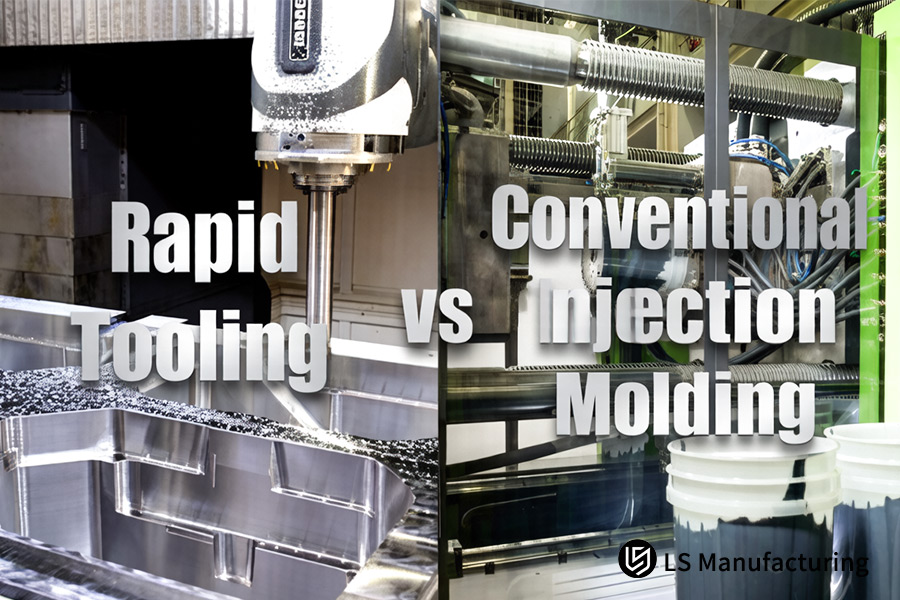
Figure 3: Rapid tooling versus conventional molding places milled wax patterns for prototyping next to an HDPE bucket production line.
Can Low Volume Manufacturing Options Meet Stringent ASTM Test Requirements Without Warping
Low-volume manufacturing that utilizes injection molding production grade processes can easily meet strict ASTM specifications without warping through precise control of resin flow, pressure, and temperature. As opposed to vacuum casting, which creates porosity and weak connections between layers, you get parts that are able to sustain functional testing under high-loads directly:
Real Resin Flow vs. Vacuum Casting
- Process foundation: Utilizes real pellets fed into screws during injection, not liquid resin pouring. Porosity and weak bond lines that result in early part breakdown during usage are no longer an issue.
- Tensile performance: PA66+30%GF attains minimum tensile strength of ≥160 MPa according to ISO 527, equal to manufactured components. This enables custom injection molding fast turnaround for structural prototypes.
- Thermal stability: Heat deflection temperature of PC parts is 132°C (1.82 MPa) according to ASTM D648, which is far above the limit of vacuum-cast urethane at 80°C.
Controlled Process Parameters for Warp Prevention
- Injection pressure: Controlled between 80 and 120 MPa to achieve full cavity filling while preventing overpacking. Ensures no residual stresses develop due to over-injection.
- Mold temperature: Kept at 90°C for PC and 110°C for PA66+30%GF, ensuring consistent crystallization and avoiding differential shrinkage.
- Result: Flattening of part reaches ±0.1mm in the span of 200 mm as verified through ISO 527 injection molding tensile strength test.
Material-Specific Optimization
- Glass-fiber orientation: Using gate position and flow leaders, your mold aligns fibers for load-bearing orientation, which improves the efficiency of injection molding fiber orientation. You get parts with consistent modulus of elasticity (E = 9 GPa for PA66+30%GF).
- Shrinkage compensation: Your mold takes into consideration anisotropic shrinkage (0.3% - 0.8%). You obtain accurate molded products according to tolerance specifications printed on the CAD file without additional trimming.
- Delivery: Entire process setup done in 7 days, facilitating under 10 day lead time molding services for certified test specimens.
Using production-grade injection molding rather than vacuum casting with controlled parameters will give you parts that meet the ASTM D648 and ISO 527 specifications with no warpage problems. Actual resin flow, temperature/pressure control and fiber orientation modeling will provide mechanical properties consistent with mass-produced parts. This way, you can be sure that your injection molding heat deflection information is valid for your low-volume parts.
How Does Advanced Cooling Channel Geometry Accelerate Custom Injection Molding Fast Turnaround
Advanced cooling channel geometry using conformal cooling reduces single-cycle cooling time from 35 seconds to 11 seconds, doubling per-shift output. By eliminating hot spots trapped in cavity corners, you receive parts with minimal thermal stress and zero rework, directly accelerating custom injection molding fast turnaround and improving injection molding cost efficiency.
| Parameter | Conventional Straight-Drilled Cooling | Conformal Cooling (Diffusion Bonded / 3D Printed) |
| Cooling Channel Path | Linear, limited by drill access | Curved, following cavity contour exactly |
| Hot Spot Elimination | Poor; corners accumulate heat | Excellent; uniform heat extraction across entire surface |
| Single-Cycle Cooling Time | 35 seconds | 11 seconds |
| Cycle Time Reduction Baseline | Industry average (Plastics Technology 2025) | 68% faster vs. conventional baseline |
| Per-Shift Output (8 hrs) | ~820 shots | ~1,640 shots |
| Thermal Stress & Warpage Risk | Moderate to high; requires post-mold correction | Low; part flatness maintained within ±0.08mm, enabled by injection molding cooling system design |
Conformal cooling revolutionizes cycle economics through a reduction of cooling time by 68%, increasing daily productivity twofold. The results come through injection molding lead time reduction that reduces the cost per part while holding ±0.08mm flatness tolerance. This method is supported by injection molding cycle analysis from the initial production batch.
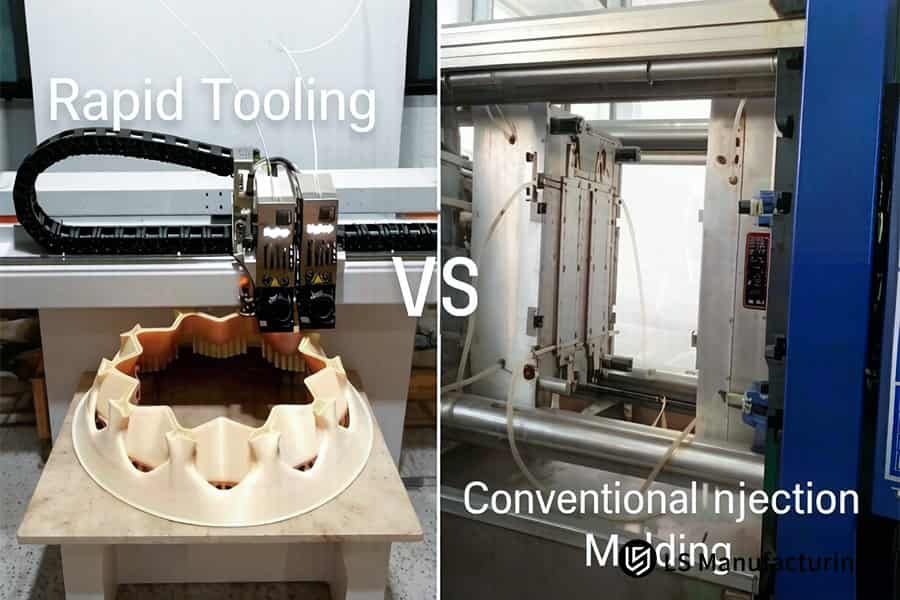
Figure 4: Rapid tooling versus conventional molding features a 3D printed resin dental mold compared to a traditional press with metal dies.
What Framework Filters The Best High Speed Tooling Manufacturer For Your Aerospace Project
Separating the best high speed tooling manufacturer for your aerospace projects relies on a three-fold auditing process that includes equipment capability, statistical process control, and quality management system compliance. The process eliminates vendors using low-level pricing competition to compete. Your vendor passes your dimensional requirements according to AS9100D, forming the basis of an injection molding supplier audit process.
High-Precision CNC and CMM Equipment
Each CNC and CMM must be valued at more than $250,000 with positioning accuracy ≤±0.003mm. Such a requirement assures you that the aerospace geometry—thin ribs, sharp corner radii, and deep cavities—can be machined on the first attempt. If the supplier lacks such capability, your aerospace components cannot be held to your required injection molding aerospace standards.
Real-Time SPC and CPK Data Availability
Require live statistical process control reports with CPK of ≥1.67 for critical dimensions. Your objective evidence that the process stays stable throughout production cycles, not just first-article inspection. The lack thereof means that the conventional molding cost comparison masks the true risk of dimensional changes during the volume cycle, putting you in danger of halting your assembly line.
IATF 16949 or AS9100D Certification
Confirm that the supplier is AS9100D (aerospace) or IATF 16949 (automotive)-certified, including the scope of its certificate covering injection molding. Suppliers that do not have a quality manual on paper will be disqualified since audits require a documented corrective system. Through this system, the injection molding process capability is subject to external audit.
Use the above three criteria — equipment value ≥$250K, CPK ≥1.67, and AS9100D certification — to identify qualified suppliers that can provide reliable injection molding services for your business. In doing so, you can ensure injection molding quality certification traceability and predictability. This way, your aerospace program will not experience any delay or nonconformities arising from low-cost tooling.
LS Manufacturing Aerospace Division: Custom PEEK Drone Housings Delivered Via Rapid Tooling Within 8 Days
A global drone company needed to redesign a PEEK housing in 12 days due to design changes, where conventional steel molds would take 25 days. Missing the product launch could cost the company over a million dollars; therefore, a completely new process, such as high-temperature injection molding, was required for 380 °C melt point within 8 days.
Client Challenge
PEEK drone housing had a very thin wall thickness at 0.8 mm. Furthermore, it was required to have complicated snap-fits and reinforcement ribs. Two previous mold makers were convinced that conventional steel mold making could not handle this part at its required 380 °C melt point; this took at least 25 days, which exceeded the client's deadlines by many days.
LS Manufacturing Solution
In only one hour, DFM simulation uncovered gas trap problem sources. By the third flow analysis iteration, the original side gate had been converted to a fan gate to avoid shear-induced stress lines on all visible surfaces.
To provide superior heat transfer over steel, the high-end Alumec 89 aluminum alloy was chosen due to its three times greater thermal conductivity compared to steel, in conjunction with continuous lighting-free, 24 hours a day, 5-axis machining.
Multi-channel hot oil circulation maintained mold temperature of 160 °C for thin-wall injection molding to reach the necessary thermal stability for complete filling and crystallinity.
Results and Value
With 3D design upload through final shipment, the mold was built and produced 1,200 qualified production units in just 8 days — an impressive 65% reduction from the usual industry lead time of 25 days for making PEEK tools.
Complete inspection on a 3D Coordinate Measuring Machine (CMM) ensured snap-fit holes were perfectly aligned within ±0.015 mm tolerance requirements.
Thanks to on-time product launch and delivery, our customer obtained a $5 million contract order, confirming PEEK injection molding through fast aluminum tooling.
As illustrated above, it does not take 25 days for injection molding of 0.8 mm PEEK housings if you have the proper materials (Alumec 89), gating (fan gate), and temperature control (oil circulation at 160 °C). It takes only 8 days to deliver you with aerospace-standard parts, ensuring risk-free program launches worth millions of dollars. This is the kind of engineering expertise LS Manufacturing offers its clients.
Cut your PEEK housing lead time from 25 days to 8. To validate a rapid aluminum tooling solution for your project, contact our aerospace division for a feasibility review and a guaranteed timeline quote.

FAQs
1. What is the maximum tool life guaranteed for rapid tooling versus conventional injection molding services?
If aerospace-grade aluminum alloys are used for rapid tooling design, then at least 10,000 to 50,000 cycles are warranted; alternatively, should you opt for the pre-hardened mild steel tooling, expect more than 100,000 stable and precise injection cycle. Choose the right tooling life for your program: 50k cycles with aluminum or 100k+ with pre-hardened steel. To define the optimal strategy, contact our engineering team for a material selection review and a project-specific quotation.
2. How much upfront capital can be saved through a rapid injection molding ROI analysis?
According to engineering reviews and assessments, small-batch rapid tooling will be able to save up to 50% to 70% upfront capital investment compared to conventional hardened multi-cavity steel molds when less than 5,000 unit parts are manufactured.
3. Can molding services with lead times under 10 days accommodate flame-retardant materials like UL94 V0?
Yes, the fast LS Manufacturing production process works perfectly well with mass-production-level engineering plastics, including Sabic Lexan PC, which is UL94 V0 rated for flame retardance and biodegradable plastics, thus ensuring that prototypes withstand thorough fire safety and regulatory testing in adverse physical conditions.
4. Why are conventional molding cost comparison models misleading for low-volume manufacturing?
As most assessment models do not take into account the intangible costs involved with the 30 days lead time associated with conventional manufacturing processes and also fail to factor in the substantial economic benefits offered by rapid molding, especially in eliminating the labor costs needed to re-tool mold and conduct trials in small lots.
5. What criteria should be detailed in a quote for short-lead-time medical device injection molding?
The correct quote for a fast medical injection molding project needs to incorporate information on the traceability of the raw material batches used, the chemical composition of the mold material, the DFM process time needed, a daily timeline starting from the first trial mold test till the final shipment stage FQC, along with secondary packaging compliance costs in a clean room environment.
6. How does a high-speed tooling manufacturer control standard dimensional tolerances for PEEK components?
LS Manufacturing employs 5-axis CNC machining with remarkable spindle stiffness and specific process tuning. When combined with multichannel conformal thermal control in the mold, it becomes easy for us to keep the coaxiality of the high-temperature PEEK bushings parts within ultra-high precision at ±0.02mm.
7. Are engineering design modifications permitted after the initial rapid custom injection molding setup?
Modifications to the extent will definitely happen. By utilizing the advantages that physical properties offer from the rapid aluminum molds, which allow us to perform second CNC micron-level milling, it becomes common practice for us to use "Metal Safe" tolerances. It allows us to make quick and affordable modifications to ribs or wall thicknesses within 48 hours.
8. Does your strategy for reducing injection molding lead times include non-destructive testing reports?
Without a doubt. The expediting process of any product offered by LS Manufacturing comes with free-of-charge CMM (coordinate measuring machine) report on geometrical dimensions, free RoHS compliant material analysis, and complimentary NDT X-Ray test pictures guaranteeing the absence of any internal voids.
Summary
Digital rapid tooling is not something cheap to be used in a corner case scenario; it’s a high-tech manufacturing method, which surpasses the 10 days cycle time limit and significantly reduces capital expenditure in small-batch production. Thanks to Alumec 89 aluminum alloy and 5-axis flexible machining technologies, LS Manufacturing can assist drone and healthcare businesses with their mold changes, enabling variances down to ±0.015mm. If you are an executive who must weigh speed, costs, and OEM quality, then you should definitely choose digital rapid injection molding service.
Don’t lose any chance because of prolonged molds. Require quality samples within 10 days? Send us your 3D CAD file to receive an instant DFM analysis. In just 2 hours from the time you upload your data, you will get a proposal including the flow analysis and gate location recommendations along with a competitive rapid injection molding quote.
📞Tel: +86 185 6675 9667
📧Email: info@lsrpf.com
🌐Website: https://lsrpf.com/
Disclaimer
The contents of this page are for informational purposes only. LS Manufacturing services There are no representations or warranties, express or implied, as to the accuracy, completeness or validity of the information. It should not be inferred that a third-party supplier or manufacturer will provide performance parameters, geometric tolerances, specific design characteristics, material quality and type or workmanship through the LS Manufacturing network. It's the buyer's responsibility. Require parts quotation Identify specific requirements for these sections.Please contact us for more information.
LS Manufacturing Team
LS Manufacturing is an industry-leading company. Focus on custom manufacturing solutions. We have over 20 years of experience with over 5,000 customers, and we focus on high precision CNC machining, Sheet metal manufacturing, 3D printing, Injection molding. Metal stamping,and other one-stop manufacturing services.
Our factory is equipped with over 100 state-of-the-art 5-axis machining centers, ISO 9001:2015 certified. We provide fast, efficient and high-quality manufacturing solutions to customers in more than 150 countries around the world. Whether it is small volume production or large-scale customization, we can meet your needs with the fastest delivery within 24 hours. choose LS Manufacturing. This means selection efficiency, quality and professionalism.
To learn more, visit our website:www.lsrpf.com