English



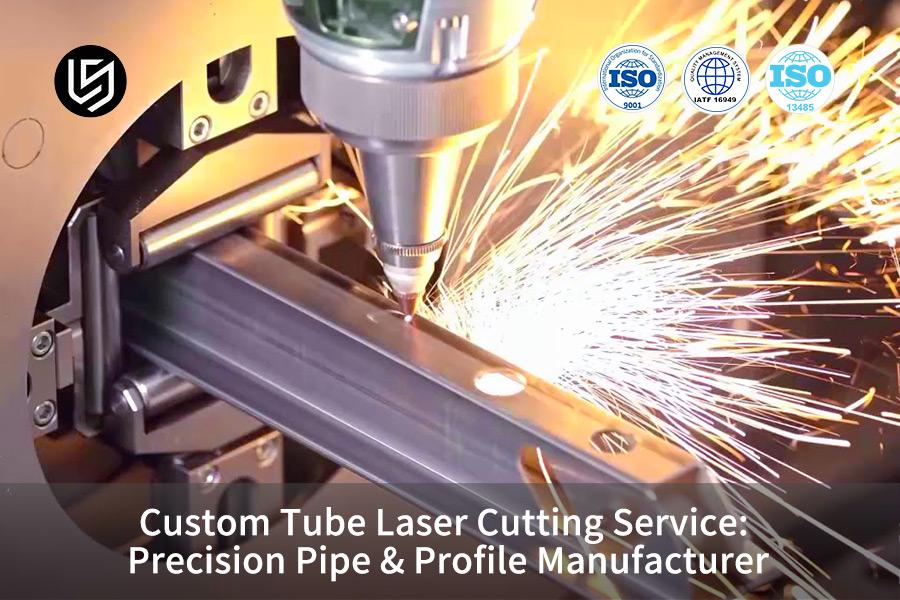
Custom tube laser cutting service provides a solution for the critical need of balancing precision with speed for tubular products. This is because we eliminate the rough cuts as well as the heat-affected zones, which are a result of other cutting methods. This means that we will cut down on the cost of other machining processes required to create weld-ready edges. Moreover, we have made sure that there will be access to our services, which will cover prototyping as well as production needs. This means that there will be a saving on assembly line time as a result of millimeter-level variations in cut profiles as well as lengths.
We have gone a step further compared to other "flat sheet" laser cutting service providers, as we have recognized the intricacies involved with cutting tubular products. This has been made evident through our achievements, which have solved the problems of beam distortion, follow errors, as well as thermal collapse. This includes our achievement of reducing the standard deviation of API 5L tube profile dimensions from 0.8mm down to 0.15mm. This is not just cutting; it is pre-fabrication.
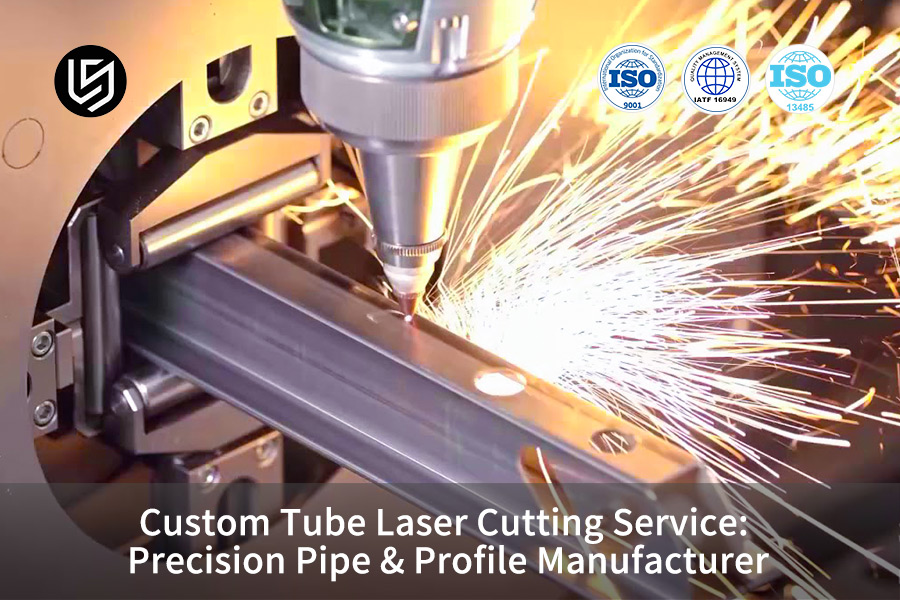
Custom Tube Laser Cutting: Essential Guidelines
| Consideration | Key Insight |
| Material & Wall Thickness | The process is applicable to metals such as steel, aluminum, and stainless steel. However, the process depends on the diameter and thickness of the tube. |
| Cutting Accuracy on Curved Surfaces | To ensure accurate cutting on a curved surface such as a tube, specific programming is required on a 3D laser cutting machine. |
| Heat-Affected Zone (HAZ) Control | The intensity of the laser beam is high enough to alter the characteristics of the material. Specific programming is required on the machine to ensure accurate speed and power. This can help in minimizing HAZ. |
| Our Advanced Technical Setup | We use 3D tube laser cutting machines. Axis synchronization is also available on these machines. Additionally, these machines can handle the material. |
| Design for Manufacturability (DFM) | We can help in designing the specifications of the tube. This includes the size of the holes in relation to the axis. |
| Result: Complex Part Consolidation | Complex laser cutting parts are created within a single tube, which means that fewer parts are required to be assembled and welded. |
| Result: High Precision & Clean Finish | Precise parts with crisp features, as well as low dross, which means that time will be saved since no secondary operations are required. |
The challenge of clean, precise cutting of complex features on metal tubes has been solved. Our 3D tube laser service converts raw tube material into precise, ready-to-use parts, which means that you will be able to consolidate parts, save time on your fabrication schedule, as well as provide structure that you will be able to use directly for product assembly.
Why Trust This Guide? Practical Experience From LS Manufacturing Experts
There are an untold number of written pieces discussing pipe cutting in one way or another. However, they are not like ours. You see, we are not theorists. Our office is not a boardroom. Our office is a battlefield. Our office is where we have spent more than 15 years attempting to master high-strength alloys, precision tolerances, and complex geometries. Precision is not an abstract term. Precision is a necessity. The very structure of a semiconductor equipment chassis, a critical joint in a racing chassis, or an ideal flow in an energy pipe is directly dependent upon precision in our cutting.
Knowledge we’ve acquired from solving very real problems. We know precisely how to fine-tune specifications to prevent collapse in thin-walled stainless tubing or to manage heat input in high-strength alloys. Our processes, particularly those in waste mitigation and air filtration, are specifically engineered to meet the most stringent demands of the United States' Environmental Protection Agency (EPA). Our knowledge is not based upon theory in any text but is backed by sparks, metallurgical testing, and proven results.
Our approach to this is to make cutting into an art form with our certified pre-fabrication process. Our deterministic process controls all parameters to ensure validation. Our certifications of materials, tolerances of parts, and specifications of cuts are set to meet the highest standards as defined by ASTM International. This way, what we provide to you are not merely cut parts but precision-engineered parts that are to be welded together seamlessly into your finished assembly.
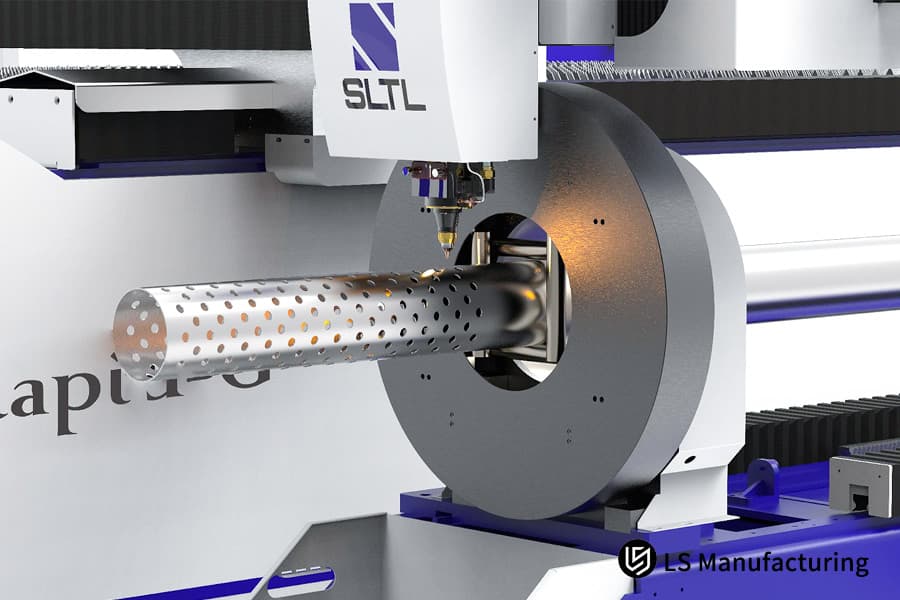
Figure 1: Cutting precise holes in a stainless steel tube for structural and filtration system components.
How Do Professional Laser Cutting Services Define The Standard Of "True Precision" In Tube Cutting?
True precision in tubular laser cutting goes well beyond mere tolerances in dimensions. It is the stringent and interdependent control of cut quality, dimensional fidelity, and geometric consistency that ultimately determines the performance of a part in assembly. This document explains our approach to mastering these complex challenges:
Engineering the Kerf: From Theory to Weld-Ready Edge
Specifications are translated into process parameters. In the cutting of an 8mm carbon steel tube, a HAZ of less than 0.3mm necessitates gas dynamics control and pulse frequency to avoid martensite formation, which causes weld zone brittleness. Kerf quality and tolerance are defined by controlling verticality at greater than or equal to 89 degrees and dross height at less than or equal to 10% of the thickness, from the first part of a batch to the last. Simply put, this means that your parts do not require secondary grinding after welding, and the weld seams are stronger.
Guaranteeing Dimensional and Positional Integrity
Our precision pipe cutting resolves the issue of error accumulation with respect to clamping, thermal, and programming errors. For instance, a ±0.1mm length tolerance of a 3-meter length tube made of a certain material will require temperature compensation as well as kinematic clamping. In a similar manner, a ±0.2mm true position accuracy of multiple holes will require C-axis synchronization as well as vision-based tool center point correction. In this manner, the theoretical data from the CAD system will be translated into a physical reality.
Mastering Precision Bevels for Structural Welding
A perfect weld starts with a perfect bevel. Our welding preparation laser cutting services quality standards demand direct control over the angle and land. This is achieved by programming and executing a 30°±1° bevel with 1mm±0.2mm land by dynamically adjusting the tilt and focus position of the cutting head in relation to the curvature of the tube. Such precision has a direct impact on the consistency of penetration in welds and minimizes any distortion after the weld.
This is our philosophy in writing this documentation: precision is not an assumption, precision is a truth. What sets us apart from our competition is not what we claim, but what we're able to prove, from our HAZ metrics to our Bevel Angle SPC plots, that our laser cutting process actually does address the real-world problems of weld quality and assembly fit of our laser cutting components. Such a process control enables the laser cutting system to move from being just a tool to being a deterministic manufacturing solution.

How Does Laser Tube Cutting Prevent Thin-Wall Tube Deformation And Thick-Wall Dross Adhesion?
Tube wall thickness signals a major change in our process with laser cutting. The fundamental challenge with laser cutting tubes of any wall thickness is the need to accomplish two conflicting objectives: the need for a low amount of energy input for thin-walled tubes, which are susceptible to deformation, and the need for a high amount of energy input for thick-walled tubes, which are susceptible to dross formation:
Protocol for Thin-Wall Tubes (t < 2mm): Combating Thermal Distortion
Our anti-deformation strategies are implemented to combat this phenomenon in its very source: excessive input of heat and mechanical deformation.
- Process: Ultra-high frequency pulsed laser cutting for tubes.
- Method: "Peck cutting" with high peak powers to keep average input low.
- Fixturing: Compliant clamping to prevent deformation before cutting.
- Result: Achieves <0.15mm ovality in 0.8mm stainless steel tubes.
Protocol for Thick-Wall Tubes (t > 6mm): Ensuring Kerf Integrity
Cutting thin-wall and thick-wall tubes requires different parameters for thick sections.
- Process: High-power continuous wave laser with dynamic focal tracking.
- Method: Assist gases (O2/N2) with pressures >20bar are used to forcibly expel molten kerf.
- Objective: Prevents dross formation and ensures verticality throughout tube wall.
Integrated Solution: From Cutting to Weld Preparation
Process library provides components already finished.
- Application: Single-operation precision laser cutting for thick sections.
- Outcome: Includes a precise weld bevel (e.g., 30°) to eliminate further operations.
- Value: Converts laser cutting system to a complete edge preparation solution.
This documentation emphasizes that precision is an engineered attribute rather than a machine attribute. What sets us apart in the marketplace is our dual, physics-based process library that actively addresses the unique challenges of both heat management and melt ejection. We ensure accurate results in the form of distortion-free thin-wall parts and clean, weld-ready thick-wall parts through deterministic parameter sets that meet the extremes of the laser cutting services continuum.
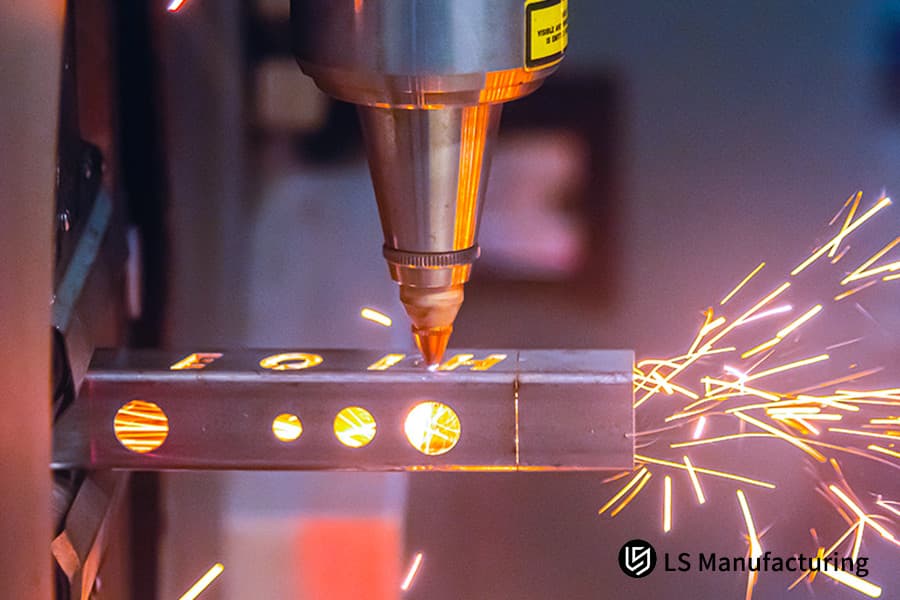
Figure 2: A laser perforates a stainless steel laser cutting for tubes with high precision for ventilation and structural components.
How Do Custom Laser Cutting Services Enable The Processing Of Complex 3D Intersection Lines And Irregularly Shaped Holes?
Custom laser cutting expertise is best demonstrated by successfully performing complex, multi-axis contours directly on tubular materials. The challenge is to correctly convert 3D representations of complex intersections and profiles into physically correct parts ready to weld. This requires a solution that integrates motion control with clever process planning to overcome the limitations inherent in 2D cutting.
| Technical Capability | Implementation Method | Quantifiable Outcome |
| Machining perfect tubular intersections | 5/6 axis synchronized motion ensures beam is always perpendicular to the tube surface. | Achieves seamless T/Y/K-node fit-ups with square kerfs ready to weld without post-processing grinding. |
| Integrated cut-and-bevel operation | Allows dynamic head positioning to adjust beam angles in real time during precision laser cutting process. | Enables the simultaneous creation of a weld prep bevel (e.g., 35° ± 1°) in addition to the contour cut. |
| Executing intricate contours from 3D data | Direct conversion of complex 3D CAD data to optimized toolpaths. | Enables the machining of multi-angle brackets with complex profile and hole cutting in one set-up to ensure dimensional harmony. |
This methodology allows us to deliver deterministic solutions to fabricating complex parts. We help solve critical fabrication challenges by offering single-setup fabrication of structurally sound parts with perfect tubular intersections. We also deliver weld prep in the laser cutting process. Additionally, we consolidate complex machining processes. Our expertise in 3D tube laser cutting allows us to convert complex designs into machined parts. This gives us a definite edge in the market.
What Type Of Process Control System Must A Professional Laser Cutting Service Establish To Ensure Consistency In Mass Production?
Achieving true consistency in high-volume production requires moving beyond machine calibration to implement a holistic process control system. This framework proactively manages variation at every stage, from raw material intake to final part validation, transforming precision from a hope into a predictable, data-driven outcome. Our system is built on three pillars of control:
Incoming Material Verification: Controlling Input Variation
We treat raw tubing as a critical process parameter. Dimensional attributes (straightness, OD, wall thickness) are measured and recorded against purchase specifications. Tubes outside tolerance are quarantined. This prevents inherent material deviation from being misinterpreted as a tube laser cutting service deficiency, ensuring the process starts with a known, qualified input.
Real-Time Process Monitoring and Correction
Our laser cutting process employs sensors such as thermal sensors and plasma sensors to monitor the cutting area. This allows for the detection of abnormalities such as focal shift and piercing problems. This also allows for automatic compensation of power or immediate stoppage of the process to ensure that non-conforming products are not manufactured. This is very important in ensuring batch production consistency.
Statistical Process Control for Predictive Quality
In our SPC in laser cutting is employed by selecting and measuring critical dimensions such as length and position in the parts being manufactured. This data is then plotted on X-R control charts to calculate the Process Capability Index (Cpk). We set a minimum Cpk of 1.33 for standard parts and 1.67 for critical parts. This statistical validation ensures that our process is stable, capable, and predictable to ensure high-volume output.
This closed-loop system is our competitive technical foundation. We address consistency by controlling input material, automating correction during processing, and verifying output using statistical analysis. This data-focused strategy for precision laser cutting offers consistent part quality, minimizes waste, and offers the empirical results necessary for trusted, high-volume partnerships in challenging profile laser cutting applications.
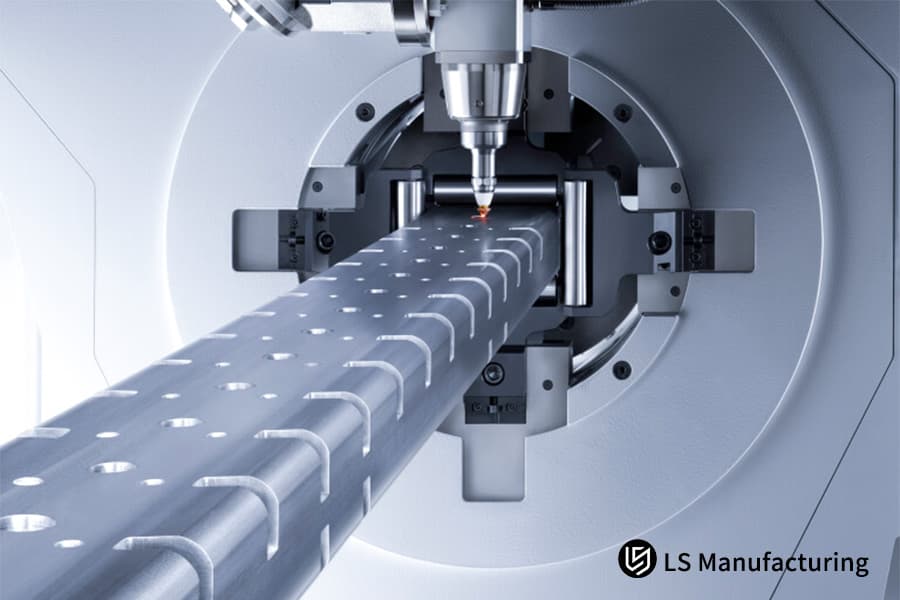
Figure 3: Creating precise perforations in a stainless steel tube from within for industrial ventilation systems.
LS Manufacturing: Precision Tube Cutting For Ultra-High-Strength Steel Crane Boom Connectors
The following document will outline a specific technical case study where LS Manufacturing supplied an integrated cutting solution to address a critical fabrication constraint. The specific case study will address the precision machining of ultra-high-strength steel tubular parts for a newly designed crane boom, where traditional processes have weakened material properties and driven costs. Our LS Manufacturing construction machinery case will illustrate the power of innovative laser use to address intricate engineering challenges:
Client Challenge
The client had to achieve accurate lockouts and pin holes on 960MPa yield strength square tubing to be used for crane booms. The existing process of plasma cutting followed by CNC milling created a large heat-affected zone on the material, which compromised material properties. This necessitated a 100% inspection process, a high rejection rate, and a 3-day lead time to produce a part. This directly impacted the prototype development process and introduced potential liabilities into the final product.
LS Manufacturing Solution
Our solution to this challenge was to design a high-strength steel tube laser cutting process using a high-power fiber laser. We designed a fixture to rigidly clamp the part for laser cutting. A high-purity nitrogen assist gas with a custom pulse waveform was employed to control heat input. All features, including lockouts, bevels, and pin holes, are programmed into a single precision laser cutting cycle.
Results and Value
The new process not only reduced the HAZ by more than 70% but also eliminated any distortion in the part. The cutting process was reduced from 3 days to under 8 hours per part, a 4x improvement in efficiency, with a 60% reduction in part cost. Most important was that parts were put through strenuous client fatigue testing, confirming the quality of the laser-cut edge and allowing the client to complete their new product design with confidence.
The case illustrates our capacity to deliver a dependable fabrication service for mission-critical parts. By developing a more streamlined process to eliminate a costly process with multiple steps and thermal damage to the part, we were able to deliver a fast-track solution that not only improved material quality but also increased development speed and reduced overall part cost. This technical solution represents our capability in solving the most demanding construction machinery fabrication challenges.
Transform high-strength tube cutting challenges into efficient, certified solutions with LS Manufacturing's advanced laser service.

How Do Professional Laser Cutting Services Handle Tubular Materials Of Various Types, Such As Stainless Steel, Aluminum, And Copper?
True custom pipe cutting expertise is measured by the capacity to adjust to the individual physical and metallurgical properties of each type of metal. Each type of material has unique issues with reflectivity, thermal conductivity, and oxidation while undergoing the laser cutting process. The current document outlines our methodology on each type of material, discussing how our custom parameters result in the best quality cut while maintaining the integrity of the materials.
| Material Category | Primary Technical Challenge | Our Targeted Process Solution |
| Stainless Steel Tubes | Preventing chromium depletion and oxidation to maintain corrosion resistance in the cut edge. | Utilizes high-purity Nitrogen/Argon assist gas to produce an oxide-free, bright cut with a tightly controlled, minimal Heat-Affected Zone (HAZ). |
| Aluminum Tubes | High reflectivity coupled with high thermal conductivity to enable consistent energy coupling without excessive dross formation. | Utilizes high-brightness lasers with anti-reflection measures and gas mixtures that are often complemented with surface pretreatment to guarantee precision laser cutting. |
| Copper & High-Alloy Tubes | Overcoming extreme reflectivity coupled with unusual thermal properties that impede processing using standard infrared laser sources. | Utilizes specialized laser sources such as green lasers to facilitate precise cuts with minimal heat input, offered as a developed advanced laser cutting service. |
This strategy addresses key application issues by maintaining weldability and corrosion resistance in stainless steel, ensuring clean and consistent laser cutting for stainless steel and aluminum tubes, and providing answers to issues with highly reflective materials. Our expertise in material-specific laser parameters means the answer is in the outcome, where the quality of the cut edge is critical in determining the reliability and integrity of high-value parts.
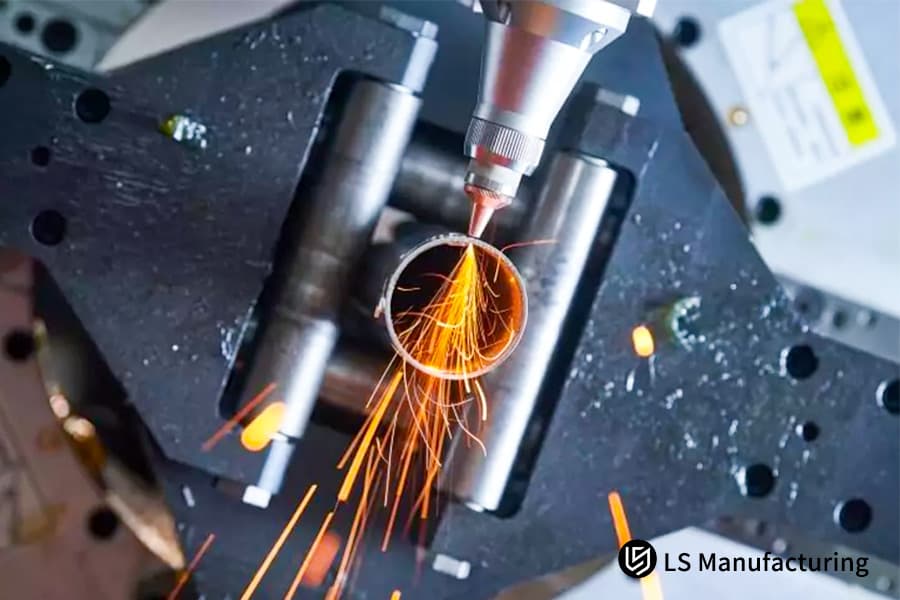
Figure 4: Perforating a stainless steel tube with a laser for custom ventilation or structural system components.
How Do Laser Cutting Services Integrate With Bending, Welding, And Finishing?
The true value of advanced manufacturing is only fully realized when the integrated laser cutting process is strategically planned as the foundation of the overall fabrication process. The problem is how to move from supplying individual parts to supplying parts that are optimized for the overall bending, welding, and machining processes. This proactive methodology is based upon the overall concept of DFA for tube fabrication. This includes the following steps:
Facilitating Precision Tube Bending
We cut physical datums and guides into the part during the initial operation.
- Bending Datums: Precision cut locator holes are provided for consistent and repeatable positioning in the bender.
- Alignment Guides: Bend lines are laser engraved for fast measurement-free setup.
Optimizing for Automated Welding
Our programming ensures components are prepared for efficient robotic welding.
- Integrated Weld Prep: A precise bevel is cut at the same time as the profile for a perfect fit.
- Robotic Guidance: Fiducial marks or holes provide a reliable source for welding robots, an example of cutting for subsequent bending and welding.
Enabling Efficient Secondary Machining
We design the cut part for ease of, and error-proofing of, all future machining.
- Unified Datums: We create finished faces or holes during cutting, which become primary datums for CNC machining.
- Integrated Fixturing: Strategic process tabs hold the part during cutting, becoming future mounting locations.
Our process of laser cutting services integration addresses the costly issue of isolated manufacturing islands. We provide components that have been engineered for efficient workflow, minimizing cumulative tolerances, eliminating the need for custom fixturing, and speeding up total processing time. Our precision laser cutting gives a real competitive advantage for a streamlined laser process, especially for complex, high-value assemblies with manufacturing efficiency as a critical factor.
How To Distinguish A Genuine Precision Tube Laser Cutting Manufacturer From A Mere Processing Shop?
In order to determine a precision tube laser manufacturer, it’s not just the specifications of the equipment that have to be considered. Rather, it’s the depth of engineering that differentiates a superior supplier from a mediocre one. This is because the essential difference between a superior supplier and a mediocre one lies in their systemic approach to process control, problem resolution, and knowledge application. The above guide offers a tangible framework for evaluation. Thus, it can be concluded that:
Evaluate Problem-Solving Through Case Study Review
Ask your potential partner to give a specific case study where there have been problems related to the material or design of the part. A superior partner will take you through their systemic process to resolve the issue, which may have been related to a 5% carbon content variance in a specific type of steel. They may have done a Design of Experiment to modify the laser cutting parameters. They will have finally validated the solution to the problem.
Demand Data-Driven Evidence and Full Traceability
Insist on objective quality data. A legitimate manufacturer will have a Process Capability report (e.g., Cpk >=1.33) on a critical dimension of a recent batch. Also, full traceability means that you can identify a finished piece down to its raw material heat number, cut time, operator, and parameter set. This is a quality system and capability audit, which forms the basis of reproducible high-volume precision work.
Assess Technical Investment and Foundational Knowledge
Look beyond the ability of a programmer to convert a CAD drawing. Ask the programmer how he or she handles the thermal properties of a particular material or optimizes a cut path of a complex shape. This depth of knowledge, precision laser cutting, combining metallurgy and physics with manual parameter optimization, is what takes a digital representation and turns it into a physical reality that is perfect and optimized, not just something a simple shop can deliver.
This allows us to better understand how to choose a tube laser cutting supplier on substance rather than claims. We solve the problem of choosing a laser cutting supplier by asking to scrutinize us, to provide transparent answers to support our claims with substance to validate our processes are controlled, traceable, and engineered. This is what makes a laser cutting manufacturer, ensuring the capability is designed to support mission-critical applications rather than just providing a service.
FAQs
1. How long does it typically take from submitting drawings to receiving cut samples?
For standard tubing and processes, we can provide delivery within 3-5 business days after drawings are confirmed. This includes programming, material and tooling preparation, cutting, and deburring.
2. What level of precision can your laser cutting service achieve?
We can ensure a tolerance in cutting length of ±0.1mm, a cut edge perpendicularity of ≥89°, and a hole position accuracy of ±0.15mm. With complex 3D contour cutting on shapes such as intersecting lines, we can ensure a profile tolerance of up to ±0.2mm. This depends on the specifications of the tubing, the type of material used in the design, and the complexity of the design.
3. What is the Minimum Order Quantity (MOQ)? Do you support small-batch prototyping?
We completely support small batch prototyping and sample run orders. The MOQs can range as low as 1-10 pieces. This is because we understand the vital role that prototype validation plays in the product development cycle.
4. Do the cut tubes require deburring? Is this service included?
Yes. Tubes cut by laser cutting machines have a small slag or burs on their edges. The standard delivery procedure includes a deburring service. This can be done by processes such as vibratory finishing or manual sanding. This is to ensure that the tubes we deliver have smooth edges and can be used in welding processes.
5. Can you handle tubing with special specifications or non-standard materials?
Yes, we can. We have access to a wide network of raw material suppliers, which enables us to source tubing with special specifications. For tubing using non-standard materials, like Duplex Stainless Steel or Hastelloy, we can develop a specific cutting process to ensure the cut tubes have the best quality. Please note, however, that there may be additional costs involved in the R&D of a specific cutting process.
6. What are the maximum dimensions of the tubing you can process?
Our laser tube cutting machines have the capacity to cut round tubes with a diameter ranging from Φ10mm to Φ250mm, square tubes with a maximum cross-section of 150mm x 150mm, and a maximum cutting length of up to 6.5 meters. The exact cutting capacities will depend on the drawings you have provided.
7. How do you ensure the security of my design drawings and intellectual property?
We respect Non-Disclosure Agreements (NDAs). We keep your designs confidential by storing them on our encrypted servers. The access permissions are tightly controlled, thus protecting your intellectual property. At the completion of the order, the digital data will be erased if you wish.
8. How do I obtain a quote? What information is required?
You will need to send us your 2D drawings (DXF, DWG) or 3D models (STEP) of your tubing, including the grade of the tubing, outer diameter, wall thickness, length, quantity, and surface finish. We will get back to you with a clear quote, including a process analysis, within 4 hours.
Summary
In high-end manufacturing, tubing has moved from a mere conduit to an integral part of the structure. Each cut is thus an artful act of "functional pre-forming." The value in working with custom tube laser cutting lies in harnessing the destructive potential of a laser beam to create "molecular-level surgery" in 3D space. The process demands a cutting service with expertise in material sciences, optics, and manufacturing technology.
Upload your drawings to us if you are seeking a cutting service to revolutionize cutting precision and cutting efficiency for your complex tubing parts. In 4 hours or less, our tube laser cutting service team at LS Manufacturing will deliver a detailed "Specialized Technical Assessment Report" to you. The report includes a "Design for Manufacturability Analysis," "Cut Quality Prediction," and "Recommendations for Process and Cost Optimization."
📞Tel: +86 185 6675 9667
📧Email: info@lsrpf.com
🌐Website: https://lsrpf.com/
Disclaimer
The contents of this page are for informational purposes only. LS Manufacturing services There are no representations or warranties, express or implied, as to the accuracy, completeness or validity of the information. It should not be inferred that a third-party supplier or manufacturer will provide performance parameters, geometric tolerances, specific design characteristics, material quality and type or workmanship through the LS Manufacturing network. It's the buyer's responsibility. Require parts quotation Identify specific requirements for these sections.Please contact us for more information.
LS Manufacturing Team
LS Manufacturing is an industry-leading company. Focus on custom manufacturing solutions. We have over 20 years of experience with over 5,000 customers, and we focus on high precision CNC machining, Sheet metal manufacturing, 3D printing, Injection molding. Metal stamping,and other one-stop manufacturing services.
Our factory is equipped with over 100 state-of-the-art 5-axis machining centers, ISO 9001:2015 certified. We provide fast, efficient and high-quality manufacturing solutions to customers in more than 150 countries around the world. Whether it is small volume production or large-scale customization, we can meet your needs with the fastest delivery within 24 hours. choose LS Manufacturing. This means selection efficiency, quality and professionalism.
To learn more, visit our website:www.lsrpf.com.