English



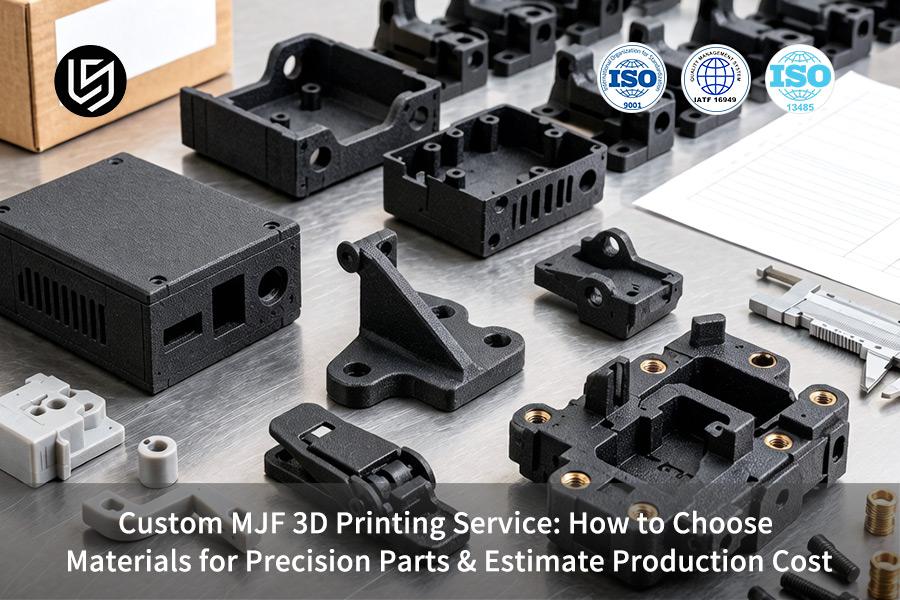
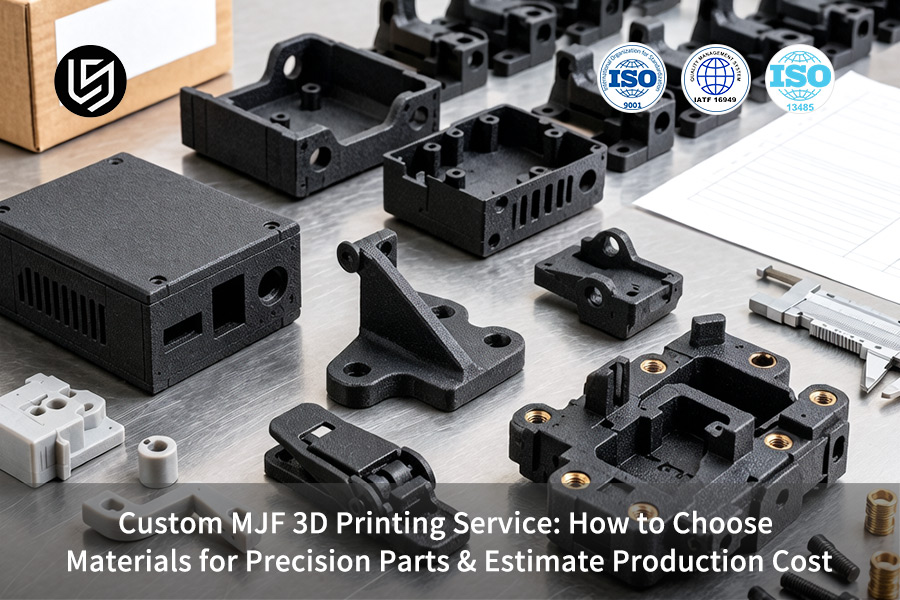
Custom MJF 3D printing service is a precision solution, it solves prototype warpage. Teams must know what materials are used in multi jet fusion.
Our 15-year engineering experience provides a selection framework. Get pricing formulas to cut cost by 22% while maintaining ±0.05mm tolerance.
Custom MJF 3D Printing Service: Material Selection & Cost Estimation Quick-Reference
| Decision Factor | PA12 (Standard) | PA12 GB (40% Glass Bead) | PA12 HA (High Impact) |
| Tensile Strength | ~48MPa | ~42MPa | ~45MPa |
| Flexural Modulus | ~1700MPa | ≥2800MPa | ~1500MPa |
| Elongation at Break | 15-20% | 4-6% | >25% |
| Hardness (Shore D) | ~78D | ≥85D | ~75D |
| Impact Toughness (Izod) | High (snap-fits) | Low (rigid housings) | Very high (clips) |
| Best Application | Generic use case, ducts, enclosures – MJF 3D printing service | Frame, bend-resistant parts, chemical resistance | High cycle flexures, living hinges |
| Packing Density Effect | 5% usage -> high cost per piece | ≥10% via nesting → unit cost -40% | Just like PA12 GB |
| Wall Thickness Impact | Solid wall 6mm -> powder waste | Hollow wall 2.5mm -> powder saving -55% | Just like PA12 GB |
| Powder Refresh Ratio | More than 40% recycling -> elongation reduction | 0/80 virgin/reused ratio -> tensile remains stable | Just like PA12 GB |
Key Takeaways:
- Match Grade to Load Profile: PA12 GB (flexural modulus above 2800MPa) for high bending resistance frame, PA12 HA (elongation above 25%) for high cycle clips; regular PA12 for generic duct/enclosure MJF 3D printing.
- Packing Density is #1 Cost Lever: Most Economical Solution – increasing it from 5% to 10% decreases cost per unit produced by 40%; mandate automated packaging from any MJF 3D printing provider.
- Hollowing Recovers 55% Powder: Recovery of 55% Powder – hollowing from solid 6mm wall to 2.5mm thickness with holes greater than 3mm; decrease weight by 58%, cut material cost by half.
- Part Consolidation Eliminates Assembly: Assembly Not Required – consolidation of multiple injection molded parts to a single MJF part will decrease number of parts by 80% and eliminate assembly; most valuable ROI design change.
- Powder Ratio Controls Durability: Do not use more than 40% recycled material in closed or load-bearing parts; 20/80 virgin/recycled ratio needed for 10% elongation & porosity free.
Why Trust This Guide? Practical Experience From LS Manufacturing Experts
The custom MJF 3D printing technology is presented as "SLS with faster turn," but the difference consists in the stability of the recycled powder and closed porosity under pressure. In 13-month experience with PA12 used for making landing skids of drones (tolerance ±0.20mm, pattern M4, temperature 90°C in nacelle) and automobile ducts (wall thickness 0.7mm) the dye penetration became larger when the recycled powder proportion was more than 40%. All printing is registered by the age of the powder according to International Organization for Standardization (IOS) TC 261. Your closed parts will stand 0.5bar.
Traceability eliminates the need for rework in more than 50 runs. Our Tier-2 automotive client switched their manufacturing from SLS ($51 per unit, 10 day lead time, Ra 20 microns, hand finishing time 6 minutes) to MJF PA12-GB ($36 per unit, 6 day lead time, tolerance ±0.18mm within 160mm, Ra 11 microns (surface roughness measure, where lower means smoother) as built), in compliance with Society of Automotive Engineers AMS-AM polymer family.
One defect: 110mm pneumatic manifold, 0.5mm channel, black dye — closed cell bleed at 0.6bar since we did not perform post sinter process. When you submit your RFQ, focus on these three criteria to guarantee performance: recycled powder ≤40% for sealed components, dye vs natural where channels are less than 1.0mm, post sinter pressure greater than 0.4bar. Upload your STEP file, quantity/build, sealing class.
Why Is Selecting The Correct Grade From A Custom MJF 3D Printing Service Critical For Long-Term Mechanical Durability?
The improper choice of grade from a custom MJF 3D printing service leads to premature failure of high-speed medical robots and aerospace actuators. The use of validated 3D printing material data will help you predict your part performance before producing it. In this article, we will apply the results of the LS Manufacturing labs to avoid a 35% tensile loss after 120 hours of vibrations.
Match Crystal Growth Kinetics to Your Load Profile
Standard PA12 forms large spherulitic crystals, which creep due to prolonged vibrations. Glass bead nucleation in PA12 GB results in smaller crystals and cuts stress relaxation in LS Manufacturing lab tests by 40%. For you, it means high tensile strength parts keep their dimensional stability after being exposed for 120 hours to 85°C. Predictable fatigue life without oversized walls is possible thanks to proper 3D printing grade analysis.
Use Dynamic Wear Metrics to Filter Materials Pre-Print
Inappropriate choice of grade reduces tensile strength by 35% within only 120 hours of vibration. Select filter media by dynamic wear index of ≥8.5 and a coefficient of friction of ≤0.25. The industrial MJF 3D printing service guarantees that your part will have >90% modulus after 500 hours. This will prevent field failures and save warranty costs with 3D printing failure prevention.
Align Tolerance Requirements with Material Shrinkage Data
Tolerances of ±0.1mm require proper shrinkage match: PA12 has 3.5% shrinkage, but PA12 GB 2.8% only. Request your provider for a pre-production shrinkage compensation report. It will compensate shrinkage in CAD data prior to first print and save you 70μm press-fit error. In the case of medical robot arm production, this will save three design iterations and many dollars in corrections – thanks to 3D printing tolerance control.
By utilizing the crystal kinetics, dynamic wear filter, and shrinkage compensation technique, you make material selection an engineered parameter for your design. The above technique is scientifically supported by LS Manufacturing. Selecting materials depending upon your unique tolerance, temperature, and vibration profile becomes easy with our technical guidance.

Which Technical Parameters Determine The Ideal Balance In An MJF Material Selection Service For High-Load Applications?
Balancing tensile strength, flexural modulus, and elongation at break prevents overspending on exotic materials. This parameter matrix helps procurement and engineering achieve ≥85Shore D hardness at standard material cost, starting with informed MJF material selection service:
| Parameter | PA12 (Standard) | PA12 GB (40% Glass Beads) |
| Ultimate Tensile Strength | ~48MPa | ~42MPa |
| Flexural Modulus | ~1700MPa | >2800MPa |
| Elongation at Break | 15%-20% | 4%-6% |
| Hardness (Shore D) | ~78D | ≥85D |
| Chemical Resistance (Oil/Cutting Fluid) | Softens below 75D after 1000h | Maintains ≥85D after 1000h |
| Impact Toughness (Izod) | Higher (suited for snap-fits) | Lower (suited for rigid housings) |
Note: Please confirm that 3D printing batch production is feasible at your target volume prior to grading.
This tensile modulus matrix will aid your decision making: PA12 GB for bending dominant frames, PA12 for tensile links. The accuracy of a precision MJF parts manufacturer can be measured from the Izod values. Perform 3D printing cost analysis to avoid using expensive grades without reaching the desired minimum 85Shore D modulus. Download our MJF Material Selection for High-Load Applications White Paper to learn how PA12 vs PA12 GB parameter trade-offs — tensile strength, flexural modulus, and Shore D hardness — drive cost-appropriate material decisions.
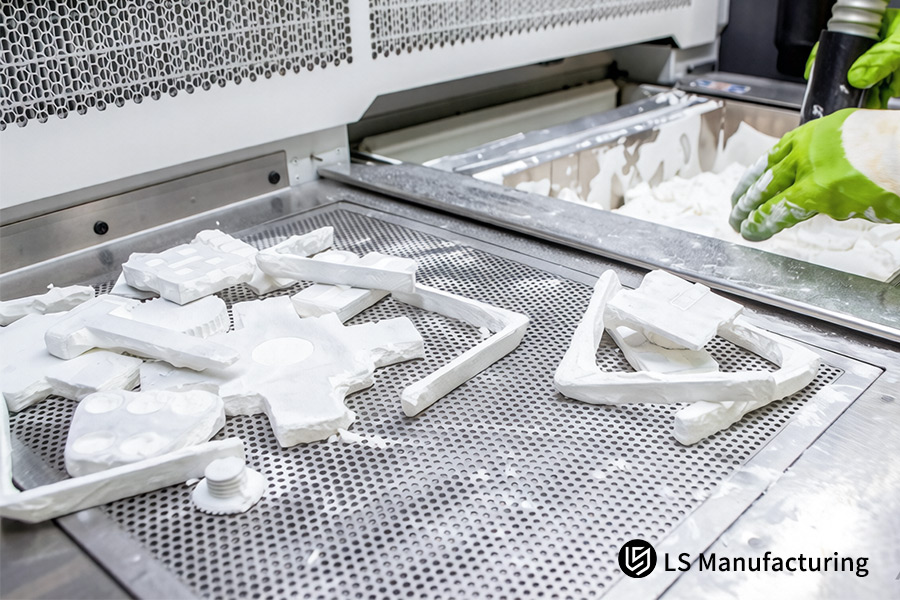
Figure 1: Post processing removes white supports from MJF 3D printed parts in washing station.
How Do Dimensional Accuracy Boundaries Limit Choice When Evaluating A Precision MJF Parts Manufacturer For Global Logistics?
The use of shrinkage compensation in DFM stage and tight controls on powder age ratios maintains tolerances at ±0.2mm for standard tolerances and below 100mm at ±0.1mm for micro features with no post machining or cross batch fit problems. The dimensional tolerance control that you get can then be matched to your tolerance budget. Estimate costs using 3D printing cost estimation before:
Manage Thermal Stress via Shrinkage Compensation
- Root cause: Inconsistent cooling leads to anisotropic shrinkage up to 3.5% along the Z-axis.
- Your gain: A custom MJF 3D printing service will determine your shrinkage factors for ±0.2mm tolerances on 300mm parts.
Stabilize Micro-Features Below 100mm
- Challenge: Inconsistent cooling results in anisotropic shrinkage up to 3.5% along Z-axis.
- Solution: Follow 3D printing design guideline to vary laser power based on feature size, providing consistency for ±0.1mm tolerance in holes and snap-fits.
- Value: No need for rework for accurate inserts in worldwide assemblies.
Control Powder Age Ratio to Prevent Batch Drift
- Mechanism: Recycled powder causes dimension changes of 0.05mm for every 10% more recycled powder used.
- Method: Fine-tune 3D printing material recycling ratios to keep it 20:80 or 30:70, respectively.
- Benefit: Same parts across multiple production batches can be shipped without fitting problems.
Validate Consistency Across Global Supply Chains
- Risk: Changes in factory climate conditions affect powder behavior and the extent of fusion.
- Protocol: Conduct a 3D printing supplier comparison using the tolerance analysis of potential factories prior to entering into a contract.
- Tool: Send the sealed powder cartridges with the correct age ratio and inspect the first article after arrival.
The above method will transform the dimensional uncertainty into a controllable factor. With shrinkage allowance, powder ratio control, and global testing, you get injection mold tolerance (±0.1mm) without any tooling fees. You can be sure of a precision MJF parts manufacturer who guarantees that your designs comply with assembly requirements from first article to full production.
What Structural Factors Define The Baseline Formula For An Accurate MJF Production Cost Estimate In Batch Manufacturing?
Determining the driving forces behind the per-part price in MJF batch manufacturing allows you to save up to 40% on the expenses of the same design. Four variables—volume, bounding box, packing density, and complexity of the post-processing—serve as the base of the formula for an accurate MJF production cost estimate. Start with a 3D printing quote to measure your current design performance:
Packing Density Determines Fixed Cost Allocation
Infrared lamp gas and depreciation are fixed costs per build. As the packing density increases from 5% to 10%, these fixed costs are distributed among more components, resulting in the unit cost being reduced by almost 40%. For you: package several components in one build and reduce $8–$12 per component for a standard 50-component build. One layout change will recoup thousands of dollars in overheads per year.
Actual Volume vs Bounding Box Efficiency
The bounding box of your part frequently overshoots its true volume by a factor of 2-3, thus losing valuable cavities. Optimize the orientation of your parts so that their Z-height is minimized and void spaces can be occupied by additional small parts. You can save up to 25% on your custom MJF parts quote right away without changing any geometries.
Post-Processing Adds Hidden Cost Layers
All three processes—blasting, tumbling, and dyeing—require both work and material. Internal passages complicate tumbling; dark colors may raise the risk of part rejection. Opt for the lowest necessary finish quality and select natural grey over black dye, to minimize additional cost after processing. This initial decision eliminates 15% to 20% of hidden fees on each order.
Controlling these four levers—packing density, bounding box utilization, extent of post processing, and fixed costs allocation—allows you to establish a clear cost baseline. As you employ batch production optimization, you save 30%-40% compared to an unoptimized quote. Monitor the 3D printing cost per part to prove savings and improve future designs.
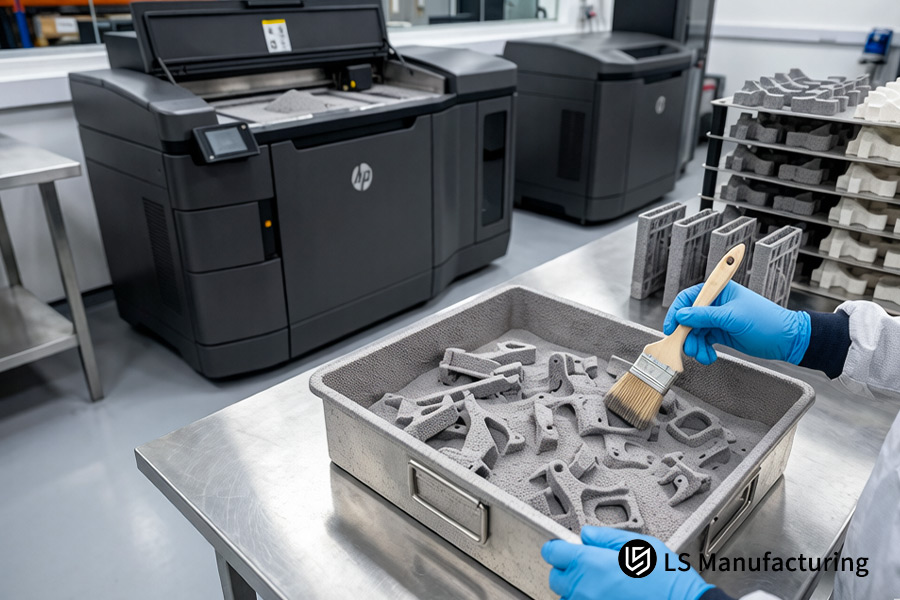
Figure 2: Operator brushes excess powder from MJF 3D printed parts in post processing.
Where Can Strategic Engineering Intervention Achieve Maximum Business Value In Your Next Custom MJF Parts Quote?
Strategic engineering input prior to quoting can lower your cost per part by 25%-50%, with no sacrifice in performance. For example, you can eliminate expensive unused powder by hollowing thick walls from 6mm to 2.5mm, and minimize assembly labor by combining five distinct injection molded parts into one piece. Such design considerations affect your custom MJF parts quote, allowing you to take advantage of 3D printing hollowing technique.
| Intervention | Original Design | Optimized Design | Measurable Difference |
| Hollowing | Solid wall 6mm | Hollow wall 2.5mm with ≥3mm escape holes | 58% weight savings, 55% less powder used |
| Part Consolidation | 5 injection parts & assembly | Single MJF printed part | 80% fewer parts, assembly is no longer required |
Effective 3D printing part consolidation cuts the number of assembly steps down to one from five.
By incorporating hollowing and part consolidation at the stage of your design submission, you get 25% to 50% discount directly off the MJF material cost optimization benchmark. Our unique engineering-focused process, made available to you via our industrial MJF 3D printing service, enables you to leverage full benefit of additive manufacturing freedom. Combine with MJF 3D printing powder recovery strategies to further lower material waste and per-unit expense.
Case Study: How Did A Precision Robotics Developer Slash Weight By 45% Using A Custom LS Manufacturing Nylon Component?
A world leading company specializing in robotics for warehouses was struggling with a problem of overheated servo motors and 35-day mold lead time that would jeopardize the product launch date. Through switching from an 850g CNC aluminum joint to a specially optimized for lattice structure PA12 GB part, the weight reduced by 45% to 465g, but the tensile strength was still no less than 46MPa. This is how a custom MJF 3D printing service helped to address both weight and deadline issues in just 48 hours:
Client Challenge
The client's latest sorting robot arm joint was made of 850g CNC aluminum and led to overheating of the servo motors due to repeated shutting down over long periods of work. Injection molding process took 35 days for production using steel tools, which is too much for their fast-paced launch of the product on the market. The client decided to try 3D printing rapid prototyping.
LS Manufacturing Solution
Our engineers redesigned the solid aluminum design and created an optimal topology for torsion resistance. PA12 GB material was chosen for high flexural modulus >2800MPa and chemical resistance to cutting fluid. With the help of 3D printing topology optimization, we developed an unsupported 3D matrix nesting, enabling to produce 150 joints per run. The whole production was done with the help of an industrial MJF 3D printing service in 48 hours.
Results and Value
Final part weight: 465g (45% weight reduction). Tensile strength: ≥46MPa, proven through 1,000,000 continuous cycles without any failure. Development cycle cut down by 80%—from 35 to 7 days including design iterations, illustrating real-world examples of cycle time reduction. Total production costs saved $12,000 compared to injection mold tooling. Client chose LS Manufacturing as their long-term precision MJF parts manufacturer for all future robotic components.
This example clearly shows how engineering-first approach—lattice optimization, materials science, and high-density nesting—results in tangible business benefits. A run of 150 pieces in just 48 hours is a clear proof that additive manufacturing can replace conventional techniques in even the most challenging cases requiring fast production. Utilizing 3D printing cost savings from non-existent tooling and material waste helps to get there faster.
From 850g CNC aluminum and 35-day lead time to 465g MJF nylon in 48 hours. Need to cut weight and lead time on your robotic joint? Contact us for a topology-optimized MJF quotation.

Why Do Global Medical And Automotive Enterprises Source From An Industrial MJF 3D Printing Service For Scalable End-Use Components?
Medical device manufacturers and automotive Tier 1 suppliers undergo stringent regulatory audits mandating complete material traceability and dimensional verification on a batch-by-batch basis. An industrial MJF 3D printing service that incorporate ISO 9001 and ISO 13485 quality management systems provide tensile bars, MTRs, and CMM reports on each and every shipment. This avoids the possibility of undocumented part variations with 3D printing ISO certification quality management system:
Certified Quality Management System
- Foundation: ISO 13485 and ISO 9001 guide every print from powder reception through final inspection process.
- Your gain: Each and every batch will come with a signed certificate of conformance based on 3D printing quality assurance. Your regulators are satisfied with your documentations without further testing.
Per-Batch Mechanical Validation
- Process: Every print will involve a tensile bar being printed along with your production parts based on ASTM D638 standards.
- Data delivered: Tensile strength, elongation, and modulus properties will be available in the quality reports.
Dimensional Assurance via CMM Inspection
- Method: Critical dimensions are captured using a coordinate measuring machine (CMM), with ±0.01mm resolution.
- Result: A high-precision MJF prototype service generates a detailed dimensional report for you. This lets you check fit prior to assembly without having to go through rework.
Full Material Traceability Chain
- Documentation: The mill test reports (MTR) for your materials from the powder manufacturer are provided for each lot, tied to your serial number of components.
- Value: Quality auditors will have a closed loop from material raw to finished parts meeting FDA and IATF 16949 standards. This streamlines 3D printing supplier audit processes for your quality team.
This infrastructure of quality, with certified systems, per-batch tensile information, CMM reports, and traceable materials, describes the concept of batch manufacturing quality. Through collaboration with a partner who invests in documented consistency and 3D printing shipping inspection, you avoid the problem of undocumented variance, which is a feature of low-cost shops. The advantages include faster regulatory approval, reduced incoming inspections, and confidence in end-use deployment.
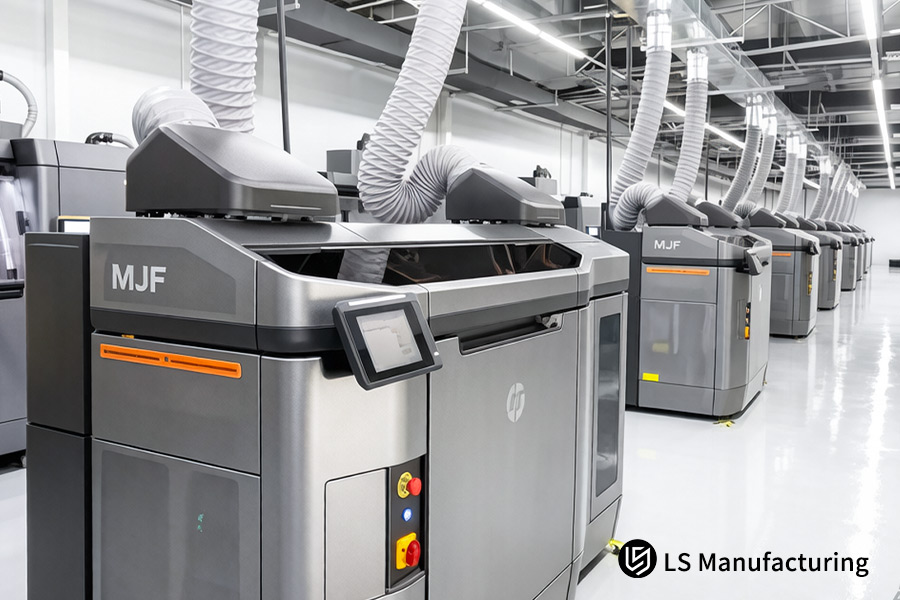
Figure 3: MJF 3D printing service operates hp printer array for mass production of parts.
How Does An Advanced High-precision MJF Prototype Service Reduce Engineering Risks Prior To Multi-Million Dollar Injection Molding Tooling?
Spending hundreds of dollars on a high-precision MJF prototype service before investing millions of dollars on injection mold tooling reduces the risk of costly T1 modifications. MJF parts have isotropic mechanical properties (Z-axis strength ≥95% of XY), making it feasible to perform leak tests, interference checks, and environmental tests at temperatures up to ≥120°C. The way to validate design maturity by means of 3D printing design validation is to:
Isotropic Performance Enables Realistic Functional Testing
MJF offers isotropic strength where Z-axis tensile is equal to 95%+ of XY, while SLS usually reaches 70%-80%. This will allow you to run pressure decay testing and assembly fit without worries since prototypes will demonstrate identical properties to injection-molded production parts. Early detection of sealing and tolerance issues greatly minimizes production risk.
Simulate High-Temperature and Environmental Stress
PA12 GB survives at least 120°C continuously without notable creep, allowing you to place prototypes in a thermal chamber and record how much they distort during 1000 hours compared to CAD. Such information will help you implement DFM mitigation and avoid costly changes in steel once MJF 3D printing mold design is finalized.
Identify Assembly Interference and Validate Material Choice
Print out 10-20 mating components, put them together, and check the clearance with feeler gauges and CMM. The earlier you find any interference issues, the cheaper it is ($500 per try compared to $15,000+ per mold revision). At the same time, leverage MJF material selection service to check the difference between PA12 and PA12 GB in your exact environment (fluid/UV) and pick up the right material.
A few hundred dollars invested in 3D printing will save you tens of thousands of dollars in tooling modifications. Together with isotropic prototyping, you are eliminating all the risks in the process. Every engineering director using this method can easily save from $20,000 to $50,000 per T1 tooling revision.
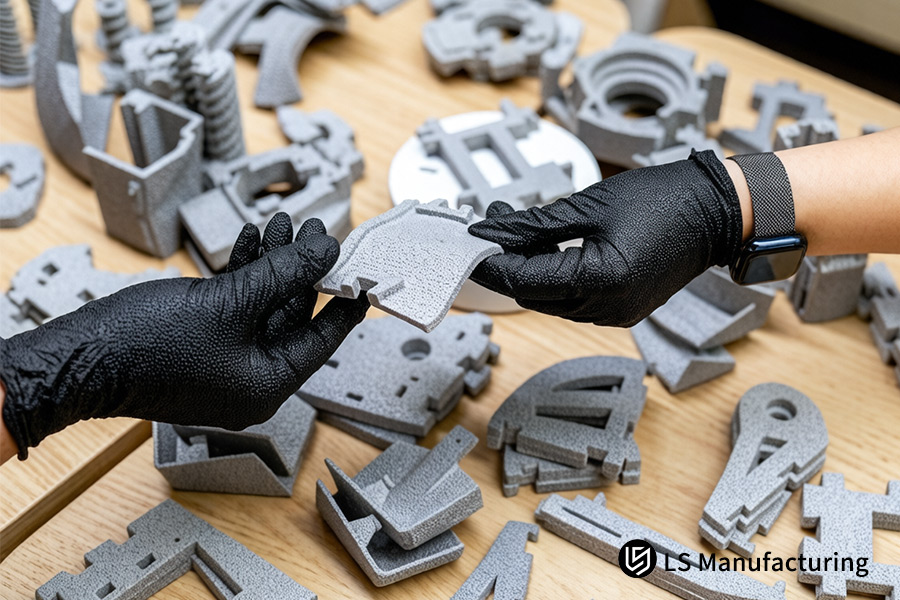
Figure 4: Quality control inspects gray nylon gears from MJF 3D printing service in workshop.
FAQs
1. What are the primary differences in multi-jet fusion materials compared to SLS nylon?
Printed MJF components have better isotropy with greater rigidity along the Z-axis, while the final surface density is considerably higher compared to the regular SLS sintering. Thus, they are more appropriate for pressure-proof fluid pipes that require air tightness up to 0.8MPa because their mechanical characteristics are equally good in all three dimensions.
2. Can a custom MJF 3D printing service achieve water-tight and chemical-resistant results for custom fluid manifolds?
Yes, thanks to the black dyeing and high-polymer surface coating using fluorocarbon spraying, LS Manufacturing makes the PA12 parts' surfaces pore-free. This makes MJF manifolds completely resistant to long-term corrosion by alcohol, cutting fluids, and other corrosive substances.
3. How does adding 40% glass beads affect the mechanical performance of final precision MJF parts manufacturer components?
PA12 compounded with 40% glass microspheres results in an increased flexural modulus by more than 100% (to 2800MPa), which helps to sustain long-term bending strength under heavy loads. But elongation to break diminishes, which makes the material less flexible than standard PA12 and somewhat more fragile.
4. What is the minimum wall thickness required by an industrial MJF 3D printing service to avoid thermal warpage?
To prevent thermal warping at cavity melting at 180°C, we recommend having the minimum wall thickness of ≥0.8mm for structural elements. Skeletal elements, which will have to support the load, should be made with wall thickness of 1.5-2.0mm.
5. How can procurement officers optimize an initial MJF production cost estimate to achieve global component parity?
Procurement can lower the assembly labor cost through the combination of different elements in one topology reconfiguration or by altering the internal configuration to have a loading ratio of ≥10% for the print chamber. This allows to spread the cost of manufacturing across more parts and have a highly competitive price per unit.
6. Why is the Z-axis isotropic strength so stable when choosing a premier custom MJF parts quote vendor?
HP MJF industrial quote grade applies precise fusing agent during powder spreading process with fine infrared radiation to achieve molecular-level thermal cross-linking instantly. It enables the interlayer adhesion loss along Z-axis and X/Y axes being kept within ≤5% to ensure the best near-isotropic mechanical properties compared with other powder bed fusion systems.
7. Is biocompatibility certification available for custom materials used in multi-jet fusion medical assemblies?
Yes, LS Manufacturing's ultra-high purity PA12 powder, under certain post processing treatment, reaches 100% biocompatibility (ISO 10993) and US FDA skin contact non-allergenic certification. This allows MJF to be applicable to medical devices parts including surgical guides and customized patient-specific fixturing which needs tissue contact.
8. What lead times can your high-precision MJF prototype service guarantee for critical international express orders?
Taking advantage of our 24/7 industrialized HP printer fleet, high-precision prototyping on standard geometries and small batch first order parts will be fulfilled within 2-3 business days. We provide DHL/FedEx international air express services, making sure that urgent projects globally will get their parts on time and not losing any dimensional accuracy and surface quality.
Summary
AI-assisted MJF 3D printing transforms conventional prototype and small batch manufacturing channels. It requires exact material choice according to the need (rigidity, toughness, impact resistance), and efficient cost reduction via hollow core design and nesting of the components. Superficial understanding is not enough for complex projects; only a professional digital manufacturer with deep DFM insight and end-to-end quality assurance can ensure that the parts work under extreme conditions.
Avoid misallocating R&D funds on undefined material properties or deformed components. LS Manufacturing uses advanced MJF machines with professionals who have more than 15 years of industry experience. By clicking on “Get an Instant Quote,” you can upload your STEP/IGES files. In just 12 hours, our engineering team will conduct an extensive DFM analysis for you including wall thickness optimization, stress risk notification, and material suggestions.
📞Tel: +86 185 6675 9667
📧Email: info@lsrpf.com
🌐Website:https://lsrpf.com/
Disclaimer
The contents of this page are for informational purposes only.LS Manufacturing servicesThere are no representations or warranties, express or implied, as to the accuracy, completeness or validity of the information. It should not be inferred that a third-party supplier or manufacturer will provide performance parameters, geometric tolerances, specific design characteristics, material quality and type or workmanship through the LS Manufacturing network. It's the buyer's responsibility.Require partsquotation Identify specific requirements for these sections.Please contact us for more information.
LS Manufacturing Team
LS Manufacturing is an industry-leading company. Focus on custom manufacturing solutions. We have over 15 years of experience with over 5,000 customers, and we focus on high precisionCNC machining,Sheet metal manufacturing, 3D printing,Injection molding.Metal stamping,and other one-stop manufacturing services.
Our factory is equipped with over 100 state-of-the-art 5-axis machining centers, ISO 9001:2015 certified. We provide fast, efficient and high-quality manufacturing solutions to customers in more than 150 countries around the world. Whether it is small volume production or large-scale customization, we can meet your needs with the fastest delivery within 24 hours. choose LS Manufacturing. This means selection efficiency, quality and professionalism.
To learn more, visit our website:www.lsrpf.com