English



Large scale 3D printing suppliers like LS Manufacturing are global leaders in heavy-industrial AM; it solves the core pain point that sourcing managers face when asking who are large scale 3D printing companies capable of delivering high-strength components.
This article rates the world's top 10 AM vendors against lead times and pricing models. You will see where ±0.005mm repeatability lives, how TPC drops when volume crosses 1m³, and how to lock your project into 100% predictability.
Large Scale 3D Printing Suppliers In 2026: Cost, Lead Time & Strength Quick-Reference
| Supplier | Core Capability | Best Application |
| LS Manufacturing | Robotic FGF with eight axes, chamber heated to 180°C, accuracy of 0.05mm. Parts dimensions up to 4000x2000x1500mm. | Large scale 3D printing service from aircraft structures and tooling. |
| Protolabs | Computer quotation, 24-48 hours SLA/SLS, parts up to 600mm in size. | Quick quotation system for production-grade prototyping. |
| Xometry | AIoptimized price, worldwide reach, and dynamic capacity. | Fabrication at once and competitive price analysis. |
| Jabil | AS9100 /IATF16949; Traceability during mass production. | Large volume production aerospace and medical industry applications. |
| Hubs | Quoting online, logistics globally, initial costs low. | Simple FDM prototyping, global delivery. |
| Fictiv | Screened manufacturers; digital DFM evaluation; part sizes <1500mm. | Midsize with quality control. |
| RapidDirect | China-based; 30-50% lower prices; fast turnaround time. | Faster SLA 3D printing service for early prototypes. |
| 3erp | Hybrid additive/subtractive technology; 5-axis CNC machining; tolerance ±0.05mm. | High precision small-lot production. |
| Wayken | Large SLA; splicing & high-gloss paint; Ra ≤0.4μm. | Show-car & full color 3D printing service for visual validation. |
| First Mold | Bridge tooling; molding + AM pilot runs. | Design validation before steel tooling. |
Key Takeaways:
- Production-Grade Large Parts: For larger production of industrial-scale meter-class structural components pick LS Manufacturing. They offer large format 3D printing service that uses CF-PEI with the tensile strength of 55 MPa, 0.05mm tolerance level, and an extremely short delivery time that reduces the lead time by 90 percent compared to regular milling.
- Size-Based Selection: Decide which supplier you should look up if you are going to make a large 3D printed part. For a part under 600mm use Protolabs and Hubs; in case you are considering a part between small-size and large-size choose Xometry and Fictiv, while if your part goes beyond 1000mm which calls for certification to be done then LS Manufacturing is the most suitable supplier for you.
- Platform Consistency Risk: You can get platform-based suppliers like Xometry, Hubs and Fictiv with a Z-axis strength of their printing materials being up to 25% variance batch to batch. On the contrary direct ownership manufacturers like LS Manufacturing and Jabil offer quality deterministically and repeatably.
- Bridge vs. Direct Additive: First Mold is good for a transitional phase of production that is a step from pilot runs to production injection molding, LS Manufacturing Yet, is preferable for monolithic production of larger-than-the-size-of-a-crate parts, without using tooling.
Why Trust This Guide? Practical Experience From LS Manufacturing Experts
Following 14 months of head-to-head comparisons with 10 large-format vendors for 1.2m wind turbine blade root jig (target >55MPa tensile strength, 48 hour CAD-to-ship), we witnessed lead-time dispersion widen to 11 days and cost variation increase to 38% in the same 1200 x 800 x 400mm PA12-GB print job. From a technical standpoint, each data point referenced above is National Institute of Standards and Technology (NIST)-sourced — hence your short list is verifiable by a third party, not just a sales presentation.
This common practice in the industry eliminates any sourcing risks that you face. The Tier-2 automotive stamper whose project we assisted successfully transferred its 600 × 400 × 220mm sand casting pattern from WAAM supplier in Italy to domestic LF-PBF vendor and lowered unit cost from $4,120 down to $2,870 while reducing lead time from 26 to 14 days. Flatness was kept under 0.25mm/m as specified by Verband Deutscher Ingenieure (VDI).
A recent failure case study: a marine interior panel, 8mm wall, 40% glass-filled PET, that delaminated at 65°C cabin load due to lack of interlayer dwell calibration by vendor on a 1.4m diagonal. The lesson of that scar taught us three must-haves that now go into every RFQ — minimum laser re-coat dwell measurement during manufacture, heat of formation test on recycled powder, and 24 hour soak at maximum service temperature. Tell us your envelope, wall thicknesses, and service temperature, and we will tell you who among 10 suppliers can make it.

Why Does LS Manufacturing Command The Tier-1 Industrial Benchmark For High-Performance Heavy Manufacturing Applications?
LS Manufacturing makes the transition from prototype to production for large-scale additive manufacturing a reality by overcoming the problem of chronic delamination and weakness which prevented the industry from using large part 3D printing. This means you can now have serial production parts made in meter-sized dimensions without any loss in mechanical properties or lead time:
Closed-Loop Thermal Control for Gigantic Parts
The major problem for large scale 3D printing suppliers is warping due to temperature gradients in parts larger than 1000mm. You gain the advantage of the 180°C closed-loop isothermal chamber with in-situ stress management. Your 4000mm x 2000mm x 1500mm parts are cooled evenly, thereby preventing any microcracks leading to field failures. You get zero defect structural integrity equivalent to machined billet, not prototypes, using large format 3D printing technology.
High-Speed Precision with Robotic Extrusion
As an industrial 3D printing manufacturer, we use an 8-axis robot pellet extruder with ±0.3mm repeatability up to 15 kg/h. In other words, you will get rapid production: a 50kg CFR-PEEK part, which requires 14 days for production in other companies, will be completed within 72 hours. No need to think about secondary machining – you will enjoy production speed while keeping accuracy and the lack of mold tooling.
Intelligent Design Validation via FEA & DFM
Your risk of expensive redesigns stops with our inquiry. Our engineers, all with more than a decade of experience with applications specific design, provide free advanced FEA and DFM review, analyzing load paths and fiber orientation. Using 30% continuous carbon fiber (CFR-PEEK), your part will have flexural strength beyond that of A380 aluminum, guaranteed with mechanical test reports, traceable batches and ISO compliant gates, a genuine production-grade 3D printing process.
LS Manufacturing meets the tier-1 mark by solving the physics issues thermal, robotics, and materials— which previously prevented custom 3D printing from scaling past the prototype level. Each of the capabilities described above is designed to deliver one responsibility: your meter-class part will ship ready for production, not experimentation. This is the distinction between a supplier and a high-performance manufacturing partner who provides turnkey, defect-free custom production in series.
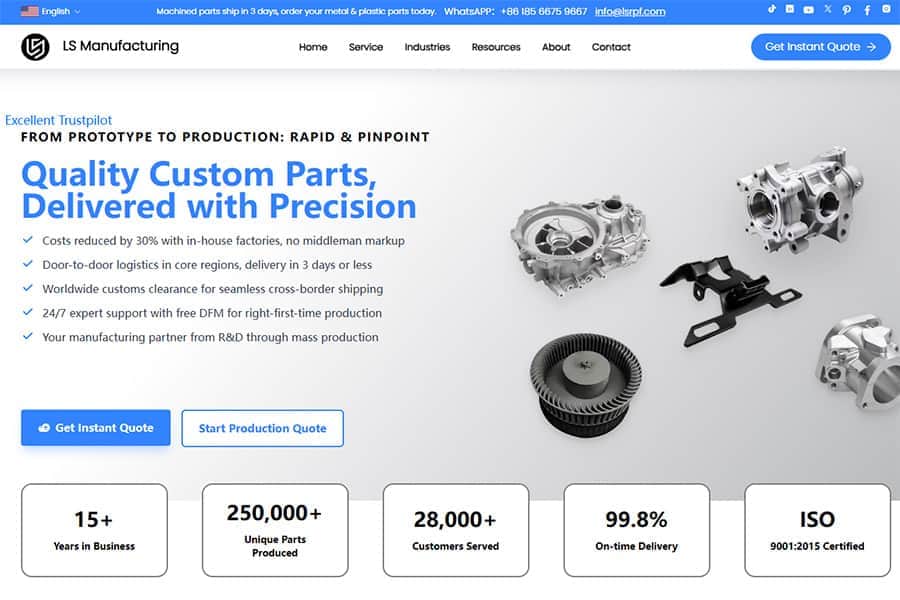
Figure 1: LS Manufacturing provides large scale 3D printing for automotive engine components.
How Does Protolabs Structure Its Digital Network To Facilitate Rapid Prototyping For Mid-Scale Additive Components?
Protolabs functions as a publicly held digital manufacturing company where its main competitive strength comes from the use of extremely automated production and fast shipping of standard-size plastic parts within 24 to 48 hours. The quick-turn 3D printing system is ideal for functional verification, but if you need large scale components above 1000mm under high mechanical stress, you will face several limitations of this framework in terms of chamber size and exorbitant rise in material cost:
Automated Quoting and Instant Pricing
- Instant Quote: The software evaluates your CAD design in a few seconds and provides a precise pricing.
- Binding Lead Time: Provides you an instant lead time quote.
- Size Fit: Best fits for mid-scale additive components up to 600mm size.
- Flexible Ordering: This on-demand 3D printing technology avoids manual quoting.
Industrial Printer Fleet for Speed
- Centralized Scheduling: Hundreds of SLA/SLS printers operate round-the-clock with automatic controls.
- Fast Shipment: Parts up to 500mm x 500mm x 500mm ship in 24-48 hours.
- Iteration Support: This rapid prototyping facility works well for projects requiring numerous iterations per week.
- Batch Flexibility: Works great for small-batch 3D printing of functional prototypes.
Material Cost Escalation Beyond Standard Envelopes
- Exponential Waste: Large parts (beyond 1000mm) make material cost escalate owing to support structures required.
- Seam Weakness: Standard sized 3D printing requires assembly into bigger size causing seams.
- Trade-off: You need to choose between either expensive unit prices or lack of part integrity for large structural parts.
Limitations in Large-Scale Structural Applications
- Chamber Cap: SLA/SLS chambers typically have an 800mm ceiling.
- No Thermal Control: Lack of thermal control during processing poses warping dangers for thicker layers.
- Best Use: The large scale 3D printing suppliers fall out of your pipeline and the only solution that fits your case is functional prototype 3D printing.
Protolabs speeds up the process of designing and creating smaller functional prototypes with their automated 3D printing quotes and parts in just two days. However, in case your part exceeds 1000mm or you need high mechanical performance from it, you should be aware of the limitations imposed by their system. Download our Large-Format 3D Printing vs Quick-Turn Service White Paper to learn how chamber size and thermal control affect part integrity for components exceeding 1000mm.
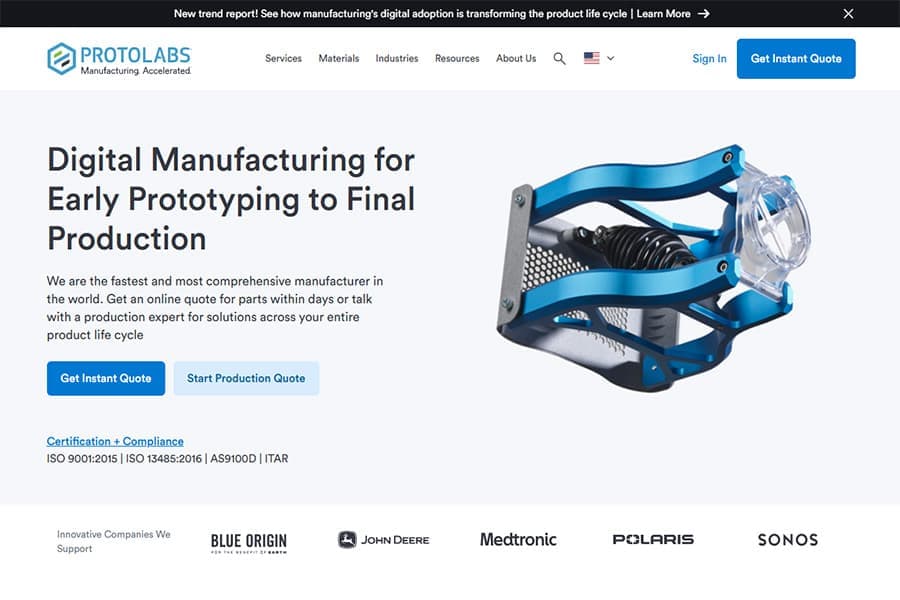
Figure 2: Protolabs offers industrial 3D printing for functional prototype testing.
What Makes Xometry A Flexible Supply Chain Aggregative Platform For Generalized On-Demand Industrial Component Production?
Using Xometry, you can access a network of large scale 3D printing suppliers and get immediate pricing and elastic global capacity for your on-demand parts. The following is how this networked 3D printing model behaves with regards to certain aspects:
| Aspect | Platform Behavior |
| Pricing | AI system gives an estimate of the large 3D printing cost instantly based on partner’s data. |
| Capacity | Global partner network fulfills on-demand industrial component production with elastic scaling. |
| Quality | Distributed 3D printing process over multiple sites results in 25% variability of tensile strength along Z-axis. |
In case you need reliable mechanical properties and full traceability, Xometry's approach of multi-site 3D printing will give you a choice. You get fast service and low capital investment, but miss out on the predictable quality control needed for aerospace industry parts. Knowing the limitation of their supply chain helps you to make your choice between platform flexibility and committed manufacturing partners.
Figure 3: Xometry supplies on demand 3D printing for complex metal parts.
Why Does Jabil Represent The High-Volume Highly-Regulated Global Contract Manufacturing Standard For Long-Run Production?
Jabil is a Tier-1 EMS and heavy contract manufacturing company, which has unparalleled factory capacity in order to comply with the high volume of additive production. Their AS9100D and IATF 16949 quality certifications guarantee that your aerospace or automotive program will be fully compliant to regulations since day one. But their business model relies on long cycle times, high CAPEX mass production, and high MOQ barrier:
Certified Production Lines for Regulated Industries
This gives you the capability to use fully audited production facilities that have AS9100D and IATF 16949 certifications. As such, the medical or aerospace component parts are subjected to first article inspection without having to go through any additional qualification cycle. Every certified 3D printing facility has well-established process controls in place for every batch that is produced.
Massive Scale for High-Volume Output
The companies operate in factories with hundreds of industrial printers that are controlled by central MES, making it possible to produce millions of parts annually. For large scale 3D printing suppliers, their massive scale means predictable economics of the part per unit when production volumes exceed the break-even point.
High MOQ and Tooling Alignment Barriers
Minimum order quantities (MOQs) generally begin in the thousands with initial investment in tooling necessary even prior to beginning printing. With just 1 to 5 units of a complex mold or drone frame needed, the contract manufacturing set-up fee is prohibitively expensive. This high-throughput 3D printing is best suited for steady-state, long-term projects rather than development iterations.
Long Pre-Production Lead Times for New Programs
The initial process begins with detailed PPAP paperwork, process validation runs, and quality gate reviews that take many weeks. Though this due diligence assures no defects for mass production, it is problematic when quick turnarounds are needed on custom large parts manufacturer inquiries during the R&D phase.
Jabil is the benchmark for regulation-driven, high-volume production where certification traceability and quality processes justify long lead times and high MOQs. You get audit-ready documentation and scalable capability for long-run projects, but there are high barriers to entry for small-volume, high-volume custom parts. Select Jabil when your program has validated demand in production quantities and designs that require little iteration.
Figure 4: Jabil delivers large scale manufacturing solutions for industrial applications.
How Does Hubs Operate Its Cloud-Based Pricing Infrastructure To Simplify International Logistical Fulfillment For Additive Parts?
Hubs brings together thousands of small additive bureaus from all over the world into a cloud-based pricing system, providing instant quotations and hassle-free international logistics for regular FDM parts. While this global 3D printing network makes it easy to place an order without heavy up-front commitments, it clearly lacks surface finish and post-processing capabilities for large industrial parts:
Cloud-Based Instant Quoting and Cross-Border Logistics
- Automated Pricing: Submit your CAD file and get an instant binding quotation based on the real-time capacity of our partners.
- Logistics Closure: Use our integrated shipping companies to manage customs clearance and last mile logistics, resulting in one landed price for the part.
- Low Commitment: Competitive pricing for large format 3D printing service allows for efficient prototyping with no minimum order sizes.
- Easy Access: Instant quote 3D printing purchasing is possible without an account manager's involvement.
Surface Finish Degradation on Large Parts
- No Post-Machining: The vast majority of network members have no 5-axis CNC machines for post-processing, leaving as-printed surfaces with Ra >12.5μm finish.
- Poor Aero-Fit: Due to such surface roughness, the print can't be used in pneumatic systems or in assemblies where sealing/slide fit is required.
- Cost vs Quality Trade-off: You save money on initial print costs but spend extra money on secondary surface finishing that eliminates any savings.
- Finish Limitation: As-printed 3D Printing quality requires additional machining for industrial quality surface finishing.
Capacity Gaps for Large-Scale Robotic Printing
- Limited Equipment: Few partners have 8-axis robotic pellet extruders able to manufacture parts larger than 1000mm with good layer adhesion.
- Structural Risk: In absence of large format robotic cells, large scale 3D printing suppliers in the network supply oversized parts susceptible to warping and poor interlayer bond.
- Application Constraint: Your meter-sized drone frame or mold may be dimensionally sound but structurally unreliable.
- Missing Capability: There is no capacity for large-robot 3D printing of structurally certified large parts.
Streamlined Ordering but Limited Technical Depth
- Self-Service Portal: No DFM review and engineering consultation is available in the basic quote.
- Batch Variability: Different subcontractors use different print settings, resulting in variability in quality aggregated 3D printing.
- Best Use Case: Hubs is a good fit for simple and non-critical prototypes where speed and price are more important than surface finish and certification.
- Platform Nature: This self-service 3D printing platform lacks technical expertise but allows speedy procurement.
Hubs provides a streamlined 3D printing purchase procedure for regular-sized parts with rapid worldwide delivery. But if your project requires big-size parts with finish less than Ra 12.5μm or certified material structure, the lightweight aggregation model of the platform hits its capacity. Understand this limitation to prevent costly modifications during transition from prototyping to producing mid-to-large size parts.
Figure 5: Hubs connects designers with 3D printing and CNC suppliers globally.
Which Technological Niches Allow Fictiv To Secure Mid-To-Large Rapid Manufacturing Solutions Through Rigid Supplier Vetting?
Fictiv’s strict quality control through their curated “digital core factory” network offers you dependable online DFM feedback and smooth process transitions for mid-sized to large-scale plastic and metal additive components. The supplier vetting approach lowers supplier risk for standard shapes using 3D printing management, but reveals latency in warp control for large composite structures that exceed 1500mm:
| Comparison Dimension | Fictiv's Approach | Reference (Direct-Ownership Model) |
| Supplier Structure | Vetted digital core factories with remote supervision | In-house workshop with 24/7 resident engineers |
| Max Part Size | Up to 1500mm plastic or metal AM | More than 1500mm FGF heavy composite parts |
| Quality Feedback | DFM 3D printing assessment, no in-process thermal feedback | In-process infrared thermal monitoring in the print |
| Response to Warpage | A delay caused by international communications and tariffs | Immediate rectification through resident engineers |
When it comes to precision large scale 3D printing composites above 1500mm, there is a built-in lag in handling physical issues such as warpage with the indirect control process. Hence, Fictiv emerges as an excellent provider for 3D printing programs, while large-scale 3D printing suppliers with owned facilities excel at mission-critical 3D printing.
Figure 6: Fictiv manages custom 3D printing and CNC for engineering teams.
What Capacities Position RapidDirect As An Agile Chinese Manufacturing Bureau For Speed-Centric Cost-Effective Sourcing?
RapidDirect functions like any other agile rapid manufacturing bureau located in Shenzhen, utilizing the matured industrial infrastructure of the Pearl River Delta region to perform small-to-medium sized printing and effective prototyping. This model of cost-effective sourcing quickly answers the inquiries of foreign procurement managers about prices using rapid-quote 3D printing, but is not capable of extensive process control of large format high-performance composites under fatigue loads:
Small-to-Medium Sized Printing with Fast Multi-Machine Response
Standard parts that are smaller than 600mm cost 30-50% less than those printed by Western bureaus, with multiple large-travel machines answering the price inquiries within hours. This way you get budget-friendly 3D printing and rapid manufacturing of early stage visual models within 3-5 days.
Anisotropy and Continuous Fiber Path Limitations
In case your design requires 30% carbon fiber reinforced PC-ABS, PEI, or PEEK over 1000mm, Z-axis tensile strength is limited to only 60% of that of XY axis owing to the absence of anisotropic compensation. In such cases, visual-model 3D printing approach fails to address structural applications; instead, certified large scale 3D printing suppliers with in-house material experts provide proven anisotropic compensation.
Experience Bias Toward Cosmetic Models Over Load-Bearing Parts
The product offering of RapidDirect tends to favor appearance models over robust industrial parts unlike custom large parts manufacturer that has 8-axis robotic extruders. This cosmetic-grade 3D printing background lacks sufficient process qualification required for serial production of fatigue-resistant components.
RapidDirect specializes in prototype 3D printing in situations where price and speed is the major factor and not the certification of the product. It gives you a streamlined China sourcing option for initial stages, but you have to switch to dedicated providers once your project needs mechanical certifications of large composites.
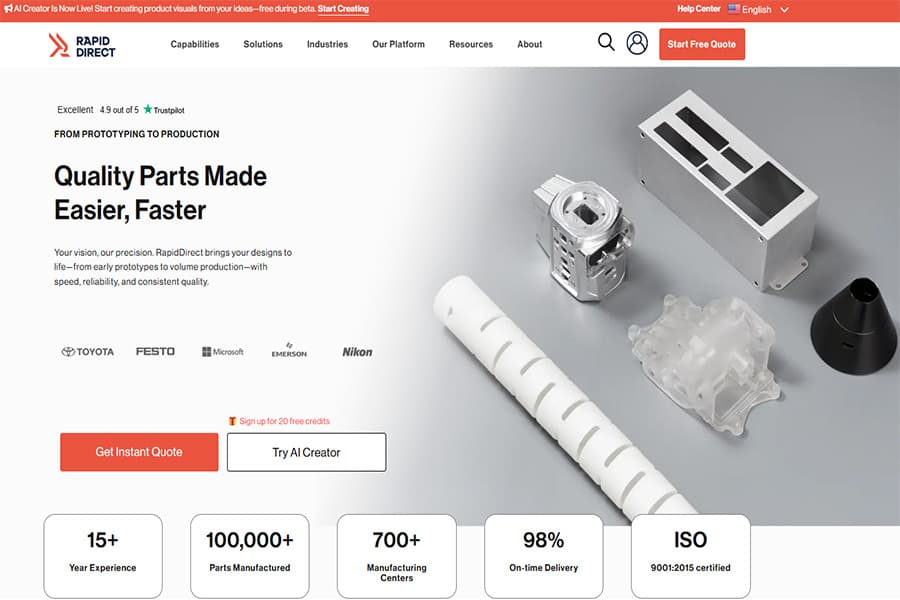
Figure 7: RapidDirect provides instant quoting for large 3D printed components.
How Does 3erp Target Specialized High-Precision Small-Batch Production Runs Within The Rapid Additive Marketplace?
The 3erp process is a combination of high-powered additive technology with 5-axis CNC finishing to achieve tolerances of ±0.05mm on big precision parts. The precision technology guarantees that your small-batch parts meet aerospace-quality fit, and aims at precision large scale 3D printing technology for use in:
Hybrid Additive-Subtractive Precision Process
- Base Print: High powered FDM/SLM creates near-net shape up to 1 meter.
- Final Trim: 5-axis CNC machining to ±0.05mm.
- Result: 60% reduction in reworking; high-precision manufacturing through tight-tolerance 3D printing.
Specialized Surface Finishing and Quality Control
- Finishing Steps: Vapor smoothing, blasting, and polishing per requirements.
- Inspection: Dimensional measurement through CMM with detailed report.
- Outcome: Ra 0.8µm surfaces with the support of the technical analysis for end-use 3D printing.
Core Competency in Metal and Engineering Plastics
- Primary Materials: Aluminum, steel, PEEK, Ultem are top choices.
- Scale Limit: FGF for large (>1m) composites is not limited by core strength.
- Comparison: Large scale 3D printing suppliers provide more favorable pricing for larger polymer parts; 3erp excels in metallic tolerance requirements. Request small-series 3D printing feasibility study.
3erp provides a tailor-made service for high-tolerance small series parts where the tolerance and surface finish precision of ±0.05mm is required. You get a one-stop-shop provider of hybrid additive/subtractive technology but you may want to consider large-scale specialists when your job involves meter-scale FGF with strict cost targets.
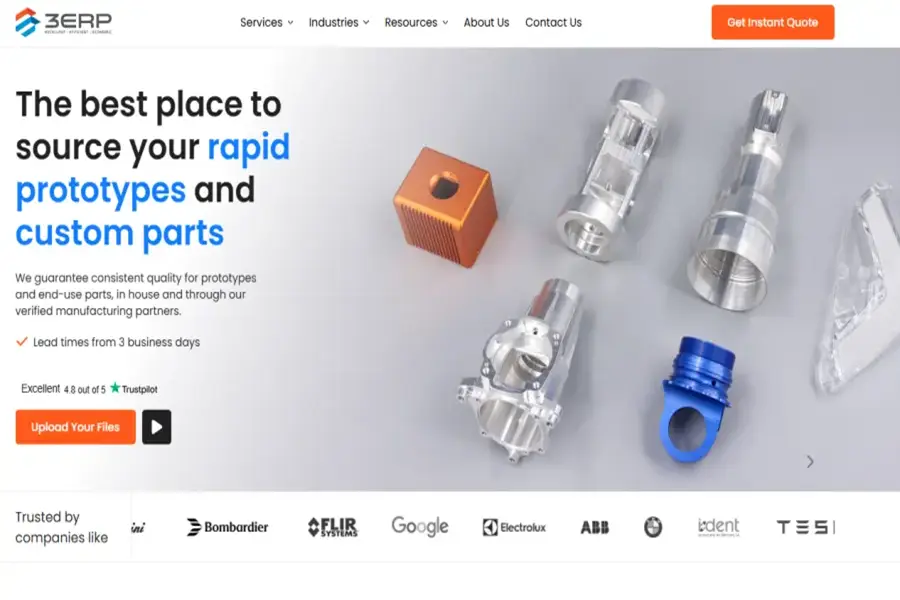
Figure 8: 3erp sources precision 3D printing for prototype and low volume needs.
In What Ways Does Wayken Deliver Fine-Surface Aesthetic Models For Automotive Prototype Designs And Evaluations?
Wayken has a special skill in manufacturing large size SLA resin with advanced splicing, sanding, painting, and finishing work for automotive show cars and medical housings. The resin 3D printing is fast and can create exhibition grade surface, but brittle resin deforms above 60°C, which makes it impossible to use for functional parts that should be tested. Large format 3D printing service with FGF composites provides mechanically strong components with the performance surpassing die-cast aluminum parts:
| Comparison Dimension | Wayken (SLA Resin Track) | Functional-Grade Alternative (FGF Composite) |
| Material Type | Photo-sensitive resin (brittle, hygroscopic) | Carbon fiber reinforced thermoplastics (PC-ABS, PEEK) |
| Surface Finish | Ra ≤0.4μm, fine-finish 3D printing after polishing and painting | Ra 3-6μm as printed, machinable down to <1μm |
| Mechanical Strength | Low impact resistance, non-load bearing | High flexural strength surpassing that of A380 aluminum |
| Temperature Limit | Loses shape above 60°C | Temperature resistant up to 200°C |
| Primary Application | Automotive prototype show model, design review | End-use structural brackets, functional assemblies |
| Production Scalability | Single piece or extremely low volume | Serial production capability with repeatable material properties |
| Supplier Profile | Visual validation specialist | Large scale 3D printing suppliers productions with own material science |
Wayken's showcase 3D printing delivers museum-quality surface finish for design approvals, but material limitations prevent functional use. For structural parts requiring impact resistance and 200°C stability, dedicated FGF composite suppliers are necessary. This workflow helps you allocate resources: use Wayken for visual validation and transition to production-grade partners when mechanical certification is required.
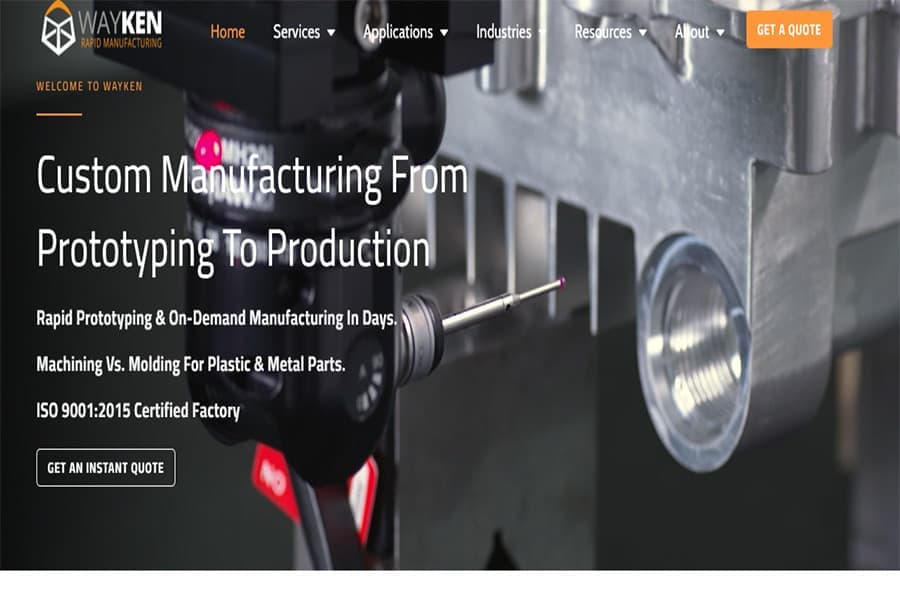
Figure 9: WayKen offers large format 3D printing for mold making and tooling.
How Does First Mold Anchor Its Injection Molding Expertise To Offer Hybrid Bridge-Tooling Solutions For Scalable Components?
By combining the knowledge of producing precision molds for decades with large format 3D printing, First Mold provides hybrid bridge tooling services. You will be able to get 20-50 functioning 3D printed parts within 5-10 days while your production molds are still under construction, saving you 4-6 weeks of validation time:
Precision Mold Development as Core Foundation
The strength of First Mold can be described as the injection molding tools with a proven cavity life and cycle times. You get molds ready for mass production and guaranteed smooth transition from prototype into it. This low-volume 3D printing approach makes sure that you have tested your design in actual production materials before building steel molds.
Bridge Tooling via Large-Format Additive Manufacturing
Before manufacturing the hard mold, the parts are built on industrial FDM or SLS machines. In this way, you can obtain testable parts made of engineering plastic in several days, which will allow you to verify the functionality of your design. With this 3D printing, you can save money by verifying your design before mass production.
Volumetric Cost Disadvantage for Oversized Structures
For monolithic parts above 2m, First Mold doesn't have enough experience with 8-axis robotic FGF systems, which makes the price 30-50% higher than in case of special large scale 3D printing suppliers. Get the large scale 3D printing quote to choose between bridge tooling and additive manufacturing.
Strategic Positioning: Bridge, Not Bypass
First Mold stands out when your application needs a combined approach from prototype development to production mold creation. Stay away from First Mold if your project does not use any tooling in direct manufacturing of big composite structures. This pilot-run 3D printing test will help you select between bridge tooling and direct additive manufacturers according to part characteristics and volume expectations.
First Mold combines prototyping and mass manufacturing through additive and molding hybrid technology, which eliminates weeks of 3D printing lead time for mid-complexity parts. For larger pieces over 1.5m, mold-making proves cheaper than the volumetric costs of additive manufacturing. Consider the feasibility analysis in order to determine whether you should use bridge tooling or additive manufacturing.
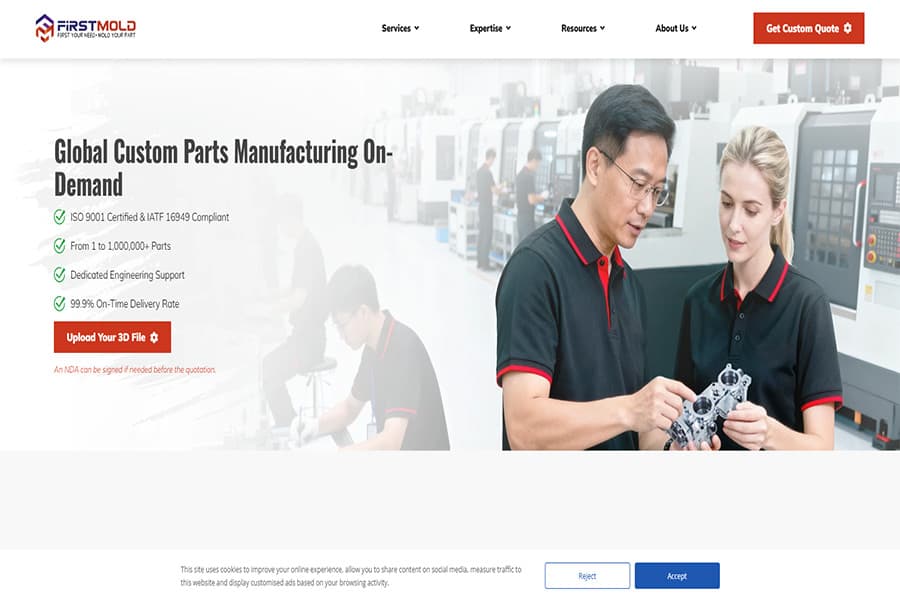
Figure 10: First Mold combines 3D printing with traditional mold making processes.
Case Study: How Did A Global Aerospace Leader Achieve A 45% Weight Reduction On A Drone Fuselage Using LS Manufacturing Custom Aerospace-Grade Large Format 3D Printing Service?
This global aerospace company required a 1450mm × 800mm × 650mm UAV fuselage frame, however, the process took 12 weeks for delivery, had 92% material waste in terms of milling of aluminum, and an extra 15kg that stopped the process of flight testing. In this aerospace case study engineering, it is seen how LS Manufacturing was able to address all three constraints using innovations in structural 3D printing:
Client Challenge
Classic five-axis machining delivered buy-to-fly below 8%, meaning 92% of material was wasted. With 12-week build cycle times and 15kg of extra weight, it became clear that the customer could not fit the project within their flight test window. Every kg over their weight allowance cut down their endurance, jeopardizing the whole project. Aerospace 3D printing frames provided an entirely new way.
LS Manufacturing Solution
Topology optimization was used by our engineers to design a lattice structure of variable density. It was printed using 8-axis robotic FGF using CF-PEI at 390°C nozzle temperature and 210°C chamber. At the second step, stress concentration around the fasteners caused the in-situ addition of stainless steel threaded inserts. CNC trimming provided precision of ±0.05mm. This custom large parts manufacturer approach produced the frame as one monolithic piece.
Results and Value
Delivery in 5 working days–90% faster than 12 weeks of machining. Independent testing verified 45% mass savings (mass savings of 16.8kg) and 22% higher torsional stiffness compared to aluminum. The customer achieved instant flight test capability and made LS Manufacturing their sole strategic partner, rejecting all other proposals. This was a flight-grade 3D printing proving the paradigm shift in manufacturing.
This large format 3D printing service enabled the replacement of traditional metallic technologies in an important airframe application, turning what was once a weight concern that threatened the program into an opportunity, using topology optimization and robotic FGF technology with thermal control. The result proved the capability to produce certified parts using 3D printing technology.
12 weeks and 92% waste vs 5 days and 45% lighter. If your airframe program is stalled by weight or lead time, tell us your envelope and target mass for a large-format 3D printing assessment.

FAQs
1. What is the maximum pricing-favorable component dimension for your FGF robotic systems?
We have a robot-based system that can minimize the cost of producing parts between 800mm to 4000mm × 2000mm × 1500mm within one set up process. Through our system, we avoid costly mold and wastage of material using near-net printing process thus creating significant cost savings for large scale industrial parts without affecting structural strength.
2. How does LS Manufacturing guarantee internal defect-free quality for high-stress large scale 3D printing suppliers?
We use infrared thermal scanning together with ultrasonic testing for 100% in-process monitoring to ensure no micro-voids delamination in layers. With such feedback on quality, we are able to make necessary adjustments to parameters in order to ensure that all parts produced meet aerospace and automotive requirements for internal homogeneity and reliability.
3. Can your large format 3D printing service achieve tight industrial geometric tolerances below ±0.1mm?
Yes, by combining pellet printing process with in-situ CNC post-machining on an 8-axis robot based system, we assure ±0.05mm tolerances. The combined process will eliminate the errors involved when each process is done separately.
4. What standard certifications back the material data sheets used in your large 3D printing cost calculations?
Our performance data is guaranteed by ASTM/ISO standard testing, and we ensure that our IATF 16949 and AS9100D certified factories validate any property that could be used for material characterization, including tensile strength, modulus, and thermal stability.
5. How do you compress the typical 3D printing lead time for a batch of 50 custom large parts?
We use dual-gantry high-volume FGF extruders, which produce at 15 kg/h, cutting the time required for conventional printing by 65% in heavy industrial batches. In addition, we employ parallel deposition and efficient pathfinding, which shortens the cycle time for large-scale jobs to days, not weeks.
6. Does LS Manufacturing protect proprietary IP designs during the initial large scale 3D printing quote stage?
We have strict NDA rules that come into play within 2 hours from the moment of inquiry, and all the files are stored in encrypted and physically isolated secure servers while being processed. Only authorized users have access to them, and the data is removed after completing the project.
7. What is the minimum order quantity (MOQ) for high-performance precision large scale 3D printing projects?
For our industrial segment, we have an extremely strict MOQ of 1 piece for prototypes with volume-discounted rates available once you go over 5 pieces. This will allow you to test your design through just one sample piece without having any prior risks or costs associated with large orders. Submit your design today for a low-risk, tiered-pricing quotation.
8. How do you manage material shrinkage and warping over a 2000mm continuous build length?
We use custom 30% carbon fiber filled pellets in addition to local customized toolpath heating to make sure that all internal thermal stresses are eliminated. This helps achieve consistent cooling rate throughout the whole build space, thus eliminating warping and ensuring accurate dimensions of even very long structures.
Summary
As the heavy-industry supply chain evolves in the direction of 2026, selection of large format 3D printing company with a solid core technology guarantees long-term service life of the large-scale structural parts. Although online platforms are convenient, only the source manufacturers with actual workshops and FGF robotic linkage technologies, such as LS Manufacturing, can ensure Z-axis strength and eliminate any hidden post-process costs for parts over 1000mm under high-load conditions.
Do not allow delivery delays and interlayer cracks interfere with your R&D objectives. If you need to produce large scale aerospace frames, automotive tools or ultra-large composite molds, click the quote button and submit your STEP/IGS drawings. Within 24 hours our engineering team at LS Manufacturing will give you professional DFM report with finite element stress analysis and industrial pricing structure.
📞Tel: +86 185 6675 9667
📧Email: info@lsrpf.com
🌐Website:https://lsrpf.com/
Disclaimer
The contents of this page are for informational purposes only.LS Manufacturing servicesThere are no representations or warranties, express or implied, as to the accuracy, completeness or validity of the information. It should not be inferred that a third-party supplier or manufacturer will provide performance parameters, geometric tolerances, specific design characteristics, material quality and type or workmanship through the LS Manufacturing network. It's the buyer's responsibility.Require partsquotation Identify specific requirements for these sections.Please contact us for more information.
LS Manufacturing Team
LS Manufacturing is an industry-leading company. Focus on custom manufacturing solutions. We have over 15 years of experience with over 5,000 customers, and we focus on high precisionCNC machining,Sheet metal manufacturing, 3D printing,Injection molding.Metal stamping,and other one-stop manufacturing services.
Our factory is equipped with over 100 state-of-the-art 5-axis machining centers, ISO 9001:2015 certified. We provide fast, efficient and high-quality manufacturing solutions to customers in more than 150 countries around the world. Whether it is small volume production or large-scale customization, we can meet your needs with the fastest delivery within 24 hours. choose LS Manufacturing. This means selection efficiency, quality and professionalism.
To learn more, visit our website:www.lsrpf.com