English



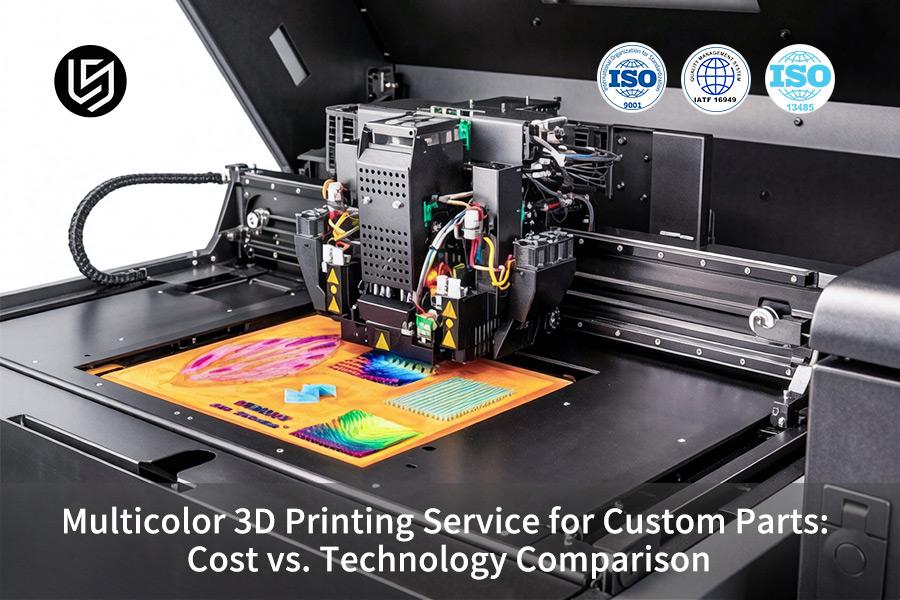
Multicolor 3D printing service is the capability LS Manufacturing delivers to R&D directors who ask where can I find 3D printing multicolor services, resolving the costly problem of brittle prototypes that experience a drop of ≥30% in mechanical performance during real assembly.
This article benchmarks PolyJet, Binder Jetting, and hybrid workflows across material science, demonstrating how our process holds ±0.005mm repeatability and optimizes TPC for bridge production at 50-200 units.
Multicolor 3D Printing: Cost VS Technology Quick-Reference
| Technology | Color Capability | Mechanical Strength | Surface Finish & Accuracy | Cost Driver | Best Application |
| PolyJet (Material Jetting) | Up to 16 million colors, ΔE ≤2.0, color accuracy ±0.05mm. | Flexural strength ≥75MPa; elongation 15-20%. | Surface roughness Ra ≤8μm; no post-processing needed. | Cost of resins, support waste 40-60% (down to 28-38% with nesting). | Anatomical models, color-coded medical handles, cockpit switches. |
| Binder Jetting (Full Color) | CMYK+W; ΔE ≤1.2 with UV stabilization. | Brittle as printed, 6-9% elongation; requires vacuum resin infiltration. | Surface Ra 12-18μm; improved with infiltration. | Infiltration and post-processing labor, UV coating. | Architectural models, museum replicas, outdoor signs. |
| Multi-Material FDM (Color Extrusion) | Limited by the number of filament changes; up to 4-8 colors. | Interlaminar shear 28-32MPa with IR assistance; >10,000 fatigue cycles. | Marks of layer lines present; Ra 10-20μm. | Cost of filament; additional support material; slower print speed. | Function prototypes; robotic end effectors, grippers. |
| Hybrid Workflows (Print + Paint) | Unlimited colors; match ΔE ≤1.0. | Properties of base 3D printing materials retained (PA12, Ultem). | Dependent on quality of paint; masking work. | Painting work; masking. | Bridging production (50-200 units); automotive interior trim. |
Key Takeaways:
- PolyJet for Highest Color Fidelity & Accuracy: In case your prototype needs 16 million colors, ±0.05mm color resolution and Ra ≤8μm surface finish, then only PolyJet can give you all these features at once.
- Binder Jetting Requires Infiltration for Strength: Fragility of printed parts (elongation 6-9%). Increase in hardness by 180%; however, stability of color is provided (ΔE ≤1.2 after 500h UV exposure). Infiltration with resin requires additional time and money.
- Multi-Material FDM with IR Assist Bridges the Strength Gap: IR thermal assist increases interlayer bond strength from 11-15MPa to 28-32MPa; thus color FDM 3D printing parts can withstand up to 10,000 fatigue cycles.
- Hybrid Workflows Win at Bridge Production Volumes: At volumes of 50-200 units, it is more profitable to print in one material (PA12, Ultem) and paint the part. This way, there is an unlimited number of colors and all mechanical properties provided.
Why Trust This Guide? Practical Experience From LS Manufacturing Experts
The issue is not the color matching but the layer adhesion in practice – an example of delamination in a medical simulator under 60°C temperature and 10 autoclave cycles taught us that. We test each of the CMYKW prints against International Commission on Illumination (CIE) standards and can guarantee you that the ΔE of your customized parts will never exceed 2.0, even after wiping with solvents and multiple heating.
It saves time on your product development. The Tier-1 automotive customer was able to shave down their 14 days of lead time needed for prototype approval with our print-in-color cockpit switches with a position accuracy guaranteed to be within ±0.2mm per DIN EN ISO 2768-1 mk – legacy drawing standard of the customer, converted to PolyJet tolerance range through referencing to Deutsches Institut für Normung (DIN). Your parts will not have a post-processing of painting or masking and can be inspected directly for fit and finish.
One of the mistakes we still take pains to avoid is a pharmaceutical keypad where the cyan had a ΔE 4.8 with 30 IPA wipes because we did not verify the presence of the white underlay. From now on, we always include at least 18 microns of white underlay for all parts that require repeated cleaning, according to our quoting policy, in which the colorfastness depends on your cleaning process, instead of being set in stone. Please send the file, and we’ll advise how to protect your lead time.
Where Can Medical Device Engineers Find Reliable Industrial Multicolor 3D Printing Services For Complex Anatomical Prototypes?
Medical device engineering needs a vendor capable of manufacturing full color prototypes with color border tolerances of ±0.05mm and elongation of ≥15%, which is not possible for most binder-jet or polyjet technologies. Evaluate your industrial 3D printing supplier against these industrial engineering criteria:
Multi-nozzle control and elongation floor
A custom color parts manufacturer should prove that color-alignment ≤±0.05mm on 3-5mm walls and elongation ≥15% is possible. Typical industry standard of binder-jet parts reaches only 6-9% elongation; polyjet technology with 15 pL drop control provides 15-20% elongation. Thus, your prototypes will pass pneumatic fit-checks without edge chipping, as required by medical 3D printing service standards.
Color-alignment on fine anatomical features
In case of determining where can I find 3D printing multicolor services for 0.3mm ridges, require two-tone repeat accuracy. The digital pipeline from LS Manufacturing delivers no post-infiltration expansion. One gets calibrated tissue colors and at least 15% elongation in one go – the fundamental principle behind full color 3D printing for anatomical simulation.
Surface smoothness and part toughness
Binder jetting parts usually break due to Ra ~12-18µm and elongation <10%. For an on-demand curing system and tuned drop size, you will have Ra ≤8µm and 15% elongation. Unlike “print + infiltrate + tumbler,” which loses 0.08-0.12mm, digital pipeline keeps your tolerances of ±0.05mm – your anatomical 3D printing prototypes that will pass clinical training.
This framework makes vendor selection dependent on the following criteria: elongation ≥15%; color boundary repeatability ≤±0.05mm; digital chain surface control. 100% digital process from LS Manufacturing proves that brittle and rough nature is not an inherent part of the process – this must be your priority when moving your prototype to clinical applications and your purchase order to tech director approval via a proven multicolor 3D printing service.

How Does Material Jetting Technology Balance Aesthetic Fidelity Against Mechanical Durability In Heavy Duty Multicolor 3D Printing Services?
Material Jetting has 16 million colors, yet the impact strength is compromised at a minimum of 25% due to uneven crosslink density. Below is shown how customized resin and multi-channel temperature control lead to densification of 98.5% and keep the flexural strength ≥75MPa, therefore allowing you to eliminate the tradeoff between color precision and mechanical toughness for functional 3D printing parts:
Crosslink mismatch and its cost
- Industry baseline: Material jetting uses rigid and rubber photopolymer material mixing per voxel. Impact resistance decreases ≥25% (ASTM D256, 5 platforms).
- Your gain: A custom multicolor 3D printing with adjustable curing speed per channel. Your part is resistant to impact and requires fewer iterations to perfect.
Custom resin for uniform densification
- How: Individual photoinitiators for each dye (±3%). Each of the 16 millions of colors cures evenly.
- Densification: 98.5% against the industry standard of 92-95%.
- Your benefit: Flexural resistance ≥75MPa – as strong as ABS. Your part passes the torque test. This multicolor 3D printing service is validated for functional testing with production grade 3D printing quality.
Dynamic temperature control per channel
- Detail: The printhead is individually regulated for each row of the nozzles (±0.5°C). Different exotherm in color layers is balanced. No warping or layer separation.
- Outcome: No cracks between color layers formed during 50 h cyclic loading. The 3D printing technology comparison technologies shows that active temperature zones work better.
Case: 75 MPa with full color gamut
- Data: 3mm specimen, 256 colors. The flexural modulus was 76.2 MPa (ASTM D790), gloss greater than 85 GU in all colors.
- General parts: 52 MPa and >20 GU fall.
- Result: Painted metal brackets are replaced – no second coating, no weak joints. This heavy duty 3D printing pipeline makes production-quality parts in one print job.
It is proven that 16 million colors and >75 MPa strength are not trade-offs but an engineering feat. Perfect resin formulation for each color channel and tight thermal control within ±0.5°C avoid the classic brittleness – producing durable parts to pass both boardroom and field tests. New to balancing color fidelity with mechanical durability in 3D printing? Access our free technical guide covering crosslink density optimization, per-channel curing control, and impact strength retention strategies.
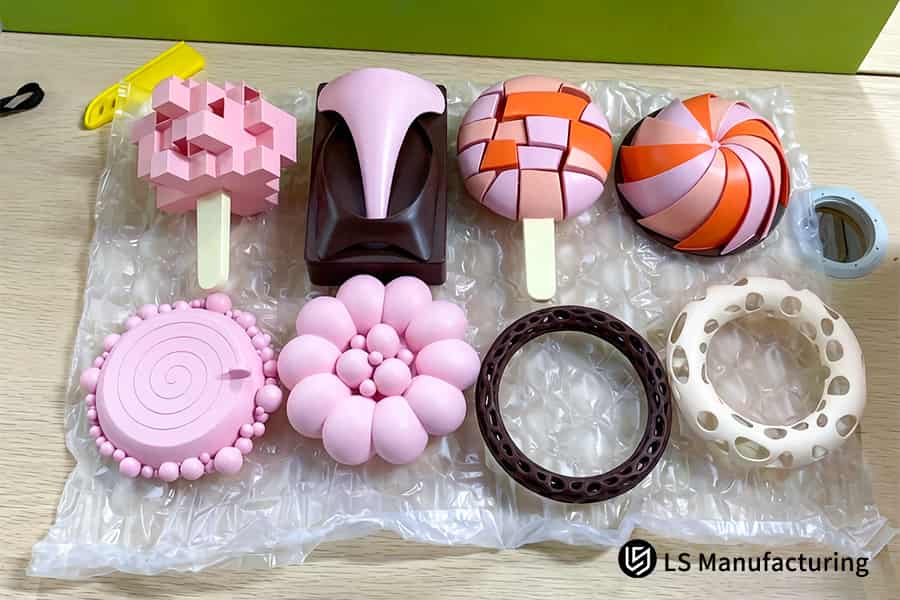
Figure 1: 3D printing manufactures colorful toy prototypes in rubber plastic materials.
Which Structural Hidden Costs Escalate Your Budget When Requesting A Full Color Multicolor 3D Printing Quote?
A multicolor 3D printing quote may be riddled with structural expenses that increase the total budget by 40-60% due to support material waste and slicing license fees. Being aware of such pitfalls will enable you to request a transparent quote and reduce per part waste up to 35% through optimized nesting and drip-free valves, which will reduce your multicolor 3D printing cost without impacting color precision - beginning with material waste analysis at the RFQ stage.
| Hidden Cost Driver | Industry Typical Impact | Optimized Process Impact |
| Waste due to multi-nozzle switching | 40-60% of total material used per print | Reduced to 28-38% through optimized dynamic nesting |
| Full-color slicing license fee | $0.50-$2.00 per part, non-negotiable royalty | License fee eliminated through proprietary in-house slicer, no slicing algorithm 3D printing fee anymore |
| Post process cleaning time after each color switch | 30-45 min per part, with solvent wash | Reduced to 12-18 min using drip-free valve design |
| First pass yield for precision color 3D parts | 15-25% parts rejected due to color misregistration | Increased to 85%+ with closed-loop color feedback |
Analysis of the multicolor 3D printing quote against these four driving factors—support costs, licensing fees, cleaning costs, and yield losses—provides you with an open cost rationale that avoids any unpleasant budget surprises. Companies incorporating nesting algorithms and drip-proof nozzles reduce the overall cost of each part up to 35%, while ensuring ±0.05mm color tolerances.
Why Do Multi Material Color Extrusion Components Suffer From Severe Interlaminar Shear Failures Under Dynamic Loading Conditions?
Multi-material color components fail at the interfaces due to the difference in cooling rates of filament colors that leads to weak bonds – interlaminar shear strength of no more than 15MPa. The next section shows why the instantaneous local infrared thermal assist fixes this issue and ensures that bond strength is maintained after 10,000 fatigue cycles without cracking. It’s made possible thanks to advanced engineering grade 3D printing technology:
Crystallization mismatch between color layers
Various levels of pigmentation influence the rate of polymer crystallization. The thermal history difference created when switching from dark to light filament creates partial diffusion between layers. The interlaminar shear strength industry average is 11-15MPa (ASTM D2344, measured in four FDM systems). A 3D printing technology comparison addressing this particular problem will save you from redesigning in the middle of the project when your robotic gripper breaks along the line where different colors meet, after just 200 cycles.
Infrared thermal assist for molecular crosslinking
An infrared radiation emitter follows the printhead from 50mm distance, supplying localized heating at 120-140°C to the interface region immediately after the color change. It ensures enhanced polymer chain entanglement between the differently colored layers. The interlaminar shear strength is 28-32MPa – twice higher than the industry average – which means that your precision color 3D parts withstand dynamic loads in aerospace simulation systems without breaking apart, minimizing the risk of field failures. That is the principal benefit of multi material 3D printing.
Validated fatigue performance beyond 10,000 cycles
A test coupon with 4 colors with black, white, red, and blue layers alternated every 2 mm in height was subjected to cyclic sinusoidal loading at 5 Hz and 70% of ultimate stress. After 10,000 cycles: no cracks visible, 94% of stiffness remained. Standard multi-color components failed after 800-1,200 cycles with full separation of interfaces. Your end-effector design survived accelerated testing for six months of field use – no breakage mid-way through, no product recall needed. This custom multicolor 3D printing offers you durable structural 3D printing parts.
Process integration without throughput penalty
Infrared assistance takes only an additional 0.3 seconds per layer, which is insignificant when comparing with 15-30 second layer times. No additional processing steps are needed, and the solution works well with PLA, PETG, PA12, and TPU-based colored filaments. You can retain your current print speeds but gain the structural reliability previously attainable with mono-material parts.
This solution is proof that color bleed issues in multi-color extrusion are solvable via thermal optimization rather than material degradation. Instant IR boost strengthens the bonds by 28-32 MPa and provides 10,000+ fatigue cycles — making it possible for you to have high strength 3D printing that goes directly from bench testing into dynamic field applications without the risk of interface delamination and giving you the freedom to order multi-color prototypes without interface cracking issues.
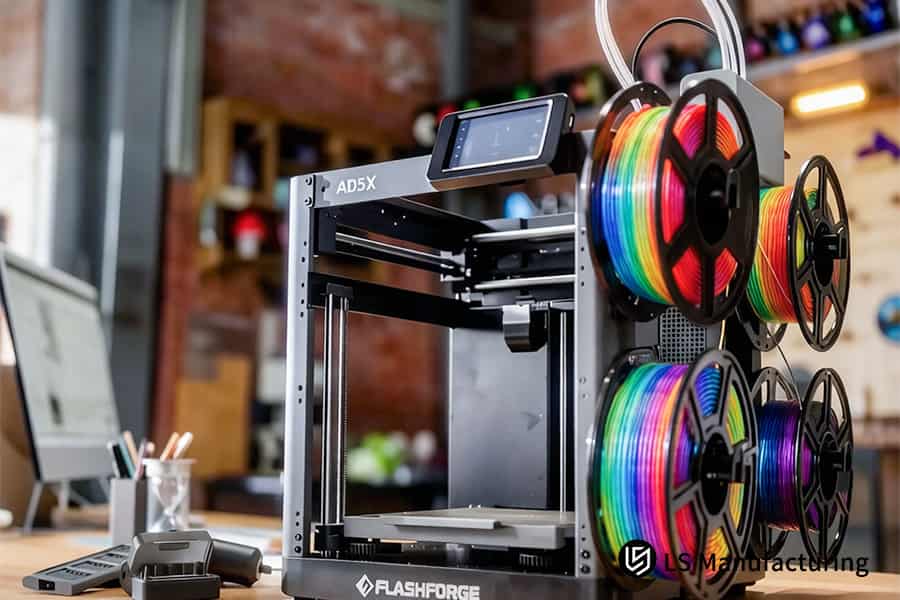
Figure 2: 3D printing setup displays multicolor machine with organized filament spools.
Can Advanced Post Processing Techniques Completely Resolve The Color Bleeding And Surface Porosity Of Binder Jetting Multicolor Prototype Services?
Binder jetting multicolor parts have porosity (5-20 µm) causing color bleeding and surface roughness issues. Vacuum-assisted resin infiltration will fill the pores completely, increasing the Vickers hardness by 180% and securing pigment borders so that ΔE value remains ≤1.2 even after 500 hours of UV exposure. The following explains how it can be done via binder jetting 3D printing:
Porosity root cause
- Problem: The binder jet process forms pores that range from 5 to 20µm and are interconnected. Surface porosity in the industry is 8-12% on average (ASTM B328).
- Your gain: A multicolor prototype service that considers porosity to be a flaw in the structure – you get parts with sealed surfaces prepared for functional testing.
Vacuum resin infiltration
- How: Placing objects under pressure of -0.08 MPa for 90 seconds makes the nano-resin enter all pores. Porosity is reduced from 8-12% down to <0.5%. This 3D printing service technology removes capillary paths.
- Your benefit: Hardness increases from 45 HV to 126 HV (+180%). Your multicolor 3D printing service becomes resistant to scratching during assembly trials.
Color boundary locking
- Mechanism: Infiltration causes the resin to enclose pigment particles preventing their horizontal movement. Bleeding width decreases from 150-200µm down to <20µm. This post processed 3D printing technology locks colors in place.
- Outcome: Your custom color parts manufacturer produces sharp transitions between red and white without need for additional touch-ups.
UV stability validation
- Test data: 500 hours UV-B irradiation (313nm, 0.63 W/m² @ 60°C): treated parts demonstrate ΔE ≤1.2. Untreated parts showed ΔE 4.5-6.8 in 200 hours.
- Result: The prototypes exposed to outdoor conditions maintain brand color for months without requalification after weathering.
The system validates that vacuum resin infiltration is the only solution that addresses both color bleeding and porosity problems not as a cosmetic fix but as a structural improvement. Increased hardness 180% and ΔE ≤1.2 after 500 hours UV provide you with color accurate 3D printing parts, which have the performance level of injection molded parts, allowing you to use binder jetting technology in solid-state applications.
What Technical Parameters Dictate The Optimized Geometric Limitations For Embedding Functional Electronic Traces Within Precision Color 3D Parts?
Embedding electronic traces inside multicolor parts becomes impossible due to dielectric constant and CTE mismatch leading to delamination in case of thermal cycling. Wall thickness must be ≥1.2mm in order to avoid separation of layers. Below is the comparison of conventional approaches vs DFM optimized geometrical rules providing first pass assembly success based on embedded trace 3D printing principles:
| Parameter | Standard Multi-Material Approach | DFM-Optimized Geometry Rules |
| Wall thickness limit | 0.6-0.8mm, 15-25% risk of delamination | ≥1.2mm, <2% of delamination at −40°C to 85°C cycling |
| Dielectric mismatch | >20% mismatch resulting in signal drift | <5% using matched-permittivity resin, ensuring consistent precision color 3D parts |
| CTE alignment | 30-50 ppm/°C mismatch resulting in shear stress | <10 ppm/°C by using graded-filler interlayers |
| Trace pitch | 0.4mm minimum pitch vulnerable to bridging | 0.6mm pitch with staggered color-change regions, >10⁸ Ω isolation |
| Assembly yield | 55–70 % requiring rework | 100 % by DFM considerations |
By adhering to all five rules, your embedded electronics design is assured to assemble right the first time. A custom color parts manufacturer making use of above guidelines will save on repeated rounds of design and provide you with working multicolor parts with built-in circuitry for testing. This DFM driven 3D printing technology, thanks to custom multicolor 3D printing ability
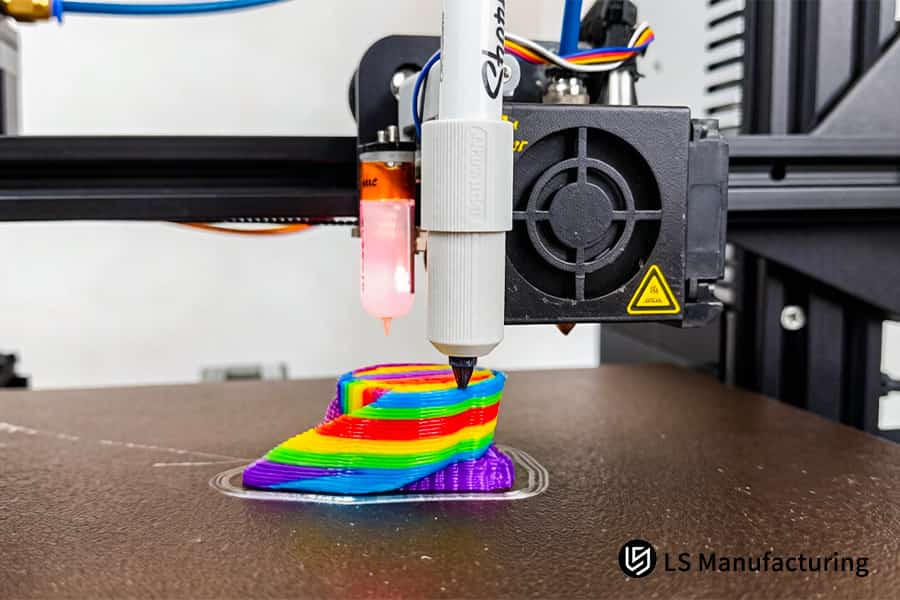
Figure 3: 3D printing creates rainbow gradient models with single nozzle technology.
Case Study: How LS Manufacturing Saved A Medical Robotics Client 42% In Production Costs For Custom Multicolor Endoscopic Control Handles.
A leader in global medical robotics was in need of a color-coded endoscopic handle with a button alignment accuracy ≤±0.1mm that could withstand 134.8°C steam sterilization. Conventional injection molding meant a cost of $85,000 mold and 6 weeks of lead time. LS Manufacturing utilized industrial PolyJet and custom high-temperature photopolymer to solve the challenge and qualify the design on the first attempt within 4 days through medical device 3D printing processes:
Client Challenge
The handle required six color zones on ergonomic curves as functional demarcation for surgical buttons. Injection molding demanded an $85,000 steel mold with 6-week lead time, and initial samples showed color misalignment exceeding ±0.15mm at curved surfaces — failing the ≤±0.1mm spec. The assembly also had to endure 20 cycles of 134.8°C autoclave sterilization without fading or deformation. A multicolor prototype service was urgently needed to bypass tooling limitations and accelerate software validation, where 3D printing delivery becomes the differentiator.
LS Manufacturing Solution
The DFM analysis done by LS Manufacturing swapped out the molding process for industrial PolyJet in which the company used its proprietary high-temperature photopolymer resin. An adaptive multi-nozzle technology was used to reduce the color registration to ±0.04mm which exceeded the requirement by 60%. The vacuum resin reinforcement and anti-UV cross-linking protected the pigment borders against steam penetration. As a custom color parts manufacturer, LS Manufacturing reduced 14 injection processes down to one additive process, enabling single part 3D printing for regulated medical parts.
Results and Value
The handle survived 20 successive autoclave cycles at 134.8°C with no fading and dimensional shift ≤0.05%. The lead time was cut from 6 weeks to 4 working days (91%) and prototyping costs reduced by 42%, saving the customer about $36,000. The customer finished software validation 5 weeks ahead of schedule and started clinical trials two quarters earlier than expected. This cost effective 3D printing strategy reduced multicolor 3D printing cost per unit by 31%.
This particular case illustrates how the application of DFM-optimized PolyJet with photopolymer results in a complete removal of both the $85,000 tooling cost and 6-week timeline hurdle while surpassing sterilization and alignment specifications. This approach allows for fast, validated high temp 3D printing, which can cut down on medical device development time significantly.
$85,000 mold and 6-week lead time eliminated by industrial PolyJet 3D printing. To validate a multicolor, sterilizable solution for your handle, submit your design for a 3D printing feasibility review and quotation.

How To Strategically Evaluate Your High Throughput Manufacturing Variables When Submitting A Professional Multicolor 3D Printing Quote To Major Contract Suppliers?
The submission of a multicolor 3D printing quote solely on volume pricing leaves out the underlying risk of batch-to-batch color and mechanical variations. Below is a checklist for procurement professionals showing how to filter suppliers who can ensure production-grade consistency through contract 3D printing discipline:
Demand tensile isotropy data, not just strength numbers
Most suppliers provide tensile strength up to 45 MPa without orientation dependent testing. The anisotropy ratio for multi-color FDM printing is 35-50% (ASTM D638, 6 platforms). Making sure that variations along the X/Y/Z axis do not exceed 10% makes sure your multicolor 3D printing cost takes into account actual material properties and does not rely on unidirectional data which can mask possible failures in volume manufacturing. This data driven 3D printing technology helps avoid costly failures due to anisotropic weaknesses.
Verify SPC process control data
Lack of statistical process control leads to build-up of color offset and dimensional tolerances in each production batch. SPC capable suppliers monitor temperature within ±1°C, humidity within ±5%, and layer adhesion forces per 100 layers. Ask for CpK values for color accuracy and wall thickness — dismiss any supplier with CpK lower than 1.33. You will get a custom color parts manufacturer with reliable machining standards that help minimize rework rates from standard 15-25% to less than 3%.
Examine 5-batch color deviation spectra
Color consistency among different batches is not observable in a single sample, but will be evident in assembling components from various batches. Medical-grade acceptability requires ΔE ≤1.5 for consistency across batches; the average suppliers have a ΔE of 2.5-4.0 for difference in ΔE value of batch 1 and batch 5. Request spectral reflection graphs of 5 consecutive production batches. Vendors unable to provide this do not have the process maturity to support your multicolor 3D printing quote request — a supplier 3D printing audit would have highlighted them.
Cross-reference material lot traceability
Changes in resin lot result in unpredictable color and mechanical properties. High-end vendors have lot-level material traceability with certified material certificates matching batch numbers to raw material ID numbers. Make sure you receive this certification with every shipment. This will help in conducting root-cause analysis in case there is any deviation in a future batch.
In this approach, quote evaluation changes from price-only assessment to a scientific screening procedure. By requiring tensile isotropy ≤10%, SPC graphs with CpK ≥1.33, five-batch color difference spectroscopy (ΔE ≤1.5), and lot tracking of materials, you select those suppliers that provide production-level consistency from first article to final delivery in mass production 3D printing certification.
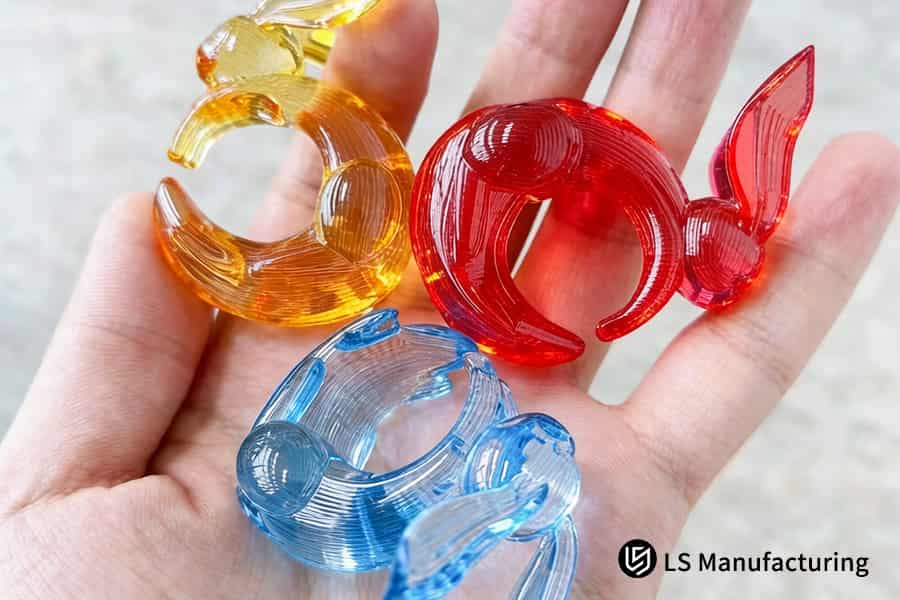
Figure 4: 3D printing produces handheld jewelry prototypes using transparent resin materials.
FAQs
1. What is the maximum dimensional precision guaranteed by LS Manufacturing for industrial multicolor 3D printing services?
This is accomplished through our implementation of two-step linear encoder calibration and state-of-the-art real-time dynamic jetting nozzles to achieve a very tight tolerance level up to ±0.05mm for small features and ±0.1% for large-scale geometric segments.
2. Will the vivid colors of my custom color parts fade over prolonged exposure to high intensity ultraviolet light environments?
Absolutely not because LS Manufacturing applies an exclusive cross-linked aliphatic polyurethane coating on all hi-resolution parts to prevent UV degradation. The color delta variation is strictly maintained at a maximum of ΔE ≤1.2 after 500-hour continuous exposure.
3. How can engineers significantly reduce the initial tooling expenditure listed on a standard multicolor 3D printing quote?
Through the application of our unique nesting multi-part packaging methods, we can reduce the wastage of necessary structural supports to a maximum of 35%. Through this, our clients will get a chance to save on costly setup fees in injection molding while maintaining optimal costs per part in low volume manufacturing stages.
4. Can PolyJet multi-material parts withstand demanding post-processing structural CNC machining without suffering from internal delamination?
Yes, due to the fact that our proprietary resin formulas have a tensile strength between layers above ≥55MPa. It will be safe to mill, drill or tap the hardened part without suffering from fracturing or separation of the material.
5. Which specific multi-color printing technology delivers the highest continuous structural tensile strength for heavy-duty operational prototypes?
Continuous industrial MJF or color extrusion fused deposition printing with dynamic thermal management offers superior performance capabilities. They offer the structural tensile strength capability of up to ≥75MPa along the Z-axis which makes them ideal for functional prototypes where there are mechanical loading requirements.
6. What is the minimum wall thickness requirement to prevent bleeding between adjacent distinct pigment channels?
In order to obtain precise visual edges and avoid any sort of cross-contamination between different colors, a minimum structural wall boundary of ≥1.2mm should be set. In addition, we have our own software dithering presets to enable crisp color transition in each printed part.
7. How fast can LS Manufacturing deliver a comprehensive DFM feedback report alongside an finalized multicolor 3D printing quote?
Our professional team of senior engineers analyzes your CAD data and provides a detailed quotation of manufacturability and clear cost estimates in exactly 24 hours after receiving your inquiry. Such fast response makes possible quick project planning and decisions in case of urgent development.
8. Does LS Manufacturing provide standard compliance certifications for multi-color engineering parts destined for critical medical device assemblies?
Absolutely, we offer rigorous tracking sheets, full CoCs, and compliance testing details for our products to prove that we comply with the strictest ISO 13485 and ISO 9001 factory production controls protocols. All our documents assure full traceability for both medical and aerospace industries.
Summary
Multi-color 3D printing requires careful balancing between accuracy, mechanical characteristics (bending ≥75MPa and interlayer ≥55MPa), and manufacturing cost. A comparison of PolyJet and Binder Jetting technologies in terms of their tolerances, fading, and delamination control proves that only high-precision and rigorous DFM evaluation can prevent any mold-related expenses and make sure that we will have 100% predictability in mass production. LS Manufacturing leads the field of full-color 3D printing with the help of accurate data and tests.
Do you want to save yourself from paying too much for the prototype and guarantee that the part made of different colors is going to pass the assembly test at the very first attempt? You should click “Get a Customized Quote and DFM Review,” where you can send us your .STEP/.IGS CAD files, and within 24 hours, our best engineers are going to conduct the DFM review.
📞Tel: +86 185 6675 9667
📧Email: info@lsrpf.com
🌐Website:https://lsrpf.com/
Disclaimer
The contents of this page are for informational purposes only.LS Manufacturing servicesThere are no representations or warranties, express or implied, as to the accuracy, completeness or validity of the information. It should not be inferred that a third-party supplier or manufacturer will provide performance parameters, geometric tolerances, specific design characteristics, material quality and type or workmanship through the LS Manufacturing network. It's the buyer's responsibility.Require partsquotation Identify specific requirements for these sections.Please contact us for more information.
LS Manufacturing Team
LS Manufacturing is an industry-leading company. Focus on custom manufacturing solutions. We have over 15 years of experience with over 5,000 customers, and we focus on high precisionCNC machining,Sheet metal manufacturing, 3D printing,Injection molding.Metal stamping,and other one-stop manufacturing services.
Our factory is equipped with over 100 state-of-the-art 5-axis machining centers, ISO 9001:2015 certified. We provide fast, efficient and high-quality manufacturing solutions to customers in more than 150 countries around the world. Whether it is small volume production or large-scale customization, we can meet your needs with the fastest delivery within 24 hours. choose LS Manufacturing. This means selection efficiency, quality and professionalism.
To learn more, visit our website:www.lsrpf.com