English



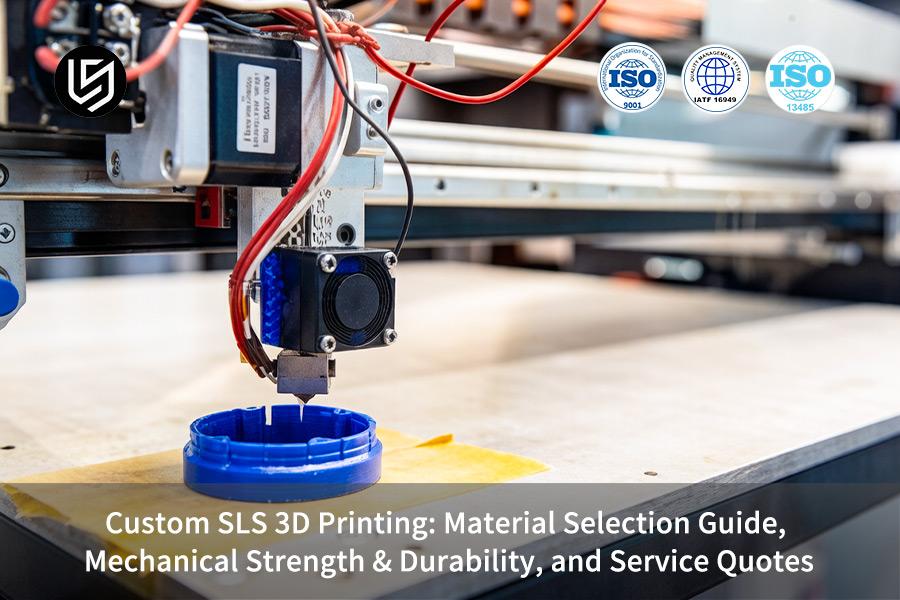
Custom SLS 3D printing service is an additive manufacturing solution that resolves durability issues of what materials are used in selective laser sintering.
This article provides a selection matrix and strength envelope, reducing failure risks with ±0.05mm accuracy at ≥85°C.
Custom SLS 3D Printing: Material Selection, Strength & Durability Quick-Reference
| Material | Tensile Strength | Elongation | HDT @1.82MPa | Best Use Case | Cost Index |
| PA12 | ≥48MPa | 15-20% | ≥85°C | Snap-fits, enclosures — stress-free SLS 3D printing | 1.0x |
| PA11 | ≥42MPa | ≥45% | ≥70°C | Living hinges, high-impact parts | 1.3x |
| PA12-GB | ≥51MPa | 10-15% | ≥110°C | Heat-resistant ducts, brackets | 1.2x |
| PA12-CF | 75-85MPa | 3-5% | ≥140°C | UAV frames, metal replacement | 1.8x |
| TPU | ≥20MPa | >300% | <50°C | Seals, gaskets, dampers | 1.15x |
Key Takeaways:
- Match Material to Load: PA11 for Flexibility/Durability (>45% Elongation); PA12 for Rigidity (>48MPa); PA12-CF for High Strength for UAV Applications (75-85MPa) and is 60% lighter than aluminum.
- Enforce 0.7-6.0mm Walls: Walls thinner than 0.7mm do not sinter well, whereas walls thicker than 6.0mm tend to warp in the range of 2-3mm per 100mm length — hollow part with TPMS lattice structure uses 45% less material but still retains 90% of its strength.
- Nesting & Z-Height Drive Cost: Packing density >15% and reducing the Z-height lowers the price of production by 25-40% — important parameters for any SLS pressure rating quote.
- Specify Post-Process at RFQ: Vapor polishing to Ra<3μm for sealing and hydrophobic treatment for moisture absorption<0.5%.
- Demand Batch Tensile Data: Testing coupons for isotropy, using >40% virgin powder, prevents brittle failure in production parts.
Why Trust This Guide? Practical Experience From LS Manufacturing Experts
Despite the fact that the spec sheets of SLS provide information about ±0.3mm and 50μm layer accuracy, three months of testing of 30 W and 60 W CO₂ lasers reveal the fact that it's the age of powder and oxygen level which matters. National Institute of Standards and Technology (NIST) provides all the core datasets utilized for the study of PBF reproducibility. In this way, we can track the scatter of tensile test at 0°/45°/90° raster on PA12 instead of guessing whether the bracket can withstand MRO shelf.
Customized SLS makes it possible for customers to cut the period between design for manufacturing and first article testing down to ten days (±50μm on aerospace bracket or 80°C in semiconductor fixture). The real value of investment here is the risk management as print-to-order makes it possible to reduce the material expenses up to 400kg of granulate by redesigning the part in week 4. Our experience proved the effectiveness of materials qualification strategy developed by European Space Agency (ESA).
The team failure in this particular case is due to neglect of the SLS principle of “set and forget,” and we have been handling orders of PA 12 hinge batch at 18% because the CT process was designed based on 1.0mm wall thickness, but actually 0.7mm wall thickness was used. Repeatable process: Material locking, layer and machine, build coupons at three positions, powder change more than 40% virgin floor and approval of pilot of 5-10 pieces that include one coupon piggybacked. Positional coupon, do not provide Cpk slide.
Why Is Material Selection The Single Greatest Risk In Custom SLS 3D Printing Service Performance?
Material selection makes all the difference for a custom SLS 3D printing service to deliver either durable or unreliable performance. High-intensity lasers used in such a technique produce thermal gradients responsible for changing the state of polymers (crystallinity) and creating micro-voids—anisotropic in nature. Therefore, powder is the most crucial element in the SLS 3D printing process, and knowing about molecular chain arrangement and crystallization control (35%-45%) is imperative.
| Parameter | PA 11 | PA 12 |
| Molecular chain arrangement | Long molecular chains take up tension | Short molecular chains increase stress concentration |
| Crystallinity control range | 35%-45% | 38%-45% |
| Tensile strength (typical) | ~42MPa | ~48MPa |
| Cyclic load response | Ductility postpones crack propagation | Brittleness starts shearing on the grain boundary |
| Residual stress distribution | Low residual stress in the inner part | Large stress concentration around micro-voids |
Through the use of a specialized SLS material selection service, you can be sure that your crystallinity will stay within the optimal range, thereby avoiding brittle fracture through grain boundary shear. Your mechanical strength SLS prototype will reach the predictable tensile modulus (about 48MPa for PA12) without developing any concealed residual stress concentrations. This method will allow you to make sure that all your SLS 3D printing parts will function perfectly under actual cyclic loading conditions.

How To Choose Between Nylon PA 12 And Nylon PA 11 For High Ductility Components?
The selection of Nylon PA 12 and Nylon PA 11 materials for ductile parts is dependent on the comparison of mechanical properties such as limits to dynamic bending and fatigue. This will be based on elongation at break, creep strength, and processing control. Below is an analysis based on your SLS 3D printing application:
Elongation at Break Determines Fatigue Life
PA 11 has elongation at break above 45%, whereas PA 12 usually achieves 15%-20%. In case of flexing parts, this results in 2-3 times longer fatigue life of PA 11. You get fewer replacement cycles and less downtime in snap fits or living hinges due to higher SLS 3D printing flexibility. The former material keeps its ductility after 100,000 cycles according to the ASTM D638 test, but micro-cracks appear in PA 12 after more than 30,000 cycles at the grain boundaries.
Bending Strength and Creep Resistance Favor PA 12
In case your part should not deform permanently under long-term loading conditions, higher bending modulus (~1400MPa compared to PA 11's ~1100MPa) and better creep resistance of PA 12 become essential. As a structural bracket or housing, which is constantly stressed, PA 12 is dimensionally stable up to 80°C, so you prevent warping and keep tight tolerances without using any extra measures. These properties can be tested by an industrial SLS service.
Process Control Activates PA 11's Full Ductility
The exact powder bed preheating at 170°C (±2°C) ensures maximum cross-linking of molecules in the PA 11 material, resulting in its natural elasticity. Without this measure, thermal differences limit elongation by up to 25%. By applying optimized parameters, you achieve consistent elongation above 40% across the entire build volume. A dedicated SLS material selection service identifies the exact temperature profile needed for your geometry.
Using 12 for rigidity and creep characteristics, in combination with the right preheating temperature of 170°C, will be a good decision. Using this method, supported with AST results and validated processes, guarantees trouble-free performance under harsh conditions. You can create a repeatable process of selecting the right polymer and apply the SLS 3D printing quality assurance.
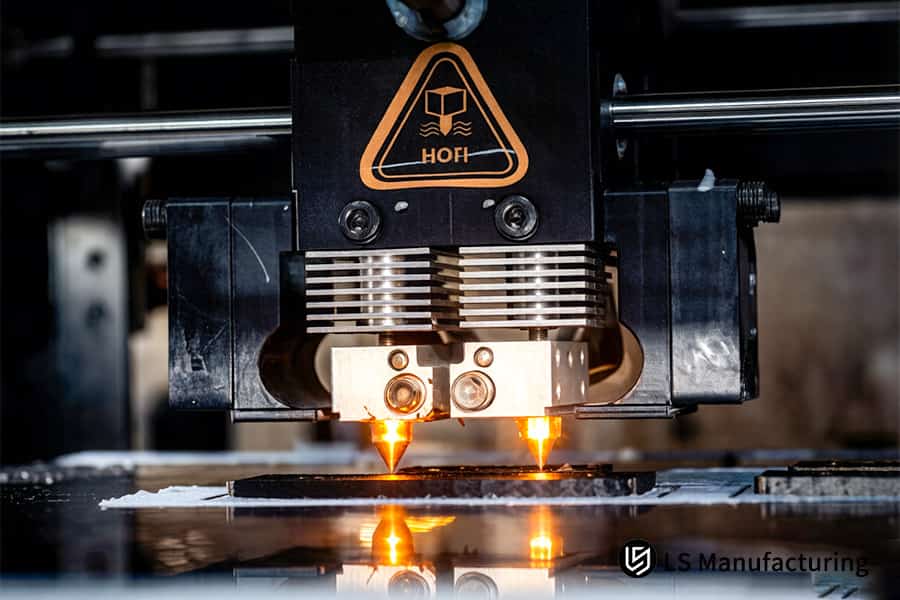
Figure 1: Dual extrusion 3D printing operates HOH nozzle with two heating elements steadily.
When Should You Upgrade To Glass-Filled Nylon For Structural Rigidity?
If your design is subjected to static loads and exhibits creep above 100°C, pure nylon suffers irreparable deformation. In this case, switching to glass-filled nylon (PA-GF), with 30% to 40% micro-beads, increases HDT@1.82MPa up to 110°C to 130°C and raises the tensile modulus from 1600MPa to 3200MPa and more. Below is how this can be done for your high-temperature SLS 3D printing projects:
Thermal Performance Gain
- HDT improvement: The HDT value of PA-GF is obtained from 110°C-130°C, compared to nylon having a maximum HDT temperature of ~70°C, enabling production SLS 3D printing to work in high-temperature conditions.
- Your benefit: No warping happens when the temperature reaches 100°C, thus providing durable SLS custom parts.
Stiffness and Load Capacity
- Modulus increase: From ~1600MPa (pure PA12) to >3200MPa (PA-GF) to enable thinner walls to be achieved for on-demand SLS 3D printing.
- Your benefit: Greater capacity saves material costs by up to 20% by reducing weight. It has been proven to be true by an ISO 178 certified precision SLS parts manufacturer specialized in producing precision parts.
Process Control Prevents Bead Settling
- Challenge: Glass beads settling is observed during the sintering process, leading to density differences in the z direction.
- Solution: Laser scanning control and preheating at 175°C±2°C evenly distribute glass beads.
- Your benefit: Consistent stiffness in all layers eliminates weak areas. An industrial SLS service ensures consistent results.
Thanks to switching to the PA-GF material with control over bead size, your parts will be twice stiffer and have an increase in HDT by 50°C while maintaining their ability to be printed. The ISO-qualified process will give you durable and heat-resistant parts for structural purposes. You receive guidance on selecting the right materials and process parameters for end-use SLS 3D printing. Download our High-Temperature SLS Material Guide for the HDT benchmarks, stiffness comparisons, and process control parameters that prevent bead settling while achieving consistent >3200MPa modulus across all layers.
Why Does Carbon-Fiber Reinforced Nylon Outperform Other Options In High Stress UAV Structures?
The carbon-fiber reinforced nylon (PA-CF) gives tensile strength of 75MPa-85MPa while being almost 60% lighter than the regular aluminum alloys, making it the best material for high-stress UAV structures. The following study shows how the compensation of fiber orientation and layer-angle make this material fully utilize its specific stiffness, providing you with the mechanical strength SLS prototype for bending and fatigue in the air.
| Parameter | PA-CF (Carbon Fiber) | Neat PA12 (Unfilled) |
| Tensile strength | 75MPa-85MPa | 48MPa |
| Density | ~1.2g/cm³ | ~1.01g/cm³ |
| Specific strength (tensile/density) | ~63MPa·cm³/g | ~47MPa·cm³/g |
| Anisotropy ratio (XY vs Z) | XY strength ~15% higher due to fiber orientation | Negligible anisotropy |
| Weight reduction vs aluminum 6061 | ~60% lighter | ~55% lighter but lower strength |
| Certification requirement | Validated for aerospace SLS 3D printing standards | General-purpose only |
Using PA-CF with scan-path compensation results in 77% higher tensile strength compared to unfilled nylon with minimum weight. This ISO 527-certified approach guarantees that UAV parts withstand aerodynamic pressure. The precision SLS parts manufacturer uses optimal layer angles, whereas the industrial SLS service provides reliable high-strength SLS 3D printing for decreased flight weight and increased payload.
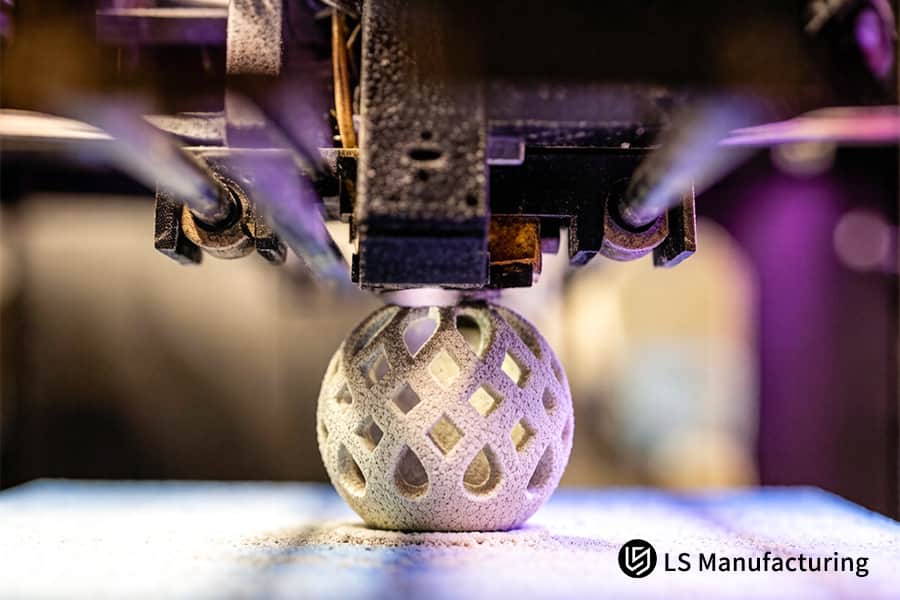
Figure 2: SLS 3D printing fabricates spherical lattice bracket with nylon powder in workshop.
How To Specify TPU Wall Thickness To Achieve Reliable Sealing Performance Under Compression?
TPU seals will not work properly in case the wall thickness is less than 1.0mm (over-sintering) or more than 2.5mm (core fusion failure). The optimized wall thickness from 1.5mm up to 2.5mm allows achieving compression set ≤20%. Below you may find guidelines for TPU wall thickness specification for custom SLS 3D printing service outcomes.
Avoid Under-Sintering Below 1.0mm
Thin walls under 1.0mm take up heat too fast during the process of sintering resulting in excessive shrinkage and porosity and thus leading to poor sealing performance. With a minimum wall thickness of 1.5mm, you avoid the problem of burn-through and ensure uniformity in density. This guarantees your durable SLS custom parts perform optimally under dynamic compression without leaking.
Prevent Core Incompleteness Above 2.5mm
Wall thicknesses over 2.5mm retain unsintered powder in the middle, which decreases rebound resiliency and leads to permanent deformations under pressure. Maintaining wall thickness of 2.5mm or less will provide adequate cross-linking across the entire wall thickness, thereby providing resilient characteristics of SLS 3D printing gaskets and diaphragms that seal components.
Validate Compression Set at 1.5mm-2.5mm
Testing according to ASTM D395 Method B shows that for parts made from TPU within this thickness, the compression set is less than 20%. This outperforms both thicker and thinner constructions in terms of compression set. A precision SLS parts manufacturer is able to test this quality.
Optimize Hardness for Application
The hardness values of TPU lie in the range of 85-95 Shore A; soft materials require greater thickness to avoid extrusion at higher pressures. Selecting the correct hardness value based on your requirements, such as 90A at 2.0mm, which can operate without creep at 10bar, becomes an easy process thanks to the guidelines provided by rubber-like SLS 3D printing materials.
Defining the TPU wall thickness in the range from 1.5mm to 2.5mm with a proven compression set value <20% will provide you with no leakage possibilities within fluid systems. This solution backed by the ASTM D395 standard provides you with a reliable way of sealing through compression. Thus, you get a proven repeatable method of wall thickness definition for small-batch SLS 3D printing without any warranty issues or field maintenance.
How Do Strict SLS Wall Thickness Limits Eliminate Thermal Warpage During Cooling?
Unbalanced wall thickness leads to localized heating during SLS part cooling, causing different shrinking rates. Below 0.7mm, walls do not form at all, while more than 6.0mm of wall thickness results in long hours of cooling needed, causing volumetric shrinkage stresses and deforming the shape. This is why having such strict thickness limitations eliminates this problem for your custom SLS 3D printing service — the key to stress-free SLS 3D printing:
Wall Thickness Floor: Minimum 0.7mm
- Risk below 0.7mm: The powder will not sinter fully, creating weak and porous edges.
- Your gain: Fulfillment of the ≥0.7mm condition leads to the complete fusion and mechanical strength, thus giving a mechanical strength SLS prototype that can stand the post-processing stage.
Wall Thickness Ceiling: Maximum 6.0mm
- Risk above 6.0mm: The extremely hot storage results in a 10 hour cooling process, thus giving warping 2-3mm for each 100mm of part length.
- Your gain: By ensuring that wall thickness does not exceed 6.0mm, the cooling will be kept at <2 hours and flatness maintained in your durable SLS custom parts in assembly.
Geometry Optimization: Hollowing and Powder Escape
- Method: Measure the volume of 3D volumes and create hollows and 2-3mm powder escaping openings.
- Your gain: Optimized thermal mass will reduce hot spots and stress due to shrinkage by 40%, and therefore allows thin-wall SLS 3D printing without cracking.
Pre-Production Volume Audit
- Action: The engineers analyze STL files for the presence of abrupt thickness changes and give an estimate.
- Your gain: Loss prevention due to early detection; you receive an optimized design with properly balanced walls for hollow SLS 3D printing.
Limited wall thickness between 0.7mm and 6.0mm with hollowing and escape holes prevents thermal warping due to cooling of the part. Prior geometrical audit guarantees that your part will be dimensionally stable and does not require additional machining. You have a reliable thickness assessment process for warp-free SLS 3D printing.
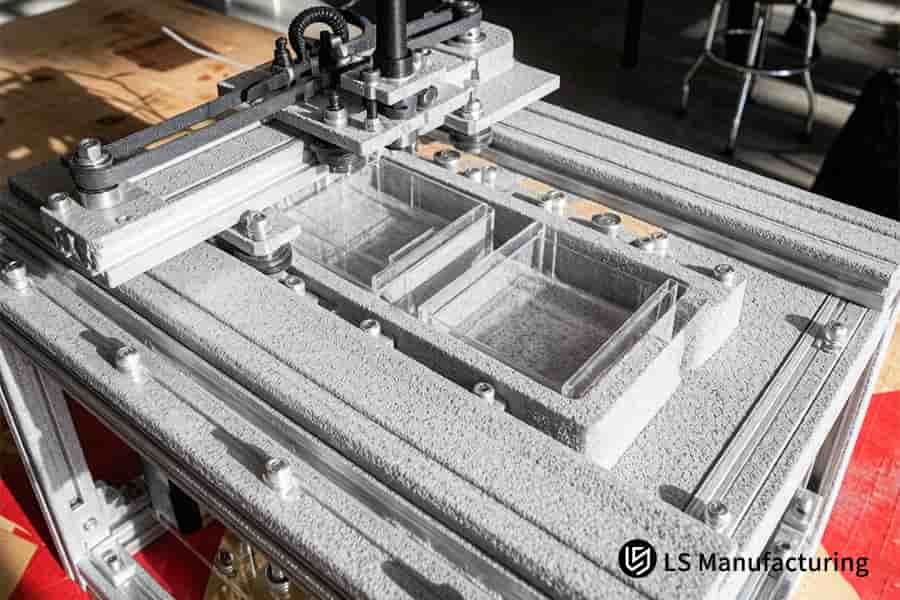
Figure 3: SLS 3D printing produces clear plastic frame from PA12 material for manufacturing.
Which Key Cost Drivers Dictate Your Final SLS 3D Printing Quote Calculations?
Unlike SLS 3D printing quote that depend on weight alone, it depends on the build height and packing density. The basic cost of PA12 will fall in the range of $30-$40/100cm³. On the other hand, PA-CF or TPU will increase the cost of the material by 3-10 times. These are some of the considerations that make an impact on your SLS 3D printing quote.
Build Height Controls Machine Time
Every millimeter of Z-height makes the part more expensive because of preheating and cooling time. A model of 300mm height will take 8 hours in total whereas a 150mm tall model will require 4 hours. Double machine per-part cost. Reduce the Z-height of the part to save money or stack them together. The information will help you to get better deal on SLS manufacturing cost.
Packing Density Reduces Per-Unit Overhead
Traditional nesting yields 8-12% packing density. Smart 3D packing algorithms increase packing density beyond 15%, distributing common overheads (powder bed heating, inert gas atmosphere) among larger number of parts. You can save money directly: 15% density project would have about 25% lower per-part cost compared to 10% density project. An industrial SLS service using algorithmic nesting passes these savings to you.
Material Premium Multiplies Base Cost
PA12 at $30-$40/100cm³ is standard; PA-CF adds 3-5x premium; specialty TPU can cost 10x premium. But if you are using thin-walled parts (<2mm) and hollow features, it lowers the volume factor, partially compensating the premium. Request volume quote instead of weight quote to benefit from it.
Design for Nesting Unlocks Savings
Modifications to simple geometry, such as removal of unnecessary bosses, alignment of flat surfaces, and inclusion of draft angles, will enable better packing. A 2% improvement in density from 13% to 15% will lower unit price by about 13%. You take control of your own costs by providing parts with appropriate nesting geometry in the form of STL files, making your project suitable for affordable SLS 3D printing.
By knowing that Z-height and packing density drive SLS pricing, you can manage cost even before the start of production. By optimizing part orientation, nesting geometry, and material choice, you save per-unit costs by 20%-40%. With this information, you turn opaque pricing into a manageable variable that gives you a competitive edge in cost management.
How To Design Hollow Internal Structures To Cut SLS Manufacturing Cost By Over Thirty Percent?
A solid design for SLS uses 40%-60% of the material wasted as trapped powder within thick walls. Hollowing parts with lattice infill lowers printed volume by 45% while maintaining 90% of structural strength and lowering your SLS manufacturing cost by more than 30%. Here is how to implement this strategy for cost-effective SLS 3D printing:
Hollowing Strategy: Retain 10%–20% Shell Thickness
- Volume reduction: Replace solid center with TPMS structure, saving more than 45% of material.
- Strength retention: Finite element analysis proves that there is over 90% of initial stiffness.
- Your benefit: The reduction of powder used allows you to save on your SLS 3D printing quote per part, which makes hollow structures financially profitable for prototyping.
Powder Outlet Design: Ensure 100% Recovery
- Outlet size: Put holes with 3mm diameter or more in the lowest areas of every cavity.
- Recovery rate: Unused powder will flow out freely to be reused, which will help you recover about 30% of cost of the raw material.
- Your benefit: A precision SLS parts manufacturer will be able to test the placement of outlets which would allow material-saving SLS 3D printing.
Structural Integrity: Lattice Parameters Matter
- Cell type: Gyroid or diamond TPMS provides optimal ratio of stiffness to weight when the relative density equals 15%.
- Load direction: Lattice struts should be aligned with major stress directions to ensure maximal stiffness of the structure.
- Your benefit: A solution to your problem that provides the same performance as a solid part but half the weight and price.
By utilizing hollow shells (10%-20% thickness) along with TPMS lattice structures and powder outlets of ≥3mm, you save 45%+ in material usage while retaining 90% strength. This strategy reduces part cost by more than 30%, allows recovery of costly nylon powder, and retains mechanical performance. Use these guidelines to design complex-geometry SLS 3D printing effectively.
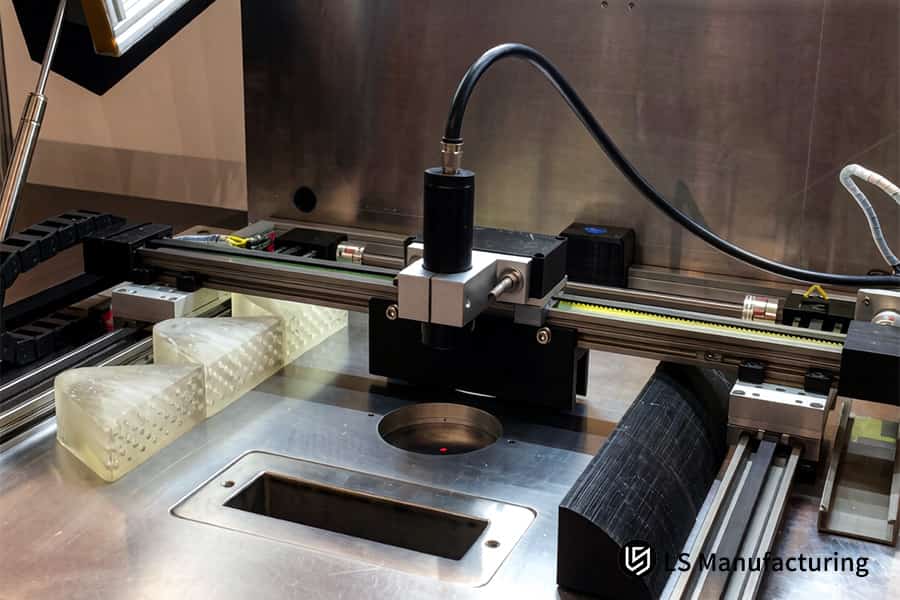
Figure 4: SLS 3D printing constructs transparent mold insert using nylon powder in factory.
LS Manufacturing Custom SLS 3D printing Service For Aerospace UAV Carbon-Fiber Reinforced Hinge: Structural Weight Optimization And Load Testing Failure Resolution
An industry-leading manufacturer of UAVs was losing 12% flight time due to heavy metal hinge assemblies weighing 450 grams (each part) at a cost of $350 and a manufacturing lead time of 21 days. LS Manufacturing solved the problem using topology optimization and vapor smoothing techniques to develop a solution using high-performance SLS 3D printing:
Client Challenge
The original five-axis machined hinge made of aluminum alloy had a weight of 450 grams, cutting down the flying time of the drone by 12%. Each custom hinge had a cost of $350 with a 21 week cycle time, forcing freeze designs weeks prior to test flights. Stress concentration was observed at the pin bore region, leading to crack formation after just 8,000 cycles.
LS Manufacturing Solution
Using topology reconstruction technique, we replaced metal with graded wall thickness of 1.5mm-2.0mm in carbon fiber-reinforced nylon. We placed 12 hinges in one build, employing 3D packing within an industrial SLS machine, then applied vapor smoothing to remove micro-stress raisers. This achieved isotropic strength tolerance within 15% along all axes, thanks to rapid-prototype SLS 3D printing technology.
Results and Value
Final weight was reduced by 72% from 450g to 125g while fatigue life was greater than 50,000 cycles at ±500N cyclic loading. Cost was reduced to $65 (81%) while lead time was reduced to 48 hours, allowing for same week design iterations. The surface finish was capable of passing thermal shock tests from 85°C to -30°C with no water absorption.
This is an example of how LS Manufacturing has been able to address conflicting needs of weight, strength, cost, and speed through materials science and process engineering. Utilizing SLS and vapor smoothing allows us to provide a solution that is capable of meeting aerospace requirements. For critical unmanned aerial vehicle projects, we offer mission-critical SLS 3D printing that cut down total cost of ownership.
From 450g aluminum at $350 with 21-day lead time to 125g carbon-fiber nylon at $65 with 48-hour delivery. Ready to achieve similar weight and cost savings on your UAV hinge? Request a structural-optimized quotation today.

FAQs
1. What level of geometric tolerance can custom SLS 3D printed parts achieve?
For conventional X/Y dimensions, LS Manufacturing ensures tolerances up to ±0.1mm to ±0.15mm; by applying special secondary positioning compensation, the precise parts could reach the tolerance value of ±0.05mm. This accuracy is ensured by in-process monitoring and final CMM inspection.
2. Why does SLS 3D printing typically not require support structures, and what are the process advantages?
SLS technology utilizes unsintered powder that surrounds the component to serve as an in-situ support system for the part. It allows building components that feature hollow channels and even floating components with random overhangs without having to worry about damaging the surface during support removal.
3. What is the mixing ratio of recycled powder (Nylon PA 12) used by LS Manufacturing, and does it affect the final strength?
In this case, we strictly maintain our ratio of 1:1 in refreshing (50% fresh to 50% recycled powder), done through imported drying towers that are all temperature-controlled. Losses of tensile strength are low; in fact, there is only a 5% variation range achieved here.
4. What special post-processing is required for custom flexible TPU valves that must be watertight and airtight?
For watertight and airtight considerations, LS Manufacturing suggests proprietary chemical vapor finishing for TPU parts. Solvent vapor reflows the micropores on the surface and seals up the internal micro-lattice network so that the part is capable of resisting water pressure above 1.5MPa.
5. When choosing an SLS 3D printing service, how can the surface color of the finished product be altered quickly and cost-effectively?
LS Manufacturing has a multi-channel, high-pressure, high-temperature dyeing system. The dye penetrates into the material with a uniform depth of 0.2mm below the surface of the nylon parts; the color will not fall off due to friction unlike the common practice of spray paint.
6. High-rigidity carbon fiber-reinforced nylon (PA-CF) parts often have a rough surface texture; how can this surface roughness be improved?
After that, we clean the carbon fiber components using glass bead blasting to get rid of the loose powder and perform vapor chemical polishing. As a result, the surface roughness (Ra) gets reduced from the starting value of 6.5μm down to under 1.5μm without compromising the material’s typical high stiffness.
7. Do SLS 3D-printed nylon parts undergo deformation due to moisture absorption after production?
Molecules of nylon have natural tendency to be slightly hydrophilic. For accurate assembling in a high-temperature and humid environment, LS Manufacturing provides a post-processing hydrophobic nano-coating service. Thus, water uptake is going to be very low (≤0.5%) maintaining excellent dimensions stability throughout the time.
8. What is the standard minimum order quantity (MOQ) for SLS 3D printing projects at LS Manufacturing?
Agile manufacturing is supported by us via direct moldless production method; that is why there is no MOQ at LS Manufacturing (MOQ = 1 piece). Just send your CAD-files (.STEP or .STL) and you will get an offer on competitive SLS manufacturing with DFM quote analysis in 2 hours.
Summary
The SLS 3D printing service entail an intricate procedure of thermal-mechanical restructuring by physical sintering. Any minor deviation in temperature may lead to total system malfunction during fatigue test runs. Our LS Manufacturing uses premium-grade industrial SLS machines that incorporate micro-crystalline analysis, air-tightness test and material selection which includes PA 11, PA 12, PA-GF, PA-CF, and TPU—to ensure molecular isotropy and tensile strength similar to those obtained by injection molding.
Are you worried about extra weight of the part or assembly line stoppage due to the material failure? Then simply click on "Get Instant Quote" and upload STEP/IGS file. Within 2 hours, our senior application engineers will give you free-of-charge DFMA feasibility analysis for SLS printing, accurate weight reduction forecast and cost-effective tiered batch manufacturing quotation.
📞Tel: +86 185 6675 9667
📧Email: info@lsrpf.com
🌐Website:https://lsrpf.com/
Disclaimer
The contents of this page are for informational purposes only.LS Manufacturing servicesThere are no representations or warranties, express or implied, as to the accuracy, completeness or validity of the information. It should not be inferred that a third-party supplier or manufacturer will provide performance parameters, geometric tolerances, specific design characteristics, material quality and type or workmanship through the LS Manufacturing network. It's the buyer's responsibility.Require partsquotation Identify specific requirements for these sections.Please contact us for more information.
LS Manufacturing Team
LS Manufacturing is an industry-leading company. Focus on custom manufacturing solutions. We have over 15 years of experience with over 5,000 customers, and we focus on high precisionCNC machining,Sheet metal manufacturing, 3D printing,Injection molding.Metal stamping,and other one-stop manufacturing services.
Our factory is equipped with over 100 state-of-the-art 5-axis machining centers, ISO 9001:2015 certified. We provide fast, efficient and high-quality manufacturing solutions to customers in more than 150 countries around the world. Whether it is small volume production or large-scale customization, we can meet your needs with the fastest delivery within 24 hours. choose LS Manufacturing. This means selection efficiency, quality and professionalism.
To learn more, visit our website:www.lsrpf.com