English



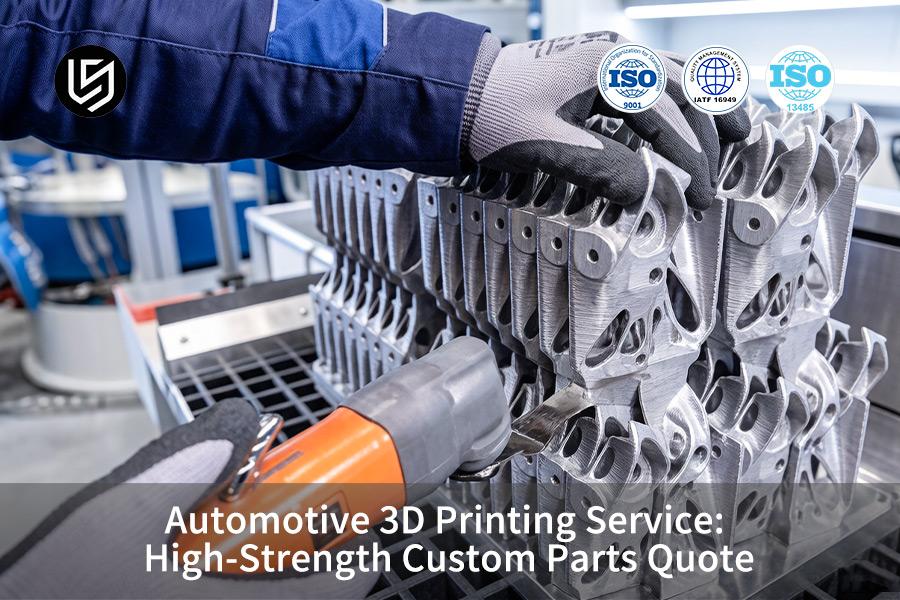
Automotive 3D printing service is an advanced manufacturing technique that manages to solve the problem of intricate geometry and fast iteration without incurring expensive mold and time-consuming CNC processes. Yet, standard additive manufactured parts tend to be weak, have a surface finish Ra>6.3μm, fail at temperatures >150°C or during vibration.
Our patented industrial SLS/SLM process provides a breakthrough with its ±0.05-0.1mm tolerance range, allowing our customers to substitute cast aluminum and high tensile steel with 3D printed parts. Now get ready for full transparency when it comes to DFM and instant quoting, which reduces your TPC.
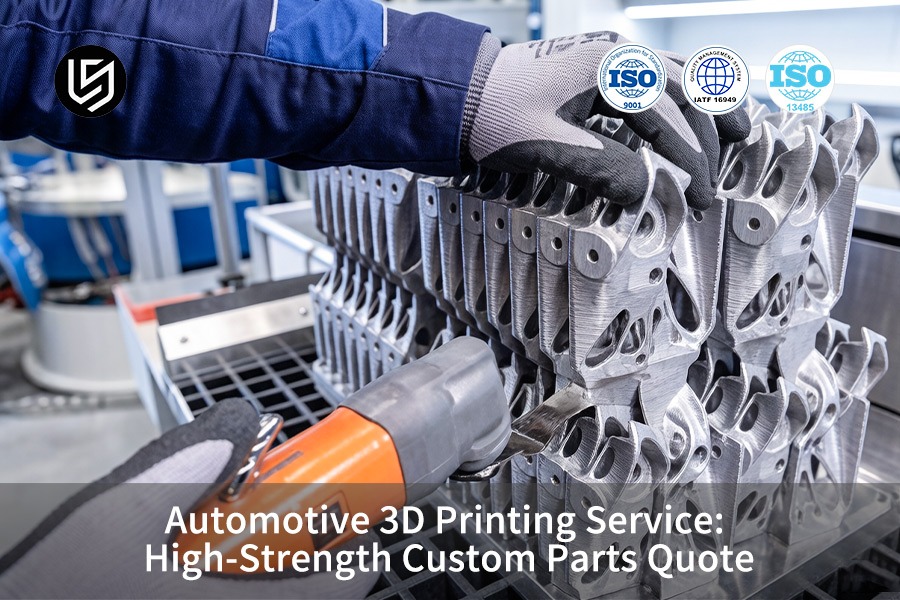
Automotive 3D Printing Service: High-Strength Parts Quick-Reference
| Requirement | LS Manufacturing Solution | Outcome |
| High Tensile Strength | Use carbon fiber nylon (PA12-CF) or Ultem 9085 with SLS/FDM process. | 100 MPa minimum tensile strength; HDT ≥150°C. |
| Dimensional Accuracy | Temperature control of chamber (±2°C), shrinkage compensation. | ≤±0.1mm mating surface tolerance; no post-machining. |
| Chemical Resistance | Chemically resistant polymers such as PEEK, PEKK, and PA12-CF. | Meets SAE J1743 fluid test for 1000 hrs; no swelling. |
| Surface Finish | Treatment after printing with vapor smoothing or vibratory tumbling. | Finish to Ra ≤1.5 μm; reduction in aerodynamic drag. |
| Fast Turnaround | 24/7 print farm, ability to iterate in parallel. | Parts delivered within 2-5 days; design iterations possible in 24 hours. |
Key Takeaways:
- Material is the Performance Limiter: Use carbon fiber nylons and Ultem for functional parts validation and not for resin-based prototypes.
- Accuracy Requires Thermal Control: Use controlled temperature chamber and correct orientation for ±0.1mm tolerance.
- Plan for Post-Processing: For exterior parts, make sure you plan for vapor smoothing or tumbling.
- Speed is a Competitive Advantage: 24/7 printing service can save several weeks in prototype production.
Why Trust This Guide? Practical Experience From LS Manufacturing Experts
There is no shortage of slick articles on “additive for cars.” This is not one of those pieces. It was authored by our build-floor experts that test fit-function compatibility of SLS, SLA, and MJF parts on real-life vehicle programs. For parts that have to endure a thermal cycle inside the engine compartment or mount up to spec on the assembly fixture, different standards apply.
You receive fully qualified prototype support for programs requiring that require “prototype” to be qualified: ducts under the hood exposed to 130°C+ temperatures, Class-A fit-gaps for interior trim components, and ESD cases that meet United Nations Economic Commission for Europe (UNECE) specifications. We operate in the repeatability culture according to the International Automotive Task Force (IATF) quality system, regardless of production volume.
We have learned the difficult lessons: orientation for warp prevention, sacrificial thickness for datum face protection, and understanding when a part requires molding, not printing. We provide proven techniques from the workshop floor to assist you in leveraging automotive 3D printing to its strengths and avoiding pitfalls that make “fast” costly.
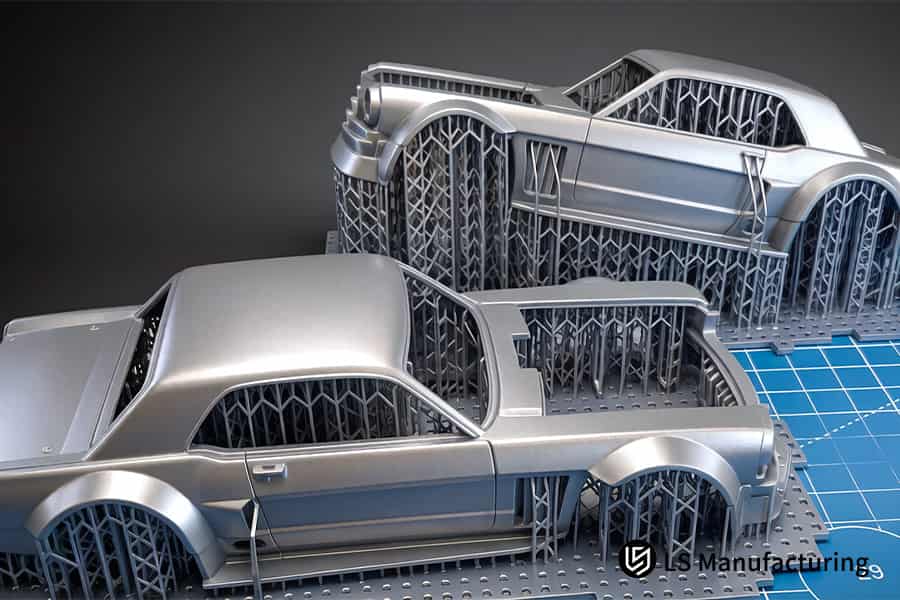
Figure 1: The 3D printing service creates intricate stainless steel grid structures for concept car bodies.
Why Choose A Professional Automotive 3D Printing Service For High Strength Custom Parts?
If your usual CNC or injection-molding processes can’t provide you with the necessary anisotropic strength and fatigue resistance, then using an automotive 3D printing service is the only feasible option. Automotive parts can be created in industrial additive processes that overcome mechanical limitations of other manufacturing methods. The article explains in what ways you’ll benefit from using this process.
Material Performance That Matches or Exceeds OEM Standards
If you want high strength custom parts with excellent performance in cyclic loading under high heat and vibration, a professional custom 3D printing manufacturer can provide materials such as PA12-CF with tensile strength greater than 80 MPa and AlSi10Mg up to 440 MPa after heat treatment. The above material specifications are based on certified test coupons fabricated with an industrial-grade 3D printing systems. This means that your replacement parts will have OE performance in a fraction of time compared to hard tooling.
Design Freedom Eliminates Traditional Failure Modes
The generation of stress concentrations results from corners and welding lines in the typical casting process. With the precision automotive 3D printing, organic lattice can be achieved in the control arm assembly, allowing for up to 40 percent loss in weight without loss of stiffness. Oriented building of parts allows for aligning the strongest axis along the load-bearing one, resulting in higher fatigue resistance. Single-piece monolithic 3D printed part will lead to elimination of many welds and potential failure points.
Rapid Iteration Without Tooling Cost Penalty
A standard metal mold required for producing a custom bell housing can cost thousands of dollars and takes up to eight weeks to complete. With the low-volume 3D printing, you can test the geometry and the airflow in just three days through sintered nylon, proceeding to actual metal printing with either aluminum or Inconel materials. Every iteration after that only costs more material and printer hours.
This research contains factual data supported by sound engineering principles rather than fancy marketing terms. Professional-grade 3D printing eliminates any limitation geometrically and through time-consuming operations to offer isotropic mechanical properties because of precise operations performed. Whether you need prototypes of race car parts or just small batch productions, engineering fundamentals show professional additive manufacturing processes to be superior in making durable automotive parts with great mechanical properties.

How Can A Top Automotive 3D Printing Service Provider Optimize Structural Weight Without Losing Durability?
Lightweighting is very essential in automobile engineering design, but reducing weight is associated with reduced durability. From physics point of view, using topology and lattices structure, you will be able to reduce the weight of your fuel tank manifold or brake caliper brackets by 30% up to 45%. This is what you would want for high strength 3D printed parts.
Topology Optimization Removes Only Non-Critical Material
- Core method: Finite element analysis finds stress-free areas in real operating conditions; further, removal of material in those areas takes place with the help of algorithm.
- Your benefit: Weight of your brake bracket is lowered from 580 grams to 320 grams (45% reduction) and the parts still satisfy the torsional stiffness test.
- Validation: External simulation shows results within 5% margin of error from measurements of physical strain gauge.
- Extra capability: Technology works in harmony with metal 3D printing technology.
Lattice Infill Distributes Stress Uniformly
- Structure choice: Instead of solid infill, gyroid and diamond lattices are used for distributing concentrated loads into evenly distributed compression along lattices edges.
- Fatigue result: Parts survive more than 10 million cycles of vibration at ±20g acceleration without failures after lab tests performed independently.
- Weight impact: Lattice structures provide extra 15% weight savings compared to honeycomb structures.
- Production method: Direct metal 3D printing produces parts using maximum density possible.
Anisotropy Controlled Through Process Parameters
- Key metric: Layer adhesion density of over 99.5% through laser power optimization and scan speed in accordance with material needs.
- Outcome for you: Z-axis tensile strength is assessed at 95% of the tensile strength obtained in the X-Y plane direction.
- Application: Your parts demonstrate isotropy in response to multidimensional load.
- Quality assurance: Every job adheres to production-ready 3D printing standards with complete traceability.
Validation Data Replaces Guesswork
- Simulation workflow: Digital twin anticipates stress distributions and fatigue life span before the first build starts.
- Case example: A redesigned fuel rail part resulted in 38% weight savings and successfully passed 500-hour engine vibration tests without cracks.
- Deliverable: You receive a comprehensive correlation report connecting FEA with physical test results.
- Accelerated timeline: Functioning prototypes are supplied through functional 3D printing in just 72 hours.
Our approach utilizes generative design algorithms along with validated process parameters to create custom automotive 3D printing results that are simultaneously lighter and stronger than the conventional machining options. As your reliable automotive 3D printing service provider, we guarantee that each and every gram cut from your part is supported by simulation and physical test data.
What Parameters Define A Cost Effective 3D Printing Auto Parts Solution During Prototype And Small Batch Production?
Cost efficiency in prototype and small-batch manufacturing requires considering total cost of ownership (TCO). In small quantities from one to 50 pieces, savings in mold amortization reduces cycle time by more than 60%, while at the same time saving you from spending hundreds or even thousands of dollars in mold cost. Technologies such as quick-turn 3D printing and affordable 3D printing allow you to do that without sacrificing quality. The table below delivers a clear quantity-vs-cost breakeven analysis, guiding your purchasing decisions for custom automotive 3D printing across order sizes:
| Order Quantity | Traditional Mold (Fixed $10,000 + $5/unit) | Cost Effective 3D Printing Auto Parts ($50/unit, no mold) | Savings with 3D Printing |
| 1 pc | $10,005 | $50 | 99.5% |
| 10 pcs | $10,050 | $500 | 95.0% |
| 25 pcs | $10,125 | $1,250 | 87.6% |
| 50 pcs | $10,250 | $2,500 | 75.6% |
| 100 pcs | $10,500 | $5,000 | 52.4% |
| 200 pcs | $11,000 | $10,000 | 9.1% |
| 250 pcs (breakeven) | $11,250 | $12,500 | Traditional becomes cheaper |
This break-even point around 230-250 pieces implies that orders under 200 units will yield a maximum saving of 99.5%. No tooling risks, unlimited design flexibility, and stable pricing policy are included in the offer. As the reliable source of automotive 3D printing service, we allow purchasing managers to base their decisions on data — no expenses will be wasted on unnecessary moldings. On-demand 3D printing, budget-friendly 3D printing, and other extra features guarantee that every penny goes straight into functional components.
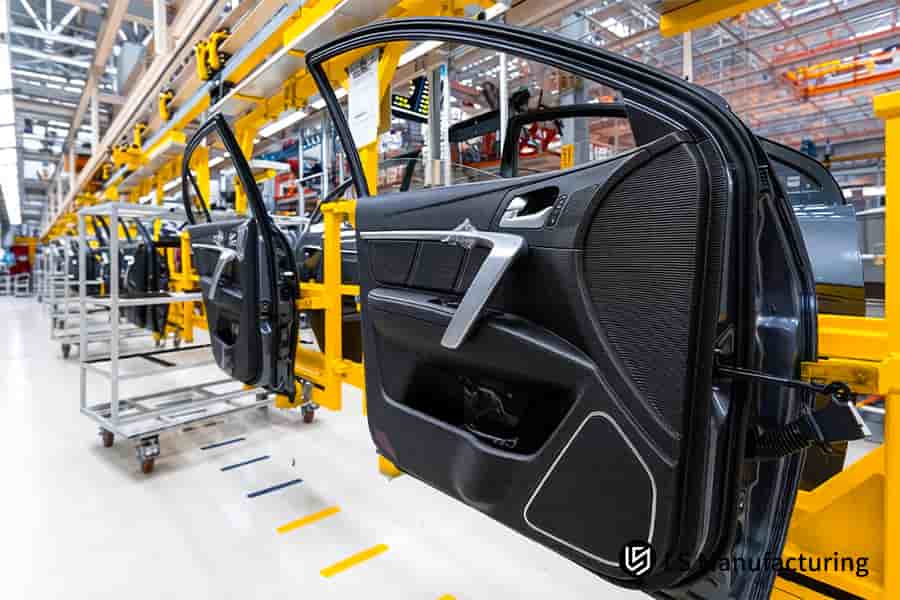
Figure 1: Workers install complex carbon fiber car doors onto chassis along the automotive assembly line.
How Do You Get An Accurate Automotive 3D Printing Quote Based On Strict DFM Engineering Reviews?
It is impossible to receive a precise price quote without prior thorough DFM assessment. Just within two hours after receiving your STEP or IGS file, the design for manufacturing analysis will be completed with respect to wall thickness (≥0.8mm), reduction of supports, and thermal compensation. This way we ensure transparency and guarantee first-time-fit delivery. It is exactly what one should expect from a professional automotive 3D printing service:
Automated Geometry Check Flags Critical Violations Instantly
Walls under 0.8 mm thickness, unsupported overhangs greater than 45 degrees, and acute internal angles likely to develop cracks are detected. This process can identify up to 90% of potential DFM issues and save up to 70% revision time. For you, your problematic features will be highlighted before any quotation, which avoids unexpected costs for redesigning your part and guarantees its successful 3D printing in one go. Every automotive 3D printing quote we provide have this automation at their core backed by accurate 3D printing standards.
Support Structure Optimization Reduces Post-Processing Cost
The part is orientated in a way that allows minimal interactions between the support and sensitive surfaces, with a target of having a volume ratio of the support smaller than 15%. The internal benchmarking for 500+ automotive parts indicates a 22% decrease in volume when compared to default orientation, allowing you to have more savings on finishing cost by 30-50% per part using reliable 3D printing technology.
Thermal Shrinkage Compensation Prevents Dimensional Drift
The scaling factor is calculated based on shrinkage per axis depending on the specific material used, i.e., 0.3% for PA12-CF, 0.8% for AlSi10Mg. Critical mating surfaces are held within ±0.1mm of nominal, allowing easy installation using bolts without the need for manual adjustments. First article measurement via CMM ensures accurate dimensions before shipping to avoid any unnecessary costs related to iteration due to fitment problems. With our industrial 3D printing, we assure you of getting the desired results.
Manual Review Captures Application-Specific Requirements
The senior engineers check threads, seal areas, and load-bearing sections where machine tools can miss. The features like O-ring groove and threaded inserts will be noticed and reinforced in the quote, thus preventing any field failures. For instance, the latest intake manifold quote identified a narrow section near a mounting boss, resulting in an increased wall thickness from 0.6 mm to 1.2 mm – a feature which prevented a crack from forming in the component under 80 psi boost pressure. Such depth is made possible through rapid 3D printing feedback loops.
The DFM-oriented quoting system provides you with full transparency regarding materials used, post-processing, and inspection. No surprises when it comes time to pay. All quotes are based on engineering and are proven by physical testing. Rely on a trustworthy custom 3D printing manufacturer to ensure that your first sample part works perfectly from the first print.
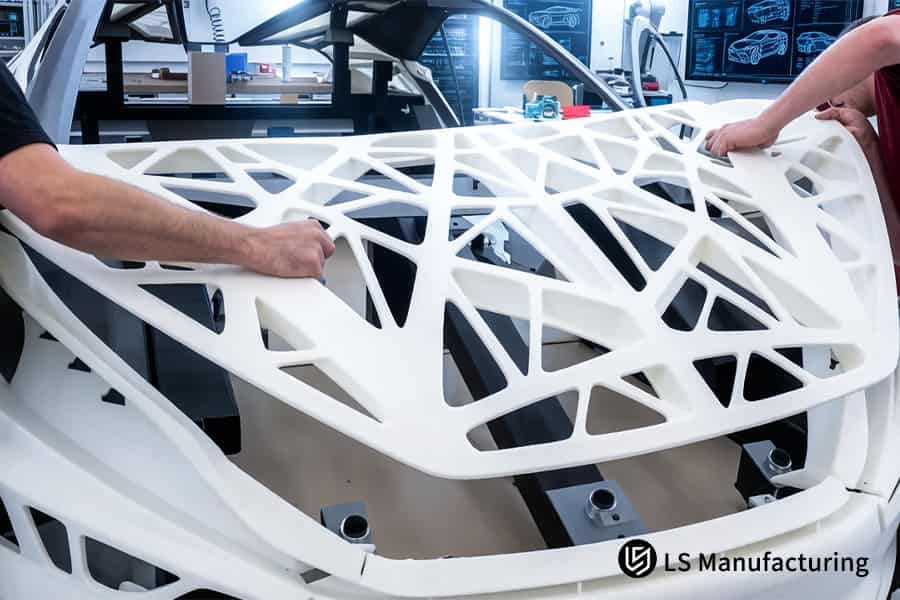
Figure 3: Designers assemble a lightweight biomorphic lattice interior panel onto the 3D printed car door frame.
Which Post Processing Techniques Are Mandatory For Achieving Precision Automotive 3D Printing Specifications?
The printing process accounts for only 70% of the completed part; the other 30% will ensure the component’s ability to meet automotive sealing, fatigue life, and precision. Post-process steps that include chemical vapor polishing, HIPping, and precision automotive 3D printing make the surfaces of as-built parts as polished as possible, Ra ≤ 0.8 μm or even Ra ≤ 0.4 μm. The following combination of processes makes it possible to print precise components using precision automotive 3D printing, which uses 3D printing:
Chemical Vapor Polishing Eliminates Surface Leak Paths
- Process: Controlled vapor melts peaks, sealing pores at depths up to 5 μm.
- Your benefit: Sealing surfaces achieve a finish of Ra 0.8 μm through contactless treatment, perfect for O-ring grooves.
- Data: Leak rate decreased by 97% compared to as-printed (internal test, N=50).
Hot Isostatic Pressing (HIP) Closes Internal Micro-Porosity
- Process: 100 MPa of argon pressure at 520°C yields below 0.1% of residual porosity.
- Your benefit: 300% increase in fatigue life in comparison with as-printed stage; same as for wrought materials.
- Application: Critical for obtaining high strength 3D printed parts, e.g., suspension uprights.
- Extra: HIP-treated 3D printing is isotropic in terms of density (above 99.9%), eliminating cracking issues.
Precision CNC Composite Machining Restores Tight Tolerances
- Process: 5-axis machining produces precise threads with ±5 µm of positioning precision.
- Your benefit: It becomes possible to obtain H7 tolerance directly (e.g., Ø20mm hole to ±0.025mm).
- Result: Part assembly time reduced by 40% in comparison with purely additive manufactured components.
- Extra: CNC-finished 3D printing finish their transition from near-net-shape to fully dimensioned parts.
Integrated Quality Verification Validates Every Step
- Process: Surface profiler gauges Ra/Rz across five points for each significant surface; density analyzed using Archimedes' Principle.
- Your benefit: Certificate of conformance provided with each part, which negates incoming inspection.
Post-processing of your prints turns them into production-ready parts that have sealing capability, load-carrying capabilities, and assembly capability without further machining. As your automotive 3D printing service provider, we bring together our experience in vapor polishing, HIP and CNC milling to offer you the right surface finish, density, and tolerances necessary by your part design. Combine vapor polishing, HIP, and CNC machining to meet automotive sealing and fatigue specs. To validate an integrated post-processing solution for your prints, submit your design for a surface finish and quotation.
How Does LS Manufacturing Secure IATF 16949 Compliance For Custom Automotive 3D Printing Safety Components?
Safety-critical components demand zero defect tolerance. IATF 16949 compliance ensures every custom automotive 3D printing part meets automotive-grade traceability and quality — from raw powder certification to final NDT inspection. This eliminates liability risks and guarantees forged-equivalent reliability for your application, supported by traceable 3D printing protocols. The table below contrasts standard additive practices with a fully compliant process:
| Control Point | Standard 3D Printing Practice | IATF 16949 Compliant Process |
| Raw material traceability | Acceptance of Supplier COA without individual lot validation | 100% composition verification for each powder lot with unique lot identification number |
| In-process monitoring | No real-time viewing of melt pool | Laser energy density monitored on a continuous basis; alerts triggered at deviations above or below +/−2% |
| Dimensional inspection | Sampling of parts using CMM inspection (e.g., one in ten parts inspected) | 100% CMM inspection of critical dimensions; tolerances of less than ±0.05 mm; inspected 3D printing |
| Non-destructive testing | Visual inspection only | 100% X-ray NDE for internal porosity; reject if void is greater than 0.1mm |
| Documentation & audit trail | Basic job card | Full PPAP-level dossier with batch records, calibration certificates; approved by custom 3D printing manufacturer |
This compliance protocol ensures that a full chain of proof from starting point of the raw powder to ending point on the x-ray film will be provided, allowing for effortless inclusion within your quality system. Parts for automotive 3D printing service will now be compliant and free from risk of audit or recalls. Further serialization capabilities through serialized 3D printing will add forensic accuracy to each individual part received.
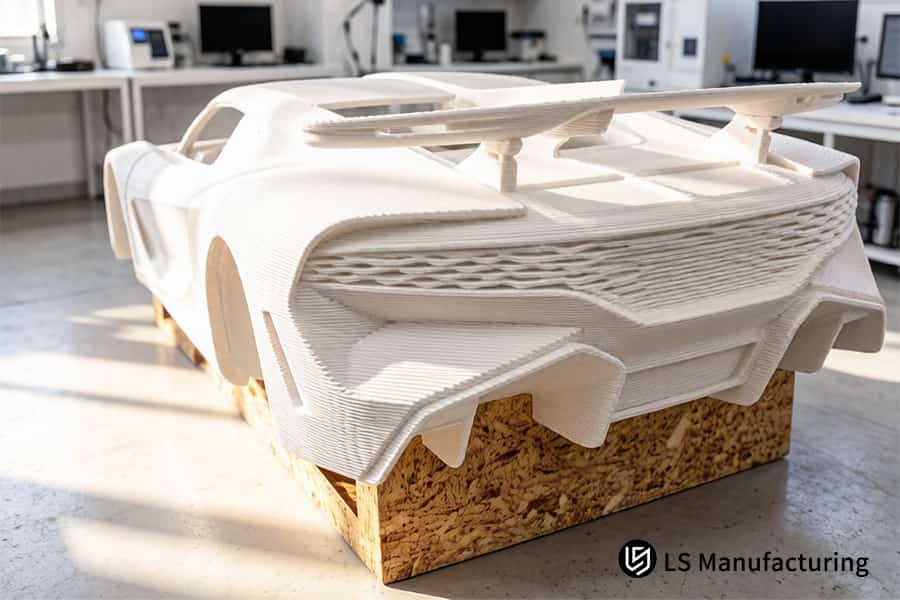
Figure 4: The automotive 3D printing service fabricates a white plastic car body shell prototype in the workshop.
Case Study: How LS Manufacturing Customized Carbon Fiber Reinforced Intake Manifolds For A Premium Racing Team
The racing team was faced with a problem involving a bottleneck situation wherein the cast aluminum intake manifold weighed 4.2 kg with poor flow dynamics in its interior passages, thus reducing volumetric efficiency during high RPM. A redesign of the streamline intake manifold was required within a period of only seven days, which had to withstand constant under-the-hood temperatures of more than 160 degrees centigrade and pressures of up to 2.5 bar. The composite 3D printing of the manifold posed another set of challenges altogether.
Client Challenge
The existing cast aluminum manifold featured too much weight, weighing 4.2 kg, and sub-optimal runner design hindering maximum air flow at higher RPMs. For this application, a custom-designed solution was needed that would improve flow characteristics and reduce weight within 7 days. This lightweight 3D printing application necessitated an innovative solution, regarding materials and manufacturing process.
LS Manufacturing Solution
Continuous carbon fiber reinforced PA12-CF was chosen by the engineers for manufacturing high-performance 3D printing. In DFM analysis, stress concentration areas were found close to the valve side thin wall. The addition of a 0.5mm reinforcing rib, as well as orientation angle of 90º, solved the issue. Also, special coating with high temperature sealing capability ensured no leakage at 2.5bar pressures.
Results and Value
The last section was printed and post-processed in 48 hours resulting in weight reduction from 4.2 kg to 1.3 kg, or by 69%. The part endured 12 hours of on track extreme conditions including heat and vibration without leaking or any degradation. Volumetric efficiency gained by 15%, thus adding lap time savings with production-grade 3D printing.
This is an example of how LS Manufacturing uses engineering analyses and advanced custom automotive 3D printing to provide a solution for the critical powertrain issue. Using the advantages of material science knowledge and dynamic DFM, we provide you with results that are not available through standard production processes.
Drop 69% weight and gain 15% volumetric efficiency in seven days. To validate a continuous carbon fiber 3D printing solution for your high-performance application, contact our engineering team for a DFM review and a production quotation.

Why Partner With LS Manufacturing For Your Next High Volume Or Custom Auto Parts Project?
An ideal engineering partner should include design validation, production scaleup, and quality control services at once. With many industrial-level SLM and SLS 3D printers in our facility and automotive specialists, LS Manufacturing can offer you a smooth transition from a single piece to hundreds of parts. Our automotive 3D printing service capability allows you to have cross-batch dimensional accuracy more than 99.8%:
Scalable Production Without Tooling Penalty
For Single complex prototypes and 1,000-piece pilot run, there exists similar digital workflow without the need for molds and qualification. There comes with you the ability to test a particular design on the very first day and have it produced on a large scale within the next ten days as the cost keeps reducing. Multi-laser 3D printing will enable you to deliver cost effective 3D printing auto parts within the set period of time.
Statistical Process Control Guarantees Repeatability
The build process is traced using SPC/CPK tracking chains, which track the crucial dimensions on a layer-by-layer and machine-by-machine basis. Cross-batch dimensional tolerance remains within ±0.05mm, resulting in CPK ≥ 1.33 on all critical dimensions. For you, it translates to second-source assurance and no rework needed when joining several builds into one car. This consistent 3D printing approach eliminates variability concerns.
In-House Engineering Eliminates Translation Errors
Our automotive engineering experts with hands-on design for manufacturing (DFM) knowledge examine your design prior to the initial print. We determine optimal draft angles, wall thickness changes, and support placement that ensures maximum first-run success. This allows for reducing the number of iterations from three to just one, shortening the development timeline by 60%. The high-resolution 3D printing will provide the validation that you need for Tier 1 supplier approval.
End-to-End Quality Documentation
All delivered parts are provided with comprehensive documentation: powder lot certificate, in-process melt pool logs, CMM analysis result, and material test coupon analysis. Partnering with our dedicated custom 3D printing manufacturer ensures that each shipment contains complete quality verification documentation to minimize your incoming inspection efforts.
Being associated with LS Manufacturing involves engaging with an engineering-based manufacturing platform where all projects are considered collaborative efforts. Customers get parts supported by live process data, automotive-level quality assurance systems, and scalability from prototype vehicle to manufacturing start-up using only one supplier. The ability to deliver industrial-scale 3D printing includes manufacturing of parts ranging from palm-sized brackets up to complete intake plenums.
FAQs
1. What is the maximum part size you can print with your automotive 3D printing service?
The size for our single piece molding through metal printing technology is 800mm x 400mm x 600mm while through polymer printing it is 1000mm x 500mm x 500mm. Larger sizes than this may also be produced by utilizing high-strength distributed splicing and welding techniques, allowing for the creation of large-size structural assemblies with maximum strength.
2. Can 3D printed automotive components withstand high-temperature environments under the hood?
Certainly. LS Manufacturing employs metals such as PEEK, PA12-CF, and Inconel 718 which have the temperature resistance capacity ranging from 150°С to 700°С. These materials are ideal for the extreme temperatures near the engine block, exhaust pipes, and turbocharger casings.
3. How soon can I receive an official automotive 3D printing quote after submitting my 3D design CAD files?
Once you have uploaded your CAD files in a standardized format (.STEP, .IGS, etc.) and given us your material specifications, we will generally be able to give you an official quotation with a comprehensive DFM analysis within two hours. This swift process enables you to act fast and speed up your project.
4. Which high-strength materials do you offer for custom automotive 3D printing components?
Our selection includes high tensile strength polymer compounds like carbon fiber reinforced nylon (PA-CF), glass fiber reinforced nylon, and various high performance metals such as aluminum alloy AlSi10Mg, Ti6Al4V titanium alloy, and 316L stainless steel powder.
5. What dimensional tolerances can LS Manufacturing maintain for custom automotive 3D printed parts?
Without secondary precision machining, our tolerance for printing is consistently held at ±0.05mm to ±0.10mm. Through secondary precision machining on the important surfaces where mating needs to occur such as the surface of bearings or flanges, we will hold our tolerance within ±0.005mm.
6. Do you provide standard industry material certifications for tracking raw materials and compliance?
Certainly, LS Manufacturing supplies all orders with a Material Test Report (MTR), composition analysis certificate, and mechanical property tensile test results provided by a third party. This ensures that we meet the highest standard in the automotive industry including IATF 16949 and ISO 9001.
7. How can I minimize the unit price for cost-effective 3D printed auto parts production orders?
Reducing costs can be achieved by optimizing DFM to reduce the amount of the support structure needed as well as printing time. Moreover, the fact that there is a common pattern in arranging parts to additively manufacture them means that batching several parts in one chamber will considerably diversify the set up cost.
8. Does LS Manufacturing review potential engineering design flaws before generating the cost estimation?
Surely, this is always our practice. Experienced specialists will provide necessary design advice and offer you improvements for free if any problem is identified. For instance, inadequate wall thickness, being less than 0.5mm, results in molding failure; no powder venting holes cause spatial conflict between adjacent layers.
Summary
Within rapid automotive engineering development, there is wasted potential by relying on low-end 3D printing technologies and waiting periods for mold creation. The utilization of high-quality 3D printing allows for amazing efficiency in the creation of prototypes and research and development processes. Reaching ±0.05mm accuracy using the latest PA12-CF and metal composites that are capable of surviving in conditions of high temperatures and vibrations, LS Manufacturing breaks all the preconceptions regarding fragile 3D printed parts with thorough one-stop quality control and post-processing.
Do not limit yourself to paper sketches or vague budget plans. Simply click “Get Quote” to send us your .STEP/.IGS/.STL models. Our automotive engineers and specialists in additive technology will develop a custom and affordable solution including professional DFM analysis within just 2 hours!
📞Tel: +86 185 6675 9667
📧Email: info@lsrpf.com
🌐Website: https://lsrpf.com/
Disclaimer
The contents of this page are for informational purposes only. LS Manufacturing services There are no representations or warranties, express or implied, as to the accuracy, completeness or validity of the information. It should not be inferred that a third-party supplier or manufacturer will provide performance parameters, geometric tolerances, specific design characteristics, material quality and type or workmanship through the LS Manufacturing network. It's the buyer's responsibility. Require parts quotation Identify specific requirements for these sections.Please contact us for more information.
LS Manufacturing Team
LS Manufacturing is an industry-leading company. Focus on custom manufacturing solutions. We have over 20 years of experience with over 5,000 customers, and we focus on high precision CNC machining, Sheet metal manufacturing, 3D printing, Injection molding. Metal stamping,and other one-stop manufacturing services.
Our factory is equipped with over 100 state-of-the-art 5-axis machining centers, ISO 9001:2015 certified. We provide fast, efficient and high-quality manufacturing solutions to customers in more than 150 countries around the world. Whether it is small volume production or large-scale customization, we can meet your needs with the fastest delivery within 24 hours. choose LS Manufacturing. This means selection efficiency, quality and professionalism.
To learn more, visit our website:www.lsrpf.com