English




Precision sheet metal fabrication services may be perceived by engineers studying how sheet metal fabrication works as a technique that provides inaccurate work; this would prove very fatal when fabricating critical housing components and robots for surgical purposes. As per the traditional method limited only up to ±0.2mm accuracy with material like 316L stainless steel, there is a frequent occurrence of spring back and thermal distortion, leading to improper fitting and sealing, along with the misalignment of sensors, owing to poor cleanroom manufacturing techniques.
In LS Manufacturing, we solve all these critical issues using our pioneering combination of the servo-bending machine with the laser measurement system in a closed-loop configuration, which guarantees outstanding accuracy of +/– 0.05 mm. Our approach is intended to manufacture FDA-certified components for medical OEMs, transforming the field into a precision-manufacturing industry, as explained further.
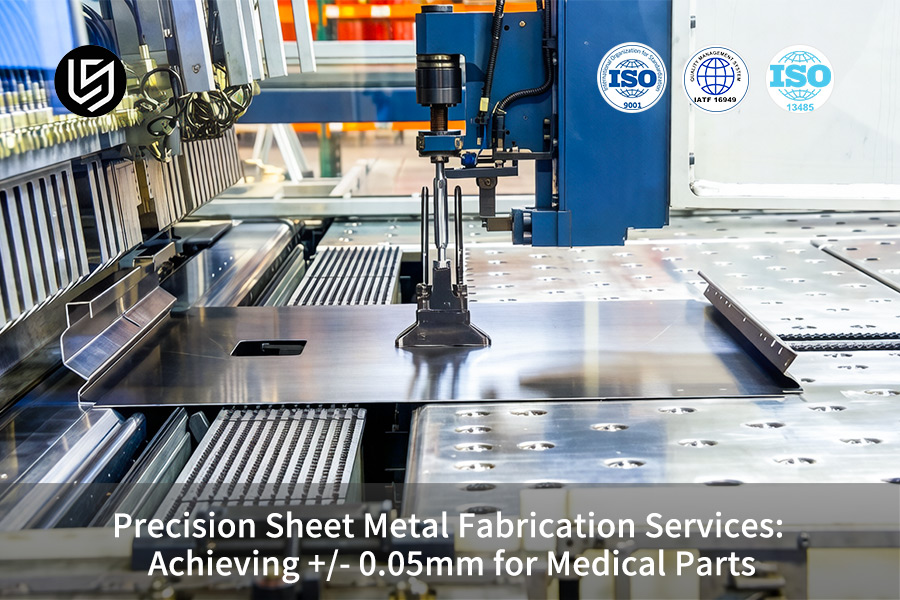
Precision Sheet Metal For Medical Parts: Tolerance Quick-Reference
| Critical Factor | Implementation for ±0.05mm Accuracy |
| Material Selection & Stability | Certified stress-relieved alloys (for example, 316LVM) with stable temper are used to make sure that there is little or no stress and spring back in the materials. |
| Advanced CNC Tooling Calibration | Press brakes and lasers are calibrated every day to compensate for possible inaccuracies and temperature changes to provide micron tolerance. |
| Cleanroom Fabrication Environment | All parts are manufactured in a controlled room to prevent contamination and dimension change due to temperature differences. |
| In-Process Metrology Integration | Laser and CMM machines do dimensional checks at every manufacturing stage and adjustments can be made before continuing the operation. |
| Our Statistical Process Control | By using statistical sheet metal fabrication process control, we guarantee that all our parts have proper dimensions during manufacturing stages. |
| Result: Biocompatible Component Fit | Completely customized parts will fit in your implant or medical device assembly procedure like a glove. |
| Result: Sterilization-Ready Surfaces | The processes provide burr-free parts surface that can be completely sanitized and sterilized. |
Our company offers a remedy for achieving high levels of accuracy in producing medical sheet metal parts with tolerances up to ±0.05mm, which is ensured by a number of controlled factors during production: the selection of material to in-process controls ensuring exact dimensions and finish of all parts produced. Thus, using the capabilities provided, we can produce reliable medical parts meeting stringent standards set in the medical industry to make assembly processes easy for patients.
Why Trust This Guide? Practical Experience From LS Manufacturing Experts
Many articles devoted to sheet metal fabrication can be found online, but why should you choose this one? To begin with, we never claim having a theoretical background because we are working with these notions every day. In our shop, we are constantly dealing with tough metals, tough deadlines, and absolute necessity of making everything perfectly fit. We cannot afford ourselves any mistakes because it means life and death to us because of our responsibility to the whole operation.
The process knowledge we possess is in line with the rules laid out by Gardner Business Media and Society of Manufacturing Engineers (SME). It is all based on factual evidence obtained through various processes to regulate the springback for 316L stainless steel material and ensure the critical tolerance of ±0.05 mm using a technique known as servo-forming together with in-line laser measuring.
All the above tips have been tested by the trials of manufacturing practice and measurement. The knowledge we give is not theoretical but practical experience which we've gained from our own processes and therefore enable us to hold tolerances that may seem too much for some people to achieve. That is the ultimate aim, using the knowledge gained to assist your efforts in precision sheet metal manufacturing.
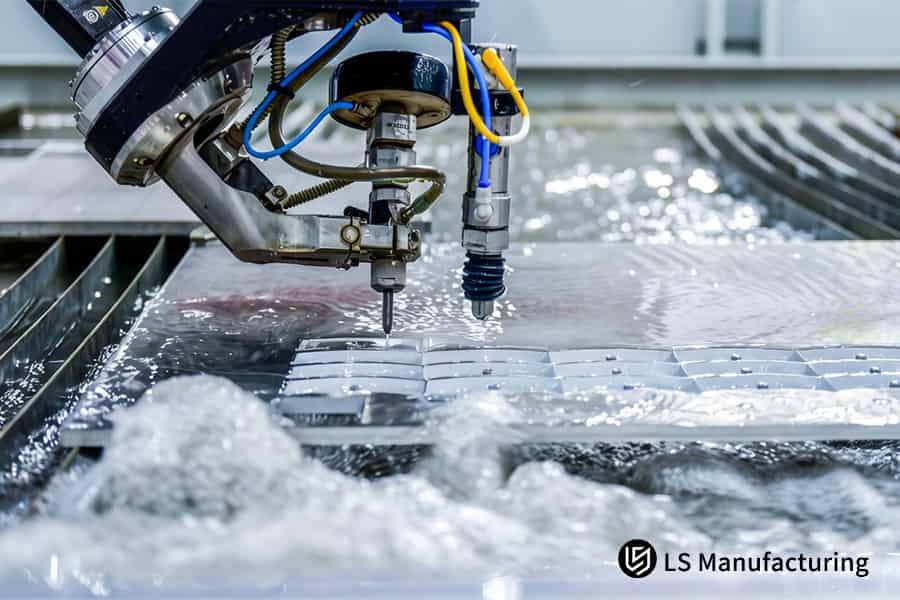
Figure 1: A waterjet precisely cuts aluminum parts for CT scanner or MRI machine structural components.
Why Do Medical Diagnostic Devices Require Precision Sheet Metal Fabrication Services For Internal Chassis?
The inner chassis of the medical imaging device is the primary framework structure, where tolerances of the sheet metal fabrication process have a direct influence on the accuracy of sensors' positioning and calibration. This part of the assignment will consider the problem of tolerance stacks in complicated multiple component assembly systems, paying particular attention to:
Guaranteeing Multi-Axis Sensor Coaxiality
The precise alignment of numerous sensors requires accurate diagnostic equipment chassis blanking and forming. In this case, we use CNC punching and laser cutting technologies that allow producing holes and pilots with high tolerance levels. The result of this work becomes the basis for further assembling of components. It describes the principles of our high-tolerance sheet metal fabrication.
Controlling Cumulative Tolerances with CMM
All essential interfaces of assemblies undergo careful examination with the help of a Coordinate Measuring Machine. It enables us to create a map of the dimensional chain of an assembly and fix possible stack-up issues at the part level. It plays a vital role in prototype sheet metal fabrication when mating happens without additional stress on the electronic devices.
Engineering for Stress-Free Assembly
Our medical sheet metal fabrication follows the practice of DFM, whereby our processes aim to avoid stress. Our methods entail proper placement of features, bending sequences, and even the use of suitable medical-grade alloy materials. Such planning ensures no warping occurs when we assemble the sheet metal fabrication.
Leveraging Process Integration for Repeatability
Consistency at LS Manufacturing is obtained through integrated processes, with servo-electric press brakes with angle compensation and in-line measuring equipment used in conjunction with one another. The process of providing precision sheet metal fabrication services using our integrated systems involves actively eliminating springback, ensuring that each chassis conforms to the +/- 0.05mm specifications necessary for high-volume sheet metal fabrication.
Through this technique, we obtain protocols for developing subsystems that have a guaranteed level of dimensional consistency, thus minimizing scrap from assembly and calibration cycle length. The depth of the information contained in this document reflects our mastery of sheet metal fabrication technology, with more focus on how we make things possible than who we are.

How Does LS Manufacturing Achieve A +/-0.05mm Tolerance Sheet Metal On Complex 316L Stainless Steel Components?
To produce +/-0.05mm tolerance sheet metal formed from 316L stainless steel, a material characterized by work hardening and spring back difficulties, calls for a system that accounts for differences and variations in materials throughout the entire process in real time. This section explores the protocols that turn this tough challenge into a realistic process of manufacturing:
Adaptive Compensation for Material Inconsistency
- Core Challenge: Sheet metal varies in thickness by ±0.03mm, thus taking up more than 50% of the tolerance limit right away.
- Our Method: At our manufacturing company, we use adaptive real-time systems that are part of the precision bending cells.
- Action: Scan the sheet with lasers to determine the true thickness.
- Result: Real-time correction of bend deduction and tonnage automatically done by the CNC program, eliminating any thickness problem from our process.
Controlling Angular Error Across Long Bends
- Core Challenge: Maintaining ±0.2° angle accuracy over 300mm long bends is crucial for maintaining final assembly flatness and gap tolerance.
- Our Method: This is achieved through closed-loop, servo-electric press brakes with angle measurement feedback.
- Action: An angle verification check occurs after each bend and, when there is an error, the servo system automatically moves the ram to make up for any discrepancy on a micron scale.
- Result: This mid-process control makes sure that the angle accuracy stays constant part to part, no matter what small changes happen in material properties, necessary in complex sheet metal fabrication.
DFM-Driven Material Grain Direction Management
- Core Challenge: The angle and surface quality can be heavily impacted depending on whether you bend parallel or perpendicular to the grain.
- Our Method: Through our front-loaded DFM evaluation, we specify the material grain direction for every critical bend in the part.
- Action: Nesting programs align part blanks in relation to the direction of the material grain.
- Result: This removes one variable that impacts springback and surface quality in medical-grade sheet metal fabrication.
Integrating a Calibrated Process Chain
- Core Challenge: The use of multiple tolerances within multiple processing stages (laser cutting, bending, welding) can cause a buildup of error in manufacturing.
- Our Method: We consider the whole process as one complete and calibrated system rather than individual processes.
- Action: The master datum system is set up and utilized throughout the entire process, starting from CAD design to CMM inspections. Operations such as high-precision sheet metal fabrication for welding preps are tightly controlled down to the sub-components.
- Result: As a result, this type of control eliminates error accumulation and ensures that the assembled component will comply with the required +/-0.05mm tolerance sheet metal standard.
The above process shows that high tolerance levels in sheet metal fabrication services cannot be accomplished using one machine alone. It requires a process that incorporates the principles of precision engineering. The process of precision engineering, which involves adaptive control, DFM, and master tooling, is what allows LS Manufacturing to achieve the required precision in its sheet metal products, thereby addressing the issues of assembly faced during medical devices' development.
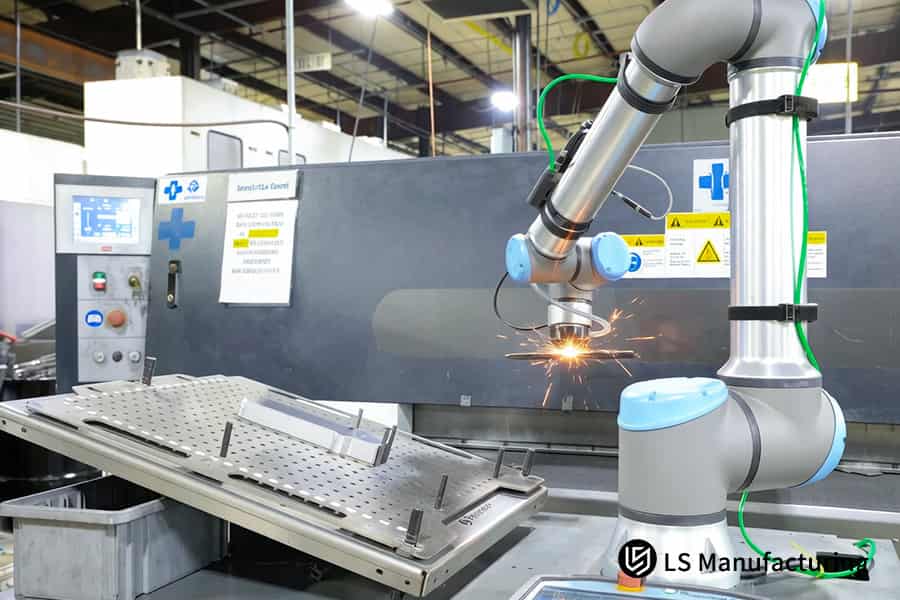
Figure 2: A robotic press stamps a stainless steel bracket for medical equipment with tight tolerance and precision.
Why Is High Precision Sheet Metal For Medical Parts The Only Choice For Robotic Surgery Consoles?
The design of the console for surgical robots calls for contradictory specifications in that it must be rigid enough for undistorted haptic feedback while still being lightweight. High precision sheet metal for medical parts enables this by making it possible to translate designs into physically robust structures. Here is a look at how this is done technically:
| Challenge | Technical Response | Measurable Outcome |
| Achieving Structural Rigidity | High precision engineering and FEA are used to optimize ribbing in custom medical sheet metal fabrication. | Deflection is kept at less than 0.1mm to guarantee stability. |
| Implementing Weight Reduction | Utilizing synergistic precision laser cutting and precision sheet metal forming to produce topology optimized structures. | Provides 20% mass reduction compared to conventional techniques while maintaining structural integrity. |
| Ensuring Dimensional Stability | Conducting precise assembly of fabricated components through the use of a master datum system. | Guarantees consistent accuracy in assemblies for the installation of delicate components. |
| Enabling Scalable Precision | Utilizing complex sheet metal fabrication process with built-in verification steps. | Guarantees consistent quality in accordance with reliability requirements of the medical devices industry. |
This high precision engineering approach provides the deterministic physical foundation that surgical robotics software requires. We solve the rigidity-lightweighting conflict via a data-verified structure from our custom medical sheet metal fabrication, ensuring algorithmic precision translates accurately into physical operation. This is the definitive value of high precision sheet metal for medical parts for high-stakes prototype sheet metal fabrication and production.
Can Sheet Metal Fabrication Services Deliver Zero Defect Components For Class III Medical Equipment?
When it comes to Class III medical devices, whose malfunctioning can prove fatal to patients, any form of part breakdown cannot be considered an acceptable outcome, and thus, defect prevention becomes a necessity rather than an idealistic aim. To ensure a zero-defect manufacturing through sheet metal fabrication services, a closed-loop manufacturing system must be implemented that incorporates all the following factors:
Implementing a Validated Cleanroom and Cleaning Protocol
Contamination is more than just ensuring the room is filtered. Our dedicated precision metal fabrication for medical components in an ISO Class 7 cleanroom, followed by three-part cleaning process (alkaline wash, rinse, then ultrasonic final clean) to ensure the removal of particles and biological agents. This helps ensure the biological inertness of the components used in our implant-grade sheet metal fabrication.
Establishing Full Digital Traceability for Every Component
Quality assurance needs continuous data integrity. Each batch of components is assigned an identifying number and is associated with an extensive electronic dossier. The dossier is made up of mill certificates for raw materials used, logs from high-reliability sheet metal fabrication machines, environmental information, and results of inspections at every step, providing an unbroken record that meets any regulatory demands.
Deploying 100% Automated Dimensional Verification
Statistical sampling cannot be used for critical-to-function features. We use automated optical scanning to conduct 100% non-contact inspection of all critical dimensions for each part inside a lot. Our system inspects each piece relative to its theoretical CAD model within seconds, providing both a pass or fail result as well as an SPC report, taking out the subjective element from inspecting medical-grade sheet metal fabrication.
Designing Proactive Error-Proofing into the Process
Our error-proofing system stops defects before they occur. Error-proofing or poka-yoke principles are designed into the machine program, material detection systems confirm that materials are present and correctly oriented before processes begin, and the process monitors check for any deviation in the parameter set during cleanroom sheet metal fabrication. Continuous process capability (Cpk) studies validate the stability and capacity of our system.
The holistic, evidence-based approach proves that zero-defect manufacturing is a demonstrable reality, not an empty marketing term. We deliver our customers with the medical OEMs a full compliance package together with their hardware components, ensuring that even the highest standards of precision metal machining for medical are converted into a compelling competitive edge.
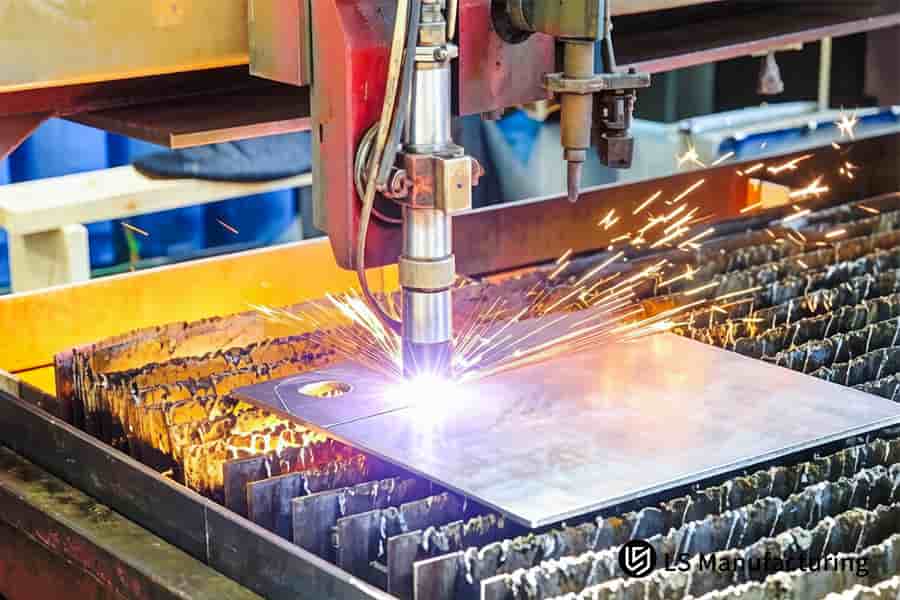
Figure 3: Cutting a medical instrument bracket from 304 stainless steel with high precision for surgical tool assembly.
How Can Custom Medical Sheet Metal Fabrication Optimize The Cooling Efficiency Of Laser Surgical Systems?
The problem of thermal management in medical laser components is one of the biggest bottlenecks, as increased heat adversely affects the functionality and longevity of the components. The solution offered by custom medical sheet metal fabrication lies in integrating airflow channels right into the chassis itself, converting the passive chassis into an active cooling unit. This solves the problem of thermal dissipation without expanding the system dimensions or increasing the fan’s power consumption:
Integrating Micro-Duct Airflow Channels
- Method: Utilizing high-tolerance progressive die stamping within our precision sheet metal fabrication services to form intricate micro-ducts and turbulators directly into enclosure panels.
- Result: Creates guided, laminar airflow paths that increase heat exchange surface area and eliminate dead zones, directly improving convective cooling efficiency.
Ensuring Critical Flange Flatness
- Method: Adopting a stress-reducing forming process followed by accurate flattening to attain a crucial flange flatness of ≤0.1mm.
- Result: It prevents any air pockets in the interface between the heat sink and the chassis, guaranteeing the best thermal coupling for efficient heat dissipation from critical medical laser components.
Employing System-Level Co-Design
- Method: Our design engineers conduct early DFM analysis through CFD simulation iterations to refine duct designs based on the capabilities of advanced sheet metal fabrication.
- Result: Creates an integrated cooling system design that can be fabricated easily without the need for re-designs, and the prototype sheet metal fabrication step guarantees its performance.
Validating Performance with Empirical Data
- Method: Fabricating functioning prototypes for evaluation in wind tunnels for accurate pressure and flow velocity measurements, validating the accuracy of CFD simulations with actual performance results.
- Result: Provides our clients with empirical performance data like a 15% improvement in airflow efficiency, thus validating the design before embarking on high-volume sheet metal fabrication.
It becomes evident from this methodology that custom medical sheet metal fabrication is indeed an enabling thermal engineering field. To overcome the particular problem of silent, efficient thermal dissipation, we engineer the enclosure into a well-tuned thermal component. This document contains an overview of the engineering justification for using precision sheet metal fabrication services as a method for increasing system efficiency.
Why Are Tight Tolerance Sheet Metal Services Critical For Modern Laboratory Automation Platforms?
Tight tolerance sheet metal services are foundational to the reliability of laboratory automation, where systems must maintain precise alignment over tens of thousands of hours. The true challenge is not just achieving initial precision, but ensuring long-term stability against dimensional drift. This document details the engineered solutions that lock in critical tolerances for the lifecycle of the equipment:
| Challenge | Technical Solution | Quantified Outcome |
| Preventing In-Service Dimensional Drift | Executing an exclusive stress-relieving annealing procedure following all forming. | Negates internal stresses that induce part distortion in time. |
| Ensuring Initial Assembly Precision | Using high-accuracy sheet metal fabrication and in-process verification through CMMs. | Keeps the critical dimensions of parts to ±0.05mm from nominal. |
| Validating Durability Under Load | Stressing the parts using extreme temperature and mechanical fatigue tests. | The results reveal a reduced critical dimension of the parts by 35%. |
| Guaranteeing Material Consistency | Utility of certified alloys with rigorous manufacturing controls for prototype and production runs. | Provides consistent mechanical characteristics which ensure reliability. |
The sheet metal fabrication services offered by us effectively address the crucial issue of dimensional drift over a long period. The OEM manufacturers of laboratory automation equipment receive components whose precision will not be affected by time or force, resulting in extremely shortened calibration periods and enhanced system efficiency. Engineering long-term stability in products is the key difference in our services for automation applications of high significance.
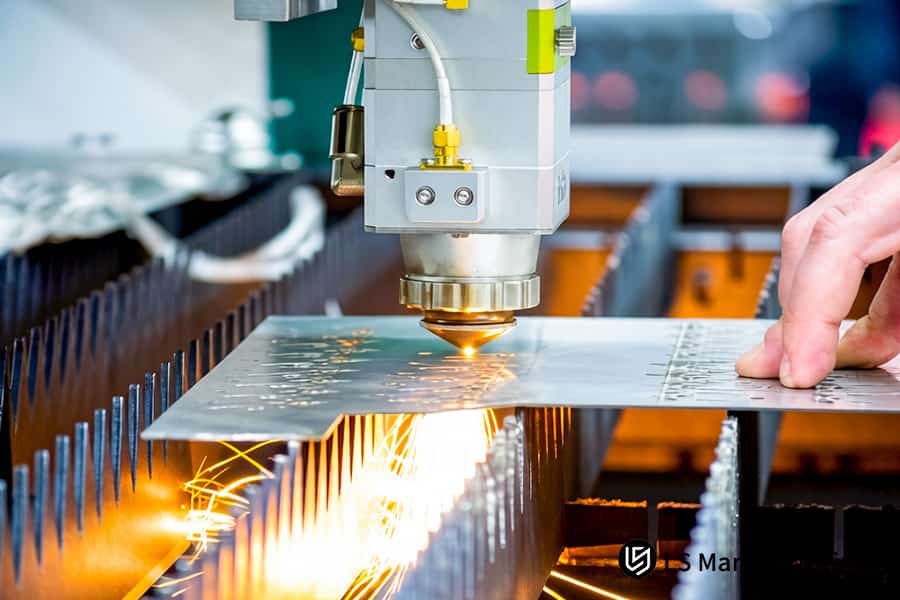
Figure 4: Sheet metal fabrication services cut 304 stainless steel for medical device parts with +/-0.05mm tolerance.
Case Study: LS Manufacturing Surgical Robot Arm Chassis Precision Metal Fabrication For Medical Custom Solution
The European pioneer in surgical robots encountered one of the most serious challenges: the thermal distortion of a 316L chassis through the welding process created a deviation of 1.2mm, exceeding the required tolerance of ±0.1mm and thus preventing any certification. The scope was clear – it marked the limitations of traditional approaches for precision metal fabrication for medical. LS Manufacturing was contracted to create a tailor-made solution by utilizing advanced sheet metal fabrication skills.
Client Challenge
The major surgical robot components required arm chassis with end effector accuracy to within ±0.1mm. The existing process required that 12 different brackets be welded from 316L stainless steel, causing unwanted thermal distortion. This led to an assembly tolerance of 1.2mm, stopping further assembly and jeopardizing the product’s market release schedule.
LS Manufacturing Solution
A DFM redesign initiated our custom solution, converting the weldment into a single-piece component using precision bending technology, resulting in the removal of 11 welds. Modular fixturing was used along with low-heat-input fiber laser welding, including 3D scanning in real time for distortion compensation. Our certified sheet metal fabrication process guaranteed geometrical accuracy from the first article to production.
Results and Value
The surgical robot components were delivered within ±0.05mm tolerances, exceeding the specification by 50%. This led to a 50% time savings during assembly by our client and 20% improvements in positional repeatability of the overall system. The platform received CE certification, ensuring market access. This validated the LS Manufacturing partnership for sheet metal fabrication.
The current instance serves as proof of LS Manufacturing as a collaborator for addressing highly sophisticated engineering problems. We offer comprehensive custom solutions, which integrate efficient designs with precision metal fabrication for medical, thereby ensuring that root cause failures do not occur. Our solutions make sure that surgical robot components meet the performance criteria.

Why Choose LS Manufacturing As Your Trusted Partner For High Precision Sheet Metal Fabrication Services?
Choosing a supplier for your precision sheet metal fabrication services is a critical decision that affects the success of your product in terms of quality, regulatory compliance, and economics. This process calls for a partner capable of handling the complete supply chain, and we at LS Manufacturing have established ourselves as the reliable manufacturer in this regard.
Providing Proactive Design for Manufacturing (DFM)
We bridge this gap through early co-engineering. We review your models designed for medical device sheet metal fabrication; we optimize the geometries, provide alternative materials, perform tolerance stacks, and give you a manufacturing roadmap with no need for design changes, reduced number of parts, and cost optimization without ever engaging the tooling.
Executing with Integrated, Validated Processes
Precision comes from process integration, not separate pieces of machinery. Both our high-mix sheet metal fabrication for prototyping and high-volume sheet metal fabrication for manufacturing operations make use of the same calibrated processes—servo-electric forming with angle correction, laser welding with thermal control, and automated finishing processes. This guarantees that the perfect geometry of the first piece gets consistently reproduced, ensuring the necessary precision for mission-critical assemblies.
Ensuring Compliance through Embedded Quality Systems
As a reliable manufacturer, meaning that we focus on embedding quality into the process, rather than inspecting it after its manufacture. Our ISO 13485-based quality system provides comprehensive traceability and process validation. Every batch goes through First Article Inspection and CMM checks, resulting in an audited dataset. Our certified sheet metal fabrication provide you with the key tool needed to prove supply chain control and component conformity.
Delivering Transparent Value with Detailed Cost Engineering
Our price quote is a transparent engineering analysis, not a simple figure. We break down the process in terms of material usage efficiency, particular process timing, tooling, and finishing costs. This approach stems from our profound experience in sheet metal fabrication services. Our solutions address the issue of pricing obscurity by giving you an insight into the cost structure and enabling you to gain competitive value without cutting back on high tolerance and medical-grade sheet metal fabrication standards.
Selecting LS Manufacturing is equivalent to associating yourself with a company that addresses the full spectrum of challenges involved in developing designs into dependable, compliant, and economical parts. Our approach will help you benefit from the expertise of a real reliable manufacturer where the process and results will be predictable for all your sheet metal fabrication services projects.
FAQs
1. What is the maximum thickness for achieving +/- 0.05mm tolerance at LS Manufacturing?
Our close loop controlled system guarantees that accuracy is always within the ±0.05mm range for sheets made of stainless steel or aluminum alloys which are between 0.5mm and 3.0mm thick.
2. How do I get an accurate price quote for custom medical sheet metal fabrication?
Click on the "Get a Quote" button below, upload your STEP file, and we will send you a precise quotation complete with a cost analysis within 24 hours.
3. Can LS Manufacturing handle low-volume, high-precision medical parts production?
Absolutely! We fully advocate for a smooth progression from prototyping individual components to mass production in quantities ranging from tens of thousands.
4. Why is LS Manufacturing a better choice than traditional suppliers for medical sheet metal fabrication?
We work under strict clean room conditions and maintain our operations under the ISO 13485 quality management system, thus avoiding any cross contamination issues and generating detailed material traceability reports.
5. Does LS Manufacturing offer surface finish options, such as medical-grade electropolishing?
LS Manufacturing offers a full range of post processing services such as electropolishing, anodizing, and passivation to guarantee that the surface roughness on our manufactured medical parts will conform to the stringent specifications required by the industry.
6. How do you control material springback during tight-tolerance sheet metal fabrication?
Utilizing our database that contains numerous material springback factors in combination with our online laser angle compensation, we can assure that even the first fabricated part conforms to your specifications and tolerances with virtually no errors.
7. Can LS Manufacturing help optimize my medical part design to reduce manufacturing costs?
Our engineering experts will review your inquiries and perform thorough DFM analysis and optimization that will allow you to realize production cost savings up to 20%.
8. What certifications does LS Manufacturing hold for precision metal fabrication in the medical sector?
LS Manufacturing holds ISO 9001 and IATF 16949 certifications and we follow all EU RoHS compliance as well as FDA quality component traceability guidelines.
Summary
In medical device manufacturing, micron-level precision defines the line between safety and risk. LS Manufacturing utilizes digital processes and rigorous quality systems to achieve exceptional +/-0.05mm tolerances in sheet metal fabrication. From diagnostic instrument chassis to surgical robot components, we are more than a parts maker—we are your strategic technical solutions partner. Choosing LS Manufacturing means selecting the most reliable physical foundation for your medical innovations.
Do not let loose tolerances compromise the performance of your medical devices. Your precision designs demand manufacturing capabilities of equal caliber. Click the "Get Instant Quote" button below now to upload your design files. LS Manufacturing’s experts in medical-grade sheet metal fabrication will provide a complimentary DFM review, helping you secure a highly competitive, direct-from-factory quote within 24 hours. Let us join forces to safeguard every life through the power of precision.
What is the trickiest deformation issue you have encountered during the machining of 316L material? Feel free to discuss it in the comments section.
📞Tel: +86 185 6675 9667
📧Email: info@lsrpf.com
🌐Website: https://lsrpf.com/
Disclaimer
The contents of this page are for informational purposes only. LS Manufacturing services There are no representations or warranties, express or implied, as to the accuracy, completeness or validity of the information. It should not be inferred that a third-party supplier or manufacturer will provide performance parameters, geometric tolerances, specific design characteristics, material quality and type or workmanship through the LS Manufacturing network. It's the buyer's responsibility. Require parts quotation Identify specific requirements for these sections.Please contact us for more information.
LS Manufacturing Team
LS Manufacturing is an industry-leading company. Focus on custom manufacturing solutions. We have over 20 years of experience with over 5,000 customers, and we focus on high precision CNC machining, Sheet metal manufacturing, 3D printing, Injection molding. Metal stamping,and other one-stop manufacturing services.
Our factory is equipped with over 100 state-of-the-art 5-axis machining centers, ISO 9001:2015 certified. We provide fast, efficient and high-quality manufacturing solutions to customers in more than 150 countries around the world. Whether it is small volume production or large-scale customization, we can meet your needs with the fastest delivery within 24 hours. choose LS Manufacturing. This means selection efficiency, quality and professionalism.
To learn more, visit our website:www.lsrpf.com.