English



Sheet metal fabrication manufacturer have long surpassed the level of simply lowering the unit price of raw materials. Instead, they reduce your total cost of ownership (TCO) to the extreme through in-depth diagnosis of process parameters such as progressive die optimization, bending springback compensation, and multi-axis combined processing.
This article will show how factories use process design, DFM variables, and machining automated path to bring about the minimum sheet metal production costs. Read on to learn how deep technological optimization at the bottom of the workshop can minimize your product manufacturing costs.
Six Key Levers to Reduce Sheet Metal Production Costs
| Cost Reduction Levers | Implementation Methods | Customer Benefits |
| Progressive Dies Replace Segmented Stamping | Single die integrates over ten processes including punching, blanking, and bending. | Reduces single-piece processing time by 70% for orders over 10,000 pieces. |
| Micron-Level DFM Compensation | Bending radius ratio R/T ≥ 1.5, hole edge distance > 2T+R. | Extends die life by 200%, eliminating secondary die repairs. |
| Vertical Process Integration | Welding + painting + assembly in a closed-loop system within the same factory. | Eliminates cross-factory logistics, shortening delivery cycle by 40%. |
Key Conclusions
- Segmented Stamping Is Replaced by Progressive Dies: Using continuous progressive dies for orders over 10,000 pieces would save 70% of single-piece processing time.
- Compensation at Level of Micron with DFM: Adjusting the bending radius ratio to the minimum recommended level of R/T≥1.5 will result in zero metal cracks so the rework is unnecessary.
- Integrating the Processes Vertically: If welding, painting, and assembly are done together in one unit, this will remove any logistics time lost in the supply chain when different suppliers are involved.
Why Trust LS Manufacturing’s Cost-reduction Solutions as a Sheet Metal Fabrication Manufacturer?
Sheet metal fabricating manufacturers who systematically reduce TCO need to master three core competences per our team with over 15 years of experience in automotive, medical, and industrial equipment sectors: progressive die development, DFM pre-audit, and vertical integration.
ISO 2768-1 specifies that the linear dimensional tolerance for precision grade (f-grade) is ± 0.05mm.
To be in line with this standard, every year our die DFM pre-audit team handles over 200 sets, because of which the cost of die repair is reduced by an average of $8,000 to $15,000, die pitch accuracy is 0.01mm through progressive, single piece machining takes time 0.4 seconds, and also as the whole thing is done in factory closed-loop, the lead time is cut by 40%.
In one automotive global Tier 1 car control box project, we managed to reduce the whole cost by 32%. Scrap rate that was initially at 24% eventually came down to 0.02% by combining bending parts, using fully dedicated progressive dies, and internal painting that saved 14 days in inter-plant logistics.
Want to see how much cost can be reduced in your design? Contact our engineers to obtain a Sheet Metal Cost Reduction Leverage Self-Checklist, which includes R/T boundaries, progressive die start-up thresholds, and a DFM pitfall list for your benchmarking.

How Does Automated Nesting on High Volume Sheet Metal Fabrication Minimize Raw Material Scrappage?
Material utilization can be A lot improved by adopting the high-precision nesting algorithms that allow the irregularly shaped parts to be cut with minimal waste on a single metal sheet. With the help of these algorithms, a manufacturer who was limited to 65% metal usage through the traditional method could actually achieve over 85% usage, thereby reducing 15% of the single-piece material procurement cost. The core problem of cost reduction for high volume sheet metal fabrication lies in nesting.
Manual Nesting vs. Advanced Algorithm Nesting
The starting point to reduce sheet metal production cost is material utilization, and there is a significant difference between the two modes.
- Collinear Cutting: The algorithm is designed so that small part edges are cut following large part edges, this way decreasing skeleton or waste.
- Big and small parts Nesting: A small part is packed between a big parts space. The compactness is beyond what can be achieved through manual operations.
- Adjusting the Stamping Pitch: Stamping pitch is varied starting from the fixed 8mm to a dynamic 5.2mm, which allows the use of micro-joint technology along with.
Layout Parameter Comparison Table (1.5mm SGCC Galvanized Steel Sheet)
| Layout Method | Part Spacing | Micro-connection | Material Utilization | Stamping Edge Scrap Rate |
| Traditional Manual | 5.0mm | None | 63% | 37% |
| Algorithm Optimization | 2.0mm | Yes | 86% | 14% |
LS Manufacturing Exclusive Test Data: Reducing the gaps between parts from 5.0mm down to 2.0mm + micro-connection decreases scrap from the stamping edge by 18%. In other words, it simply translates into 12-15 more parts being produced from a 1220mm x 2440mm sheet and so a directly noticeable drop in material costs.
Material utilization for stamping tonnage and die pitch are essentially factors that determine the lean manufacturing strength of a sheet metal fabrication manufacturer. Sheet metal fabrication by CNC machine also includes nesting logic which can be extended to mixed product runs of multi-variety small-batch scenarios, in fact, the algorithm is quite sophisticated - it can identify and match up the common outer contour edge parts that can be joined.
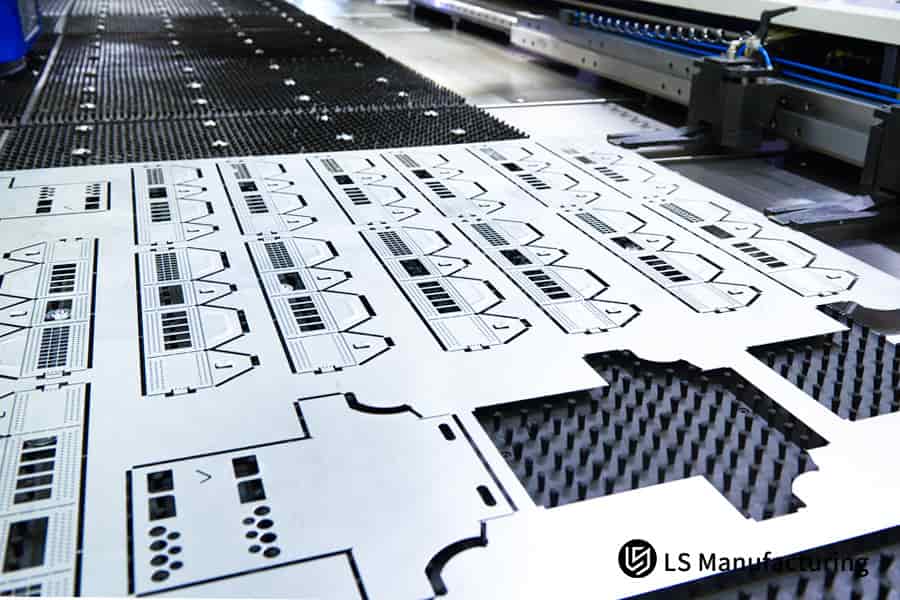
Figure 1: CNC laser cutting machine processing sheet metal with automated nesting patterns.
Why Is Advanced DFM for Sheet Metal Essential to Eliminate Premature Tooling Wear and Cracking?
Rigorous DFM geometric review of bending radius and hole edge distance in the early design phases can prevent cracks in metal after stretching and extend die life by as much as 200%.It even can eliminate the need for further die repairs by DFM.The essence of a DFM for sheet metal is to relate these principles with stress boundaries particular to the product.
Geometric Red Lines for Bending and Punching
DFM inspection of custom sheet metal services involves checking of two types of design boundaries. In particular, for aluminum sheet metal fabrication, the R/T red line is the more critical of the two because of the relatively weaker nature of aluminum sheets compared to steel ones. Because of this, 1.8 or higher is recommended for 5052:
- Bending Radius Red Line: R/T less than 1.5 results in the metal grains being stretched beyond their limit, microcracks propagating along the grain boundaries, and the die cutting edge chipping within 3000 strokes.
- Hole Edge Distance (Red Line): There should be a distance of more than 2T + R from the edge of all punched holes to the bending line because otherwise the hole will be stretched into an ellipse, resulting in wire breakage during subsequent tapping.
Design Engineering Calculation
We manage springback at LS Manufacturing not as a matter of experience by over pressing by 2° for instance we calculate this based upon the yield strength of the material, the result being:
- 5052-H32 Aluminium: Yield strength 195MPa, a springback angle compensation of 3°-4°, a V12 die.
- SUS304 Stainless steel: Yield strength 310MPa, springback angle compensation 5°-6°, calls for an overpressure forming station.
- SPCC Cold rolled: Yield strength 180MPa: springback angle compensation 1.5°-2°, standard die is adequate.
This kind of sheet metal manufacturing optimization is achieved through these calculations in phase with DFM, that's why no changes need to be made after the manufacturing tool (die) is put in operation. Our engineering team alone pre-approves DFM for over 200 sets of molds every year, which actually saves an average of 8,000-15,000 in mold repair costs per client. Also, springback compensation of stainless steel sheet facrication needs considering work hardening rate, the 304 yield strength progresses with each bend.
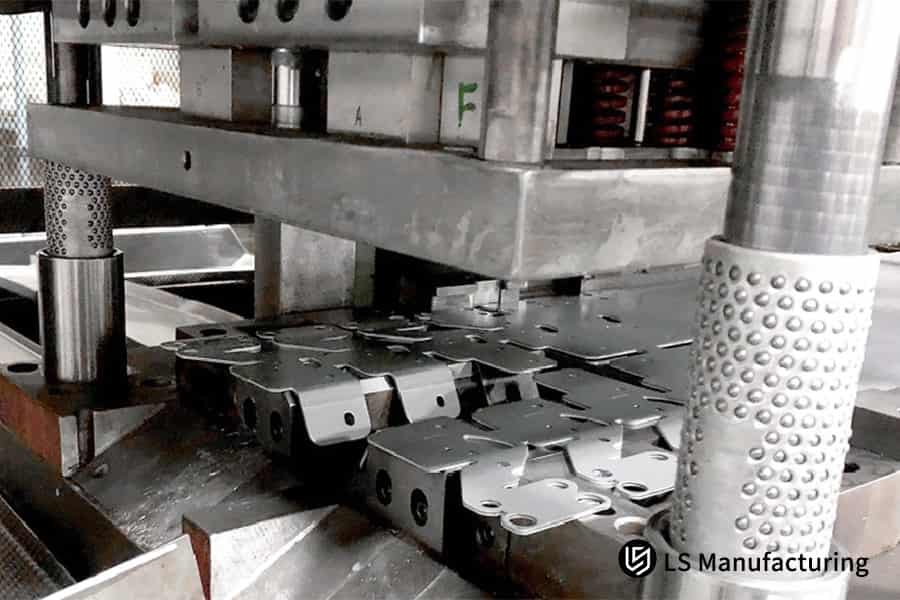
Figure 2: Stamped metal parts produced using advanced DFM optimized tooling.
How Can Progressive Die Tooling Significantly Lower Unit Costs in Long Run Procurement?
Progressive dies are designed to integrate as many as over ten manufacturing processes including punching, blanking and bending together in one single tool. These tools enable a fully automated high-speed forming operation, reaching 150 strokes per minute, which reduces the processing costs of large volume single-piece production to practically zero. Cost effective metal fabrication through economies of scale is fully supported by progressive dies.
Progressive Die vs. Single-Operation Die ROI Comparison
In the case where a single batch of custom parts is 50,000 pieces, plainly the difference between the two technologies is substantial. The pitch accuracy of sheet metal stamping dies is the soul of progressive dies:
| Comparison Dimensions | Single-operation die (segmented) | Progressive die (continuous) |
| Manpower Configuration | 4 people × 4 presses | 1 person × 1 press |
| Single-piece processing time | 45 seconds | 0.4 seconds |
| Feed pitch accuracy | ±0.15mm | ±0.01mm |
| Total processing time for 50k pieces | 625 hours | 5.5 hours |
| Single-piece processing cost | $1.85 | $0.22 |
Data Anchor Point
The 0.01mm progressive die feeder pitch accuracy means that the total tolerance resulting from continuous stretching over different processes is still inside the standard. Even the highest capital costs related to tooling for high volume sheet metal fabrication can be justified as it is expected to dilute the initial cost of tools almost to zero over a run of hundreds of thousands of pieces, which will have a dramatic effect on single-piece processing costs.
LS Manufacturing is capable of designing and developing progressive dies for a closed height of up to 300 tons, which means that even the longest deliveries for the most volume-demanding parts like automotive brackets and motor housings can be delivered on-time. The service life of progressive dies for sheet metal is generally inversely proportional to the level of stamping tonnage. Dies operated with a pressing force of less than 150 tons only need edge honing every 50,000 press strokes.
Acceptance or rejection of progressive die orders by a sheet metal fabrication manufacturer can be taken as a major measure of its capability to withstand huge cuts in cost.
Unsure if your production volume has reached the progressive die production threshold? Download the Progressive Die ROI Calculation Table, fill in the quantity and part dimensions, and it will automatically generate the dividing point and unit cost curve.
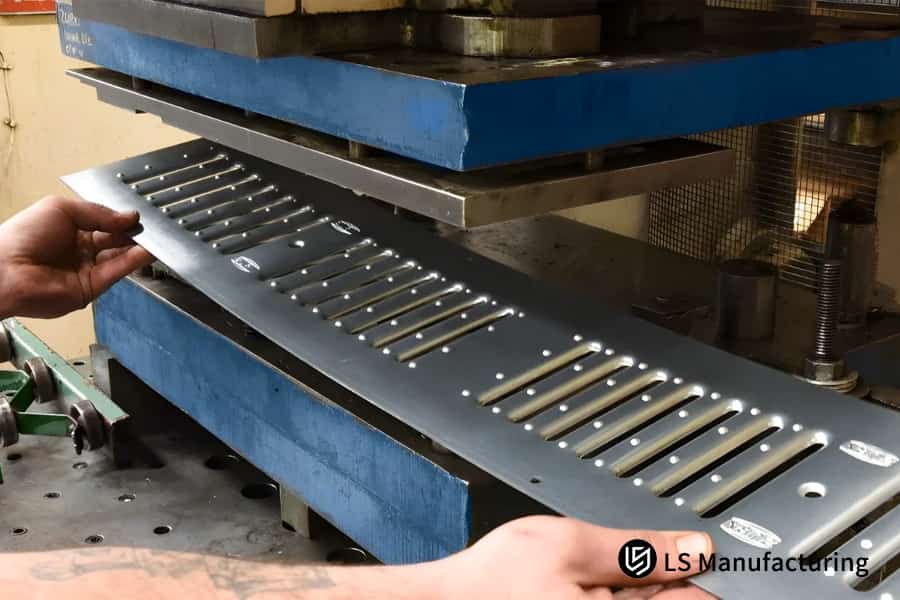
Figure 3: Progressive die stamping machine producing metal brackets in long run.
Why Does Upgrading to Intelligent Laser Cutting Optimizations Curtail Post Processing Deburring Costs?
Utilizing a high-power fiber laser and regulating auxiliary gas parameters in a very specific and precise way can be one of the factors resulting in the surface cut roughness Ra 3.2 or below, with no signs of spatter or burr, and without any energy consuming secondary deburring operations to start with. The cost reduction logic of sheet metal manufacturing optimization in the laser segment is one section at a time.
LS Manufacturing's 3mm SUS304 Parameter Combination
The laser process of sheet metal fabrication service needs to be precise to each variable. The cross-sectional quality of fiber laser sheet cutting is most sensitive to the focal position:
- Power of the fiber laser: 6000W ensures fast enough melting.
- Frequency: 2500Hz, pulse modulation to prevent burnout.
- Focal point of a lens: -1.2mm below the sheet surface, this gives the cut edge an inverted V shape which enables smooth cleaning of molten material.
- Assist gas: high-pressure, high-purity nitrogen >99.999%
Because of such settings, the height of molten layer dross is less than 0.02mm whereas the roughness of the surface is RA 2.8-3.2, making manual deburring unnecessary by removing the burrs. In simple terms, that means that you can save 3-8 minutes per piece on a manual grind resulting on a savings of 500-1300 man-hours for tens of thousands of pieces.
Traditional cutting technology like plasma cutting or cutting with a low power laser usually takes post cutting grinding - the cost of this hijacked by tools and procedures. To be able to do without deburring when cutting the sheet metal with a laser and to avoid balancing the cut quality versus speed for thick plates that require cutting with low-pressure oxygen still, you have to make the right trade-off during the design stage and it is also a question, if you are ready enough to push your laser parameters limits to this combination of settings.
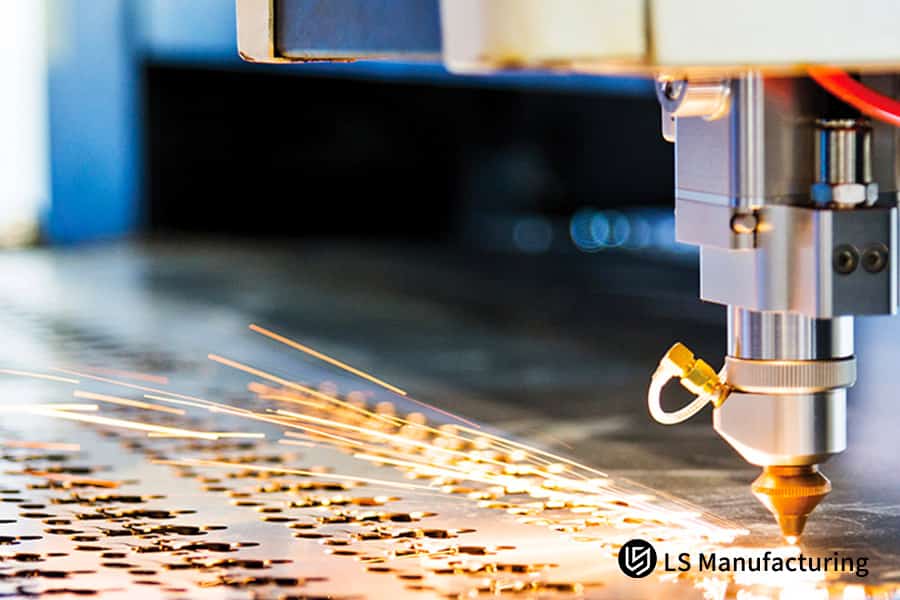
Figure 4: CNC laser cutting machine optimizing cuts to reduce post processing.
How Does Consolidating Secondary Finishing Under One Roof Prevent Supply Chain Cost Creep?
A one-stop fully integrated plant combining processes like welding, powder coating, electroplating and component assembly will not only completely eliminate cross-factory logistics costs that multiple suppliers incur but will also shorten delivery time by 40% overall. Vertical integration of custom sheet metal services can help eliminate hidden costs.
Mysterious Areas of Decentralised Supply Chains
When it comes to sheet metal fabrication service, hidden costs that happen while moving from one factory to another include:
- Cross-factory packing expenses: rust-proof paper + bubble wrap + EPE per piece, 800-2000 a large batch.
- Transportation-related scratches and damages: blaming each other, rework 3-8%, and disputes 1-2 weeks.
- Lack of tolerance accumulation: bending 0.3mm at factory A, welding 0.5mm at factory B, assembly failure.
The Real Advantages of Manufacturing a Single-Plant Closed Loop System
Using large server chassis as the example, the stamping and ESD coating have both been done at the same factory. Usually, sheet metal enclosure manufacturing is the one that takes the most advantage of a closed loop. In the closed loop the chassis body after bending is moved directly to the painting line without intermediate packing:
- Packing and transporting cost: 1200-3500 per large batch savings.
- Delivery cycle: From 28 days to 17 days or 40% less.
- Accountability loop: When a process breaks down one can get internal traceability of defective product within 2 hours without halting the production line.
The vertical integration of cost effective metal fabrication is essentially about picking up profits from transportation and bargaining. It is much easier to control color and film thickness uniformity in powder-coated sheet metal products in a factory with closed-loop production because pretreatment chemical polishing time can be synchronized with the stamping cycle.
Is your project also being handled by multiple suppliers? Contact an engineer to calculate the supply chain integration costs and see how much hidden costs can be eliminated.
What Grade and Thickness Engineering Adjustments Secure Structural Integrity at a Fraction of the Material Price?
Using thorough mechanical simulations, substituting plates made from thick plates with those of high-strength thin plates, or just replacing 5052 aluminum alloy with cost-effective galvanized steel plates, one can a lot reduce total material costs by 25% keeping the structural stiffness unaltered. Substituting one material for another to reduce sheet metal production cost is one of those very basic design VA/VE issues.
Sheet Metal Optimization Case Study Driven by FEA (Finite Element Analysis)
The rationale of changes to the sheet metal manufacturing optimization. In places with moderate corrosion resistance level requirements like indoor chassis and electrical control cabinets, galvanized sheet metal parts can be the substitute for 5052 aluminum. The materials have a cost difference of more than 2 times:
- Original Design: 2.0mm 5052-H32 aluminum plate, stiffener spacing 80mm.
- FEA (finite element analysis) Simulation: Maximum von Mises stress 145MPa, still way lower than the yielding of aluminum of 195MPa, 34% material redundancy.
- Change Plan: Replace 5052-H32 with 1.2mm HSLA steel (high-strength low-alloy steel, yield strength 240MPa), also stiffener spacing has to be decreased to 50mm.
- Outcome: The peak stress is 218MPa with a safety factor of 1.1, weight -28%, the cost per unit weight of material has gone down to 2.1/kg from 4.8/kg, and the material cost per unit -25%.
Parameter Comparison Table Before and After Modification
| Parameters | Original Design (5052 2.0mm) | Modified (HSLA 1.2mm + Reinforcement) |
| Yield Strength MPa | 195 | 240 |
| Maximum von Mises MPa | 145 | 218 |
| Unit Weight kg | 3.6 | 2.6 |
| Material Unit Price $/kg | 4.8 | 2.1 |
| Unit Material Cost $ | 17.28 | 5.46 |
Profit margin of custom sheet metal services VA/VE modification is the profit that professional manufacturer stolen for the client during the design phase. For hot-rolled steel sheet manufacturing, the level of cold-weld cracking should be considered when choosing HSLA steels. It is recommended Ceq 0.42%, otherwise preheat 100-150℃ is recommended.
How Do Rigid In Process SPC and CPK Tracking Frameworks Eliminate Expenses from Late Stage Recalls?
It is possible that by applying very strict SPC, one could keep the defect rate of large quantities of delivery goods at very low levels of the defect rate. One reason that sheet metal fabrication factories are not allowed to have quality consistency is because their quality can not be consistent with the production batch, and this would mean big recall in the future.
SPC Implementation under IATF 16949
IATF 16949:2016 Clause 8.5.1.1 says quite clearly: The organization must deploy statistical process control on a set of characteristics, where the critical characteristic CPK 1.33.
We have taken a couple of measurements and a 2.5D measuring camera + Coordinate Measuring Machine (CMM) at the bending core station which is critical for tolerance (0.05mm), to comply with this mentioned requirement. Each time 50 parts are produced, a measurement is taken. X-bar charts are used to monitor any trend changes in defects. The use of defect parts is stopped in a timely manner.
A high volume sheet metal fabrication process means that this implementation of the SPC system is a sleep sound feature. That major fear of the automotive, medical, and industrial equipment purchasing teams is production stoppages and claims arising from batch defective parts, and our CPK 1.33+ real-time data availability prevents all these fears.
The Cost of Quality Consistency
- Factory without SPC: Batch size 10k pieces, defect rate 0.8%, rework + production stoppage losses $18,000.
- LS Manufacturing (CPK 1.33+):Defect rate < 0,02% per batch, rework < $200.
The quality guarantee of sheet metal fabrication service is an insurance policy to protect from the risk when procuring long-cycle, large-quantity goods.
Do automotive or medical components have strict CPK requirements? Upload 3D CAD drawings, and we'll provide a DFM + SPC solution within 24 hours, including a list of critical characteristics and target CPK values.
Case Study: How LS Manufacturing Saved Automotive Client 32 Percent on Custom Sheet Metal Services?
Client Challenge
A top-level international automotive parts supplier wanted to make their large control box assemblies with many cavities more customized. The first method made use of three different companies stamping, spot welding manually, and painting the final product was subcontracted as well. Initially when parts were bent together cumulative deviation was ±0.6mm, welds would crack quite often, and 24% of work was redone. Due to Truth is the three suppliers were pointing fingers the whole assembly line got closed down.
LS Manufacturing Solution
A manufacturing plant with industrial sheet metal production, multi-cavity products are the most likely to break if a workpiece has to travel through several factories:
- DFM Geometry Reconstruction: Five separate stamped parts were combined into one bending part through sheet metal integration, which virtually removed a large portion of all 80% welding.
- Solely Devoted Progressive Die: Springback compensation angle fixed bending accuracy to 0.08mm.
- Internal Processing: Protective (corrosion resisting) paints were brought into the factory and painting done in automated line to create a closed loop process.
Results and Value
Total production cost -32%, defective rate 24% down to 0.02% (completely defect free), 14-day saving on factory to factory logistics. It demonstrates that for high-volume precision parts sourcing, going with a reasonably priced, vertically integrated metalworking partner is the best option.
Is your project also stuck in multi-supplier disputes? Upload your 3D CAD (STEP/IGS/DXF) and get a free DFM + quote within 24 hours. Replicate this integration path.

FAQs
Q1: What are the main factors that increase total costs in a custom sheet metal fabrication service?
The primary cost factors are: very complex structural designs that require the use of multi-part molds, overly small ratios of bending radius to thickness (R/T < 1.5), choosing non-standard metal thicknesses, expensive manual post-processing steps like heavy manual grinding and deburring, and complex manual spot welding.
Q2: Why should you pick LS Manufacturing as your main B2B sheet metal fabrication manufacturer?
LS Manufacturing has a senior engineers' DFM optimization team, an IATF 16949 certified SPC quality control system with CPK 1.33, efficient high-volume progressive die manufacturing capabilities, and a one-stop vertically integrated production line including automated painting, all of which ensure extremely low TCO and zero-defect deliveries at the same time.
Q3: How does picking the proper sheet metal thickness contribute to the cost reduction of sheet metal production?
Selecting the standard commercial sheet metal specifications removes the need for the additional cost of steel mills' custom non-standard materials. Also, part thickness optimization using finite element analysis allows high-tensile thinner sheet metal to be used instead of redundant heavy structural plates, so saving up to 25% on the material costs without compromising the physical strength of the parts.
Q4: What are the advantages of choosing a bulk sheet metal manufacturing method vs. using a low-volume run?
Bulk manufacturing lets you use high-speed continuous progressive dies that will reduce the stamping cycle to less than a second. This technique will spread the initial fixed costs of engineering design, machine tool alignment, and CAM programming over thousands of components and will lead to a sharp reduction in the cost of processing per piece.
Q5: Will a professional, advanced DFM (Design for Metal) review of sheet metal reduce your investment in tools at the start?
The review by an engineer DFM of a product design can help you avoid making mistakes like lack of bending unloadinggrooves, making corner radius very small for the interior or too close hole edge. Making those corrections at the prototype stage will ensure that no major die is damaged during the stamping phase and so prevent you from going through expensive work withhardened dies.
Q6: Why choose one-stop metal parts manufacturer in comparison with different independent suppliers to produce custom parts of a same project?
Having the whole manufacturing process carried out in one factory would be the only way to eliminate logistics expenses related to inter-factory transfer besides avoiding potential assembly failure because of accumulation of tolerance problems coming from different suppliers. And it shortens production time by as much as one out of every two weeks and prevents quality complaints getting shifted among suppliers.
Q7: Fiber laser cutting accuracy - does it help to reduce metal manufacturing costs more effectually?
State-of-the-art fiber laser cutting machines have the feature of very tight tolerances (down to 0.03 mm) and smooth work surfaces (Ra 3.2). They are so good at what they do that no need for manual deburring by vibration or secondary milling processes that are usually followed after conventional plasma cutting so much as you will witness a major decrease in direct costs for your labor force.
Q8: Which structural certifications to check for consistent quality of sheet metal parts?
Manufacturers should be strictly audited for holding ISO 9001 and IATF 16949 international quality management system certificates, and verified for deploying a statistical process control (SPC) framework for real-time data capture and recording in the workshop to ensure that mass-produced parts strictly comply with the engineering blueprint. Click on 'Get Quotation' to upload the drawings.
Summary
With modern sheet metal procurement, a high ROI and even a sheet metal production cost reduction, that are really closed-loop processes, depend heavily on the supplier's engineering capabilities. If processes are merged, layout is accurate, and CPK 1.33 tracking is continuously done, not only can technical and logistic costs be eliminated, but you also can avoid the hassle of working with several different suppliers. Working with a supplier that gets the mold process and can also be integrated vertically would A lot help you to remain profitable in B2B hardware sector.
Are you ready to reduce production costs and manufacturing constraints? Contact LS Manufacturing senior engineering team immediately, upload 3D CAD drawings and clarify tolerances. Application experts will deliver a free comprehensive DFM study and high-precision mass production estimate within a day to make sure complex designs will become a real, high-quality and cost-effective manufacturing solution.
📞Tel: +86 185 6675 9667
📧Email: info@lsrpf.com
🌐Website:https://lsrpf.com/
Disclaimer
The contents of this page are for informational purposes only.LS Manufacturing servicesThere are no representations or warranties, express or implied, as to the accuracy, completeness or validity of the information. It should not be inferred that a third-party supplier or manufacturer will provide performance parameters, geometric tolerances, specific design characteristics, material quality and type or workmanship through the LS Manufacturing network. It's the buyer's responsibility.Require partsquotation Identify specific requirements for these sections.Please contact us for more information.
LS Manufacturing Team
LS Manufacturing is an industry-leading company. Focus on custom manufacturing solutions. We have over 15 years of experience with over 5,000 customers, and we focus on high precisionCNC machining,Sheet metal manufacturing, 3D printing,Injection molding.Metal stamping,and other one-stop manufacturing services.
Our factory is equipped with over 100 state-of-the-art 5-axis machining centers, ISO 9001:2015 certified. We provide fast, efficient and high-quality manufacturing solutions to customers in more than 150 countries around the world. Whether it is small volume production or large-scale customization, we can meet your needs with the fastest delivery within 24 hours. choose LS Manufacturing. This means selection efficiency, quality and professionalism.
To learn more, visit our website:www.lsrpf.com