English



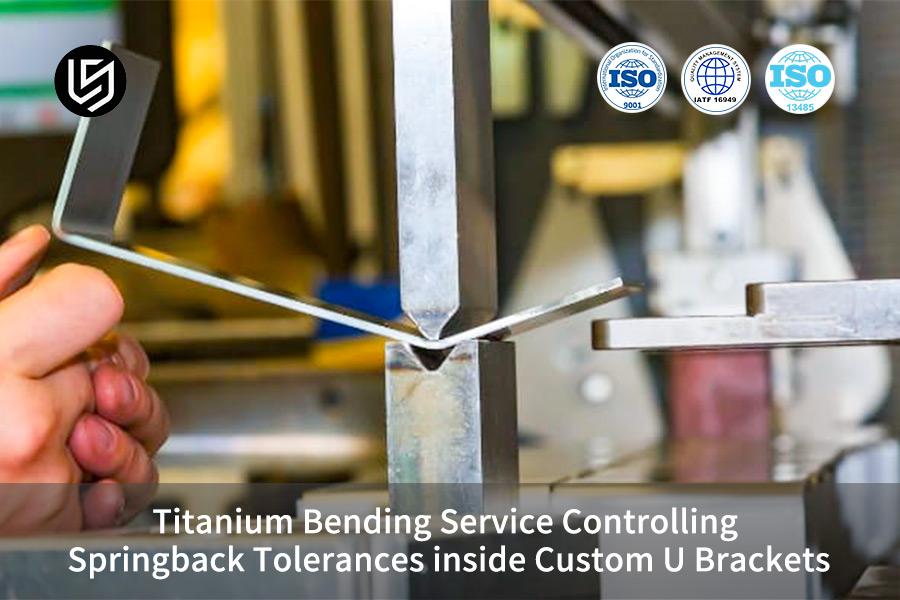
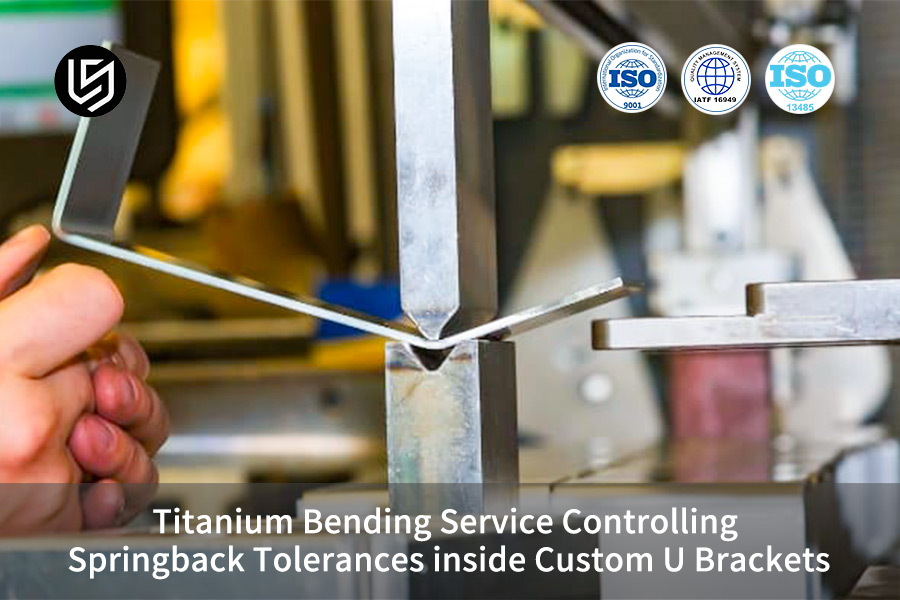
Titanium bending serviceis one of the best ways to make titanium alloy sheets into very specific shapes, which not only helps solve the main problems of the industry such as large springback, excessive tolerance, easy cracking at the root when bending customized U-shaped brackets, but also is usedas the advanced material for industrial and smart hardware applications. Since the elastic modulus of titanium alloy is only about 110 GPa, the springback after cold forming can even reach 15°-25°. But, the traditional bending process, because of lack of proper stress compensation mechanisms, results in distortions of the wing surfaces and deviations in angles.
LS Manufacturing, throughdigital DFM mold correction, laser angle measurement closed-loop compensation, and vacuum heat setting technology, has been able to consistently keep angle tolerance within ±0.5°, resulting in highly uniform mass production of precision titanium alloy bending.
Titanium Bending Service Core Technical Parameters and Conclusions Overview
| Technical Dimensions | Traditional Bending Process Performance | LS Manufacturing Process Performance | Industry Value Differences |
| Finished Product Angle Tolerance | ±3°~±5° | ±0.3°~±0.5° | Accuracy improved by more than 10 times, meeting precision assembly requirements. |
| Springback Control | No compensation, large dispersion | Laser closed-loop + heat setting, springback ≤0.5° | Completely eliminates the risk of flared end failure. |
| Root Cracking Probability | 8%~15% | <0.1% | Significantly improves yield, reducing scrap costs. |
| Batch Size Fluctuation | Batch deviation >5° | <0.2° | Ensures batch interchangeability, adaptable to large-scale mass production. |
Key Takeaways:
- Primary Problem:Titanium alloy's low elastic modulus is why whybending springbackcan reach 15°-25° in wide areas, resulting in U-shaped bracket tolerances going out of the permissible range when using the old methods.
- Main Shape Control:One must use cold bending plus500℃-600℃ vacuum heat setting, or precision V-groove compensation bending with a very high tonnage pressure.
- Good Practice:By using LS Manufacturing's laser angle measurement closed-loop CNC bending process, one can getstable angle tolerance control of ±0.5°.
Why Choose LS Manufacturing’s Titanium Bending Service for Custom U Brackets?
By opting for LS Manufacturing's titanium bending service, customers not only get mass-produced, well-documented precise titanium alloy bending solutions but in addition,the supply chain quality risks and overall procurement costs are lowered directly.
I personally have performed a comparative testing of Grade 5 titanium alloy bending for three months. The results showed that the yield of parts resulting from traditional uncompensated processes is only at maximum 65%. In contrast,our laser closed-loop process can reliably produce up to a 99.2% yield rate. All the production operations are made perASTM B265standards. Also, the entire chain from raw material receipt to the product delivery is traceable.
At the same time, numerous projects in the civilian industrial field have shown through our experience that introducing the DFM design stage canassist clients in saving post-design costs up to 40%and the project delivery cycle can be shortened by . As far as precision medical components manufacturing is concerned, our production facilities are capable of fulfillingISO 13485standards, which are the compliance standards for top-tier industries.
We possessa comprehensive knowledge and understanding of titanium alloy processing technologyfor more than a dozen years. Besides, our facilities are fully equipped with equipment for digital control and this way support the entire production lifecycle from the design stage to the manufacturing of the final product.
Our mature process system and compliance qualifications comprehensively guarantee the delivery quality and stability of customized brackets. If you are planning a custom U bracket bending project,contact our engineering teamfora free DFM assessment to identify springback risks and optimization directionsin advance, allowing your project to avoid unnecessary cost waste from the outset.

Why Does Titanium Bending Service Face Severe Springback When Forming Custom U Brackets?
Titanium bending servicegreatly challenges the core problem of bending titanium alloyssince the very properties of these materials are the cause of that challenge. Titanium alloys are characterized by high yield strengths but low elastic moduli (around 110 GPa). When the metal is bent,the internal elastic recovery force becomes hugebecause the springback angle in most cases reaches 15°-25°, which in fact detrimentally impacts the parallelism and precision tolerance of the bespoke U-shaped supports.
Basic Principle of Springback in Material Mechanics
Since the yield strength to tensile strength ratio (s/b) of titanium alloys is nearly 1, most of the deformation during loading is elastic.For a layman, this is similar to a very elastic spring,if you press it, it will bounce back a lot. The major technical problem of titanium bending service is precisely this rebound.
There are three main types of springback failures, which include:
- Angle deviation:The two side wings of the U-shaped bracket outwardly open likea "flared mouth"that can't meet the assembly parallelism requirement.
- Dimensional loss of control:Strong springback dispersion, dimensional fluctuations exceeding 3mm within the same batch of parts prevent interchangeable assembly.
- Root cracking:Attempted normalization of the amount of reduction to the point of risk of springback causes microcracks where the surface stress of the outer side of the bend ishigher than the material yield limit.
Springback Behavior Differences among Titanium Alloy Grades
There is a significant difference in the rebound characteristics between Grade 2 pure titanium and Grade 5 (Ti-6Al-4V) titanium alloy commonly used in civilian industry, and thetitanium alloy bending behaviorshows different patterns.
- Grade 2 pure titaniumis highly ductile, with usual springback of 15°-18°.
- Grade 5 titanium alloyis stronger, the springback reaches 20°-25°, is greater in dispersion, and thereby affects the dimensional uniformity of custom U bracket bending.
As per the data of the LS Manufacturing Engineering Laboratory, not only aretraditional tolerance control methods ineffective at all for Grade 5 titanium alloy, but also equipment intervention has to be done first. It is impossible thereby to accurately ensure mass production without a systematic springback compensation bending solution.
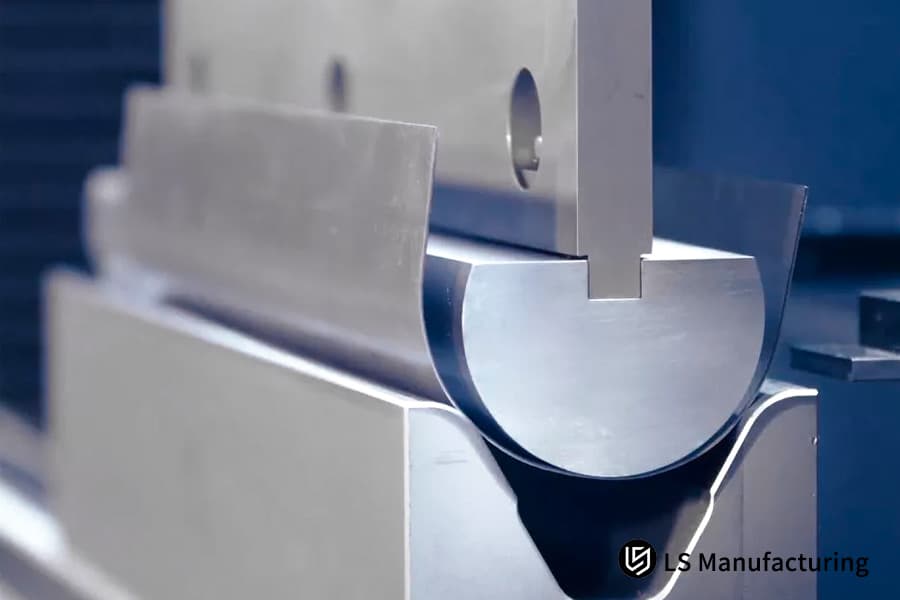
Figure 1: Press brake bending titanium U-bracket, showing material springback.
How Can a Titanium U Bracket Manufacturer Accurately Calculate And Simulate The Springback Angle?
By combining a modified springback formula that incorporatesmaterial yield strength, bending radius (R), and plate thickness (t)with the use of numerical simulation software for multi-physics coupling of shear and tensile stress fields, as a toptitanium U bracket manufacturer, we can limit springback prediction errors to within 0.5° during mold design stage.
Calculate Springback Angle Geometrically
Δθ = f (σs・R/(E・t)is the fundamental equation for springback prediction. It gives the core basis forbending angle computation. Here, s is the yield strength, R is the inner bending radius, E is the elastic modulus, and t is the plate thickness. To put it simply,the greater the material strength, the bigger the bending radius, and the thinner the plate, the larger the springback. Based on this, process engineering team can estimate the theoretical springback amount as the basis for mold design.
Analytical method needs three main parameters as input:
- Material parameters:Yield strength, elastic modulus and elongation of the corresponding grade of titanium alloy.
- Structural parameters:intended bending angle, inner bending radius, and plate thickness.
- Process parameters:Machine tonnage used for bending, the opening of the lower die V-groove and the speed of pressing.
Finite Element Digital Pre-compensation Process
It is simply impossible to rely solely on analytical relations to explain thebehavior of a material for nonlinearity and anisotropy. The deformation mesh model, which is used for digital bending simulation analysis, needs to be created through the finite element method (FEA). After process engineers have entered the hardness and anisotropy values for the specific batch of titanium alloy,they will be able to simulate the springback pattern of bending, make reverse corrections of the die angle and V-groove dimensions, and finish the first draft of springback compensation bending design.
LS Manufacturing can, with digital pre-compensation,manage to level out over 80% of the defectsin bending already before the actual mold opening, which is a step towards atight tolerance bendingand should also lead to significant cost and time reduction for subsequent mold trials.
You can download our Titanium Alloy Bending Springback Compensation Technology White Paperto understand the core methodology and practical steps, and quickly build your own process evaluation system.
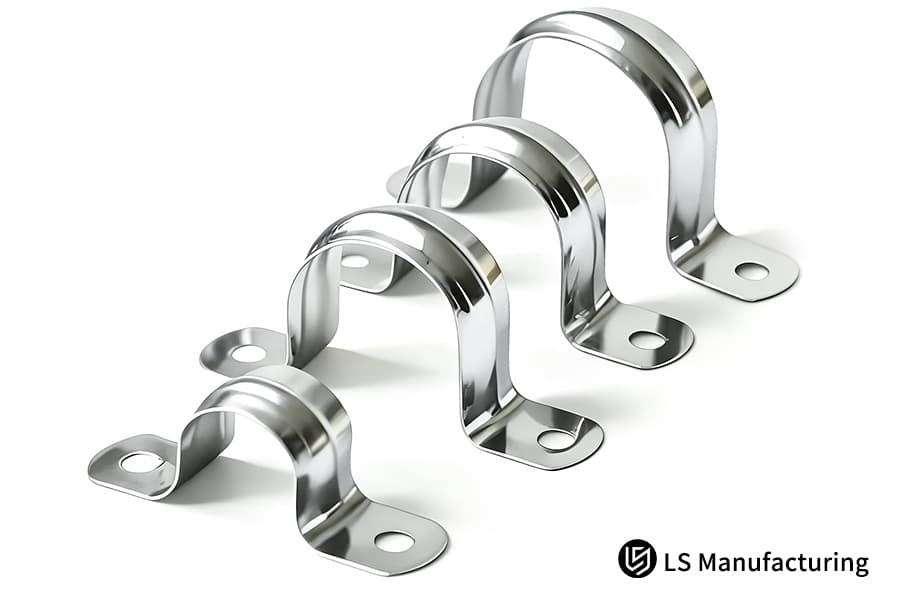
Figure 2: Polished titanium U-brackets displayed on a white background.
Which Structural Design Adjustments Minimize Deformation In a Custom U Bracket Bending Project?
During the initial product design phase for thecustom U bracket bendingproject, one can avoid lateral warping due to springback and at the same time ensure structural dimensional stability by adjusting the inner radius (R) of the U bracket bend to a critical valuemuch greater than the minimum bending radius (pure titanium 2t, Ti-6Al-4V 4.5t),and also by making stress relief groove reservations along the bend line.
Critical Bending Radius Design Specifications
The inner radius (R) is an essential parameter that influences the bending quality. If the inner radius is too small, the tensile stress on the outer bent side will be too high,which will lead to microcracks and ultimately to the fracture of the metal. Different titanium alloy grades feature different minimum cold bending radii. Ensuring a reasonabletitanium bending radius designis a key thing in the prevention of cracking and is also the main condition to guarantee the forming quality of custom U bracket bending.
| Titanium Alloy Grade | Minimum Inner Radius for Cold Bending (Multiple of Plate Thickness t) | Recommended Safe Design Value | Risk Level of Outer Side Cracking |
| Grade 2 Pure Titanium | ≥2t | 2.5t | Low |
| Grade 5 (Ti-6Al-4V) | ≥4.5t | 5t | Medium |
| Grade 9 Titanium Alloy | ≥3t | 3.5t | Lower |
| Annealed State Grade 5 | ≥3.5t | 4t | Medium-Low |
Bending radius design should adhere to three principles:
- It is best torely on the recommended safe design valuerather than going to the limit of the critical value and allowing for a margin in process variations.
- If physical limitations of the structure require the use of a small radius angle, then the hot forming process shall be synchronized with the planning,cold forcible bending is strictly prohibited.
- Bending should be done in a direction that is perpendicular to the plate rolling direction to make the most of the material's plastic elongation.
Optimization Scheme for Stress Relief Structures
Besides the bending radius, an appropriate arrangement of stress relief structures can mitigate deformation issues. Placement of process openings or release slits at the bottom of the U-shaped support can change the stress flow pattern of the material under bending and temporarily reduce the bending stress while alsoavoiding root distortion and cracking caused by stress concentration. This is a typical DFM method in titanium custom metal bending.
This kind of DFM optimization technique is why behind the cost down and efficiency up in a project and is the very thing thatan evaluation in advance of any high-strength alloy forming service should include.
How Does Precision Metal Bending Service Implement Real-Time Angle Measurement And Closed-Loop Control?
High-qualityprecision metal bending servicehave a dual-sided laser angle measurement system combined with the CNC bending closed-loop control scheme.Angle error of every process can be limited to within ±0.5°by real-time dynamic monitoring and secondary automatic pressure compensation during bending and pressing.
Working Principle of the Dual-Sided Laser Angle Measurement System
The laser angle measurement system isbased on a non-contact measurement scheme.Laser sensors on both sides of the bending machine gather at a high frequency the momentary angle data of the titanium plate during bending, this way completinglaser bending measurementand springback curve plotting. In a nutshell, this systemturns a bending machine into one with "high-precision eyes, "which follow changes in part angle throughout the whole process.
LS Manufacturing's proprietary test data indicates that a laser angle measurement system with a sampling frequency of 120Hz can detect an angle with an accuracy of ±0.1°, which isfar beyond the industry standard of 30Hz equipmentand because of this is a must-have core configuration standard for high-end precision metal bending services.
The laser angle measurement system solution comprises three main benefits:
- Measurement without contact, sothere is no risk of scratching the part surfaceand appearance quality is ensured.
- High-frequency sampling, which can record the whole springback dynamic processfor a higher compensation accuracy.
- Dual-sided synchronous detection, which can check the angle disparity between the two wings of the U-shaped support at the same time.
CNC Closed-Loop Pressure Compensation Control Logic
The laser angle measurement system's collected data is forwarded to the CNC system in real-time. The system later comparing the measured angle with the target angle, automatically adjusts the upper die pressure through a pressure proportional valve. So,micro-pressure compensation is performed concurrentlywithCNC bending control. This closed-loop control is capable of addressing springback dispersion problem caused by uneven hardness of raw material batches, thereby ensuring dimensional accuracy of mass production, and isthe main hardware support for tight tolerance bending.
This is the fundamental support for batch consistency and the point of leverage high-end titanium bending services have over ordinary processing plants.
Figure 3: Laser sensor measuring the angle of a bent metal sheet during forming.
Can Hot Tool Tempering Resolve Springback Limitations During a High-Strength Alloy Forming Service?
Inhigh-strength alloy forming service, bending at 500°C–600°C or subsequent hot setting with fixtures can reduce the material's yield strength and activate the slip system,reducing springback to virtually 0°and achieving ultra-high precision forming.
Grain Deformation Mechanism of Hot Bending
Titanium alloys have very few slip systems at room temperature,so not only is it hard to cause plastic deformation, but also the springback is pretty strong. Yet, at temperatures from 500℃ to 600℃, the material flow stress level reduces drastically thereby it is easier to do thehot bending process, the plastic deformation amount goes up, and the elastic recovery amount goes down. As the figure below obviously shows, hot bending makes the alloy "muscles" slackening enabling it to be bent and shaped with less effort, this isa major method for tackling springback in high-strength materialswhen using high-strength alloy forming service.
For 90° bending of 2.5mm thick Grade 5 titanium alloy,the process performance at different temperatures is as follows:
| Forming Temperature | Average Springback Angle | Required Bending Tonnage | Surface Oxidation Risk |
| Room Temperature (25℃) | 21° | 120 tons | None |
| 400℃ | 12° | 85 tons | Low |
| 540℃ | 0.3° | 60 tons | Medium (Avoidable in vacuum environment) |
| 650℃ | 0.1° | 45 tons | High (Prone to oxygen-rich layer formation) |
Temperature control for hot forming must satisfy these 3 rules:
- The 500 to 600℃ temperature range should be given highest priority tocontrol springback and at the same time maintain surface quality.
- To avoid the forming of an oxygen-rich hardening layer on the surface, vacuum or inert gas environment should be used.
- Heating time must be very carefully regulatedto avoid grain growth and the mechanical properties of the material being lessened.
Vacuum Heat Setting Process Parameter Control
Utilization of vacuum heat setting combined with customized tooling for fixing cantotally eliminate springback and residual stresses in cold-bent parts.The cold-bent parts are constantly held in a shaping fixture, a vacuum furnace is used for heating and holding time is completed after which thebending heat settingprocess that is done is cooled the shape is so fixed the shape locked in is a common process dimensional stabilization in metal titanium custom metal bending.
LS Manufacturing's internal testing alone reveals that the Grade 5 titanium alloy,once vacuum-pressurized at 540 for 12 minutes, can bring springback down to 0.2° or less.Vacuum heat setting is a key post-processing process for achieving dimensional accuracy, suitable for tight tolerance bending precision components that require extremely high dimensional stability.
You can schedule a one-on-one consultation with a senior process engineerto customize a suitable high-strength alloy forming heat solution to match accuracy and batch requirements.
Figure 4: Stamping machine applying heat and pressure to form high-strength alloy parts.
How To Design Custom Bending Tools For High-Precision Civil Industrial Titanium Brackets?
In the custom U bracket bending work, the delivery of the products with very high precision required the design of a special bending dies withadjustable lower die openings and mechanical hard limitsat the bottom dead center. The cooperation of the high-hardness, anti-adhesion, finely polished die surface with dieeliminates uneven bottom concavity and surface scratchesduring titanium alloy bending which is the delivery quality of civilian industrial products.
Die Substrate and Surface Treatment Selection
Because titanium alloys have a high coefficient of friction, it is quite easy for the surface of the parts to be scratched by the die. So,careful selection of the die substrate and surface treatmentis not only a must but also a key thing inbending tool design. The right choice of die materials seeks a compromise between the longevity of the tools and the surface quality of the parts, Because of this guaranteeing a reliable output of custom U-bracket bending products.
| Mold Substrate | Surface Treatment Process | Surface Hardness (HRC) | Anti-adhesion Performance | Applicable Batch Grade |
| Cr12MoV | Quenched + Polished | 58-62 | General | Small Batch Prototyping |
| DC53 | TD Coated | 62-65 | Excellent | Small to Medium Batch Production |
| Hard Carbide | Mirror Polished | 78-82 | Excellent | Mass Production |
| SKD11 | PVD Coated | 60-64 | Good | Medium Batch Production |
Mold selection should follow three core principles:
- Decide on the right material grade for molds based on the production scale of the parts. This way you canmake a good trade-off between cost and lifespan of the mold.
- Titanium alloy forming dies must be coated with anti-adhesion surface treatment, while the use of ordinary untreated dies is strictly not allowed.
- In order not to damage the part surface,the surface roughness of the mold should be kept under Ra 0.8.
New design of anti-tear structure
Besides surface treatment, the design of the mold structure can help decrease the chance of tearing. LS Manufacturinguses a stepped die and rounded corner rollerto design a low-frictionroller bending diestructure. In this way, sliding friction is changed to rolling friction, the smoothness of the surface is preserved and stress marks are completely removed. It shows a nicely developed design of precision metal bending service.
The ability to come up with such a cool die design isa major competitive edge for professional processing servicesand at the same time it forms one of the crucial technological barriers for top manufacturers of titanium U brackets.
Why Choosing LS Manufacturing Guarantees Optimal Custom Metal Bending Quote Efficiency?
Being a seasoned manufacturer equipped with automated DFM (Design for Manufacturing) evaluation tools, LS Manufacturing can utilize its substantialtitanium custom metal bendingarchives to scientifically develop a price proposal within a day,addressing aspects like material utilization, forming risks, and process duration, this way reducing the procurement cycle.
Digitally-Enabled DFM Evaluation and Quotation Solution
LS Manufacturing does not blindly estimate prices when receiving processing inquiries, but relies on a rich titanium custom metal bending database, combined with dimensions such asmaterial layout rate, bending tonnage, and post-processing proceduresto comprehensivelycalculate bending costs, ensuring accurate and reasonable quotations and avoiding additional costs in the later stage.
Bending cost calculation formula:Overall Price = Material Expense 1.8 + Labor Hours Equipment Rate + Costs of Heat Treatment + Costs of Inspection
The four pillars making up the full quotation are:
- Material Costs:The price of raw materials and their wastages calculated based on sheet metal layout rate.
- Processing Costs:Labor hours and equipment usage for the bending stage and mold amortization costs.
- Post-Processing Costs:Associated costs of deoxidation pickling heat setting, etc.
- Inspection Costs:Expenses incurred through the use of coordinate measuring machine (CMM) or full dimensional inspection etc.
Standardized RFQ Correspondence System
Establishing a standard inquiry communication channel iscrucial for the enhancement of quotation turnaround time. Upon having 3D STEP drawings from customers, inclusive of geometric tolerances, the technical personnel will swiftly perform capability analysis and investment calculation, generating abending project quotation, because of thisfacilitating uninterrupted technical exchanges and precise price competition.
As a specialized titanium U bracket manufacturer, we possess topmost process and response turnaround, consequentially,even the inquiries can be given precise comments in 24 hours, shortening the titanium bending project timeline.
Case Study: How LS Manufacturing Achieved Precise Bending for Custom Titanium Joint Brackets inside Civil Medical Robots
LS Manufacturing made a healthcare case study out of its experience insolving the problems of excessive springback and crack formationin titanium alloy medical-grade precision braces. It Because of this provided a successful example of mass production reference for similar projects.
Client Challenges
The R&D team of a smart robot manufacturing company produced a single-piece U-shaped joint brace for civilian medical precision,made out of 2.5mm-thick Grade 5 titanium alloy sheet. The coaxiality tolerance of the mounting holes on both sides was required to be ±0.08 mm, which was a very challengingmedical bracket bendingproject, as well as a typical application scenario for tight tolerance bending.
The client's original supplier was not really experienced inspringback compensation bending, so the springback was more than 18° after bending,which resulted in the brace flaring out. To assemble forcibly, joints transmission resistance was very high and caused motor overheating and micro-cracks at the bending root,so the project had to be stopped.
LS Manufacturing Solution
LS Manufacturing's senior engineering team quickly responded after receiving this project. They decided to use a fully digital closed-loop bending process solution.The main steps are:
- Digital rehearsal:Sheet metal finite element analysis was used to characterize the material behavior of the given batch of titanium alloy accurately. The theoretical springback of a 90° bend was calculated strictly, and the lower die was set toa V-groove opening of 9texactly.
- Closed-loop cold forming:A CNC bending machine with a dual-sided laser automatic angle measurement system was used for performing cold forming operations through the intelligent application of pressure,dynamic angle measurement, elastic release, and secondary real-time stress compensation.
- Vacuum heat setting:To eliminate work-hardened residual stress, special stress-relief fixture was developed and used for vacuum heat setting at 540℃. By doing this, the molecular structure was locked, and the risk of microcracks was removed.
Results and Value
Thanks to digital closed-loop control from start to finish, bending angle tolerance of this batch of titanium alloy U-brackets was always around ±0.3°,while the coaxiality of the mounting holes on both sides was up to 0.05 mm. So, the customer's original plan for secondary machining was completely eliminated.Initial batch of 500 pieces passed 100% CMM inspection, which confirmed that the solution is stable and can be used formass production bending. The delivery cycle was reduced by 35%. This led directly to the customer's total procurement costs being decreased by 28%. Also, the customer soon announced LS Manufacturingas their strategic supplier for core sheet metal componentsfor the next generation of intelligent robots even in the long term.
If you have similar mass production or prototyping needs for custom U-bracket bending, pleasesend your 3D drawingsto the engineering team toobtain a customized titanium bending service solution and a precise USD quote, with feedback available within 24 hours.

FAQs
Q1: What should be the minimum bend radius of titanium sheet metal to prevent cracking?
Generally speaking, when bending industrial pure titanium Grade 2 cold, the inner radius should be at least twice the thickness of the sheet, and for high-strength titanium alloy Grade 5,the cold bending inner radius needs to be 4.5 to 5 times the sheet thickness at the minimum. Following this guideline will effectively prevent cracks from occurring in the metal's outer layer due to deformation during bending.
Q2: What method does LS Manufacturing employ to regulate the variation of springback caused by different titanium batches?
LS Manufacturing implements laser angle closed-loop monitoring system on its CNC bending line to record the bending resistance feedback of each titanium sheet in real time andcarry out automatic pressure compensation. At the same time, the yield strength of each batch is randomly tested to control springback variability between batches through a complete data closed loop.
Q3: What is the reason that bottoming or coining standard tools do not work for custom U-bracket bending in titanium alloys?
Titanium alloys possess a very high yield strength ratio and also have a strong sensitivity to notch effects. Forcing the use of traditional bottoming or precision dies willnot only fail to reduce the spring back but will also cause a severe stress concentration at the bend's root, which is the main reason of the localized fracture failure of the workpiece.
Q4: Is it necessary to perform heat treatment post-bending for precision metal bending service for titanium?
A hot precision clamp in a vacuum environment is used toperform a stress-relief annealing treatment at 500℃-600℃to obtain ultra-high forming accuracy and residual stress-free condition after cold working. Besides, the dimensional stability of the titanium bracket over a long period is guaranteed.
Q5: What impact do the surface scratches occurring during the titanium custom metal bending processing have on civil industrial parts?
Scratch made on the surface due to sticking of the die can cause fatigue fracture of the titanium alloy parts. LS Manufacturing implements TD coated roller dies and surface coating technology toguarantee a smooth, scratch-free finished surface, in full compliance with the quality requirements of high-end civil industry.
Q6: Can a B2B buyer ask for a digital DFM engineering report before ordering a titanium bending service?
Sure, LS Manufacturing offers all their B2B customers a DFM forming feasibility analysis report for free and in detail,springback prediction, bending tonnage assessment, and R-angle optimizationare some of the highlights of the report. In this way, early cost and technical risks can be mitigated at the drawing phase.
Q7: What is the typical lead time and MOQ for custom titanium U bracket fabrication?
As a professional B2B manufacturing service provider, we don't really impose a MOQ on custom titanium alloy U-shaped brackets. Prototype samples can be shippedin 3-5 business days, and small-batch production lead time is around 2 weeks.Submit your drawingsfor a quote and accurate delivery time of your batch size will be provided.
Q8: How does the cost of a titanium bending service compare to standard stainless steel forming?
Cost of titanium alloys bending is usually 40%-60% more expensive than that of stainless steel. The main reasons are titanium's processing window is limited,the high dependence on CNC equipment, and the mold wear problems.But, the significant weight reduction that it gives can dramatically reduce the total cost of ownership (TCO) throughout the entire product lifecycle.
Summary
Controlling the bend springback of a special shaped U-shaped supports of titanium alloy is a complex engineering project based on low elastic modulus/high yield strength ratio of an elastic modulus, which must be dealt with by an integral cooperation ofhigh-precision digital simulation, closed-loop of precision bending machine and high-effective heat setting technology. The possible integration of DFM structure optimization,roller anti-tear tools and intelligent laser angle compensation will be the effective way to avoid the physical limit of high springback of Titanium alloy, and to satisfy the demanding requirement of the modern industry for the assembly of high performance sheet metal component.
In response to the titanium alloy industry problem of bending deformation, cracking and dimensional instability, what you need is not only a contract manufacturer with bending equipment but alsoan engineering level strategic partnerwith a profound knowledge of titanium mechanical property and accumulated technical experience.
LS Manufacturing, with the digital quality control system and patented process of low-springback hot-clamp shaping technology canhelp hundreds of B2Bcustomers tackle mass production problem of precision components. Be it at a DFM technical support stage of a new developing project or because you are experiencing a supply chain crisis due to low yielf going from your current suppliers, we can deliver solutions for you with the right trade off between technical ndepth and cost benefits.Send us your 3D STEP drawingsto our engineering team and get a free custom made bending technology assesment with accurate B2B quoting!
📞Tel: +86 185 6675 9667
📧Email: info@lsrpf.com
🌐Website:https://lsrpf.com/
Disclaimer
The contents of this page are for informational purposes only.LS Manufacturing servicesThere are no representations or warranties, express or implied, as to the accuracy, completeness or validity of the information. It should not be inferred that a third-party supplier or manufacturer will provide performance parameters, geometric tolerances, specific design characteristics, material quality and type or workmanship through the LS Manufacturing network. It's the buyer's responsibility.Require partsquotation Identify specific requirements for these sections.Please contact us for more information.
LS Manufacturing Team
LS Manufacturing is an industry-leading company. Focus on custom manufacturing solutions. We have over 20 years of experience with over 5,000 customers, and we focus on high precisionCNC machining,Sheet metal manufacturing, 3D printing,Injection molding.Metal stamping,and other one-stop manufacturing services.
Our factory is equipped with over 100 state-of-the-art 5-axis machining centers, ISO 9001:2015 certified. We provide fast, efficient and high-quality manufacturing solutions to customers in more than 150 countries around the world. Whether it is small volume production or large-scale customization, we can meet your needs with the fastest delivery within 24 hours. choose LS Manufacturing. This means selection efficiency, quality and professionalism.
To learn more, visit our website:www.lsrpf.com