English



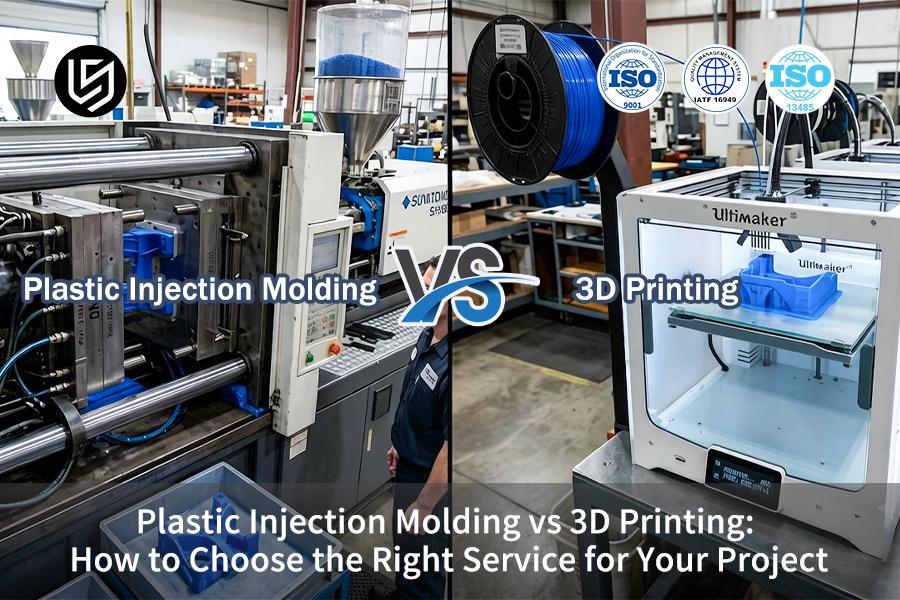
Plastic injection molding vs. 3D printing services helps solve the important decision issue that faces many engineers working in quickly-evolving industries, since the wrong first choice in processing may cost them the millions invested in mold tooling, or result in product failure from material anisotropy. The fundamental problem is not about choosing prototype vs mass-production stages but in measuring the actual return on investment in that tricky zone of 500 to 5000 units, which traditional methods do not address in terms of plastic behavior during shear or cooling.
With this analysis, you get an apples-to-apples comparison based on internal factory data, which includes the simulation curves of warpage using FEA technology for both PEEK and PA12-CF, so that you can calculate the break-even point. What that means is that you have an effective model that will help you to cut down CT and TPC by as much as 35%.
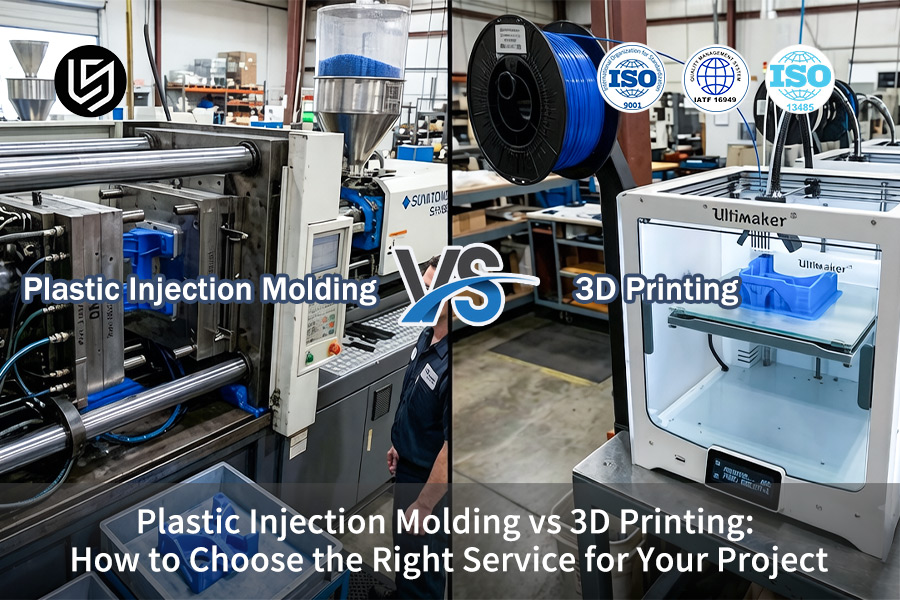
Plastic Injection Molding VS 3D Printing: Service Selection Quick-Reference
| Key Decision Factor | Plastic Injection Molding | 3D Printing (Additive) |
| Optimal Production Volume | High volume (>1,000 parts). | Low volume (<100 parts) and prototypes. |
| Lead Time to First Parts | Long (weeks to months for tooling). | Rather short (hours to days). |
| Part Cost at Volume | Per-part cost is very low at scale. | Part cost remains high and there are no economies of scale. |
| Material & Mechanical Properties | From standard commodity thermoplastics to high-performance engineering grades, with isotropic properties. | Limited material selection; often anisotropic properties, inferior to plastic injection molding parts. |
| Design Complexity & Freedom | Complexity can be high, although within constraints of moldability (draft, uniform walls). | Highest geometric freedom; can make internal lattices, undercuts, and organic shapes at no additional cost. |
| Surface Finish & Tolerances | Consistent, repeatable finish (SPI standards) and tight tolerances (±0.1mm). | Layer lines are visible; post-processing is then often required to achieve a smooth finish. Tolerances normally ±0.2mm. |
Key Takeaways:
- Volume is the Primary Decider: The cost break-even point is around 100-1,000 parts. At lower volumes, 3D printing is cheaper; at higher volumes, plastic injection molding prevails.
- Time vs Money: 3D printing gives you speed for prototyping; plastic injection molding involves initial costs (money and time) that eventually bring part cost savings.
- Material Drives Function: When your application demands certain properties of engineered plastics (e.g., chemical resistance or impact resistance), plastic injection molding is the way to go.
- Complexity Has Different Meanings: Molded “complexity” like ribs or bosses is a job for plastic injection molding; "unmoldable" complexity like hinges or lattices is impossible without 3D printing.
Why Trust This Guide? Practical Experience From LS Manufacturing Experts
The Internet is full of theories on how to compare plastic injection molding and 3D printing. Our guide differs. It’s written by our very team that decides whether or not to spend $50,000 on a mold for a part that will cost $500 if printed every single day. Our approach stems from the solid cost-modeling methodology for advanced manufacturing developed by the National Institute of Standards and Technology (NIST).
We work in industries where making the wrong call will waste six figures – whether that means creating 10,000 medical device housings instead of 5 prototypes, or producing flight-ready aerospace ducting instead of a wind tunnel test model. We use industry-standard design specifications in our process validation for critical applications, based on those set out by the Association Connecting Electronics Industries (IPC) for electronic assemblies.
We’ve paid for our wisdom in failed projects and succeeded through optimized processes. We know the exact unit level where injection molding becomes cost-effective, what geometries make 3D-printed parts anisotropically weak, and why a 2-degree draft will reduce mold costs by 15%. Our manufacturing-verified information will help you determine the best process without falling into common traps involving unnecessary tooling, insufficient prototyping, or prohibitive unit economics.
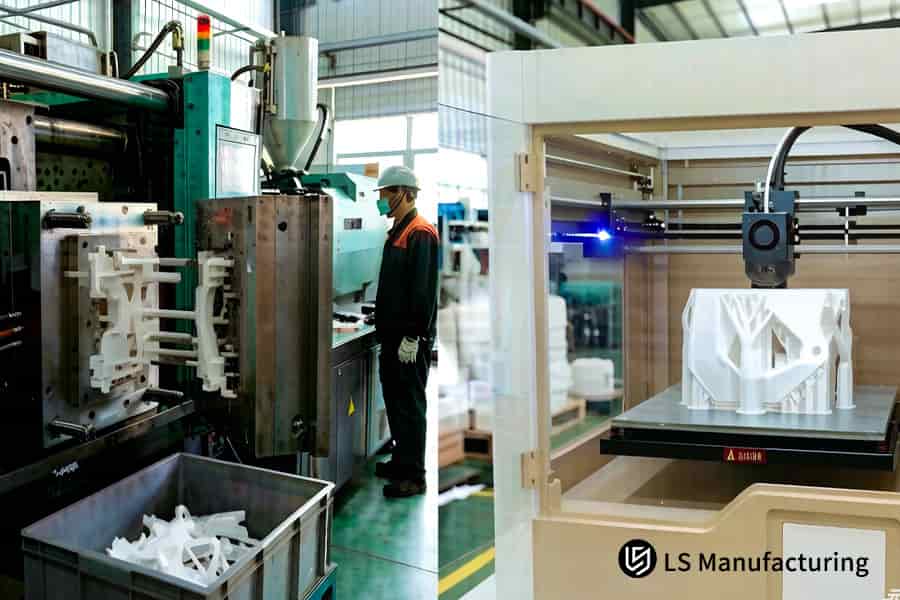
Figure 1: Plastic injection molding vs. 3D printing services contrast high-speed molding on the left with additive layering on the right.
Which Mechanical Performance Bottlenecks Determine Your Structural Part Processing Technology Selection?
In terms of making a concrete decision between plastic injection molding vs. 3D printing services for structural applications, beating the anisotropic mechanical limitations is essential. When considering obtaining industrial manufacturing components, using precision plastic injection molding will be backed by facts guaranteeing functional performance. This discussion aims to shed light on the critical mechanical limitations in order to aid you in your technology selection decision.
| Aspect | Industrial SLS 3D Printing | High-Pressure Injection Molding |
| Process Basis | The layer-based process makes material properties directional. | The process results in homogeneous filling and curing in a sealed mold. |
| Z-Axis Tensile Strength | Suffers from an 15-25% anisotropy (weakening of properties). | Nearly isotropic; no weakening of properties along the Z-axis. |
| Cyclic Load Performance | May cause early failure when not optimized for cyclic loads. | Eliminates premature part failure due to ≥80 MPa alternating loads when engineered plastic injection molding. |
| Primary Control Lever | Laser settings and temperature of the powder bed. | Material selection and prediction based on Moldflow analysis. |
The key benefit for mission-critical applications lies in the predictability of isotropy. By virtue of the data-centric approach of high-pressure plastic injection molding, the variable nature of anisotropy found in 3D printing is avoided, providing direct benefits through reduction in the probability of in-service failures. In the context of B2B custom processing, it comes down to finding companies with the capabilities of tensile strength optimization and custom plastic injection molding.

How Do Geometric Feature Constraints Dictate Your Rapid Prototyping Production Strategy?
The geometry of the parts determines what the feasible way of manufacturing the product will be. Wall thickness, draft angle, and other characteristics form the limits within which the product can be manufactured. Either custom injection molding service or 3D printing service can be chosen depending on the geometry of the parts. In turn, a formal DFM evaluation helps bridge the gap between design and production.
Decoding Hard Geometric Limits
Different technologies have their limitations that cannot be ignored. Low-volume plastic injection molding involves maintaining uniform wall thickness (1.5–4.0mm) and draft angles of at least 1.5° to avoid defects. On the other hand, industrial selective laser sintering printing allows using thin walls with no more than 0.8mm thick and draft-free lattices. Compliance with the relevant rule set allows you to save time for future redesigns.
Proactive DFM Mitigates Defect Risk
DFM evaluation actively evaluates manufacturability under those geometric feature constraints. In case of molding, the analysis evaluates flow and cooling behavior to forecast possible warpage, while in case of printing, it recommends appropriate positioning of support structures. The process translates an otherwise abstract concept of risk into concrete feedback to optimize design, thus ensuring you get a prototype that both matches your dimensions and represents manufacturing behavior.
Aligning Prototype Strategy with Production Goals
It should work for both testing and scaling purposes. Make sure to use 3D printing service for fast and form-and-fit testing for geometries without restrictions. To get a more precise test and check true cooling and stress behavior, you need plastic injection molding with materials suitable for production.
Translating Constraints into a Clear Action Plan
The idea is to have data-driven and certified information fast enough. With a service that will give you DFM evaluation within hours, you will have everything ready to go. You will get a detailed report about feature clashes, recommended tolerances, and a process-based strategy. This way, you will convert your geometry constraints into DFM data, guaranteeing your schedule and budget.
With the help of this model, you can choose the prototyping process according to measurable geometry-based rules. It favors DFM analysis that will reduce risks during the development process and give you data for making decisions based on your prototyping and future technical plastic injection molding production objectives. Define your prototyping strategy based on geometry, not guesswork. Leverage our DFM analysis to receive a clear strategy report and production pathway for your design.
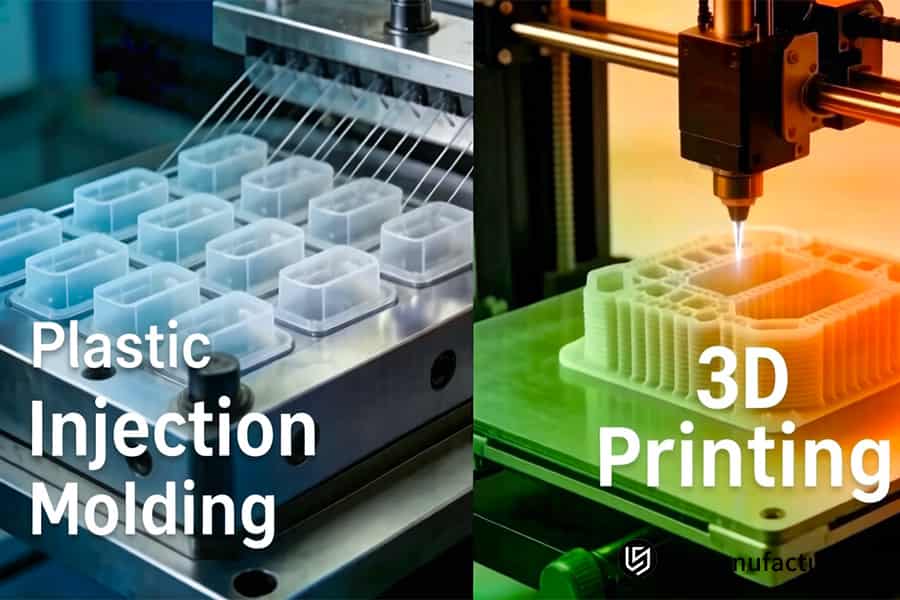
Figure 2: The diagram shows plastic injection into a mold on the left and layered 3D printing on the right for part creation.
Where Is The Precise Volume Tipping Point For Manufacturing Cost Amortization?
Your choice between additive manufacturing and plastic injection molding depends on determining the volume at which processing cost amortization becomes critically important for the project. In this way, we give you a clear financial model that is built around the example of an automotive grade PA66-GF30 connector. It helps you find the right solution without over-investing into the tools or paying too much for individual parts.
Decoding the Core Cost Drivers
- Additive Path: $0 in NRE mold fees.
- Your Takeaway: High, constant per-part cost ideal for low-volume validation.
- Molding Path: Significant upfront NRE mold fees.
- Your Takeaway: Very low, stable variable cost, enabling low-cost plastic injection molding at scale.
Pinpointing the Economic Crossover
The real-world cost comparison injection molding 3D printing for a typical 100×50×30 mm product will be used to determine the point where each respective ROI manufacturing curves crosses over.
- For Volumes ≤350: The upfront costs for additive manufacturing drop as much as 60%.
- For Volumes >1,000: Costs per unit become exponentially lower due to molding, making it the obvious choice for high-volume plastic injection molding.
Building a Phased Sourcing Strategy
- Validation Phase (<500 units): Consider 3D printing for prototype manufacturing.
- Scaling Phase (>1,000 units): Ensure you choose injection molding to ensure the most cost-effective per-unit production possible.
Translating Analysis into an Actionable Plan
- Action: Ask for a dedicated analysis and a comprehensive DFM report.
- Outcome: Get a clearly defined financial basis for your decision-making process in regard to durable plastic injection molding scalability strategy.
The model provided does away with all guesswork associated with making volume-based decisions. You will be able to get what is necessary to make all of your decisions regarding investments in tools and minimize the risk involved in scaling up production. With such a strategy, you will be confident in handling the transition into production through prudent investment of your capital resources in your complex plastic injection molding projects.
Why Do Surface Finish And Dimensional Tolerance Precision Dictate Your Supplier Standard?
Surface finish and accuracy serve as clear cut standards that distinguish between prototype and production. In situations where perfection in fit and finish is mandatory, your supplier’s competence in high precision manufacturing is vital. This article supplies you with the information required to assess a plastic injection molding service and confirm their ability to deliver.
| Aspect | Industrial 3D Printing (SLS/SLA) | Precision Plastic Injection Molding |
| As-Built Surface Roughness (Ra) | Ra value of 6.3-12.5 μm due to existence of layer lines. Exhibits a staircase-like appearance. | Capable of achieving finishes of SPI-A2 rating (Ra<0.05 μm). |
| Achievable Dimensional Tolerance | Dimensional tolerance is typically within the range of ±0.1-0.3% of the dimension, depending on the orientation and thermal stress. | Conformity to dimensional tolerance standards of ±0.02mm. |
| Path to Improved Finish | Requires extensive finishing after manufacturing process which could alter significant dimensional parameters. | Surface finish is crucial; a high gloss as well as texturing could be done using molds during optical-grade plastic injection molding process. |
| Quality Verification & Data | Not easy to verify post-manufacturing process since measurements would not be connected to the production run data. | Validated using in-line process inspection and reported with CMM measurements. |
Based on the above data, tight-tolerance plastic injection molding is required for flawless assembly processes. It offers guaranteed consistency and high-quality surface finishes, allowing for smooth and seamless assembly. Selecting an experienced company who provides proven custom metal and plastic processing through data will result in quality and consistent parts without assembly defects.
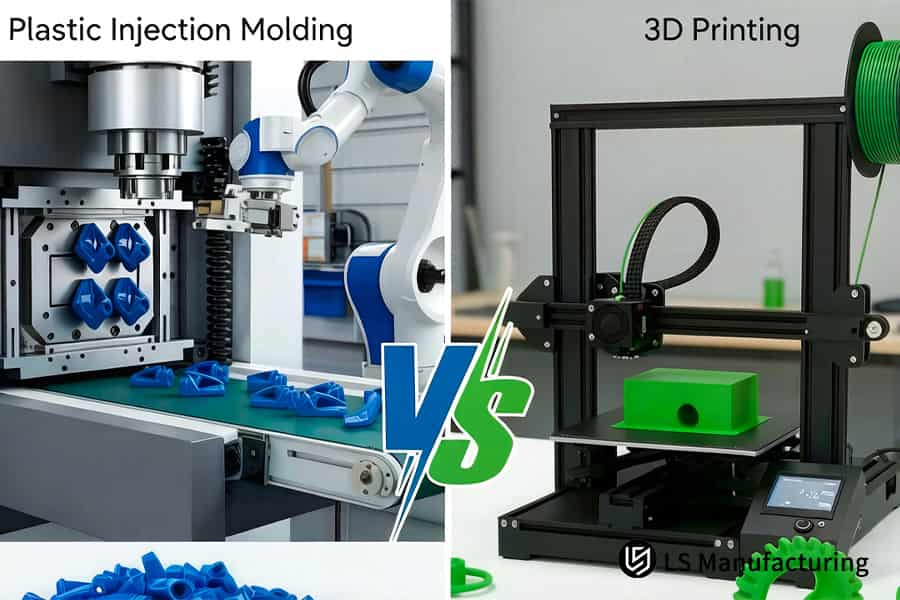
Figure 3: A robotic arm extracts blue thermoplastic parts from a mold while a 3D printer deposits green ABS filament.
How Can Injection Molding VS Additive Manufacturing Lead Times Impact Project Scheduling?
Project lead times depend on the basic flow of the process that you select. Injection molding vs. additive manufacturing offers a crucial difference in terms of a critical path. The analysis below examines the differences in the timelines for each option to highlight how the optimal choice and concurrent operation of these processes can help reduce your schedule for industrial production scheduling more than 40%.
Initial Part Delivery: Hours vs Weeks
The biggest difference in time comes from the very beginning of the project. With industrial additive manufacturing, initial article manufacturing is completed in less than 24 hours after obtaining CAD approval. On the other hand, although you may get rapid tooling services, even in such a case, you will need 15-21 working days to make and test your first molding sample.
The Mold-Making Critical Path and Compression Strategies
The central timing issue involved is the forced mold fabrication process, which is a sequential operation involving design, CNC, EDM, and polishing. Nevertheless, taking advantage of the agile plastic injection molding using parallel engineering like simultaneous acquisition of mold base and CAM programming can cut the time by 25-30%. This will help you reduce the amount of time to obtain certified production parts.
Implementing a Phased Hybrid Approach for Optimal Speed
The ideal solution involves employing the two processes in stages. Start off by making the first prototypes and producing between 50 and 500 units of your product using on-demand additive manufacturing. Simultaneously, start designing and making the mold required for your accelerated plastic injection molding. This way, while you have been able to test the demand, your tooling will be ready and you can start large-scale production at once.
From Linear Wait to Parallel Execution: Quantifying the Gain
The transition from the conventional linear approach to a more integrated parallel approach is crucial for cutting down timelines. Incorporating manufacturing engineering right at the last phase of design development in the context of bridging-tool plastic injection molding allows a decrease in total design-to-production cycle of up to 40% due to proactive planning, eliminating costs and delays caused by design alterations, thus ensuring the fixed date of the product release.
Such timeline analysis provides a specific roadmap for aligning manufacturing activities with project stages. The analysis clearly indicates that the optimal combination of additive manufacturing for the initial design flexibility and parallel engineering for the molded production gives the most efficient results, which are vital in such competitive conditions of product release.
What Custom Material Selector Matrices Guarantee High Temperature And Chemical Resistance?
Product durability in adverse environments is fundamentally determined by material selection. The following custom material selector matrix will guide your decision-making process to help you determine whether choose injection molding or 3D printing should be used in order to increase the reliability of your product at high temperatures and under corrosive conditions.
Material Library Breadth: Additive's Niche vs. Molding's Universe
- 3D Printing's Palette: Advanced PEEK and PPSU plastics for prototype testing.
- Injection Molding's Domain: More than 1,000 types of advanced, optimized materials.
- Your Gain: High temperature plastic injection molding to optimize materials.
Targeted Solutions for High Heat and Corrosive Media
- High-Temperature Performance (>150°C): Require plastics with high HDT and low creep.
- Critical Path: Use advanced plastic injection molding materials such as PEEK.
- Chemical Resistance & Compliance: Needs confirmation and certification.
- Your Action: Rely on a chemical resistance supplier’s library of compounds with FDA/UL94 certifications.
From Data Sheets to Guaranteed Performance
- Beyond Published Specs: The real-world performance requires specialized processing expertise.
- Your Assurance: A specialist in engineering plastic processing will provide you with guaranteed specifications from your data sheet.
- Leverage Pre-Validated Libraries: Utilization of already certified materials streamlines the compliance process.
- Your Gain: Reduced regulatory time spent and qualification overhead for mission-critical applications.
Applying the Matrix to De-Risk Development
- Quantify the Environment: Define your environmental factors (maximum temperature, chemicals, and duration).
- Filter and Select: Make a choice based on a matrix, reducing options to 3-5 materials.
- Prototype with Intent: Prototype using certified-material plastic injection molding service.
- Your Outcome: Evidence-based solution with no chance of field failure.
It turns material selection from a speculative approach to an engineering science. The framework offers the necessary actions and requirements for selecting the material in such a way that ensures performance under challenging conditions, which requires a mandatory process of due diligence in engineering design of mission-critical elements in regulated industries.
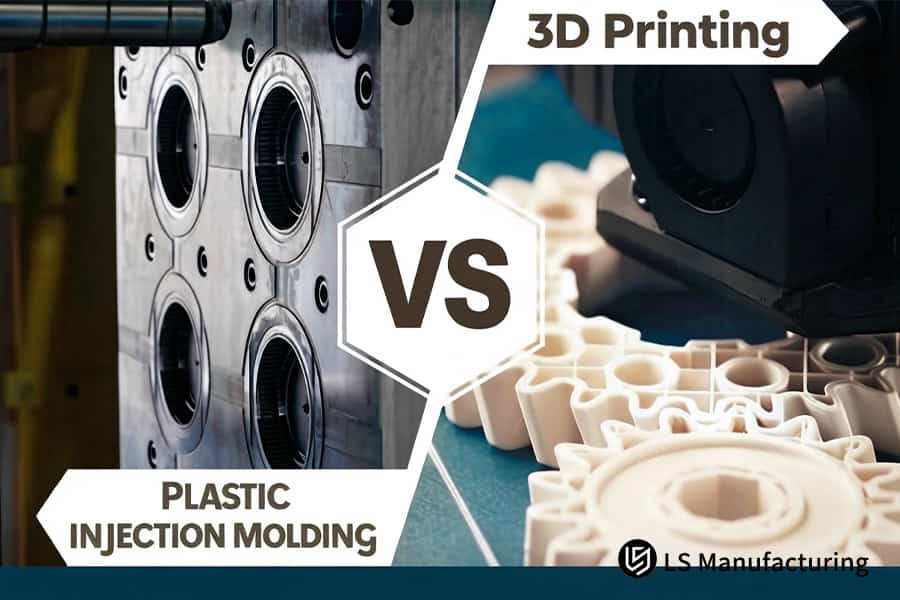
Figure 4: The LS Manufacturing floor visually contrasts the high-speed plastic injection molding process with 3D printing technology.
How Did LS Manufacturing Optimize A Medical Device Housing With Custom Injection Molding?
This case details how LS Manufacturing resolved a critical time-to-market and performance challenge for a European OEM’s portable defibrillator. Facing failed drop tests and prohibitive costs with 3D printing, the client needed a rapid, reliable custom injection molding service for production. Our integrated strategy of rapid tooling project execution delivered a certified, high-strength medical device housing weeks ahead of schedule.
Client Challenge
The initial 3D-printed housings did not meet the required standards for a 1.5m drop test, making the company urgently seek for a certified-medical plastic injection molding process. The prohibitive unit cost of printing made volume validation impossible, whereas the lengthy 25-30 days lead time for a steel mold put them at risk of missing their trade show deadline.
LS Manufacturing Solution
After just one hour into working on the project, our experts carried out a DFM process. We suggested a two-phase approach. We began by delivering ten reinforced SLS prototype units within 48 hours for their upcoming presentation. In parallel, we set up the production-ready plastic injection molding using a fast aluminum mold with a medical-grade PC/ABS material.
Results and Value
The final housings passed all the required 1.5m drop and biocompatibility tests. Rapid tooling reduced total NRE costs by 45%. Most importantly, our integrated project management allowed a complete batch of 1,500 housings to be delivered two weeks ahead of schedule. This ensured a successful product launch, resulting in our high-reliability plastic injection molding partnership.
This is a great example of one of the main strengths of LS Manufacturing, namely its expertise in using hybrid manufacturing solutions to handle complex, urgent engineering issues. Using advanced knowledge of materials along with flexible tools and processes, we provide not only parts, but guaranteed performance and access to the market for our customers within the medical field, among others.
To lock in a 45% NRE reduction and a 2-week early launch for your device, contact us today to discuss a rapid aluminum tooling and materials solution, and receive a firm quotation.

Why Can Rapid Prototyping VS Production Molding Co-Exist In Your Supply Chain?
The perception that rapid prototyping vs. production molding can only exist independently in the manufacturing process poses a risk in terms of a vulnerable supply chain. It is essential to develop a hybrid supply chain that utilizes both technologies for maximum benefit in the relevant phase of the product life cycle.
Stage 1: EVT/DVT – Accelerated Learning with Additive
For testing and validation purposes during engineering and design validation, speed and agility become key considerations. On-demand plastic injection molding of prototypes is impractical. In such cases, industrial 3D printing can provide functional parts within 24-48 hours. Such a solution allows for faster form, fit, and functional testing, thus shortening the early development cycle in weeks by not requiring prototype tooling to be produced.
Stage 2: PVT – Bridging to Production with Hybrid Tactics
For pilot validation, you require parts that behave similarly as the final production parts. This is where a hybrid supply chain performs very well. In such a scenario, make use of 3D printing technology to modify the part on-the-fly for the last design change required. Meanwhile, go ahead and begin production with plastic injection molding technology with the use of rapid aluminum molds.
Stage 3: SOP & Beyond – Scalable, Responsive Volume Production
Once in production, the concern is more around quality, cost, and scale. Here, your supply chain partner will transition to the use of hardened steel molds. However, the synergy happens when changes are required for your design or when you need spare parts. Rather than making modifications for an expensive mold for a limited production run, switch to scalable plastic injection molding with rapid tools from your supply chain.
Quantifying the Agile Advantage: Risk Mitigation and Speed
With the model you get complete protection against all risks associated with your product throughout its entire lifecycle through quantified manufacturing agility. The time spent on transferring from one supplier to another is cut down by the absence of the usual 6-8 weeks wait period. The single digital thread and quality system allows you to react rapidly and flexibly to any changes of demand and even engineering design.
This paradigm represents a new way of doing things by offering a robust, single-partner integrated plastic injection molding solution that will be flexible enough to adapt to changes in the demands of your product. Your selected partner will not just be a high volume production supplier, but rather will provide you with a competitive edge.
FAQs
1. Is 3D printing always cheaper than injection molding for micro-batches?
Not necessarily. 3D printing is relatively cheaper for batches ≤350 items since there is no tooling cost. However, when considering simple parts with a batch total larger than 500 pieces, LS Manufacturing's aluminum injection molding becomes less expensive owing to a significant drop in cost per item when the tooling cost is amortized across the batch size.
2. Can 3D printed parts achieve the same tensile strength as custom injection molding components?
Most probably not since they will not be able to provide the isotropic level of strength as molded parts. There is a reduced Z-axis (layer) strength by 15-25%. In case parts need at least 80 MPa of tensile strength, then only injection molding will suffice as it guarantees the required strength.
3. What is the typical lead time difference between these two custom services?
It is clear that parts using 3D printers can be made faster since they take just 24-48 hours and are then sent via fast delivery airfreight. However, parts using rapid injection molding technology by LS Manufacturing, which involves aluminum mold, have reduced the usual 25-day period to 11-14 days.
4. Which manufacturing process offers better surface quality for high-end electronic enclosures?
The surface finish in injection molding is significantly better. It allows for the creation of surfaces with SPI-A2 quality level (Ra ≤0.05 µm) without additional treatment. Injection molding produces no "stair-stepping" effects common for 3D-printed products and guarantees the flawless surface finish that is needed for consumer electronic and automotive parts.
5. Can I use the exact same CAD model for both plastic manufacturing services?
Not recommended. CAD designs intended for injection molding should have ≥1.5° draft angles and walls with constant thickness (1.5-4.0mm) in order to facilitate demolding and filling. LS Manufacturing offers free DFM service to improve the design based on the manufacturing technique you chose.
6. Are fire-retardant materials available in industrial 3D printing services?
The variety of FR materials available for 3D printing is quite narrow and very expensive. On the other hand, LS Manufacturing can offer more than 1,000 types of modified engineering plastics certified for high fire safety and excellent mechanical properties at the most affordable prices, according to the UL94 V-0 standard. Contact our materials team for a selection report and a competitive quote.
7. How does LS Manufacturing ensure the dimensional accuracy of large volume orders?
The accuracy control is performed using strict Statistical Process Control and the control of critical dimensions throughout the entire production process. In addition, every delivery is supplied with measurement reports generated by CMM machines and projectors. We maintain all dimensional tolerances up to ±0.02mm.
8. Why should I choose a manufacturer that offers both rapid prototyping and production molding?
The integration of rapid prototyping and production molding into one supply chain will provide you with the convenience of transferring your project from a single prototype printed on demand to 100,000+ injection-molded parts produced in one company without any additional expenses related to engineering handoff.
Summary
There is no single winning process in terms of comparing plastic injection molding and 3D printing; it all depends on aligning science with the lifecycle, specifications (i.e., >80 MPa tensile strength), tolerances (±0.02 mm), and budget break-even point (350‒1000 units). At LS Manufacturing, an internationally acclaimed expert in the field of B2B manufacturing, we do not promote either process, but instead give you an optimal ROI by offering efficient, reliable, and customized solutions for you through a digital manufacturing chain.
No more process discussions, start expanding into the market right away! Get started by clicking [Get Real-Time Manufacturing Quote and Free DFM Review]. Our team of plastic injection molding engineers will offer a multi-dimensional analysis and quote based on your STEP/STP files within just 2 hours to make sure that your new venture enters the market quickly.
📞Tel: +86 185 6675 9667
📧Email: info@lsrpf.com
🌐Website: https://lsrpf.com/
Disclaimer
The contents of this page are for informational purposes only. LS Manufacturing services There are no representations or warranties, express or implied, as to the accuracy, completeness or validity of the information. It should not be inferred that a third-party supplier or manufacturer will provide performance parameters, geometric tolerances, specific design characteristics, material quality and type or workmanship through the LS Manufacturing network. It's the buyer's responsibility. Require parts quotation Identify specific requirements for these sections.Please contact us for more information.
LS Manufacturing Team
LS Manufacturing is an industry-leading company. Focus on custom manufacturing solutions. We have over 20 years of experience with over 5,000 customers, and we focus on high precision CNC machining, Sheet metal manufacturing, 3D printing, Injection molding. Metal stamping,and other one-stop manufacturing services.
Our factory is equipped with over 100 state-of-the-art 5-axis machining centers, ISO 9001:2015 certified. We provide fast, efficient and high-quality manufacturing solutions to customers in more than 150 countries around the world. Whether it is small volume production or large-scale customization, we can meet your needs with the fastest delivery within 24 hours. choose LS Manufacturing. This means selection efficiency, quality and professionalism.
To learn more, visit our website:www.lsrpf.com.