English



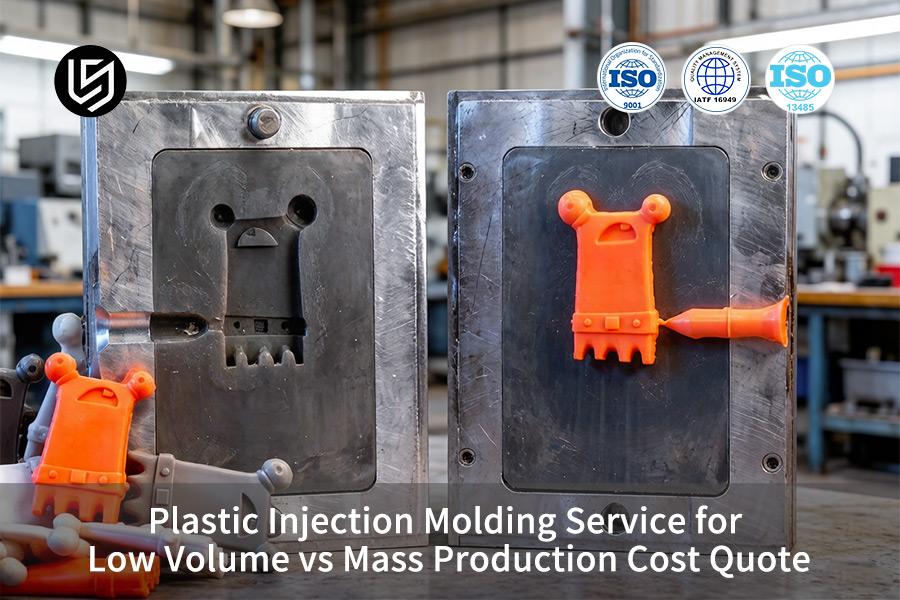
Plastic injection molding service by LS Manufacturing is a precision manufacturing solution; it completely eliminates critical technical defects (like bubbles, uncured parts, and sticking) to secure your NPI cycles. Often, the root cause is industry-wide challenges like lack of professional moldflow analysis,mismatched steel and coating, and poor investment in deciding between prototype and production molds due to unaligned EAU.
This article presents a unique solution derived from over 15 years of industry experience, along with a method to completely eliminate such defects through the optimization of process-level parameters. We offer short lead times—ranging from just 7 to 14 days—for precision parts with tolerances as tight as 0.005mm, as well as a clear guide on selecting the right supplier. The following sections introduce a clear, quantifiable cost management toolkit covering the entire lifecycle, from pilot runs of 100 units to mass production of one million units.
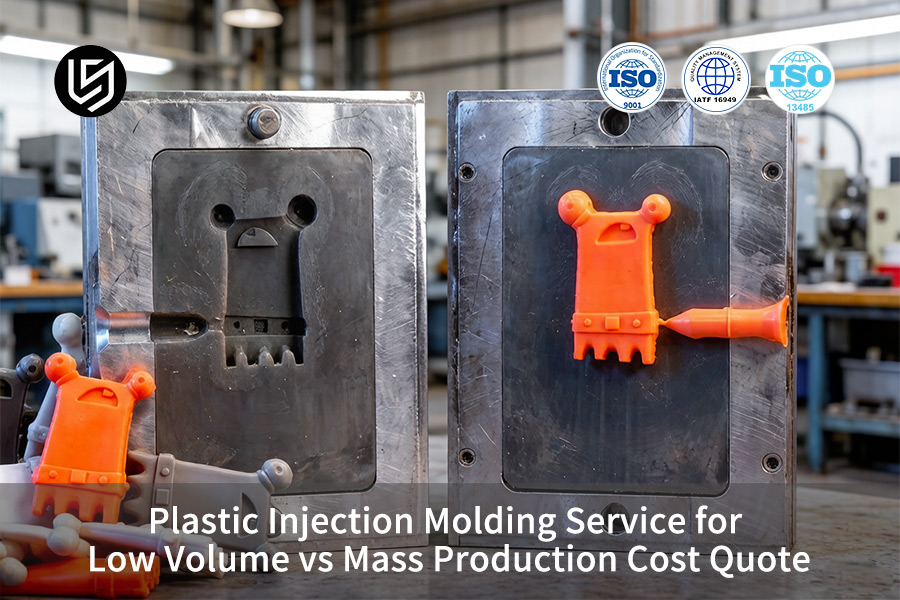
Plastic Injection Molding: Low Volume VS Mass Production Cost-Quote Guide
| Cost Factor | Low-Volume Cost Quote | Mass Production Cost Quote |
| Tooling Investment | High per-part allocation; prototype-grade (aluminum) or soft tooling. | Amortized over high volume; hardened steel, multi-cavity plastic injection molding. |
| Cycle Time Optimization | Secondary priority; focus on part functionality. | Primary cost driver; optimized cooling and automation. |
| Machine & Setup Cost | Significant per-part allocation. | Minimal per-part allocation. |
| Quality & Inspection | Manual or sample-based inspection. | Automated 100% inspection and SPC. |
| Our Quoting Model | Total project cost: tooling + piece price. | Piece price at target volumes, optimized for the lowest stable cost. |
In short, choose aluminum for under 10k parts to save upfront costs, but switch to steel for high volume to minimize your per-part price.
Key Takeaways:
- Tooling is the Dominant Cost in Low Volume: The main focus is a working mold that can produce good parts. Aluminum tooling may often be the best.
- Cycle Time is King in Mass Production: Each time-saving measure results in a direct reduction in the piece price. The mold is designed for speed and durability.
- Quotes Answer Different Questions: A low-volume quote is for the cost to get the parts made. A mass-production quote is for the cost per plastic injection molding part at a high volume.
- The Crossover Point is Calculated: There is a volume where production-grade steel tooling is less expensive than prototype tooling. A detailed quote will reveal this break-even point.
Ready to optimize your project costs? Click here to Upload Your 3D CAD Files for a 24-Hour Verified Quote.

Why Trust This Guide? Practical Experience From LS Manufacturing Experts
You can read many academic articles on injection molding theory. This guide is different. It's written by the very same process engineers and machine operators whose hands get dirty with production every day. Our process ways are not only informed but strictly validated against the standards for plastic materials and processing published by the SAE International, This way our insight is derived from the factory floor, not the laboratory.
We mold parts in environments where the process has a paramount importance: at a medical devices level sterile particulate-free components, aerospace housings capable of thermal shock from -40°C to 120°C, and automotive connectors securing perfect electrical insulation. The qualification of our materials and methods is done by the global testing and performance specifications of ASTM International, which give the non-negotiable baseline for our part quality and consistency.
Our engineering insights are continuously validated through diagnosing and solving over 500+ field cases of warpage, sink marks, and incomplete crystallization. We are experts in the exact drying of nylon to avoid hydrolysis, a cooling plan to remove warpage of glass-filled polymers, and the gate design to produce a perfect surface finish. We are open about this production-proven, scrap-limiting knowledge so you can effectively confront the real challenges of molding and be able to sidestep the costly errors of ill design, material degradation, and tool failure.
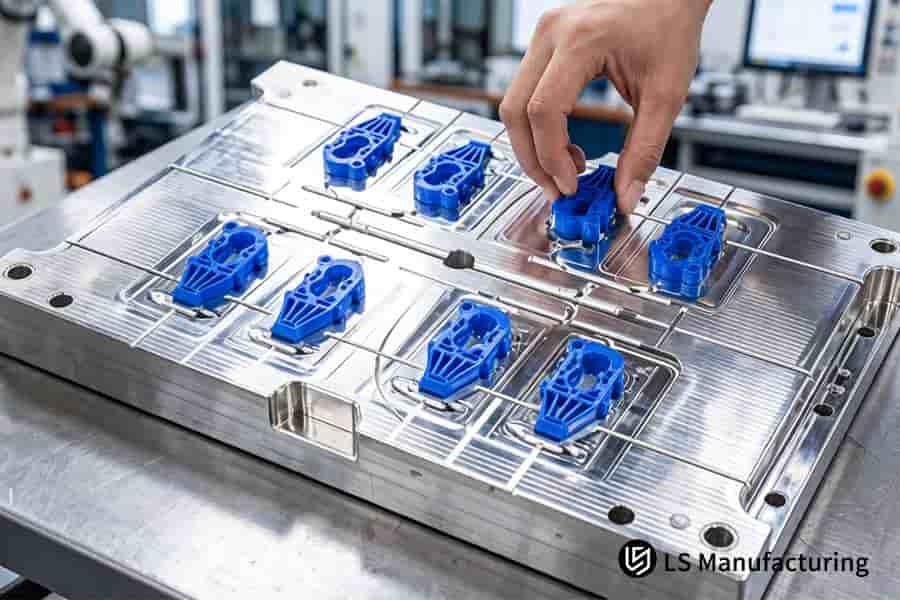
Figure1: A bare hand places a blue plastic component into a precision metal mold cavity for final assembly.
Why Does Low Volume Injection Molding Cost Fluctuate Based On Structural Design?
Understanding that the structural design of your plastic part is the main determinant of tooling if you want to keep tight control over your project budget. The smallest design changes point directly to the level of machining required, the duration of the production cycle, and the quality of the part produced. That's why, the initial design evaluation for effectively managing your low volume injection molding cost. The subsequent parts explain how to convert various design aspects into measurable manufacturing results and savings.
Wall Thickness Uniformity: Controlling Stress and Sink
Variations in wall thickness result in non-uniform cooling and flow, and changes in internal shear stress that cause warpage and sink marks. A nominal wall with a thickness deviation of not more than 15% will give you a dimensionally stable part and a shorter cycle time that you can count on. Basically, this is the main method that you can use to influence your most important injection molding cost factors and this method will determine the success of your plastic injection molding process.
Draft Angles: Directly Reducing Mold Polish Labor
Low or insufficient draft angles will increase the polishing times by the mold makers and their staffs. If you require a minimum 1.5-degree draft on all vertical walls, then the finishing can be accomplished by machining only, possibly avoiding more than 25 working hours of hand polishing.
The end result is a cheaper initial tooling spend and quicker first-article inspection when you deal with precision injection molding services as it lessens the plastic injection molding design stage.
Rib and Boss Design: Preventing Sinks and Short Shots
Thick ribs and bosses can cause not only surface shrinkage on the part but also the need for higher clamping force during molding. Following design guidelines, for instance, keeping a rib's base thickness equal or less than 50% of the neighboring resistance wall for maintaining the strength of the part and at the same time making the flow of material easier and proper.
This would lead to avoiding defects in your custom plastic injection molding project, so that you could be able to use a smaller-tonnage press which in turn will reduce your piece-part cost and help you to smooth the overall plastic injection molding project.
Through this approach, one can convert a scenario where structural design was a cost variable into a situation where it is an input that can be controlled; That's why you have a clear, doable plan. This means getting a part design ready for manufacture which results in very little tooling rework, production being consistent, and having per-part cost that is predictable so your project never goes out of time and over budget.
How To Prevent Fixing Bubbles And Uncured Defects In Low Volume Rapid Tooling?
Bubble and uncured defect prevention in low-volume rapid tooling is a matter of thinking beyond just the default settings and having a detailed control over packing and venting parameters to perform reliable plastic injection molding. This problem greatly affects the strength of your parts, how good they look, and your project schedule as well. The protocols given here deal with these specific ways that the parts can fail so that your production yield is not only good but also consistently meets quality levels first article onwards.
Optimized Packing Pressure Profile
- Challenge: Internal voids and sinks because of not enough material packing.
- Our Method: We packed the material at pressure (60-80% of injection pressure) to make up for shrinkage with the gate closed.
- Your Gain: Compact, dimensionally correct parts without internal bubbles or sinks that can hold up the structural integrity of your low volume tooling.
Precision Venting to Eliminate Trapped Air
- Challenge: Gas traps causing burns, short shots, or uncured areas on the part surface.
- Our Method: We designed mold vents with a precise depth of 0.015mm-0.025mm so that air can escape but not cause flash.
- Your Gain: The first run realizes complete cavity fill and cosmetically clean parts that lead to less scrap and demonstrate the value of precision injection molding services.
Scientific Process Validation for Consistency
- Challenge: Quality is unpredictable because the process variables are unmeasured and uncontrolled.
- Our Method: We developed a documented process window that can be repeated for all critical parameters (pressure temperature time).
- Your Gain: A reliable, repeatable process that ensures you get the same high quality parts in every single batch, giving you the definition of a trustworthy plastic injection molding service.
Strict Thermal Management for Complete Cure
- Challenge: Improper flow and incomplete curing due to wrong melt or mold temperatures.
- Our Method: We keep melt temperature within 5°C and mold temperature within 2°C of the material-specific set points.
- Your Gain: Consistent material flow and complete polymerization that will get rid of weak, uncured areas and producing high-quality plastic injection molding.
This outcome-based approach attacks the causes of gas entrapment and undercure directly and replaces the unknown with a proven, controlled methodology. You get a well-defined manufacturing recipe that maximizes your first-pass yield, greatly reduces waste, and produces dependable parts from your rapid tooling spend. Secure first-pass yield and eliminate bubbles in your next tooling project. To begin, contact our engineering team with your part details for a process validation and a firm quote.
Which Surface Treatments Eliminate Sticking In Resin Molds During High Precision Runs?
Mold sticking is a leading contributor to unscheduled downtime and part damage in high-volume manufacturing. When it comes to custom plastic injection molding of complex or sticky resins, choosing the right surface treatment is key to consistent release. This report describes engineering solutions that prevent sticking and enable predictable, automated production runs.
| Solution | Technical Approach & Specification |
| Mold Base Material | Hardened steel (e.g. S136) offers a stable base for high end finishes and is more wear resistant than aluminum or resin when used in production plastic injection molding. |
| Non-Stick Coatings (PTFE) | A permanent Teflon coating on the surface reduces adhesion of the surface and force to release, which is recommended for sticky polymers such as TPE on prototype plastic injection molding. |
| High-Speed Mirror Polishing | Minimizing mechanical anchors by operating at Ra 0.05μm–0.1μm for cosmetic clarity in precision injection molding services. |
| Ejection System Precision | Adjusting ejector pin parallelism to ±0.02mm grants a uniform force distribution, which keeps the part from warping or sticking in the mold upon ejection. |
| Integrated Process Control | Surface modification, combined with tight control of mold temperature (±1.5°C) and best cooling cycles, leads to reproducible results in a complex plastic injection molding process. |
The best option combines the use of a hardened steel mold with a chosen surface finish - PTFE for sticky resin or a mirror-like polish and a well-adjusted ejection mechanism. This method will help you raise your production uptime and part yield directly. It is a way to make sure your plastic injection molding service can provide the level of dependability that allows for continuous automated production without any interruptions, at the same time, safeguarding your tooling investment and the quality of your product.
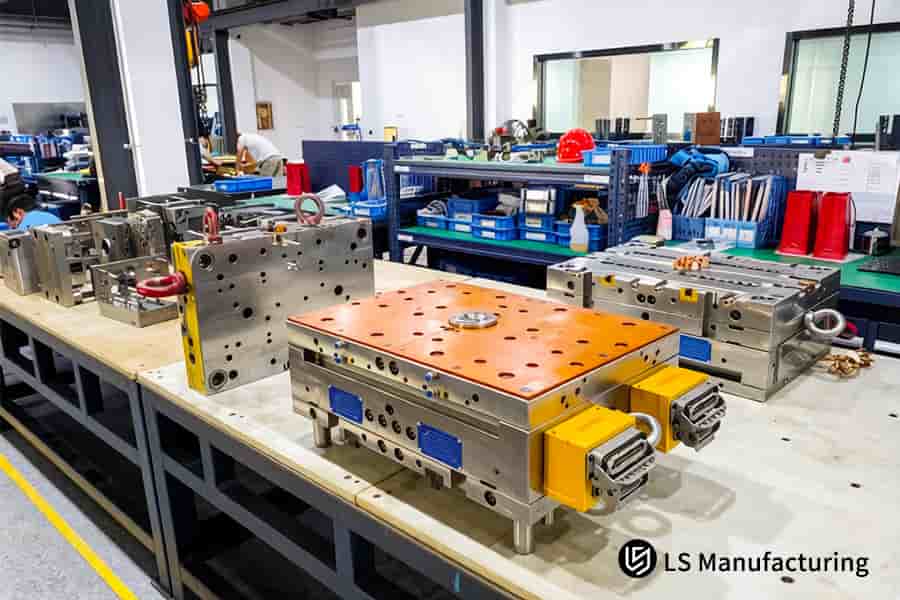
Figure 2: Large metal tooling modules are prepared on a workbench for custom injection molding services at LS Manufacturing.
What Is The Cost Difference Between Soft Tooling And Hard Tooling?
Choosing between soft (aluminum) and hard (steel) tooling is a major financial and technical decision that can determine the per-part cost of your project, its timeline, and production capacity. A thorough injection molding cost compare will require a detailed assessment of the tangible aspects of the tooling and the predicted volume. The structured data below presents a comprehensive and practical tool to help you make this investment decision.
| Comparison Dimension | Soft Tooling (Aluminum, e.g., P20) | Hard Tooling (Steel, e.g., S136/H13) |
| Typical Tool Life | 5,000 – 20,000 cycles. | 100,000+ cycles. |
| Mold Hardness | ~HRC 30-35. | HRC 52+. |
| Cost per Part Curve | Lower initial cost, rises after ~10k parts due to wear. | Higher initial cost, plummets and stabilizes, offering the lowest mass production injection molding quote. |
| Optimal Volume Range | 50 – 10,000 parts, defining low-volume plastic injection molding. | 10,000 – 1,000,000+ parts. |
| Lead Time (Fabrication) | 3 – 5 weeks. | 8 – 12 weeks. |
| Surface Finish Longevity | Good for prototypes, degrades with abrasive materials. | Excellent, durable for high-gloss plastic injection molding. |
| Primary Economic Driver | Minimizes upfront investment for pilot runs. | Minimizes lifetime cost via amortization, enabling consistent precision plastic injection molding. |
The numbers suggest a very simple rule decision: With confirmed production in excess of 10,000 parts, HST provides the lowest sustainable cost per part. For you that analysis allows you to realize the greatest low volume injection molding cost for prototyping and assists you to make a supported-by-data decision to proceed into hard tooling for scaled production. Put this way and you can’t go wrong by the volume projections you have."
When Should Global Procurement Transition From A Soft Tool To Mass Production Injection Molding Quote?
The move from soft-tool prototyping to full-on mass production entails a certain, quantifiable trade-off point between annual volume, the maturity level of the part design, and cost of ownership. This is the tipping point for this analysis, and the technical breakthroughs for driving them to scalable, cost-managed manufacturing. The aim is to create a straightforward guideline for obtaining a justified and competitive mass production injection molding quote.
Defining the Transition Volume Threshold
- Primary Trigger: EAU is significantly above 50,000 parts. Until now, the initial lower cost of soft tooling is the most attractive. On top of that, you can amortize the hard tool cost – such as a multi-cavity plastic injection molding tool – and watch the per part cost drop precipitously.
- Your Gain: A simple to understand, volume-driven investment rationale to support capital expenditure, taking the conversation from low vs high volume molding quote analysis to a firm, low cost production solution.
Engineering the Multi-Cavity Production Mold
- Technical Execution: We manufacture multi-cavity hardened steel molds with runner systems scientifically optimized to provide even filling across all cavities to meet or exceed the expectation for demanding plastic injection molding projects.
- Your Gain: Geometric expansion of output per tool cycle to directly reduce effective cycle times and is the key term in AP-209 OEM plastic molding cost estimate.
Optimizing Cycle Time with Hot Runner Systems
- Technical Execution: The hot runner system and the mold are designed for use with thermal control the hot runner system avoids waste form cold runner and reduce the injection step to get on for a target cycle time of 12 seconds for efficient plastic injection molding.
- Your Gain: Full press utilization and per hour output. This simplification of the unit economics is necessary for a compelling return on investment (ROI) in the production tool cost.
Locking in Quality and Consistency
- Technical Execution: At run production set-up: complete robotics part removal / robotic vision inspection and SPC monitoring.
- Your Gain: This guarantees that your large-scale plastic injection molding production meets rigorous quality standards, minimizing risk in your supply chain.
That systematic point of view replaces guesswork with engineering economics. You receive a clear decision matrix to upgrade at the right time, a technically optimized tool to run them at the highest efficiency, and a cost model you can count on. This allows you to confidently ask for and compare a real mass production injection molding quote that is supported by the data necessary for a fast ROI and growing supply.
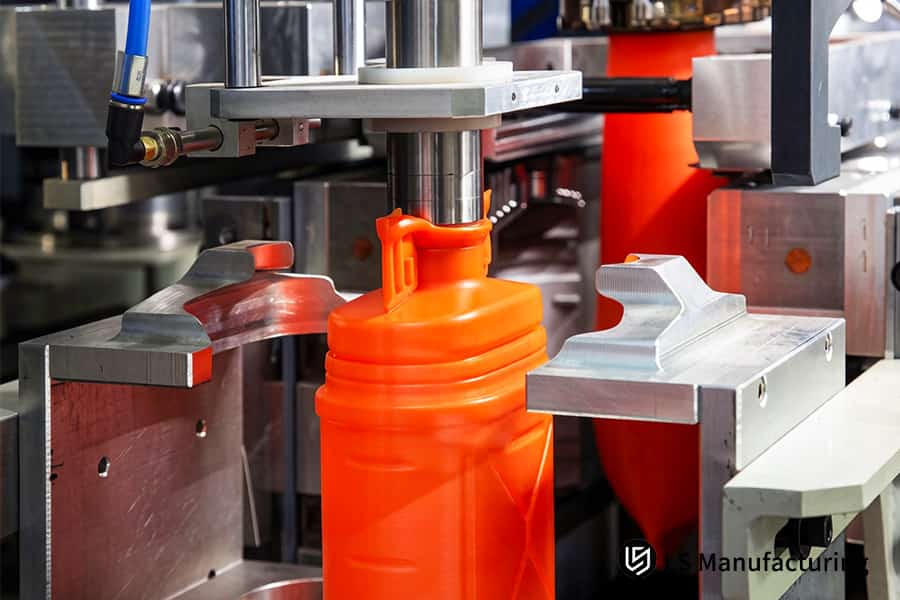
Figure 3: Custom plastic injection molding forms an orange bottle in a metal mold on a high-speed production line.
How Does OEM Plastic Molding Cost Quote Balance Tolerance Control With Budget Limits?
To achieve a good balance between tight tolerances and budget in an OEM plastic molding cost quote, one needs to employ tolerance planning with materials science rather than just use the tighter machining. The answer is separating critical from cosmetic dimensions, and using material specific shrinkage factors in your design so you can avoid expensive mold rework.
Functional vs. Cosmetic Tolerance Tiers
Not every dimension needs to be precise to the same extent. We split tolerances into critical functional interfaces (finer than ±0.02mm) and non critical cosmetic surface finishes (looser than ±0.05mm or standard). This approach in your custom plastic injection molding project is executed at the DFM level and prevents you from having to call out unnecessarily tight tolerances for the entire part. This specific distribution can save you up to 25% in machining and quality control costs without affecting performance.
Material Selection to Leverage Natural Shrinkage
Shrink is a different beast for each polymer. We model this with certified data: ABS (~0.5-0.7%) PC (~0.5-0.7%) and glass filled Nylon 66 (~0.2-0.4%). Choosing a material whose inherent natural shrinkage characteristics are closest to your tolerance expectations is one of the basic tricks to tight-tolerance plastic injection molding. And for you, selecting PA66+30%GF for a stable, tight-tolerance part can let you save on post-mold machining, taking a direct cut at your per-part cost. In simple terms, this means you get parts that don’t warp after cooling, saving you from expensive secondary machining.
Predictive Correction via Moldflow Analysis
Rather than making the mold at nominal dimensions, we distort the mold cavity using moldflow inversely to predicted shrinkage and warpage. This upfront simulation is a style that focuses on first-article success for advanced plastic injection molding programs. You get a mold that makes in-spec parts on the first run rather than taking 2-3 passes of costly steel cuts and hold ups, generally cutting total tooling adjustments by 30-50%.
Design for Assembly (DFA) to Simplify Validation
Complex systems with interfaces are an order of magnitude more expensive. We look for parts that can be integrated, have living hinges, snap-fits or other similar ways to reduce part count. This eliminates the number of critical tolerances that must be managed in cost-driven plastic injection molding. Your company will enjoy a simpler, more rugged product that is easier to assemble with lower part cost and total quality assurance overhead.
This technique converts tolerance specification from being a cost driver to a controlled parameter. You get a cost effective, functional design that is ready for manufacturing, a predictable and consistent quote, and the confidence that your precision injection molding services investment is applied only to what provides real product value.
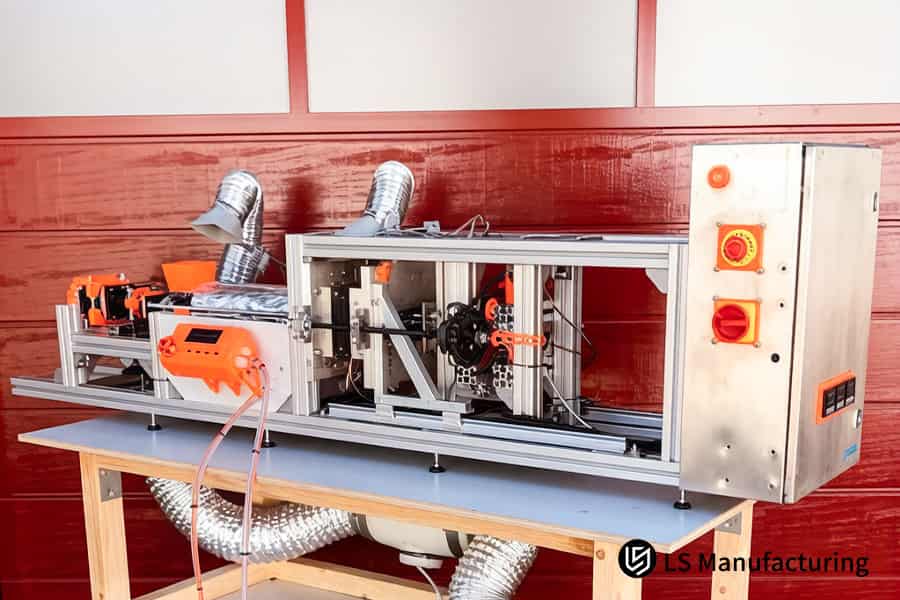
Figure 4: LS Manufacturing presents a precision injection molding service with its industrial machine and control unit.
Case Study Of Medical Device Gears Custom Plastic Injection Molding By LS Manufacturing
This case study describes how LS Manufacturing solved significant quality and cost growth issues for a medical-grade plastic injection molding project. A major global medical device OEM was in a dual bind with a micro-metering pump gear, looking for a bridge partner to go from broken prototypes to certified, high-volume production, the all too common hurdle in technical plastic injection molding.
Client Challenge
Initial prototypes of POM gear were suffering from a 35% defect rate with dimensions out of ±0.01mm due to poor tooling. At the same time, production capacity demands increased from 500 up to 200,000 units a year, which put a strain on their plastic injection molding service in place. This created an immediate requirement for a cost effective scalable solution and a straight forward injection molding cost compare to support the investment in production tooling.
LS Manufacturing Solution
During the mold trial, we discovered that the initial gate design caused filling imbalance; we subsequently redesigned the runner balancing scheme using Moldflow data. We designed a hardened S136 steel mold (HRC 52+) with a well-balanced 1x4 hot-runner system, based on simulation results. This precision injection molding services concept that leverages integrated 100% in-line optical measurement and real-time SPC specifically addresses variation at its source. Such control is also necessary for plastic injection molding, where there is no room for failure.
Results and Value
The final manufacture produced gears with consistent tolerances of ±0.005mm, with no defects and at 42% less cost per unit. The production mold was able to exceed 1 million cycles, enabling stable supply. This result gave a strong low-cost plastic injection molding advantage enabling fast ROI and thus allowing the client to fully consolidate with our custom plastic injection molding expertise for their product range.
This work reflects our general approach to addressing the fundamental tension between extreme precision, cost, and scalable volume. By providing a validated, controlled manufacturing process, we enable customers with a de-risked, streamlined path to market, converting challenging technical problems into a sustainable and dependable competitive advantage for mission critical applications.
Secure the same ±0.005mm precision and a 42% cost reduction. Submit your part design today to receive a feasibility assessment and a formal quote for your precision gears.

FAQs
1. What is the baseline cost for low-volume injection molding at LS Manufacturing?
Our minimum cost for low-volume production is typically $1500, and that is mostly for rapid tooling for pilot runs. The final, project specific price is calculated within 24 hours, and finely tuned based on your part's geometric complexity, required material grade, and the choice of mold steel (e.g. aluminum vs pre-hardened steel) in order to maximize value.
2. How does LS Manufacturing prevent gas entrapment (bubbles) in precision custom plastic injection molding?
We stop gas entrapment with a two-pronged approach. First, we micromachine precision venting channels (0.015mm deep) at all last areas to fill. Second, injection speed to pressure transfer point is optimized dynamically using real-time software tool, to help egress trapped air before the cavity is sealed, which helps to ensure solid, defect free parts.
3. Can you modify the tooling if our design changes during the validation phase?
Absolutely, we design proactively for modification. Our tools are designed with planned reserve steel in key areas and worked with a modular quick-change insert system. This foresight enables economical and accurate changes to be made through bit-by-bit CNC re-machining of individual inserts to allow for your iterative designs within an NPI (new product introduction) cycle rather than the cost and time to produce a whole new mold.
4. What standards ensure the reliability of a mass-production injection molding quote?
The accuracy of our quotes is supported by having the systems of IATF 16949 and ISO 9001 for quality management system certification. In addition to that, every quote is backed by the promise that a full First-Article inspection report based on results from the Coordinate Measuring Machines (CMM) and full raw material traceability certificates, will be delivered, making sure that what is reflected in the quoted price is a guaranteed and auditable quality.
5. How do you address issues like incomplete curing or warping in thick-walled engineering components?
These problems are tackled with scientifically designed, multi-channel conformal cooling circuits that trace the contour of the part. This keeps mold surface temperature at a very narrow ±2°C range, and contributes to consistent resin crystallization and shrinkage. This methodology prevents both warping and incomplete curing, in addition to a decrease in cooling cycle time up to 30% leading to improved productivity.
6. What are the typical lead times for OEM plastic molding quotes and tool sampling?
A detailed, official quotation will be sent within 24 hours upon receipt of your complete 3D CAD data. For sampling, rapid aluminum prototype molds and parts can be supplied as quickly as in 7 days. High-volume production multi-cavity hardened steel molds, including delivery-14 to 21 days and samples for customer validation, a clear and rapid path to your mass production.
7. Do you offer free DFM optimization feedback prior to tool manufacturing?
Yes, we do offer a free comprehensive DFM review as part of the standard service. Performed by our senior engineers, this review identifies and mitigates potential manufacturing risks including insufficient draft angles, inconsistent wall thickness, poor gate locations and potential sink marks early in the process one prior to any tooling investment, resulting in significant time and cost savings.
8. How does LS Manufacturing protect the intellectual property associated with custom molds?
We have strong IP protection policy − including legally binding Non-Disclosure Agreement (NDA) signed prior any project discussion. As for all your proprietary drawings, 3D models, and tooling designs, everything is stored and processed within our own secured, encrypted, and physically isolated on-premise internal servers, with a strict access control policy, ensuring complete confidentiality during the course of the partnership.
Summary
The selection of the right plastic injection molding company is important whether you are working through issues in early stages, such as bubbles, incomplete curing, or sticking and/or needing to reduce cost for high-volume production. Trusted by global OEMs, LS Manufacturing seamlessly combines cross-process insight, rigorous parametric control, and proven expertise in precision gears and medical-grade manufacturing to transform complex challenges into commercial success.
We rely on data, not empty claims, to secure your project. If weighing soft vs hard tooling or needing to de-risk a new design, click “Get Instant Injection Molding Quote” to upload your STEP/IGS files. Within 24 hours, our plastic injection molding engineers will provide a transparent mass-production quote and a free $500 DFM assessment—ensuring your product is realized successfully.
📞Tel: +86 185 6675 9667
📧Email: info@lsrpf.com
🌐Website: https://lsrpf.com/
Disclaimer
The contents of this page are for informational purposes only. LS Manufacturing services There are no representations or warranties, express or implied, as to the accuracy, completeness or validity of the information. It should not be inferred that a third-party supplier or manufacturer will provide performance parameters, geometric tolerances, specific design characteristics, material quality and type or workmanship through the LS Manufacturing network. It's the buyer's responsibility. Require parts quotation Identify specific requirements for these sections.Please contact us for more information.
LS Manufacturing Team
LS Manufacturing is an industry-leading company. Focus on custom manufacturing solutions. We have over 20 years of experience with over 5,000 customers, and we focus on high precision CNC machining, Sheet metal manufacturing, 3D printing, Injection molding. Metal stamping,and other one-stop manufacturing services.
Our factory is equipped with over 100 state-of-the-art 5-axis machining centers, ISO 9001:2015 certified. We provide fast, efficient and high-quality manufacturing solutions to customers in more than 150 countries around the world. Whether it is small volume production or large-scale customization, we can meet your needs with the fastest delivery within 24 hours. choose LS Manufacturing. This means selection efficiency, quality and professionalism.
To learn more, visit our website:www.lsrpf.com.