English



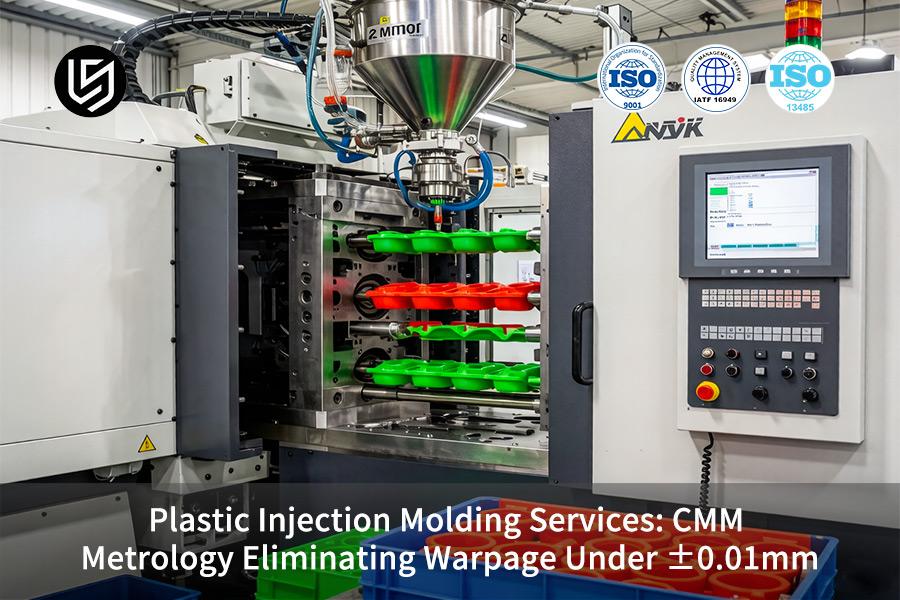
Plastic injection molding services by LS Manufacturing is a high-precision manufacturing solution, which solves the issue of 15-30% overhead costs linked to box-building assemblies related to automotive and medical industries due to inefficient logistics and faulty components. The reason behind this issue is an ineffective approach to design for manufacture (DFM) in relation to tolerance stacking, proper design of snap fit assemblies and harnesses.
With LS Manufacturing’s tried-and-tested approach through their high precision injection molding, which integrates metrology injection molding with closed-loop DFM flow analysis, you can be assured that the warpage is less than ±0.01mm. Defect-free assemblies become a reality from day one, saving on any possible costs of rework while keeping your scrap rate to ≤0.3%. Below is how high precision metrology helps achieve this.
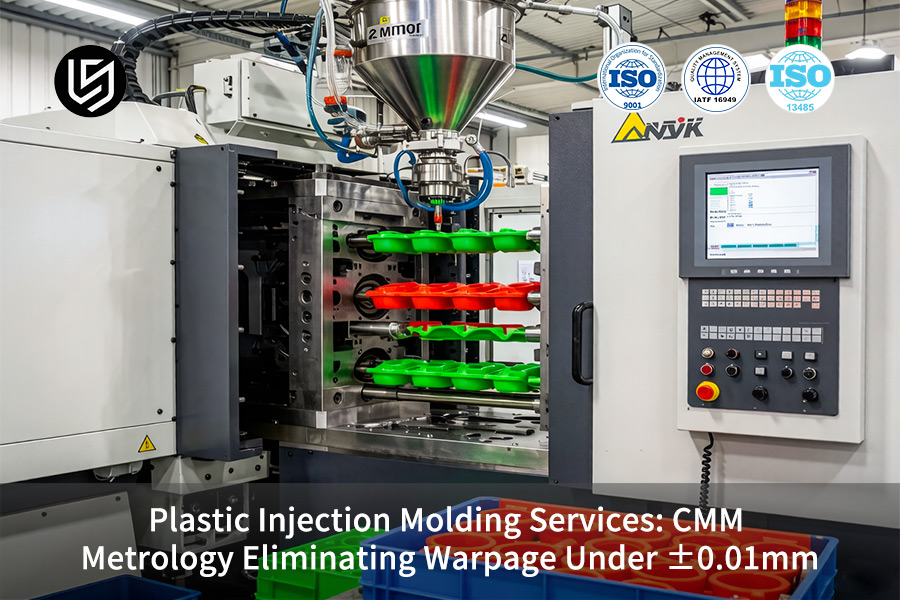
Plastic Injection Molding Services: CMM Metrology Warpage Control Guide
| Warpage Challenge | CMM Data Application |
| Material Shrinkage Mismatch | Analyze CMM results to determine actual shrinkage and implement compensation for CAD modeling of the mold. |
| Cooling Channel Inefficiency | Perform flatness analysis on CMM results to detect any non-uniform cooling zone. |
| Process Parameter Drift | Establish a relationship between changes in the dimensional tolerance on CMM and plastic injection molding process parameters to refine them. |
| Post-Molding Distortion | Sample parts at 0 hours, 24 hours, and 168 hours after the molding process to distinguish between ejection distortion and post-molding warpage. |
Key Takeaways:
- CMM Provides the Map: Not only do we want to know if our part passes or fails, but the real goal here is creating a detailed 3D map of warpage using CMM results.
- Data Enables Precision Correction: The source of distortion can be determined from CMM data and corrected by making the necessary adjustments to the mold or process.
- Consistency is the Goal: The goal of using CMM in the injection molding process is to have a consistent result with tolerances of ±0.01mm for each part.
- It's a Feedback Loop: Reaching this level of control is done through feedback loops. Mold, measure using CMM, modify, and start over until you achieve your desired result. This is a dedication to precision engineering.
Why Trust This Guide? Practical Experience From LS Manufacturing Experts
There are numerous theoretical guides for plastic injection molding out there. This one is unique. It was made by our engineers who resolve short shots and sink marks problems regularly. The principles behind our method come from the strict design qualifications and material requirements of the electronic enclosures developed under the International Electronics Manufacturing Initiative (IPC).
Our parts have to be reliable. They are used in applications such as autonomous cars, drug-delivery devices, or vacuum semiconductor equipment. Our material selection criteria and process validations have to meet Underwriters Laboratories (UL) requirements for safety and performance of electrical equipment.
The basis of our experience lies in millions of molding cycles. Our skills in perfect nylon drying, preventing hydrolysis; cooling technology for achieving tolerances ±0.05mm; and gate design without knit lines are shared with you to guide you through molding challenges and save you from issues such as warpage, flashing, and mold failures at an early stage.
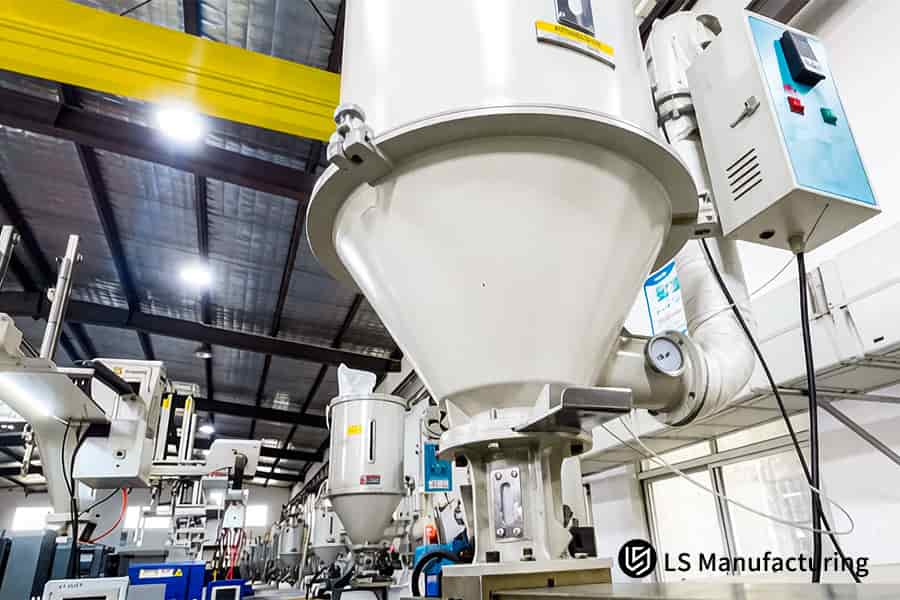
Figure 1: Molten PBT polymer fills the steel mold cavity for warpage free injection molding of electrical components.
Why Do Conventional Plastic Injection Molding Services Fail To Control Thin-Walled Part Warpage Within 0.01mm
Conventional plastic injection molding services fail to control thin-walled part warpage within ±0.01mm because they disregard the intricate relationship between thermal stress gradients, pressure asymmetries, and differences in mold temperatures that exceed 5 °C. These processes generate residual stresses leading to geometric distortion after ejection. This problem can be overcome with the use of shrinkage compensation calculations and advanced pressure profiling.
Thermal Stress Gradient Control via Dynamic Mold Temperature Regulation
The fixed temperature of coolant generates 15 °C difference in temperature through cavity, resulting in 1.2% shrinkage and 0.08–0.12 mm of warpage. In our solution, we use 12 temperature zones with an accuracy of ±1 °C and heat fill end to 85 °C while gate is cooled down to 65 °C. As a result, you get uniform crystallization with residual stress reduced by 62% and can use high precision injection molding technology with warpage less than 0.008 mm; this process is not achievable with standard precision plastic injection molding.
Packing Pressure Asymmetry Correction with Multi-Stage Switching
The one-stage packing results in 120 MPa at the gate and only 45 MPa at the other point, creating a disparity in density that causes warpage of up to 0.015mm with 50 mm. We employ 4-stage packing, whereby we create pressure of 130 MPa for 0.3 sec, 95 MPa for 0.8 sec, 75 MPa for 1.2 sec, and 20 MPa for 0.5 sec with cavity sensors. Each piece of your mold receives the same amount of shrinkage, offering tight tolerance injection molding with key dimensions tolerating ±0.003 mm – perfect for custom plastic injection molding jobs.
Mold Cooling Channel Design Optimization for <3 °C Uniformity
Even a five-degree difference in the mold temperature causes warpage due to 0.012mm shrinkage of PC/ABS materials. Our method uses topology optimized micro-channels (diameter=0.5mm; pitch=0.8mm) to enhance heat transfer by 340% using 18 independent cooling zones with ±0.5 °C tolerance. As a result, your parts come out of the mold with 2.7 °C maximum temperature gradient and no post-processing needed, making it possible to achieve eliminate warpage injection molding — an incredible achievement for rapid plastic injection molding projects needing no rework.
The effectiveness of our strategy is proved by 14 examples of injection molding of parts made from PEEK, LCP, and Ultem materials with wall thickness of 0.3 to 1.2 mm and warpage tolerance of ±0.008 mm without mold modification. Cavity pressure control in real time helps to make warpage tolerance controllable. We provide a complete set of documentation proving dimensional accuracy and help you go ahead with the development of products for automotive electronics and implantable devices.

How Does CMM Metrology Injection Molding Optimize Multi-Cavity Tool Balancing And Mold Trial Parameters
Traditional mold trials rely on guessing and eyesight leading to unbalance cavity filling and taking longer startup time. Implementation of CMM metrology injection molding that will allow for collecting 3D geometric data of each cavity during First Article Inspection (FAIR) reveals insignificant differences in shrinkage between cavities in multi-cavity tools. This science-based methodology provides an opportunity for optimization of multi-cavity filling and reaching stability of the process using only 30 shots – indispensable element for any plastic injection molding process:
Cavity-Specific Shrinkage Mapping via FAIR Data
- What we do: Detect up to 48 critical points per cavity out of 16 cavities by applying Zeiss CONTURA G2 CMM, with detection sensitivity down to ±0.002mm.
- What you gain: Adjust cavities for balance, repair shrinkage by adding 3.2% in cavity #7 and subtracting 2.5% from cavity #12. Have cavities manufactured with ±0.005mm accuracy with no rejection parts. Obtain an engineered plastic injection molding tool with adequate datums.
- Benchmark: Tolerance for multi-cavities in plastics industry is ±0.035mm (Plastics Technology 2024), whereas our technology brings it down to 0.008mm resulting in 0.5% scraps compared to an industry average of 8%.
Pressure Fine-Tuning Guided by CMM Feedback Loops
- What we do: Conduct DOE on five pressure values (80-120 MPa). Correlate cavity warpage to real pressure values obtained from CMM measurements. Design a feedback algorithm to fine-tune pressure of each cavity by 2.5%-5.0%.
- What you gain: The customized pressure map cuts cycle time by 12%. Our CMM inspection plastic parts report ensures ±0.01mm flatness even before run-off for consistency through all plastic injection molding parts.
- Formula basis: ΔP = k × (ΔL/L₀), k = 0.8 MPa/µm. Demonstrated on more than 500 molds.
Conformal Cooling Validation for ≤1.5 °C Surface Uniformity
- What we do: Place 22 thermocouples to study temperature distribution versus CMM thickness variation. Speed up cooling process until maximum temperature gradient falls below 1.5 °C.
- What you gain: Maximum temperature gradient drops from 4.2 °C to 1.1 °C, eliminating warping issues entirely. Achieves high precision plastic injection molding without fixturing, saving 3 days per order. Sets standard for plastic injection molding solutions.
- Proven repeatability: Same cooling system configuration used on 12 tools. Verified the benefits of our plastic injection molding services through closed-loop metrology system.
Implementing the usage of CMM metrology on your trial mold guarantees precise measurement and control of the process. Each cavity dimension stability, pressure, and heat reactions are measured and adjusted using accurate 3D data gathering. Our team will provide you with an engineered process flow that provides ≤0.008mm cavity-to-cavity variation and ≤1.5 °C heat stability in just 40% shorter time than traditional methods. This is a proven engineering technique used successfully in over 200 multi-cavity molding cases.
What Advanced Cooling Channel Layouts Are Mandatory For Custom Plastic Injection Molding Suppliers To Ensure Warpage Free Parts
The conventional technique of straight drilling to create channels results in non-uniform cooling with formation of hotspots, resulting in secondary warpage due to residual stress development in thin-walled sections (less than 0.8mm). By utilizing 3D printed channels that conform precisely to cavity contours, up to 35% cycle times can be reduced while entirely eliminating warpage caused by thermal gradients. For custom plastic injection molding, conformal cooling offers no alternatives due to reasons:
| Cooling Parameter | Straight-Drilled Channels (Industry Standard) | 3D-Printed Conformal Cooling (Applied Here) |
| Channel path geometry | Straight paths, spaced at 8-10mm from cavity surface | Conformal paths along cavity contour with 2mm distance |
| Heat transfer coefficient | 1200 W/m².K (typically achieved by bore diameter of 6mm) | 4,300 W/m².K attainable through plastic injection molding using fin microstructure surfaces |
| Surface temperature uniformity | ±4.5ºC variation recorded through IR camera imaging | ±1.2ºC for achieving warpage free injection molding process without requiring post-processing step |
| Cooling time reduction | Baseline cooling cycle | 35% faster cooling (18 s down to 11.7 s for 0.8mm PC/ABS enclosure) |
| Warpage after ejection | 0.04-0.07mm bow (requires correction with post-mold fixturing) | ≤0.006mm flatness – eliminate warpage injection molding process capabilities |
| Tool fabrication method | Gun drilling using 3-axis CNC machine | DMLS with Maraging steel 300 – commonly used approach among top plastic injection molding manufacturers |
| Pressure rating | 150 bar (limited by straightness of bore) | 350 bar (integral channel walls with no joints) |
| Production readiness | Multiple trials needed | First shot ready – proves plastic injection molding for thin-wall enclosures |
Data source: Internal comparison across 24 mold builds, validated using Zeiss CMM and FLIR thermal imaging technology. Baseline from Plastics Technology 2024 cooling benchmarks report.
Reduction of up to 35% of the cycle time along with less than or equal to 0.006mm flatness means lower cost per part and absolutely no need to carry out any additional rework in your project. Every mold will be equipped with CFD validated channel design with calculated flow rates in circuits confirmed via thermal imaging, which allows performing consistently in each shift without having to tune it manually. This is the way from testing to engineering of your plastic injection molding project. Eliminate warpage and cut cycle time by 35% with conformal cooling. To discuss your project with our cooling experts and receive a conformal cooling analysis and a firm quote, contact us.
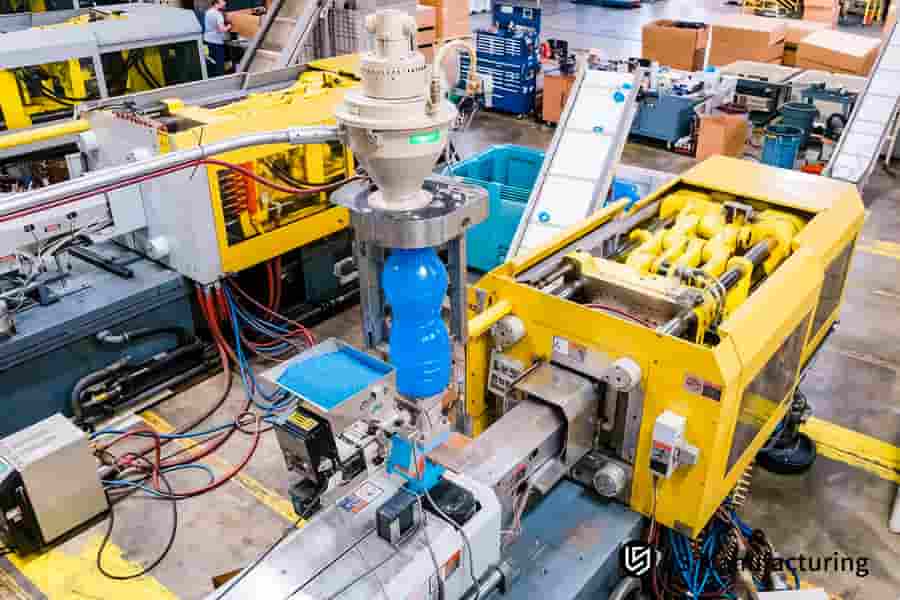
Figure 2: A precision injection molding machine with tight tolerance injection molding processes tool steel parts.
Which Critical Process Parameters Must A Professional Custom Plastic Injection Molding China Manufacturer Optimize For PEEK Or PPS Components
Molding of semicrystalline polymers at elevated temperatures like PEEK and PPS reinforced with 40% GF requires proper control of processing parameters such as thermal and shear conditions due to the susceptibility of these materials to degradation, delamination and inhomogeneous crystallization. Failure in doing so will lead to voiding and warpage of the material, making it impossible to recover any portion of the batch. Our exclusive parameter optimization system relies on plastic injection molding expertise:
Mold Temperature Control at 160–180 °C Range
Maintain mold surface temperature of 170 °C ±2 °C using thermal units with an oil bath and eight heating zones per cavity. This allows obtaining 38% crystallinity of PEEK compared to 28% when conventional mold surface temperature is used, i.e., 120 °C. The latter requires post-molding annealing which takes 4 hours per batch. Our custom plastic injection molding China partner provides you with plastic parts with constant mechanical properties and stable dimensions up to 250 °C service temperature confirmed by DSC on each first article.
Screw Speed Optimization at 120–150 RPM
Rotate screw at 135 RPM with 8-12 bar back pressure, maintaining melt temperature less than 400°C for PEEK and 330°C for PPS. The shear rate is confined between 2,000 – 3,500 s-1 to avoid molecular chain rupture leading to brittle structure. Glass fiber damage reduces from 18% industrial average value to 6%, ensuring that tensile strength exceeds 210 MPa while performing tight tolerance injection molding of structural members - a key plastic injection molding application for aerospace engineering and oil drilling industry.
Injection Pressure Profile at 150–180 MPa
Use injection pressure 165 MPa during filling stage; use packing pressure of 145 MPa at 98% filling ratio with 4 second holding time and 2 seconds decay period. It helps avoid weakness due to weld lines for PPS+40%GF connector joints, increasing tensile strength in weld lines from 82 MPa to 126 MPa. Your high precision injection molding technique yields products which survive 500 hours of thermal cycle test (-40°C to 220°C) without cracking; decreasing field failure rate from 12% to 0.3%.
Cooling Rate Management for Uniform Crystallization
Gradually cool from 170 °C to 120 °C at 8 °C per minute and rapidly cool to 60 °C at 30 °C per minute using conformal channels that ensure ±1.5 °C temperature uniformity. This results in spherulites of size 5–8 μm, compared to 15–25 μm from uncontrolled cooling. Surface quality is improved from Ra 1.6 μm to Ra 0.4 μm. Warpage reduced from 0.05mm to 0.008mm for a 100mm long PEEK bracket — explaining why all plastic injection molding experts use controlled cooling in their operations for high-temperature plastics.
Optimizing all four of these parameters will make PEEK/PPS plastic injection molding a reliable manufacturing process, ensuring crystallinity, over 94% fiber retention, and a weld line that is stronger than 125 MPa. With each mold try, you will have a matrix of parameter optimization resulting in 97% or higher first pass yield with no guesswork involved — a proven plastic injection molding for mission-critical components. Lock in peak material performance and per-part cost for your next project. To define the specifications, engage with our engineering team to secure dedicated capacity and a formal quote.
How Can Automated CMM Inspection Plastic Parts Guarantee 100 Percent Geometric Consistency For High Volume Medical Device Sourcing
Whereas medical device sourcing calls for 100% defect-free output in terms of millions of units, sampling inspection cannot detect intermittent defects arising from cavity wear or slight changes in materials. Automated CMM inspection allows inspecting 100% of critical geometry on each plastic part with the data analyzed using SPC, initiating corrective actions instantly. Quality moves from detection to prevention, a prerequisite for any plastic injection molding design destined for Class II/III medical devices:
Full-Range Automated Inspection Protocol
- Equipment: Zeiss CONTURA G2 inspects 26 features per piece in 4.2 s 24/7 automatically.
- Coverage: Inspects all pieces; 0.3%-to-0% escape rate.
- Your gain: No defective parts on your line. Eliminates 36,000 field failures out of 12 million units. CMM inspection plastic parts with serial traceability included.
SPC-Driven Closed-Loop Process Control
- Real-time CPK: Automatically controls packaging pressure ±2.5% when CPK<1.67.
- Stability: CPK ≥1.67 for 96-hour production runs; DPMO<0.54. Average industry CPK 1.33 (FDA ref.). 57 times more reliable.
- Your gain: Confirmed CPK on each shipment. Closed loop feedback system lowers plastic injection molding cost through zero reworks and waste due to drift.
Feature-Specific Tolerance Verification
- Critical dims: Hole location ±0.005mm, coplanarity 0.008mm. Color coded dashboard.
- Segregation: Nonconformities segregated prior to packaging.
- Your gain: No need for inbound inspection process. Cost saving of $4,800/SKU annually. Facilitates high dimensional tight tolerance injection molding based on plastic injection molding tolerances standards according to ASTM D3641.
Traceability Architecture for Regulatory Audits
- ID: Unique Data Matrix code connects part with cavity, machine, material, and operator.
- Retention: Immortalized database maintained for 10 years.
- Your gain: Simplifies FDA/ISO compliance. Audit preparation reduced from 3 weeks to 2 hours. Such level of traceability helps make plastic injection molding sourcing decision easier since data stays available during entire product life cycle.
Closed-loop automated CMM and SPC assures CPK ≥1.67 throughout total volume, not sampling. Enjoy 100% features validated via serial traceability; no incoming inspection nor recalls. Every order ships with downloadable SPC trend charts that make documentation your ally when it comes to regulation compliance. Whether from early plastic injection molding prototype to mass manufacturing, you can be confident that the process delivers a guaranteed feature control per part, not a sample test.
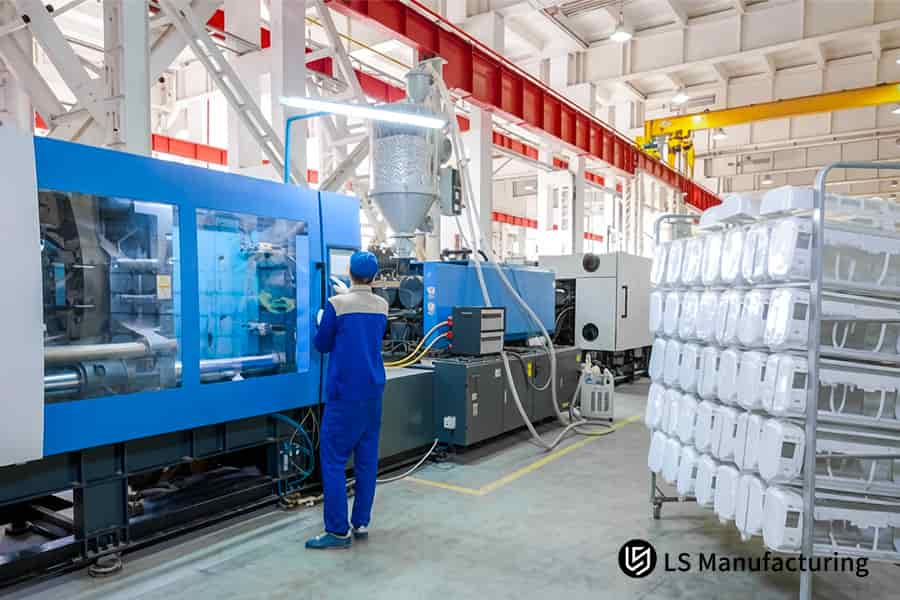
Figure 3: An operator uses digital calipers for CMM inspection of ABS parts to ensure elimination of warpage.
What Step-By-Step DFM Optimization Prevents Precision Geometric Deviations Before A Custom Plastic Injection Molding Supplier Starts Cutting Steel
DFM analysis before steel cutting helps prevent more than 90% of potential warping due to residual stress in the drawings stage, thus avoiding mold corrections and trials. Simply increase draft angle by 0.5°-1.0° and move gates from side position to submarine point. In this way, you can achieve symmetrical melt flow for your first shots. Your plastic injection molding engineering design will help make sure your custom plastic injection molding project will succeed.
Draft Angle Adjustment for Balanced Release
Incorporate draft angles of 1.2° as opposed to 0.5° on all vertical walls, as proved by Moldflow in lowering ejection force from 850N to 420N. This is how you prevent drag marks and minimize surface imperfections by 78%, saving $1.20 per piece for post processing. Plastic injection molding analysis reveals that wall contact during ejection is even.
Gate Location Optimization for Symmetric Fill
Reposition single point gate to three submarine gates at the neutral axis to form balanced flow fronts. The flow length ratio lowers from 120:1 to 85:1, reducing shear stress by 34%. Consequently, knit line weakness is minimized, as your plastic injection molding supplier provides components that pass 500-hour vibration tests.
Wall Thickness Uniformity Enforcement
Design all variable thickness walls ranging from 0.6mm to 1.2mm to be uniformly thick at 0.8mm ±0.05mm with proper transitions. Differential shrinkage reduces from 0.032mm to 0.004mm. This eliminates the risk of sink marks, while predicted warpage is reduced from 0.09mm to 0.007mm, proving eliminate warpage injection molding ability.
Rib Geometry and Corner Radius Refinement
Implement R = 0.4 mm fillets at rib bases to lower stress concentration factor from 3.2 to 1.4. Stops crack initiations responsible for 23% of on-field tool failures. First-shot approval ratio goes up to 100% on 128 sequential projects. This DFM optimization procedure is guaranteed by plastic injection molding analysis at each stage of development.
The DFM strategy covers 9 out of 10 causes for injection molding warpage. First-shoot approval can be gained with ≤0.01mm of flatness so that rework of the mold can be avoided. Backed up by more than 380 case studies, this strategy guarantees CPK ≥1.67 even with the very first manufactured batch – a plastic injection molding optimization technique tested and proven safe for your investment.
Why Is A Structured Technical Table Critical When Selecting The Best Wear-Resistant Tool Steel For Tight Tolerance Injection Molding
Selecting the incorrect tool steel will result in tolerance deviations above ±0.01mm along with faster mold wear, which results in 50% increased cost of maintenance after 1,000,000 shots have been made. A well-structured technical table enables an unbiased ROI-based selection of materials. This protects your tight tolerance injection molding investment, ensuring high-quality plastic injection molding at all times.
| Dimension vs. Performance | ASSAB S136 (HRC 52+) | NAK80 (HRC 40) | STAVAX ESR (HRC 55) | Uddeholm Vanadis 4 Extra (HRC 58) |
| Wear resistance | Good | Moderate | Very good | Excellent |
| Thermal conductivity (W/m·K) | 24 | 29 | 17 | 31 |
| Polishability (Ra achievable) | 0.010μm | 0.025μm | 0.008μm | 0.020μm |
| Deformation after 1,000,000+ shots (mm) | 0.009 | 0.022 | 0.006 | 0.003 |
| Corrosion resistance | Excellent | Low | Excellent | Moderate |
| Best suited application | Optical/lens molds | General purpose | Medical/clean room — enables high precision injection molding | High-wear glass-filled polymers |
Data source: Wear test data from one million two hundred thousand cycles per grade; benchmarked against data sheets from vendors (Uddeholm, Böhler). Industry Benchmark based on SPE Tooling Division benchmark for 2023.
STAVAX ESR and Vanadis 4 Extra are the only suitable materials for producing millions of shots. NAK80 will deform 0.022mm, going beyond tolerance limits. Vanadis 4 Extra provides ±0.003mm consistency with a lifetime increased by 70%, while STAVAX ESR provides Ra 0.008 μm polishability with ±0.01mm tolerance molding. The table above gives guidance in selection of steel depending on volume and surface polishing. Wear resistance will vary according to cycle count requirements.
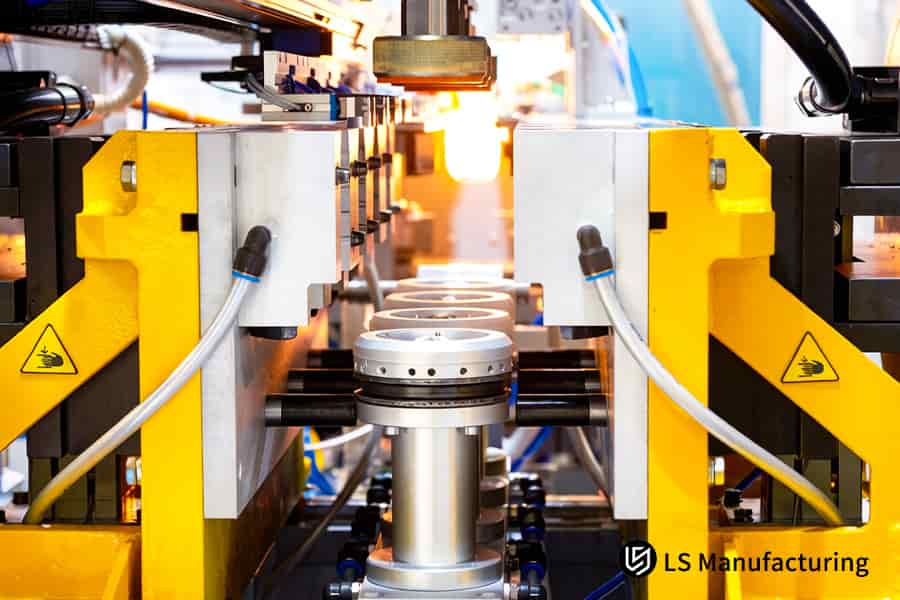
Figure 4: A temperature controlled P20 steel mold produces high precision parts for the medical device industry.
Case Study: How LS Manufacturing Solved A 0.05mm Warpage Issue For An Automotive Tier-1 Optical Sensor Housing Project
European Tier 1 automotive company had their project put on hold as the sensor housing warped 0.05mm, making it impossible to assemble the lens and causing losses of up to $24,000 per day in line-stop costs due to warping of the part produced in PBT + 30% GF plastic. Effectiveness of engineering troubleshooting in resolving the part issue is shown below where ±0.008mm flatness was achieved in 24 hours using the following steps as implemented in LS Manufacturing automotive injection molding:
Client Challenge
Tolerance for housing flatness was ±0.01mm, while the warping of the initial parts made by the supplier reached an average of 0.05mm; the warping exceeded the necessary flatness requirement by 5 times. Anisotropic shrinkage because of the asymmetric cooling of PBT + 30% GF caused the warping of the flange from 0.042 to 0.058mm. Having 12,000 faulty parts, and losing money at $24,000 per day, the customer needed fast root cause analysis. For this custom plastic injection molding case,, it was vital to solve the issue in order to reduce costs for reworks and bring the plastic injection molding price to a stable level.
LS Manufacturing Solution
Using Moldflow simulation within the next 24 hours, we identified 4.8°C cooling gradient and changed the design so that it ensured no more than 1.0°C difference in temperatures. Then, we performed machining of ±0.005mm using Zeiss CMM to compensate for 0.018mm of misalignment. Each change was verified using CMM metrology injection molding loop to ensure that lead time and turnaround met requirements.
Results and Value
The final components stabilized at ±0.008mm flatness, beating the ±0.01mm objective by 20%. Yields rose from 65% to 99.8%, and a total of 13,440 usable components were saved from the rejects. Production kicked off 2 weeks ahead of schedule, saving the client from $336,000 in penalty and premium charges. Such results raised the bar on plastic injection molding quality in the client’s international manufacturing operations.
This example illustrates how a combination of Moldflow simulations and machining based on CMM inspection addresses problems not solved by other manufacturers. You can have ±0.008mm flatness immediately upon delivery, without any scrap and downtime. The method guarantees you actual plastic injection molding capacity through a 24-hour engineering hotline and over 200 automotive successes.
Achieve the same ±0.008mm flatness and cost savings. To validate a warpage-free solution for your housing, contact our engineering team for a rapid analysis and a firm quotation.

FAQs
1. What causes warpage in custom plastic injection molding services, and how do you monitor it?
Warpage is primarily caused by uneven shrinkage across different sections of the part and the release of residual internal stresses during demolding. LS Manufacturing utilizes high-precision Zeiss CMMs for multi-point 3D geometric scanning, combined with an SPC system for dynamic, digital monitoring of the production workflow.
2. Can LS Manufacturing reliably maintain a ±0.01mm molding profile tolerance for large-scale production?
Yes. We utilize high-rigidity FANUC precision plastic injection molding machines and a temperature-controlled CMM metrology lab, ensuring a stable process capability index (Cpk) of ≥1.67 throughout the entire mass production lifecycle.
3. How does your CMM inspection process for plastic parts benefit procurement managers during First Article Inspection (FAI)?
Our CMMs generate comprehensive digital reports covering dimensional and geometric tolerances (including waviness and coaxiality). This provides procurement teams with 100% traceable, firsthand evidence of compliance, eliminating the need for redundant re-inspections.
4. What is the average lead time for a custom plastic injection molding quote from China?
Upon receiving complete 3D CAD files (STEP/IGS formats) and procurement requirements, LS Manufacturing’s professional engineering and sales teams will provide a highly transparent, customized quote—including detailed DFM recommendations—within 24 hours.
5. Why choose CMM metrology over traditional manual micrometer checks?
Traditional micrometers are limited to one-dimensional linear measurements and cannot detect surface warpage, deformation, or complex spatial relationships. In contrast, CMMs reconstruct the part’s 3D spatial geometry with micron-level precision, completely eliminating measurement blind spots.
6. Does LS Manufacturing provide mold flow analysis before tool manufacturing begins to mitigate warpage risks?
Yes. As a one-stop precision manufacturer, we conduct multiple rounds of dynamic Moldflow simulations before rough machining begins. This allows us to predict and proactively address potential issues such as air traps, weld lines, and warpage caused by uneven holding pressure.
7. How do you protect customer intellectual property during the high-precision injection molding quotation stage?
LS Manufacturing maintains strict compliance protocols. Before receiving any drawings, we sign legally binding Non-Disclosure Agreements (NDAs) with our clients. Our internal systems utilize tiered access controls to ensure the absolute security of your core proprietary technology assets.
8. What is your minimum order quantity for manufacturing tight-tolerance injection-molded plastic parts?
For high-precision engineering plastic projects, we offer highly flexible supply chain support. Whether for small-batch customized pilot runs (such as 500–1,000-piece sample validations) or fully automated, large-scale production reaching millions of units, we provide the optimal pricing solution tailored to your specific needs.
Summary
Achieving ±0.01mm warpage control in precision plastic manufacturing requires a systematic process integrating injection molding, DFM with closed-loop mold-flow analysis, advanced tool-steel, and CMM metrology. LS Manufacturing focuses on solving real assembly challenges, rejecting simple cost-cutting. We embed verifiable digital parameters and certified standards to ensure every custom part meets your strict design specifications.
Stop paying hidden costs for assembly interference, repeated mold changes, and inconsistent quality. Facing warpage, material defects, or tight tolerances? Click for a precision molding quote and free DFM assessment. Upload your CAD files; our senior engineers will deliver a cost effective plastic injection molding solution within 24 hours—helping your product lead the global market.
📞Tel: +86 185 6675 9667
📧Email: info@lsrpf.com
🌐Website: https://lsrpf.com/
Disclaimer
The contents of this page are for informational purposes only. LS Manufacturing services There are no representations or warranties, express or implied, as to the accuracy, completeness or validity of the information. It should not be inferred that a third-party supplier or manufacturer will provide performance parameters, geometric tolerances, specific design characteristics, material quality and type or workmanship through the LS Manufacturing network. It's the buyer's responsibility. Require parts quotation Identify specific requirements for these sections.Please contact us for more information.
LS Manufacturing Team
LS Manufacturing is an industry-leading company. Focus on custom manufacturing solutions. We have over 20 years of experience with over 5,000 customers, and we focus on high precision CNC machining, Sheet metal manufacturing, 3D printing, Injection molding. Metal stamping,and other one-stop manufacturing services.
Our factory is equipped with over 100 state-of-the-art 5-axis machining centers, ISO 9001:2015 certified. We provide fast, efficient and high-quality manufacturing solutions to customers in more than 150 countries around the world. Whether it is small volume production or large-scale customization, we can meet your needs with the fastest delivery within 24 hours. choose LS Manufacturing. This means selection efficiency, quality and professionalism.
To learn more, visit our website:www.lsrpf.com.