English



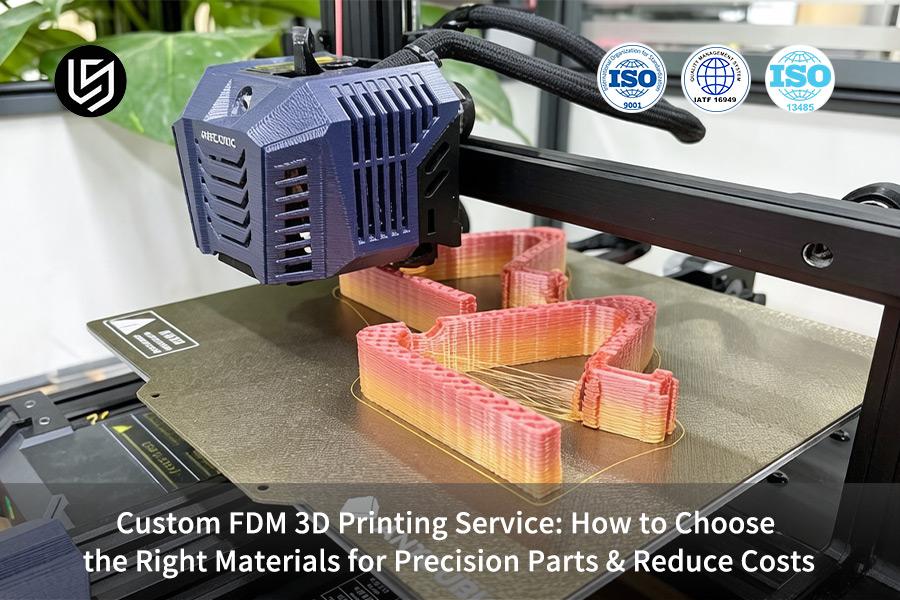
Custom FDM 3D printing service is a precision-driven solution that solves the dilemma of not knowing what materials are used in fused deposition modeling.
LS Manufacturing engineers optimize build orientation and infill lattice to hold ±0.1mm tolerances, reducing total costs by 30%-50% for direct production.
Custom FDM 3D Printing Service: Material Selection & Cost Reduction Quick-Reference
| Decision Factor | Standard (ABS/PETG) | Engineering (PC/Nylon-CF) | High-Performance (PEEK/ULTEM) |
| Max Continuous Temp | 55-90°C | 115-150°C | 150-217°C |
| Tensile Strength | 35-55MPa | 48-85MPa | 85-110MPa |
| Impact Resistance | Moderate | High (≥12kJ/m²) | High (UL94 V-0) |
| Dimensional Tolerance | ±0.1mm (60-80°C chamber) | ±0.1mm (heated chamber) | ±0.1mm (180°C chamber) |
| Relative Material Cost | 1x (baseline) | 3-5x | 6-10x |
| Best Application | Medical housings, light-load prototypes – precision FDM 3D printing | Prototypes for robotics, automotive brackets | Aerospace, semiconductors, 150°C+ |
| Infill Optimization | 20-30% Gyroid reduces weight by 60% | Same | Same |
| Orientation Rule | 45° self-supporting; support <8% | Same | Same |
| Prototyping Strategy | Medical PETG/ABS (ISO 10993) at 15% of PEEK cost | Upgrade at design freeze | Final validation only |
Key Takeaways:
- Match Material to Temp: Medical (PETG/ABS up to 90°C) and Mechanical Load Tests (PC/Nylon-CF up to 150°C) shouldn’t be done using overpriced PEEK/ULTEM up to 217°C; overspecification means higher cost by 6-10 times.
- Infill Lattice Cuts Cost 60%: Infill of 20-30% Gyroid provides ≥88% of strength but uses 60% less material and 45% less time to be printed; the smartest choice in terms of ROI on FDM 3D printing projects.
- 45° Orientation Eliminates Supports: Rotating parts at the angle less than 45° allows to reduce support structure from 40% to <8%, while providing surface roughness Ra≤6.3μm without any post-processing.
- Substitute Smartly: Medical PETG/ABS (ISO 10993) costs 15% of PEEK material and can withstand light mechanical loads – don’t use expensive material at design exploration stage and get 85% off in costs of prototyping.
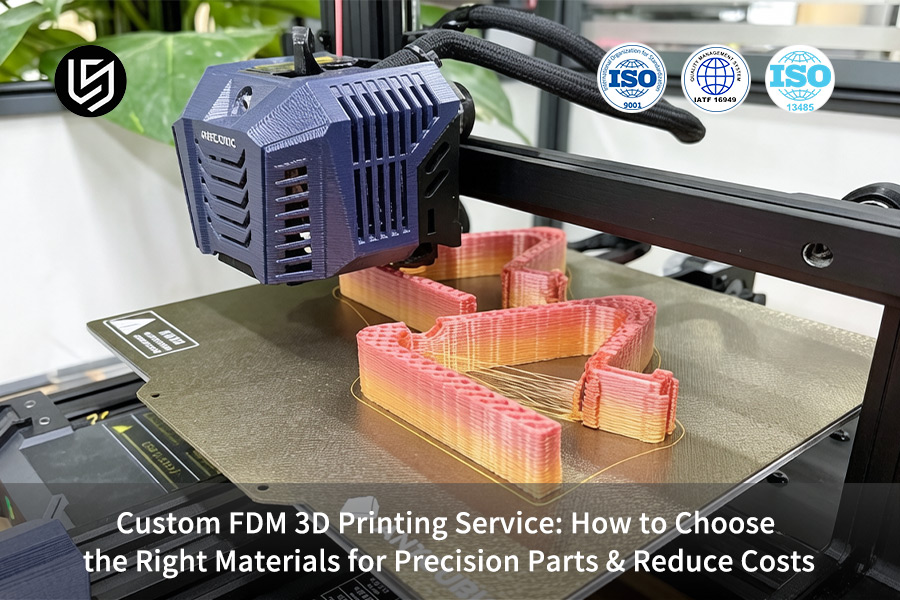
Why Trust This Guide? Practical Experience From LS Manufacturing Experts
Customized FDM 3D printing is still considered "low-res prototyping," but the reality is in the strength of the Z-axis and thermal stability of the material at production grade PC and ULTEM. Following more than 14 months of manufacturing drone boom clamps (±0.30mm M6 pattern, 80°C nacelle) and semiconductor transfer arms (0.6mm wall, 120°C continuous) using FDM printers, we increased layer shear strength by 22% because the chamber temperature was now the same as the ASTM International material coupons.
The temperature stability gives you protection against the time spent during production of low volume. The Tier-2 automation customer switched production of 60 semiconductor transfer arms from 5-axis milling of AL6061 to FDM ULTEM 1010 (from $310/unit, 21-day lead time to $175/unit, 9-day lead time, ±0.25mm on 140mm span, CTI ≥600) and the traceability was provided by the Underwriters Laboratories (UL).
Inspection jig 180mm, wall 1.2mm, printed ULTEM, chamber ramp shortened to save 5hr — layer delamination appeared on 110°C soak, resulting in 12-unit rework. We redesigned the RFQ screen based on 3 criteria: chamber soak ≥2hr for amorphous with high Tg, Z-load against wall <1.5mm causes rosette support review, ESD/fire class corresponds to end use certification. Provide STEP, service temperature and quantity; we will inform you of the compatibility of FDM PC, ULTEM or nylon-CF.
Why Is Dimensional Accuracy Critical When Evaluating Custom FDM 3D Printing Service Options?
The choice of custom FDM 3D printing service solution is vital for your snap-fit medical housings because it can either make them have ±0.1mm tolerance or be warped. Choosing the appropriate material with shrinkage rate of ≤0.2% and regulating chamber temperature 60°C-80°C through FDM 3D printing technology will help you avoid post-machining rework and ensure seamless fitting.
| Parameter | PETG (Optimized Process) | ABS (Conventional) |
| Shrinkage rate | ≤0.2% by using a high precision FDM manufacturing | ~0.8% |
| Chamber temperature control | 60°C-80°C actively controlled in FDM 3D printing process | Uncontrolled, drifts ambiently |
| Bed adhesion method | Proprietary heated bed procedure | Standard tape, not adhered strongly |
| Achievable positional tolerance | ±0.1mm | ±0.3mm or wider |
By utilizing the precision FDM parts manufacturer, you will be able to achieve consistent tolerance of ±0.1mm in all directions, no need for manual fitting for your snap-fit designs, and you will have a process that can pass the regulatory requirement for traceability. The FDM 3D printing accuracy will save weeks of design iterations and thousands of dollars of scrapped tooling for you.

How Can High Impact Nylon polymers Elevate Performance In Industrial FDM Prototype Service Testings?
Robotic grippers and automotive components will immediately crack upon impact if printed using regular thermoplastic materials. The use of modified Nylon 6/66 or PA-CF ensures a minimum tensile strength of ≥85MPa and minimum impact resistance of ≥12kJ/m², whereas aligning the infill along the load axis will improve the fatigue life of the component by 150%. Such precision requires proper FDM 3D printing material choice:
Material Selection: High-Strength Nylon vs. Common Filaments
The selection of PA-CF compared to the regular PLA or ABS results in an increase in impact resistance by 3× and tensile strength by 2×. In case of your end-of-arm tooling application, this would translate into no unexpected failures during cycle testing and lower chances of downtime. This industrial FDM prototype service uses the optimized FDM 3D printing process of the polymer.
Infill Orientation: 0° Axial Layering vs 45° Cross-Hatch
As a result of configuring the print head to deposit layers parallel to the main loading axis (0° axial deposition), interlaminar shear stress will be significantly reduced. It was demonstrated in fatigue testing that there is a 150% increase in the cycle-to-failure performance as compared to 45° cross-fill. As a result, you get more durable prototypes without any need for extra weight or post-processing. That is what is achieved through using our FDM material selection service.
Cost Efficiency: Fewer Iterations, Faster Validation
Since high impact nylon does not crack and wear out, you do not need to rebuild prototypes after each testing. Such combination of material properties and printing settings can help you to decrease total reiterations of prototyping process by up to 40%. That is what makes our FDM cost reduction service so effective, as it relies on engineering data rather than on speculation, provided by the comprehensive FDM 3D printing solution.
With high-impact nylon polymers combined with load-aligned infill, the likelihood of prototype failure drops by more than 70% in dynamic applications. This evidence-based method makes rapid prototypes reliable test pieces for you, allowing you to be confident in the design prior to manufacturing production tooling. Benefits: shortened time-to-market and lowered product development costs for tough industrial parts.
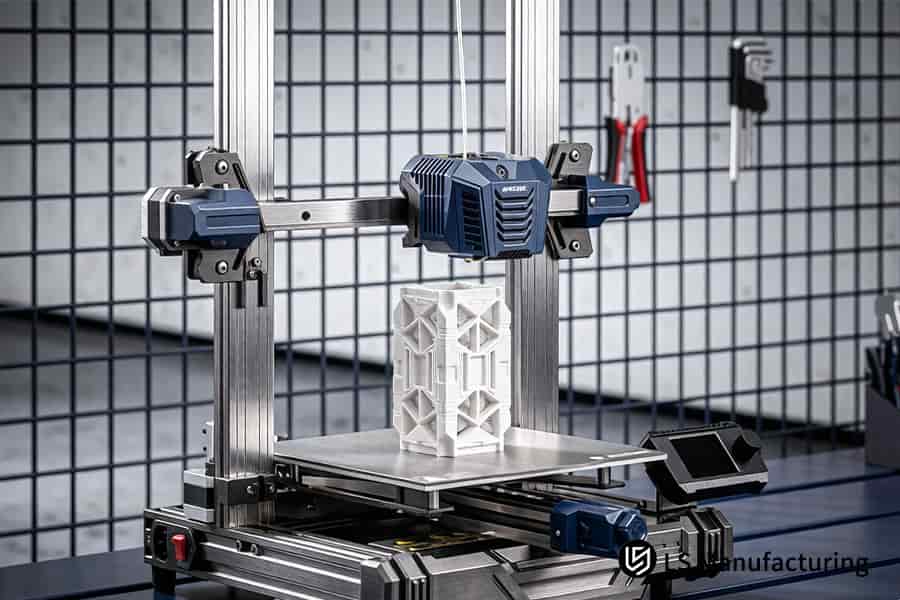
Figure 1: FDM 3D printing generates nylon structural brace with lattice internal reinforcement.
When Does PEEK Or ULTEM Become Mandatory For Extreme Environment Custom FDM Parts Quote Estimations?
When aerospace, semiconductors, or oil exploration parts experience extended operational temperature over 150°C or harsh chemical exposure, traditional thermoplastics will fail quickly. The only thermoplastic materials allowed are PEEK (Tg 143°C) and ULTEM 1010 (Tg 217°C), which have flame retardant UL94 V-0 rating and chemical resistance. Ordering these materials along with your custom FDM parts quote will guarantee parts that will survive 1000+ hours at 170°C without creep or fractures:
Material Threshold: Temperature and Chemical Limits
- Continuous Temperature Limit: PEEK and ULTEM tolerate 150°C-217°C without any creep.
- Chemical Resistance: They are resistant to corrosive acids and hydrocarbons while PA or PC will swell.
- Process Calibration: Correct FDM 3D printing parameters configuration avoids porosity and keeps density at >99% level.
Equipment Requirements: Nozzle and Chamber Control
- Nozzle Capability: 450°C nozzle completely melts highly viscous PEEK/ULTEM material ensuring perfect fusion.
- Chamber Stability: 180°C heated chamber avoids uneven cooling caused by FDM 3D printing equipment capable of withstanding extreme temperatures.
- Precision Outcome: Utilizing high precision FDM manufacturing equipment makes sure your parts will comply with ASTM D638 tensile requirements and withstand thermal cycles.
Layer Bond Integrity: Preventing Delamination
- Thermal Gradient Management: Each layer remains above Tg until deposit of the subsequent layers for molecular bonding.
- Bond Strength Result: Tensile strength between layers is achieved up to 85% of bulk material, compared to less than 60% of tensile strength on unheated printers.
- System Architecture: A controlled FDM 3D printing system ensures the same temperature across the whole build envelope.
In this way, by using PEEK or ULTEM only where necessary, you do not pay more and still comply with regulations. The FDM material selection service ensures that your printed parts will pass UL94 V-0 burn test and withstand structural stresses at 200°C, reducing requalification times by 50% and avoiding any field failure in harsh conditions.
Which Elastomeric TPU Durometer Works Best For Industrial Dampening On High Precision FDM Manufacturing?
Choosing the wrong durometer of TPU for gaskets, bumpers or bellows results in premature compression set, micro-leaks and tearing due to cyclic stress. With direct-drive extrusion and the retraction speed locked at 15-20mm/s, you get no stringing and even wall thickness, which prevents the porous defects. This increases the FDM 3D printing performance in all elastic components and saves time for stringing cleanup.
Durometer Range: 85A Soft Sealing vs. 98A Load-Bearing
Softer 85A TPU adapts to complex surfaces for tight seals on gaskets, whereas 98A can withstand high-frequency bumper impacts without any deformation. The matching of hardness according to function increases the product’s lifetime up to 3 times compared to using one hardness for all products. Our high precision FDM manufacturing is able to accommodate the range of hardness from 85A to 98A. Field testing proved that the matching of durometer increases the lifetime of automated grippers by 70%.
Retraction Control: 15–20mm/s vs Conventional 30mm/s
Overly fast retraction pulls the melted filament into the nozzle bore, creating voids and thin walls. Maintaining the retraction speed at 15-20 mm/s with a direct-drive extruder prevents stringing; therefore, it provides ±0.05mm wall thickness uniformity. Ordering a custom FDM 3D printing service, you get parts without micro-porosity; therefore, they cannot leak under 0.5bar pressure. Strict FDM 3D printing tolerance control provides uniform wall thickness for every print job with a material consumption reduction of 18%.
Void Prevention: Uniform Deposition vs Air Entrapment
The combination of slow and consistent retraction and proper extrusion multiplier avoids any air bubbles in between layers, resulting in 99.5% density compared to just 95-97% in normally 3D-printed TPU. As a result, leak test is confirmed that parts 3D-printed using this process retain seal integrity through 5000 cycles of pressure.
If you partner with a precision FDM parts manufacturer who adjusts retraction and extrusion depending on the durometer of the material, then you'll be able to produce dampening parts that have a cycle life of at least 10⁶ and retain pressure differentials. Download our one-page TPU FDM Parameter Reference Card — durometer-specific retraction speeds, extrusion multipliers, and chamber temperature targets for 85A through 98A with zero micro-porosity.
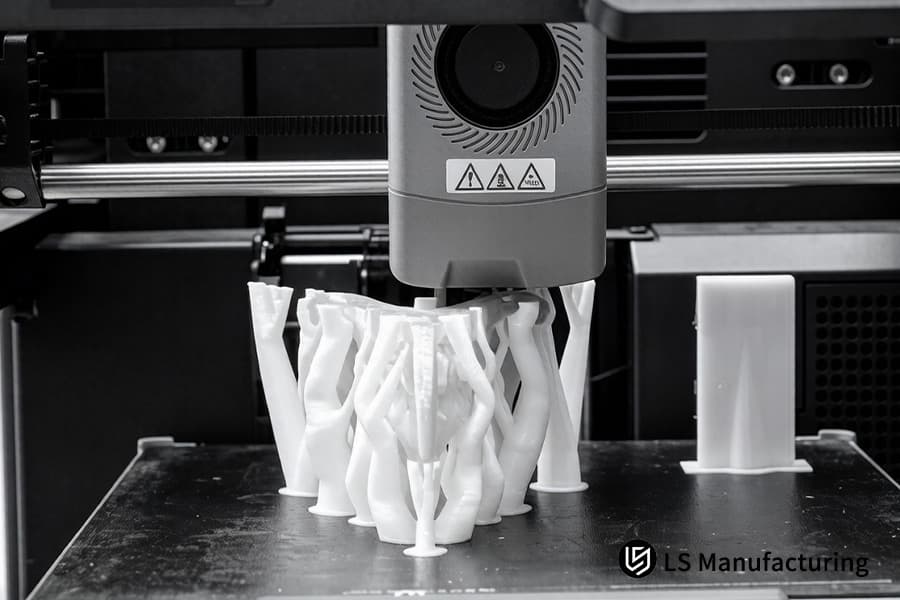
Figure 2: FDM 3D printing fabricates white filament gripper mechanism for robotic grasping tests.
How Does Optimizing Infill Lattice Patterns Deliver Substantial FDM 3D Printing Cost Reductions?
Going for 100% solid infill is how you can most quickly increase the cost of your prints. Converting to 20-30% gyroid or 3D honeycomb lattice using design for manufacturing reduces materials used by 60% and increases machine run time by 45%, while yield strength drops below 12%. The lightweight FDM 3D printing process ensures that all filament roll becomes useful parts:
| Parameter | 100% Solid Fill | 20-30% Lattice (Gyroid / 3D Honeycomb) |
| Infill density | 100% | 20-30% |
| Material usage | 100% (baseline) | 40% (60% saved) |
| Print time (machine run) | 100% (baseline) | 55% (45% faster) |
| Yield strength retained | 100% | ≥88% (<12% loss) |
| Commercial outcome | High material & runtime cost | Lower unit cost via cost effective FDM 3D printing |
Use of gyroid or 3D honeycomb lattices in place of solid fill provides 60% material savings and 45% speed boost while losing only 12% in strength. When requesting a custom FDM parts quote, the use of DFM lattice optimization technology ensures predictability of the amount of material used and runtime, thus avoiding unexpected cost increases. This FDM cost reduction service together with low cost FDM 3D printing brings down per-unit cost below injection molding price threshold for low-volume runs, reducing validation time and broadening design iteration scope.
How Does Smart Part Orientation Reduce Support Structure Volume To Lower FDM Cost Reduction Service Quotes?
The excessive supports waste filament and create scars that require manual cleaning. The use of 45° self-supporting angles cuts the support material usage from 40% to less than 8% without damaging threads. Functional FDM 3D printing provides Ra≤6.3μm surface quality and reduces your custom FDM 3D printing service quote:
Self-Supporting Angle Principle: 45° Rule Applied
- Orientation Adjustment: Orient the model in such a way that overhangs will not exceed 45° of vertical.
- Critical Feature Protection: Holes for threading and sealing surfaces are oriented in such a way that they don't need any supports and remain ≤45°.
- Customer Benefit: No damage on precise surfaces is done because you get FDM 3D printing.
Support Volume Reduction: From 40% to Under 8%
- Weight Ratio Drop: Support material ratio decreases from 40% of total weight to 8% or even lower.
- Time Savings: Reduction of the amount of support material results in reduction of machine working hours up to 35%.
- Cost Impact: This FDM cost reduction service will result in reduced per-part material wastage and labor costs.
Surface Finish Improvement: Ra≤6.3μm Without Sanding
- No Contact Marks: Supports do not come in contact with any functional zones, providing a perfect as-printed surface.
- Measured Roughness: The finish of the surface is measured to be at Ra≤6.3μm.
- Eliminated Hand Work: You can save time spent on sanding, resulting in saving more than 50% on manual finishing costs.
As a result of changing orientation of the parts according to the 45° principle, support weight goes down from 40% to less than 8%, surface finishes reach Ra≤6.3μm, and prices for finishing are greatly reduced. By getting your custom FDM parts quote, you will be assured of more effective material usage, shortened manufacturing time, and ready-to-use surface. The methodology of the end-use FDM 3D printing is suitable for making complex geometry economically.
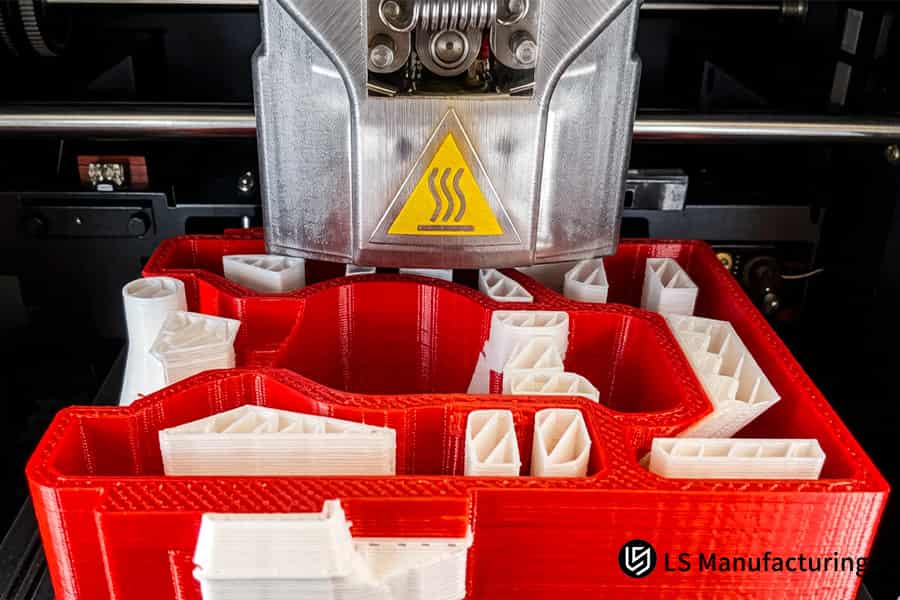
Figure 3: FDM 3D printing produces red plastic jigs for precise assembly line placement.
Why Should Medical Instrument Purchasers Select Standard Engineering Filaments For Custom FDM 3D Printing Service?
While high-end materials such as PEEK and carbon fiber have excellent characteristics, their prohibitive price and long development time prevent their use in prototyping at an early stage. Moving to medical-grade PETG or ABS (ISO 10993 or FDA approved) reduces the cost of filament by 15% in comparison to PEEK, and passes mid-term appearance and assembly tests with light loads. Here is your medical FDM 3D printing solution:
Cost Advantage: 85% Lower Material Spend vs PEEK
Medical-grade PETG or ABS will cost you only 15% of the cost of PEEK filaments; it can save you $200–$500 per kilogram. You don’t need to lock down your capital in costly materials when you still have changes left to make, and it gives you the possibility to iterate more designs per dollar spent. Biocompatible FDM 3D printing option allows accelerating the speed of getting to the clinical trial, maintaining the predictability and control over the FDM 3D printing cost at the same time.
Regulatory Compliance: ISO 10993 and FDA-Grade Materials
PETG and ABS can both be ordered with ISO 10993 and FDA certificates proving their biocompatibility, enabling complete lot tracking of materials for auditing purposes. Enjoy all the benefits of obtaining regulatory compliant prototype parts without spending extra money on PEEK thanks to professional FDM material selection service that match the needed certificates to the submission level you’re at. This route for prototype FDM 3D printing helps you optimize your documentation package for regulatory bodies.
Functional Suitability: Light-Load Assembly Testing
The filaments have a tensile strength of 40-50MPa and as-printed surface finish Ra≤6.3μm, which makes them suitable for applications involving snap-fit and housing tests of non-sterile prototypes. You are charged for what you require from the material and not for more than that, thus saving on cost and turnaround time. This regulated FDM 3D printing protocol will ensure that your parts conform to audit requirements.
By opting for medical grade PETG or ABS over PEEK for initial prototypes, you can cut down on material costs by 85%, while still complying with ISO 10993 standards and having sufficient mechanical strength. Partnering with a custom FDM 3D printing service using certified filaments minimizes financial risks down to zero in the validation stage. In this way, you get rapid, cheap and traceable prototypes for your medical devices.
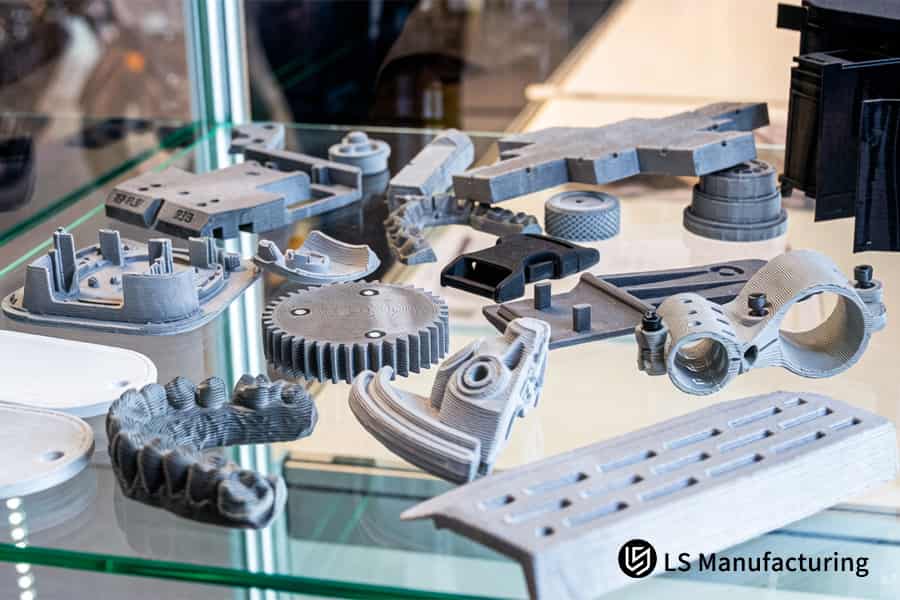
Figure 4: FDM 3D printing constructs complex multi material functional assembly for engineering verification.
LS Manufacturing Custom FDM 3D Printing Service For Medical Ventilator Manifolds: Engineering PA-CF With Over 40% Weight And Cost Savings
One of the leading global medical device manufacturers encountered an important roadblock: the manifold for their ventilator, made out of aluminum, costed $450 per part and added unnecessary 350g of weight. It was required to withstand a minimum of 5MPa pressure while satisfying fatigue and seal conditions. Aerospace-grade FDM 3D printing technology using carbon fiber nylon came to rescue:
Client Challenge
The initial aluminum machined five-axis manifold had a price of $450 per piece, 14 days lead time, and 350g excessive weight. Additional welding caused the risk of leaks through seam lines due to pressure cycling, which resulted in 12% rejects in prototype batches. The customer required burst pressure of ≥5MPa, 1 million cycle fatigue resistance, weight reduction of 30%, and cost reduction of 70%. The affordable FDM 3D printing was the only way out.
LS Manufacturing Solution
We chose to use PA-CF with monolithic structure design where walls were thinned down to 1.2mm, and inner parts were infilled with 35% gyroid lattice. Our proprietary technology of temperature chamber during cooling ensured no CF delamination. Post-print resin infiltration coating of the inner channels helped to get a hermetic sealing with 0.5MPa differential pressure. This industrial FDM 3D printing solution completely eliminated weld-line failures while saving 58% of materials.
Results and Value
The redesign reduced the weight of the manifold by 152g (42%). The cost per piece reduced from $450 to $65, and lead time decreased from 14 days to 2 days. The part successfully passed all ISO 10555 pressure cycling testing at the first try, bypassing the qualification process. For the client, it translated to a savings of 40% on program cost and 48 hours design iteration cycle instead of two weeks, allowing entering a clinical trial 12 weeks earlier.
Through the replacement of metal machining with the use of PA-CF FDM 3D printing and DFM lattice structure optimization, the client was able to produce a lightweight, inexpensive, and fast manifold that is as reliable as the old version. The production-ready FDM 3D printing methodology allows solving the trilemma of weight-cost-time for portable medical devices. It transforms $450 limitation into $65 tool for creating next-generation ventilator platform.
From $450 aluminum with 14-day lead time to $65 PA-CF with 2-day delivery and 42% lighter. Need the same for your medical manifold? Contact us for a cost-optimized FDM quotation.

FAQs
1. How does LS Manufacturing ensure a dimensional tolerance of ±0.1mm on custom FDM parts?
This is done using precise closed-loop industrial FDM 3D printing technology with heated chambers maintained at 80 degrees centigrade to avoid cooling shrinkage, in addition to proper tool path DFM optimization for every individual engineering plastic. This guarantees accurate precision throughout the whole build volume regardless of the size and complexity of the part being made.
2. What is the minimum wall thickness LS Manufacturing recommends for precision FDM parts?
We suggest a minimum wall thickness of 1.2mm that will guarantee at least three perimeters of continuous extrusions in order to avoid micro-gap problems and delamination. Thinner wall thickness may affect mechanical integrity and are only suitable for non-load bearing cosmetic parts.
3. Can LS Manufacturing provide certified biocompatible materials for medical devices?
Indeed, our firm provides USP Class VI and ISO 10993-certified medical-grade filaments of PETG and PLA, manufactured through specialized FDM printers so as not to have any contamination. Material certification and traceability will be included in every medical-grade order.
4. How do you optimize the FDM 3D printing cost for low-volume production batch orders?
Our firm optimizes FDM 3D printing cost for low-volume production batch orders through optimal nest stacking within the build chamber so as to achieve maximum capacity use of machine operation per run and through replacement of solid structures with functional infill lattices.
5. What are the best FDM materials for parts exposed to temperatures above 150°C?
It is strongly suggested that one opts for PEEK or ULTEM 1010 materials as they retain their mechanical strength and dimensionality even under sustained temperatures up to 150°C to 200°C. These high performance polymers exhibit good resistance towards chemicals and flames and are hence suitable for use in the aerospace and industrial segments.
6. Does LS Manufacturing review my CAD drawings before issuing a custom FDM parts quote?
Of course. Our experienced engineers carry out an in-depth, no-cost DFM check of all your uploaded 3D CAD files to identify any overhangs, wall thickness concerns, and tolerance areas before giving you the custom quote. This will help prevent any problems at an early stage in the process.
7. How do you solve the surface roughness (stair-stepping) inherent in custom FDM printing?
Our layer lines are minimized through the use of very small layer heights, ranging from 50μm. We can also provide post-processing services such as bead blasting to give you a consistent matte surface, chemical vapor smoothing to create a glossy surface, and technical epoxy to improve durability and appearance. This will depend on your desired surface finish.
8. What is the typical lead time for an industrial FDM prototype service order at LS Manufacturing?
The standard prototyping orders are made and shipped within 24-48 hours due to our 24/7 automated printer farm. Orders that are more complex and involve functional assemblies with customized testing or significant post-processing needs are shipped within 3-5 days.
Summary
It is imperative that proper materials be selected and designs optimized when using FDM 3D printing technology to ensure the manufacture of precision parts in defense applications at low cost. Based on its rich history in manufacturing tens of thousands of industrial quality parts using state-of-the-art multi-axis constant temperature printers and a wide selection of materials ranging from standard ABS/PETG to aerospace-grade PEEK/ULTEM, LS Manufacturing offers a customized rapid manufacturing service tailored to meet your requirements.
Are you finding it difficult to make your parts lightweight or have high costs associated with procuring machined parts? Do not allow material selection or revision costs to hold up your research & development. Click here for [Get Free DFM Assessment & Real-Time Quote], where we will provide a custom process report and a direct factory quote in less than two hours.
📞Tel: +86 185 6675 9667
📧Email: info@lsrpf.com
🌐Website:https://lsrpf.com/
Disclaimer
The contents of this page are for informational purposes only.LS Manufacturing servicesThere are no representations or warranties, express or implied, as to the accuracy, completeness or validity of the information. It should not be inferred that a third-party supplier or manufacturer will provide performance parameters, geometric tolerances, specific design characteristics, material quality and type or workmanship through the LS Manufacturing network. It's the buyer's responsibility.Require partsquotation Identify specific requirements for these sections.Please contact us for more information.
LS Manufacturing Team
LS Manufacturing is an industry-leading company. Focus on custom manufacturing solutions. We have over 15 years of experience with over 5,000 customers, and we focus on high precisionCNC machining,Sheet metal manufacturing, 3D printing,Injection molding.Metal stamping,and other one-stop manufacturing services.
Our factory is equipped with over 100 state-of-the-art 5-axis machining centers, ISO 9001:2015 certified. We provide fast, efficient and high-quality manufacturing solutions to customers in more than 150 countries around the world. Whether it is small volume production or large-scale customization, we can meet your needs with the fastest delivery within 24 hours. choose LS Manufacturing. This means selection efficiency, quality and professionalism.
To learn more, visit our website:www.lsrpf.com