English



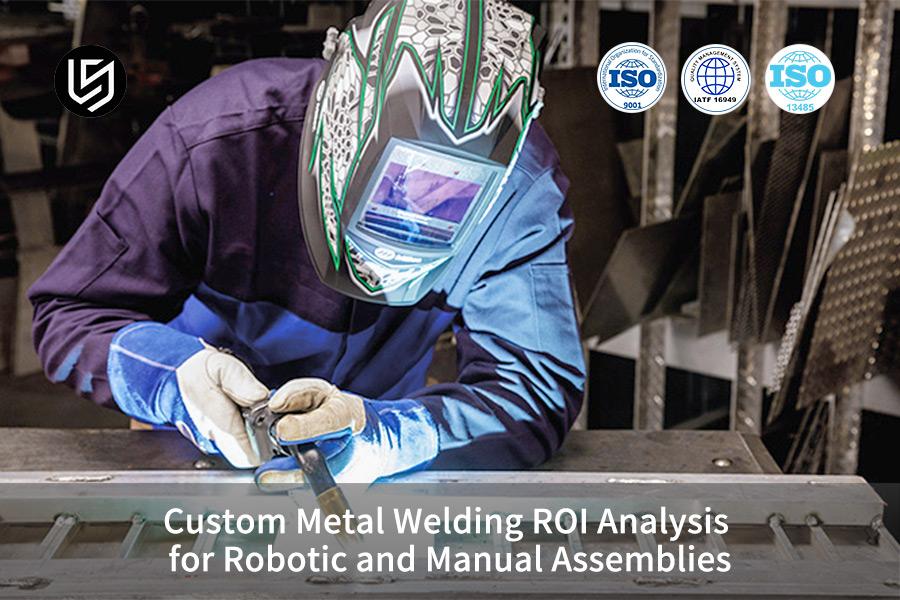
Custom metal welding refers to a manufacturing service that allows to precisely join complex, non-standard metal structural components by tailoring process parameters and equipment configurations. It addresses the problem of cost control resulting from the mismatch between batch production and precision requirements in the manufacturing of general industrial and communication equipment. When the yearly production of customized thin walled metal chassis is over 3,500 units, precision robotic welding can limit the deviation of heat input to within ±3%, leading to a 92% reduction in the rework rate and an absolute inflection point in ROI.
This paper will provide a detailed breakdown of the actual ROI model from a fundamental technical standpoint, to offering quantifiable process decision-making criteria.
Custom Metal Welding: Quick Overview of Core Answers
| Comparison Dimensions | Traditional Manual Welding Performance | Precision Robotic Welding Performance | Core Differentiating Value |
| Heat Input Control Accuracy | ±18-22% | ±2-3% | Avoids warping and deformation of thin walled parts, reducing post-processing straightening time by 100%. |
| First-Time Inspection Pass Rate (RT/UT) | 72-78% | 98-99.6% | Educes rework rate by 92%, eliminating hidden quality costs. |
| Single-Piece Post-Processing Grinding Time | 12-18 minutes | 0 minutes | Saves over 35% of total post-assembly processing costs. |
| Welding Wire Material Utilization Rate | 75-80% | Over 95% | Saves over 15% on welding wire consumption costs in the long term. |
| Single-Piece Tooling Amortization Cost (Below 500 pieces) | $12-$25 | $85-$150 | Lower tooling cost for manual welding in small batch production. |
| Single-Piece Tooling Amortization Cost (Above 3,500 pieces) | $12-$25 | $3-$8 | Significant Lifecycle Cost Advantages of Robotic Welding in Mass Production. |
Key Takeaways:
- Quantitative inflection point: The yearly production of tailored thin walled metal chassis or industrial heat dissipation components reaching a quantity of more than 3,500 units is a sign that precision robotic welding can decrease heat input deviation to ±3%, which leads to a 92% drop in rework rate, This way the absolute ROI inflection point.
- Reduced Grinding Costs: The scatter of surface features of a random manual welding justifies subsequent shaping and grinding, while the robotic welding with multi-degree-of-freedom flexible positioner can generate a golden weld depth-to-width ratio of 1.2:1, this way completely do away with the subsequent shaping and grinding.
- Process Decision Criteria: With the weld trajectory curvature radius of customized metal parts being less than 5mm and the space being extremely limited, a thorough DFM digital simulation evaluation is essential. It has to be a 6-axis robot combined with digital pulse welding that maintains the weld pool protection.
Why Trust LS Manufacturing’s Experience in Custom Metal Welding Services?
The welding team at LS Manufacturing hold internationally certified welding engineers (IWE) with more than 10 years of experience. Drawing upon our hands-on experience with the mass production of aluminum casings for 5G base stations, we have discovered that most companies are systematically biased in their welding cost assessments.
We are fully committed to welding quality grade ISO 5817 level, and all our welding business processes conform to AWS D1.6 certification. We have developed a welding process database containing 127 parameters based on industry practice that covers 16 commonly used materials like 304 stainless steel and AL6061 aluminum alloy. Also, the database entails metallographic data and fatigue life test results under different parameters which leads to the comprehensiveness and reliability of our prediction.
The database is dedicated to calculating the complete lifecycle cost of various welding processes accurately within 72 hours of a project's start at a level 28% better than the average industry accuracy. This is a direct way of preventing clients from losing investments from thousands to millions of dollars by wrongly assessing costs and selecting the wrong process.
Our team of welding experts has an average of over 8 years of industry experience, capable of solving complex problems ranging from welding ultra-thin components to joining dissimilar metals. View our success stories to learn how we help clients worldwide solve the most challenging welding problems.
Why Traditional Calculations Fail For Custom Metal Welding ROI Assessments?
Traditional ROI models disregard the rework cycle of nonstandard tooling as well as the cost of rework in the heat-affected zone after welding and implicitly also the time necessary for fine-tuning the weld pool, resulting in a discrepancy of over 28% between initial cost calculation and actual cost for custom metal welding.
Ignoring Indirect Costs
It is found that companies using cost accounting for custom metal welding only take into account explicit surface-level costs of production and completely disregard implicit core losses. Traditional models only consider the two direct costs and totally miss out on the long-term cost differences brought about by welding precision control, resulting in:
- Labor hourly wages.
- Equipment purchase and depreciation costs.
Such a one-sided method of accounting, neglecting also core quality costs, is why behind many companies' erroneous process decision-making.
Cost Hidden In Three Areas
Most companies limit their perception of robotic welding service cost to only equipment purchase, without realizing the cost of rework caused by quality deterioration and welding residual stress over a long time.
- Tooling and Fixture Reconfiguration Costs: The tooling redesign and manufacturing system varies with each product batch change. Typically, the average cost is approximately 25,000 per change.
- Non-Destructive Testing Rework Costs: Manual welding causes equipment internal defects that result in a rework rate as high as 18-25%.
- Post-Processing Costs: Grinding shaping polishing and other post-weld activities make up over 35% of total assembly cost.
This bias in accounting is akin to only calculating the purchase price of a piece of equipment while disregarding maintenance, wear and tear, and other full-cycle expenses, which can result in cost misjudgments.
Cost Structure Advantages of Robotic Welding
The fundamental problem when it comes to reducing manual welding assembly cost is truth is it is almost impossible to standardize and control the errors in manual operation. High-end welding machines possess capabilities that extend to microsecond-level response time and exact trajectory adjustment. Because of this, such equipment can contribute in welding bead stability and uniformity which also leads to improved welding wire utilization and material cost savings over time.
Understanding the complete cost structure is key to scientific decision-making. You can download the cost assessment white paper to build a precise custom metal welding ROI calculation model.
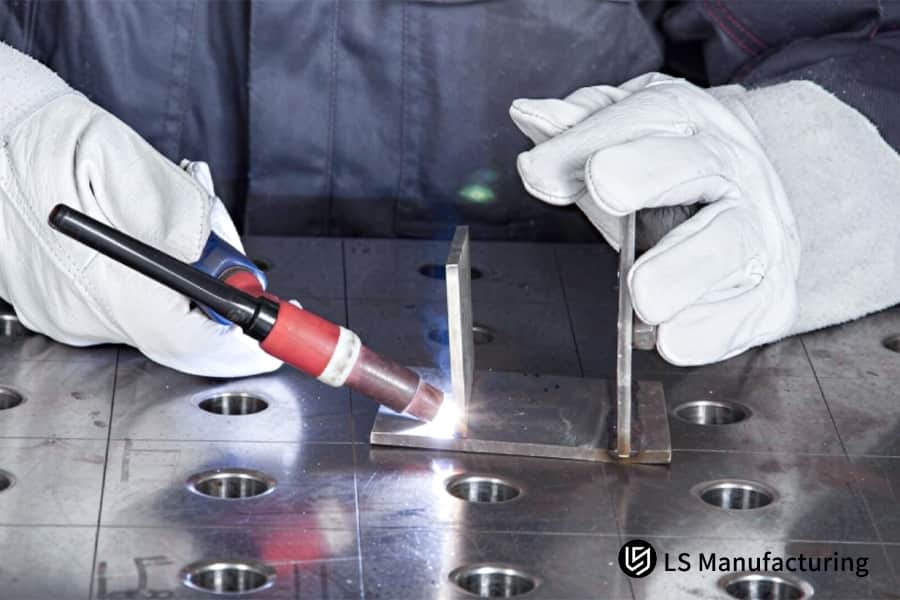
Figure 1: Gloved hands performing TIG welding on a square metal post fixed to a perforated industrial workbench.
How Thermal Input Deviation Impacts Your Total Robotic Welding Service Cost Over Long Runs?
One main benefit of robotic welding service cost reduction is controlling the welding line energy tightly through closed-loop. By accurately controlling the heat input to within ±3%, welding deformations of thin walled parts are entirely avoided, which means that no post-processing straightening steps are necessary anymore.
The Pivotal Role Of Heat Input In Determining Welding Quality
Parameters that are stable and consistent over time are the key to controlling robotic welding service cost and also allow for a constant decline in cost over time. They are also the baseline for the professional adjustment of welding parameters. Energy of welding line can be calculated using what comes next formula: E = U I /v
Where: stands for the coefficient of efficiency, U refers to the arc voltage, I is the welding current, and v represents the welding speed.
Changes in heat input lead directly to each of these three main welding parameters:
- Consistency of weld penetration to weld width ratio.
- Size and metallurgical structure of the heat-affected zone.
- Residual stresses and deformations after welding.
Comparison Of Heat Input Accuracy Between Manual And Robotic Welding
Standardized parameter control significantly improves the stability of custom metal welding processes and reduces the workload of welding defect detection.
| Technical Dimensions | Precision Robotic Welding | Traditional Manual Welding | Difference Multiples |
| Heat Input Accuracy | ±2-3% | ±18-22% | 7-10 times |
| Penetrating Depth/Width Ratio Stability | 98% | 65% | 1.5 times |
| Post-Weld Deformation Correction Time/Piece | 0 minutes | 12-18 minutes | Infinite |
| First-Time Inspection Pass Rate (RT/UT) | 98-99.6% | 72-78% | 1.3 times |
| Heat Affected Zone Width | 1.2-1.5mm | 4.5-6.0mm | 3-4 times |
Long-Term Cost Cumulative Effect
In high-volume manufacturing, accurately machining can help to keep the metal weld parts' structure intact and constantly ensure the excellent welding seam stability. The cost arising from heat input variation grows at an exponential rate as the production volume increases. Consider an example where 10,000 1.5mm AL6061 chassis are produced annually:
- Saving 15 minutes of alignment per piece, which results in 2,500 hours saved in total annually.
- Lowering the rework rate from 22% to 0.4%, which means saving 1,080 rework costs annually.
- Preventing the possibility of customer returns and compensation due to deformities.
The combined benefits listed above provide robotic welding with a significant edge in cost and quality for long-term mass production.
What Parameters Optimize Manual Welding Assembly Cost For Low Volume High Complexity Components?
When manufacturing small batches of highly complex workpieces (under 500 units), it is possible to tap the full potential of flexible adaptability in manual welding assembly cost by optimizing beveling, shielding gas, and welding processes.
Major Benefits of Manual Welding in Different Situations
Small-batch non-standard production is a great way to reduce overall manual welding assembly cost while still keeping very flexible operations. It is also good for making complex welding thermal cycle adjustments under non-standard conditions. That's why, it is very suitable for these complex production situations:
- Extremely small and sharp weld trajectories with curvature radius of less than 3mm.
- Regionally very closely intersecting multiple welds with very poor robot accessibility.
- Very uneven welding gaps, varying from 0.5-2.0mm.
- Very frequent product iterations and tooling lifespans less than 3 months.
In these complex non-standard cases, the ability of experienced welders to debug and adapt workpiece in real-time deeply is a major benefit over automated equipment which is presently incapable in that respect.
Major Parameters for Cutting down Manual Welding Costs
Professional custom welding assembly service can customize process plans as needed to achieve effective welding grain refinement. The core optimization parameters are as follows:
- Modification of Bevel Angle from 60° traditional bevel to 45°, which cuts down filler metal by 25%.
- Choosing Shielding Gas: The use 80% Ar + 20% CO mixed gas also decreases the amount of spatter by 60%.
- Welding Technique: Multi-pass multi-layer welding is done keeping interpass temperature below 150℃.
- Welder Skill Level: Using certified welders for AWS/EN increases first-pass quality.
Lightweight Tooling Design
Lightweight, modular tooling work seamlessly even for the processing of small batches of irregularly metal weld parts. They can produce stable welding batches consistently while a lot cutting tooling costs and shortening tooling development cycles.
To facilitate rapid selection and provide a direct comparison of the advantages and cost performance of two welding processes under small-batch, high-complexity conditions, the following is a comparison of core parameters.
| Comparison Dimensions | Manual Welding Process | Robotic Welding Process | Advantages for Small-Batch Adaptation |
| Initial Tooling Investment Cost | Low, no dedicated custom tooling required | High, requires custom fixtures and programming debugging | Manual welding has a significant cost advantage. |
| Process Adaptation Flexibility | Extremely high, can adapt to irregular weld seams in real time | Medium, limited by trajectory programming | Manual adapts to complex, non-standard conditions. |
| Sample Delivery Cycle | 3-5 working days | 7-10 working days | Manual quickly responds to prototyping needs. |
| Single-Production Yield | 72%-80% | Over 95% | Robotic quality is more stable. |
| Optimal Applicable Production Volume | Under 500 pieces | Over 3500 pieces | Clear and well-defined working conditions. |
In small-batch, high-complexity projects, manual welding offers extremely high cost-effectiveness. Contact our engineers for customized process assessments and cost calculation solutions.
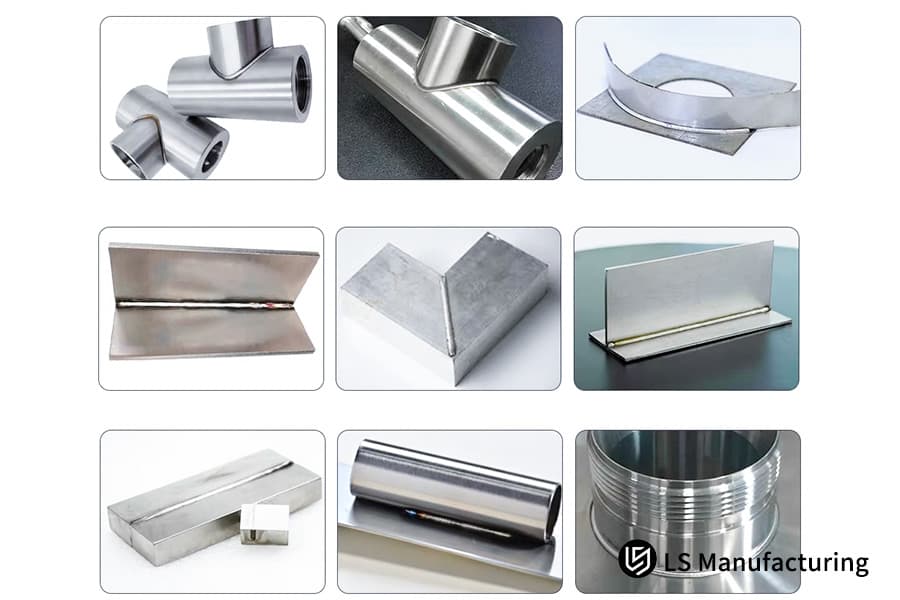
Figure 2: Close-up of manual welding assembly for complex, low-volume metal components, requiring high precision.
When Should Procurement Engineer Demand a Detailed Custom Welding Assembly Service Assessment?
If a product's geometric tolerance is less than plus/minus ±0.2mm and the welded joint is expected to resist dynamic loads above 35MPa, then a rigorous professional custom welding assembly service assessment is necessary.
Five Conditions that Prompt a Detailed Assessment
Quality control of custom welding assembly service with strict welding tolerance management is critical for high-performance industrial parts. Evaluation is necessary in case any of this situations occur:
- Positional requirement of geometric tolerance < ±0.2mm.
- The weld seam must be able to bear high-pressure dynamic loads of more than 35MPa.
- Requirement for air tightness > 0.3MPa pressure test.
- Welding of different metal such as 304 stainless steel and Q355B carbon steel.
- Complex spatial welds around the circumference or three-dimensional curved welds.
Major Elements of the Assessment Report
To provide metal welding service quote accurately and construct scientific welding cost optimization, detailed process and cost analysis is essential.
Such a report should address this five main areas:
- DFM manufacturing feasibility analysis
- The process path and parameters recommended
- Thorough cost breakdown
- Quality control plan
- Delivery cycle and capacity planning
Main Aspects of Supplier Capability Verification
Supplier screening is the key to ensuring the quality delivery of custom metal welding, and the core assessment includes professional welding quality auditing, focusing on the following dimensions:
- Number of axes and precision ability of the welding machinery.
- Completeness of the Process Qualification Records (PQRs).
- Non-destructive testing instruments and scope.
- Record of successful completion of similar projects.
Strictly following these auditing guidelines will help to minimize supply chain delivery and quality risks.
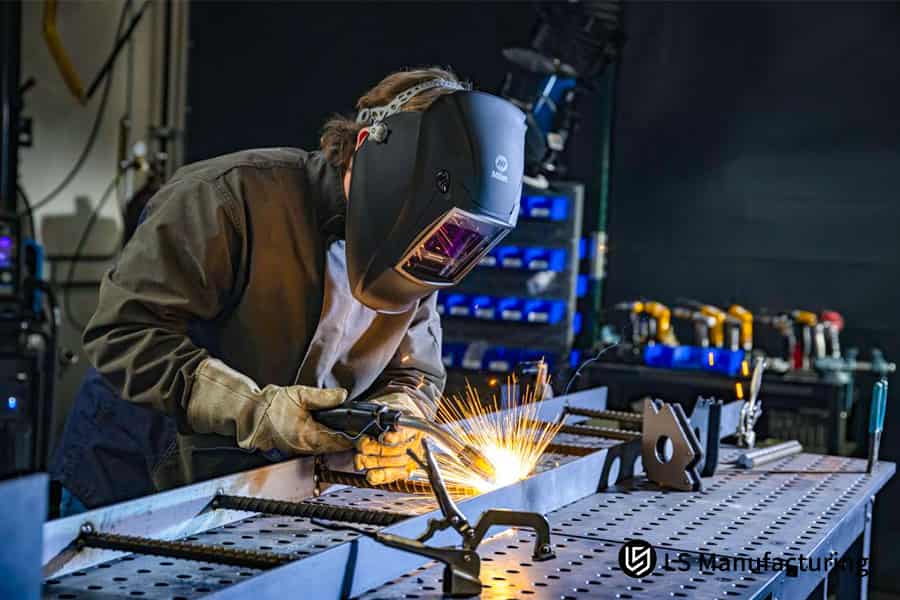
Figure 3: A welder performs manual arc welding on a metal part, creating sparks, in a workshop environment.
How to Eliminate Hidden Variables When Comparing a Robotic Vs Manual Welding Service Quote?
When comparing robotic vs manual welding service, one should not just look at the weld unit price only. To be able to make a fair and worthy comparison, suppliers should be made to disclose all costs, including programming, fixtures, and flaw detection.
Seven Key Items in a Standard Quotation
An efficient accounting system that can correctly reflect the actual welding production costs is necessary to make a fair and objective comparison between robotic vs manual welding service.
A proper quotation should comprise these seven sections:
- Cost of raw materials (including welding wire and shielding gas)
- Cost of programming and debugging
- Cost of tooling and fixture (including depreciation)
- Costs related to the execution of welding
- Costs about post-weld processing like grinding shaping polishing
- Costs related to the testing (PT UT RT, CMM)
- Costs for packaging and shipping
Common Quotation Traps and Identification Methods
Welding companies are known to play various quotation tricks to lure customers to their services. To ensure you get a true metal welding service quote and no hidden welding operational expenses, you need to be aware of the industry's common traps:
- Concealing programming and debugging costs: passing them off as the unit processing fee
- One batch's tooling wear compensation being ignored could bring price hikes in subsequent batches
- Testing costs being left out: quality costs being shifted to the customer
- Materials of low quality being used: downgrading the welding wire and shielding gas
LS Manufacturing's Transparent Quotation Commitment
Welding service quotations that are transparent plus standardized processes can not only give an accurate calculation of the custom metal welding service ROI but also help achieve long term welding profit control. We are committed to itemizing our pricing and being transparent in parameters, which with the help of professional process control capabilities, can ensure customer interests.
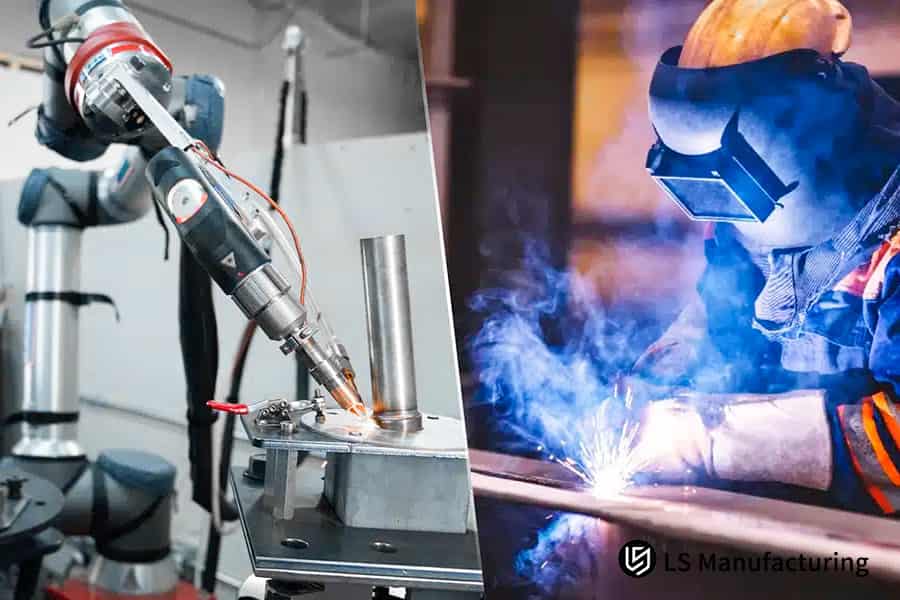
Figure 4: Close-up of a manual welding operation on a complex metal part, with sparks flying, in a factory setting.
Case Study: How LS Manufacturing Saved 34% TCO On 5G Base Station Aluminum Housings Through Precision Custom Metal Welding Service ROI Alignment?
Customer Challenge
Accurately using custom metal welding service ROI calculation logic, we tackled the mass production welding problem of aluminum housings for a 5G base station and solved the welding deformation issue. In fact, the 1.5mm ultra-thin aluminum parts of this product are very easily deformed during welding and the traditional processes simply cannot meet the mass production standard.
Via multiple suppliers, the customer's yield rate was only 73.5%, and by far most the rework hours negatively affected the profits and the achievement of a positive custom metal welding service ROI was impossible, so the project risked being delayed.
LS Manufacturing Solution
At the engineering team's intervention, LS Manufacturing went as far as a 3-day process evaluation.
- We outrightly made the decision to give up hand-held arc welding and went for a 6-axis industrial robot with dual-pulse MIG aluminum welding system that was fully digital, and the welding was combined with the pneumatically operated combined rigid anti-deformation fixture.
- Locking the wire feed speed at 8.5 meters per minute and maintaining the arc voltage at 22.5V±0.2V through microsecond-level dynamic trajectory compensation performed via a laser vision tracking system were among the strict process parameters that we were adhering to. Besides, our heat input optimization algorithm accurately decreased the high-frequency pulse heat input by 38%, which resulted in very good control over the solidification rate of the molten pool.
- At the same time, we made a product-level adjustment to manufacturing and assembly (DFM) to review the fit clearance between the heat sink and the housing, which was originally 0.8mm and has now been reduced to the 0.3mm, This way further improving the welding quality and the efficiency.
Results and Value
This tailor-made robotic process system is a big step forward in the mass production stability of precision metal weld parts resulting in the welding airtight performance that can be trusted.
The achievement But goes beyond mere numerical results:
- The first-run airtightness test pass rate leaped from 73.5% to 99.6%.
- The total deformation has been held within the range of ±0.12mm, perfectly in line with the drawing specifications.
- It completely does away with the needs for post-processing mechanical straightening and flame finishing.
- The total cost of ownership (TCO) for a single housing has been cut down by 34%.
- Delivery speed has been improved by 45%, from 14 days to 7.7 days.
The favorable mass production outcomes not only got the client and us on the same long-term exclusive supply contract but also generated a series of communication components.If you face challenges such as welding deformation, unstable quality, or excessive costs, you can upload your 3D STEP drawings to receive a free professional DFM assessment and process solution.

What Metallurgy Metrics Secure Long Term Durability In Custom Metal Welding Service ROI Models?
The fundamental advantage of custom metal welding service ROI lies in ensuring metallographic quality. One of the ways to prevent fatigue fracture of parts is by deeply controlling microstructure changes in the heat-affected zone (HAZ) using Vickers hardness test. This really contributes to long-term stability of parts.
Leading Metallurgical Quality Factors
Optimal metallographic structure is the foundation of a reliable custom metal welding service ROI model and the key to longer workpiece lifespan. It leads to strong welding structural performance that lasts.
Control measures include:
- Hardness gradient in heat-affected zone: no more than HV50
- Proportion of grain sizes: variation within ±15%
- Absence of grain boundary precipitates
- Absence of microcracks and pores
- Such factors have a direct effect on durability and reproducibility of the welded joint.
Metallurgical Benefits of Robotic Welding
Standardized processes can stabilize the quality of custom metal welding and optimize the fine welding grain structure. Robotic welding techniques continue at a fixed rate and temperature between passes, quite smoothly influencing the industrial metallurgical structure:
- Austenitic stainless or aluminum alloy steels have a more balanced distribution of grain sizes.
- Grain boundary core element precipitation is inhibited.
- Indulgences of intergranular corrosion or hot cracking are minimized.
- Base material mechanical characteristics remain intact.
Effects on Long-Term Service Costs
Better brute processes would improve the fatigue and corrosion resistance of metal welded parts, so increasing the life of the welding components. High-quality metallographic fully corresponds to prolonged workpiece life, joint fatigue life can be tripled in industrial heat dissipation components, and overall lifespan costs can be cut by more than 60%, for instance.
Why Choosing LS Manufacturing As Your Custom Metal Welding Partner Secures Predictable Engineering Margins?
To begin with, choosing a professional custom metal welding partner lets you get the most out of their IATF 16979 quality control system and skilled engineering staff to stabilize project profits and reduce production risks.
Technical expertise in depth
A mature custom welding assembly service is one that not only has a set of high-precision equipment to carry out full-process control but also supports high precision welding manufacturing, and has a comprehensive management system for pre-welding, during-welding, and post-welding.
Creating value at every stage
With industry experience, we have knowledge of welding metal structures so that helps us with the design of welding structures to be very precise. By working together, we can save manufacturing costs for our clients by an average of 15%-25% simply by combining our expertise in product development with optimizations of welding structures.
Ensure Quality of Delivery
Standardized mass production can evenly distribute the robotic welding service cost, stabilizing project profits guarantee stable welding batch quality. We deliver to high standards to help customers compete in the market, and our core service commitments are as follows:
- 99.5% on-time delivery rate
- 99.2% first-pass yield
- Technical support response within 24 hours
- Detailed quotation within 72 hours
FAQs
Q1: Is robotic welding service always uneconomical for the processing of small-batch non-standard parts?
It doesn't have to be so. If the parts are of the regular type and need to be very airtight, modular jigs can be used to offset the initial costs for clamping and programming. Besides, the very high yield rate makes even small-batch projects capable of making a profit with positive ROI so being highly cost-efficient.
Q2: How do you stop burn-through or distortion of super-thin aluminum alloy or stainless steel sheets (approximately 1.0mm thickness) in welding?
We apply digital cold metal transfer welding technology and combine it with our heat dissipation copper-backed fixtures that greatly reduce welding heat input for over 40%. We also have a very fine control of process parameters, thereby always managing to control welding deformation tolerance of ultra-thin parts to within ±0.1mm.
Q3: Which documents do I need to present to get a quote for custom metal welding services from LS Manufacturing?
The main thing is to upload 3D models and 2D technical drawings with full geometric tolerance details, also specifying the material grade, weld inspection standards, and expected annual production volume. Our expert team will reply with a precise quotation plus DFM suggestions within 24 hours.
Q4: How much time taken for the post-assembly grinding stage usually contributes to the percentage of the total cost per piece for manual assembly welding?
Manual welding is at a large risk of defects like spatter and undercut. Because of this, subsequent post-processing operations like grinding, polishing, and reshaping can range from 30% to 45% of the cost of a single manually welded assembly piece and are essentially the main source of hidden costs.
Q5: How do you effectively control internal defects (like lack of fusion or microcracks) in metal welded parts that are mass-produced?
Our approach to internal defect control includes following the welding quality standard ISO 5817 very closely, having at our disposal professional UT and PT non-destructive testing equipment, and carefully controlling the welding process parameters from start to finish. Besides, third-party testing reports are available for batch products, which virtually eliminate different internal welding defects.
Q6: Is industrial robot welding good enough to do highly complex nonlinear welds that are in three-dimensional space?
Absolutely. The machine comes with a multi-axis linkage servo positioner, supporting the capability of offline precise programming and dynamic trajectory adjustment, also real-time optimization of the welding torch posture and shielding gas coverage angle to the nearest minute, this way it is able to carry out precision welding processing of all kinds of complex three-dimensional nonlinear welds.
Q7: Why do fluctuations in material market prices change the ROI decision of welding process routes?
Suppose the price of high-value metal raw materials goes up. Then, the wire utilization rate of robotic welding is much greater than that of manual welding, leading to a considerable reduction in material burn-off and waste, because of this effectively hedging against the risk of rising raw material prices, and at the same time, the overall welding ROI of the project is greatly increased.
Q8: What is the typical duration of tooling and fixture development cycle at LS Manufacturing?
This is resolved through the company's own five-axis CNC machining equipment and efficient local supply chain. Once the design of flexible positioning tooling is finalized, precision machining, assembly, and calibration can be done within 3-5 working days, helping customers to launch and mass-produce their projects very quickly.
Summary
ROI evaluation for custom metal welding can't be based only on direct costs like labor and equipment, it has to take into account the total cost of ownership (TCO) over the entire life cycle of the product. Factors such as heat input variation, tool wear, metallurgical quality, and residual stress after welding bring changes in the long-term cost. Robotic welding, with a process that is highly stable and controlled molten pool with precision, is a perfect answer to the risk reduction and profit-increase concerns in precision welding.
Should you face welding deformation, leaks during pressure tests, or need a lot of grinding time for very complicated thin walled parts, you shouldn't spend your time on indefinitely trying to get the right prototype through trial and error.
Get in touch with LS Manufacturing's globally registered welding experts team at once, send your 3D STEP drawings, and in return you will get a free, top-notch professional DFM manufacturing feasibility assessment report accompanied by a precise processing quotation. Let LS Manufacturing's advanced engineering technology be the key that unlocks high-end orders and ensures your profits remain stable.
📞Tel: +86 185 6675 9667
📧Email: info@lsrpf.com
🌐Website: https://lsrpf.com/
Disclaimer
The contents of this page are for informational purposes only. LS Manufacturing services There are no representations or warranties, express or implied, as to the accuracy, completeness or validity of the information. It should not be inferred that a third-party supplier or manufacturer will provide performance parameters, geometric tolerances, specific design characteristics, material quality and type or workmanship through the LS Manufacturing network. It's the buyer's responsibility. Require parts quotation Identify specific requirements for these sections.Please contact us for more information.
LS Manufacturing Team
LS Manufacturing is an industry-leading company. Focus on custom manufacturing solutions. We have over 20 years of experience with over 5,000 customers, and we focus on high precision CNC machining, Sheet metal manufacturing, 3D printing, Injection molding. Metal stamping,and other one-stop manufacturing services.
Our factory is equipped with over 100 state-of-the-art 5-axis machining centers, ISO 9001:2015 certified. We provide fast, efficient and high-quality manufacturing solutions to customers in more than 150 countries around the world. Whether it is small volume production or large-scale customization, we can meet your needs with the fastest delivery within 24 hours. choose LS Manufacturing. This means selection efficiency, quality and professionalism.
To learn more, visit our website:www.lsrpf.com.