English




The 5-axis machining service of LS Manufacturing provides support for the full process fromDFM analysisto optimization in cutting, including improving manufacturing efficiency through advanced equipment and process innovation. In this section, we will analyze how 5-axis technology enables multi-faceted machining within a single clamping operation and helps companies establish a manufacturing advantage.
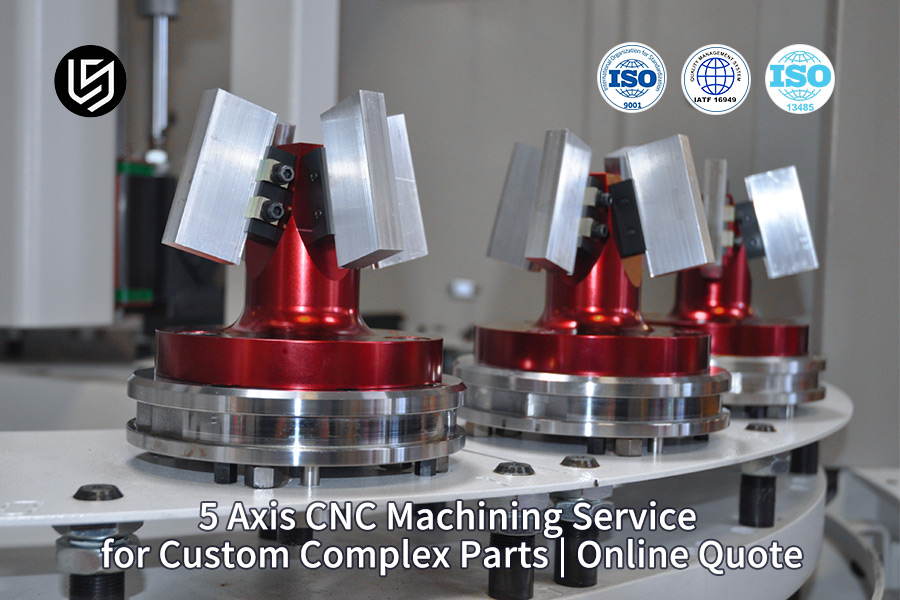
5-Axis CNC Machining Quick Reference Table
| Module Classification | Core Content |
| Basic Definition | Technology for machining a complex curved surface bylinking up 5 axes of motion. |
| Process Characteristics | Multi-face machiningdone in a single setup; thus, it reduces repetitive positioning errors. |
| Equipment Types |
Rotary table type, swivel head type, and others to satisfy various machining requirements. |
| Software Technology | Toolpath optimizationand planning using professionalCAMsoftware. |
| Precision Control |
Dynamic compensation technology ensureshigh precision in machining. |
| Applicable Materials |
Engineering materials includemetals and composite materials. |
| Cost-economy | Reduces the number of setups andincreases production efficiency. |
The5-axis CNC machining technologyachieves multi-axis linkage for one-time forming of complex parts, which greatly improves the production efficiency while ensuring that the accuracy of machining is met. It is especially suitable for high-precision requirements in high-end manufacturing fields likeaerospace and medical devices, providing an important support for modern manufacturing to be intelligent and precise.
Why Trust This Guide? Practical Experience From LS Manufacturing Experts
The following insight is based on practical experience and had been built up by the engineering team at LS Manufacturing over the last fifteen years in the field of5-axis CNC machining.We have manufactured engine blades that directly impact flight performance for aerospace clients, produced implants for medical technology companies that require perfect bone-fitting implants, and provided core structural components that determine the overall stability of precision optical equipment.
Our technology system is firmly in step with the authoritative industry standards. In process development, we refer to machining specifications published by theSociety of Manufacturing Engineers (SME). Also, production management follows the process control methods advocated by theAmerican Production and Inventory Control Society (APICS). The strict adherence to international standards provides professionalism and repeatability for our solutions.
Whether it is to achieve micron-level precision in the machining of multi-angle irregular hole systems or to balance efficiency and cost in rapid iteration cycles, we can offer proven solutions that turn5-axis machininginto a real engine to accelerate product innovation.
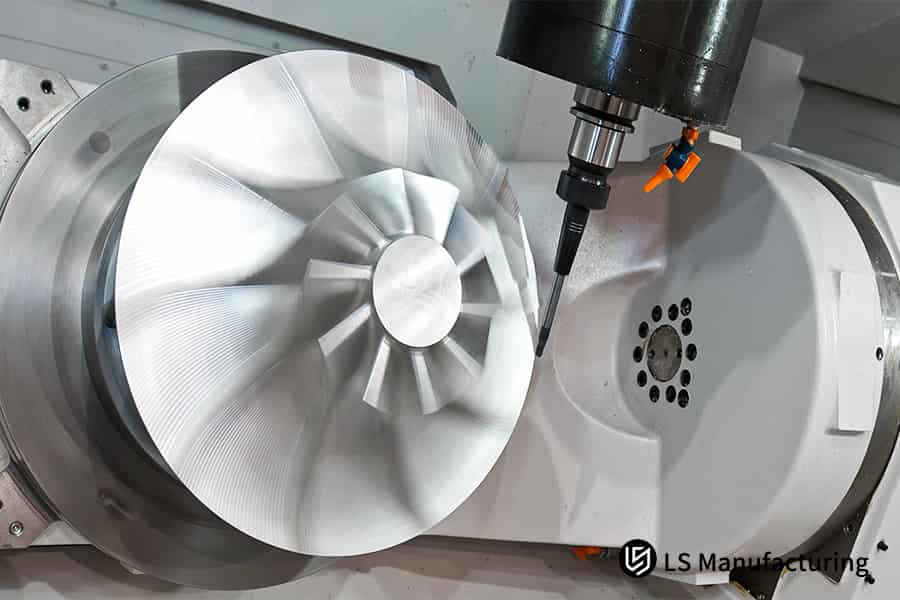
Figure 1: Custom complex parts with real-time machining by LS Manufacturing
What Are The Precise Limitations Regarding Complex Parts With 3-Axis Machining?
Traditional3-axis CNC machiningfaces significantComplex geometry machiningchallenges, such as parts with intricate curved surfaces, multi-angle features, or deep cavity structures. Due to the tool's movement being restricted to three linear axes, the flexibility and precision fall short of meeting high-end manufacturing requirements. Theselimitations of 3-axis machiningare clearly illustrated in the following comparative diagrams and tables.
| Limitations Dimension | Specific Manifestations and Impacts |
| Multiple Clamping Errors | Several readjustments of workpiece setting are involved, with inevitable accumulations of errors and consequent deviations in hole positioning and misalignments of contour. |
| Unavoidable Tool Marks | Thelayered machining of planar surfacesgives rise to noticeable step marks in transitions from one curved surface to the other. This initiates some problems with respect to surface quality and also assembly accuracy. |
| Deep cavity machining is difficult | The tool's length-to-diameter ratio is limited, making it prone to vibration and bounce, and the accuracy of the sidewalls and the flatness of the bottom surface are difficult to guarantee. |
| Deformation of Thin-Walled Parts | Acontinuous unidirectional cuttingforce on weak areas easily causes chatter and plastic deformation. |
In short, thelimitations of 3-axis machiningis the direct restriction of final accuracy and efficiency of parts incomplex geometry machining. Such problems emphasize the need to migrate to5-axis machining technologyusing dynamic adjustment of tool angle and multi-faceted machining in asingle clamping setupto avoid all the above problems fundamentally and accomplish high-quality manufacturing of complex parts.

Generally Speaking, How Does 5-Axis CNC Machining Change The Process Of Producing Complicated Parts By Clamping Just Once?
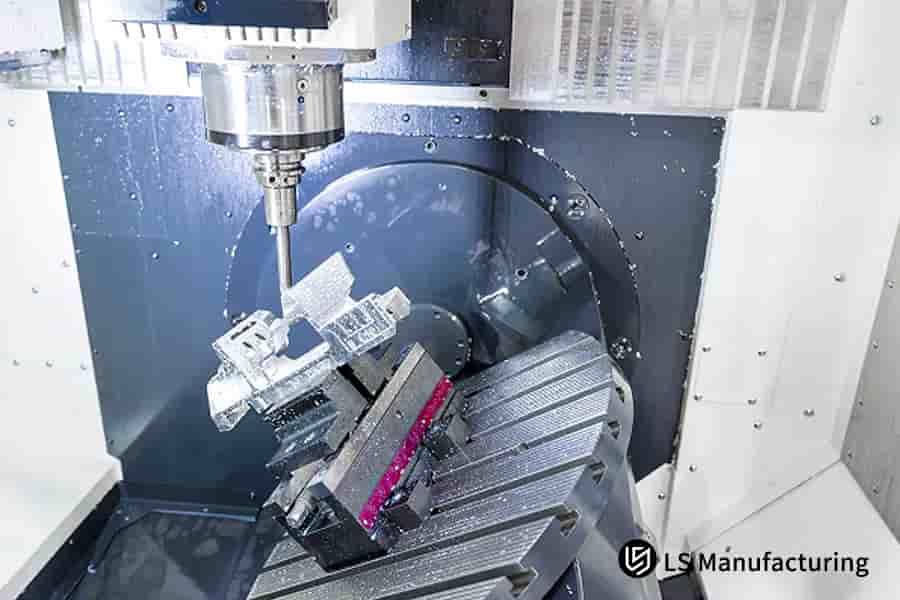
In the manufacturing of complex parts,5-axis CNC machiningrealizes the technological innovation ofone-time clamping machiningthroughmulti-axis linkage,such as the rotation of the workpiece stage or tool head with an A/C axis. It basically solves the accuracy loss and efficiency bottleneck due to repeated positioning in traditional manufacturing. Its advantages can be explained in the following dimensions:
Higher geometrical freedom means that the tool can continuously change its spatial posture
5-axis machiningdynamically controls the tool angle, allowing the tool's side edge, rather than just the tool tip, to participate in cutting. Taking impeller blades as an example,traditional processes require multiple clamping and machining in different areas,while5-axis technologycan continuously move the tool along curved flow channels, completing multi-angle flow channel and root clearing operations in one go,avoiding tool marks and improving the consistency of aerodynamic performance.
Shorter tool length and stronger rigidity effectively suppress the vibration deformation
By adjusting the workpiece angle through the rotary axis, the tool can approach deep cavities or inclined features with the shortest possible extension length.When thin-walled aluminum alloy shells are machined, the increased rigidity of short cutting tools enables a30%improvement in cutting parameters, with a60%reduction in risk of oscillation, thereby significantly assuring dimensional stability for thin-walled structures.
Improved surface quality and accuracy translates to less manual grinding
Less manual intervention and more automation will lead to shorter delivery cycles
Single-point clamping saves not only time in adjustment but also allows for continuous automation through a unified coordinate system in the process of machining complicated pieces.The5-axis machining processcan integrate traditional processes' roughing, semi-finishing, and finishing steps of automotive mold cavities and reduce more than40%of total machining time.
Advantages of 5-axis CNC machining are fundamentally rooted in redefining manufacturing logic through kinematic innovation.This technological leap not only achieves breakthroughs in precision and efficiency but also empowers designers to overcome process limitations and unleash the innovative potential of complex geometries.
Besides The Equipment Itself, What Core Capabilities Should An Excellent 5-Axis Machining Service Provider Possess?
- CAM Programming and Toolpath Optimization Capability:Excellent service providers should mastermulti-axis linkagetoolpath planning technology to optimize the cutting parametersaccording to material properties and geometric features. For example, in the case of the machining of aerospace titanium alloy parts, continuous control of the tool axis vector avoids sudden turns and reduces fluctuation in the cutting force, increasing tool life by more than30%and maintaining consistent surface accuracy.
- Tooling and fixture design, customization capability:Complex and irregularly shaped parts require specially designed fixture systems.Medical implant manufacturing uses custom-designed fixtures made from low-melting-point alloysto realize full-circumferential positioning of irregular skeletal structures, and hence constrain clamping errors within ±0.01mm and deformation due to traditional mechanical clamping.
- Materials Science and Machining Technology Knowledge:There is a need to establish a materials database and a database of machining parameters for special materials like high-temperature alloys and composite materials. For instance, during themachining of Inconel 718 turbine disks, the layered variable-speed cutting strategy stabilizes the cutting temperature below700℃, effectively suppressing work hardening and increasing parts' fatigue strength up to25%.
- Total Quality Management System: Online measurement and SPC, Statistic Process Control, should be implemented. For example, inautomated 5-axis machining, on-machine probes are used for compensating thermal deformation errors in real time, maintaining cross-scale accuracy for the large mold cavities constantly at 0.02mm/m throughout the process, which far exceeds the requirements of theISO 10791-1 standard.
To put it another way, the choice of the5-axis CNC manufacturinghas to be deeper than just superficially considering parameters of equipment.Where thestandard of a high-quality 5-axis CNC manufacturermanifests concretely is in its capability to realize equipment potentials into quality output stably and provide customers with full life-cycle manufacturing solutions.
How Does LS Manufacturing Overcome The Manufacturing Challenges Regarding High-Temperature Alloy Blades For Aerospace Customers?
Customer Challenges
An aerospace equipment manufacturer needs to mass-produce Inconel 718 high-temperature alloy turbine blades.This part features a large twisted surface, thin walls with a gradually decreasing thickness to0.3mm, and narrow cooling channels with a depth-to-width ratio of8:1. Traditional3-axis processesrequire six clamping and faceting operations, resulting in blade profile errors exceeding0.05mm,channel wall thickness unevenness reaching 15%, and blade inlet and outlet edge collapsedue to cutting vibration, leading to a batch scrap rate consistently as high as30%.
LS Manufacturing Solutions
- 5-Axis Linkage Process Design:On a dual-table5-axis machine tool,A/C axis dynamic deflection keeps the tool at an angle ±2°from the surface normal for continuous finishing from root to tip.
- Dedicated Tooling System:Development of substrate helical angle positioning vacuum adsorption fixture: throughFEA, an optimum design of the layout of the adsorption point enhances rigidity of clamping3 times.
- Cutting Parameter Optimization:In layered milling of the flow channel, the wave-edge roughing tool with8MPa high-pressureinternal cooling technology is used to control cutting temperature below650 ℃and avoid phase transformation of materials.
- In-machine measurement compensation: The in-machine probe scans the profile every 3 machiningsto compensate for tool wear in real time and stabilizes contour accuracy at±0.01mm.
Results and Value
- Precision Improvement:Blade profile accuracy≤0.025mm, all flow channel wall thickness tolerances stabilized within±0.03mm;
- Efficiency Breakthrough:Single-piece machining time reducedfrom 18 to 11 hours, capacity increase of40%;
- Yield Leap:First-pass yield reached98%, blade aerodynamic efficiency exceeded design value by2.3%in customer bench testing.
The typical value paradigm of casesis reflected in the following example. For high-requirement scenarios likeaerospace parts machining, this project of a turbine blade helped the customer obtainAS9100Dcertification and shortened the mass production cycle of its new engine by6 months, fully reflecting the strategicvalue of 5-axis machining in the manufacturing of high-performance components.
Overcome the manufacturing challenges of high-temperature alloy blades and reach the5-axis machining expertsnow!

Based On Scientific DFM Analysis, How To Do The Most Cost-Effective 5-Axis Machining?
- Integration of Features, Simplification of Processes:Reduced number of setups by combining dispersed machining features. For example, a hydraulic valve block had26 angled holesinitially at different angles.LS Manufacturing DFMrecommended to make it3sets of composite corner hole systems, whichreduced 5-axis machining setup number from 7 to 2and lowered the single-piece machining time by35%.
- Geometrical Optimization and Standardization of Tools: Convert the unnecessary sharp corners into rounded corners, which can be formed by standard tools.Corner-clearing radius of deep cavity in the aerospace bracket is modifiedfrom R0.2mm to R0.5mm, in order to avoid adopting customized micro tools. The tooling cost is reduced by60%with a remarkable improvement in stability of machining.
- Material Usage and Cutting Strategy Optimization: Waste reduction of material through optimized allowance distribution.For structural parts designed by titanium alloy, the change from uniform thickness wall plate to variable thickness meets the mechanical requirement with a22% raw material consumption reduction. Meanwhile, the tool life is extended by3 timesthrough the use of a cycloidal roughing strategy.
- Rational Tolerance Allocation and Simplified Inspection:Distinguish critical functional dimensions from assembly dimensions by using different tolerance zones.The non-mating surface in this optical equipment bracket was widened to ±0.05mm from ±0.02mm after adjustment with DFM, which results in reducing finishing time by 40%.Allow the appropriate, overall quality to be ensured by centralized control of critical dimensions.
The preceding case forDFM analysisshows that improving the5-axis machining cost-effectivenessis essentially an optimization process in technical decisions.LS Manufacturing DFM's systematic design optimization proves that the greatest cost-effectiveness is a result of strategic vision for manufacturing feasibility, not just a pursuit of low-cost processing.
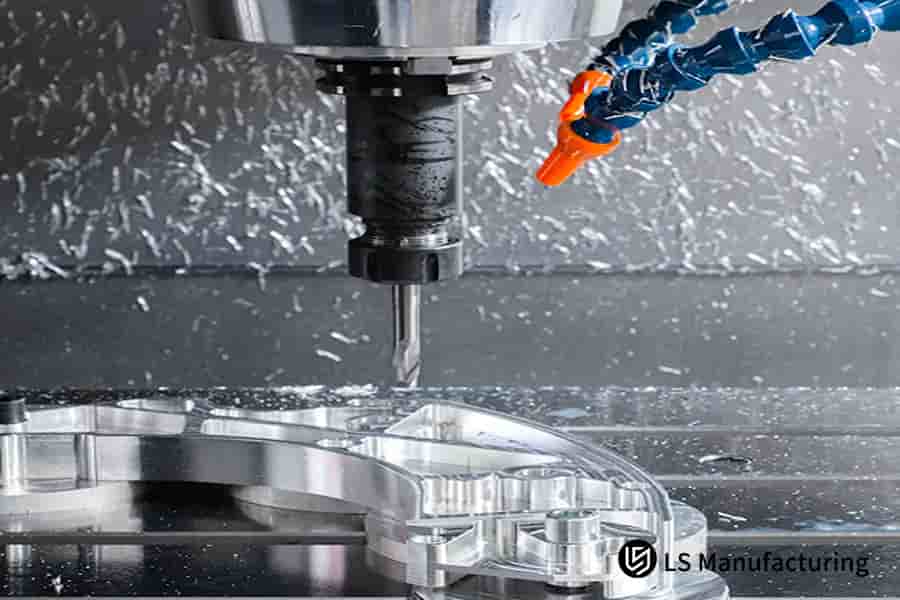
Figure 3: 5-axis CNC manufacturing with dynamic coolant flow by LS Manufacturing
How LS Manufacturing Ensures Precision In Complex Part Machining?
At the high-end manufacturing level, theprecision complex componentsneed overall process control via a properly structuredLS Manufacturing quality system. Its quality control process involves 3 core stages:
Preventive control for first-piece inspection
An inspection path is generated based on the 3D model;a 4-step verification method is adopted:process review; design of inspection tooling; full-dimensional scan by CMM; data comparison and analysis.For example, in the course of aerospace turbine disk machining, first-piece inspection can find a0.015mmdeviation in symmetry in the blade root groove and thusenable timely adjustment of the clamping scheme to avoid issues with batches.
Real-time intervention of process monitoring
An online probe from Renishaw is integrated into the5-axis machining center,and it will automatically trigger in-machine measurement after every 3 processes.In the mass production of a joint prosthesis from a medical device,it detected real-time deviations in spherical roundness caused by tool wear and then automatically triggered a compensation program, which helped to stabilize the accuracy within±0.008mm.
Data traceability for final inspection
Full-surface inspection by a GOM blue light scanner before final delivery.Upon inspection, a color difference map quality inspection report with over2000measuring points will be reported, attaching sample screenshots. In the automotive turbocharger housing project, by comparing the test data with the historical batches, the range of fluctuation of leakage rate has been successfully reducedfrom ±5% to ±1.5%.
Due to this implementation, theprecision and complex components quality controlis upgraded from passive inspection to proactive prevention. ThisLS Manufacturing quality systemintegrates authoritative certification and digital inspection, ensuring that customers reachISO 9001-levelquality consistency and can even extend lifelong quality archives forcustom complex partsby means of end-to-end data traceability.
Is The Collaboration Process - Starting From Inquiry To Delivery - With LS Manufacturing Clear And Smooth?
In the high-end manufacturing sector, a clear and standardized collaboration process is very important to project success.TheLS Manufacturing collaboration processensures that every stage in the whole chain-from demand matching to product delivery-is transparent and controllablethrough standardized node control and digital tools. The following describes how it works in several key stages:
| Stage | Core Activities and Outputs |
|
Customer Demand Submission and Analysis |
Through the official website portal, the customer submits his 3D model and technical specifications.The system automatically generates a basic framework by whichonline CNC machining quate is possible. |
| Technical Review & DFM Optimization | Upon receipt of the engineering data, the manufacturability analysis will be completed in4 hours, anda formal quotation will be provided with process optimization suggestions. |
| Order Confirmation-Production Scheduling | After confirming the technical solution, the system automatically creates the production work order and allocates it to the best production line. |
| Monitoring and Communication | Customer can view the progress of processing in real time through a dedicated portal.Key nodes are automatically pushed with inspection reports. |
| Quality Inspection and Delivery | The quality inspection department releases a full-size report according to the AS 9100 standard.Logistic professional, packing, and delivery are arranged by the logistics team. |
ThisLS Manufacturing collaboration process will maximize customer value. By flipping traditional manufacturing's ambiguous"black box operations"into data-driven and transparent processes,we ensure quality and reliability for the aerospace grade of parts while achieving agile response and cost control-key priorities at the R&D phase.
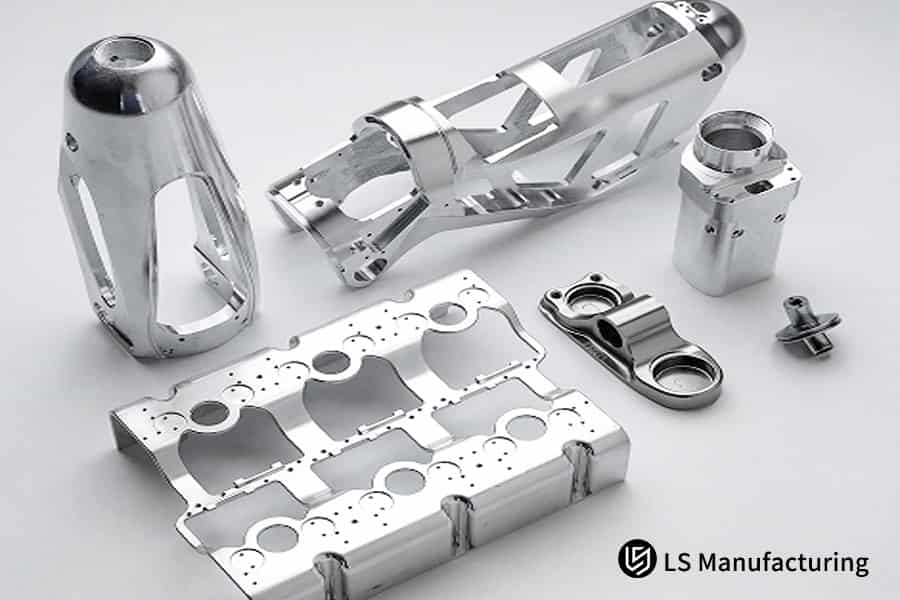
Figure 4: Complex geometry machining for industrial applications by LS Manufacturing
Why Does LS Manufacturing Become The Preferred 5-Axis Machining Partner Of Choice For So Many Industry Leaders?
Expert-Led Engineering Team
Our engineers average 12 years of industry experience and hold SME-certifiedCNC machiningexpert qualifications.For instance, in the satellite attitude control support project, considering the base vibration spectrum, the team developed a clamping damping optimization scheme to control within0.01mmthe machining deformation of thin-walled frames, exceeding customers' expectations far too much.
Customer Success-Oriented Service System
We have established a dual-track responsibility system of"Product Engineer + Project Manager."For example, in the medical device client's joint prosthesis R&D, through17 iterations of Design Flow Analysis (DFM), we totally saved them2.1 million RMBtrial production cost and accelerated the product launch cycle by45 days.
Full Manufacturing Lifecycle Technical Support
From prototype verification to the mass production of tens of thousands, we provide seamless transfer services for process parameter packages.Connect5-axis machining strategieswith heat treatment deformation compensation algorithm, ensuring stable mass production with a pass rate of more than99.5%in the new energy vehicle motor housing project.
These practices are what place LS Manufacturing in its niche as a5-axis machining partner:When clients entrust us with machining aero-engine blades, they receive not only products conforming toAMS standardsbut also digital assets such as databases of cutting parameters and tool life prediction models.In essence, the choice of LS Manufacturing is about choosing Certainty where full lifecycle manufacturing assurance is achieved in the dynamic market.
FAQs
1. How long does it take from submitting drawings to receive a detailed quote from LS Manufacturing?
For a complex part, we ensure to provide atransparent quotationincluding recommendations for DFM analysis within 8 working hours. Material, labor, process costs, and optimization solutions listed in the quotation will explicitly help you precisely control your budget and find some potential optimization opportunities.
2. My design needs some optimization; I need suggestions about how to edit it, and maybe you can help me?
We provide free in-depth DFM analysis services.Our engineers will provide the improvement suggestions with detail according to material properties and structural manufacturability, including fillet optimization and feature integration that can improve manufacturability and reduce the general cost.
3. How does LS Manufacturing ensure that my design drawing or any form of my intellectual property does not leak?
We implement a Tier-4 data security protocol:end-to-end encryption during transmission, isolation of access to the storage system, and signed NDAs by all employees. Only your design files for this project are used and will never be leaked or reused.
4. Is 5-axis machining economic for small-batch prototyping?
Of course.5-axis technology completes multi-facet machining in one setup and saves dedicated tooling cost, making the technology especially suitable for prototypes that are complicated. As compared to the conventional way, this can reduce the cycle time by over40%and greatly lower the costs for trial production.
5. What is the processing range and what is the upper limit for the parts you can deal with?
Our5-axis machining equipmentcan handle big parts from tens of millimeters to several meters. For a particular capability, please provide drawings, and our engineers will give you an accurate estimate.
6. Other than metals, does LS Manufacturing's 5-axis machining support engineering plastics and composite materials?
We have plenty of experience in processing high-temperature plasticssuch as PEEK, PEI, and carbon fiber composites. In mastering such processes as low-temperature cutting and micro-lubrication, risks of material thermal deformation and delamination can be effectively controlled.
7. Would it be possible to expedite production if this project is of exceptional urgency?
We have a fast track whereby we have delivered urgent parts to aerospace clients within48 hours. Our intelligent scheduling system prioritizes resource allocation so that urgent projects are not affected.
8. How do I get started with my first 5-axis machining project collaboration?
You only need to upload your3D files (STEP/IGES/X_T)on our website. Systems will automatically push to the concerned expert and start technical review in4 hours, proactively connect with details.
Summary
5-axis CNC machining represents a strategic technology choice in solving one of the most fundamental challenges of manufacturing complicated parts.Indeed, the real value of this technology is not just in the equipment but in an expert team behind it, like LS Manufacturing, with deep process knowledge, a rigorous quality system, and customer-centric service philosophy. We act as more than a supplier, we're a driving force behind your product's success.
Your complex designs are worth the most accurate manufacturing.Please upload your part drawings now at the bottom of this page and get a tailored solution, including design for manufacturability optimization suggestions and a transparent quote! LetLS Manufacturing 5-axis machining expert teamprotect your innovation.
📞Tel: +86 185 6675 9667
📧Email: info@lsrpf.com
🌐Website:https://lsrpf.com/
Disclaimer
The contents of this page are for informational purposes only.LS Manufacturing servicesThere are no representations or warranties, express or implied, as to the accuracy, completeness or validity of the information. It should not be inferred that a third-party supplier or manufacturer will provide performance parameters, geometric tolerances, specific design characteristics, material quality and type or workmanship through the LS Manufacturing network. It's the buyer's responsibility.Require partsquotation Identify specific requirements for these sections.Please contact us for more information.
LS Manufacturing Team
LS Manufacturing is an industry-leading company. Focus on custom manufacturing solutions. We have over 20 years of experience with over 5,000 customers, and we focus on high precision CNC machining,Sheet metal manufacturing,3D printing,Injection molding.Metal stamping,and other one-stop manufacturing services.
Our factory is equipped with over 100 state-of-the-art 5-axis machining centers, ISO 9001:2015 certified. We provide fast, efficient and high-quality manufacturing solutions to customers in more than 150 countries around the world. Whether it is small volume production or large-scale customization, we can meet your needs with the fastest delivery within 24 hours. choose LS Manufacturing. This means selection efficiency, quality and professionalism.
To learn more, visit our website:www.lsrpf.com.