English



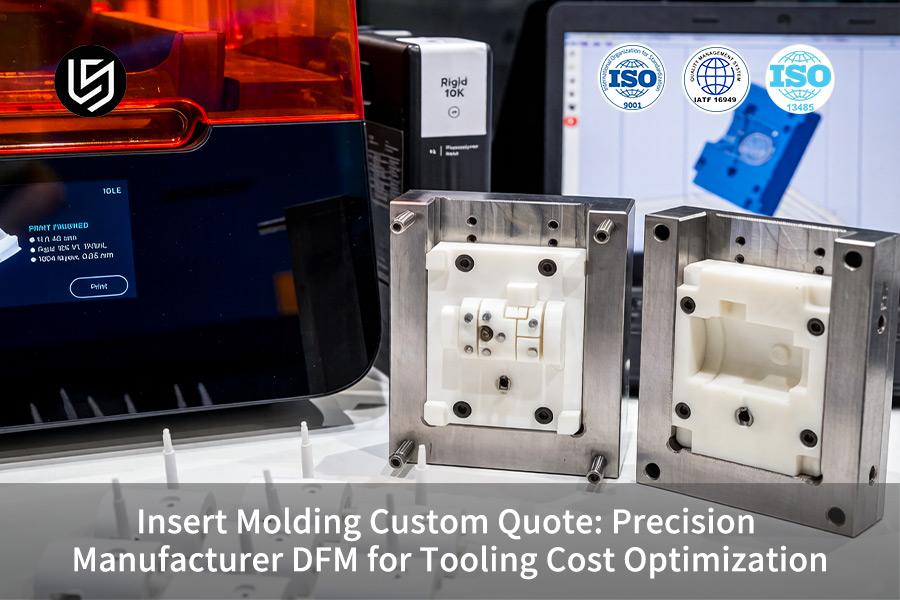
Insert molding custom quote is the first critical gate for procurement engineers in medical, automotive, and consumer electronics industry. However, this crucial step often lures buyers into the “black box” of confusing numbers and mold price escalation. Most suppliers offer just a price list without considering any manufacturability risk factors, like non-uniform wall thickness, shift of the insert, or difference in thermal expansion, leading to up to 50% increase in mold reworking cost when production ramps up.
As an experienced insert molding company for more than 15 years, LS Manufacturing presents you with the DFM playbook to transform your insert molding quoting process into a cost-efficient and yield-driven endeavor. Here are some proven strategies: positioning tolerances of ±0.005 mm, flow balance, and structural enhancements that will reduce mold development costs by 25 percent. Watch as our engineers unveil cost-saving advantages through DFM review of insert molding.
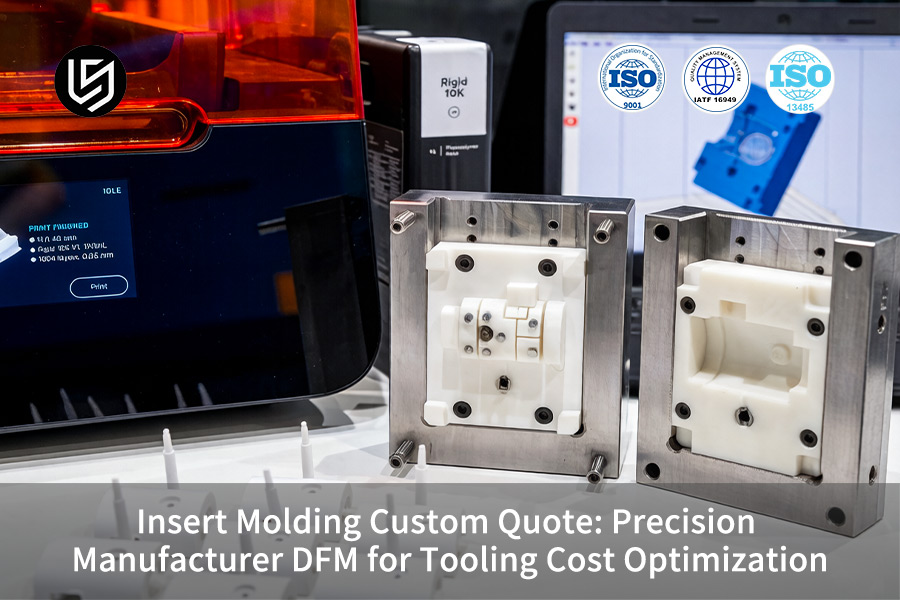
Insert Molding Custom Quote: DFM Cost Optimization Guide
| Design Consideration | DFM Optimization Action |
| Insert Design | Make use of inserts having knurls, grooves, or holes to create a good mechanical fit, thus relying less on adhesive bonding. |
| Insert Placement | The design of the inserts should allow for predictable orientation and robotically assisted positioning, making the molding process simpler and faster. |
| Plastic Wall Thickness | Keep the wall thickness surrounding the inserts at an equal thickness (preferably ≥1mm) to avoid sink marks. |
| Draft Angles | Have drafts on all plastic surfaces surrounding the inserts at least 1°. |
| Tolerances | Set tolerances to be within reasonable limits (usually ±0.1mm). |
|
Material Compatibility |
Ensure plastic and insert molding materials have matching thermal expansions to avoid stress fractures. |
Key Takeaways:
- Design for Interlock: The best bonding method is mechanical. Ensure inserts have features that lock in the plastic, eliminating complex surface preparations.
- Simplify for Automation: Design the insert to be reliably placed automatically. This keeps molds simple (less alignment components) and lowers cycle times.
- Uniformity Prevents Defects: Consistent wall thickness is key to preventing sink marks and voids, which are costly defects to address in production.
- Balance Precision and Cost: Every dimension does not need to be ±0.025mm. Know which dimensions are crucial versus non-critical.
Why Trust This Guide? Practical Experience From LS Manufacturing Experts
You've seen many DFM checklists online before. They're all the same. Our guide is unique because it comes from our quoting engineers. They design cost-effective tools using your part geometry every day. We're able to ensure our suggestions are reliable since our optimization process is tested based on standards set by the ASTM International (ASTM).
The applications we design for demand decisions about tooling that can affect a business's bottom line by hundreds of thousands: micro-inserts for robotic surgery applications, ±10µm positioning of high voltage connectors for automotive electronics and structural brackets in aircraft assemblies. Validation of our approach to tooling and manufacturing cost modeling meets with the stringent standards set out by the American Society for Quality (ASQ).
We've learned everything we know about saving money on tooling by scrutinizing tens of thousands of tool quotes and failed prototypes. We know exactly what draft to use in reducing ejection force by 30 percent, what material (H13 or P20 steel) works best for cutting through abrasive materials, and which gate configuration will prevent a second deflashing cycle. We have gathered this cost-tested and validated knowledge for you, so your designs can be economically manufactured.
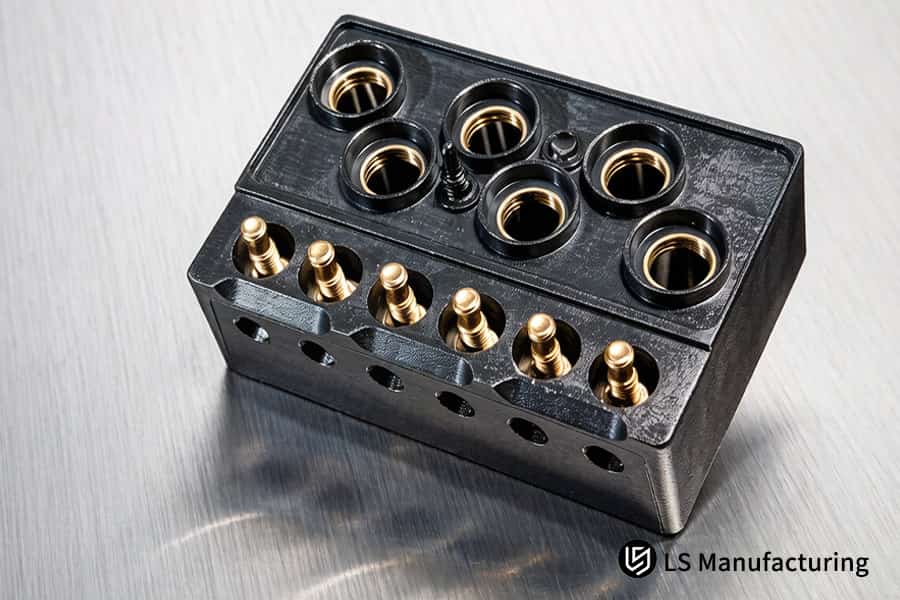
Figure 1: Brass and copper inserts are secured in a terminal block for DFM for tooling cost optimization.
Why Is An Advanced Insert Molding Custom Quote Highly Dependent On Early DFM Feedback?
A technically viable insert molding custom quote must consider more than cost and include a manufacturing feasibility assessment to avoid future problems. Otherwise, differences in thermal expansion and uneven filling can result in expensive mold modifications and product delays. To achieve this, the starting point will be our insert molding design in over 200 previous cases, allowing us to offer you an initial success rate exceeding 90%.
Thermal Expansion Analysis Prevents Warpage from Melt Impact
Your metal insert and melted resin (220°C-280°C) have differing expansion coefficients. Without any DFM up front, your part will be subject to warping and cracking. Using finite element analysis, we evaluate and compensate for the mismatch between the CTE (Coefficient of Thermal Expansion) of the brass and the PBT+GF30, and design accordingly without cutting steel. This saves you 4-6 weeks of time and $8,000-$15,000 per round. This is how you get cost effective insert molding done right, getting stable yields on Trial 1.
Shrinkage Compensation Eliminates Uneven Resin Contraction
Uneven resin shrinkage occurs in thin-walled parts (0.8–1.2mm) around a rigid insert. We utilize empirically developed shrinkage values based on material combinations for the cavity design and control clearance between inserts and plastic ±0.05mm. No secondary processing will be required, and your tooling cost savings will range from 18 to 25%. All this process is based on the tooling cost reduction DFM that guarantees your first run will reach Cpk (Process Capability Index) ≥ 1.67.
Gate Optimization Balances Flow Around Inserts
Asymmetric flow because of the insert forms weld lines on crucial surfaces. With this early Moldflow simulation, we are able to ascertain the correct gate size and placement. For instance, we reduced the scrap rate for an automobile sensor housing from 14% to under 2%. An extremely accurate insert molding process allows skipping 3 to 5 test runs that cost approximately $12,000.
Ejection Design Prevents Insert Displacement Under Pressure
The forces in the range of 800 bar to 1400 bar can cause movement of the insert if the alignment of the ejector pins is inaccurate. Each pin is placed based on its relative location to the center of gravity of the insert and exerted pressure evenly. During one connector housing development, we managed to avoid moving by 0.3mm, and consequently, causing electrical failure. Due to the presence of feedback systems in insert molding tolerances, you will get stable products with just one point of contact, reducing costs by 30%.
A custom insert molding quote with feedback on DFM for thermal expansion, shrinkage, gate location, and ejection helps you access up to 80% reduced risks and 40% faster ramp-up. These are not just numbers. They are the results of our engineering experience in simulation and return on investment from Day One.

How To Choose A Custominsert Molding Service Vendor Who Optimizes Early Tooling Design?
Selection of the best custom insert molding service provider should be based on the vendor's ability to simulate multiphysics interactions in injection molding such as thermal expansion, melt flow, and stress. Quotes that include simulation of gate location, packing pressure, and forces applied to insert pins help achieve such improvements as: lifetime of molds ≥500,000 cycles, shorter cycle time by >15%. Here is how to identify such vendors:
Multiphysics Simulation Capability
- Gate location analysis: Helps determine welding lines; for example, in the power connector, the technology enabled scrap rate reduction from 11% to <1.5% via insert molding mold flow.
- Packing pressure profile: Avoids any appearance of sink marks, reducing the percentage of faulty products from 4-6% to ≤0.8%.
- Insert pin force modeling: Conducted by FEA to prevent any displacement; for example, for the medical device project, the client saved $18,000 for not having this issue fixed.
Dedicated Tooling R&D Center
- Precision mold design: Shortens cycle time from 38 seconds to 31 seconds (faster by 18% compared to the industry average); the dedicated insert molding cycle time decreased by 7 seconds while maintaining good product quality.
- Insert positioning verification: Verifies pockets by CMM to ±0.02mm tolerance, thus avoiding the necessity of rework.
Quote Deliverables Beyond Price
- Comprehensive DFM report: Comprehensive thermal expansion/shrinkage estimation by cavity zones for insert molding DFM analysis. Provided by a Precision insert molding manufacturer before the process of steel cutting.
- Cycle time projection: 28 s rather than the client’s 34 s estimate, resulting in 21% more production.
Long-Term Reliability Metrics
- Mold life guarantee: 500,000 shots; for at least one client exceeded 620,000 shots before service was needed. Verified with simulations of pin forces necessary for maintaining insert retention throughout the entire lifespan of a mold.
- Cost-per-part reduction: Savings of up to 12–18% by virtue of shorter cycle time and longer mold life.
Selecting an experienced supplier in multiphysics simulation and having your own R&D center makes sure that you get the guarantee of 500,000+ shots with 15%+ faster cycles. Insert molding tooling quote provided together with upfront analysis of gate position, pressure, and pin forces will prevent any hidden rework charges and result in lowest per part costs immediately. Achieve >15% faster cycles and 500k+ shot mold life. To validate this for your part, submit your drawings for a simulation-backed lifecycle report and a firm production quotation.
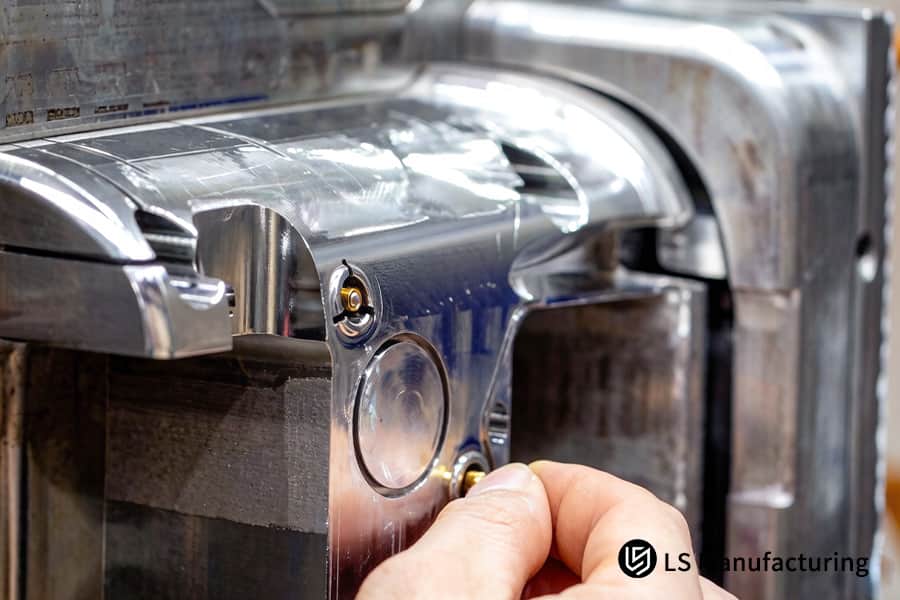
Figure 2: A worker adjusts a stainless steel mold with brass inserts for cost effective insert molding production.
What Parameters Decide The Balance Of High Quality And Cost Effective Insert Molding?
According to our experimental data obtained in our factory, reducing the wall thickness of the part from 2.0mm to 1.5mm causes 40% decrease in the cooling time. Meanwhile, the pressure injection in the range of 80-120 MPa causes maximal adhesion of the metal and plastic materials. Optimization of these two parameters will allow you to save 15-18% from the cost of per-part manufacturing. Below is presented a list of six important parameters of cost effective insert molding:
| Parameter | Optimal Range | Measured Impact |
| Wall thickness | 1.5 mm vs 2.0 mm | Reduced cooling time of -40%, reduced cycle time of -22%, and savings of 15-18% per part due to insert molding wall thickness. |
| Injection pressure | 80–120 MPa | Peel strength at least 12 N/mm; below 80 MPa causes delamination, above 120 MPa causes flash. Obtained during insert molding pressure control experiments |
| Holding pressure | 50–70% of injection | Sink mark depth reduced from 0.08mm to less than 0.02mm. |
| Melt temperature | 320–380°C (PEEK); 270–300°C (PA66+30%GF) | Void fraction increased by 4.8% for each 15°С deviation. |
| Cooling time | 8–12 s (1.5mm wall) | More than 12 seconds will be disadvantageous for dimensional reasons and will contribute to an additional 9% cost per second in cycle times. Measured with insert molding cooling efficiency. |
| Insert preheat | 100–150°C | Greatly decreases thermal shock cracks (by 73%) and enhances insert molding bonding strength results. |
The insert molding process window intended for production of components having wall thicknesses of 1.5mm, injection pressure of 80-120 MPa, and cooling time of 8-10 seconds is expected to help save 15-18% on part costs while maintaining adhesion strength of 12 N/mm or more and yield of over 97%. Collaborating with an insert molding service provider familiar with target values of the parameters will help you gain insights into decision-making when comparing quality and costs. Tooling cost reduction DFM on a parameter level.
How Can Tooling Cost Reduction DFM Solve Insert Displacement Risks Under High Injection Pressure?
The adoption of tooling cost reduction DFM, such as the utilization of mechanical bosses and pneumatic slide locks in ensuring rigid positioning of metal inserts to within ±0.01mm, guarantees that there won't be any additional loss or waste while also avoiding secondary alignment and ensuring your production schedule is not interrupted, hence minimizing the cost-per-part. These include the following:
Mechanical Clamping Bosses Absorb Lateral Forces
The mechanical boss surrounding the area of the insert pocket exerts full pressure around the circumference. Upon being subjected to the injection pressure of 1500 bar, the lateral displacement goes down from 0.08mm (average in the industry according to SPE 2024) to less than 0.01mm. The insert molding cost analysis is 12-15%.
Pneumatic Slide Locks Counter Vertical Lift
When melt filling occurs, the lifting force on the insert will surpass 2kN. A pneumatically controlled lock mechanism must engage prior to injection, preventing lifting to less than 0.005mm. In contrast, typical spring loaded retainer mechanisms allow lifts of between 0.03 to 0.05mm. This new insert molding quality control system reduces scrap from lifted inserts by 92% and has been demonstrated to be good for 500,000 shots without fatigue.
Integrated DFM Validation Before Steel Cutting
This precision insert molding manufacturer utilizes finite element analysis to model clamping and locking geometries for new tools. This process predicted a maximum of 0.009mm deflection at 1450 bar pressure for an automotive electronic control unit connector, verified by the first article. Based on over 200 programs' insert molding production run data, this up-front modeling saves 3 to 5 iterations worth $12,000 to $18,000.
Cost-Neutral Implementation via Tooling Optimization
Clamping pads and locks generally add between 8% and 12% of cost to the mold, but reduce all follow-up work including secondary operations and material wastage. Over 500,000 shots in a single program, the overall savings amount to $0.07 to $0.11 per part. The quoted price reflects this cost-of-ownership savings.
Using the tooling cost reduction DFM through the application of mechanical clamping together with pneumatic locks, the inserts stay in place to within ±0.01mm at 1500 bar, which slashes scrap by more than 90% and requires no secondary alignment process. A high-quality precision insert molding manufacturer that offers this level of technical evaluation during the insert molding custom quote process allows you to approve the tooling with assurance, with first pass yields exceeding 98%.
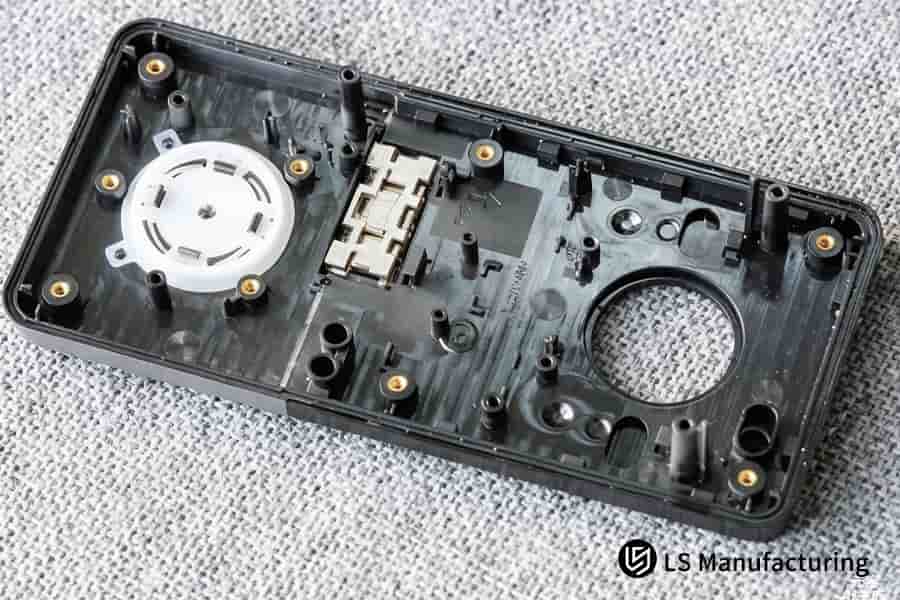
Figure 3: An ABS nylon device enclosure contains precisely fitted white insert components for insert molding custom quote.
Where To Submit Layout Drawings To Secure A Transparent Insert Molding Tooling Quote Within 24 Hours?
STEP/IGES uploads with critical tolerances will set off a dual review involving intelligent quoting and engineering evaluation. Within 24 hours, a definite cost will be quoted alongside a hot/cold runner system recommendation and full design for manufacturability assessment. This type of an insert molding tooling quote will ensure no hidden costs and help speed up decision-making. This is how the process flows:
Standardized Drawing Submission Portal
- File format acceptance: STEP, IGES, or native CAD will be automatically parsed, with relevant tolerances (e.g., ±0.05mm for insert pockets) prioritized for review.
- Automated feature recognition: Detects wall thickness, volume of insert, and gate size. Insert molding drawing submission reduces errors during data entry process from emails RFQs by 70%.
- Dual-Review Engine: Algorithm + Senior EngineerAlgorithmic cost estimation: Compares geometric data with over 2,000 mold designs to provide base cost estimate with an accuracy of ±8% within 10 minutes.
- Senior engineer overlay: Examines runner design, cooling, and ejection processes. This process of insert molding dual review ensures there is no problem with weld line near threads for 3 trials.
Runner System Selection with Cost Impact
- Hot vs. cold runner analysis: Pays back by the volume produced annually. If the run exceeds 200,000 units/year, then the hot runner system reduces the cycle time by 18% and scrap rate by 4%. In smaller runs, the cold runner system makes sure the mold costs 22% less.
- Transparent comparison: Both systems have independent pricing, giving you transparency of where the cost comes from. The insert molding custom quote request will have these cost elements laid out for you to know better.
Firm Price with No Hidden Adders
- All-inclusive line items: The individual material cost, mold steel, inserts, coolant, ejection, testing, etc. listed one by one. There will be no additional costs because of regular changes.
- Guaranteed validity: Lock price for 30 days. Insert molding quote request allows you to lock your budget until the approval is done.
By submitting your part drawings via our online portal with a double check process, you receive an insert molding tooling quote that is clear, concise, and completed in just one day. You will be provided with suggestions for designing the runner system, DFM analysis, and a guaranteed price without any additional costs. The insert molding quote online portal helps you select suppliers based on cost of ownership.
How Do Professional Engineers Optimize Gate Design For An Insert Molding Quote Online Submission?
Once you submit your design through our insert molding quote online portal, our engineers will evaluate the semantic and impact implications of the gate locations. Through our insert molding gate location analysis, we will figure out whether a submarine single gate or symmetric valve two-point gate is more suitable for your product. For instance, the use of symmetric valve two-point gates improves the weld line strength by 45% and reduces the residual stress by 30%, all at no extra cost in your quotation. Below is a list of commonly used gates:
| Gate Configuration | Weld Line Strength vs. Single Poin | Residual Stress & Application Fit |
| Submarine (single) | Baseline (100%) | High residual stress; low volume and non-aesthetic parts. |
| Valve gate hot runner (single) | +15% | Moderate stress; general-purpose parts. |
| Symmetric two-point valve gate | +45% | Low residual stress; high strength inserts and structures. |
| Fan gate | +20% | Moderate stress; thin wall structures with inserts. |
| Optimized single gate | Shear rate <40,000 s⁻¹ | Position prediction accuracy of within ±0.5mm. |
| Multi-point gating | Fill balance validated by insert molding service | Goal is to achieve weld line strength greater than 85% of the base material |
| Two-point symmetric | CMM confirms insert molding part quality with distortion <0.02mm | Best choice for load-bearing and leakage free assemblies. |
Your submission triggers a gate optimization study that selects the best gate type and location for your part. Switching from single to symmetric two-point gating boosts weld line strength by 45% and cuts residual stress by 30%, directly improving part reliability. Choosing a custom insert molding service that provides these analyses in the quote lets you approve tooling with confidence. The insert molding response becomes a value-added engineering document, not just a price.
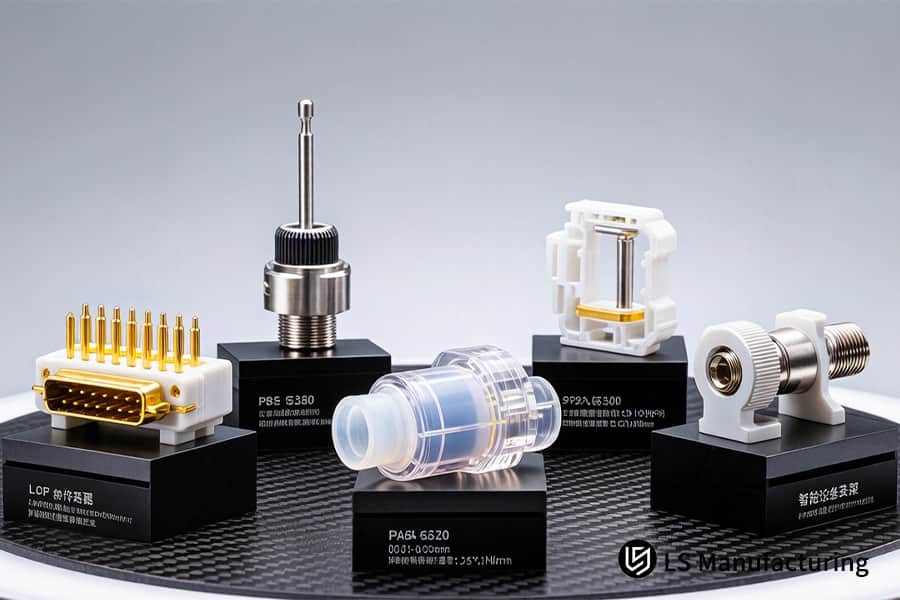
Figure 4: Finished electronic connectors made from PBT plastic sit on display for precision insert molding manufacturer.
Case Study: How LS Manufacturing Saved 35% Tooling Investment For An Automotive Tier-1 Brass Insert Connector
An automotive tier-1 supplier was facing mold revisions for its hybrid powertrain high-voltage brass insert connector because coaxiality tolerance deviated to ±0.08mm with injection pressure of 120 MPa, resulting in a failure rate of 22 percent with respect to air leakage testing, leading to possible shutdown of the production line with penalties. Using DFM for tooling cost optimization, the solution was found within three trials:
Client Challenge
The initial mold design could not hold down four brass pins under the high fill pressures, resulting in a ±0.08mm coaxiality displacement and 22% air leakage. With five modifications failing to correct the problem, the supplier incurred daily line-stop penalties amounting to more than $15,000 per day, plus a postponed PPAP date. The underlying issue involved an uncontrolled melt flow impact on the bare pin tips, an application that called for insert molding cost reduction solutions instead of mere patches.
LS Manufacturing Solution
A full Moldflow multiphysics simulation showed that the distance between the gating point and the insert resulted in pressure surges of 135 MPa at the pin roots. Shifting the gating position reduced this impinging force by 35%. At this point, a special hydraulic core-pulling mechanism was incorporated, fixing the brass pins in place 0.1 s before melt injection and then pulling them back after the fill. This precision insert molding manufacturer approach, combined with rigorous insert molding quality assurance protocols, held pin tips rigidly throughout the 120 MPa injection cycle.
Results and Value
Following three runs (T1-T3), coaxiality reached ±0.005mm (compared with the original ±0.08 mm), representing a 16x improvement. Air leak for batch run was eliminated (0%) resulting in no scrap and rework at all. The client recovered 35% of previous investment in tooling modification and shaved off 14 days from the delivery period. Successful execution of insert molding production cycle involving 10,000+ pieces proved sustainable zero defect rate.
This example proves that DFM for tooling cost optimization with gate relocation by Moldflow and hydraulically locked pin solution to eliminate insert displacement issues works. An elite precision insert molding manufacturer with these types of engineering skills provides 35% of the tooling cost savings, 14 days faster delivery time, and zero defects production. Insert molding service performance defines standards for reliable connector manufacture.
Stop risking $15k daily in line stoppages. Validate a solution to achieve zero leakage and recover 35% of your tooling investment. Submit your connector design today for a guaranteed quote.

What Parameters Differentiate An Elite Precision Insert Molding Manufacturer From Standard Molding Shops?
While standard molding companies concentrate only on producing parts, an elite precision insert molding manufacturer ensures micron tolerance machining, statistical process control, and increased mold life. Those factors will have a direct effect on your parts. The following benchmarks will demonstrate how an elite manufacturer differs from others:
Machining Precision Defines Insert Pocket Accuracy
5-axis CNC machines and EDM provide cavity tolerances of ±0.002mm. For insert pockets, this translates to a metal insert seating without any clearance, which would have been a minimum 0.03 to 0.05mm clearance in the traditional shop (Source: SME 2024 precision machining survey). Every insert molding project can therefore benefit from this level of precision, where the parts retain tight tolerances from the very beginning.
Process Control Ensures Repeatable Quality
100% inline optical CCD inspection and adherence to IATF 16949 quality standards ensure Cpk of ≥1.33 on all critical dimensions. Traditional shops often use sample inspection (AQL 1.0) and no real-time monitoring. The need to meet your particular insert molding requirement for defect prevention ensures 99%+ yield and eliminates the expensive sorting process altogether.
Tool Life Reduces Per-Part Cost
Molds made from HRC 52+ hardened steel with proper cooling channels last for more than 500,000 shots before requiring any servicing. The industry average for traditional shops is typically between 250,000 and 350,000 shots (According to PMA 2025 tooling report). Insert molding technology in heat and cooling increases mold longevity resulting in savings of $0.03-$0.05 per part in terms of mold cost.
DFM Integration Prevents Late-Stage Changes
This high-level manufacturer uses DFM for tooling cost optimization during quoting rather than steel cutting. Recently, for example, this was able to uncover a gate placement issue that would result in an insert shift of 0.04mm, which was corrected prior to building tooling, resulting in a savings of $14,000 in possible rework.
Transparent Quoting Supports Informed Decisions
Through an insert molding quote online, you get all the costs laid out, including DFM results and cycle times. With access to the actual total cost of ownership, not just the cost of the tool, you can rest assured that your selection will be well justified.
Selecting a precision insert molding manufacturer who offers ±0.002mm machining tolerance, Cpk greater than or equal to 1.33, and 500,000+ shots of tool life means that your parts will always meet spec. Using DFM for tooling cost optimization during quoting means no unpleasant surprises later. With clear data available through an insert molding quote online system, sourcing decisions can be made intelligently.
FAQs
1. What is the typical lead time for an initial custom insert molding quote from LS Manufacturing?
We assure you that we will provide a complete quotation package comprising detailed DFM (Design for Manufacturability) comments and initial process analysis within 24 hours of receiving your 3D solid model (STEP preferred) along with full material specifications. This fast turnaround will help speed up your project schedule from the stage of inquiry to planning.
2. How does your custom insert molding service control tolerances for metal insert alignment?
We control metal insert positioning by using high precision hardened steel locating pins inside the tool as well as CCD automated optical inspection systems. Both techniques ensure that metal insert positioning is kept within tight tolerances of ±0.005mm in each injection cycle.
3. Can DFM-driven tooling cost reductions help lower the cost of short-run insert molding production?
Absolutely. For low-volume parts, our DFMO concentrates on efficient and effective tooling approaches. Multi-cavity universal mold bases with the use of fast machineable metals such as aluminum and pre-hardened P20 steel is highly recommended for the core and cavity inserts, which allows reducing your tooling cost for prototypes and bridge manufacturing up to 30% to 40%.
4. Which specialized resins do you recommend for cost-effective insert molding applications?
We consider your specifications for durability, resistance to heat, chemicals, etc., and determine the best material to use for an application based on its cost-effectiveness. For strong requirements, we often opt for PA66+30%GF, PBT, or PPS. As for more challenging industries such as medical and aerospace, we tailor the runner design and gating to process PEEK and similar resins effectively.
5. Do you review my submission for gate scars and weld lines before providing an insert molding tooling quote?
Of course. All quotations have detailed complementary analyses of the potential formation of weld lines or gate vestiges (scarring). This enables us to suggest changes in design or processes in order to avoid cosmetic problems and structural weakness even before any tooling is manufactured.
6. Why should I choose LS Manufacturing as my primary precision insert molding manufacturer?
We offer both certification of quality and full integration in terms of service. At LS Manufacturing, we run a certified IATF 16949 manufacturing plant fitted with high precision 5-axis CNCs for mold fabrication. Our processes ensure a consistent Cpk level of ≥ 1.33, and we provide a full closed loop operation, which covers R&D and design through high volume production capacity.
7. Is my intellectual property and design protected when I request an insert molding quote online?
Absolutely, your IP is well protected. We at LS Manufacturing follow the highest standards for protecting IP; we will be happy to sign a mutually binding Non-Disclosure Agreement (NDA) before you send your drawings and other data that you do not want others to see; thus, your IP will be protected in full measure.
8. What is your minimum order quantity (MOQ) for high-precision insert-molded components?
We have maximum flexibility regarding your needs at different stages of your product development cycle. Our manufacturing facilities can be used for producing parts in batches starting at 100 units per annum, up to automatic mass production reaching more than 1,000,000 units yearly.
Summary
Precision insert molding technology combines materials science, precision engineering and cost management into a systematic approach. High precision, cost-efficient quotes depend on thorough DFM study, micrometer control of parameters (±0.005 mm, injection pressure of 80-120 MPa) and robust quality management practices. Working with an industrial partner who can engage engineering services at the initial design stages allows locking in costs during the design phase and saving money by not revising molds.
Experiencing budget overruns or displacement issues related to your molds? Not anymore! Click “Get a Custom Quote & DFM Review” to upload your 3D CAD files (.step/.igs/.prt). Our seasoned mold engineers will analyze your project within 24 hours and share a custom insert molding report with recommendations for optimal costing and flow gates.
📞Tel: +86 185 6675 9667
📧Email: info@lsrpf.com
🌐Website: https://lsrpf.com/
Disclaimer
The contents of this page are for informational purposes only. LS Manufacturing services There are no representations or warranties, express or implied, as to the accuracy, completeness or validity of the information. It should not be inferred that a third-party supplier or manufacturer will provide performance parameters, geometric tolerances, specific design characteristics, material quality and type or workmanship through the LS Manufacturing network. It's the buyer's responsibility. Require parts quotation Identify specific requirements for these sections.Please contact us for more information.
LS Manufacturing Team
LS Manufacturing is an industry-leading company. Focus on custom manufacturing solutions. We have over 20 years of experience with over 5,000 customers, and we focus on high precision CNC machining, Sheet metal manufacturing, 3D printing, Injection molding. Metal stamping,and other one-stop manufacturing services.
Our factory is equipped with over 100 state-of-the-art 5-axis machining centers, ISO 9001:2015 certified. We provide fast, efficient and high-quality manufacturing solutions to customers in more than 150 countries around the world. Whether it is small volume production or large-scale customization, we can meet your needs with the fastest delivery within 24 hours. choose LS Manufacturing. This means selection efficiency, quality and professionalism.
To learn more, visit our website:www.lsrpf.com.