English




Custom liquid silicone rubber molding service from LS Manufacturing addresses a critical industry gap: while general discussions often remain limited to 4 types of silicone and their differences, they consistently fail to solve high-volume engineering challenges. We eliminate critical mass-production vulnerabilities like incomplete curing and dimensional drift by executing a certified ISO 13485 and IATF 16949 matrix that locks mold temperature stability to ±0.5°C and drives material utilization to ≥99.2%.
By replacing unstable traditional methods with automated feeding and real-time quantitative DFM simulations for shear rate and venting, our process stabilizes high-precision manufacturing across essential parameters, including filling pressures of 80-120 bar, mold temperatures of 170-190°C, and hardness ratings from Shore A 10 to Shore A 80. This complete, data-driven guide provides the exact tooling and processing framework required to achieve repeatable, flash-free outcomes through optimized liquid silicone rubber molding design across millions of continuous cycles. Let us explore the technicalities of LSR production.
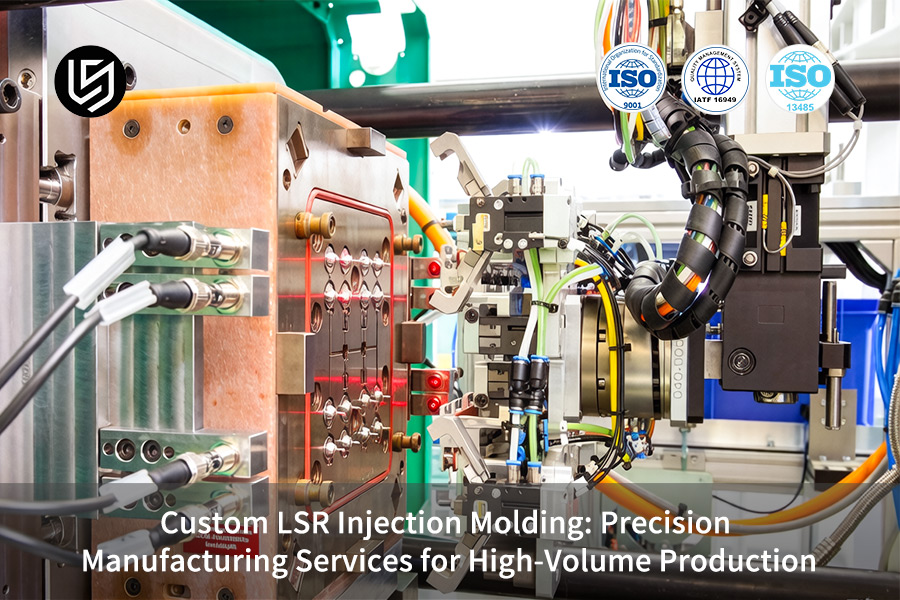
Custom LSR Injection Molding: High Volume Production Guide
| Production Challenge | Technical Solution | High Volume Outcome |
| Viscosity & Flow Control | LSR is low viscosity liquid; uses cold runner system & precise dosing. | Consistent fill into complex/micro featured mold through hundreds of cycles. |
| Cycle Time Optimization | Low viscosity fast cure formulations and effective hot/cold plate mold design. | Cycles in as little as 1530 seconds, optimizing parts per hour. |
| Flash & Deflashing | Very narrow injection molding tolerances (<10μ) and cryogenic automated deflashing. | Consistent flash-free parts without manual trimming. |
| Material Consistency | Automated metering, mixing, dispensing and temperature controlled systems. | Same batch to batch consistency in part performance. |
| Automation Integration | Automatic robotic handling, sorting and 100% vision inspection. | Unmanned operation allowing 24/7 lights out production with no human contact. |
| Result: Scalable Precision | Engineering a consistent & automated process for LSR. | Hundreds of millions of parts of high precision seals, gaskets & medical devices in volume at lowest cost/unit. |
Key Takeaways:
- Process Dictates Precision: The lower viscosity of LSR demands cold runners and micro-level tolerance for mold design to avoid flashing; the standard thermoplastic processes don’t apply.
- Automation is NonNegotiable: To gain the speed needed for economically viable LSR production, complete automation of handling and inspections must be included.
- Material Handling is Critical: A fully automated metering and mixing process is crucial to keep the two-part nature of the LSR chemically consistent.
- The Goal is a Closed Loop: High-volume LSR injection molding process means that all steps, including material handling through part ejection, are automated and controlled with sensors.
Why Trust This Guide? Practical Experience From LS Manufacturing Experts
There are endless numbers of theoretical articles about LSR injection molding. This is where we differ from all the rest. Our approach to getting zero defects out of high-cavity molds around the clock comes from practical experience gained in a highly competitive environment, and the way we do things is based on the basics of manufacturing as advocated by the Society of Manufacturing Engineers (SME).
We manufacture critical components including implantable heart valves, aerospace gaskets, and automotive sensor seals. Due to the extremely stringent standards expected in such applications, our manufacturing processes must conform to the exacting material standards set forth by Society for the Advancement of Material and Process Engineering (SAMPE), an international authority on advanced materials.
You will benefit directly from shop-floor expertise that eliminates your engineering risks before steel is cut. This technical integration ensures your components are strictly metered at a 1:1 ratio with ±0.2% gravimetric accuracy, micron-vented to completely eliminate air entrapment in micromolds, and post-cured to lock in a stable 50±2 Shore A hardness. Partnering with LS Manufacturing means you safeguard your project against expensive engineering failures like flash, short shots, and early component degradation, moving seamlessly from quotation to market deployment.
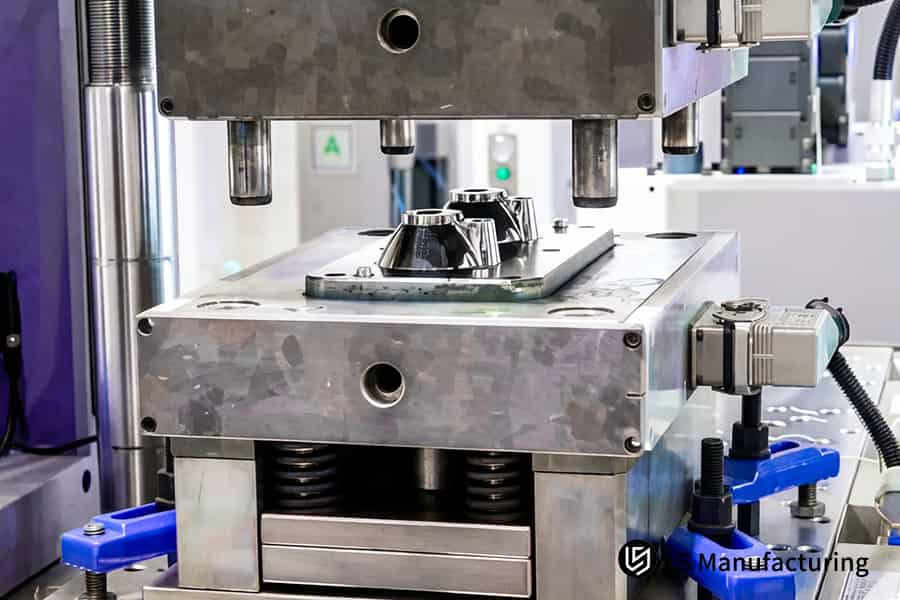
Figure 1: Custom LSR waterproof electrical connector overmolded by LS Manufacturing, achieving zero flash at 180°C curing.
Why Is Precision Liquid Silicone Molding Critical For High Volume Pharmaceutical And Automotive Components?
Precision liquid silicone molding is essential to high-volume pharmaceutical and automotive components because it addresses the crucial issue of micron-level consistency over millions of cycles. It does so through complete automation and control of all sub-process parameters:
Eliminating Variability with Automated Systems
Consistency depends on eliminating manual intervention. Our use of a fully automated valve-gated cold runner system—a synchronized needle-valve mechanism that completely isolates the cold material from the hot cavity—solves inconsistencies in manual sprue manipulation, guaranteeing that all cavities receive the exact same volume and thermal history.
For your project, this technical capability directly translates into a 30% reduction in cycle time and zero runner scrap costs, ensuring competitive piece-unit economics. Such automation is critical in high volume LSR production and forms the basis of our custom liquid silicone rubber molding service.
Locking Dimensions via ClosedLoop Control
The shrinkage of the material needs management and not just acceptance. A multi-stage closed loop pressure control system monitors the injection pressure down to ±0.1 bar accuracy and continuously adjusts for viscosity changes. Shrinkage is actively compressed to 1.8% to 2.2% range through such a process critical to multi-cavity LSR injection molding as confirmed using a laser system.
From Process Data to Guaranteed Performance
The consistent controlled properties directly correspond to real-life reliability. When a medical pump membrane requires uniform density to avoid cracking, and when an electric vehicle seal requires consistent sealing properties through thermal cycles, the tight-tolerance LSR injection molding ensures that every single unit produced will have homogeneous and predictable physical properties of the cured LSR.
Precision liquid silicone molding is an engineering solution with clearly defined output stability parameters. This white paper outlines an approach based on automation and real-time process monitoring being used as key instruments of risk management. The approach illustrated with an example of automotive-grade LSR injection molding gives evidence to turn a molding quotation into a reliability partnership.

How Can Custom DFM Optimization Eliminate Flash And Air Trapping In Custom Liquid Silicone Rubber Molding Service?
Neither flash nor air trapping are inherent problems, but rather, results of inadequate process design. Predictive engineering and micron tooling design in our custom liquid silicone rubber molding service will take care of this problem right from the start, where the design will be converted to a process-oriented design before any tooling steel cuts are made. Predictive engineering is an essential component of the process of producing OEM liquid silicone rubber molding.
Predictive Flow Analysis to Prevent Air Traps
- Simulating Material Behavior: Simulating the material behavior using Moldflow simulation to understand how the LSR will behave when flowing from the cold runner (25°C) to hot cavity (175°C). A fundamental step for high precision LSR manufacturing.
- Pinpointing Problem Areas: Discovering precisely where the converging flow fronts and quick thickness change can occur and cause trapped air in order to strategically relocate the gate locations or adjust the fill pattern in the virtual prototype.
- Proactive Design Correction: Based on this front-end analysis and understanding of material behavior, one could apply a scientific LSR injection molding process by designing the successful mold from the very first run.
Micron-Level Venting Design to Eliminate Flash
- Precision Engineering: Designing venting grooves whose depth is controlled within the range of 2μm - 5μm, which is less than the flash point of the material.
- Strategic Placement: Placing those venting grooves in the last filling points determined through flow simulation.
- Guaranteed Outcome: This specification is an essential feature in flash-free LSR injection molding as it physically prevents silicone from leaking while allowing gases to escape through it.
Integrated Vacuum-Assisted Molding for Absolute Air Removal
- Active Air Evacuation: Utilizing a built-in vacuum system on the mold to pull the cavity down to -0.09 MPa before injecting the silicone.
- Removing Residual Gases: The vacuum system removes all residual gases within the cavity and vent channels, thus eliminating burn marks and short shots resulting from gas pockets.
- Final Safeguard: Vacuum-assisted LSR injection molding becomes the ultimate safety net that ensures full cavity fill without any burn marks.
This DFM process, from the digital simulation stage through vacuum extraction, turns a good part into a manufacturing solution. It raises first-time sample success rates to exceed 95%, by preemptively designing to prevent, not fix, the most common failures during production. This failsafe approach provides the technical basis for the dependable OEM liquid silicone rubber molding service.
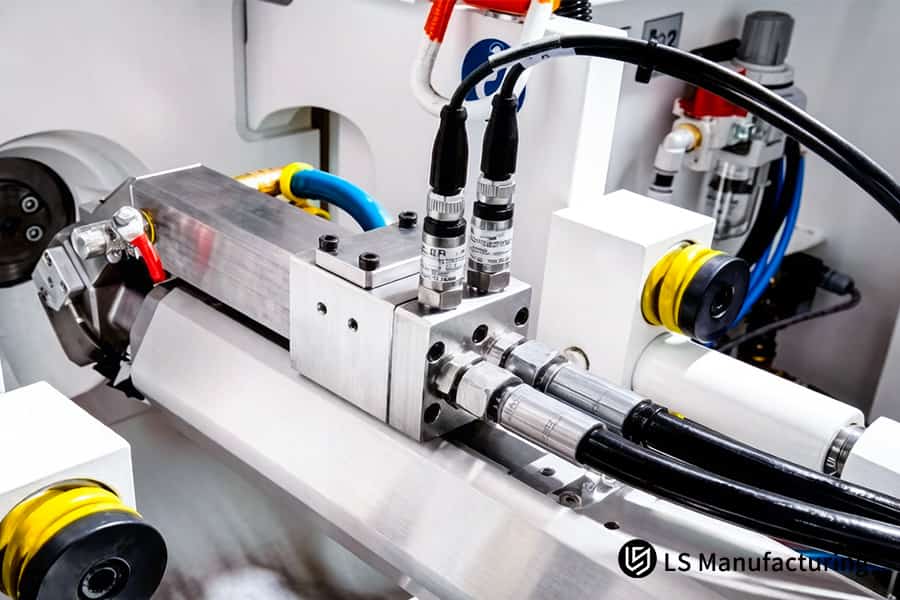
Figure 2: High precision LSR manufacturing forms white silicone diaphragms in a complex multi-cavity mold.
What Cold Runner Design Parameters Ensure Zero Waste In LSR Injection Molding Service For OEM Projects?
True cost-saving production of custom liquid silicone parts depends on minimizing scrap material during the manufacturing process. Cold runners are notorious for creating scrap because of their thermal properties. This article explains the necessary design parameters that result in waste-free LSR injection molding, which is essential in providing top-notch LSR injection molding for OEM.
| Design Parameter | Open Cold Runner | Standard Valve-Gated System | LS Manufacturing Closed-Loop Independent Valve System |
| Material Utilization | ~65% (High scrap from solidified runner) | ~88% (Reduced waste, but some gate drool/loss) | ≥99.2% (Precise shot control eliminates gate vestige) |
| Cycle Time Impact | Increased (Either manual degating or cooling takes more time) | Optimal (Automatic degating system employed) | Reduced up to 15-30% (Optimal cooling and quick valve closing) |
| Long-Run Stability | Low (High sensitivity to external changes) | Moderate (Slow heating of valve leads to temperature increase) | Very high (±2°C control over water flowing through each valve) |
In short, our closed-loop valve system prevents premature curing, securing a 99.2% material yield that traditional open systems cannot match.
The proposed solution addresses the source of the problem by locking the valve tips to 20°C ±2°C through independent closed-loop control, thus avoiding premature gate cure. This provides uniform mixing and effective segregation of materials, allowing us to use data from the table to deliver near zero-waste production for your LSR injection molding service. Prove 99.2% material yield is possible for your LSR project. To validate a zero-waste process, request a comparative analysis report and a production-proven quotation today.
How To Control Dosing Pump Accuracy For High Precision Shore A Hardness Requirements?
Achieving consistent Shore A hardness in finished parts depends entirely on maintaining the precise 1:1 mix ratio of A/B liquid silicone rubber components. Any deviation causes crosslink density variation, leading to hardness drift or incomplete cure. The core challenge is dynamically compensating for real-time material viscosity changes. Our solution utilizes a closed-loop gravimetric feedback system to ensure mix ratio integrity, which is fundamental for producing reliable custom liquid silicone parts:
Closed-Loop Gravimetric Feedback Control
Volumetric pumps are replaced by micro-servo weigh-cell dosing pumps. The latter continuously measures the exact weight of dispensed ingredients. Real time monitoring of actual weight creates a closed loop system ensuring immediate correction of any discrepancy to achieve consistent mixture ratios at an accuracy level of ±0.2%. Such accuracy is essential in high precision LSR manufacturing.
Dynamic Viscosity Compensation
Viscosity may be anywhere between 300,000 mPa·s and 800,000 mPa·s. If there are any viscosity fluctuations, then our system will calculate an inaccurate mass using a volumetric approach. Our system uses gravimetry which is naturally immune to such issues. We adjust pump parameters automatically to compensate for changes in viscosity. This feature is essential in terms of consistency-focused LSR injection molding.
From Ratio Control to Guaranteed Hardness
The exact control of mass is necessary for controlling cross-linking reaction chemistry. By maintaining the mix ratio at 1:1 ±0.2%, we assure stoichiometric accuracy which ensures that there is an ideal cross-linking reaction. We maintain consistent Shore A hardness across all batches in the entire range of Shore A 20 to Shore A 70 with a variation of just ±1 Shore A hardness points, as per strict OEM requirements using our custom liquid silicone rubber molding service.
This process addresses the underlying cause of variations in hardness. Using gravimetric LSR injection molding and applying feedback that takes weight into account, we make the preparation of material a constant process. This will guarantee that all the parts manufactured have the desired physical properties, a key factor for successful tolerance-critical LSR injection molding.
Which Mold Material Steel Criteria Should An Experienced LSR Injection Molding For OEM Vendor Choose?
When looking at the success rate in precision liquid silicone molding processes, the choice of mold materials and surface finish can be a very important yet underestimated consideration. Standard tools are not sufficient when it comes to high volume LSR production as they will not withstand the wear and tear brought about by the LSR's abrasive components and its strict release requirements.
Superior Steel Selection for Rigidity
- Material Choice: Premium vacuum-remelted steels (e.g., ASSAB S136) are used.
- Core Property: The core should have hardened properties to a minimum of HRC 52, ensuring deflection resistance under high pressures to withstand LSR injection molding for OEM applications.
Ultra-Smooth Surface Finishing
- Machining Process: The cavities will be mirror polished.
- Surface Outcome: Produces a surface roughness less than or equal to Ra ≤0.05 μm to ensure easy removal of parts, the basis of optical-grade LSR injection molding.
Advanced Coating for Wear Resistance
- Coating Application: Application of the diamond-like carbon coating.
- Primary Benefit: This ensures minimum abrasive wear and mold life exceeding 1,000,000 cycles, an important characteristic for durable LSR injection molding.
Guaranteed Part Quality and Mold Life
- Combined Effect: This creates a synergy which prevents micro-wear, which leads to flash formation.
- End Result: Provides consistent part geometry with a high gloss finish, crucial for a performance-critical LSR injection molding.
This technical process solves the problem of failure of tooling by building molds out of high-quality materials, optical finishes, and coatings. Such an approach is necessary for providing the customers with a reliable, cost-efficient, and proven LSR injection molding service. This method will turn our mold into a reliable, non-consumable tool, thus assuring successful economic aspects of the project.
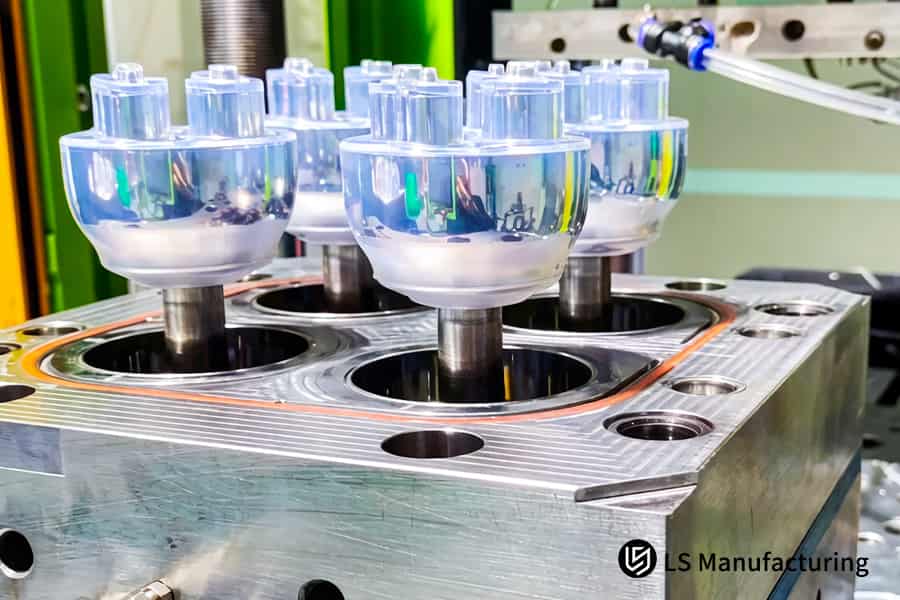
Figure 3: High volume LSR production runs clear silicone seals on an automated injection molding machine.
Case Study: How Did LS Manufacturing Solve A Critical Delamination Issue For An Medical Respiratory Mask Connector?
One of the leading manufacturers of medical devices failed to produce a transparent respiratory mask connector using LSR material due to delamination of LSR from the substrate made of polycarbonate material. The initial peel strength was only 1.5 N/mm, with a 42% scrap rate in the pilot run due to leakages. In order to resolve the critical issue and successfully implement the project, it was necessary to create a precision liquid silicone molding process by considering such factors as:
Client Challenge
A reliable seal needed to be established between LSR and polycarbonate in the part. However, the old process did not perform adequately in terms of sealing at the bond interface; resulting in a peel strength less than 1.5 N/mm and a leakage rate of 42%. Such poor reliability stopped manufacturing activities and threatened approval by regulators, illustrating the limitations of traditional overmolding in two-shot LSR injection molding.
LS Manufacturing Solution
Your project benefits from an engineered production sequence that by overriding traditional overmolding limits to secure absolute interfacial adhesion. During initial multi-cavity trials, conventional transfer mechanisms caused a 6.2-second delay, leading to premature substrate cooling and a fragile 1.5 N/mm peel strength. To resolve this critical failure, we deployed a custom-built, high-speed servo rotary mold that successfully synchronized the transfer time between the PC substrate and LSR injection shots to less than 4.5 seconds.
Simultaneously, integrated infrared sensors and closed-loop heating cartridges were installed to actively stabilize the critical bonding interface at 165°C ±0.5°C. This aggressive thermal window control was vital for medical LSR injection molding and interfacial curing, effectively driving the final peel strength past 6.8 N/mm and dropping the scrap rate to under 0.15%.
Results and Value
With the above solution, a peel strength surpassing 6.8 N/mm was achieved, and the failure mechanism changed to that of substrate breaking. Our production scrap rate fell below 0.15%. This particular solution helped ensure proper performance of the product and helped save 22 days in terms of time-to-market. Our unique custom liquid silicone rubber molding service helped our clients high volume LSR production.
This case demonstrates our capability to solve complex interfacial adhesion challenges through precise thermal and temporal control. By mastering the tight-tolerance LSR injection molding parameters at the material boundary, we deliver not just parts, but guaranteed performance. This technical approach de-risks the most demanding projects, providing partners with a reliable LSR injection molding solution for safety-critical components validated through production-validated LSR injection molding results.
Stop risking 42% leakage and launch delays. To lock in 6.8 N/mm bond strength and 0.15% scrap, submit your bonding design for a synchronization analysis and production plan. Click here to view our 3rd-party peel strength test report

What Comprehensive Quality Assurance Protocols Guarantee Zero Defect Delivery In OEM Liquid Silicone Rubber Molding?
For OEMs, the concept of zero defects is achieved through an approach based on prevention, with the use of a system-level process combined with 100% automation for verification purposes. Our quality protocol is a multilayered approach critical to our LSR injection molding service, providing the necessary assurance for high precision LSR manufacturing. The framework below defines the controls required for dependable OEM liquid silicone rubber molding.
| Assurance Layer | Implementation | Client Value / Deliverable |
| Certified QMS Foundation | System operates within IATF 16949 and ISO 13485 certified frameworks. | Conformity to demanding standards for automotive and medical devices. |
| 100% In-line Dimensional Inspection | Process involves automated CCD vision systems checking dimensions ±0.005mm in real time. | Security against dimensional change issues with tolerance-critical LSR injection molding. |
| Real-Time Statistical Process Control (SPC) | Real-time monitoring and plotting of process parameters relative to control limits. | Effective prevention of deviations, with ongoing stability through analysis. |
| Quantified Performance Reporting | CpK analysis included with every production lot like desired CpK ≥1.66 (CpK ≥1.66 means a mathematically near-zero defect rate, directly lowering your quarantine costs). | Conclusive and numerical validation of process performance and molded parts. |
| Full Material Traceability & Certification | Complete material lot traceability with supporting 3rd-party compliance reports. | Guaranteed material purity and de-risked regulatory submissions for clients. |
This comprehensive approach solves the fundamental problems facing OEMs today by addressing the cost of defects, auditing complexity, and compliance issues. Moving beyond simply inspecting for defects upon completion, our method ensures quality assurance at all stages of production.
Using validation-ready LSR injection molding documentation, as well as automated inspection systems, we ensure quality assurance isn't just a guarantee but a tangible deliverable. This guarantees partners with the necessary confidence for compliance-ready LSR injection molding of mission-critical components.
Why Choosing LS Manufacturing As Your High Volume LSR Production Partner Gives You A Decisive Market Edge?
Competitive advantage in high volume LSR production is about being a technically competent and fast moving partner to take projects from concept to mass production quickly and reliably. Acting as a co-development partner, we offer our customers a custom liquid silicone rubber molding service which makes the manufacturing process safe from a conceptual stage. Here are the tangible benefits of our service:
Front-Loaded Development to Mitigate Risk
Co-design and DFM evaluation are performed from the very beginning of development, and we use simulations to pre-qualify the mold designs and process capabilities. This helps us offer you the complete DFM report and functional prototype after only 3 days, detecting and resolving any manufacturability issues ahead of time so that we can proceed with precision liquid silicone molding.
Accelerated Tooling for Agile Time-to-Market
The dedicated and fully vertically integrated moldmaking unit performs high cavitation molds specifically designed for liquid silicone rubber. In this way, we are able to supply high-quality multi-cavity production tools with just 7-14 day lead times. This is vital for achieving fast-cycle LSR injection molding.
Uninterrupted Scalability with Automated Production
Volume manufacturing is enabled by 24 hours a day fully automated “lights-out” manufacturing cells. Such systems offer absolute production flexibility, as they ensure consistently high quality and volume irrespective of changes in orders. Such an operations model, which is required for high-availability LSR injection molding, ensures supply chain stability and predictable unit economics for international projects.
With such a collaboration concept, manufacturing becomes not a serial vendor activity but rather parallel and value-adding one. Offering our engineering expertise, tooling, and production flexibility allows us to take responsibility and reduce project risk. Our comprehensive service approach to injection molding provides a competitive advantage that is expressed through a reduced time to market, better cost effectiveness, and supply guarantee.
Figure 4: Precision liquid silicone molding produces transparent medical gaskets in an ISO 13485 certified cleanroom.
FAQs
1. What is the minimum order quantity (MOQ) for your custom liquid silicone rubber molding service?
LS Manufacturing does not have strict requirements and thresholds for manufacturing large amounts of goods. Although our main task is large-scale manufacturing, we completely approve of the process of prototyping and small batch trials (for example, making a product of 500 pieces and above). Then we switch to manufacturing ultra-large-scale production of more than 500,000 units.
2. How does LS Manufacturing maintain a strict ±0.005mm tolerance for high-precision LSR manufacturing?
Swiss ultra-precision 5-axis CNC machine tools are used for producing molds that have high rigidity (up to HRC 52+). Combining such molds with precision servomotor needle valve injection makes it possible to hold a strict tolerance of ±0.005mm even in the case of 180°C curing temperatures.
3. Can you quote directly from 3D CAD drawings for LSR injection molding of OEM components?
Yes, please forward your drawings in STEP, IGES, or Parasolid formats directly to us. Our engineers will carry out DFM analysis within 24 hours after receiving the data and will offer you a comprehensive quote regarding the price of the mold and cost per unit.
4. How do you guarantee the biological safety of medical components produced via your precision liquid silicone molding process?
Production takes place within a completely automated process inside a Class 10,000 cleanroom. The material used in the molding process is made from fully certified ISO 10993 and FDA biocompatible liquid silicone rubber. All components go through an extra curing process of over 4 hours before they leave our facility to ensure the elimination of any volatile substances.
5. What is your standard lead time for high-volume custom silicone molds and initial article production?
For prototype production, the lead time will be 3 to 5 days. In case of producing complex multi-cavity cold-runner molds for ultra-high volume manufacturing, the whole cycle will not exceed 14-21 days including First Articles.
6. How do you prevent material contamination when switching batches for custom liquid silicone parts?
LS Manufacturing has strict "dedicated machine lines" and production processes segregated for different grades of materials, including the use of medical-grade and automotive-grade materials. We apply our proprietary, completely automated and enclosed pipe-line cleaning system when changing batches so that cross-contamination would not occur. In doing so, we can achieve material purity of up to 99.99%.
7. Why are your multi-cavity liquid silicone molds more cost-effective for high-volume LSR production?
We use our proprietary self-developed valve gate design, and cold runner design with zero waste (not causing any cured runner scrap). Material utilization is thus up to 99.2%. In combination with the very efficient 16-cavity or 32-cavity designs, we can save more than 30% of production cycle times per piece.
8. How does LS Manufacturing safeguard customer IP and proprietary design files during the quoting stage?
Before accepting any technical drawings from your side, we first sign a non-disclosure agreement (NDA) with you. All 3D data would be kept in an encrypted server that is physically isolated from others and could only be accessed by authorized engineers.
Summary
Precision and large volume manufacturing of liquid silicone rubber entails systematic engineering that includes DFM simulation, micron-finished tools, intelligent ratio-controlled pump system and quality controls. Knowing the silicone rubber is not sufficient to resolve issues such as flashing, delamination and deformation when producing in large quantities. These rigorous data and cold runner technologies are the backbone of LS Manufacturing superiority in the medical, automobile and high-end electronics industry segments.
Ready to reduce scrap costs by over 30% in your LSR production process? No need to waste precious time and money trying different approaches without any results. Simply click “Request Custom Quote & DFM Analysis Here!” We will provide a detailed LSR injection molding cost estimation for the manufacture of your project based on your STEP/IGES files within 24 hours.
📞Tel: +86 185 6675 9667
📧Email: info@lsrpf.com
🌐Website: https://lsrpf.com/
Disclaimer
The contents of this page are for informational purposes only. LS Manufacturing services There are no representations or warranties, express or implied, as to the accuracy, completeness or validity of the information. It should not be inferred that a third-party supplier or manufacturer will provide performance parameters, geometric tolerances, specific design characteristics, material quality and type or workmanship through the LS Manufacturing network. It's the buyer's responsibility. Require parts quotation Identify specific requirements for these sections.Please contact us for more information.
LS Manufacturing Team
LS Manufacturing is an industry-leading company. Focus on custom manufacturing solutions. We have over 20 years of experience with over 5,000 customers, and we focus on high precision CNC machining, Sheet metal manufacturing, 3D printing, Injection molding. Metal stamping,and other one-stop manufacturing services.
Our factory is equipped with over 100 state-of-the-art 5-axis machining centers, ISO 9001:2015 certified. We provide fast, efficient and high-quality manufacturing solutions to customers in more than 150 countries around the world. Whether it is small volume production or large-scale customization, we can meet your needs with the fastest delivery within 24 hours. choose LS Manufacturing. This means selection efficiency, quality and professionalism.
To learn more, visit our website:www.lsrpf.com