English




Custom silicone overmolding service often encounters issues where engineers evaluating what materials are used in overmolding overlook the bonding limits between medical-grade Liquid Silicone Rubber and thermoplastics, leading to seal delamination in pressure tests due to poor process control. This is made worse by the fact that traditional manufacturers have no ISO 13485 certified quality system and closed loop processing that cannot keep within ±0.005mm tolerances or deal with advanced technical challenges such as flashing and degradation of the material.
LS Manufacturing is a leading medical grade silicone overmolding manufacturer that addresses this challenge through DFM analysis, multi-physics thermal-flow simulation, highly precise mold manufacturing, and special surface treatments to overcome the bonding and tolerance challenges, providing biocompatible and durable parts. Through understanding the technical reasoning behind precision overmolding, we directly apply solutions to improve yields of medical components.
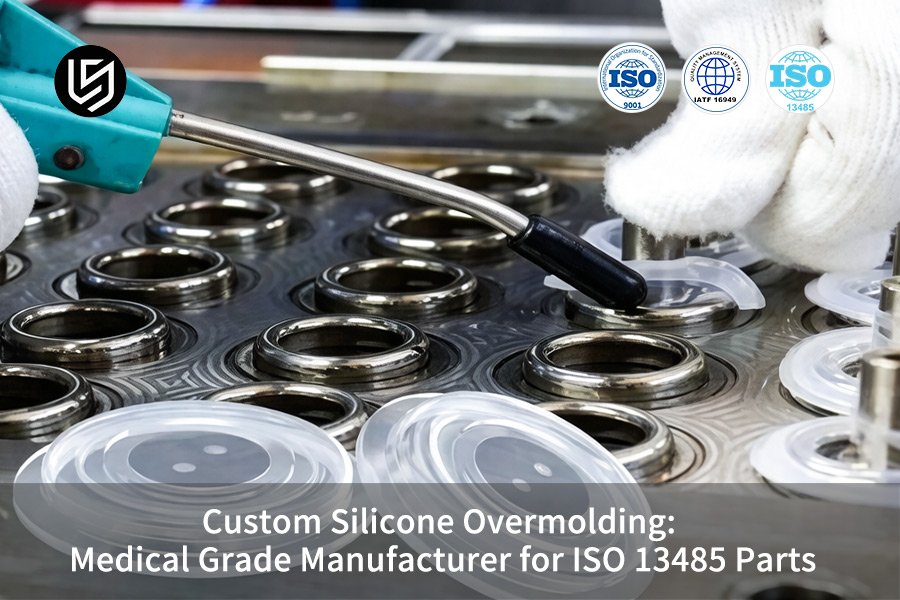
Custom Silicone Overmolding: Medical Grade Quick-Reference
| Key Focus | Compliance Requirement | Clinical Result |
| Material Certification | USP Class VI certified silicone material with traceability. | Biocompatible components for human interaction, conforming to ISO 10993. |
| Bonding to Substrates | Special surface treatment for bonding with rigid plastics. | Tough and permanent seal for flow paths and soft touch applications. |
| Cleanroom Environment | Overmolding process in ISO Class 7/8 cleanroom environment. | Suitable for sterile packaging and clinical applications. |
| Process Validation | IQ/OQ/PQ validation for molding, curing, and tooling process. | Provides batch-to-batch reliability in performance and dimension. |
| Quality Verification | 100% automated inspection and leak test verification. | Zero-defect delivery of critical components for medical devices. |
| Regulatory Readiness | Complete DHR (Device History Record) documentation. | Fast-track FDA/CE compliance and other regulatory submissions. |
Key Takeaways:
- Material Traceability is Essential: Only certified USP Class VI silicones are suitable.
- Process Validation is Critical: IQ/OQ/PQ guarantees reproducible adhesion and quality parts.
- Cleanroom is Non-Negotiable: The production environment affects the sterility and safety of the finished product.
- Documentation Enables Compliance: DHR documentation is equally important to the physical part.
Why Trust This Guide? Practical Experience From LS Manufacturing Experts
There are plenty of articles on the theory behind silicone overmolding processes. What sets this guide apart is that it was created by us - the guys who produce medically approved LSR parts through validated production processes on a regular basis. Our process validation techniques and material test procedures have been meticulously verified based on global empirical data from ASTM International.
Components where material integrity is key are produced by us; such as long term implantable drug delivery ports, wearable medical device sensor enclosures, and single use surgical tool handles. Material integrity is the top priority in all of these cases, which means we have to exceed the standards for pressure vessel design and construction, as well as bioprocessing equipment design and construction as specified by the American Society of Mechanical Engineers (ASME). There is no room for error in any of these areas.
Experience gained on the shop floor through each lot acceptance test and analysis of adhesion failures is what gives us mastery of the trade. We know the correct parameters for plasma treatment for bonding to PEEK, the exact temperatures of the molds that will produce parts without any knit lines on sealing surfaces, and the SPC limits to ensure proper flash free dimensions. This experience is shared with you to help you design your overmolded parts successfully.
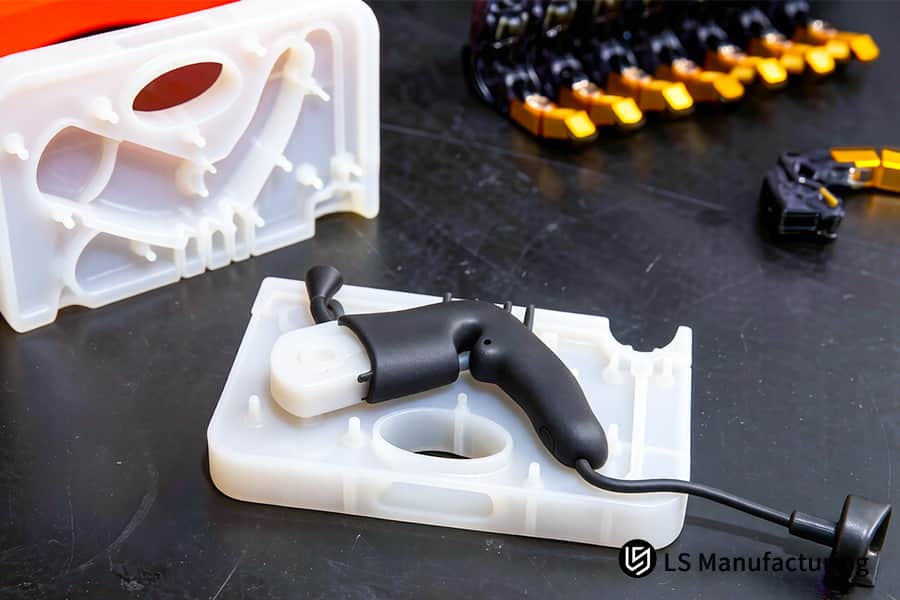
Figure 1: Custom silicone overmolding service inserts a tool into the cavity of a white plastic overmolded assembly.
Why Is Selecting An ISO 13485 Certified Factory Critical For Custom Silicone Overmolding Service?
Partnering with an ISO 13485 silicone overmolding manufacturer goes beyond mere compliance to provide reliable custom silicone overmolding service by focusing on proactively minimizing risks. It tackles the key technical issues of contamination, dimensionality, and traceability. Below is the way we ensure reliability in each part:
Contamination Control in a Validated Environment
Our Class 100,000 cleanroom, which features positive pressure and rigorous gowning procedures, is the first line of defense. This controlled environment is crucial for medical grade silicone overmolding as it ensures no contamination occurs. Our cleanroom allows us to start with a clean base during the liquid silicone overmolding process, which is then validated against USP Class VI standards before manufacturing.
Process Consistency Through Statistical Control
We use SPC in real time to track and control variables such as injection pressure, temperature, and cure times. Such an approach, which is absolutely necessary to ensure high precision silicone overmolding, ensures that the overmolding bond strength and dimensional accuracy required to assemble devices and make them perform well is guaranteed.
100% Automated Verification of Critical Features
In addition to sampling, we employ inline automation vision systems to inspect each part for flash, voids, and encapsulation. This automated overmolding inspection provides documentation for any quality claim that can be made. This step is essential in our multi-material overmolding projects, where there are multiple interfaces.
End-to-End Digital Traceability
Each part produced is associated digitally with the batch of production, machine parameters, and material lot. This process, which is required for certified overmolding dimensional stability, ensures quick traceability. If there is ever an issue, it becomes possible to contain it in a small way rather than a mass recall that damages your brand.
This paper outlines a highly technical solution to manufacturing risk. Our methodology, characterized by certified environmental controls, live SPC, full automation in inspection, and digital traceability, offers a complete solution to the key problems of medical device overmolding. The level of sophistication involved in our approach enables us to provide a safe and consistent foundation for making essential medical devices using high precision silicone overmolding.

What Material Combinations Deliver The Strongest Bonding Strength In Medical Grade Silicone Overmolding?
Creating a chemically bonded joint in medical grade silicone overmolding that withstands 134°C autoclave cycles repeatedly is an absolute must. For that, one has to go beyond data sheets and engineer the interface on a molecular level. Our methodology leverages surface chemistry, precise process controls, and testing to create a bond that exceeds 4.2 MPa even without the use of mechanical fasteners:
Molecular-Level Surface Activation
- Core Action: We modify the substrate surface to be chemically active rather than inert.
- Technical Execution: Using 248nm UV-Ozone treatment on both plastics (PC, PEEK) and metal surfaces. This cleans the surface down to the molecular level and leaves behind a high-energy surface suitable for covalent bonding with silicone.
- Problem Solved: This initial step directly enables durable silicone overmolding, solving the problem of interface failure through chemical adhesion rather than just physical attachment.
Thermodynamic Precision During Molding
- Core Action: We carefully control the thermodynamic and kinetic properties at the bonding interface.
- Technical Execution: We pre-heat the substrate to a tight range of 130-150°C, followed by high pressure injection. This keeps the substrate surface energy intact while pushing the silicone fluid into the micro-features before cross-linking occurs.
- Problem Solved: This establishes the high precision silicone overmolding process, achieving full wetting and starting the chemical reaction, which is vital for overmolding bond strength.
Validated Performance Through Simulated Aging
- Core Action: We put the bond through its entire lifetime of stress prior to manufacturing.
- Technical Execution: The bonded parts are put through over 100 autoclave cycles, followed by destructive tensile shear testing. We match the strength results (>4.2 MPa) to the manufacturing process window.
- Problem Solved: This intensive overmolding validation testing process provides scientific evidence of autoclave-resistant overmolding, ensuring real-world performance.
This technical document describes the process we use to ensure the formation of chemical bonds that are resilient to extreme sterilization. As a custom silicone overmolding manufacturer, we provide a solution to the problem of autoclave-induced delamination by designing the interface using surface activation, thermodynamics, and strict validation testing. The result is a solution that ensures reliability in medical device overmolding applications, turning a typical problem into an advantage.
How Does Advanced DFM Analysis Eliminate Flash And Short Shots During High Precision Silicone Overmolding?
In high precision silicone overmolding, one of the critical challenges is the low viscosity nature of Liquid Silicone Rubber (LSR), which means that high pressure is required to fill the mold, but this will cause flash. On the other hand, insufficient venting leads to short shots. This technical document explains our advanced DFM analysis method to avoid these defects in the design phase itself.
| Key Challenge | Our Targeted DFM Solution | Technical Outcome |
| Flash Prevention at Parting Lines | We simulate cavity pressure and optimize gate design/tonnage to control LSR's flow. | The simulation results in 15% lower cavity pressure, preventing flash physically. |
| Eliminating Air Traps for Complete Fill | Prediction of air traps allows us to place vents with precise spacing (0.003-0.005 mm). | This allows perfect filling of cavities without any LSR overmolding short shots in complex molds. |
| Thermal Management for Uniform Curing | The conformal cooling channels' design is optimized using thermal equilibrium simulation. | It guarantees even curing, which is crucial for thin-wall overmolding parts. |
| Optimizing the Molding Process | The analysis directs silicone overmolding process optimization for runner geometry. | Guarantees laminar flow and bond strength, essential for a reliable custom silicone overmolding service. |
The proactive design for manufacturability approach converts the potential problems that come with LSR into a predictable and reliable process. By overcoming flash and short shot issues with simulation during the design stage, we guarantee as-molded quality. This method ensures the accuracy and reliability needed to work with OEM silicone overmolding partners.
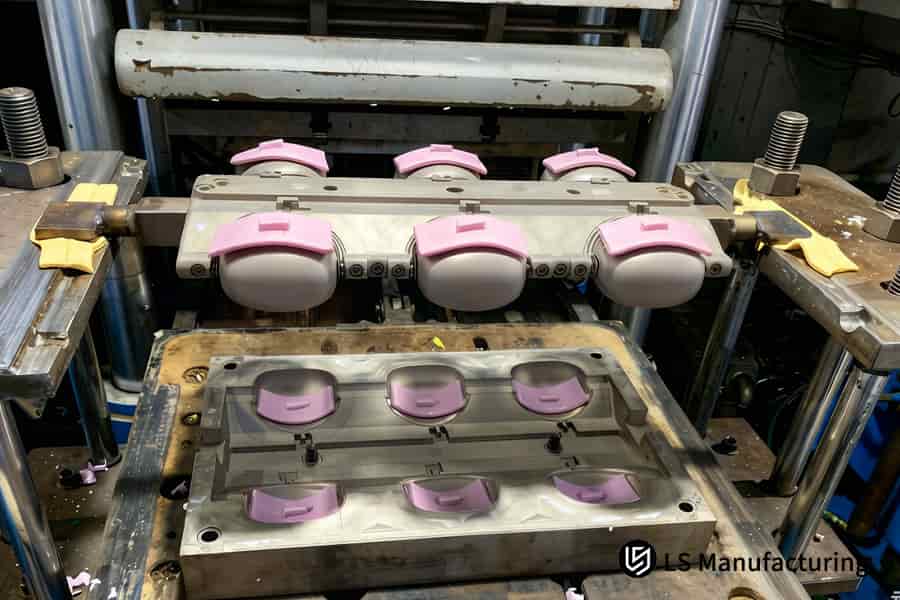
Figure 2: Silicone overmolding for medical parts injects pink material into a precision metal mold cavity.
Which Design Constraints Prevent Structural Deformation In Custom Silicone Overmolding Manufacturer Tooling?
However, in the case of thin wall parts (<0.4mm) or intricate medical housing parts, the thermal stress and injection pressure in the case of high precision silicone overmolding may lead to substrate warping, thus distorting the dimensions of the parts. This document will outline our approach to designing tooling that guarantees part stability through engineering considerations:
Material Selection for Ultimate Rigidity
We use high hardness and highly resistant to corrosion materials such as ASSAB S136, heat-treated to HRC 52+. Such material base is crucial as the material basis which will resist deflections under high pressure of injection – an indispensable condition of a high-quality medical silicone overmolding service. The inherent stability directly combats the root cause of plastic substrate warping during the overmolding process.
Advanced Machining for Perfect Geometry
Precision multi-axis CNC machining and EDM are used to ensure that the cavity shape and parting line are nearly perfect. Such accuracy eliminates stress points and flash potential. It is vital for a custom silicone overmolding manufacturer since it helps to avoid any factors that could cause the tool to create misshapen parts or non-uniform wall thickness.
Proactive Structural Design Within the Tool
The inclusion of a network of support pins and internal reinforcement in the tool design helps us to distribute clamping pressure and injection forces equally and prevent the cavity from bending. This engineering solution is necessary for complex overmolding tooling design and enables tools to preserve their lifetime accuracy at ±0.02mm through more than 500,000 cycles.
Substrate deformation is accounted for from the beginning through the construction of the tool. With the use of high-rigidity material, accurate machining, and smart structural design, we address the fundamental problem of substrate deformation. Such an approach allows us to guarantee that tools used in complex overmolding applications will provide consistent and precise parts throughout the process.
How Does LS Manufacturing Ensure Biomedical Safety Compliance For Silicone Overmolding For Medical Parts?
Biocompatibility is absolutely necessary when producing implantable or fluid contacting devices. Biocompatibility can only be achieved by implementing a reliable system that will prevent any kind of contamination in all stages of production. The present document describes the protocol for silicone overmolding for medical parts designed specifically for achieving biocompliance.
Certified Material Sourcing & Management
- Action - Sourcing Control: All raw materials used in the production of our medical device overmolding products are made only using silicones that have been tested according to USP Class VI and ISO 10993 standards.
- Action - Physical Segregation: These materials are manufactured under segregated conditions within a cleanroom facility in order to avoid any contamination with industrial silicones.
- Result: This creates a pure and traceable starting point for our entire process of manufacturing medical device overmolding products.
A Closed-Loop, Contamination-Free Process
- Action - Closed System Molding: The manufacturing of our medical grade silicone overmolding products takes place within a dedicated system of enclosed feed systems and closed pipe feed lines.
- Action - Environmental Control: Our medical device overmolding process takes place within a positively pressurized cleanroom, hence avoiding any ambient contamination within the cleanroom overmolding process.
- Result: This guarantees physical segregation of the production process chain.
Documentation & Lot Traceability
- Action - Batch Documentation: Every production batch has detailed documentation, which includes test results conducted in external labs (cytotoxicity, sensitization, irritation).
- Action - Digital Traceability: Full traceability of the product part from the initial batch of the raw polymer to the end product is guaranteed and documented digitally.
- Result: We offer full documentation that proves that we comply with OEM silicone overmolding, which offers the required evidence for your regulatory submission and quality audit.
Biomedical safety is assured through system control, not just material validation. Our solution uses validated materials in an enclosure and ensures complete traceability documentation. Complete system control ensures that the two main concerns – contamination prevention and compliance verification – are solved to ensure certified safety and integrity of the supply chain for biomedical implantable device overmolding.
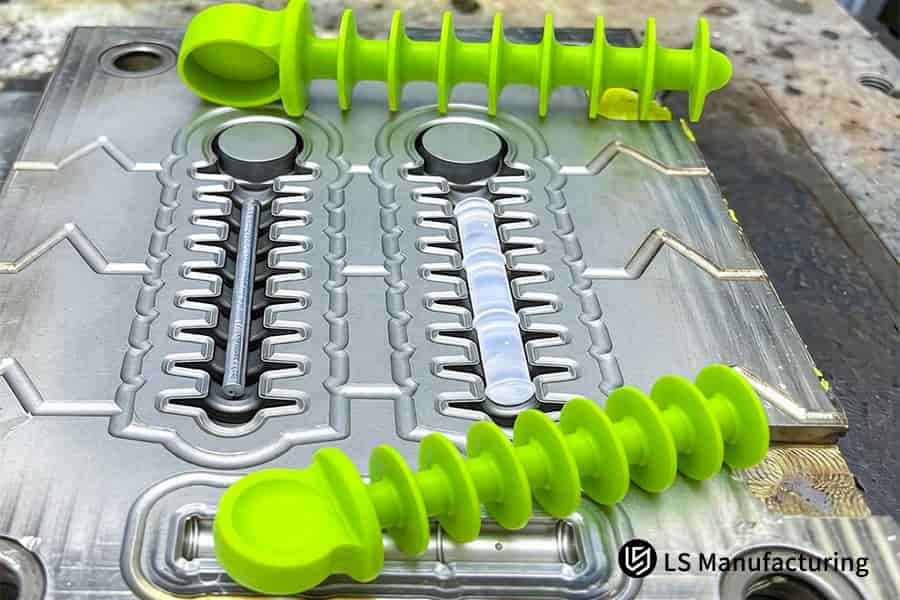
Figure 3: High precision silicone overmolding fills a metal mold cavity with green silicone for a surgical grip.
Case Study: How LS Manufacturing Solved the Layer Separation Problem Of A Custom Medical Endoscope Handle For An Endoscopy Device Brand
One of the popular brands of endoscopy systems faced a significant problem with their newly designed surgical handpiece, wherein the layer of silicone designed as a grip separated during repeated sterilization processes. This case study illustrates how our medical silicone overmolding service were able to solve this problem in order to prevent delays in their clinical trial.
Client Challenge
The client’s prototype, a PEEK substrate with an LSR (Liquid Silicone Rubber) overmolded grip, failed at the bond interface. After just 15 autoclave cycles (134°C steam), the layer delaminated, leading to moisture ingress. Furthermore, the actuation force of the silicone buttons degraded by over 40%. These failures halted the product’s development timeline, putting its FDA submission and market launch at severe risk, highlighting the extreme demands of complex medical device overmolding.
LS Manufacturing Solution
Our engineering team delivered a three-part solution. Firstly, we replaced the substrate with a 30% glass filled medical grade PEEK that offered excellent thermal dimensional stability. Secondly, we incorporated our own proprietary design of a micro dovetail interlock geometry into the PEEK substrate to create a mechanical bond to supplement the chemical bond. Thirdly, we refined the autoclave-resistant overmolding process by stabilizing the cure process at 165°C and using 95 bar injection pressure, along with a two-step vacuum process to remove all interface micro-bubbles.
Results and Value
The redesigned handle exceeded all requirements. It passed 200 consecutive autoclave cycles with zero delamination, representing a 250% improvement in bond strength. Button actuation life exceeded 1 million cycles. This reliability allowed the client to secure FDA 510(k) clearance on schedule. The project proved the value of partnering with a custom silicone overmolding manufacturer capable of deep material and process engineering to solve intractable high-performance overmolding challenges.
This case demonstrates that solving advanced medical device failures requires integrated expertise in materials science, precision mechanics, and process engineering. By systematically redesigning the substrate, interface, and curing parameters, we delivered a solution that guaranteed lifelong performance under extreme conditions, showcasing our unique capability to execute mission-critical medical device overmolding projects.
To prevent FDA delays from autoclave failures, replicate this 200-cycle proven bond. Submit your overmolding design for a sterilization validation plan and a production-ready solution.

What Are The Primary Factors Driving The Cost And Quote Of A Custom Silicone Overmolding Project?
To accurately estimate costs associated with custom silicone overmolding service, one must go further than merely looking at the cost per part. In order to properly plan and value engineer an investment in a highly valuable OEM relationship, it is important to know what drives the cost of a project. The following document dissects the five major drivers of the project cost quotation process to help evaluate a medical silicone overmolding service.
| Primary Cost Driver | Impact on Project Economics |
| Tooling Strategy: Cavitation | While single cavity tools work best for prototypes, multi-cavity overmolding is necessary for minimizing costs on volume production. |
| Automation & Process Design | The use of robotic substrate insertion is critical to minimize waste and ensure reliable volume manufacturing. |
| Cycle Time Efficiency | While there are many variables driving costs, the most important is the LSR curing time (e.g. 20s vs 60s). |
| Regulated Production Environment | Molding in a cleanroom facility increases costs but is required for implantable device overmolding. |
| Volume Commitments & MOQ | Annual volumes agreed upon allow for tooling amortization and pricing stability, setting the parameters of OEM partnerships value. |
Partnering with a custom silicone overmolding manufacturer makes cost a controllable factor. By evaluating all five factors listed above, we ensure you make a decision based on accurate information. Upload your 3D data and receive a comprehensive, cost-certain quote in 24 hours. Eliminate budgeting surprises and lock in your project’s true TCO with our DFM analysis.
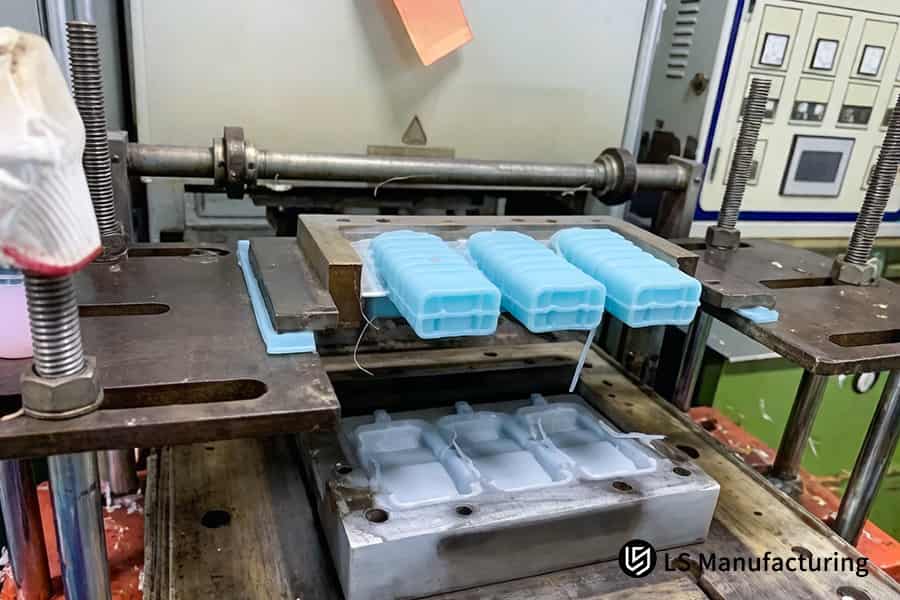
Figure 4: A hydraulic press injects blue liquid silicone rubber into a four-cavity plastic mold for medical parts.
Why Choosing LS Manufacturing As Your Premium Medical Silicone Overmolding Partner Will Accelerate Your Time-To-Market?
In the highly competitive world of medical devices, delayed launch results in lost sales and market share. Speed to market cannot be achieved simply by fast machining; it needs to be complemented with extensive silicone overmolding for medical parts experience coupled with an efficient and tightly controlled supply chain process. LS Manufacturing handles all design, tooling, molding, and sterilization, offering a one-stop solution that removes delays and maintains compliance from the very start:
Front-Loaded Engineering to Eliminate Iterations
Our integrated overmolding solutions start with our expert DFM analysis alongside your initial inquiry. We find and fix manufacturability, materials, and regulatory issues during the design stage. By doing so, we avoid costly re-engineering of your design down the road, thus ensuring a streamlined timeline from the very beginning and providing you with a genuine custom silicone overmolding service.
Vertical Integration for Unmatched Speed
We are able to manage the whole process in-house – from mold manufacturing on our state-of-the-art CNC and EDM machines to cleanroom overmolding conditions and subsequent sterilization logistics. Vertical integration eliminates the usual 3-4-week lead time due to coordination among different external vendors. Thanks to that, we can provide you with fast-turn overmolding prototyping within 7-10 business days.
A Streamlined Path to Regulatory Compliance
As a professional custom silicone overmolding manufacturer, we know all about compliance. We can provide you with all the documentation required for your product to go through the quality audit process and receive FDA approval much faster than in the case with a regular supplier.
Choosing LS Manufacturing means speeding up your process because it turns your fragmented, sequential supply chain into a synchronized one. We tackle the bottleneck problems in conventional manufacturing using our unique processes of concurrent engineering, full control of the whole value chain, and built-in regulatory compliance. The result is reliable speed and guaranteed quality that meet all your needs for mission-critical overmolding.
FAQs
1. What is the typical lead time at LS Manufacturing for a medical silicone overmolding prototype tool?
In terms of making a prototype mold for medical silicone overmolding, after we freeze the design according to the DFM requirements, we are able to manufacture the molds and provide you with the first round of samples—meeting all ISO 13485 requirements—in 7 to 10 business days.
2. Can you overmold Liquid Silicone Rubber (LSR) onto temperature-sensitive plastic substrates?
Yes. Through the use of our unique low temperature cure medical grade silicones in combination with our multi-zone controlled injection mold temperature, we have been able to create deformation-free overmolded products on specific plastic substrates with low melting points.
3. What minimum tolerances can LS Manufacturing achieve for high-precision silicone overmolding parts?
Thanks to advanced automated injection molding machines and high-strength S136 mold steel, we can effectively control critical silicone dimensions and alignments to within ±0.005mm, thus satisfying extremely stringent precision requirements for medical assembly.
4. How do you guarantee that there will be no delamination during high-temperature autoclave sterilization?
Through the pretreatment of plastic substrate in terms of either physical surface roughening or chemical primer treatment under vacuum conditions, we can increase the cross-linking bond strength to above 4.2 MPa, allowing the component to endure more than 200 cycles of 134°C high pressure steam sterilization without delamination.
5. What cleanroom standards do you maintain for custom silicone overmolding products?
Our entire production process of medical silicone overmolding, automatic feeding system, and primary packaging takes place under the closed-loop system in the Class 100,000 (ISO 8) certified clean room environment, in full accordance with the country's regulations, thus completely ruling out any chance of exogenous contamination.
6. Do you accept low-volume orders, and what is your Minimum Order Quantity (MOQ) for medical parts?
We are always ready to assist in developing high-profile medical R&D programs. In the course of development and testing, we provide sample run capabilities starting from 100 pieces, along with low-volume manufacturing for validation purposes. After that, we will provide you with a flexible and economically sound solution for mass production, in line with your schedule.
7. How does LS Manufacturing protect customers' intellectual property (IP) and proprietary medical designs?
We fully recognize the invaluable nature of medical patents. We are prepared to sign legally binding Non-Disclosure Agreements (NDAs) even before initial inquiries or technical discussions begin. Furthermore, all technical documentation is stored on physically isolated, encrypted servers and managed by a dedicated engineering team with strictly controlled access permissions, ensuring 100% protection against the unauthorized leakage of your core technologies.
8. Can your engineering team provide comprehensive DFM and Moldflow simulation reports before we place an order?
Yes. Once you submit your design drawings or initial inquiry, our team of senior engineers will provide you—within 24 hours—with a free, in-depth DFM (Design for Manufacturability) review report—including predictions regarding trapped air, deformation analysis, and gate optimization recommendations—along with a detailed quotation.
Summary
This guide details the core principles of custom medical-grade silicone overmolding, covering material compatibility, tolerance control, delamination resistance, and regulatory compliance. Manufacturing high-precision, autoclavable medical parts demands a closed-loop process with ±0.005mm tolerances, cleanroom environments, and proactive DFM—standards that general industry cannot meet. Partnering with an ISO 13485-certified specialist like LS Manufacturing accelerates R&D while building an unshakable foundation of product quality.
Struggling with delamination, cracking, or flash on surgical handles, endoscopic parts, or ventilator masks? Stop wasting time and materials with unqualified suppliers. Click “Get Instant Quote & DFM Assessment” to upload your 3D files (STEP/IGS). Within 24 hours, our silicone overmolding specialists will provide a report with hot-runner simulations, defect-correction advice, and a transparent tiered quote—let LS Manufacturing accelerate your path to FDA/CE certification.
📞Tel: +86 185 6675 9667
📧Email: info@lsrpf.com
🌐Website: https://lsrpf.com/
Disclaimer
The contents of this page are for informational purposes only. LS Manufacturing services There are no representations or warranties, express or implied, as to the accuracy, completeness or validity of the information. It should not be inferred that a third-party supplier or manufacturer will provide performance parameters, geometric tolerances, specific design characteristics, material quality and type or workmanship through the LS Manufacturing network. It's the buyer's responsibility. Require parts quotation Identify specific requirements for these sections.Please contact us for more information.
LS Manufacturing Team
LS Manufacturing is an industry-leading company. Focus on custom manufacturing solutions. We have over 20 years of experience with over 5,000 customers, and we focus on high precision CNC machining, Sheet metal manufacturing, 3D printing, Injection molding. Metal stamping,and other one-stop manufacturing services.
Our factory is equipped with over 100 state-of-the-art 5-axis machining centers, ISO 9001:2015 certified. We provide fast, efficient and high-quality manufacturing solutions to customers in more than 150 countries around the world. Whether it is small volume production or large-scale customization, we can meet your needs with the fastest delivery within 24 hours. choose LS Manufacturing. This means selection efficiency, quality and professionalism.
To learn more, visit our website:www.lsrpf.com.