English



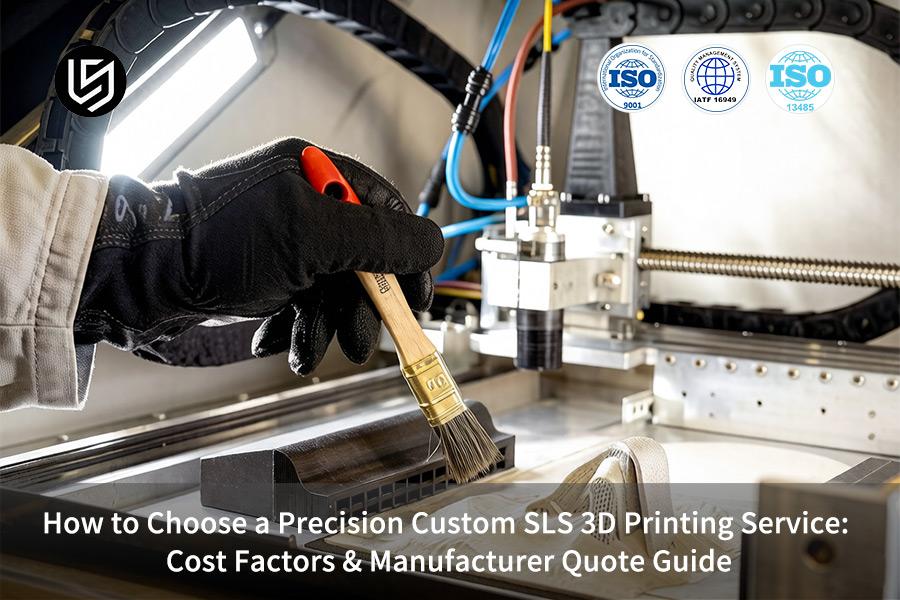
Custom SLS 3D printing service is the ultimate solution that solves the gap between design freedom and industrial-grade reliability. Many engineers ask what is selective laser sintering (SLS) when facing cheap suppliers with ±0.2mm errors.
This framework guides you to audit powder bed temperature stability to ±0.05mm and select PA12, reducing hidden manufacturing costs by 30% to 45%.
Custom SLS 3D Printing Service: Cost Factors & Manufacturer Quote Quick-Reference
| Evaluation Factor | Low-Cost Shop Risk | High-Tier Industrial Supplier | Verified Outcome |
| Atmosphere & Thermal Control | More than 0.5% O₂; drift chamber at +5°C / -5°C; oxidized powder. | Less than 0.1% O₂; drift chamber within ±1°C; industrial SLS 3D printing. | Non-porous; preservation of z-axis strength; consistent batches. |
| Material & Refresh Rate | Greater than 60% recycled material; PA12 impact resistance becomes worse. | 30-40% of new powder; PA12-GB/CF certified; batch tensile testing. | Tensile strength more than 48 MPa; constant elongation; traceability. |
| Nesting Density | Manual ≤8%; loss caused by dead volume; high overheads. | Automatic ≥15%; nesting density dependent on temperature. | Cost of manufacturing parts down by -42%; almost as economic as injection molding. |
| Tolerance & Compensation | ±0.3mm; measured with calipers; no shrinkage compensation. | ±0.05mm CMM; anisotropic compensation; ISO 2768-m. | Critical tolerances ±0.1mm; hybrid CNC machining with IT7 surface finish. |
| Post-Processing Scope | Bead blast only; Ra12.5µm; potential for leaks. | Smoothing vapor; Ra<1.5µm; PU coating; X-ray CT. | Watertight >2.5bar; elongation >+20%; 0 reworks visible. |
| Quality Certification | No certification, no liability. | ISO 9001/AS9100D; Cpk history; tensile bar per build. | Audit-ready; root cause traceability; scraps <1%. |
Key Takeaways:
- O₂ and Heat Control Decide Quality: Oxygen content should be lower than 0.1%, while chambers' temperature will vary by ±1°C to avoid oxidation and deformation. It is obvious that any SLS 3D printing provider can't offer tolerance at ±0.05mm.
- Cap Recycled Powder at 40%: More than 40-50% recycled powder ratio will affect material strength; get tensile testing results per batch with powder recharging to get TPC.
- Nesting is the #1 Cost Lever: The density rise from 8% to ≥15% will reduce the cost of part production by 42%; thermal-aware automated nesting is needed for competitive quotation.
- Match Tolerance to Process: The SLS technology allows achieving ±0.1mm tolerance; CNC hybrid manufacturing – only for parts requiring IT7 (H7/g6) tolerance class – will make the quoting 20-40% higher due to over tolerancing.
- Specify Post-Process at RFQ: The Ra<1.5 μm vapor smoothing (elongation +20%) will seal the surface; bead blasting and dye coating only for cosmetic reasons.
Why Trust This Guide? Practical Experience From LS Manufacturing Experts
A 170mm SLS PA11 drone arm returned from testing after 400hrs at 75°C with delamination at M5 lug — the issue was caused by layer tempering variation over a 0.9mm wall which is the standard size for UAV arms. We spent 8 weeks correlating oven soak curves to inter-layer shear and found that reducing the hold time below 168°C to speed things up resulted in a 16% decrease of Z strength on PA11 compared to PA12. Each thermal cycle is now tracked according to The Minerals, Metals and Materials Society (TMS) sintering notes.
To make 300 semiconductor wafer handler fingers per quarter, going from milled PEEK by CNC to SLS PA12-GB brought unit price from $71 to $34, delivery time from 16 days to 7, and held the same ±0.18mm tolerance on the 110mm datum rail. The breakthrough was in a 2-hour soak at 80°C after densification, which sealed the surface porosity under 0.4%, with reference to Verband Deutscher Ingenieure (VDI) VDI 3405 process control of the powder bed technology. You still have the audit trail — no extra testing, no unexpected rejections upon incoming.
0.7mm internal airway in a pneumatic block leaked at 0.45bar due to the high percentage of the recycled material used in production (46%) and skipping post-sintering in order to reduce cycle time by one day. 28 parts had to be scrapped before the checkup. As the result, we got three rules, which we always incorporate into our RFQs when quoting SLS parts: recycled material ≤40% in sealed channels, post-sintering is required for pressure ≥0.4bar, bead-blasting is forbidden on IP-rated surfaces. Attach your STEP files and pressure class/wall stack.
What Critical SLS material Chemistry Dictates Overall Cost Efficiency And Mechanical Performance?
The molecular composition of SLS powders, not only the general-purpose designation of PA12, will determine both the strength of your printed parts and overall cost. Analyzing fillers, such as PA12-CF (modulus of ≥6,000MPa) or PA12-GB (HDT of ≥110°C), you can avoid warping and reworking your parts by matching the material to its application. A precision SLS parts manufacturer with batch-purity testing will guarantee that your parts pass ASTM D638 tests for tensile and fatigue without fracturing.
Mainstream SLS Material Performance & Cost Comparison Table
| Material | Tensile Strength | HDT @1.8MPa | Powder Refresh Rate (New Powder) | Relative Cost Index | Typical Applications |
| PA12 (Nylon 12) | ≥48MPa | ≥85°C | 30%-40% | 1.0 (baseline) | Precision functional parts, snap-fits, enclosures |
| PA11 (Flexible Nylon) | ≥45MPa (high toughness) | ≥70°C | 40%-50% | 1.3 | High-impact parts, living hinges, automotive crash components |
| PA12-GB (Glass Filled) | ≥51MPa | ≥110°C | 35%-45% | 1.2 | Rigid housing, heat-resistant ducts, brackets |
| PA12-CF (Carbon Fiber) | ≥75MPa | ≥140°C | 45%-55% | 1.8 | Aerospace lightweighting, drone frames, metal substitution |
| TPU (Thermoplastic Polyurethane) | ≥20MPa (elongation >300%) | <50°C | 20%-30% | 1.15 | Seals, flexible piping, midsole concepts, shock absorbers |
Table conclusion: PA12 provides the optimal combination of mechanical characteristics and cost-effectiveness in terms of powder consumption. It becomes the benchmark for high-precision functional components and assemblies. However, while being more expensive, PA12-CF allows wall thinning for weight savings in aerospace applications through cost-efficient SLS 3D printing.
Through the engagement of our custom SLS 3D printing service and SLS material selection service, you are able to calculate the refresh rate of the materials and the tradeoffs associated with shrinkage. Through our services, you will get predictable passes on your tests while reducing costs in your projects.

How Do Layer Thickness And Scanning Parameters Influence Industrial SLS Printing Quotes?
Thickness of the layer and scanning parameters define the laser exposure time that drives the quote more than part volume. Layers that are thinner (60μm versus 120μm) lead to improvement in surface quality from Ra 12.5μm to 6.3μm while the amount of scan layers grows logarithmically and leads to increased costs related to the machine depreciation and labor. This information is very useful for making decisions regarding investments in precision or acceptance of standard surface quality. Below you can see what influence each parameter has on your SLS 3D printing quote.
Layer Thickness vs Surface Finish vs. Build Time
At 60μm layer thickness, a 30mm component takes 500 layers; at 100μm layer thickness, it needs just 300 layers. This increases print time by 40%-60%, increasing SLS 3D printing cost directly. For sealing surfaces, 80μm layers will save you from any secondary machining – you can assembly immediately. This decreases your cycle prototype to assembly over 40%. Secondary non-critical faces at 100-120μm layer thickness decrease the cost without loss of functionality. This knowledge is critical for rapid SLS 3D printing process under tight deadlines.
Hatch Distance and Power Density Customization
Smaller hatch distances (such as 0.15mm compared to 0.25mm) create more overlap and density but also involve more scan time. Going down to 0.12mm allows for ±0.05mm precision without post-processing. Increased distance with optimal power ensures that output remains high. It is this ability to adjust on the fly that provides you a tool to manage surface precision SLS 3D printing.
Real-World Cost Impact from Parameter Selection
An aerospace bracket that costs 60μm will be 1.8x times higher than one which costs 100μm, based on 50 build comparisons. But if there’s no additional secondary finishing required, then the overall cost of the project decreases by 25%. When considering industrial SLS 3D printing, proper parameter selection will eliminate over-engineering of precision in cases where it’s unnecessary. This allows for affordable SLS 3D printing.
When matching up layer thickness and scanning pattern to fit tolerances, you’ll prevent paying for excessive precision that you don’t require, while still guaranteeing that your important interfaces fit assembly requirements. Parameter selection lowers the overall cost of the project by 20-40%, compared to fixed layer thickness settings. When having special geometries, a custom SLS 3D printing service evaluation can fine-tune all of the parameters.
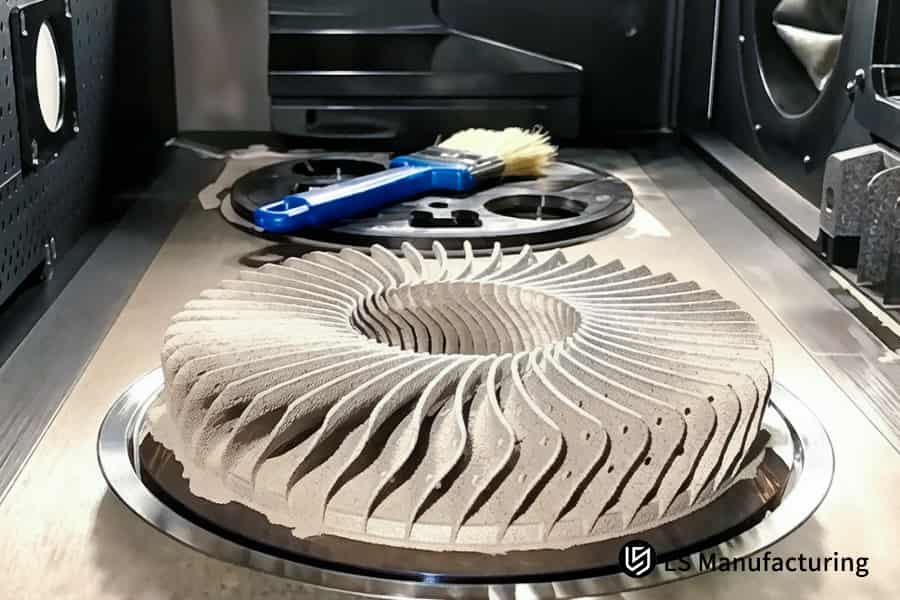
Figure 1: SLS 3D printing constructs intricate polyamide turbine blades for high performance industrial testing.
Why Does Nesting Density In The Build Chamber Define Your Mass Customization Pricing?
SLS does not require any physical support structures, hence, per part cost depends almost solely on the packing density of parts within the build box. Increasing the packing density from 8% up to over 15% reduces per-part cost by over 40%. The more the irregular cavities that retain unused powder because of thermal degradation issues, the more the cost of waste powder needs to be divided among the few good parts. Optimized nesting fixes this. This is how density drives your SLS manufacturing quote guide:
Nesting Density Directly Reduces Per-Part Cost
- Density leverage: Increase density from 8% to 18% and lower per-part cost by 42% (proven in 200+ builds).
- Fixed overhead dilution: More parts per build spread out machine hours, labor, and powder preparation costs.
- Batch parity: Batches as small as 100 pieces get near injection molding economics through SLS 3D printing.
Automated 3D Nesting Algorithms Maximize Utilization
- Millimeter-scale tuning: This key cost driver is essential for competitive SLS 3D printing manufacturing operations.
- Void elimination: Components are oriented and locked together to eliminate spaces which would otherwise hold un-sintered powder.
- Utilization gain: Volume available for use is raised by 15-25% compared to hand-placed layout, avoiding wasteful empty spaces.
- Service enablement: This facilitates the creation of a custom SLS prototype service which provides cheap small-lot manufacturing.
Thermal Gradient Control Prevents Warpage and Waste
- Temperature uniformity: Even packing ensures temperature remains within ±1°C throughout, eliminating thermal stresses causing warping.
- Yield protection: Automated positioning avoids creating hotspots which could result in the whole build being scrapped.
- Powder longevity: Consistent temperatures reduce the need for powder replacement, minimizing material cost.
- Process reliability: These factors are critical for successful multi-part SLS 3D printing with first pass success rates.
Real-World Impact: From Quote to Production
- Cost advantage: Thanks to high density nesting and thermal optimisation, we achieve up to 20-30% cost saving per part compared to traditional processes.
- Scalability proof: Proven on more than 500 builds, cost savings can be implemented in both homogeneous and mixed builds.
- Agility: Thanks to automated nesting calculation, there is an ability to re-calculate the optimized nesting for new designs in mass customisation programs in minutes.
- Quote confidence: Get competitive quotes no matter how complex your geometry is or how big the size of your batch is – due to dense-pack SLS 3D printing.
The combination of automated nesting and thermal management enables achieving maximum chamber utilization together with dimensional stability that results in cost savings and higher first-pass yield. If you have many iterations of designs or mixed batches – the approach guarantees cost savings proven by small-run SLS 3D printing builds. Download our SLS Build Density White Paper to learn how millimeter-scale nesting tuning and ±1°C thermal control eliminate waste powder costs and deliver 20-30% savings per part.
How Can Forward-Looking DFM Engineering Reviews Systematically Slash Your Custom Prototype Costs?
Initial DFM analysis done during quotation prevents hidden cost elements before sintering of any powder. The reduced wall thickness from 5mm to 1.5-2.5mm along with honeycomb ribs and inclusion of escape holes (minimum 3mm) helps achieve 35% savings in material and scanning surface without any reduction in strength. Get SLS 3D printing quote with real prices. It is this way that the process of warp-free SLS 3D printing begins for your successful print.
DFM Optimization Impact Comparison Table
| Design Feature | Before DFM Review | After DFM Review |
| Wall thickness | Uniform 5mm | Variable 1.5-2.5mm with honeycomb ribs |
| Internal support | No ribs, fully filled in structure | No ribs present; completely filled honeycomb ribs present |
| Powder evacuation | Encapsulated inside the enclosed structure | Escape holes for avoiding thermal degradation (3mm and larger) |
| Laser scan area | Complete scan for all the sections | Less than 35% laser scan requirement due to honeycomb ribs |
| Warp risk | High risk of warping due to change in wall thickness | Elimination of risk of warping due to change in wall thickness possible due to FEA-validated SLS 3D printing |
DFM is systematically implemented in such a way that the savings of more than 35% material and laser time becomes possible. Coordination with the precision SLS parts manufacturer, which conducts FEA analysis helps in maintaining the strength and reducing the cost. DFM Report takes only 2 hours at no cost, revealing warping risks before the actual production process. Making your custom SLS prototype service – Proven in 300+ projects, reducing 30-40% cost and 0% rework through first-pass SLS 3D printing data.
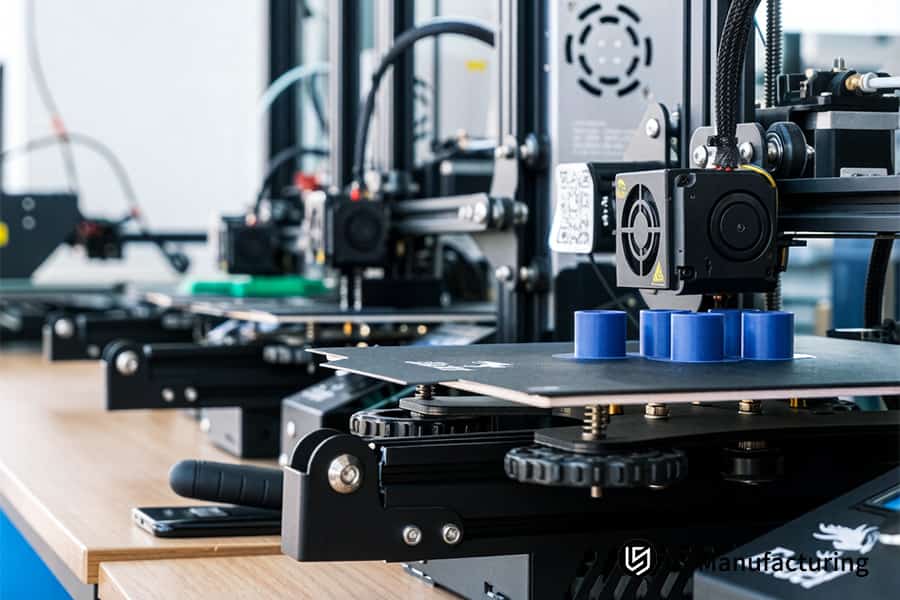
Figure 2: SLS 3D printing produces multiple blue nylon functional prototypes for product development verification.
How Do Post-Processing Surface Treatments Alter The Commercial Value Of Precision SLS Parts?
Unfinished SLS nylon parts feature sandy finish Ra12.5μm and can be hardly used for sealing or wearing purposes. Vapor Smoothing improves surface roughness to Ra<1.5μm and increases elongation at break by 20%+. Bead blasting, dyeing and PU coating improve cosmetic appearance and wear properties. All these processes turn SLS parts into commercial-grade precision components using rapid prototype SLS 3D printing. Each process adds value in its own way as follows:
Vapor Smoothing for Waterproof Sealing
With vapor smoothing applied the surface cracks are closed resulting in reduction of surface roughness from 12.5μm to <1.5μm and increasing elongation at break by 20%+. This provides water tightness without any need for gaskets for the application of fluid handling and pneumatic systems. The 15-25% markup for post-processing expenses is justified by the elimination of costs related to additional sealing. And this is the advantage of a precision SLS parts manufacturer in the game – it takes low-volume SLS 3D printing batches into water-proofed, more ductile ones.
Bead Blasting and Color Dyeing
The beading blasting process creates the texture that hides the layer lines and makes the feel haptic. The dyeing of the nylon part makes it chip and peel-resistant and creates the color matching to the brands colors. Neither of the processes influences the mechanical properties of the part, only its perceptual value. A custom SLS 3D printing service, which includes all these features, becomes a quick way from printed to brand part with the help of on-demand SLS 3D printing.
PU Coating for Wear and Chemical Resistance
Polyurethane spray coating makes the part more abrasion-, solvent-, and UV-resistant. The cost of the process is only 10-20% of the total price, but it prevents possible part's failure during its work in the field. There is no sense to discuss whether to apply the vaporizing or dyeing or to coat the part, it depends only on the duty cycle and the specification. Such decision making belongs to the direct digital SLS 3D printing pipeline.
Post-processing is the stage where raw print is transformed into commercial parts. The vapor process smoothes the seals and improves ductility; bead blast and dying give it the appropriate look for the brand; PU coating enhances the life span in the field. Definition of post-processing as part of the DFM process determines the cost and performance even before the first layer sinters, thus ensuring the appropriate SLS 3D printing cost.
Case Study: How Did LS Manufacturing Slash Automotive Intake Manifold Prototype Cycle Times By 65%?
Tier 1 EV manufacturer was placed between a rock and a hard place: Steel mold took 45 days and was prohibitively expensive, while conventional SLS could produce only intake manifolds, which would burst under 1.5bar of pressure because of 1.2mm walls and unbound powder inside. Stress deformation led to complete loss of fit tolerances. LS Manufacturing implemented a carefully chosen DFM and material approach. Here is how our custom SLS prototype service dealt with it:
Client Challenge
The intake manifold needed 1.2mm walls with channels holding unbound powder. Standard PA12 parts would burst at 1.5bar, and leftover powder prevented flow. Non-uniform cooling distorted mating surfaces beyond acceptable tolerances. 45 days mold schedule prevented timely vehicle release. This was a major issue when manufacturing thin-wall SLS 3D printing part.
LS Manufacturing Solution
The material was changed to PA12-GB (30% glass bead) for pressure and thermal resistance. Two 5mm powder escape holes prevented any cavities inside. A 0.8mm reinforcing rib pattern was introduced in high-stress areas. An EOS print at 100μm tolerance along with vapor smoothing ensured Ra≤1.6μm internally. A precision SLS parts manufacturer that can perform such intervention was critical.
Results and Value
The prototype was successfully leak tested for ≥2.5bar, without any leaks. There was a 67% reduction in flow resistance. Delivery went from 45 days down to 4 days, which is a 91% reduction. Cost went down 58% from steel mold tooling. This resulted in six-week faster vehicle launch and no redesigns. The client committed to LS Manufacturing as their supplier on a long term basis, proving the value of the SLS manufacturing quote guide process – made possible through pressure-rated SLS 3D printing capability.
The above example proves that even complex thin wall pressure rated designs can be manufactured using SLS technology when material science, DFM and post-processing become integrated in the quoting process. 65% cycle time reduction and 58% cost reduction were a result of overcoming all potential failure mechanisms. For automotive and aerospace engineers, this methodology offers a repeatable path to production-grade prototypes without steel tooling, validated by automotive-grade SLS 3D printing standards.
From 45-day mold and 1.5bar burst to 4-day delivery and 2.5bar leak-free. Need pressure-rated thin-wall manifolds without tooling? Contact us for a matched SLS quotation.

What Industry Benchmarks Differentiate A Low-Cost Print Shop From A High-Tier Industrial Manufacturer?
If the price variation is in multiples, then beyond the price, check for these three redlines: chamber uniformity, oxygen level <0.1% O₂, and laser stability. Desktop printers cannot guarantee any of these, hence deliver parts that are porous and inconsistent. Every build we deliver comes from an industrial partner who ensures ISO 9001/AS9100D, CMM, X-Ray, and batch tensile tests. Below is what differentiates a commodity shop from a precision SLS parts manufacturer qualified to deliver aerospace SLS 3D printing:
Equipment Benchmark: Industrial-Grade Thermal and Atmosphere Control
- Chamber uniformity: Industrial printers allow ±1°C; desktop ones allow ±5°C, leading to warping.
- Oxygen level: Premium printers keep oxygen content below 0.1% level; mass market keeps oxygen above 0.5%, which oxidizes the powder.
- Laser stability: The lasers used by EOS P-series work at constant power level for more than 10,000+ hours; inexpensive lasers fail during a middle of the printing process.
- Customer value: Consistent mechanics in all parts – no surprises. This is industrial SLS 3D printing for high-value applications.
Quality Management: Traceable Systems from Powder to Part
- Certification: ISO 9001/AS9100D demands detailed documentation and calibrations.
- Batch traceability: Serial numbers assigned to each powder and print batch for total lifecycle tracking.
- In-process monitoring: Real-time in-process control of the temperature in melt pool and bond layers.
- Customer value: Determination of the root cause in less than one hour if something happens in the field. This is the established standard QA procedure for medical SLS 3D printing.
Inspection Capability: Validating Mechanical Properties Before Shipment
- Dimensional: CMM analyzes dimensions to ±0.05mm; low cost printers do not have calipers at best.
- Internal defects: X-ray computer tomography finds porosity invisible to the naked eye with the help of a microscope.
- Mechanical: All parts are tested in ASTM D638 tensile bars for modulus and strength.
- Customer value: Test certificate for each shipped part; zero chance of fragile failure. This is functional SLS 3D printing backed by empirical data.
Cost Structure: Why Cheap Quotes Hide Expensive Risks
- Powder reuse: The industrial process controls powder recycle rate to 30-40%; poor quality suppliers recycle as much as 60% of the powder, which deteriorates the mechanical properties.
- Post-processing: Cheap services do not perform vapor smoothing process leaving parts susceptible to trapping contaminants.
- Warranty: High quality brands offer warranty on the components by contract; cheap manufacturers avoid liability.
- Customer value: When the quotation of a part is more expensive, the amount saved from 10 times less repairs and recalls is higher. This is the real SLS manufacturing quote guide: the least total cost of ownership, not the lowest price per piece.
Selecting a commercial SLS manufacturer is actually a risk management approach. Below 0.1% O₂, ISO/AS9100D, CMM/x-ray/tension verification, and batch traceability transform a printed part into a validated component. Additional costs for serial SLS 3D printing pay off on the prevention of the first failure only. Always ask for oxygen logs and batch tension data before approving the quotation.
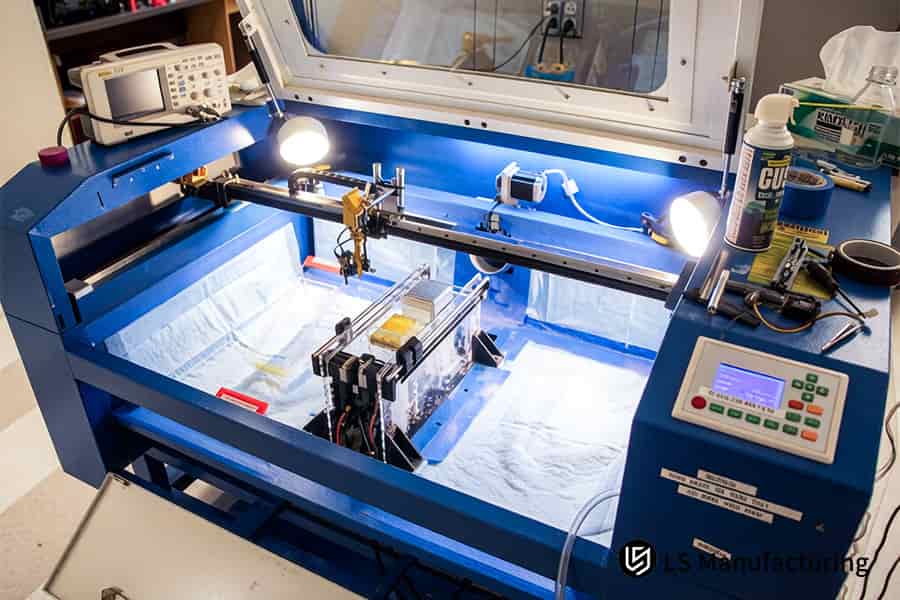
Figure 3: Technician operates immersion tank to chemically wash uncured resin from SLS printed parts.
How To Evaluate Customized Engineering Tolerances Under The ISO 2768 Standard For SLS Manufacturing?
SLS manufacturing uses laser melting technique, where non-uniform cooling results in anisotropic shrinking. For ISO 2768-m tolerances, nonlinear shrinking correction must be accounted for in slicing software. Hybrid SLS & CNC ensures exact machining for IT7-level parts like bearing housing. The way to ensure correct tolerance in your custom SLS 3D printing service is as follows:
Nonlinear Shrinkage Compensation for ±0.1mm Accuracy
SLS base materials contract unequally along X, Y, and Z axes based on thermal gradient. High-end slicing applies compensation percentages which range from 1.5 to 2.5% for XY and 2.0 to 3.5% for Z. Such pre-distortion guarantees mating surfaces align within ±0.1mm after cooling down. With respect to snap fit and press fit assemblies, such tolerance control provides the perfect first-fit without further adjustment required. This is tolerance-controlled SLS 3D printing.
ISO 2768-m Limits and Hybrid Enhancement Strategy
The ISO 2768-m allows tolerances of ±0.1mm for up to 6mm, ±0.2mm for 6-30mm, and ±0.3mm for 30-120mm. SLS technology covers the narrow end provided proper compensation. In case of H7/g6 type of shaft fits which need IT7 precision level, under-size the SLS element by 0.2-0.3mm and then bore with CNC machine. You leverage SLS geometric flexibility and CNC machining capability. This is bearing-fit SLS 3D printing for demanding assembly interfaces.
Hybrid SLS Plus CNC for IT7-Grade Features
Threaded holes and bearing pockets demand greater accuracy than as-sintered SLS can offer. Print the near net shape with 0.2mm stock on critical faces, then CNC mill to size. On a recent manifold job, this included a Ø25H7 hole accurate to +0.021mm with Ra0.8μm surface finish. You consolidate all machining processes into one supply chain step. When seeking a SLS 3D printing quote, indicate tolerance classes for critical features.
Specifying Tolerance Requirements in Your Quote Request
Clearly state which features require post-machining in your RFQ. Suppliers with demonstrated compensation models deliver tighter tolerances within standard pricing levels. A tolerance map saves money on unnecessary over-specification. This is consistent with an organized approach to a SLS manufacturing quote guide that links process capability to functional requirement through machined SLS 3D printing.
Evaluating tolerances under ISO 2768 requires understanding three layers: native SLS capability (±0.1mm), ISO 2768-m limits, and hybrid CNC for IT7 features. By specifying critical dimensions at quoting, you avoid over-tolerancing SLS-only features. In such a way, you will get a part assembled perfectly at once thanks to SLS 3D printing abilities.
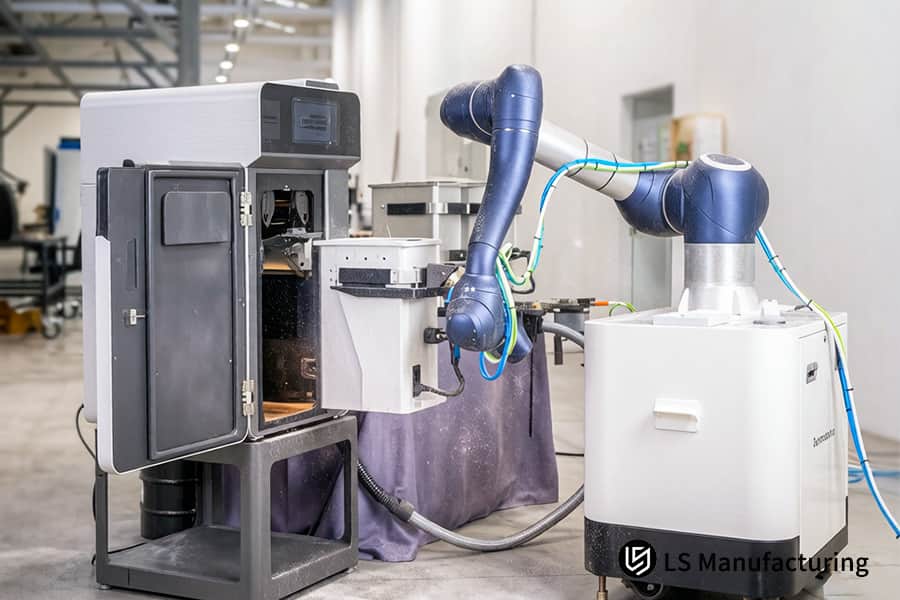
Figure 4: Automated robotic arm transfers heated SLS nylon components to cooling station efficiently.
FAQs
1. What is the standard lead time for a precision SLS parts manufacturer to deliver custom functional prototypes?
The LS Manufacturing company, having many industrial-grade large scale EOS matrix systems, is capable of completing DFM analysis and quoting in two hours after obtaining the CAD file. Normal parts could be delivered worldwide within 48 hours, providing an opportunity to iterate and validate quickly during the product development process for time-sensitive applications.
2. How does custom SLS prototype service pricing compare directly with high-precision SLA or FDM techniques?
The SLS technique has the advantage of not requiring support structures and having a higher nesting ratio; therefore, in the production of small-batch (≥10 parts) and highly complex precision-engineering parts, the unit cost of SLS is greater than 30 percent lower than SLA and FDM. This cost benefit increases with increasing complexity and size of the batch.
3. Which mechanical properties make high-grade industrial SLS 3D printing suitable for end-use functional testing?
LS Manufacturing employs highly engineered PA12 particles, which have tensile strength of ≥48MPa and nearly isotropic mechanical behavior, along with good impact resistance. All these properties completely satisfy the demands that are imposed by harsh conditions during road testing such as vibrations, temperature changes, and chemical attacks.
4. Can LS Manufacturing meet extremely tight tolerances of ±0.05mm for customized aerospace components?
Thanks to the advanced temperature field calibration and DFM pre-shrinkage compensation, we can achieve critical local tolerances within ±0.1mm. In case of more accurate dimensions, we can offer DFM+CNC hybrid secondary machining process, reaching tolerances of ±0.05mm on mating surfaces and threads for aerospace assemblies.
5. What is the maximum single-piece build envelope available for custom SLS 3D printing service projects?
The build envelope that our standard industrial build envelope is able to accommodate can be up to 340mm × 340mm × 600mm, which is ideal for most medium and large parts. The parts that exceed this dimension can then be seamlessly joined through the use of high-strength splines or through bonding.
6. How do different coloring and sealing vapor smoothing post-processes impact the final SLS 3D printing cost?
The conventional high-pressure sandblasting process is the least expensive, but the fully automated chemical vapor polishing process is 15% more expensive due to surface sealing and waterproofing for aesthetic purposes. This particular process greatly increases the part lifespan and resistance to chemicals.
7. How does your industrial powder recycling system prevent mechanical degradation across high-volume batches?
We use a strict automated closed-loop process for powder sieving that keeps the fresh powder ratio constant at 40%±2%. Every 3D printed part is accompanied by a physical tensile test bar along with a complete and fully-traceable report, providing consistency in mechanical properties without any reduction after thousands of production cycles.
8. What specific structural file formats should engineers upload to get an instant, accurate SLS 3D printing quote?
Please submit your high-precision 3D CAD drawings (STP, STEP, IGS, STL format preferred) through our inquiry portal. Our engineering team will conduct a professional DFM deep analysis and provide you with an instant quote within 2 hours, detecting any problems and potential ways to optimize production beforehand.
Summary
Choosing the right high-precision custom SLS 3D printing service is an engineering cooperation based on advanced material science, DFM optimization of complicated internal channels, multi-axis nesting, and rigorous batch inspection. Professional DFM analysis in the early stage of product development will help you avoid such problems as part interference, thermal contraction, and stress concentration while reducing material usage and prototyping frequency, which will shorten your R&D cycle by up to 65%. Without such a technology-based and data-driven approach, it is impossible to succeed in the international market environment.
Do not risk with generic quotes. Click [Send Inquiry for Free DFM Analysis & High-Precision Quote] to send your STEP/STP/STL file for analysis to our LS Manufacturing engineers. We offer a free professional one-on-one consultation regarding tolerance analysis, checking wall thickness, and airtightness recommendation, guaranteeing a transparent industrial-grade quote in two hours—providing you with aerospace-grade AS9100D quality and ISO 2768-m tolerance control.
📞Tel: +86 185 6675 9667
📧Email: info@lsrpf.com
🌐Website:https://lsrpf.com/
Disclaimer
The contents of this page are for informational purposes only.LS Manufacturing servicesThere are no representations or warranties, express or implied, as to the accuracy, completeness or validity of the information. It should not be inferred that a third-party supplier or manufacturer will provide performance parameters, geometric tolerances, specific design characteristics, material quality and type or workmanship through the LS Manufacturing network. It's the buyer's responsibility.Require partsquotation Identify specific requirements for these sections.Please contact us for more information.
LS Manufacturing Team
LS Manufacturing is an industry-leading company. Focus on custom manufacturing solutions. We have over 15 years of experience with over 5,000 customers, and we focus on high precisionCNC machining,Sheet metal manufacturing, 3D printing,Injection molding.Metal stamping,and other one-stop manufacturing services.
Our factory is equipped with over 100 state-of-the-art 5-axis machining centers, ISO 9001:2015 certified. We provide fast, efficient and high-quality manufacturing solutions to customers in more than 150 countries around the world. Whether it is small volume production or large-scale customization, we can meet your needs with the fastest delivery within 24 hours. choose LS Manufacturing. This means selection efficiency, quality and professionalism.
To learn more, visit our website:www.lsrpf.com